REVIEW 1 major objections 4 minor 65 references
Migration and accumulation of bacteria with chemotaxis and chemokinesis
T0 review · 1 major / 4 minor · reviewed 2026-08-14 · deepseek-v4-flash
Pith's one-line read Chemokinesis combined with chemotaxis can split a bacterial population in a fixed gradient, broaden its traveling wave, and reduce the navigation bias from a decaying attractant source.
desk verdict A useful continuum model for chemotaxis-chemokinesis with a factor-2 error in the drift that shifts a headline threshold but leaves the qualitative conclusions intact. read the letter →
The pith
A machine-rendered reading of the paper's core claim, the machinery that carries it, and where it could break.
The reading
What carries the argument
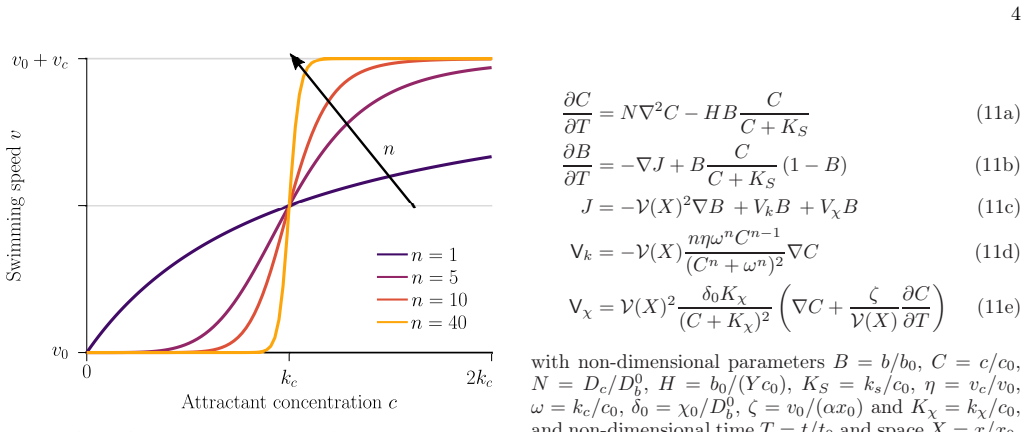
The central object is the bacterial flux $$J = -D \partial b/\partial x + V_k b + V_\chi b,$$ where the diffusion coefficient $D = v^2/(2\alpha)$ depends on the local swimming speed $v$, the chemokinetic drift $V_k = -(v/\alpha)\partial v/\partial x$ points down the speed gradient, and the chemotactic drift $V_\chi = \chi(\nabla f_\chi + (1/v)\partial_t f_\chi)$ points up the attractant gradient. Here $\chi(x) = \chi_0 v(x)^2/v_0^2$, so faster swimming raises chemotactic sensitivity, and the speed obeys $v(x)=v_0 + v_c c^n/(c^n+k_c^n)$. The competition between $V_k$ and $V_\chi$ carries the argument: when the Hill coefficient $n$ exceeds a threshold set by Eq. (15), chemokinetic drift dominates at $c=k_c$ and the population can accumulate at low attractant instead of high.
What would settle it
Measure $v(c)$ for a chemokinetic bacterium while holding the gradient fixed, then run the model with the measured function: if a two-front split appears in a fixed linear gradient for a Hill coefficient below the threshold in Eq. (15), or if no split appears for a coefficient above it, the central drift-competition claim is falsified. A separate check is to observe whether the traveling-wave broadening disappears when the speed response is shallow, since the model predicts broadening only when the speed gradient is significant over the band.
Extended reading notes
Core claim
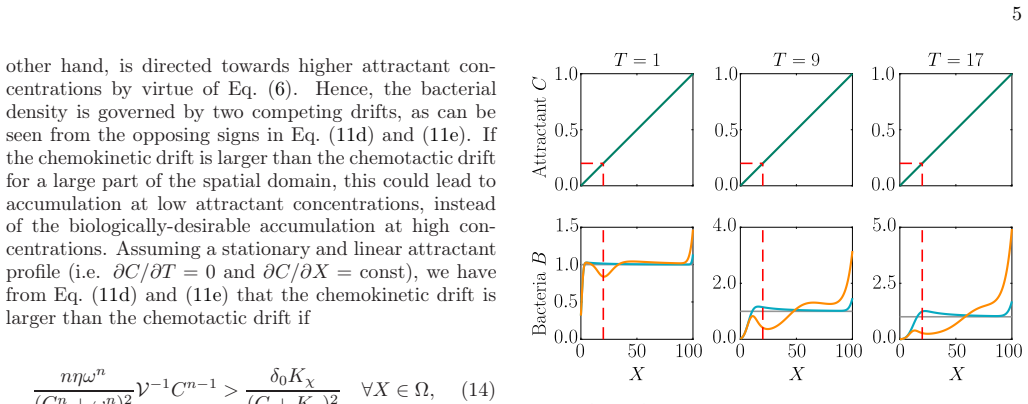
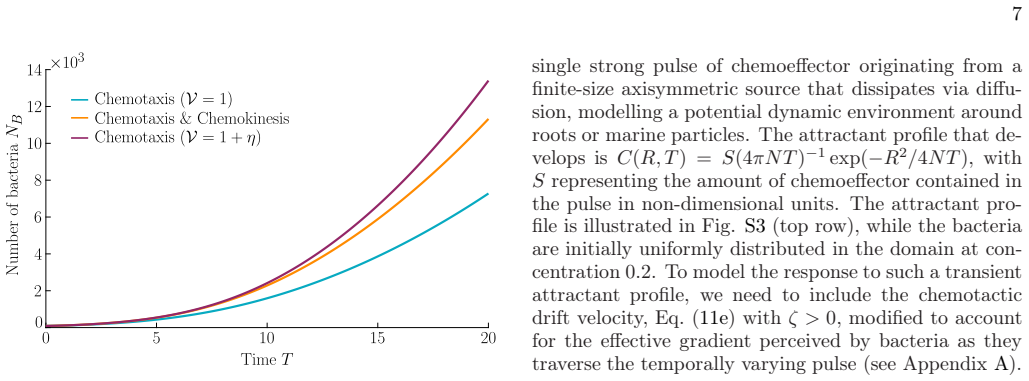
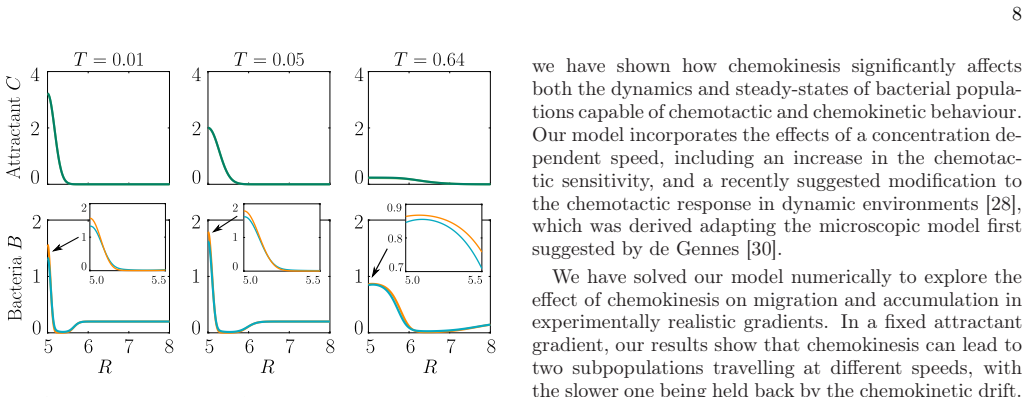
The paper's central claim is that for a population combining chemotaxis and positive chemokinesis, the total bacterial flux decomposes into contributions from diffusion, a chemokinetic drift, and a chemotactic drift, and the chemokinetic term can qualitatively reshape the accumulation. In a fixed linear gradient, the model's criterion for chemokinetic drift to dominate is $n > 4\delta_0\omega K_\chi/(\omega+K_\chi)^2(1/\eta+1/2)$ evaluated at $C=\omega$; when met, part of the population is carried toward low attractant instead of continuing up-gradient. In a self-generated gradient, the travelling wave of a chemotactic-chemokinetic population is faster but broader than the pure chemotactic wave, and the pulse travels slower than a uniformly fast-swimming population because front speed scales with pulse amplitude. Around a transient diffusing source, chemokinesis leads to faster, stronger accumulation and reduces the bias caused by the attractant's decay, because the temporal term in the chemotactic drift is weighted by $1/v$.
Load-bearing premise
The weakest load-bearing premise is the assumed functional form of the chemokinetic response, $v(c)=v_0+v_c c^n/(c^n+k_c^n)$ with instantaneous adaptation: the pure chemokinetic speed increase as a function of attractant concentration has never been systematically measured for any species, and if the true response is non-monotonic, much shallower, or has a very different half-saturation, the predicted split, band broadening, and bias reduction would weaken or disappear.
Editorial extensions
If this is right
- In fixed microfluidic gradients, a steep enough chemokinetic response (large $n$) should be observable as a temporary or persistent split, with a subpopulation trapped near the half-saturation concentration rather than at the source.
- In agar plate assays, chemokinetic species should show broad, less sharply peaked rings rather than the sharp Adler bands, and their population should grow faster in the same nutrient budget.
- Around a decaying nutrient pulse, chemotaxis-chemokinesis should accumulate a larger fraction of cells at the source than pure chemotaxis, and the prediction should be insensitive to whether the temporal term in the drift is included.
- When the chemokinetic response is very steep (step-like), chemokinesis can inhibit rather than help chemotaxis, so the relation between speed response steepness and accumulation is non-monotonic.
Reading between the lines
- If the measured speed-vs-attractant curve for a species is steeper than the threshold, Eq. (15) becomes a testable diagnostic: species with steep responses should show the split, species with shallow responses should not, regardless of absolute speed increase.
- The model's assumption of instantaneous speed adaptation sets a lower bound on the effect; real adaptation delays of order 10–200 s would likely smear the split and further broaden the wave, so transient measurements could discriminate.
- The same flux decomposition applies to synthetic chemokinetic swimmers whose speed rises with fuel concentration, so the predicted low-fuel accumulation should be reproducible with Janus particles in a fuel gradient.
- The metabolic-cost discussion implies that chemokinesis concentrates swimming expenditure just where nutrients are available, which is a plausible evolutionary reason for the behavior even when it slows the band's leading edge.
Signed reviews
Editorial analysis
A structured set of objections, weighed in public.
Referee Report
Summary. The manuscript extends the Keller-Segel model to describe bacterial populations that combine chemotaxis with chemokinesis, i.e., a swimming speed that depends on local attractant concentration. The model is derived from run-and-tumble dynamics and yields a drift-diffusion flux with a concentration-dependent diffusion coefficient, a chemokinetic drift directed down speed gradients, and a chemotactic drift whose sensitivity grows with the square of the swimming speed. The authors apply the model to three scenarios: a fixed linear attractant gradient, a self-generated gradient on an agar plate, and a transient diffusing source. They report that chemokinesis can split the population in a fixed gradient, broaden a traveling wave, and reduce the navigation bias caused by a decaying attractant source. The paper includes analytical threshold conditions and numerical solutions, with code and data deposited on Zenodo.
Significance. The paper addresses a relatively underexplored aspect of bacterial motility and provides a transparent continuum framework that connects microscopic parameters (swimming speed, tumble rate) to macroscopic chemotactic sensitivity. The explicit inclusion of temporal-gradient effects following Hein et al. and the treatment of speed-dependent diffusion and chemotactic sensitivity are useful contributions. The quantitative predictions are falsifiable with existing microfluidic and agar-plate assays, and the authors are honest about the lack of measured chemokinetic response functions. The availability of code and data strengthens reproducibility. However, a factor-2 error in the chemokinetic drift and diffusion terms changes the key threshold condition and undermines the illustrative demonstration of the population split, so the results cannot be accepted in their current form.
major comments (1)
- [Sec. IIB, Eq. (9); Appendix B; Sec. IV] The qualitative predictions depend on the assumed Hill-type chemokinetic response function v(c) = v0 + vc c^n/(c^n + kc^n) (Eq. 9), whose parameters η, ω, and n are not measured but are estimated only loosely from literature values (Appendix B gives n ≈ 1–3 from refs. [5,13]). After correcting the flux factor error, the threshold for the population split becomes n ≳ 80 for the parameters used in Fig. 4, which is far above the cited empirical estimates. This raises the question of whether the predicted split is a realistic biological phenomenon or an artifact of an extreme parameter choice that was not flagged as such in the abstract. The authors should provide a more systematic robustness analysis (e.g., non-monotonic or much shallower response functions, and different relative values of ω and Kχ) or explicitly present the split as a high-steepness limiting case. The Discussion acknowledges the missing measurements, but the central claims would be considerably strengthened by making the sensitivity to the assumed response function more explicit and by testing the predictions against alternative functional forms.
minor comments (4)
- [Appendix A, Eq. (A14)] The angle brackets used in the definition of I2(t) appear to denote path averaging, but the notation is not defined here and the placement of the brackets is ambiguous; please clarify by adding an explicit definition and consistent notation.
- [Sec. IIC and Appendix B] The main text states that parameters were chosen 'to best illustrate the chemokinetic effect' and Appendix B notes that η=2 is 'an extreme value'. Please state this explicitly in the main text where Fig. 3 and Fig. 4 are discussed, so that readers do not interpret the chosen parameters as representative of real bacteria.
- [Abstract and Sec. IIIC] The phrase 'measuring bias' in the abstract is unclear; consider 'navigation bias' or 'measurement bias' to convey that the temporal change in the attractant gradient reduces the accuracy of chemotactic navigation.
- [Sec. IIIB, Fig. 5 and S2] The text refers to Fig. S2 for the comparison of chemotactic populations at constant speed, but the main-text relevant figure is Fig. 5; please ensure the cross-references are consistent and that the reader can follow which results are in the main text versus the supplementary material.
Circularity Check
No significant circularity: the chemokinesis-chemotaxis model is derived from run-and-tumble dynamics with an explicitly assumed Hill response, and its predictions are conditional model outputs rather than restatements of fitted inputs.
full rationale
The derivation chain is self-contained and not circular. The macroscopic flux (Eqs. 1-4) is obtained from a microscopic run-and-tumble description following published independent derivations (Schnitzer; Othmer and Hillen; de Gennes), and the chemotactic sensitivity relation (Eqs. 7-8) is derived in Appendix A rather than assumed. The only chemokinesis-specific input is the Hill form v(x)=v0+vc c^n/(c^n+kc^n) (Eq. 9), which the paper explicitly labels as an assumption because 'the pure chemokinetic speed increase as a function of attractant concentration has not been systematically measured.' This is an unmeasured modeling input, not a parameter fitted to the outputs being predicted. The chemokinetic drift Vk=-(v/alpha) dv/dx is a mathematical consequence of a position-dependent speed and of the assumed monotonic increase of v with c; the threshold condition (15) is derived by comparing the two drift terms, not chosen to reproduce the two-subpopulation split. The steady-state formula (17) follows by direct integration of the zero-flux equation. Self-citations (Croze et al. 2011 for parameters; de Gennes 2004 for the kernel method) are ordinary external methodological and parametric support and are not used as uniqueness arguments or to forbid alternative responses. The paper explicitly flags its missing empirical support for v(c) and presents the qualitative effects across parameter sweeps (n, eta, omega) in the text and supplement, so the conclusions are conditional on transparent assumptions rather than forced by the assumptions by construction. A separate internal factor-of-two inconsistency between Eqs. (2)-(3) and the non-dimensionalisation in Eq. (10c) is a quantitative correctness concern that changes the threshold (15) and Fig. 4, but it is not a circularity.
Assumptions & free parameters
free parameters (5)
- eta (vc/v0) =
2 (Figs. 3,4,S3), 0.5 (Fig. S2)
- omega (kc/c0) =
0.2 or 0.5
- n (Hill coefficient) =
1, 5, 10, 40
- delta0 (chi0/D0b) =
50 or 105
- S (pulse strength) =
0.5
assumptions (5)
- domain assumption Bacterial run-and-tumble motion is a two-state 1D process with tumble rate alpha_R+alpha_L=2alpha and no directional persistence.
- domain assumption The chemotactic memory kernel perfectly adapts and the response is small (Delta << 1).
- domain assumption Swimming speed is constant during a run and adapts instantaneously to local attractant concentration.
- ad hoc to paper The chemokinetic response follows a Hill function v(c)=v0+vc c^n/(c^n+kc^n).
- domain assumption Attractant profiles in the three scenarios are idealized (linear, self-generated Gaussian, diffusing pulse).
Cite this review
Pith. "Pith review of Migration and accumulation of bacteria with chemotaxis and chemokinesis." pith.science (2026). https://pith.science/paper/AJBPUZZW
@misc{pith2026190805050,
  author       = {Pith},
  title        = {Pith review of: Migration and accumulation of bacteria with chemotaxis and chemokinesis},
  year         = {2026},
  howpublished = {\url{https://pith.science/paper/AJBPUZZW}},
  note         = {Machine review of arXiv:1908.05050}
}
read the original abstract
Bacteria can chemotactically migrate up attractant gradients by controlling run-and-tumble motility patterns. In addition to this well-known chemotactic behaviour, several soil and marine bacterial species perform chemokinesis: they adjust their swimming speed according to the local concentration of chemoeffector, with higher speed at higher concentration. A field of attractant then induces a spatially varying swimming speed, which results in a drift towards lower attractant concentrations -- contrary to the drift created by chemotaxis. Here, to explore the biological benefits of chemokinesis and investigate its impact on the chemotactic response, we extend a Keller-Segel-type model to include chemokinesis. We apply the model to predict the dynamics of bacterial populations capable of chemokinesis and chemotaxis in chemoeffector fields inspired by microfluidic and agar plate migration assays. We find that chemokinesis combined with chemotaxis not only may enhance the population response with respect to pure chemotaxis, but also modifies it qualitatively. We conclude presenting predictions for bacteria around dynamic finite-size nutrient sources, simulating, e.g., a marine particle or a root. We show that chemokinesis can reduce the measuring bias that is created by a decaying attractant gradient.
Figures

Figures from the paper (4 more)


Reference graph
Works this paper leans on
-
[1]
is coupled to a chemoattractant density field c via the 3 chemotactic drift speed, given by Eq. ( 4). In the stan- dard Keller-Segel model it is phenomenologically asserted that this chemotactic drift speed is proportional to the change in the chemical attractant in space, Vχ = χ ∇fχ , where χ is the chemotactic sensitivity parameter and fχ is a function o...
-
[2]
Berg HC. E. coli in motion. Springer; 2004
work page 2004
- [3]
-
[4]
Marine bacterial organisation around point-like sources of amino acids
Barbara GM, Mitchell JG. Marine bacterial organisation around point-like sources of amino acids. FEMS Micro- biology Ecology. 2003;43(1):99–109
work page 2003
-
[5]
A bacterial pathogen uses dimethyl- sulfoniopropionate as a cue to target heat-stressed corals
Garren M, Son K, Raina JB, Rusconi R, Menolascina F, Shapiro OH, et al. A bacterial pathogen uses dimethyl- sulfoniopropionate as a cue to target heat-stressed corals . ISME J. 2014;8(5):999–1007
work page 2014
-
[6]
Thus, there is a subpopulation driven to small attractant concentrations by chemokinesis
is ful- filled, the chemokinetic drift is larger than the chemotac- tic drift. Thus, there is a subpopulation driven to small attractant concentrations by chemokinesis. The effect of varying the Hill parameter n in Eq. (
-
[7]
Attmannspacher U, Scharf B, Schmitt R. Control of speed modulation (chemokinesis) in the unidirectional rotary motor of Sinorhizobium meliloti. Molecular mi- crobiology. 2005;56(3):708–718
work page 2005
-
[8]
164 · 10−3, η = 2 (η = 0 if no CK), ω = 0. 2, n = 1, S = 0. 5; no bacterial growth. If Vχ includes the effect of transient source, ζ = 8. 164 · 10−3, otherwise ζ = 0. IV. DISCUSSION Chemokinesis is a known response for many environ- mentally relevant bacteria, yet its consequences for bac- terial population dynamics have been little explored. In this work,...
Show all 65 references
-
[9]
Note that upon setting n = 1 , one recovers a Michaelis-Menten type response; for n → ∞, Eq
have the same half-saturation constant. Note that upon setting n = 1 , one recovers a Michaelis-Menten type response; for n → ∞, Eq. ( 9) ap- proaches a step function, which has been used previously to approximate the chemokinetic response [5, 15]. Finally, in situations where...
-
[10]
We rescale the attractant and bacterial densities by their respective initial densities , c0 and b0
is non- dimensionalised using the characteristic time and length scales t0 = k−1 g and x0 = √ t0D0 b , where the bacterial diffusivity is D0 b = v2 0α −1. We rescale the attractant and bacterial densities by their respective initial densities , c0 and b0. The system of PDEs in ...
-
[11]
includes the effect of growth and consumption as well as chemotaxis and chemokine- sis. Thus, any change in the spatial distribution of the bacterial population due to chemotaxis and chemokine- sis will feed back onto the attractant distribution due to consumption by the bacter...
-
[12]
is illustrated in Fig. 4. For the parameters chosen in Figure 3, condition (15) is met for n > 39. 78. In experiments, this would re- quire observing the transient bacterial concentration pro - files in addition to the commonly reported steady-state profiles. As the attractant c...
-
[13]
Thus, the increase in chemotactic sen- sitivity χ (see Eq
represents the chemotactic contri- bution to the steady state, which does not depend on the swimming speed. Thus, the increase in chemotactic sen- sitivity χ (see Eq. ( 8)) must be balanced by the increase in diffusivity at steady state in a fixed chemical gradient. However, che...
-
[14]
5, n = 5, T = 1, 8
5, ω = 0. 5, n = 5, T = 1, 8. 8, 16. 4 tially uniformly distributed in a 2D axisymmetric setting. This set-up is reminiscent of the classical agar plate ex- periments, in which bacteria are inoculated in the centre of a nutrient agar plate, see e.g. [29, 34]. While growing and...
-
[15]
Conversely, if η < 0 (i.e
is always met at the threshold concentration C∗ = ω since n → ∞ . Conversely, if η < 0 (i.e. modelling a negative chemokinetic response), condition ( 15) will never be met as the chemotactic and chemokinetic drift have the same direction (chemokinesis in this case is stabilisi...
-
[16]
01X, while the bacteria are uniformly distributed B(X, 0) = 1 . 0. For the self-generated gradient (Fig. S2 and Fig. 6) we assume a Gaussian bacterial inoculum, B(R, 0) = exp( −R2/σ 2), with a corresponding attrac- tant distribution, C(R, 0) = 1 − exp(−R2/σ 2) [29]. Fi- nally,...
-
[17]
The exponen- tial term in Eq
reduces to the chemotactic steady-state solution. The exponen- tial term in Eq. (
-
[18]
0 3, 4, S3 -
5 S2 - η 2. 0 3, 4, S3 -
-
[19]
0 3, 4,S2 -
5 S2 [5] n 1 4, S3 - 5 3, 4,S2 - 10 4 - 40 4 - ζ 0. 0 3, 4,S2 -
-
[20]
0 3, 4,S2, S3 [29] Kχ 0
164·10− 3 S3 [29] KS 1. 0 3, 4,S2, S3 [29] Kχ 0. 53 3, 4,S2, S3 [29] S 0. 5 S3 8 Upon (visual) inspection of results, half-saturation con- stants may be about 0. 1mM of glucose and 0. 1mM of ac- etate for E.coli [13] and R. sphaeroides [12], respectively. In [5], the half maxi...
-
[21]
Random walks in biology
Berg HC. Random walks in biology. Princeton University Press; 1993
1993
-
[22]
Overview of Mathematical Approaches Used to Model Bacterial Chemotaxis II: Bacterial Populations
Tindall MJ, Maini PK, Porter SL, Armitage JP. Overview of Mathematical Approaches Used to Model Bacterial Chemotaxis II: Bacterial Populations. B Math Biol. 2008;70:1570–1607
2008
-
[23]
Bacterial chemotaxis: Rhodobacter sphaeroides and Sinorhizobium meliloti - variations on a theme? Microbiology
Armitage JP, Schmitt R. Bacterial chemotaxis: Rhodobacter sphaeroides and Sinorhizobium meliloti - variations on a theme? Microbiology. 1997;143:3671– 3682
1997
-
[24]
Bacteria can exploit a flagellar buckling instability to change direction
Son K, Guasto JS, Stocker R. Bacteria can exploit a flagellar buckling instability to change direction. Nature Phys. 2013;9(8):494–498
2013
-
[25]
Functional analysis of nine putative chemoreceptor proteins in Sinorhizobium meliloti
Meier VM, Muschler P, Scharf BE. Functional analysis of nine putative chemoreceptor proteins in Sinorhizobium meliloti. J Bacteriol. 2007;189(5):1816–1826
2007
-
[26]
Different roles of CheY1 and CheY2 in the chemotaxis of Rhizobium meliloti
Sourjik V, Schmitt R. Different roles of CheY1 and CheY2 in the chemotaxis of Rhizobium meliloti. Molec- ular microbiology. 1996;22(3):427–436
1996
-
[27]
Motility, chemokinesis, and methylation-independent chemotaxis in Azospirillum brasilense
Zhulin IB, Armitage JP. Motility, chemokinesis, and methylation-independent chemotaxis in Azospirillum brasilense. J Bacteriol. 1993;175(4):952–958. 14 FIG. S3: Diffusing attractant from a transient source. Bacterial populations (bottom row) are attracted to source of diffusing ...
1993
-
[28]
5, n = 1, T = 0
5, ω = 0. 5, n = 1, T = 0. 01, 0. 05, 0. 64; no bacterial growth
-
[29]
Chemoki- nesis in Rhodobacter sphaeroides is the result of a long term increase in the rate of flagellar rotation
Brown S, Poole PS, Jeziorska W, Armitage JP. Chemoki- nesis in Rhodobacter sphaeroides is the result of a long term increase in the rate of flagellar rotation. Biochim Biophys Acta. 1993;1141:309–312
1993
-
[30]
The chemokinetic and chemo- tactic behavior of Rhodobacter sphaeroides: Two inde- pendent responses
Packer HL, Armitage JP. The chemokinetic and chemo- tactic behavior of Rhodobacter sphaeroides: Two inde- pendent responses. J Bacteriol. 1994;176(1):206–212
1994
-
[31]
Variation in swimming speed of Escherichia coli in response to attractant
Deepika D, Karmakar R, Tirumkudulu MS, Venkatesh KV. Variation in swimming speed of Escherichia coli in response to attractant. Arch Microbiol. 2014;197(2):211– 222
2014
-
[32]
Temperature-induced behavioral switches in a bacterial coral pathogen
Garren M, Son K, Tout J, Seymour JR, Stocker R. Temperature-induced behavioral switches in a bacterial coral pathogen. ISME J. 2016;10:1363–1372
2016
-
[33]
Speed-dependent chemotactic precision in marine bacteria
Son K, Menolascina F, Stocker R. Speed-dependent chemotactic precision in marine bacteria. Proc Natl Acad Sci USA. 2016;113(31):1–6
2016
-
[34]
Two mechanisms of chemotaxis in Paramecium
Van Houten J. Two mechanisms of chemotaxis in Paramecium. J Comp Physiol. 1978;127(3):167–174
1978
-
[35]
Chemosen- sory behavior in protozoa
Van Houten J, Hauser D, Levandowsky M. Chemosen- sory behavior in protozoa. Biochemistry and physiology of protozoa. 1981;4:67–124
1981
-
[36]
Computer simulation of Paramecium chemokinesis behavior
Van Houten J, Van Houten J. Computer simulation of Paramecium chemokinesis behavior. Journal of Theoret- ical Biology. 1982;98(3):453–468
1982
-
[37]
The ciliate Paramecium shows higher motility in non-uniform chemical landscapes
Giuffre C, Hinow P, Vogel R, Ahmed T, Stocker R, Consi TR, et al. The ciliate Paramecium shows higher motility in non-uniform chemical landscapes. PloS one. 2011;6(4):e15274
2011
-
[38]
Bacterial tracking of motile algae
Barbara GM, Mitchell JG. Bacterial tracking of motile algae. FEMS Microbiology Ecology. 2003;44(1):79–87
2003
-
[39]
Janus particles: synthesis, self- assembly, physical properties, and applications
Walther A, Müller AH. Janus particles: synthesis, self- assembly, physical properties, and applications. Chem Rev. 2013;113(7):5194–5261
2013
-
[40]
Self-motile colloidal particles: from directed propulsion to random walk
Howse JR, Jones RA, Ryan AJ, Gough T, Vafabakhsh R, Golestanian R. Self-motile colloidal particles: from directed propulsion to random walk. Phys Rev Lett. 2007;99(4):048102
2007
-
[41]
Simulating chemosensory responses of ma- rine microorganisms
Jackson GA. Simulating chemosensory responses of ma- rine microorganisms. Limnol Oceanogr. 1987;32(6):1253– 1266
1987
-
[42]
Growth-rate dependent resource investment in bacterial motile behavior quantitatively follows potential benefit of chemotaxis
Ni B, Colin R, Link H, Endres RG, Sourjik V. Growth-rate dependent resource investment in bacterial motile behavior quantitatively follows potential benefit of chemotaxis. Proceedings of the National Academy of Sciences. 2020;117(1):595–601
2020
-
[43]
Theory of continuum random walks and application to chemotaxis
Schnitzer MJ. Theory of continuum random walks and application to chemotaxis. Phys Rev E. 1993;48(4):2553– 2568
1993
-
[44]
The diffusion limit of transport equations II: Chemotaxis equations
Othmer HG, Hillen T. The diffusion limit of transport equations II: Chemotaxis equations. SIAM Journal on Applied Mathematics. 2002;62(4):1222–1250
2002
-
[45]
Diffusive transport without detailed balance in motile bacteria: does microbiology need statistical physics? Rep Prog Phys
Cates ME. Diffusive transport without detailed balance in motile bacteria: does microbiology need statistical physics? Rep Prog Phys. 2012;75(4):042601
2012
-
[46]
Physical limits on bacterial navigation in dynamic envi- ronments
Hein AM, Brumley DR, Carrara F, Stocker R, Levin SA. Physical limits on bacterial navigation in dynamic envi- ronments. J Royal Soc Interface. 2016;13(114):20150844
2016
-
[47]
Mi- gration of chemotactic bacteria in soft agar: Role of gel concentration
Croze OA, Ferguson GP, Cates ME, Poon WCK. Mi- gration of chemotactic bacteria in soft agar: Role of gel concentration. Biophys J. 2011;101(3):525–534
2011
-
[48]
Chemotaxis: The role of internal delays
De Gennes PG. Chemotaxis: The role of internal delays. Eur Biophys J. 2004;33(8):691–693
2004
-
[49]
Microfluidics Expand- ing the Frontiers of Microbial Ecology
Rusconi R, Garren M, Stocker R. Microfluidics Expand- ing the Frontiers of Microbial Ecology. Annu Rev Bio- phys. 2014;43(1):65–91
2014
-
[50]
The mathematical analysis of bi- ological aggregation and dispersal: progress, problems and perspectives
Othmer HG, Xue C. The mathematical analysis of bi- ological aggregation and dispersal: progress, problems and perspectives. In: Dispersal, individual movement and spatial ecology. Springer; 2013. p. 79–127
2013
-
[51]
Painting with light-powered bacteria
Arlt J, Martinez V A, Dawson A, Pilizota T, Poon WC. Painting with light-powered bacteria. Nat Commun. 2018;9(1):768
2018
-
[52]
Chemotaxis in bacteria
Adler J. Chemotaxis in bacteria. Science. 1966;153:708– 716
1966
-
[53]
Traveling concen- tration pulses of bacteria in a generalized Keller–Segel model
Seyrich M, Palugniok A, Stark H. Traveling concen- tration pulses of bacteria in a generalized Keller–Segel model. New J Phys. 2019 oct;21(10):103001
2019
-
[54]
Three genes of a motility operon and their role in flagellar ro- tary speed variation in Rhizobium meliloti
Platzer J, Sterr W, Hausmann M, Schmitt R. Three genes of a motility operon and their role in flagellar ro- tary speed variation in Rhizobium meliloti. J Bacteriol. 1997;179(20):6391–6399
1997
-
[55]
The metabolic cost of flagellar motion in P seu- domonas putida KT 2440
Martínez-García E, Nikel PI, Chavarría M, de Lorenzo V. The metabolic cost of flagellar motion in P seu- domonas putida KT 2440. Environmental microbiology. 2014;16(1):291–303
2014
-
[56]
Chemo- taxis toward phytoplankton drives organic matter parti- tioning among marine bacteria
Smriga S, Fernandez VI, Mitchell JG, Stocker R. Chemo- taxis toward phytoplankton drives organic matter parti- tioning among marine bacteria. Proc Natl Acad Sci USA. 2016;113(6):1576–1581
2016
-
[57]
Rapid chemotactic response enables marine bacteria to exploit ephemeral microscale nutrient patches
Stocker R, Seymour JR, Samadani A, Hunt DE, Polz MF. Rapid chemotactic response enables marine bacteria to exploit ephemeral microscale nutrient patches. Proc Natl Acad Sci USA. 2008;105(11):4209–4214
2008
-
[58]
Bacteria push the limits of chemotactic preci- sion to navigate dynamic chemical gradients
Brumley DR, Carrara F, Hein AM, Yawata Y, Levin SA, Stocker R. Bacteria push the limits of chemotactic preci- sion to navigate dynamic chemical gradients. Proc Natl Acad Sci USA. 2019;116(22):10792–10797
2019
-
[59]
The energetics and scaling of search strategies in bacteria
Mitchell JG. The energetics and scaling of search strategies in bacteria. The American Naturalist. 2002;160(6):727–740. 15
2002
-
[61]
Trade-offs of chemotactic foraging in turbulent water
Taylor JR, Stocker R. Trade-offs of chemotactic foraging in turbulent water. Science. 2012;338(6107):675–679
2012
-
[62]
Persistence of direction increases the drift velocity of run and tumble chemotaxis
Locsei JT. Persistence of direction increases the drift velocity of run and tumble chemotaxis. J Math Biol. 2007;55:41–60
2007
-
[63]
Macroscopic equations for bacterial chemotaxis: integration of detailed biochemistry of cell signaling
Xue C. Macroscopic equations for bacterial chemotaxis: integration of detailed biochemistry of cell signaling. J Math Biol. 2015;70(1-2):1–44
2015
-
[64]
Temporal compar- isons in bacterial chemotaxis
Segall JE, Block SM, Berg HC. Temporal compar- isons in bacterial chemotaxis. Proc Natl Acad Sci USA. 1986;83(23):8987–8991
1986
-
[65]
Marine bacterial chemoresponse to a stepwise chemoattractant stimulus
Xie L, Lu C, Wu XL. Marine bacterial chemoresponse to a stepwise chemoattractant stimulus. Biophysical jour- nal. 2015;108(3):766–774
2015
-
[105]
2 3, 4, S3 -
0 S2 [29] ω 0. 2 3, 4, S3 -
Reviewed August 14, 2026 · model on record in the stance chip above.
Discussion (0). Continue with ORCID to comment.