Half-Life Measurements of ¹¹⁰Sn, ¹¹³Sn, ^(117m)Sn, and ^(123m)Sn Produced via Photon Activation of Natural Tin
Pith reviewed 2026-06-26 01:38 UTC · model grok-4.3
The pith
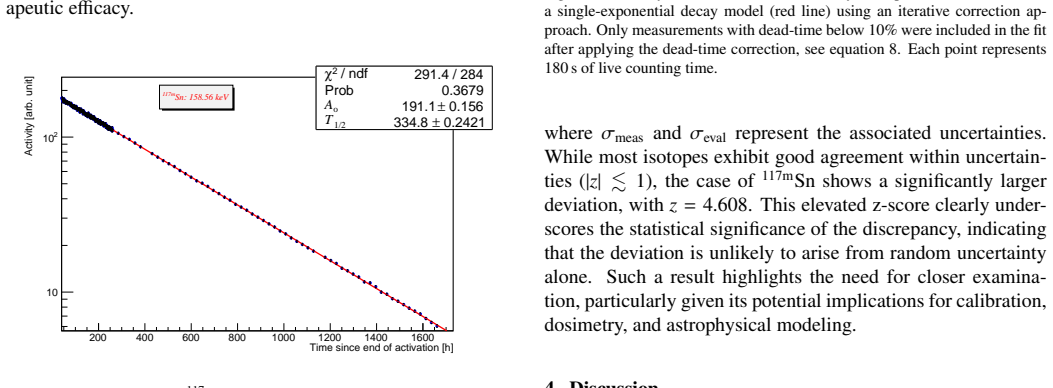
The half-life of 117mSn is measured as 13.95 days, longer than the 13.76 days recommended by Nuclear Data Sheets.
A machine-rendered reading of the paper's core claim, the machinery that carries it, and where it could break.
Core claim
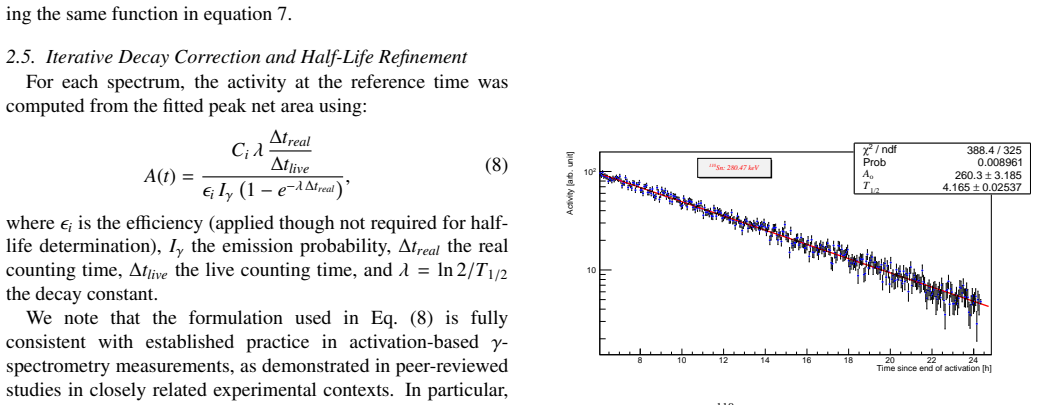
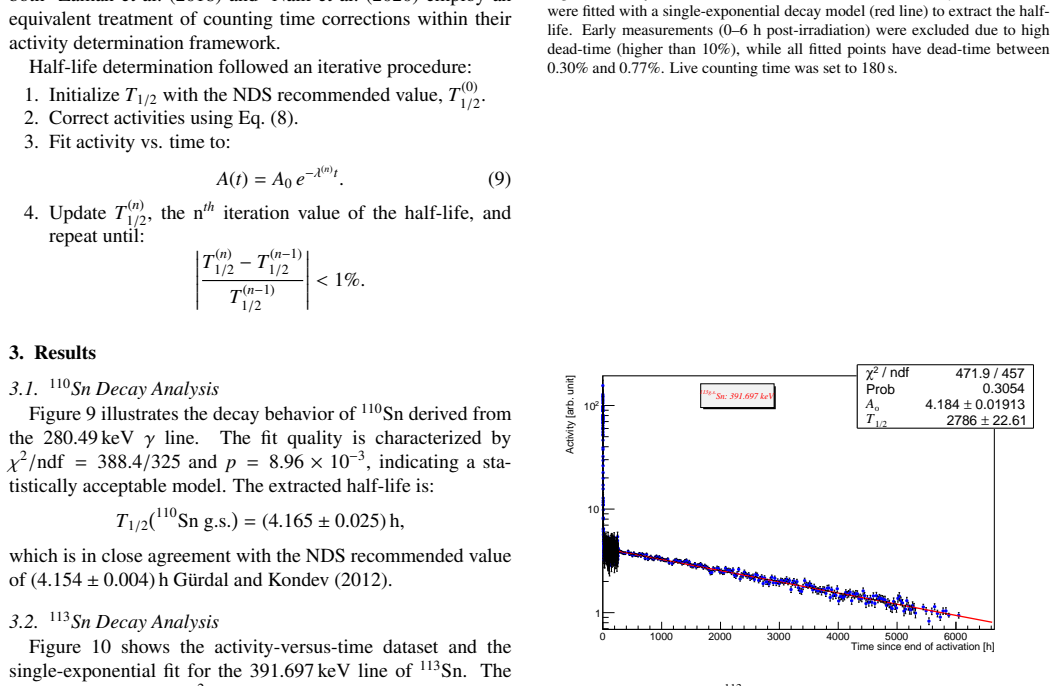
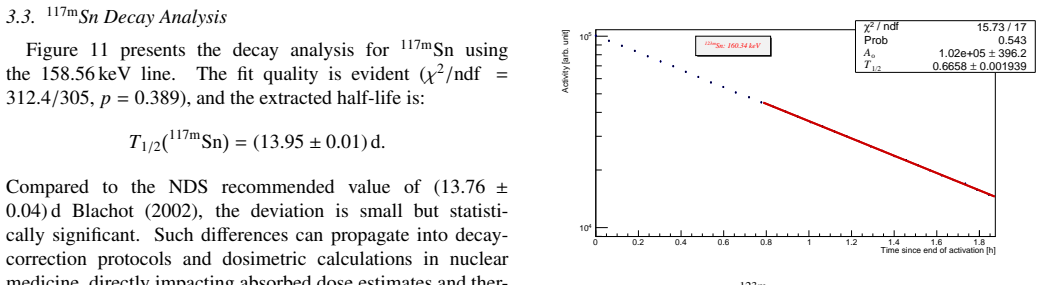
Independent half-life determinations from photon-activated natural tin yield 4.165(25) h for 110Sn, 116.08(94) d for 113Sn, 13.95(1) d for 117mSn, and 39.95(12) min for 123mSn. The first three and the last agree with NDS values within uncertainties, while the 117mSn value differs from 13.76(4) d at a statistically significant level, pointing to a possible systematic offset in prior evaluations.
What carries the argument
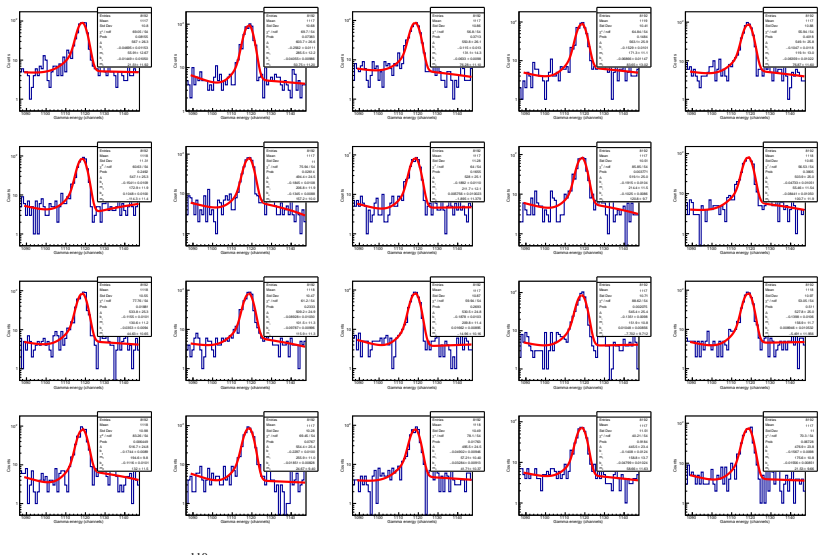
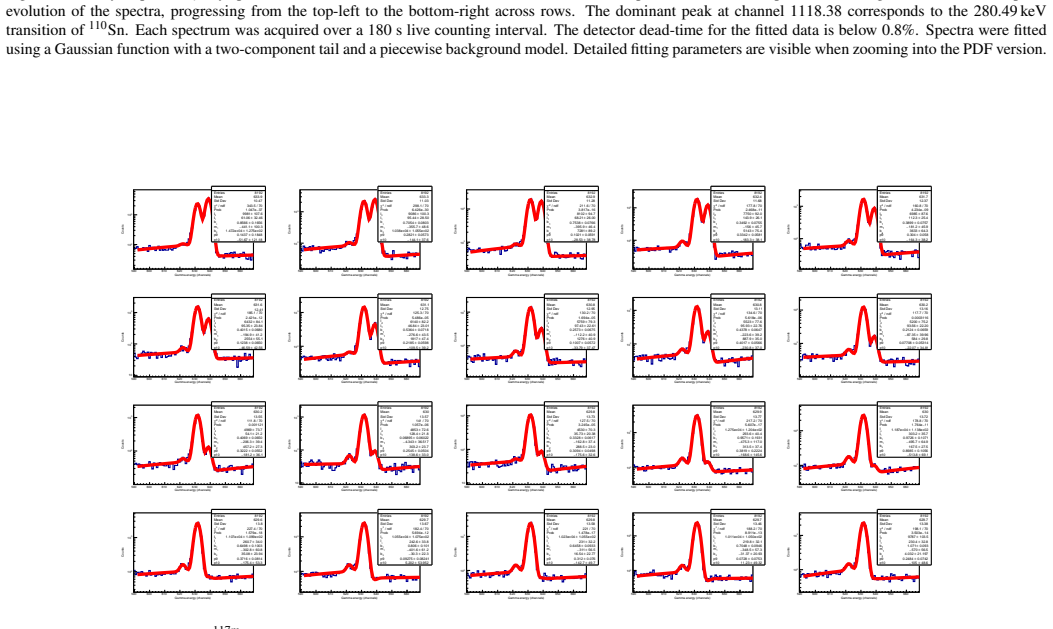
Gaussian peak fitting applied to the time series of counts in the 158.56 keV gamma transition to construct the decay curve for 117mSn.
If this is right
- Applications that use 117mSn decay data for dosimetry or calibration would shift if the longer half-life is adopted.
- Nuclear data evaluations should re-examine the 117mSn entry in light of the new measurement.
- The three isotopes whose half-lives agree can serve as cross-checks for future activation experiments.
- Photon activation of natural tin provides a practical route for producing these isotopes without chemical separation.
Where Pith is reading between the lines
- A confirmed longer half-life for 117mSn would alter the weighting of this isomer in any cumulative yield calculations that combine multiple production paths.
- The same activation-plus-spectroscopy method could be applied to other tin isomers whose evaluated half-lives rest on single older datasets.
- If the discrepancy survives further checks, it may trace to differences in how background subtraction or dead-time corrections were handled in earlier work.
Load-bearing premise
The selected gamma-ray peaks arise solely from the listed transitions of the target isotopes with no significant overlapping lines or time-varying background contributions from contaminants.
What would settle it
An independent half-life measurement of 117mSn performed with a different production route or detector that returns a value statistically consistent with 13.76 d would falsify the reported discrepancy.
Figures
read the original abstract
We report independent determinations of the ground-state half-lives of $^{110}$Sn, $^{113}$Sn, and the isomeric states $^{117\mathrm{m}}$Sn (J$^{\pi} = 11/2^{-}$) and $^{123\mathrm{m}}$Sn (J$^{\pi} = 3/2^{+}$), produced via photon activation of natural tin using a TT-300HE Rhodotron accelerator. The activated samples were monitored over several months using a high-purity germanium (HPGe) detector. Time-dependent $\gamma$-ray spectra were analyzed using Gaussian peak fitting for the \SI{280.49}{keV}, \SI{391.697}{keV}, \SI{158.56}{keV}, and \SI{160.34}{keV} transitions, yielding half-lives of \SI{4.165(25)}{h} for $^{110}$Sn, \SI{116.08(94)}{d} for $^{113}$Sn, \SI{13.95(1)}{d} for $^{117\mathrm{m}}$Sn, and \SI{39.95(12)}{min} for $^{123\mathrm{m}}$Sn. Agreement with Nuclear Data Sheets (NDS) recommended values is generally observed for $^{110}$Sn, $^{113}$Sn, and $^{123\mathrm{m}}$Sn, with deviations consistent within combined uncertainties when quantified using standardized differences (z-scores). In contrast, $^{117\mathrm{m}}$Sn exhibits a statistically significant deviation from the evaluated value of \SI{13.76(4)}{d}, with a z-score indicating a discrepancy well beyond expected statistical fluctuations. This result suggests a systematic difference warranting further investigation, with potential implications for applications relying on precise decay data, including calibration, dosimetry, and astrophysical modeling.
Editorial analysis
A structured set of objections, weighed in public.
Referee Report
Summary. The manuscript reports independent half-life measurements for 110Sn (4.165(25) h), 113Sn (116.08(94) d), 117mSn (13.95(1) d), and 123mSn (39.95(12) min) produced by photon activation of natural tin on a Rhodotron accelerator. Time series of HPGe gamma spectra are analyzed via Gaussian peak fitting to the 280.49 keV, 391.697 keV, 158.56 keV, and 160.34 keV transitions, respectively; the resulting values are compared to NDS recommendations via z-scores, showing agreement within uncertainties for three isotopes but a statistically significant deviation for 117mSn.
Significance. If the 117mSn discrepancy is confirmed after validation of the spectral analysis, the result would warrant updating the evaluated half-life and could affect applications in calibration, dosimetry, and astrophysical modeling. The work supplies new experimental data from a controlled activation setup and direct decay-curve fitting, providing a useful independent check on existing evaluations.
major comments (1)
- [Abstract] Abstract (spectral analysis paragraph): The reported 13.95(1) d value for 117mSn and its z-score discrepancy with the NDS value of 13.76(4) d are extracted solely from Gaussian fits to the 158.56 keV transition. Because natural tin and bremsstrahlung activation open multiple (γ,n), (γ,p), and isomeric channels, the manuscript must explicitly demonstrate that this peak receives no measurable contribution from overlapping transitions, contaminants, or time-dependent backgrounds; without such verification (e.g., multi-component fits, purity tests, or background spectra), the deviation cannot be attributed unambiguously to a true half-life difference rather than an analysis artifact. This assumption is load-bearing for the central claim of a systematic discrepancy.
Simulated Author's Rebuttal
We thank the referee for their careful review and constructive comments on our work. We address the major comment below.
read point-by-point responses
-
Referee: [Abstract] Abstract (spectral analysis paragraph): The reported 13.95(1) d value for 117mSn and its z-score discrepancy with the NDS value of 13.76(4) d are extracted solely from Gaussian fits to the 158.56 keV transition. Because natural tin and bremsstrahlung activation open multiple (γ,n), (γ,p), and isomeric channels, the manuscript must explicitly demonstrate that this peak receives no measurable contribution from overlapping transitions, contaminants, or time-dependent backgrounds; without such verification (e.g., multi-component fits, purity tests, or background spectra), the deviation cannot be attributed unambiguously to a true half-life difference rather than an analysis artifact. This assumption is load-bearing for the central claim of a systematic discrepancy.
Authors: We agree that explicit verification of peak purity for the 158.56 keV transition is necessary to support the claimed discrepancy. The full manuscript describes the use of Gaussian fitting on time-series HPGe spectra and notes consistency with known decay schemes, but we acknowledge that additional explicit checks (such as background spectra, multi-component fits, and contaminant searches) were not highlighted sufficiently. In the revised manuscript we will add a dedicated paragraph and supporting figure(s) detailing these purity tests, including results from attempts to fit additional components and examination of possible overlapping transitions from other Sn isotopes or activation products. This will allow unambiguous attribution of the observed deviation. revision: yes
Circularity Check
No circularity: purely experimental half-life extraction from direct decay curves
full rationale
The paper performs photon activation of natural tin followed by time-series HPGe gamma spectroscopy. Half-lives are obtained by Gaussian peak fitting to extract count rates for specific transitions (280.49 keV, 391.697 keV, 158.56 keV, 160.34 keV) and then fitting exponential decay curves to those rates. These measured values are compared to external NDS recommended values using z-scores. No derivation, ansatz, parameter fitting to a subset, or self-citation chain is present; the central results are independent experimental outputs with no reduction to the paper's own inputs by construction.
Axiom & Free-Parameter Ledger
Reference graph
Works this paper leans on
-
[1]
Sato, Tatsuhiko and Iwamoto, Yosuke and Hashimoto, Shintaro and Ogawa, Tatsuhiko and Furuta, Takuya and Abe, Shin-ichiro and Kai, Takeshi and Matsuya, Yusuke and Matsuda, Norihiro and Hirata, Yuho and Sekikawa, Takuya and Yao, Lan and Tsai, Pi-En and Ratliff, Hunter N. and Iwase, Hiroshi and Sakaki, Yasuhito and Sugihara, Kenta and Shigyo, Nobuhiro and Si...
-
[2]
2018 , doi =
Nuclear Data Sheets , volume =. 2018 , doi =
2018
-
[3]
Koning, Arjan J. and Rochman, Dimitri and Sublet, Jean-Christophe and Dzysiuk, Natasa and Fleming, Michael and van der Marck, Steven , title =. Nuclear Data Sheets , year =. doi:10.1016/j.nds.2019.01.002 , url =
-
[4]
Chen, Jun , title =. Nuclear Data Sheets , year =. doi:10.1016/j.nds.2021.05.001 , url =
-
[5]
Nuclear Data Sheets for A=110 , journal =
G. Nuclear Data Sheets for A=110 , journal =. 2012 , volume =. doi:10.1016/j.nds.2012.05.002 , url =
-
[6]
Utsunomiya, H. and Goriely, S. and Kamata, M. and Akimune, H. and Kondo, T. and Itoh, O. and Iwamoto, C. and Yamagata, T. and Toyokawa, H. and Lui, Y.-W. and Harada, H. and Kitatani, F. and Goko, S. and Hilaire, S. and Koning, A. J. , title =. Physical Review C , year =. doi:10.1103/PhysRevC.84.055805 , url =
-
[7]
Stevenson, Nigel R. and St. George, George and Sim. Methods of producing high specific activity Sn-117m with commercial cyclotrons , journal =. 2015 , volume =. doi:10.1007/s10967-015-4031-7 , url =
-
[8]
Maslov, O. D. and Starodub, G. Ya. and Vostokin, G. K. and Gustova, M. V. and Dmitriev, S. N. and Shvetsov, V. N. and Sz. Production of ^. Applied Radiation and Isotopes , year =. doi:10.1016/j.apradiso.2011.02.031 , url =
-
[9]
IAEA Photonuclear Data Library 2019 , journal =
Kawano, Toshihiko and Cho, Yong Sun and Dimitriou, Paraskevi and Filipescu, Daniel and Iwamoto, Naohiko and Plujko, Vasiliy and Tao, Xiaona and Utsunomiya, Hiroaki and Varlamov, Vladimir and Xu, Ru and Capote, Roberto and Gheorghe, Ioan and Gorbachenko, Oksana and Jin, Yongli and Renstr. IAEA Photonuclear Data Library 2019 , journal =. 2020 , volume =. do...
-
[10]
Journal of Nuclear Science and Technology , year =
Iwamoto, Osamu and Iwamoto, Nobuyuki and Kunieda, Satoshi and Minato, Futoshi and Nakayama, Shinsuke and Abe, Yutaka and Tsubakihara, Kohsuke and Okumura, Shin and Ishizuka, Chikako and Yoshida, Tadashi and Chiba, Satoshi and Otuka, Naohiko and Sublet, Jean-Christophe and Iwamoto, Hiroki and Yamamoto, Kazuyoshi and Nagaya, Yasunobu and Tada, Kenichi and K...
-
[11]
Lagoutine, F. and Legrand, J. and Perrot, C. and Brethon, J.-P. and Morel, J. , title =. The International Journal of Applied Radiation and Isotopes , year =. doi:10.1016/0020-708X(72)90058-0 , url =
-
[12]
Houtermans, H. and Milosevic, O. and Reichel, F. , title =. The International Journal of Applied Radiation and Isotopes , year =. doi:10.1016/0020-708X(80)90139-8 , url =
-
[13]
Unterweger, Michael P. and Hoppes, Dale D. and Schima, Francis J. , title =. Nuclear Instruments and Methods in Physics Research Section A , year =. doi:10.1016/0168-9002(92)90180-C , url =
-
[14]
Hoppes, D. D. and Schima, F. J. , title =. 1982 , doi =
1982
-
[15]
Blachot, Jean , title =. Nuclear Data Sheets , year =. doi:10.1016/j.nds.2005.03.002 , url =
-
[16]
Sauter, T. and K. (p,\( \)) rates of \(^. Physical Review C , year =. doi:10.1103/PhysRevC.55.3127 , url =
-
[17]
Bork, J. and Schatz, H. and K. Proton capture cross sections of the ruthenium isotopes , journal =. 1998 , volume =. doi:10.1103/PhysRevC.58.524 , url =
-
[18]
Chloupek, F. R. and Murphy, A. St. J. and Boyd, R. N. and Cole, A. L. and G. Measurements of proton radiative capture cross sections relevant to the astrophysical rp- and \( \)-processes , journal =. 1999 , volume =. doi:10.1016/S0375-9474(99)00167-0 , url =
-
[19]
Atomic Data and Nuclear Data Tables , year =
Rauscher, Thomas and Thielemann, Friedrich-Karl , title =. Atomic Data and Nuclear Data Tables , year =. doi:10.1006/adnd.2001.0863 , url =
-
[20]
Arnould, M. and Goriely, S. , title =. Physics Reports , year =. doi:10.1016/S0370-1573(03)00242-4 , url =
-
[21]
Boschi, Alessandra and Uccelli, Licia and Martini, Petra , title =. Applied Sciences , year =. doi:10.3390/app9122526 , url =
-
[22]
Varlamov, V. V. and Ishkhanov, B. S. and Orlin, V. N. and Troshchiev, S. M. , title =. Bulletin of the Russian Academy of Sciences: Physics , year =. doi:10.3103/S1062873810060237 , url =
-
[23]
Fultz, S. C. and Berman, B. L. and Caldwell, J. T. and Bramblett, R. L. and Kelly, M. A. , title =. Physical Review , year =. doi:10.1103/PhysRev.186.1255 , url =
-
[24]
Gy. -induced cross sections of ^. Physical Review C , year =. doi:10.1103/PhysRevC.74.025805 , url =
-
[25]
Ponsard, B. and Srivastava, S. and Garland, M. and Knapp, R. and Mirzadeh, S. and Mausner, L. F. , title =. Applied Radiation and Isotopes , year =. doi:10.1016/j.apradiso.2009.02.023 , url =
-
[26]
Excitation function of the -particle induced nuclear reactions on enriched ^
Ditr. Excitation function of the -particle induced nuclear reactions on enriched ^. Atomic Data and Nuclear Data Tables (preprint) , year =
-
[27]
Browne, E. and Tuli, J. K. , title =. Nuclear Data Sheets , year =. doi:10.1016/j.nds.2017.09.002 , url =
-
[28]
Nuclear Data Sheets , volume =
Blachot, Jean , title =. Nuclear Data Sheets , volume =. 2002 , doi =
2002
-
[29]
, title =
Goriely, S. , title =. Physics Letters B , volume =. 1998 , doi =
1998
-
[30]
Emery, G. T. , title =. Annual Review of Nuclear and Particle Science , year =. doi:10.1146/annurev.ns.22.120172.001121 , url =
-
[31]
Zaman, Muhammad and Kim, Guinyun and Naik, Haladhara and Kim, Kwangsoo and Shahid, Muhammad and Nadeem, Muhammad and Shin, Sung-Gyun and Cho, Moo-Hyun , title =. Nuclear Physics A , year =. doi:10.1016/j.nuclphysa.2018.07.017 , url =
-
[32]
Journal of Radioanalytical and Nuclear Chemistry , year =
Naik, Haladhara and Kim, Guinyun and Nguyen, Thi Hien and Kim, Kwangsoo and Shin, Sung-Gyun and Kye, Yong-uk and Cho, Moo-Hyun , title =. Journal of Radioanalytical and Nuclear Chemistry , year =. doi:10.1007/s10967-020-07105-9 , url =
discussion (0)
Sign in with ORCID, Apple, or X to comment. Anyone can read and Pith papers without signing in.