REVIEW 4 major objections 5 minor
Strengthening Target-Language Features: SAE-Based Steering for Multilingual Inference
T0 review · 4 major / 5 minor · reviewed 2026-08-06 · deepseek-v4-flash
Pith's one-line read The paper claims that strengthening a small set of sparse, target-language-specific features, identified by contrasting SAE activations on parallel sentences and decoded into a steering vector, improves multilingual reasoning accuracy at…
desk verdict A useful training-free multilingual steering idea with held-out gains, but the abstract/table mismatch and a missing random-feature control need attention before the core claim is fully convincing. read the letter →
The pith
A machine-rendered reading of the paper's core claim, the machinery that carries it, and where it could break.
The reading
What carries the argument
The central object is the per-layer target–centroid activation difference $\Delta^l_{\tau,\mathrm{multi}} = \mu^l_\tau - \mu^l_{\mathrm{multi}}$, where $\mu^l_\tau$ is the average SAE activation of the target language and $\mu^l_{\mathrm{multi}}$ is the average over all non-target languages on parallel sentences. A sparse autoencoder is a network that represents a hidden state as a small set of interpretable features, and the multilingual centroid is treated as the shared, language-neutral semantic content of the aligned sentences. The method ranks SAE features by $|\Delta^l_{\tau,\mathrm{multi}}|$, keeps the top $k$ with their signed differences, sets all other dimensions to zero, and decodes this sparse code with the SAE decoder to produce the steering vector added to the hidden state with strength $\alpha$. This pipeline is what converts the hypothesis 'language is a sparse, steerable feature set' into a concrete intervention.
What would settle it
Run feature selection on FLORES-200 sentence groups after permuting the translations so the sentences are no longer semantically aligned across languages, then apply the same steering to the same test sets; if the accuracy gains persist, the selected features are not actually isolating language while controlling for content, whereas if they vanish, semantic alignment is the load-bearing ingredient.
Extended reading notes
Core claim
The central claim is that strengthening target-language features, rather than aligning representations or retraining, is enough to narrow the multilingual performance gap. Using model-matched pretrained SAEs on Gemma-3-12B-it, the paper identifies, for each layer, the features whose activation differs most between the target language and the average of the other languages on 500 parallel sentence groups. Those top-$k$ features are decoded into a steering vector and added to the residual stream at the final prompt position before the model generates its answer. The paper argues the gains are causal: the intervention improves accuracy on commonsense reasoning, natural language inference, and math word problems, and ablations show that scaling hidden states or steering raw hidden dimensions does not reproduce the effect.
Load-bearing premise
The method assumes that averaging the SAE activations of the non-target languages yields a language-neutral semantic centroid, so that subtracting it from the target-language average leaves purely language-specific features rather than accidental content or style differences.
Editorial extensions
If this is right
- Multilingual reasoning can be improved on any model with compatible SAEs using only a few hundred parallel sentences, no gradient updates, and no language-specific training data.
- Across the nine XCOPA languages the gain is uniformly positive (Table 1, average +11.3 points), showing the effect is not confined to high-resource languages.
- Since XCOPA and XNLI answers are label tokens A/B/C, the improvement cannot be explained by steering the model toward English surface output; it reflects changed processing of the non-English input.
- A fixed steering strength of $\alpha = 0.6$ still improves average accuracy on all three datasets, so per-language hyperparameter search is not essential to the benefit.
- The ablation result that hidden-state scaling and raw hidden-dimension steering barely move scores implies the sparse SAE code, not activation magnitude, is what carries the language signal.
Reading between the lines
- If this holds, language identity in multilingual models behaves like a small, sparse, causally effective feature set, which suggests the same contrastive SAE recipe could steer other categorical properties such as dialect, register, or domain.
- A direct test of the centroid assumption: use a parallel corpus that is topic-matched but not sentence-aligned; if the gains persist, content alignment is not the mechanism and the centroid may be capturing a broader language prior.
- Both an early layer (6) and a late layer (47) support effective steering, so target-language features are distributed; combining steering across multiple layers is a natural extension that could exceed single-layer gains.
- The English-relative variant performs nearly as well as the multilingual variant, which is consistent with English-centered internal representations in this model family, but evaluating on a model trained on more balanced multilingual data would separate reference choice from the model's own inductive bias.
Editorial analysis
A structured set of objections, weighed in public.
Referee Report
Summary. The paper proposes an inference-time, training-free method for improving multilingual LLM performance. Using parallel sentences from FLORES-200, the method compares SAE activations of target and reference languages, selects the top-k features with the largest activation differences, decodes those differences into a steering vector via the SAE decoder, and adds the vector to the hidden state at the final prompt position of a chosen transformer layer. Experiments with Gemma-3-12B-it and Gemma Scope 2 SAEs report average accuracy gains on XCOPA, XNLI, and MGSM, alongside ablations comparing reference representations (multilingual centroid vs. English), signal content (language-only vs. full representation), and non-SAE controls (hidden-state scaling, direct hidden-dimension steering, least-squares English projection). The paper claims that strengthening target-language-related SAE features improves held-out multilingual task performance without parameter updates.
Significance. If the central causal claim holds, this is a useful contribution: a lightweight, training-free method for multilingual inference that leverages independently pretrained SAEs, with evaluation on held-out test splits and hyperparameters selected on validation splits. The use of a parallel corpus separate from the downstream evaluation set, the validation-based tuning of the steering coefficient, and the public release of code are strengths. However, the missing control with random or least-discriminative SAE features leaves the mechanistic interpretation underdetermined, and several reporting inconsistencies in the headline numbers need correction. The method may still be practically useful even if the language-specificity explanation is not fully established, but the current evidence does not support all the paper's interpretive claims.
major comments (4)
- [§6, Figure 4, Table 3] The central causal claim that language-discriminative feature selection drives the gains is not established, because no control uses the same SAE-based steering pipeline with random or least-discriminative features. All four SAE-based strategies improve over baseline, but a non-sparse, non-SAE baseline (least-squares English projection) reaches 68.4 on XCOPA, above the main method's 65.8. This leaves open the possibility that the improvement comes from adding any sparse SAE-decoded vector at layer 47 rather than from the language-specificity of the selected dimensions. I recommend adding a random-feature control (e.g., top-k features with the smallest absolute activation difference, or randomly sampled SAE features) and reporting whether it also improves performance; this directly tests the paper's mechanistic interpretation.
- [§5, Table 1 vs. Abstract and Appendix G] The reported gains are internally inconsistent. The abstract states average gains of 10.9, 5.3, and 1.9 percentage points on XCOPA, XNLI, and MGSM, while Table 1 reports 11.3, 4.1, and 0.6. Additionally, the Appendix G text says the target-language signal on MGSM achieves 83.6 against an 81.7 baseline, whereas Table 1 and Figure 10 report 81.1 against 80.5; Figure 10's caption also says the average is over German, Spanish, and French, but Table 1 includes Japanese. These discrepancies must be resolved before the results can be assessed, and the abstract should match the table.
- [§5, Table 1] The claim of 'consistent improvements' is too strong given the per-language results and the absence of error bars or significance tests. On XNLI, German decreases by 2.5 points; on MGSM, Japanese decreases by 0.5 points and the average gain is 0.6 points. With no repeated runs, confidence intervals, or significance tests, the reader cannot distinguish a real effect from tuning noise, especially for MGSM. I recommend reporting bootstrap or standard-error estimates, or at minimum clearly flagging the language-level variability and softening the consistency claim.
- [§3.2, Eqs. (5)–(6)] The method assumes that the average SAE activation of non-target languages is a language-neutral semantic centroid, so that subtracting it isolates language-specific features. This assumption is load-bearing: if the centroid retains language-specific information or is affected by semantic misalignment in the parallel sentences, the selected features will not be purely target-language features, and the steering signal will have an unintended component. The paper does not validate this assumption. A concrete test would be to check the stability of the selected features under different subsets of non-target languages, or to compare the centroid with a leave-one-out estimate; the current English-reference variant only partially addresses this concern.
minor comments (5)
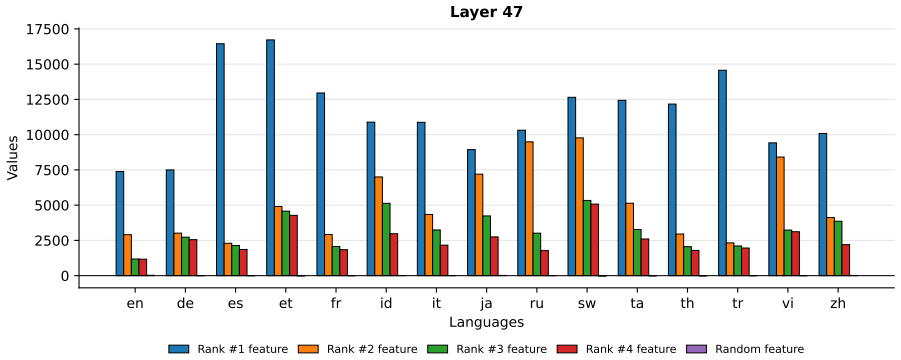
- [§4.3, Figure 2] The 'Random feature' control is said to be close to zero and not visible at the figure's scale; showing it in an inset or on a log scale would make the contrast informative rather than invisible.
- [§4.4] Layer 47 is selected based on XCOPA validation performance and then used for all datasets. The paper should state whether this introduces selection bias and, ideally, show layer-wise results for XNLI and MGSM in addition to XCOPA.
- [§4.3] The number of selected features is fixed at k=3 without a sensitivity analysis. Since k is a free parameter, reporting results for k=1, 5, 10 would help establish robustness.
- [Appendix G, Figure 10] The caption and the text disagree about which languages are averaged in the MGSM ablation; please correct the caption to match the data reported in Table 1.
- [§2, Related Work] The paper cites two preprints (Kirtane and Huang, 2026; Sterz et al., 2025) to justify the claim that averaging across languages attenuates language-specific variation. If these are not yet publicly available or peer-reviewed, please provide additional detail or a more standard citation.
Circularity Check
No significant circularity: features come from the independent FLORES-200 corpus, tuning is confined to validation splits, and the reported held-out gains reduce to no fitted quantity.
full rationale
Walking the paper's derivation chain: the target-language features are selected exclusively from SAE activations of FLORES-200 parallel sentences (Eqs. 3-8); the steering vector is the deterministic SAE decode of the resulting sparse code of activation differences (Eqs. 10-11); and the only tuned quantities are the per-language steering coefficient alpha (validation split, Section 4.5) and the intervention layer (XCOPA validation set, Section 4.4). All reported gains (Table 1; Figures 4, 9, 10) are measured on held-out test splits that are never touched by feature selection or tuning, so no equation in the paper reduces a claimed improvement to a fitted parameter or to the definition of a feature. The load-bearing assumption that the multilingual centroid (Eq. 5) approximately captures language-neutral semantics is an empirical hypothesis, explicitly probed by the English-reference, full-representation, hidden top-k, scaling, and least-squares controls (Section 6); it is not an algebraic identity. No load-bearing citation involves the present authors (Deng et al. 2025, Chou et al. 2025, Kirtane and Huang 2026, Sterz et al. 2025, and Wang et al. 2025 are all external), so there is no self-citation chain. The manuscript's Limitations paragraph honestly notes that results may not generalize to other models without matched SAEs, which supports a low circularity reading. Reporting inconsistencies exist -- the abstract's 10.9/5.3/1.9 percentage points do not match Table 1's 11.3/4.1/0.6, and Appendix G's text (83.6/81.7) disagrees with Figure 10 (81.1/80.5) -- but these are correctness defects, not circular reductions. The missing random-feature steering control and the validity of the language-neutral centroid assumption are underdetermination concerns, not cases where the derivation reduces to its inputs.
Assumptions & free parameters
free parameters (3)
- Steering coefficient alpha (per language, per dataset) =
See Table 1 (e.g., XCOPA: 0.8-2.5; XNLI: 0.0-1.0; MGSM: 0.0-0.9)
- Number of top features k =
3
- Intervention layer l =
47
assumptions (5)
- domain assumption The multilingual centroid of non-target languages approximates a language-neutral semantic representation.
- domain assumption Parallel sentences in the FLORES-200 corpus are semantically aligned across languages, so that differences in SAE activations reflect language rather than content.
- domain assumption The pretrained Gemma Scope 2 SAEs provide a sufficiently faithful sparse decomposition of the residual stream for the intervention to be meaningful.
- domain assumption Adding a decoded sparse code to the hidden state at the final prompt position steers the model's next-token distribution toward the target language.
- domain assumption The English-centered representation hypothesis motivates the English-reference condition but is not required for the main method.
Cite this review
Pith. "Pith review of Strengthening Target-Language Features: SAE-Based Steering for Multilingual Inference." pith.science (2026). https://pith.science/paper/AJK55OOA
@misc{pith2026260804904,
  author       = {Pith},
  title        = {Pith review of: Strengthening Target-Language Features: SAE-Based Steering for Multilingual Inference},
  year         = {2026},
  howpublished = {\url{https://pith.science/paper/AJK55OOA}},
  note         = {Machine review of arXiv:2608.04904}
}
read the original abstract
Multilingual large language models exhibit substantial performance differences across languages, while existing adaptation methods often require parameter updates and considerable multilingual training data. We propose an inference-time multilingual steering method that uses pretrained sparse autoencoders to identify and strengthen target-language-related features. Using multilingual parallel sentences, we compare SAE activations across languages and select a small number of layer-specific features associated with each target language. These features are decoded into steering signals and injected into the model's hidden states without additional training. Experiments with Gemma-3-12B-it show average accuracy improvements of 10.9 percentage points on XCOPA, 5.3 points on XNLI, and 1.9 points on MGSM.
Figures


Figures from the paper (5 more)


Reviewed August 6, 2026 · model on record in the stance chip above.
Discussion (0). Sign in to comment.