REVIEW 3 major objections 5 minor 20 references
Advection improves homogenized models of continuum diffusion in one-dimensional heterogeneous media
T0 review · 3 major / 5 minor · reviewed 2026-08-14 · deepseek-v4-flash
Pith's one-line read An effective advection term in the homogenized equation makes constant-coefficient approximations of heterogeneous-medium diffusion more accurate than the standard harmonic-average model, across nine test cases.
desk verdict A clean, reproducible method that fits an advection-diffusion homogenized model to two moment constraints, but the reported gains are partly calibration and deserve out-of-sample tests. read the letter →
The pith
A machine-rendered reading of the paper's core claim, the machinery that carries it, and where it could break.
The reading
What carries the argument
The engine is a pair of matching constraints applied to two boundary value problems. The first is the steady-state profile $s(x)$ of the heterogeneous model; the second is $w(x)=\int_0^\infty [s(x)-u(x,t)]\,dt$, the signed, time-accumulated gap between the transient solution and steady state. The paper derives boundary value problems for $w(x)$ and its homogenized analogue $W(x)$, so both quantities are obtained without solving the time-dependent problem. Equating the spatial averages of $s$ and $S$ and of $w$ and $W$ gives two nonlinear equations in the unknown constants $D_{\rm eff}$ and $v_{\rm eff}$; solving that small system supplies the homogenized advection-diffusion model. In the classical rapidly oscillating limit the extra equation returns a near-zero velocity, so the model collapses toward the standard harmonic-average description.
What would settle it
Construct a one-dimensional problem with the paper's Dirichlet data but an initial condition concentrated on a small interval away from both boundaries, say a sharply peaked Gaussian centred at x = L/3, and a diffusivity whose derivative changes sign; compute the effective coefficients from constraints (12) and (17), then compare the full time-dependent homogenized solution with the heterogeneous solution. If the homogenized solution is farther from the heterogeneous solution than the harmonic-average diffusion-only model in any region or time window, or if large local errors coexist with matched spatial averages, the blanket improvement claim fails for that case.
Extended reading notes
Core claim
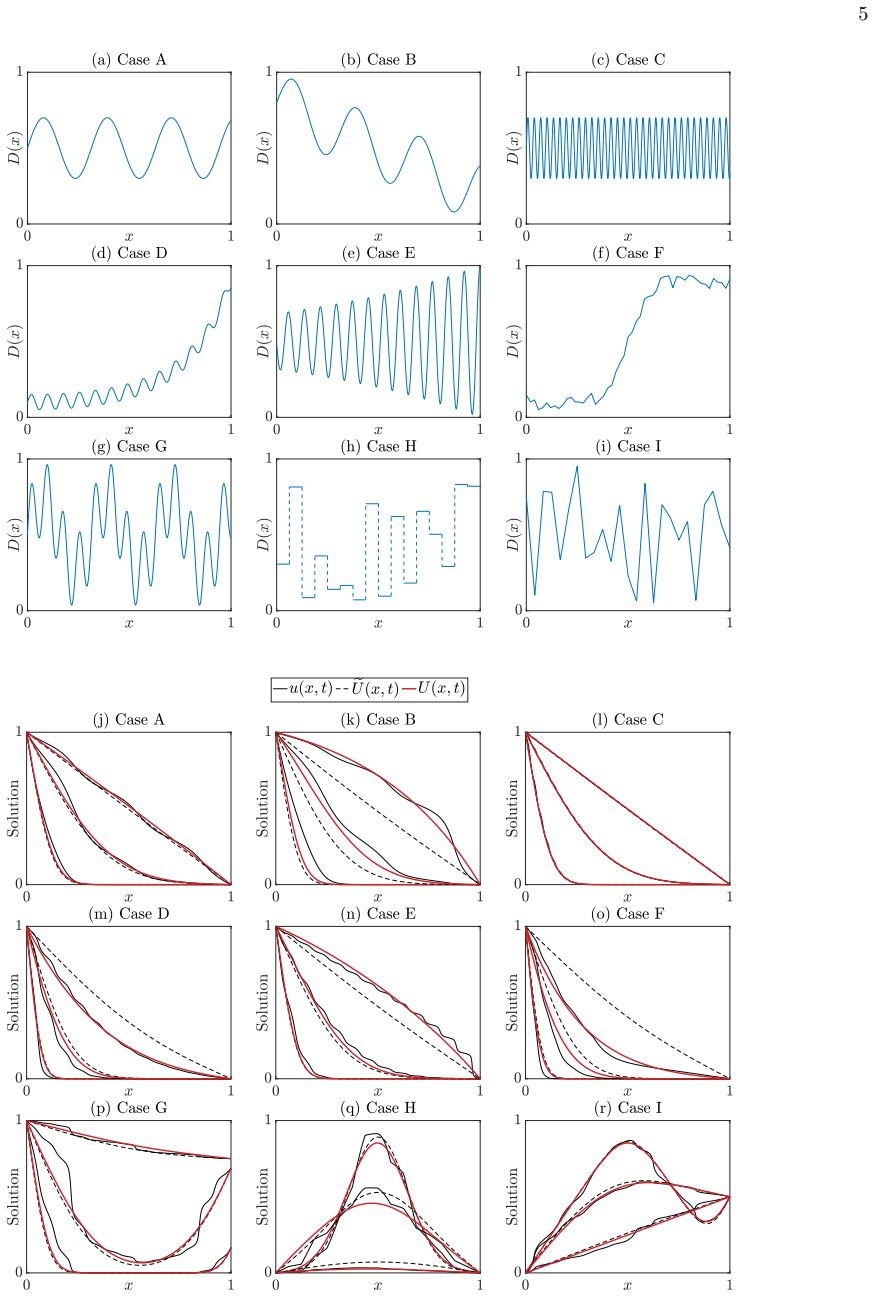
Starting from $\partial u/\partial t = D(x)\partial^2 u/\partial x^2 + D'(x)\partial u/\partial x$, the paper's central claim is that a constant-coefficient homogenized equation should keep the $\partial u/\partial x$ term: $\partial U/\partial t = D_{\rm eff}\partial^2 U/\partial x^2 - v_{\rm eff}\partial U/\partial x$. The coefficients are chosen by solving two uncoupled boundary value problems over the heterogeneous medium and enforcing that the spatial averages of the steady state and of the time-integrated transient deviation agree with the homogenized model's counterparts. In all nine test cases, covering smooth, oscillatory, random, piecewise-constant, and piecewise-linear diffusivities plus time-dependent boundary data and non-uniform initial data, the advection-diffusion model has a smaller mean absolute error than the standard diffusion-only model built on the harmonic average of $D(x)$. The effective coefficients also inherit a dependence on the boundary conditions, not just on the diffusivity.
Load-bearing premise
The method assumes that matching two numbers, the spatial average of the steady-state profile and the spatial average of the time-integrated gap between transient and steady state, fixes the two effective coefficients and makes the homogenized solution accurate everywhere and at every time, an assumption the paper adopts rather than derives from homogenization theory.
Editorial extensions
If this is right
- For media with a strong spatial trend in $D(x)$, the advection-diffusion homogenized model reduces mean absolute error by a factor of several relative to the harmonic-average diffusion-only model, as in the paper's cases B, D, E, and F.
- Effective coefficients are boundary-condition dependent, so a tabulated or measured effective diffusivity should not be reused for a different boundary setting without recomputing the coefficients.
- The coefficient calculation requires only two steady-state boundary value problems plus a small nonlinear solve, so it stays cheaper than resolving the full heterogeneous transient.
- The model accommodates time-dependent boundary data and non-uniform initial data while remaining a constant-coefficient equation, which makes it practical for heat and mass transfer applications.
- In higher dimensions, additional constraints of the same type would be needed for the extra diffusivity and velocity components, the direction the paper itself points to.
Reading between the lines
- Because the two constraints match only global spatial averages, a sharply localised initial condition or a localised sink could preserve the matched averages while producing large early-time local errors; this is a testable stress case the paper does not run.
- Since $w(x)$ and $W(x)$ are zeroth temporal moments, imposing constraints on first or second temporal moments is a natural route to fixing more coefficients in two or three dimensions; the paper flags this direction in its conclusion.
- The boundary-condition dependence of $v_{\rm eff}$ suggests the effective velocity is better read as a representation of boundary-driven asymmetry in the homogenized equation than as a material property of the medium; that interpretative framing is not the paper's own.
Signed reviews
Editorial analysis
A structured set of objections, weighed in public.
Referee Report
Summary. The paper proposes an alternative homogenized model for one-dimensional diffusion with a spatially varying diffusivity. Instead of the standard diffusion-only homogenized equation with harmonic-average diffusivity, the authors assume a constant-coefficient advection-diffusion equation, Eqs. (9)-(11), with effective diffusivity D_eff and effective velocity v_eff. The two coefficients are determined by two integral constraints: equality of the spatial averages of the steady-state solutions (12), and equality of the spatial averages of the time-integrated deviations from steady state (17). These constraints require solving two boundary value problems over the heterogeneous medium, Eqs. (13)-(14) and (20)-(22), and two over the homogenized equation, Eqs. (15)-(16) and (23)-(25), yielding the nonlinear system (26)-(28). Nine test cases are presented in Table I, and Table II reports smaller mean absolute errors for the new advection-diffusion homogenized model than for the standard diffusion-only model in all cases. The paper concludes that including an advection term improves homogenized models of continuum diffusion in one dimension.
Significance. If the central claim holds, the method provides a simple, practical way to capture directional, advective-like effects of spatial heterogeneity with constant coefficients, extending the author's earlier work on stochastic diffusion. The paper is clearly written and the numerical code is publicly available, which is a strength. The reported improvement is consistent across all nine test cases, including cases with time-dependent boundary conditions and non-uniform initial data. However, the evidence as presented is not fully convincing because the effective coefficients are calibrated to each benchmark problem before the errors are computed, and no out-of-sample test or error bound is provided. The significance is therefore conditional on the ability to demonstrate that the improvement is not merely an artifact of fitting two parameters to each solution.
major comments (3)
- [Section IV, Eqs. (26)-(28), Table II] The numerical comparison is in-sample: for every test case, D_eff and v_eff are obtained by solving the nonlinear system (26) with constraints (12) and (17) against the same heterogeneous problem that is later used to compute the errors in Eqs. (33)-(34), whereas the baseline diffusion-only model uses the uncalibrated harmonic average (32). The reported improvement therefore confounds two effects: the presence of the advection term and the addition of a second, solution-calibrated parameter. To support the central claim, the authors should include an out-of-sample test (for example, calibrate the coefficients on one set of initial/boundary conditions or on one sub-interval and then evaluate the error on a different set or sub-interval) and should also compare against a diffusion-only model whose D_eff is calibrated by a one-constraint analogue of the same procedure, so that the comparison is between models with the same number of fitted parameters.
- [Section III, Eqs. (20)-(22) and (23)-(25)] The effective coefficients depend on the initial condition f(x), not only on the diffusivity and boundary conditions as stated in the abstract and in Section V. This is evident because w(x) solves Eq. (20) with source r(x)=f(x)-s(x), and W(x) solves Eq. (23) with R(x)=f(x)-S(x); hence D_eff and v_eff obtained from (26) depend on f through these equations. Homogenized coefficients are normally intrinsic properties of the medium, and a dependence on the initial data is a qualitatively different claim. The authors should either clarify that the coefficients are intended to be problem-specific calibration parameters and discuss the implications, or modify the method so that the coefficients are determined without the initial condition.
- [Section III, Eq. (26) and Section IV] The nonlinear system (26) is central to the method, but the paper gives no existence or uniqueness results for its solution, no discussion of how the initial guess for fsolve is chosen, and no sensitivity analysis. The two constraints (12) and (17) are introduced as a modeling choice without a derivation from homogenization theory and without error bounds. In addition, no grid-convergence study is reported for N_x, N_t, or the fsolve tolerances, so the errors in Table II cannot be verified as converged. Please add the numerical details and a convergence study, and comment on the well-posedness of the system (26).
minor comments (5)
- [Section III, paragraph before Eq. (23)] The operator defined in the text appears as Lϕ := D_eff ∂²ϕ/∂x − v_eff ∂ϕ/∂x; the second derivative should be ∂²ϕ/∂x².
- [Section V] The word 'homgenization' in the conclusions should be 'homogenization'.
- [Section IV, first paragraph] The phrase 'To obtain the the effective coefficients' contains a duplicated 'the'.
- [Table I, Case F] In the formula for D(x_i), the expression exp(20(x−0.5)) uses an unbound variable x; it should be exp(20(x_i−0.5)) or the formula should otherwise be clarified.
- [Section IV, numerical details] The initial guess supplied to fsolve for the pair (D_eff, v_eff) is not reported; this information is needed for reproducibility and to assess the possibility of multiple solutions of (26).
Circularity Check
In-sample calibration: effective coefficients are fitted to each benchmark via constraints (12) and (17), so the reported accuracy gains may reflect the extra fitted parameter rather than an independent advection effect.
-
fitted input called prediction
[Section III, Eqs. (12), (17), (20)-(28); Section IV, Table II]
"To determine the two unknown effective coefficients, Deff and veff, we specify two constraints. First, we enforce equality of the spatial-average of the steady-state solutions of the heterogeneous (6)-(8) and homogenized (9)-(11) models. ... To match the temporal behaviour of U(x,t) and u(x,t) we enforce: ..."
The effective coefficients (Deff, veff) are obtained for each test case by enforcing (12) and (17), where s(x) solves (13)-(14) and w(x) solves (20)-(22) with r(x)=f(x)-s(x). Both s and w are defined directly from the benchmark heterogeneous solution u(x,t), so the advection-diffusion homogenized model is calibrated to the very problem later used to evaluate its error. The reported mean absolute errors (33)-(34) in Table II compare this calibrated model against the same u(x,t), while the baseline diffusion-only model uses the uncalibrated harmonic-average diffusivity (32). Thus the observed improvement is not an out-of-sample test of the advection term; it is an in-sample comparison with one model having a second, solution-fitted parameter.
full rationale
The paper is transparent that its method computes effective coefficients by solving auxiliary BVPs tied to the heterogeneous solution's steady state and transient integral. However, the central claim that 'including an advection term in the homogenized equation leads to improved approximations' is supported only by in-sample errors. Constraints (12) and (17) force the homogenized model to match two integral functionals of the exact benchmark solution, and the same benchmark solution is then used to compute the mean absolute errors (33)-(34). The comparison against the diffusion-only model is unequal because that model's harmonic-average diffusivity (32) is not fitted to the benchmark, so the improvement confounds the advection term with the addition of a second, problem-calibrated parameter. This is the pattern of a fitted input called a prediction: Table II reports calibration quality on the training problems, not independent predictive performance. No out-of-sample or transferability test is given, and no error bound connects the two matched moments to the full space-time trajectory. The technique citations ([16]-[18]) are not load-bearing for this circularity issue. Score 6 reflects that the central claimed improvement reduces substantially to an in-sample two-parameter fit, though the moment-matching idea itself has independent methodological content.
Assumptions & free parameters
free parameters (2)
- D_eff (effective diffusivity) =
Case-dependent, e.g., 0.497 for Case A, 0.409 for Case B (Table II)
- v_eff (effective velocity) =
Case-dependent, e.g., 0.079 for Case A, 0.805 for Case B (Table II)
assumptions (4)
- ad hoc to paper The homogenized model has the form of an advection-diffusion equation with constant coefficients (Eq 9).
- ad hoc to paper The two constraints (12) and (17) are the appropriate way to determine the effective coefficients.
- domain assumption The boundary functions g0(t) and gL(t) have limits as t approaches infinity.
- domain assumption The time integrals defining w(x) and W(x) (Eqs 18-19) converge.
Cite this review
Pith. "Pith review of Advection improves homogenized models of continuum diffusion in one-dimensional heterogeneous media." pith.science (2026). https://pith.science/paper/AK37CYZN
@misc{pith2026190802417,
  author       = {Pith},
  title        = {Pith review of: Advection improves homogenized models of continuum diffusion in one-dimensional heterogeneous media},
  year         = {2026},
  howpublished = {\url{https://pith.science/paper/AK37CYZN}},
  note         = {Machine review of arXiv:1908.02417}
}
read the original abstract
We propose an alternative method for one-dimensional continuum diffusion models with spatially variable (heterogeneous) diffusivity. Our method, which extends recent work on stochastic diffusion, assumes the constant-coefficient homogenized equation takes the form of an advection-diffusion equation with effective (diffusivity and velocity) coefficients. To calculate the effective coefficients, our approach involves solving two uncoupled boundary value problems over the heterogeneous medium and leads to coefficients depending on the spatially-varying diffusivity (as usual) as well as the boundary conditions imposed on the heterogeneous model. Computational experiments comparing our advection-diffusion homogenized model to the standard homogenized model demonstrate that including an advection term in the homogenized equation leads to improved approximations of the solution of the original heterogeneous model.
Figures

Reference graph
Works this paper leans on
-
[16]
E. J. Carr, M. J. Simpson, New homogenization ap- proaches for stochastic transport through heterogeneous media, J. Chem. Phys. 150 (2019) 044104
work page 2019
-
[1]
F. Chen, L. Ren, Application of the finite difference het- erogeneous multiscale method to the Richards equation, Water Resour. Res. 44 (2008) W07413
work page 2008
-
[2]
P. Perr´ e, I. W. Turner, A heterogeneous wood drying computational model that accounts for material prop- erty variation across growth rings, Chem. Eng. J. 86 7 (2002) 117–131
work page 2002
-
[3]
A. Matzavinos, M. Ptashnyk, Homogenization of oxy- gen transport in biological tissues, Appl. Anal. 95 (2016) 1013–1049
work page 2016
-
[4]
M. Huysmans, A. Dassargues, Equivalent diffusion co- efficient and equivalent diffusion accessible porosity of a stratified porous medium, Transport Porous Med. 66 (2007) 421–438
work page 2007
-
[5]
J. L. Auriault, Heterogeneous medium. Is an equivalent macroscopic description possible?, Int. J. Eng. Sci. 29 (1991) 785–795
work page 1991
-
[6]
A. J. Roberts, The harmonic mean renormalises ran- dom diffusion across a spatial multigrid, ANZIAM J. 51 (2010) C83–C96
work page 2010
-
[7]
Y. Davit, C. G. Bell, H. M. Byrne, L. Chapman, L. Kimpton, G. Lang, K. Leonard, J. Oliver, N. Pearson, R. Shipley, S. Waters, J. Whiteley, B. Wood, M. Quin- tard, Homogenization via formal multiscale asymptotics and volume averaging: how do the two techniques com- pare?, Adv. Water Resour. 62 (2013) 178–206
work page 2013
Show all 20 references
-
[8]
E. J. Carr, I. W. Turner, P. Perr´ e, Macroscale modelling of multilayer diffusion: Using volume averaging to cor- rect the boundary conditions, Appl. Math. Model. 47 (2017) 600–618
2017
-
[9]
Abdulle, W
A. Abdulle, W. E, Finite difference heterogeneous multi-scale method for homogenization problems, J. Comput. Phys. 191 (2003) 18–39
2003
-
[10]
Samaey, D
G. Samaey, D. Roose, I. G. Kevrekidis, The gap-tooth scheme for homogenization problems, Multiscale Model. Sim. 4 (2005) 278–306
2005
-
[11]
Crank, The mathematics of diffusion, 2nd ed., Oxford University Press, 1975
J. Crank, The mathematics of diffusion, 2nd ed., Oxford University Press, 1975
1975
-
[12]
Hornung, Homogenization and Porous Media, Springer-Verlag, New York, 1997
U. Hornung, Homogenization and Porous Media, Springer-Verlag, New York, 1997
1997
-
[13]
M. H. Holmes, Introduction to Perturbation Methods, 2nd ed., Springer, New York, 2013
2013
-
[14]
G. A. Pavliotis, A. M. Stuart, Multiscale Methods: Av- eraging and Homogenization, Springer, New York, 2008
2008
-
[15]
N. Ray, A. Rupp, R. Schulz, P. Knabner, Old and new approaches predicting the diffusion in porous me- dia, Transport Porous Med. 124 (2018) 803–824
2018
-
[17]
E. J. Carr, Rear-surface integral method for calculating thermal diffusivity from laser flash experiments, Chem. Eng. Sci. 199 (2019) 546–551
2019
-
[18]
E. J. Carr, M. J. Simpson, Accurate and efficient calcu- lation of response times for groundwater flow, J. Hydrol. 558 (2018) 470–481
2018
-
[19]
A. J. Ellery, M. J. Simpson, S. W. McCue, R. E. Baker, Critical time scales for advection-diffusion-reaction pro- cesses, Phys. Rev. E 85 (2012) 041135
2012
-
[20]
R. S. Puzko, A. M. Merzlikin, Homogenization of maxwells equations in layered system beyond static ap- proximation (2019) arXiv:1708.01661
2019 arXiv
Reviewed August 14, 2026 · model on record in the stance chip above.
Discussion (0). Continue with ORCID to comment.