REVIEW 3 major objections 3 minor 50 references
Dynamical quantum phase transitions in a hybrid quantum dot system with superconducting and ferromagnetic leads
T0 review · 3 major / 3 minor · reviewed 2026-08-11 · deepseek-v4-flash
Pith's one-line read A quantum dot attached to superconducting and ferromagnetic leads undergoes dynamical quantum phase transitions when the leads are suddenly switched or the level is abruptly shifted, with the transient dynamics set by competing pairing…
desk verdict Abstract-only submission: the TD-NRG route is credible and the system is worth a look, but the DQPT claim rests on convergence checks the abstract does not report. read the letter →
The pith
A machine-rendered reading of the paper's core claim, the machinery that carries it, and where it could break.
The reading
What carries the argument
The central objects are the Loschmidt echo, the squared overlap between the initial state and the time-evolved state, and the return function built from that overlap; non-analytic points or cusps in the return function mark dynamical quantum phase transitions. The method that carries the argument is the time-dependent numerical renormalization group, which resolves the transient dynamics after abrupt parameter changes without assuming weak coupling. The relevant energy spectra, together with the time evolution of the induced superconducting pairing and magnetization, are the observables that reveal which correlations dominate the dynamics.
What would settle it
Keep increasing the number of retained states in the time-dependent numerical renormalization group and recompute the return function: if the cusp positions or the critical times shift systematically, or the cusps vanish, as the discarded weight decreases, the reported dynamical quantum phase transition is a numerical artifact rather than a property of the model.
Extended reading notes
Core claim
The paper's core claim is that, in a hybrid quantum dot system with superconducting and ferromagnetic leads, a sudden change in the coupling strengths or in the orbital level drives non-equilibrium dynamics whose Loschmidt echo and return function show non-analytic behaviour, the established fingerprint of a dynamical quantum phase transition. The transient state is not dominated by a single correlation: the induced on-dot pairing and the exchange field from the ferromagnet compete, and the relevant energy spectra determine when the echo revives or collapses. The time-dependent numerical renormalization group treatment is fully non-perturbative, so the claim is that the observed signatures are inherent to the model rather than artefacts of a weak-coupling expansion.
Load-bearing premise
The calculation's accuracy rests on the time-dependent numerical renormalization group keeping enough states after each step; if truncation error is uncontrolled, the apparent non-analyticities in the echo could be numerical artifacts.
Editorial extensions
If this is right
- Dynamical quantum phase transitions can occur in a single-impurity mesoscopic system, not only in extended quenched lattices, so the Loschmidt echo is a useful diagnostic for hybrid dot devices.
- The position and shape of the non-analytic features should be tunable through the superconducting gap, the ferromagnetic polarization, and the level position, giving experimental control over the transient regime.
- The competition between pairing and exchange field should be visible in the early-time dynamics of the induced magnetization and on-dot pairing, offering local observables that track the transition.
- Because the time-dependent numerical renormalization group is non-perturbative, the predicted signatures should persist beyond weak coupling and survive in the strong-correlations regime.
Reading between the lines
- A direct comparison between the hybrid dot and a dot coupled to two normal leads would isolate which echo signatures come from superconductivity and which from the ferromagnetic exchange field; such a comparison is not reported in the abstract.
- If the transition is genuine, applying the same sudden-quench protocol with varying ferromagnetic polarization should move the cusp positions monotonically, which is a testable consequence of the competition claim.
- Because the Loschmidt echo itself is not directly measurable in a transport experiment, a time-resolved measurement of the dot's charge or spin after a gate pulse would be a practical proxy; the abstract does not propose this readout.
Editorial analysis
A structured set of objections, weighed in public.
Referee Report
Summary. The manuscript, based on its abstract, theoretically examines the non-equilibrium dynamics of a single quantum dot coupled to ferromagnetic and superconducting leads. The authors apply the time-dependent numerical renormalization group (TD-NRG) method to study the response to sudden changes in lead couplings or the orbital level. They compute the time evolution of induced local superconducting pairing and magnetization, examine energy spectra, and analyze the Loschmidt echo and return function to identify signatures of dynamical quantum phase transitions (DQPTs). The abstract concludes that the results reveal a non-trivial competition between superconducting pairing and the ferromagnet-induced exchange field.
Significance. If the central claims are correct, this work would extend the study of DQPTs to a hybrid quantum-dot geometry with competing superconducting and ferromagnetic correlations, using a non-perturbative tool (TD-NRG). The topic is timely and the observable set is appropriate. However, the abstract alone does not provide quantitative evidence, convergence details, or a comparison to known results; therefore the significance cannot be fully assessed from the submitted material. The paper has the potential to be significant if the numerics are controlled and the DQPT signatures are robust under truncation.
major comments (3)
- [Abstract (par. 1)] The central claim that the Loschmidt echo and return function exhibit DQPT signatures rests entirely on TD-NRG computations, but the abstract reports no convergence parameters (e.g., the NRG discretization parameter Λ, the number of kept states N_keep, or the discarded weight) and no error estimates. Because the return function's non-analytic points are sensitive to truncation in numerically renormalized time evolution, the observed signatures are unsubstantiated without such information; if the full text contains these tests, the abstract should state that explicitly, and if it does not, this is a load-bearing gap.
- [Abstract (par. 2)] The statement that "the determined dependencies reveal non-trivial competition between relevant correlations" is a qualitative conclusion with no supporting quantitative data in the abstract; no parameter values, figure references, or error bars are given, so this claim cannot be verified or falsified from the submitted text.
- [Abstract (par. 1)] The abstract does not specify the initial state used for the quench (e.g., whether the system starts decoupled from the leads or in a correlated ground state), which is essential for interpreting the Loschmidt echo and return-function dynamics; without this information the precise meaning of the DQPT signatures is unclear.
minor comments (3)
- [Abstract (par. 1)] The phrase "the relevant energy spectra are examined" is vague; the authors should identify which spectra (e.g., the NRG many-body spectrum) and how they relate to the dynamical observables.
- [Abstract (par. 2)] The term "ferromagnetic-contacted induced exchange field" is awkward; consider rephrasing to "the exchange field induced by the ferromagnetic contact."
- [Abstract (par. 1)] The abstract should define the "return function" (e.g., as the Loschmidt amplitude squared) to avoid ambiguity, since this quantity is central to the DQPT analysis.
Circularity Check
No circularity identifiable from the abstract; the study is a first-principles TD-NRG simulation with no fitted inputs or self-referential predictions.
full rationale
The available text is the abstract only, and it contains no equations, no fitted parameters, no self-citations, and no claim that a quantity is predicted from a definition that already contains it. The stated method, time-dependent numerical renormalization group (TD-NRG), is used to compute time evolution after a sudden coupling or level change, with the Loschmidt echo and return function analyzed for dynamical quantum phase transition signatures. These are genuinely computed observables rather than outputs constructed to match target data. There is no reduction of the central claim to its own input: the Loschmidt echo is not defined in terms of the DQPT rate function being reported, and no parameter is fitted to the quantity that is later called a prediction. The only substantive concern is methodological — TD-NRG truncation accuracy for the Loschmidt echo is not documented in the abstract — but that is a correctness or reproducibility risk, not circularity. Under the hard rules, absence of full text and absence of any quoted equation or self-citation chain means no specific circular step can be exhibited. The honest finding is therefore no significant circularity, score 0.
Assumptions & free parameters
assumptions (2)
- domain assumption The time-dependent numerical renormalization group (TD-NRG) accurately captures the non-equilibrium dynamics of the quantum dot system.
- domain assumption The model Hamiltonian (single-level quantum dot with superconducting and ferromagnetic leads) captures the essential physics of the nanoscale system.
Cite this review
Pith. "Pith review of Dynamical quantum phase transitions in a hybrid quantum dot system with superconducting and ferromagnetic leads." pith.science (2026). https://pith.science/paper/AK54C45W
@misc{pith2026260807744,
  author       = {Pith},
  title        = {Pith review of: Dynamical quantum phase transitions in a hybrid quantum dot system with superconducting and ferromagnetic leads},
  year         = {2026},
  howpublished = {\url{https://pith.science/paper/AK54C45W}},
  note         = {Machine review of arXiv:2608.07744}
}
read the original abstract
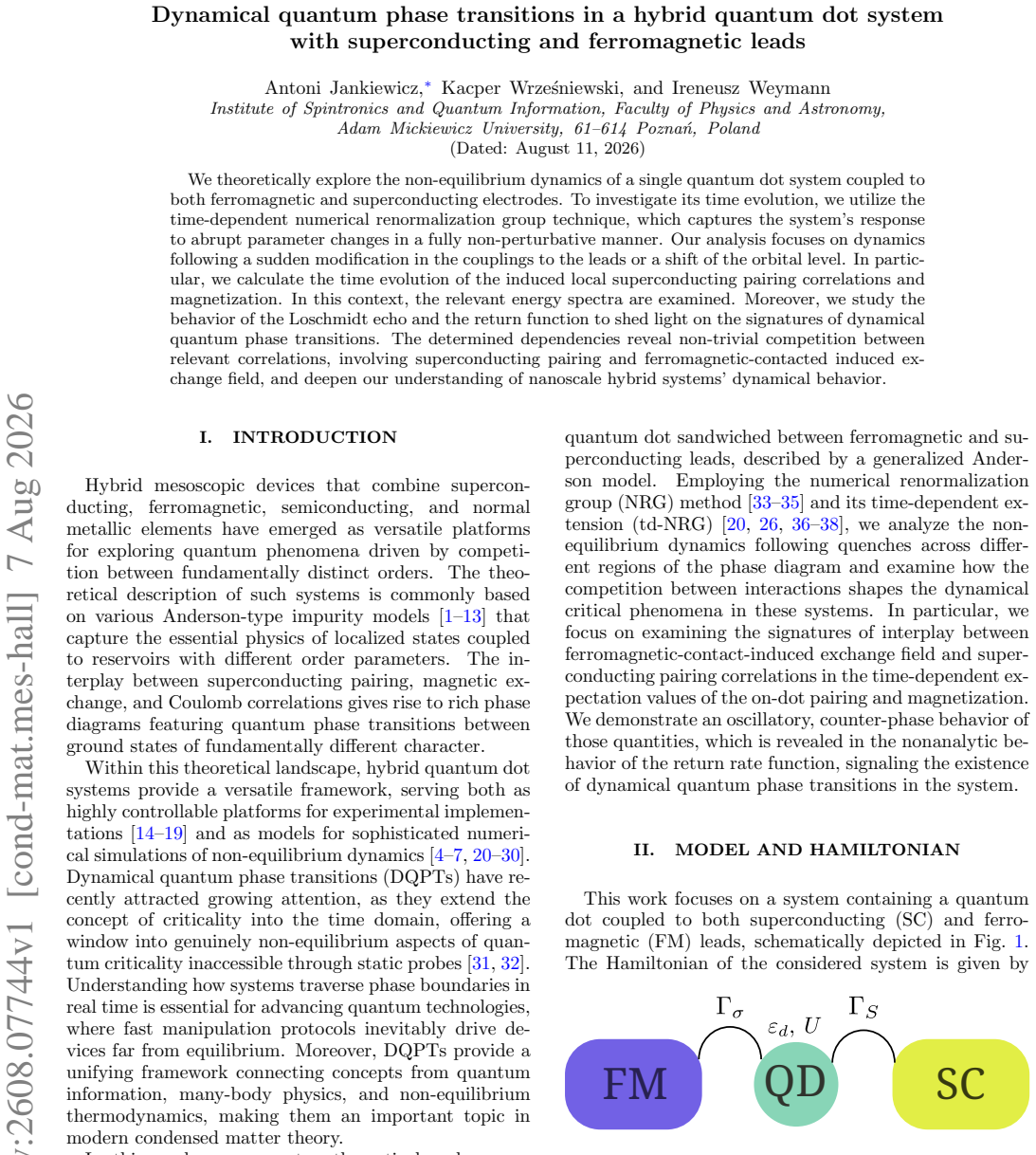
We theoretically explore the non-equilibrium dynamics of a single quantum dot system coupled to both ferromagnetic and superconducting electrodes. To investigate its time evolution, we utilize the time-dependent numerical renormalization group technique, which captures the system's response to abrupt parameter changes in a fully non-perturbative manner. Our analysis focuses on dynamics following a sudden modification in the couplings to the leads or a shift of the orbital level. In particular, we calculate the time evolution of the induced local superconducting pairing correlations and magnetization. In this context, the relevant energy spectra are examined. Moreover, we study the behavior of the Loschmidt echo and the return function to shed light on the signatures of dynamical quantum phase transitions. The determined dependencies reveal non-trivial competition between relevant correlations, involving superconducting pairing and ferromagnetic-contacted induced exchange field, and deepen our understanding of nanoscale hybrid systems' dynamical behavior.
Figures


Figures from the paper (2 more)


Reference graph
Works this paper leans on
-
[1]
P. W. Anderson, Localized Magnetic States in Metals, Phys. Rev.124, 41 (1961)
1961
-
[2]
A. Mart ´ ın-Rodero and A. Levy Yeyati, Josephson and andreev transport through quantum dots, Advances in Physics60, 899–958 (2011)
work page 2011
-
[3]
A. V. Balatsky, I. Vekhter, and J.-X. Zhu, Impurity- induced states in conventional and unconventional su- perconductors, Rev. Mod. Phys.78, 373 (2006)
2006
-
[4]
D. M. Kennes, V. Meden, and R. Vasseur, Universal quench dynamics of interacting quantum impurity sys- tems, Phys. Rev. B90, 115101 (2014)
work page 2014
-
[5]
R. Taranko and T. Doma´ nski, Buildup and transient os- cillations of Andreev quasiparticles, Phys. Rev. B98, 075420 (2018)
work page 2018
-
[6]
K. Wrze´ sniewski, B. Baran, R. Taranko, T. Doma´ nski, and I. Weymann, Quench dynamics of a correlated quan- tum dot sandwiched between normal-metal and super- conducting leads, Phys. Rev. B103, 155420 (2021)
work page 2021
-
[7]
R. Taranko, K. Wrze´ sniewski, B. Baran, I. Weymann, and T. Doma´ nski, Transient effects in a double quantum dot sandwiched laterally between superconducting and metallic leads, Phys. Rev. B103, 165430 (2021)
work page 2021
-
[8]
I. Weymann and P. Trocha, Superconducting proximity effect and zero-bias anomaly in transport through quan- tum dots weakly attached to ferromagnetic leads, Phys. Rev. B89, 115305 (2014)
work page 2014
Show all 50 references
-
[9]
Weymann and K
I. Weymann and K. P. W´ ojcik, Andreev transport in a correlated ferromagnet-quantum-dot-superconductor de- vice, Phys. Rev. B92, 245307 (2015)
2015
-
[10]
Hwang, R
S.-Y. Hwang, R. L´ opez, and D. S´ anchez, Large thermo- electric power and figure of merit in a ferromagnetic– quantum dot–superconducting device, Phys. Rev. B94, 054506 (2016)
2016
-
[11]
Trocha and J
P. Trocha and J. Barna´ s, Spin-dependent thermoelectric phenomena in a quantum dot attached to ferromagnetic and superconducting electrodes, Phys. Rev. B95, 165439 (2017)
2017
-
[12]
Sonar and P
V. Sonar and P. Trocha, Spin dependent thermoelectric transport in a multiterminal quantum dot hybrid includ- ing a superconductor and ferromagnets, Sci. Rep.15, 14509 (2025)
2025
-
[13]
Sonar and P
V. Sonar and P. Trocha, Impact of gap anisotropy of Po- lar and Anderson-Brinkman-Morel p-wave superconduc- tors on thermoelectric properties of quantum dot hybrids, Sci. Rep.16, 13629 (2026)
2026
-
[14]
Hatter, B
N. Hatter, B. W. Heinrich, M. Ruby, J. I. Pascual, and K. J. Franke, Magnetic anisotropy in Shiba bound states across a quantum phase transition, Nat. Commun.6, 8988 (2015)
2015
-
[15]
Hofstetter, A
L. Hofstetter, A. Geresdi, M. Aagesen, J. Nyg ˚ ard, C. Sch¨ onenberger, and S. Csonka, Ferromagnetic Proximity Effect in a Ferromagnet–Quantum-Dot– Superconductor Device, Phys. Rev. Lett.104, 246804 (2010)
2010
-
[16]
B. W. Heinrich, J. I. Pascual, and K. J. Franke, Single magnetic adsorbates on s-wave superconductors, Prog. Surf. Sci.93, 1 (2018)
2018
-
[17]
Garc ´ ıa Corral, D
A. Garc ´ ıa Corral, D. M. T. van Zanten, K. J. Franke, H. Courtois, S. Florens, and C. B. Winkelmann, Magnetic-field-induced transition in a quantum dot cou- pled to a superconductor, Phys. Rev. Res.2, 012065 (2020)
2020
-
[18]
Huang, J
H. Huang, J. Senkpiel, C. Padurariu, R. Drost, A. Vil- las, R. L. Klees, A. L. Yeyati, J. C. Cuevas, B. Kubala, J. Ankerhold, K. Kern, and C. R. Ast, Spin-dependent tunneling between individual superconducting bound states, Phys. Rev. Res.3, L032008 (2021)
2021
-
[19]
C. M. Moehle, P. K. Rout, N. A. Jainandunsing, D. Kuiri, C. T. Ke, D. Xiao, C. Thomas, M. J. Manfra, M. P. Nowak, and S. Goswami, Controlling Andreev Bound States with the Magnetic Vector Potential, Nano Lett. 22, 8601 (2022)
2022
-
[20]
F. B. Anders and A. Schiller, Real-Time Dynamics in Quantum-Impurity Systems: A Time-Dependent Numer- ical Renormalization-Group Approach, Phys. Rev. Lett. 95, 196801 (2005)
2005
-
[21]
Kamp and B
M. Kamp and B. Sothmann, Higgs-like pair amplitude dynamics in superconductor–quantum-dot hybrids, Phys. Rev. B103, 045414 (2021)
2021
-
[22]
A. E. Antipov, Q. Dong, and E. Gull, Voltage Quench Dynamics of a Kondo System, Phys. Rev. Lett.116, 036801 (2016). 9
2016
-
[24]
´Slusarski, K
T. ´Slusarski, K. Wrze´ sniewski, and I. Weymann, Numer- ical renormalization group study of the Loschmidt echo in Kondo systems, Sci. Rep.12, 9799 (2022)
2022
-
[25]
H. T. M. Nghiem and T. A. Costi, Time Evolution of the Kondo Resonance in Response to a Quench, Phys. Rev. Lett.119, 156601 (2017)
2017
-
[26]
H. T. M. Nghiem, H. T. Dang, and T. A. Costi, Time- dependent spectral functions of the Anderson impurity model in response to a quench with application to time- resolved photoemission spectroscopy, Phys. Rev. B101, 115117 (2020)
2020
-
[27]
Wrze´ sniewski, I
K. Wrze´ sniewski, I. Weymann, N. Sedlmayr, and T. Doma´ nski, Dynamical quantum phase transitions in a mesoscopic superconducting system, Phys. Rev. B105, 094514 (2022)
2022
-
[28]
Bedow, E
J. Bedow, E. Mascot, and D. K. Morr, Emergence and manipulation of non-equilibrium Yu-Shiba-Rusinov states, Commun. Phys.5, 281 (2022)
2022
-
[29]
L. C. Ortmanns, J. Splettstoesser, and M. R. Wegewijs, Transient transport spectroscopy of an interacting quan- tum dot proximized by a superconductor: Charge and heat currents after a switch, Phys. Rev. B108, 085426 (2023)
2023
-
[30]
Wrze´ sniewski and I
K. Wrze´ sniewski and I. Weymann, Quench dynamics of spin in quantum dots coupled to spin-polarized leads, Phys. Rev. B100, 035404 (2019)
2019
-
[31]
M. Heyl, A. Polkovnikov, and S. Kehrein, Dynamical Quantum Phase Transitions in the Transverse-Field Ising Model, Phys. Rev. Lett.110, 135704 (2013)
2013
-
[32]
Heyl, Dynamical quantum phase transitions: a re- view, Rep
M. Heyl, Dynamical quantum phase transitions: a re- view, Rep. Prog. Phys.81, 054001 (2018)
2018
-
[33]
K. G. Wilson, The renormalization group: Critical phe- nomena and the Kondo problem, Rev. Mod. Phys.47, 773 (1975)
1975
-
[34]
Bulla, T
R. Bulla, T. A. Costi, and T. Pruschke, Numerical renor- malization group method for quantum impurity systems, Rev. Mod. Phys.80, 395 (2008)
2008
-
[35]
Weichselbaum, Tensor networks and the numerical renormalization group, Phys
A. Weichselbaum, Tensor networks and the numerical renormalization group, Phys. Rev. B86, 245124 (2012)
2012
-
[36]
F. B. Anders and A. Schiller, Spin precession and real- time dynamics in the Kondo model: Time-dependent nu- merical renormalization-group study, Phys. Rev. B74, 245113 (2006)
2006
-
[37]
H. T. M. Nghiem and T. A. Costi, Time-dependent numerical renormalization group method for multiple quenches: Application to general pulses and periodic driving, Phys. Rev. B90, 035129 (2014)
2014
-
[38]
H. T. M. Nghiem and T. A. Costi, Time-dependent numerical renormalization group method for multiple quenches: Towards exact results for the long-time limit of thermodynamic observables and spectral functions, Phys. Rev. B98, 155107 (2018)
2018
-
[39]
A. V. Rozhkov and D. P. Arovas, Interacting-impurity Josephson junction: Variational wave functions and slave-boson mean-field theory, Phys. Rev. B62, 6687 (2000)
2000
-
[40]
T. Meng, S. Florens, and P. Simon, Self-consistent de- scription of Andreev bound states in Josephson quantum dot devices, Phys. Rev. B79, 224521 (2009)
2009
-
[41]
Tanaka, A
Y. Tanaka, A. Oguri, and A. C. Hewson, Kondo effect in asymmetric Josephson couplings through a quantum dot, New J. Phys.9, 115 (2007)
2007
-
[42]
Vecino, A
E. Vecino, A. Mart ´ ın-Rodero, and A. L. Yeyati, Joseph- son current through a correlated quantum level: Andreev states andπjunction behavior, Phys. Rev. B68, 035105 (2003)
2003
-
[43]
Goussev, R
A. Goussev, R. A. Jalabert, H. M. Pastawski, and D. Wisniacki, Loschmidt echo, Scholarpedia7, 11687 (2012)
2012
-
[44]
Legeza, C
We used the open-access Budapest Flexible DM-NRG code, http://www.phy.bme.hu/˜dmnrg/; O. Legeza, C. P. Moca, A. I. T´ oth, I. Weymann, G. Zar´ and, arXiv:0809.3143 (2008) (unpublished)
2008 arXiv
-
[45]
Bauer, A
J. Bauer, A. Oguri, and A. C. Hewson, Spec- tral properties of locally correlated electrons in a Bardeen–Cooper–Schrieffersuperconductor, J. Phys.: Condens. Matter19, 486211 (2007)
2007
-
[46]
Martinek, M
J. Martinek, M. Sindel, L. Borda, J. Barna´ s, J. K¨ onig, G. Sch¨ on, and J. von Delft, Kondo Effect in the Presence of Itinerant-Electron Ferromagnetism Studied with the Numerical Renormalization Group Method, Phys. Rev. Lett.91, 247202 (2003)
2003
-
[47]
Martinek, Y
J. Martinek, Y. Utsumi, H. Imamura, J. Barna´ s, S. Maekawa, J. K¨ onig, and G. Sch¨ on, Kondo effect in quantum dots coupled to ferromagnetic leads, Phys. Rev. Lett.91, 127203 (2003)
2003
-
[48]
A. N. Pasupathy, R. C. Bialczak, J. Martinek, J. E. Grose, L. A. K. Donev, P. L. McEuen, and D. C. Ralph, The kondo effect in the pres- ence of ferromagnetism, Science306, 86 (2004), https://science.sciencemag.org/content/306/5693/86.full.pdf
2004
-
[49]
Martinek, M
J. Martinek, M. Sindel, L. Borda, J. Barna´ s, R. Bulla, J. K¨ onig, G. Sch¨ on, S. Maekawa, and J. von Delft, Gate- controlled spin splitting in quantum dots with ferromag- netic leads in the kondo regime, Phys. Rev. B72, 121302 (2005)
2005
-
[50]
Gaass, A
M. Gaass, A. K. H¨ uttel, K. Kang, I. Weymann, J. von Delft, and C. Strunk, Universality of the kondo effect in quantum dots with ferromagnetic leads, Phys. Rev. Lett. 107, 176808 (2011)
2011
-
[51]
K. P. W´ ojcik and I. Weymann, Proximity effect on spin- dependent conductance and thermopower of correlated quantum dots, Phys. Rev. B89, 165303 (2014)
2014
Reviewed August 11, 2026 · model on record in the stance chip above.
Discussion (0). Continue with ORCID to comment.