REVIEW 3 major objections 5 minor 1 cited by
On Inference of Network Topology and Confirmation Bias in Cyber-Social Networks
T0 review · 3 major / 5 minor · reviewed 2026-08-14 · deepseek-v4-flash
Pith's one-line read This paper proves that a directed social network's influence weights and each agent's confirmation-bias parameters can be recovered exactly from observed opinions as $\mathbf{W}=\mathbf{Q}\mathbf{P}^{-1}$, and characterizes precisely when…
desk verdict Solid sufficient-condition result for exact topology and bias inference; the advertised iff characterization has a real proof gap in Theorem 2, but the main reconstruction method survives. read the letter →
The pith
A machine-rendered reading of the paper's core claim, the machinery that carries it, and where it could break.
The reading
What carries the argument
The load-bearing object is the state-difference correlation identity $\mathbf{W}P=Q$ for the linear time-invariant representation $x(k+1)=Ax(0)+Wx(k)$, which follows because consecutive opinion differences satisfy $x(k+1)-x(k)=W^k L x(0)$ with $L=W+A-I$. The known measurement matrices $P$ and $Q$ are computed by summing outer products of successive differences, so when $P$ is invertible the unknown matrix $\mathbf{W}$ is simply $\mathbf{Q}\mathbf{P}^{-1}$. The proof of exactness grounds uniqueness failure in the condition $x(0)\in L^{-1}\ker(\hat O)\cap\ker(\hat A+\hat W)$, then uses the full-rank condition on the matrix $[Lx(0), WLx(0), \ldots, W^{n-1}Lx(0)]$ to force $\hat W=0$ and hence $\hat A=0$.
What would settle it
Generate a trajectory from (13) with random initial opinions that keep every $x_i(0)$ nonzero and make $P$ full rank; compute $\tilde{W}=QP^{-1}$ and compare with the planted $W$. The first case in which the error exceeds floating-point precision would refute Theorem 3, since no such case should exist if the proof is correct.
Extended reading notes
Core claim
The central claim is Theorem 3: if every follower of an information source has nonzero initial opinion and the matrix $P=\sum_{k=0}^{m-1}(x(k+1)-x(k))(x(k+1)-x(k))^\top$ has full rank $n$, then the weighted influence matrix is exactly $\mathbf{W}=\mathbf{Q}\mathbf{P}^{-1}$ with $Q=\sum_{k=0}^{m-1}(x(k+2)-x(k+1))(x(k+1)-x(k))^\top$. The off-diagonal entries of $\mathbf{W}$ are the social influence weights $w_{i,j}$; the diagonal entries give the confirmation-bias slope $\gamma_i = [\mathbf{W}]_{i,i}/x_i(0)$; and the intercept $\beta_i$ is recovered from the formula in (29). The paper also proves necessity: exact inference is solvable if and only if the linear equation $\tilde{W}P=Q$ has a unique solution, and it gives the practical sufficient check rank($P$)=$n$. In the no-bias case with uncontrolled sources, the same identity recovers $\mathbf{W}$ when $P$ is full rank, although with multiple sources the source-to-agent weights cannot be separated. In the unknown-bias case, exactness is retained only for the incoming links of non-followers.
Load-bearing premise
The exact-recovery claim holds only if the observed opinions are generated exactly by the stated model with piecewise-linear confirmation bias, innate opinions equal to initial opinions, and (in Problem I) information sources that can be silenced; any noise, model mismatch, or uncontrollable source breaks the identity that makes the inversion exact.
Editorial extensions
If this is right
- When the conditions of Theorem 3 hold, a single matrix inversion recovers the entire directed topology and all bias parameters; no node-by-node probing or external stimulation is needed.
- The necessity result implies a clean boundary: if any follower starts with opinion zero, or if the accumulated difference data are rank-deficient, no exact inference method can succeed for this model.
- In the no-bias setting, exact topology inference remains possible even when information sources are uncontrollable, as long as their opinions are known and $P$ is full rank.
- In the unknown-bias setting, the algorithm is guaranteed exact for the incoming weights of non-followers, which could be used to identify which agents are not exposed to information sources.
- As a corollary of the recovered matrices, the steady-state opinions are predicted by $x^*=(I-W)^{-1}Ax(0)$, so the same data yield the long-run consensus value.
Reading between the lines
- If measurement noise is present, the identity $\tilde{W}=QP^{-1}$ becomes a noisy linear solve rather than an exact reconstruction; a natural extension, not explored in the paper, is a regularized total-least-squares estimator that exploits the known structure of $W$ (zero diagonal, nonnegative off-diagonals).
- Because the rank condition depends on the trajectory exploring enough independent directions, agents whose opinions converge quickly will produce near-singular $P$; in practice, active probing or deliberately varied source opinions may be needed to satisfy the condition.
- The same difference-correlation construction applies to any linear time-invariant-plus-drift process anchored at initial states, so the technique may transfer to other network-reconstruction problems, such as epidemic spreading or financial contagion, whenever the drift term is known to equal the initial state.
- The paper's Problem III result suggests a practical litmus test: exact row recovery under an unknown bias model can certify which agents are not followers of any information source, without knowing the bias mechanism.
Signed reviews
Editorial analysis
A structured set of objections, weighed in public.
Referee Report
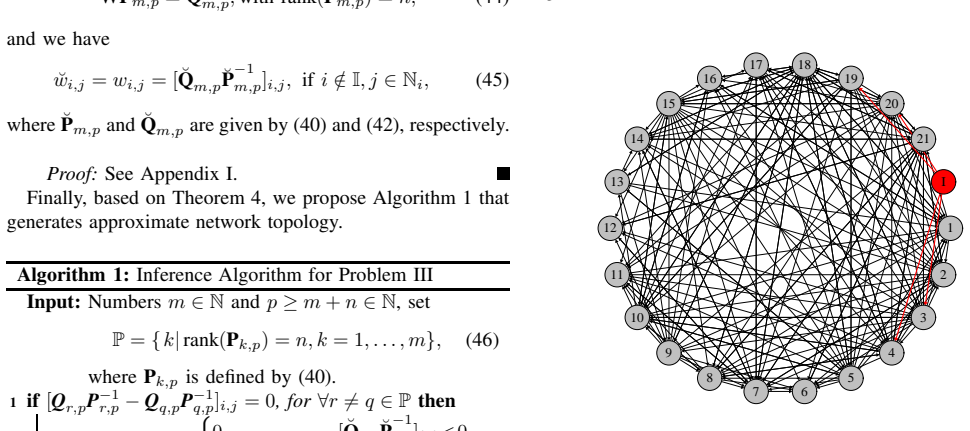
Summary. The paper studies exact and approximate inference of a directed social network's topology and of confirmation-bias parameters from noiseless full-state observations of a discrete-time opinion dynamics model. Under a piecewise-linear bias model and zeroed information sources, the nonlinear dynamics are rewritten as x(k+1)=A x(0)+W x(k), and the authors derive the correlation identity W P = Q from the state-difference matrices P and Q. They state necessary and sufficient conditions for exact inference (Theorems 1 and 2), give the closed-form recovery W=Q P^{-1} when rank(P)=n (Theorem 3), treat the no-bias case (Problem II), and, for an unknown bias model, prove that the rows of the influence matrix corresponding to non-followers of the information source can still be recovered exactly (Theorem 4, Algorithm 1). The theoretical results are supplemented by simulations on a 12-node example and on Krackhardt's advice network.
Significance. If the gaps identified below are repaired, this is a valuable contribution: it provides a simple, linear-algebraic identification procedure for a directed opinion-formation model with confirmation bias, and it identifies exactly which parts of the topology remain identifiable when the bias model is unknown. The appendices contain detailed proofs, the core identity (22) is correct for the noiseless model, and the numerical experiments are consistent with the theory. The paper's main strengths are the explicit treatment of confirmation bias and the partial-recovery guarantee for non-followers in the model-agnostic setting. However, the advertised necessary-and-sufficient characterization currently outruns the proofs, and one auxiliary lemma has a sign error; these issues are local and repairable.
major comments (3)
- [Section III-A, Theorems 1–3, Eq. (19)]
- [Appendix F, Theorem 2 necessity proof]
- [Appendix H, Lemma 3, Eq. (41)]
minor comments (5)
- [Section II-A and Section VI-A] The symbol B is used both for the bipartite edge set in the model and for the weighted adjacency matrix in the simulation; please rename one of them.
- [References [1] and [41]] References [1] and [41] appear to be the same Allerton paper and should be consolidated.
- [Definition 1] 'two following two conditions' should read 'the following two conditions'.
- [Equation (29)] The time index k in (29) is unspecified; state explicitly that the formula holds for any k≥0.
- [Appendix A, Eq. (59)] The displayed equality in (59) mixes A^l and W^l typographically; the intended identity is <tilde>W W^l L x(0)=0, l=0,…,m−1, and should be written uniformly.
Circularity Check
No significant circularity: the central exact-inference result is an algebraic consequence of the stated model, and the paper's self-citations supply only the adopted dynamics, not the inferred conclusion.
full rationale
The derivation chain is self-contained after the explicitly stated modeling assumptions (1), (8), (9) and Remark 1 (s_i = x_i(0)). Lemma 1 proves the correlation identity WP = Q, Eq. (22), from the trajectory relation x(k+1)-x(k) = W^k Lx(0) (Appendix C); W is not fitted into P and Q, it is the unknown matrix that must satisfy this linear identity. Theorem 3 then solves for W uniquely when rank(P) = n, and gamma_i and beta_i are read off from definitions (14c) and (25), with condition (19) making the divisions legitimate. This is genuine inference from data, not a renaming of the input. The authors build on their own opinion-dynamics model [39] and preliminary conference material [41], but the necessary assumptions are restated as equations in this paper rather than imported as unexamined uniqueness theorems, and the inference theorems are proved from those equations. The simulations generate trajectories from the same model and then test whether QP^{-1} recovers the planted weights; that is a self-consistency validation, not a circular prediction. I did not score the possible gap in Appendix F (the admissible choice "we can set \hat A = -\hat W" is questionable because \hat A is constrained to be diagonal) as circularity: that is a rigor/correctness issue, not a reduction of the conclusion to the input.
Assumptions & free parameters
assumptions (6)
- domain assumption The opinion dynamics follow the model x_i(k+1)=alpha_i(x_i(k))s_i+sum_j w_{i,j}x_j(k)+sum_d w_hat_{i,d}(x_i(k))u_d with alpha_i chosen to normalize row sums.
- domain assumption Innate opinion equals initial opinion, s_i=x_i(0).
- domain assumption Confirmation bias is piecewise linear, w_hat_{i,d}(x_i)=beta_i-gamma_i|x_i-u_d|.
- domain assumption Information sources can be controlled to a common opinion, u_d=0.
- domain assumption All agent opinions are observed without noise for the required window.
- domain assumption The data window yields rank(P)=n.
Cite this review
Pith. "Pith review of On Inference of Network Topology and Confirmation Bias in Cyber-Social Networks." pith.science (2026). https://pith.science/paper/AK6XF3X5
@misc{pith2026190809472,
  author       = {Pith},
  title        = {Pith review of: On Inference of Network Topology and Confirmation Bias in Cyber-Social Networks},
  year         = {2026},
  howpublished = {\url{https://pith.science/paper/AK6XF3X5}},
  note         = {Machine review of arXiv:1908.09472}
}
read the original abstract
This paper studies topology inference, from agent states, of a directed cyber-social network with opinion spreading dynamics model that explicitly takes confirmation bias into account. The cyber-social network comprises a set of partially connected directed network of agents at the social level, and a set of information sources at the cyber layer. The necessary and sufficient conditions for the existence of exact inference solution are characterized. A method for exact inference, when it is possible, of entire network topology as well as confirmation bias model parameters is proposed for the case where the bias mentioned earlier follows a piece-wise linear model. The particular case of no confirmation bias is analyzed in detail. For the setting where the model of confirmation bias is unknown, an algorithm that approximates the network topology, building on the exact inference method, is presented. This algorithm can exactly infer the weighted communication from the neighbors to the non-followers of information sources. Numerical simulations demonstrate the effectiveness of the proposed methods for different scenarios.
Figures


Forward citations
Cited by 1 Pith paper
-
Novel Stealthy Attack and Defense Strategies for Networked Control Systems
Periodic topology switching with carefully chosen monitored agents makes informed zero-dynamics attacks detectable in multi-agent consensus control while preserving state privacy.
Reference graph
Works this paper leans on
-
[17]
Topology re construction of dynamical networks via constrained Lyapunov equations,
H. J. v. Waarde, P . Tesi, and M. K. Camlibel, “Topology re construction of dynamical networks via constrained Lyapunov equations, ” IEEE Transactions on Automatic Control, DOI: 10.1109/TAC.2019 .2894585
doi:10.1109/tac.2019 2019
-
[1]
On network topology inference of soc ial networks,
Y . Mao and E. Akyol, “On network topology inference of soc ial networks,” in 2019 57th Annual Allerton Conference on Communication, Control, and Computing , pp. 804–809, 2019
work page 2019
-
[2]
Genetic netwo rk inference: from co-expression clustering to reverse engineering,
P . D’haeseleer, S. Liang, and R. Somogyi, “Genetic netwo rk inference: from co-expression clustering to reverse engineering,” Bioinformatics, vol. 16, no. 8, pp. 707–726, 2000
work page 2000
-
[3]
Wireless sensor net work localization techniques,
G. Mao, B. Fidan, and B. D. Anderson, “Wireless sensor net work localization techniques,” Computer networks, vol. 51, no. 10, pp. 2529– 2553, 2007
work page 2007
-
[4]
A survey of link prediction in s ocial networks,
M. Al Hasan and M. J. Zaki, “A survey of link prediction in s ocial networks,” in Social network data analytics , pp. 243–275, 2011
work page 2011
-
[5]
Networ k structure inference, a survey: Motivations, methods, and applicatio ns,
I. Brugere, B. Gallagher, and T. Y . Berger-Wolf, “Networ k structure inference, a survey: Motivations, methods, and applicatio ns,” ACM Computing Surveys , vol. 51, no. 2, p. 24, 2018
work page 2018
-
[6]
Semi-blin d inference of topologies and dynamical processes over dynamic graphs,
V . N. Ioannidis, Y . Shen, and G. B. Giannakis, “Semi-blin d inference of topologies and dynamical processes over dynamic graphs, ” IEEE Transactions on Signal Processing , 2019
work page 2019
-
[7]
Network identificati on with latent nodes via autoregressive models,
E. Nozari, Y . Zhao, and J. Cort´ es, “Network identificati on with latent nodes via autoregressive models,” IEEE Transactions on Control of Network Systems , vol. 5, no. 2, pp. 722–736, 2017
work page 2017
Show all 44 references
-
[8]
Graph topology inference based on sparsifying transform learning,
S. Sardellitti, S. Barbarossa, and P . Di Lorenzo, “Graph topology inference based on sparsifying transform learning,” IEEE Transactions on Signal Processing , vol. 67, no. 7, pp. 1712–1727, 2019
2019
-
[9]
Topological identificat ion in networks of dynamical systems,
D. Materassi and G. Innocenti, “Topological identificat ion in networks of dynamical systems,” IEEE Transactions on Automatic Control , vol. 55, no. 8, pp. 1860–1871, 2010
2010
-
[10]
Estimating topology of networks,
D. Y u, M. Righero, and L. Kocarev, “Estimating topology of networks,” Physical Review Letters , vol. 97, no. 18, p. 188701, 2006
2006
-
[11]
Robust topology identifi cation and control of lti networks,
M. Fazlyab and V . M. Preciado, “Robust topology identifi cation and control of lti networks,” in 2014 IEEE Global Conference on Signal and Information Processing , pp. 918–922, 2014
2014
-
[12]
S parse network identifiability via compressed sensing,
D. Hayden, Y . H. Chang, J. Goncalves, and C. J. Tomlin, “S parse network identifiability via compressed sensing,” Automatica, vol. 68, pp. 9–17, 2016
2016
-
[13]
Network inf erence from consensus dynamics,
S. Segarra, M. T. Schaub, and A. Jadbabaie, “Network inf erence from consensus dynamics,” in IEEE 56th Annual Conference on Decision and Control, pp. 3212–3217, 2017
2017
-
[14]
Characterization and inference of graph diffusion proces ses from observations of stationary signals,
B. Pasdeloup, V . Gripon, G. Mercier, D. Pastor, and M. G. Rabbat, “Characterization and inference of graph diffusion proces ses from observations of stationary signals,” IEEE Transactions on Signal and Information Processing over Networks , vol. 4, no. 3, pp. 481–496, 2017
2017
-
[15]
Network identific ation via node knockout,
M. Nabi-Abdolyousefi and M. Mesbahi, “Network identific ation via node knockout,” IEEE Transactions on Automatic Control , vol. 57, no. 12, pp. 3214–3219, 2012
2012
-
[16]
Topology identifica tion of directed dynamical networks via power spectral analysis,
S. Shahrampour and V . M. Preciado, “Topology identifica tion of directed dynamical networks via power spectral analysis,” IEEE Transactions on Automatic Control, vol. 60, no. 8, pp. 2260–2265, 2014
2014
-
[18]
Solution of the matrix e quation ax+ xb= c [f4],
R. H. Bartels and G. W. Stewart, “Solution of the matrix e quation ax+ xb= c [f4],” Communications of the ACM , vol. 15, no. 9, pp. 820–826, 1972
1972
-
[19]
Sparse solution of the Lyapu nov equation for large-scale interconnected systems,
A. Haber and M. V erhaegen, “Sparse solution of the Lyapu nov equation for large-scale interconnected systems,” Automatica, vol. 73, pp. 256– 268, 2016
2016
-
[20]
Reaching a consensus,
M. H. DeGroot, “Reaching a consensus,” Journal of the American Statistical Association , vol. 69, no. 345, pp. 118–121, 1974
1974
-
[21]
Mathematical models of the distributio n of attitudes under controversy,
R. P . Abelson, “Mathematical models of the distributio n of attitudes under controversy,” Contributions to mathematical psychology , 1964
1964
-
[22]
Social influence and op inions,
N. E. Friedkin and E. C. Johnsen, “Social influence and op inions,” Journal of Mathematical Sociology , vol. 15, no. 3-4, pp. 193–206, 1990
1990
-
[23]
Opinion dynamics and boun ded con- fidence models, analysis, and simulation,
R. Hegselmann and U. Krause, “Opinion dynamics and boun ded con- fidence models, analysis, and simulation,” Journal of artificial societies and social simulation , vol. 5, no. 3, 2002
2002
-
[24]
Opinion dynamics and lear ning in social networks,
D. Acemoglu and A. Ozdaglar, “Opinion dynamics and lear ning in social networks,” Dynamic Games and Applications , vol. 1, no. 1, pp. 3–49, 2011
2011
-
[25]
Easley and J
D. Easley and J. Kleinberg, Networks, crowds, and markets . Cambridge University Press, 2010, vol. 8
2010
-
[26]
A tutorial on modeling and analysis of dynamic social networks. parts i,
A. V . Proskurnikov and R. Tempo, “A tutorial on modeling and analysis of dynamic social networks. parts i,” Annual Reviews in Control, vol. 43, pp. 65–79, 2017
2017
-
[27]
A tutorial on modeling and analysis of dynamic soci al networks. part ii,
——, “A tutorial on modeling and analysis of dynamic soci al networks. part ii,” Annual Reviews in Control , vol. 45, pp. 166–190, 2018
2018
-
[28]
N. E. Friedkin and E. C. Johnsen, Social influence network theory: A sociological examination of small group dynamics . Cambridge University Press, 2011, vol. 33
2011
-
[29]
Confirmation bias: A ubiquitous pheno menon in many guises,
R. S. Nickerson, “Confirmation bias: A ubiquitous pheno menon in many guises,” Review of general psychology , vol. 2, no. 2, pp. 175–220, 1998
1998
-
[30]
The science of fake news,
D. M. Lazer, M. A. Baum, Y . Benkler, A. J. Berinsky, K. M. G reenhill, F. Menczer, M. J. Metzger, B. Nyhan, G. Pennycook, D. Rothsch ild et al. , “The science of fake news,” Science, vol. 359, no. 6380, pp. 1094–1096, 2018
2018
-
[31]
News feature: The genuine problem of fak e news,
M. M. Waldrop, “News feature: The genuine problem of fak e news,” Proceedings of the National Academy of Sciences , vol. 114, no. 48, pp. 12 631–12 634, 2017
2017
-
[32]
The spreading of misi nformation online,
M. Del Vicario, A. Bessi, F. Zollo, F. Petroni, A. Scala, G. Caldarelli, H. E. Stanley, and W. Quattrociocchi, “The spreading of misi nformation online,” Proceedings of the National Academy of Sciences , vol. 113, no. 3, pp. 554–559, 2016
2016
-
[33]
Blue Feed, Red Feed,
J. Keegan, “Blue Feed, Red Feed,” http://graphics.wsj.com/blue-feed-red-feed/, accesse d 2018-02-25. 12
2018
-
[34]
Study: Facebook can ac- tually make us more narrow-minded,
A. Willingham, “Study: Facebook can ac- tually make us more narrow-minded,” https://www.cnn.com/2017/01/22/health/facebook-study-narrow-minded-trnd/index.html, accessed 2018-02-25
2017
-
[35]
Fake news and the economy of emot ions: Problems, causes, solutions,
V . Bakir and A. McStay, “Fake news and the economy of emot ions: Problems, causes, solutions,” Digital journalism, vol. 6, no. 2, pp. 154– 175, 2018
2018
-
[36]
Information-the oretic approach to strategic communication as a hierarchical game,
E. Akyol, C. Langbort, and T. Bas ¸ar, “Information-the oretic approach to strategic communication as a hierarchical game,” Proceedings of the IEEE, vol. 105, no. 2, pp. 205–218, 2017
2017
-
[37]
The game of misinformation (abstract),
E. Akyol, “The game of misinformation (abstract),” in 55th Annual Allerton Conference on Communication, Control, and Comput ing, Oct 2017
2017
-
[38]
Signaling games for information dispersion over n etworks (ab- stract),
——, “Signaling games for information dispersion over n etworks (ab- stract),” in Asilomar Conference on Signals, Systems, and Computers , 2018
2018
-
[39]
Spread of information with confir- mation bias in cyber-social networks,
Y . Mao, S. Bouloki, and E. Akyol, “Spread of information with confir- mation bias in cyber-social networks,” IEEE Transactions on Network Science and Engineering, DOI: 10.1109/TNSE.2018.2878377
2018
-
[40]
Competitive information spread wi th confirma- tion bias,
Y . Mao and E. Akyol, “Competitive information spread wi th confirma- tion bias,” in Asilomar Conference on Signals, Systems, and Computers , 2019
2019
-
[41]
On network topology inference of social networks,
——, “On network topology inference of social networks, ” 57th Annual Allerton Conference on Communication, Control, and Comput ing, 2019
2019
-
[42]
Opinion dynamics in het erogeneous networks: Convergence conjectures and theorems,
A. Mirtabatabaei and F. Bullo, “Opinion dynamics in het erogeneous networks: Convergence conjectures and theorems,” SIAM Journal on Control and Optimization , vol. 50, no. 5, pp. 2763–2785, 2012
2012
-
[43]
Debia sing social wisdom,
A. Das, S. Gollapudi, R. Panigrahy, and M. Salek, “Debia sing social wisdom,” in Proceedings of the 19th ACM SIGKDD international conference on Knowledge discovery and data mining , pp. 500–508, 2013
2013
-
[44]
Cognitive social structures,
D. Krackhardt, “Cognitive social structures,” Social networks , vol. 9, no. 2, pp. 109–134, 1987
1987
Reviewed August 14, 2026 · model on record in the stance chip above.
Discussion (0). Continue with ORCID to comment.