REVIEW 2 major objections 5 minor 45 references
Short Non-Binary Low-Density Parity-Check Codes for Phase Noise Channels
T0 review · 2 major / 5 minor · reviewed 2026-08-14 · deepseek-v4-flash
Pith's one-line read Short non-binary LDPC codes with DPSK reach within 1.2 dB of finite-length bounds on phase-noise channels down to a CER of 1e-3.
desk verdict A solid, reusable design methodology for short non-binary LDPC codes on phase-noise channels; the 1.2 dB claim is plausible, but the DT bound supporting it is under-quantified. read the letter →
The pith
A machine-rendered reading of the paper's core claim, the machinery that carries it, and where it could break.
The reading
What carries the argument
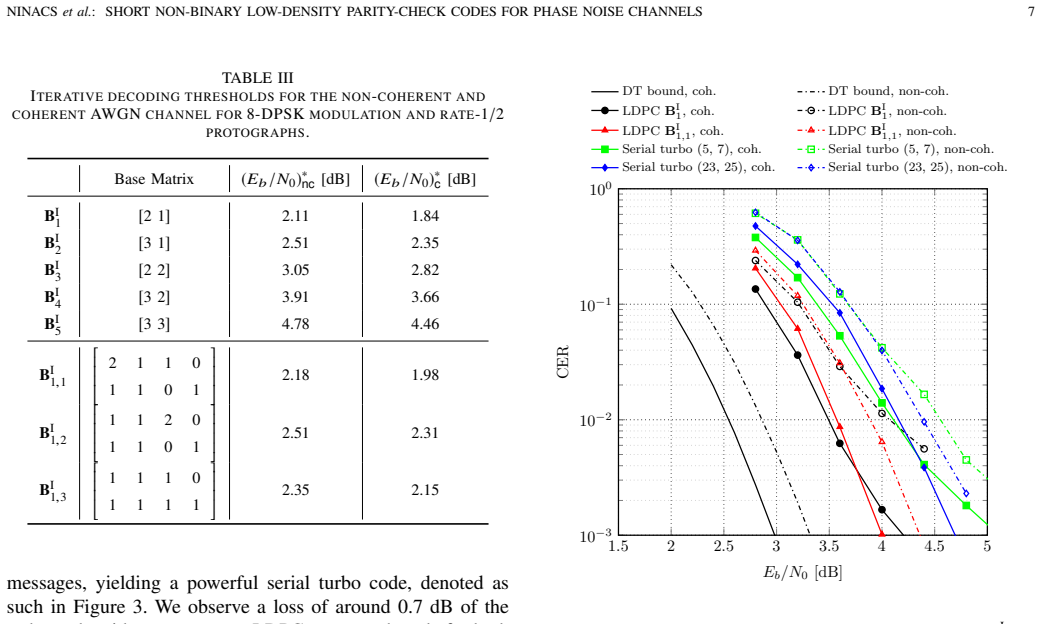
The engine is the protograph base matrix -- a small integer matrix whose entries count edges between check-node and variable-node types. The design searches exhaustively over matrices with entries in {0,1,2,3}, expurgates those with zero-weight columns or too many degree-1 columns, reduces to a minimal set modulo row/column permutations, and selects the ensemble with the best iterative threshold computed by Monte Carlo density evolution; a second step adds a single edge to the winning base matrix to lower the error floor. At the receiver, the discretized-phase (DP) algorithm runs forward-backward recursions on a phase-quantized trellis with L=8m levels and a simplified three-point increment distribution, producing extrinsic symbol probabilities that feed a non-binary belief-propagation decoder over GF(m). Detector and decoder exchange extrinsic messages iteratively as parts of one factor graph.
What would settle it
Recompute the dependency-testing bound for the same channel parameters with a much larger Monte Carlo sample or deterministic numerical integration, and check whether the reported gap of about 1.2 dB at a CER of $10^{-3}$ persists; also test the same codes with the unquantized phase-increment density instead of the P_Delta=0.1 approximation.
Extended reading notes
Core claim
The central claim is that a serially concatenated scheme consisting of a non-binary protograph LDPC code over GF(m) and an m-ary DPSK modulator, with iterative detection and decoding on a joint factor graph, reaches codeword error rates within 1.2 dB of the dependency-testing bound at $10^{-3}$ over a Wiener phase-noise AWGN channel. This is demonstrated for an 8-ary (160,80) rate-1/2 code, an 8-ary (120,80) rate-2/3 code, and a 16-ary (128,96) rate-3/4 code, with phase-noise standard deviations of 2° and 1° respectively. The authors further show that the protographs selected for the non-coherent channel also have the best thresholds among the searched candidates on the coherent AWGN channel, so the phase-noise-tolerant design is not achieved at the cost of coherent performance. They also report gains of about 0.7 dB over a reference serial turbo scheme with binary convolutional codes.
Load-bearing premise
The benchmark against which the 1.2 dB gap is measured is a Monte Carlo estimate of the dependency-testing bound whose sample count and statistical accuracy are not reported, so a biased or noisy benchmark would change the headline gap.
Editorial extensions
If this is right
- Rate-1/2, 2/3 and 3/4 short non-binary LDPC codes with m-DPSK operate within 1.2 dB of the dependency-testing bound down to 10^-3 codeword error rate on Wiener phase-noise channels, without pilots.
- Protographs that are threshold-optimal on the non-coherent channel also win on the coherent AWGN channel among the searched candidates, so a single code can serve both receiver modes.
- The two-step design (threshold search plus single-edge refinement) removes visible error floors above 10^-3 at a small waterfall penalty.
- The designed codes outperform a reference serial turbo scheme with binary convolutional codes by about 0.7 dB in both coherent and non-coherent operation.
Reading between the lines
- If the 1.2 dB gap holds under more careful bound estimation, it suggests the short-block performance penalty on this channel is mostly captured by the dependency-testing bound, and the phase discretization (L=8m) and simplified increment model are not limiting.
- The same search procedure could be applied to other channels with memory -- for example, channels with frequency offset or time-varying fading -- by replacing the channel model in the density evolution and the DP detector.
- Because the best non-coherent protographs coincide with the best coherent ones, a practical system could use a single code and switch between coherent and non-coherent receiver processing without redesign.
- A natural test is to scale the design to longer blocks (N=500 or 1000) and see whether the 1.2 dB gap stays constant or grows, revealing whether the method is specific to the ultra-short regime.
Signed reviews
Editorial analysis
A structured set of objections, weighed in public.
Referee Report
Summary. This paper presents a design methodology for short non-binary protograph LDPC codes concatenated with m-ary DPSK over AWGN channels affected by Wiener phase noise. The receiver performs iterative detection and decoding on a joint factor graph using the discretized-phase algorithm for symbol detection and non-binary belief propagation for decoding. The authors propose a two-step protograph search based on Monte Carlo density evolution thresholds, with a refinement step to lower error floors. Performance is benchmarked against finite-length dependency-testing (DT) bounds and information-rate limits, and against a serial turbo scheme from the literature. The headline result is that the designed codes perform within 1.2 dB of the DT bounds down to a codeword error rate of 10^-3 for rate 1/2 with 8-DPSK, rate 2/3 with 8-DPSK, and rate 3/4 with 16-DPSK.
Significance. If the reported margins are accurate, the paper provides a useful and concrete benchmark for short-block coded modulation over phase-noise channels, a regime relevant to mMTC. The explicit protograph matrices, threshold tables, and the comparison against a serial turbo detector make the design results reproducible and practically meaningful. The main limitation is that the central claim depends on a Monte Carlo estimate of the DT bound whose statistical quality and computation details are not reported; this must be addressed before the headline margin can be fully accepted.
major comments (2)
- [Section III, Eq. (17)] The DT bound curves in Figures 3-5, which are the reference for the headline "within 1.2 dB" claim, are obtained by averaging the summand in Eq. (17) over D simulated (s,r) tuples. The manuscript does not state D, the observed variance of the estimator, or any confidence interval for the bound. Since the horizontal displacement of the bound at CER = 10^-3 directly changes the reported gap, the central claim is not fully verifiable as written. Please report D, a variance estimate, and confidence or error bars for the bound curves, and state explicitly that the bound estimates are accurate to the claimed margin.
- [Section III, Eq. (17)] The computation of the information density i(s;r) for the non-coherent Wiener phase-noise channel is only described as done "as described in [32]" with a Monte Carlo approach. Reference [32] does not provide an algorithm for continuous-phase channels with memory, so it is unclear whether p(r) and p(r|s) are computed exactly (e.g., by a forward recursion on the factor graph) or with the same L-point phase discretization used by the detector. If the latter, the bound would not be a finite-length bound for the true channel and the 1.2 dB gap would be uninterpretable. Please provide the explicit recursion used to compute i(s;r), state the distribution over s, and clarify that the channel is not discretized for the bound.
minor comments (5)
- [Section II-C, Eq. (7)] There is a typographical error in Eq. (7): "p(ψi+1|,ψ i, ai+1)" should read "p(ψi+1|ψi, ai+1)".
- [Abstract] In the abstract, "1:2 dB" should be "1.2 dB".
- [Section III, Eq. (17)] The notation "K log2 m − 1" in Eq. (17) is an approximation of log2((M−1)/2); the text should state this explicitly, since the expression is not obviously equal for finite M.
- [Section V, Examples 1-3] The comparison with the serial turbo scheme does not report the interleaver size, number of turbo iterations, or other implementation parameters; please provide these details to make the benchmark reproducible.
- [Section IV-B] The Monte Carlo density evolution used for the thresholds in Tables III-V does not report the number of decoding attempts or any measure of the accuracy of the threshold estimates; adding these would strengthen the design selection procedure.
Circularity Check
No significant circularity: the central performance claim is measured against an independent finite-length bound and a literature benchmark, and the code-design procedure is not defined in terms of its own output.
full rationale
The paper's derivation chain is self-contained. The claimed result is that protograph-based non-binary LDPC codes, designed by Monte Carlo density-evolution threshold search, perform within about 1.2 dB of the finite-length dependency-testing (DT) bound down to CER 1e-3. The DT bound in Eq. (16)-(17) is an independent benchmark from Polyanskiy, Poor, and Verdu [32], evaluated by Monte Carlo using the channel information density; it does not depend on the designed code or on the fitted detector parameter. The threshold search in Section IV selects protographs by comparing iterative thresholds to the information-rate limit, but this is a design procedure, not a derivation of the simulated CER. The final CER curves are generated by Monte Carlo simulation of the actual concatenated system and are compared against external benchmarks: the DT bound and the serial turbo scheme from [6]. Self-citations to [21], [12], [15], and related work are present, but they are used to import established detection algorithms and a preliminary version of the system, not to justify the numerical performance claim. The tuning of P_Delta = 0.1 is a detector design parameter, and the paper explicitly reports it as obtained via simulation; it is not renamed as a prediction. No equation in the paper reduces the claimed gap to a fitted quantity or to a self-citation. The unquantified number D of Monte Carlo tuples in Eq. (17) is a statistical-quality concern, not a circularity concern: even a noisy bound is an independent benchmark rather than an input that determines the code's simulated CER by construction.
Assumptions & free parameters
free parameters (3)
- P_Delta (detector phase transition probability) =
0.1
- L (phase discretization levels) =
8m
- Nit (maximum detector-decoder iterations) =
200
assumptions (5)
- domain assumption Wiener phase noise with independent Gaussian increments (Eq. 3) adequately models the target channels.
- domain assumption The factorized transition p(psi_i | psi_{i-1}, a_i) and the single-Gaussian approximation for p_Delta (Eqs. 9-13) are valid.
- ad hoc to paper The simplified DP transition p.d.f. with P_Delta (Eq. 14) and L = 8m incurs negligible loss.
- domain assumption Monte Carlo density evolution with the all-zero codeword assumption gives accurate iterative decoding thresholds.
- domain assumption The dependency testing bound computed via Monte Carlo (Eq. 17) is a valid finite-length benchmark for this DPSK system.
Cite this review
Pith. "Pith review of Short Non-Binary Low-Density Parity-Check Codes for Phase Noise Channels." pith.science (2026). https://pith.science/paper/AKBTQCLE
@misc{pith2026190802816,
  author       = {Pith},
  title        = {Pith review of: Short Non-Binary Low-Density Parity-Check Codes for Phase Noise Channels},
  year         = {2026},
  howpublished = {\url{https://pith.science/paper/AKBTQCLE}},
  note         = {Machine review of arXiv:1908.02816}
}
read the original abstract
This work considers the design of short non-binary low-density parity-check (LDPC) codes over finite fields of order m, for channels with phase noise. In particular, m-ary differential phase-shift keying (DPSK) modulated code symbols are transmitted over an additive white Gaussian noise (AWGN) channel with Wiener phase noise. At the receiver side, non-coherent detection takes place, with the help of a multi-symbol detection algorithm, followed by a non-binary decoding step. Both the detector and decoder operate on a joint factor graph. As a benchmark, finite length bounds and information rate expressions are computed and compared with the codeword error rate (CER) performance, as well as the iterative threshold of the obtained codes. As a result, performance within 1:2 dB from finite-length bounds is obtained, down to a CER of 1e-3.
Figures


Figures from the paper (1 more)

Reference graph
Works this paper leans on
-
[32]
Channel coding rate in the finite blocklength regime,
Y . Polyanskiy, H. V . Poor, and S. Verdú, “Channel coding rate in the finite blocklength regime,” IEEE Trans. Inf. Theory , vol. 56, no. 5, pp. 2307–2359, May 2010
work page 2010
-
[1]
IMT Vision-Framework and overall objectives of the future development of IMT for 2020 and beyond,
International Telecommunication Union, “IMT Vision-Framework and overall objectives of the future development of IMT for 2020 and beyond,” Recommendation ITU-R M.2083-0 , 2015. 6.5 7 7.5 8 8.5 9 9.5 10 10.510−3 10−2 10−1 100 Eb/N0 [dB] CER DT bound, coh. DT bound, non-coh. LDPC BIII 1 , coh. LDPC BIII 1 , non-coh. Fig. 5. Simulation results of an LDPC cod...
work page 2020
-
[2]
Scenarios for 5G mobile and wireless communications: the vision of the METIS project,
A. Osseiran, F. Boccardi, V . Braun, K. Kusume, P. Marsch, M. Maternia, O. Queseth, M. Schellmann, H. Schotten, H. Taoka, H. Tullberg, M. A. Uusitalo, B. Timus, and M. Fallgren, “Scenarios for 5G mobile and wireless communications: the vision of the METIS project,” IEEE Commun. Mag., vol. 52, no. 5, pp. 26–35, May 2014
work page 2014
-
[3]
Toward massive, ultrareliable, and low-latency wireless communication with short packets,
G. Durisi, T. Koch, and P. Popovski, “Toward massive, ultrareliable, and low-latency wireless communication with short packets,” Proc. IEEE , vol. 104, no. 9, pp. 1711–1726, Sep. 2016
2016
-
[4]
Multiple-symbol differential detection of MPSK,
D. Divsalar and M. K. Simon, “Multiple-symbol differential detection of MPSK,” IEEE Trans. Commun. , vol. 38, no. 3, pp. 300–308, Mar. 1990
work page 1990
-
[5]
Algorithms for iterative decoding in the presence of strong phase noise,
G. Colavolpe, A. Barbieri, and G. Caire, “Algorithms for iterative decoding in the presence of strong phase noise,” IEEE J. Sel. Areas Commun., vol. 23, no. 9, pp. 1748–1757, Sep. 2005
work page 2005
-
[6]
Communications over phase-noise channels: A tuto- rial review,
G. Colavolpe, “Communications over phase-noise channels: A tuto- rial review,” Int. J. Satell. Commun. Network. , vol. 32, pp. 167–185, May/Jun. 2014, article first published online: Jul. 2013
work page 2014
-
[7]
Theoretical analysis and performance limits of noncoherent sequence detection of coded PSK,
G. Colavolpe and R. Raheli, “Theoretical analysis and performance limits of noncoherent sequence detection of coded PSK,” IEEE Trans. Inf. Theory, vol. 46, pp. 1483–1494, Jul. 2000
work page 2000
Show all 45 references
-
[8]
Iterative decoding for coded noncoherent MPSK communications over phase-noisy AWGN channel,
M. Peleg, S. Shamai, and S. Galan, “Iterative decoding for coded noncoherent MPSK communications over phase-noisy AWGN channel,” IEE Proceedings - Communications , vol. 147, no. 2, pp. 87–95, Apr. 2000
2000
-
[9]
Turbo DPSK: iterative differential PSK demodulation and channel decoding,
P. Hoeher and J. Lodge, “Turbo DPSK: iterative differential PSK demodulation and channel decoding,” IEEE Trans. Commun. , vol. 47, no. 6, pp. 837–843, Jun. 1999
1999
-
[10]
Construction and iterative decoding of LDPC codes over rings for phase-noisy channels,
S. Karuppasami and W. Cowley, “Construction and iterative decoding of LDPC codes over rings for phase-noisy channels,” EURASIP Journal on Wireless Communications and Networking , vol. 2008, pp. 1–9, Jan. 2008
2008
-
[11]
Low-rate non- binary LDPC codes for coherent and blockwise non-coherent AWGN channels,
B. Matuz, G. Liva, E. Paolini, M. Chiani, and G. Bauch, “Low-rate non- binary LDPC codes for coherent and blockwise non-coherent AWGN channels,” IEEE Trans. Commun., vol. 61, no. 10, pp. 4096–4107, Oct. 2013
2013
-
[12]
Soft-output decoding of rotationally invariant codes over channels with phase noise,
A. Barbieri and G. Colavolpe, “Soft-output decoding of rotationally invariant codes over channels with phase noise,” IEEE Trans. Commun., vol. 55, no. 10, pp. 2033–2033, Oct. 2007
2007
-
[13]
On sparse graph coding for coherent and noncoherent demodulation,
C. Piat-Durozoi, C. Poulliat, N. Thomas, M. Boucheret, and G. Lesthievent, “On sparse graph coding for coherent and noncoherent demodulation,” in Proc. IEEE Int. Symp. Inf. Theory , Jun. 2017, pp. 2905–2909. NINACS et al.: SHORT NON-BINARY LOW-DENSITY PARITY-CHECK CODES FOR PH...
2017
-
[14]
Serial concate- nation of LDPC codes and differential modulations,
M. Franceschini, G. Ferrari, R. Raheli, and A. Curtoni, “Serial concate- nation of LDPC codes and differential modulations,” IEEE J. Sel. Areas Commun., vol. 23, no. 9, pp. 1758–1768, Sep. 2005
2005
-
[15]
On the information rate and repeat- accumulate code design for phase noise channels,
A. Barbieri and G. Colavolpe, “On the information rate and repeat- accumulate code design for phase noise channels,” IEEE Trans. Com- mun., vol. 59, no. 12, pp. 3223–3228, Dec. 2011
2011
-
[16]
Design of repeat-accumulate codes for iterative detection and decoding,
S. ten Brink and G. Kramer, “Design of repeat-accumulate codes for iterative detection and decoding,” IEEE Trans. Signal Process., vol. 51, no. 11, pp. 2764–2772, Nov. 2003
2003
-
[17]
Convolutional codes over rings,
J. L. Massey and T. Mittelholzer, “Convolutional codes over rings,” in Proc. 4th Joint Swedish-Soviet Int. Workshop on Inf. Theory , Gotland, Sweden, Aug. 1989, pp. 14–18
1989
-
[18]
Coded modulation with convolutional codes over rings,
R. Filho and P. Farrell, “Coded modulation with convolutional codes over rings,” in Proc. EUROCODE ’90, ser. Lecture notes on computer science, Udine, Italy, Nov. 1990, pp. 271–280
1990
-
[19]
LDPC code construction and iterative receiver techniques for channels with phase noise,
S. Karuppasami, W. G. Cowley, and S. S. Pietrobon, “LDPC code construction and iterative receiver techniques for channels with phase noise,” in VTC Spring 2008 - IEEE Vehicular Technology Conference , May 2008, pp. 2892–2896
2008
-
[20]
LDPC codes over rings for PSK modulation,
D. Sridhara and T. Fuja, “LDPC codes over rings for PSK modulation,” IEEE Trans. Inf. Theory , vol. 51, no. 9, pp. 3209–3220, Sep. 2005
2005
-
[21]
Non-binary LDPC coded DPSK modulation for phase noise channels,
T. Ninacs, B. Matuz, G. Liva, and G. Colavolpe, “Non-binary LDPC coded DPSK modulation for phase noise channels,” in Proc. IEEE Int. Conf. Commun., Paris, France, May 2017, pp. 1–6
2017
-
[22]
Low density parity check codes over GF(q),
M. Davey and D. MacKay, “Low density parity check codes over GF(q),” IEEE Commun. Lett. , vol. 2, no. 6, pp. 70–71, Jun. 1998
1998
-
[23]
EXIT chart analysis and design of non-binary protograph-based LDPC codes,
B.-Y . Chang, L. Dolecek, and D. Divsalar, “EXIT chart analysis and design of non-binary protograph-based LDPC codes,” in MILCOM 2011 Military Communications Conference, Baltimore, MD, USA, Nov. 2011, pp. 566–571
2011
-
[24]
Non- binary protograph LDPC codes for space communications,
L. Costantini, B. Matuz, G. Liva, E. Paolini, and M. Chiani, “Non- binary protograph LDPC codes for space communications,” Int. J. Satell. Commun. Network., vol. 30, no. 2, pp. 43–51, Mar. 2012
2012
-
[25]
Design of regular (2, dc)- LDPC codes over GF (q) using their binary images,
C. Poulliat, M. Fossorier, and D. Declercq, “Design of regular (2, dc)- LDPC codes over GF (q) using their binary images,” IEEE Trans. Commun., vol. 56, no. 10, pp. 1626–1635, Oct. 2008
2008
-
[26]
Factor graphs and the sum-product algorithm,
F. Kschischang, B. Frey, and H.-A. Loeliger, “Factor graphs and the sum-product algorithm,” IEEE Trans. Inf. Theory , vol. 47, no. 2, pp. 498–519, Feb 2001
2001
-
[27]
Optimal decoding of linear codes for minimizing symbol error rate,
L. R. Bahl, J. Cocke, F. Jelinek, and J. Raviv, “Optimal decoding of linear codes for minimizing symbol error rate,” IEEE Trans. Inf. Theory, vol. 20, no. 2, pp. 284–287, Mar. 1974
1974
-
[28]
Decoding algorithms for nonbinary LDPC codes over GF(q),
D. Declercq and M. Fossorier, “Decoding algorithms for nonbinary LDPC codes over GF(q),” IEEE Trans. Commun. , vol. 55, no. 4, pp. 633–643, Apr. 2007
2007
-
[29]
Log-domain decod- ing of LDPC codes over GF( q),
H. Wymeersch, H. Steendam, and M. Moeneclaey, “Log-domain decod- ing of LDPC codes over GF( q),” in Proc. IEEE Int. Conf. Commun. , vol. 2, Paris, France, Jun. 2004, pp. 772–776
2004
-
[30]
Nonbinary hybrid LDPC codes,
L. Sassatelli and D. Declercq, “Nonbinary hybrid LDPC codes,” vol. 56, no. 10, pp. 5314–5334, Oct. 2010
2010
-
[31]
Simulation-based computation of information rates for channels with memory,
D. M. Arnold, H. A. Loeliger, P. O. V ontobel, A. Kavcic, and W. Zeng, “Simulation-based computation of information rates for channels with memory,” IEEE Trans. Inf. Theory, vol. 52, no. 8, pp. 3498–3508, Aug. 2006
2006
-
[33]
Low-density parity-check (LDPC) codes constructed from protographs,
J. Thorpe, “Low-density parity-check (LDPC) codes constructed from protographs,” NASA JPL, Pasadena, CA, USA, IPN Progress Report 42-154, Aug. 2003
2003
-
[34]
Progressive edge-growth Tanner graphs,
X.-Y . Hu, E. Eleftheriou, and D. M. Arnold, “Progressive edge-growth Tanner graphs,” in Proc. IEEE Global Telecommun. Conf., San Antonio, TX, USA, Nov. 2001, pp. 995–1001
2001
-
[35]
Non-binary protograph- based LDPC codes for short block-lengths,
B. Y . Chang, D. Divsalar, and L. Dolecek, “Non-binary protograph- based LDPC codes for short block-lengths,” in Proc. IEEE Inf. Theory Workshop, Lausanne, Switzerland, Sep. 2012, pp. 282–286
2012
-
[36]
Design and analysis of nonbinary LDPC codes for arbitrary discrete-memoryless channels,
A. Bennatan and D. Burshtein, “Design and analysis of nonbinary LDPC codes for arbitrary discrete-memoryless channels,” IEEE Trans. Inf. Theory, vol. 52, no. 2, pp. 549–583, Feb. 2006
2006
-
[37]
Protograph LDPC codes design based on EXIT analysis,
G. Liva and M. Chiani, “Protograph LDPC codes design based on EXIT analysis,” in Proc. IEEE Global Telecommun. Conf. , Washington, DC, USA, Nov. 2007, pp. 3250–3254
2007
-
[38]
MacKay, Information Theory, Inference & Learning Algorithms
D. MacKay, Information Theory, Inference & Learning Algorithms . New York, NY , USA: Cambridge University Press, 2002
2002
-
[39]
Non-binary LDPC code design for the poisson PPM channel,
B. Matuz, E. Paolini, F. Zabini, and G. Liva, “Non-binary LDPC code design for the poisson PPM channel,” IEEE Trans. Commun. , vol. 65, no. 11, pp. 4600–4611, Nov. 2017
2017
-
[40]
Serial concate- nation of interleaved codes: performance analysis, design, and iterative decoding,
S. Benedetto, D. Divsalar, G. Montorsi, and F. Pollara, “Serial concate- nation of interleaved codes: performance analysis, design, and iterative decoding,” IEEE Trans. Inf. Theory , vol. 44, no. 3, pp. 909–926, May 1998
1998
-
[41]
Design of efficient erasure codes with differential evolution,
A. Shokrollahi and R. Storn, “Design of efficient erasure codes with differential evolution,” in Differential Evolution. Springer, 2005, pp. 413–427
2005
-
[42]
Binary representation of cycle tanner- graph GF(2b) codes,
X. Y . Hu and E. Eleftheriou, “Binary representation of cycle tanner- graph GF(2b) codes,” in Proc. IEEE Int. Conf. Commun. , vol. 1, Paris, France, Jun. 2004, pp. 528–532
2004
-
[43]
Bounds on the error probability of block codes over the q-ary erasure channel,
G. Liva, E. Paolini, and M. Chiani, “Bounds on the error probability of block codes over the q-ary erasure channel,” IEEE Trans. Commun., vol. 61, no. 6, pp. 2156–2165, Jun. 2013
2013
-
[44]
Digital Video Broadcasting (DVB); Second Generation Framing Struc- ture, Channel Coding and Modulation Systems for Broadcasting, Inter- active Services, News Gathering and Other Broadband Satellite Appli- cations (DVB-S2), ETSI EN 302 307 v1.2.1, ETSI European Standard (Teleco...
2009
-
[45]
TSG RAN WG1 meeting no. 85 R1-164041,
“TSG RAN WG1 meeting no. 85 R1-164041,” 3GPP, Nanjing, China, Tech. Rep., May 2016
2016
Reviewed August 14, 2026 · model on record in the stance chip above.
Discussion (0). Continue with ORCID to comment.