REVIEW 4 major objections 7 minor 4 references
Vector Ontologies as an LLM world view extraction method
T0 review · 4 major / 7 minor · reviewed 2026-08-07 · deepseek-v4-flash
Pith's one-line read A large language model's internal map of music can be projected onto an 8-dimensional audio space and matches real genre data.
desk verdict Consistency results are strong, but the accuracy claim rests on a non-independent 'ground truth' that needs a song-level check. read the letter →
The pith
A machine-rendered reading of the paper's core claim, the machinery that carries it, and where it could break.
The reading
What carries the argument
The central object is the vector ontology: a domain-specific vector space whose axes are interpretable dimensions, so that an entity like a genre becomes a coordinate vector rather than an unstructured embedding. Here the space is 8-dimensional, with axes such as danceability, energy, acousticness, and tempo, discretized into six equal-frequency bins per axis to form about 1.7 million hypercubes. The LLM is prompted to return bin indices for a genre, and those indices are compared across prompt variations for consistency and against the song distributions inside the same bins for accuracy; this shared geometric frame is what lets the authors treat projection and ground truth as the same kind of object.
What would settle it
Rebuild the ground-truth ontology from human expert genre ratings of individual songs rather than the streaming platform's model-derived features, then rerun the centroid and cosine-similarity comparisons; if the LLM's projections no longer align with that human ground truth, the accuracy claim is refuted.
Extended reading notes
Core claim
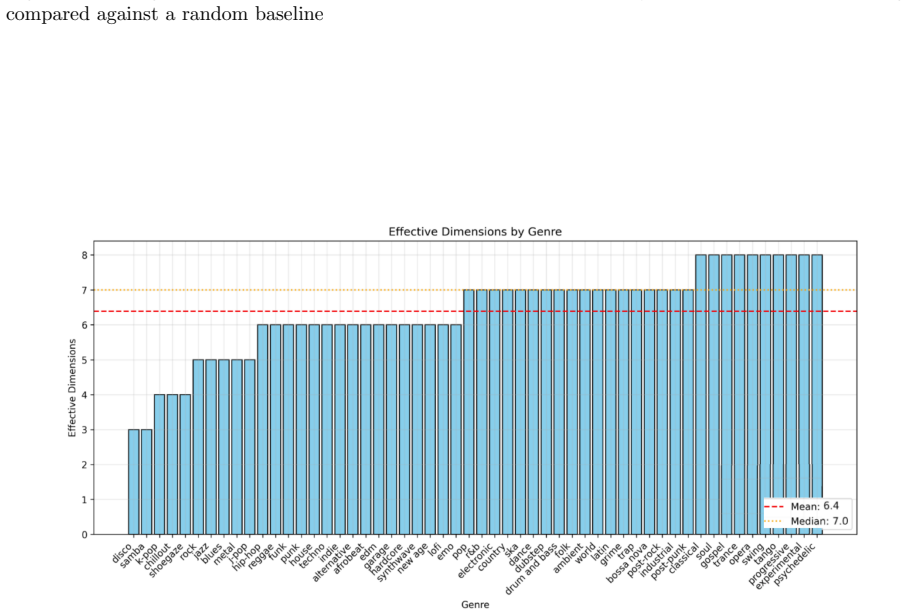
The authors claim that an LLM does indeed possess a consistent and extractable internal world model that can be projected onto a predefined vector ontology. Measured across 47 query formulations for each of 50 genres, the projected locations average only 12.5 unique positions per genre, sit much closer to their genre centroid than a random baseline, and cover roughly 0.0019% of the space by volume versus 48% for random sampling. The projected genre centers also align with ground-truth genre centers built from real song data, with adjusted cosine similarity 0.88 versus 0.64 random, leading the authors to conclude that the extracted worldview is both stable and accurate.
Load-bearing premise
The accuracy claims rest on treating a streaming platform's audio features and artist-level genre tags as the true locations of genres, even though those features come from a mix of signal processing and a model trained on human labels, and the tags describe artists rather than individual songs.
Editorial extensions
If this is right
- An LLM's knowledge can be exposed and checked without fine-tuning or modifying the model, using only natural-language queries into a predefined ontology.
- The same projection can act as a retrieval system: a user query maps to an ontology position, and real items from that bin can be returned, which the paper demonstrates for songs.
- Because prompt phrasing shifts genre positions in locally consistent directions, the ontology appears to track changes in the model's latent representation, not just random text generation.
- Genres occupy lower-dimensional subspaces, suggesting the model uses different feature subsets for different genres, which matches musical intuition and may help explain genre-specific accuracy differences.
- If the approach transfers, domains with scores already organized into interpretable dimensions could gain transparent LLM-based knowledge extraction.
Reading between the lines
- If the consistency results generalize past music, vector ontologies could become a cheap interpretability probe for factual beliefs: place any concept in a fixed semantic space and test whether paraphrases move the model's answer.
- The local prompt-consistency finding suggests that 'prompt direction' vectors exist in the latent space and shift ontology coordinates in structured ways, which could be mapped the way concept vectors are mapped in embeddings.
- A direct next test would swap the streaming platform's model-derived audio features for human expert ratings of the same genres; if the LLM aligns with the human ground truth at least as well, the accuracy claim is strengthened, and if not, the result may partly reflect similarities between the LLM and the platform's own model.
- The method's reliance on predefined dimensions is both its strength and its boundary: for domains without natural continuous axes, the hard work is constructing the ontology rather than extracting from the LLM.
Signed reviews
Editorial analysis
A structured set of objections, weighed in public.
Referee Report
Summary. The paper introduces 'vector ontologies' as an interpretable low-dimensional projection of an LLM's internal world model, building on the authors' earlier preprint (Rothenfusser, 2025). Using GPT-4o-mini and an 8-dimensional audio-feature ontology derived from Spotify data, the authors prompt the model to locate 50 musical genres across 47 query formulations. They report two main results: (1) high spatial consistency of the extracted genre locations across query variations, measured against a random baseline, and (2) alignment of these locations with a 'ground truth' ontology populated from Spotify audio features and artist-level genre tags. A further analysis claims a local, query-formulation-dependent shift in the extracted locations. The paper concludes that LLMs possess a consistent and accurate extractable internal world model of music.
Significance. If the consistency result holds, the paper makes a useful methodological contribution: it offers a cheap, prompt-based way to elicit structured spatial knowledge from an LLM and tests it against controlled random baselines with strong effect sizes. The release of code is a concrete strength. However, the accuracy claim (Hypothesis 2) is the load-bearing part of the abstract's joint 'consistent and accurate' assertion, and that claim is currently supported only by a ground truth that is itself model-derived and likely present in the LLM's training data. The consistency evidence in §6.2 is credible and well-controlled; the accuracy evidence in §6.3 needs substantially stronger validation before the paper's central conclusion can be accepted. The additional analysis in §6.4 is intriguing but only shows local, not global, prompt-conditioned shifts, so the abstract's third claim is overstated.
major comments (4)
- [§5.1, §6.3.3] The accuracy claim (Hypothesis 2) rests on a ground-truth ontology whose features are produced by Spotify's proprietary signal-processing plus ML pipeline trained on human labels, as the paper itself states in §5.1. Because GPT-4o-mini was trained on web-scale text that plausibly includes Spotify/Echonest feature metadata and genre descriptions, the §6.3.3 alignment (Euclidean distance 0.46 vs. 0.66 random; cosine 0.96 vs. 0.9) may reflect the LLM recalling the same external source rather than an independently verified internal world model. To support the accuracy claim, the authors need an independent, song-level ground truth (e.g., human expert ratings or audio-signal features not trained on the same label distribution) and a contamination check, such as evaluating on genres or artists whose metadata postdates the model's training cutoff.
- [§5.3, §6.3.3] Genre labels are inherited from artists to all songs by that artist, as described in §5.3. This means the ground-truth genre centroids are contaminated by artist-level aggregate genre tags, which may diverge from the genre of individual songs. The authors acknowledge this limitation in §5.3 but do not quantify its effect. A song-level genre validation set, or at minimum a per-song artist-genre agreement analysis, is required before the weighted-average centroids used in §6.3.3 can be treated as ground truth.
- [§6.3.3, Figure 11] The quantitative accuracy comparison reports only means, p-values, and effect sizes against a random baseline, without confidence intervals, per-genre breakdowns, or a description of how the random baseline was constructed for the shifted-space cosine similarity. Given that the improvement is modest (distance 0.46 vs. 0.66; original cosine 0.96 vs. 0.9), it is important to know whether the effect is driven by a few well-separated genres and whether the random baseline matches the marginal distribution of genre centroids. Reporting per-genre distances and a bootstrap or permutation interval would make the claim verifiable.
- [§6.4, Abstract claim (3)] The abstract claims 'evidence of a direct relationship between prompt phrasing and spatial shifts,' but the global analysis in Figure 13 shows no significant correlation (mean cosine 0.013 vs. random 0.13). The local 5-nearest-neighbor correlation of 0.84 in Figure 14 is interesting, but it is a local, context-dependent effect, not a global 'direct relationship.' The conclusion in §7 and §8 overstates this finding; the text should be revised to describe it as preliminary evidence of local prompt-conditioned shifts.
minor comments (7)
- [§5.1, Table 1] The bin ranges in Table 1 have overlapping boundary values (e.g., Danceability r5 begins at 0.76 and ends at 1.00, while the previous bin ends at 0.76; Tempo ranges similarly). Please clarify the convention for assigning values exactly on a boundary, and confirm that the binning is implemented consistently in code.
- [§6.2.1, Figure 3] The text reports an average of 12.5 unique locations per genre but does not state the total number of generations per genre (47) explicitly in Figure 3's caption or in the text; clarify the relationship between the 'total' and 'unique' counts shown in the figure.
- [§6.2.4, Figure 7-8] The hypersphere volume calculation treats the discrete bin space as continuous and reports volumes above 100% for the random baseline; explain the discrete-space volume formula and why a sphere can exceed the space boundaries, as the footnote only partially addresses this.
- [§6.3.1, Figure 9] The genre distribution analysis explicitly lacks quantification and does not correct for global genre frequency, a limitation the authors themselves note; consider adding a normalized metric (e.g., lift or pointwise mutual information) to make this analysis interpretable.
- [§7, Discussion] The phrase 'during its pertaining' should read 'during its pretraining.' Also, the claim that the model was 'never explicitly trained on our specific vector ontology or musical feature space, to our knowledge' is speculative and should be removed or supported with documentation.
- [§6.3.3, Figure 11] The text uses 'shifter space' where 'shifted space' is meant; check for similar typographical errors throughout the results section.
- [§6.2.3, Figure 6] The dimensionality analysis uses the convex hull of query points; please state whether the hull is computed in the original 8D discrete space or in the PCA-projected 2D space, since this affects the interpretation of 'subspace dimensionality.'
Circularity Check
No significant circularity: the consistency and accuracy claims are empirical comparisons against external data, not derivations from the cited prior framework.
full rationale
The paper's derivation chain is not circular. The vector-ontology framework is adopted from the authors' earlier preprint (Rothenfusser, 2025), but the claims in this paper are empirical validations, not derivations from that framework. Hypothesis 1 (consistency) is tested by prompting GPT-4o-mini with 47 query formulations per genre and comparing the spread of returned coordinates to a random baseline; no parameter is fitted to the data and the result could have failed. Hypothesis 2 (accuracy) compares LLM-produced genre centroids with centroids computed from Spotify audio-feature data and artist-level genre tags; the observed alignment (Euclidean distance 0.46 vs 0.66 random, cosine similarity 0.96 vs 0.9 random) is an empirical correlation that is not forced by construction. The system prompt does disclose the bucket ranges, but the LLM still chooses among roughly 1.68 million possible cells, so returning consistent, genre-discriminative coordinates is a substantive empirical outcome. The main weakness, namely that the 'ground truth' is derived from Spotify's model-trained audio features and artist-level genre tags, is a validity and external-evidence concern (the LLM may have seen similar data during pretraining), not a circularity of the derivation. No fitted input is renamed as a prediction, and no uniqueness result is imported from the authors' prior work to make the choice of framework forced. Accordingly, steps are empty and the circularity score is 0.
Assumptions & free parameters
assumptions (3)
- domain assumption Spotify audio features are a valid representation of musical genre location in the vector ontology.
- domain assumption Artist genre tags approximate song genres.
- ad hoc to paper Binning strategy with n=6 and 50% density criterion is an appropriate discretization.
invented entities (1)
-
Vector ontology
Cite this review
Pith. "Pith review of Vector Ontologies as an LLM world view extraction method." pith.science (2026). https://pith.science/paper/AKBWLUOQ
@misc{pith2026250613252,
  author       = {Pith},
  title        = {Pith review of: Vector Ontologies as an LLM world view extraction method},
  year         = {2026},
  howpublished = {\url{https://pith.science/paper/AKBWLUOQ}},
  note         = {Machine review of arXiv:2506.13252}
}
read the original abstract
Large Language Models (LLMs) possess intricate internal representations of the world, yet these latent structures are notoriously difficult to interpret or repurpose beyond the original prediction task. Building on our earlier work (Rothenfusser, 2025), which introduced the concept of vector ontologies as a framework for translating high-dimensional neural representations into interpretable geometric structures, this paper provides the first empirical validation of that approach. A vector ontology defines a domain-specific vector space spanned by ontologically meaningful dimensions, allowing geometric analysis of concepts and relationships within a domain. We construct an 8-dimensional vector ontology of musical genres based on Spotify audio features and test whether an LLM's internal world model of music can be consistently and accurately projected into this space. Using GPT-4o-mini, we extract genre representations through multiple natural language prompts and analyze the consistency of these projections across linguistic variations and their alignment with ground-truth data. Our results show (1) high spatial consistency of genre projections across 47 query formulations, (2) strong alignment between LLM-inferred genre locations and real-world audio feature distributions, and (3) evidence of a direct relationship between prompt phrasing and spatial shifts in the LLM's inferred vector ontology. These findings demonstrate that LLMs internalize structured, repurposable knowledge and that vector ontologies offer a promising method for extracting and analyzing this knowledge in a transparent and verifiable way.
Figures


Figures from the paper (11 more)




Reference graph
Works this paper leans on
-
[1]
Cimiano, P., & Paulheim, H. (2016). Knowledge graph refinement: A survey of approaches and evaluation methods. Semantic Web, 8 (3), 489–508. https://doi.org/10.3233/SW-160218
-
[2]
Drain, D., Chen, C., Grosse, R., McCandlish, S., Kaplan, J., Amodei, D., Wattenberg, M., & Olah, C. (2022). Toy models of superposition [https://transformer-circuits.pub/2022/toy model/index.html]. Transformer Circuits Thread
work page 2022
-
[3]
Lindsey, J., Gurnee, W., Ameisen, E., Chen, B., Pearce, A., Turner, N. L., Citro, C., Abrahams, D., Carter, S., Hosmer, B., Marcus, J., Sklar, M., Templeton, A., Bricken, T., McDougall, C., Cunningham, H., Henighan, T., Jermyn, A., Jones, A., . . . Batson, J. (2025). On the biology of a large language model. Transformer Circuits Thread. https://transforme...
work page 2025
-
[4]
Rothenfusser, K. (2025). To be or not to be: Vector ontologies as a truly formal ontological framework. arXiv preprint arXiv:2505.14940. 18
work page Pith review arXiv 2025
Reviewed August 7, 2026 · model on record in the stance chip above.
Discussion (0). Continue with ORCID to comment.