REVIEW 1 major objections 2 minor 35 references
TEQUILA: Mechanism-free polarimetry for astronomy
T0 review · 1 major / 2 minor · reviewed 2026-07-03 · grok-4.3
Pith's one-line read TEQUILA measures absolute polarization of point sources at 0.15 percent RMS uncertainty with a fixed on-chip micro-polarizer array and no moving parts.
desk verdict TEQUILA shows a working commercial-sensor polarimeter on a 1.3 m telescope with 0.15% RMS in pupil tracking, but the flat-field correction needs verification. read the letter →
The pith
A machine-rendered reading of the paper's core claim, the machinery that carries it, and where it could break.
The reading
What carries the argument
On-chip wire-grid micro-polarizer array on a CMOS sensor that extracts simultaneous single-exposure Stokes I, Q, and U parameters without any moving optical components.
What would settle it
Repeated observations of a polarized standard star in pupil-tracking mode that yield RMS scatter exceeding the combined measurement noise and standard-star uncertainty by more than the reported 0.15 percent would show an unaccounted systematic.
Extended reading notes
Core claim
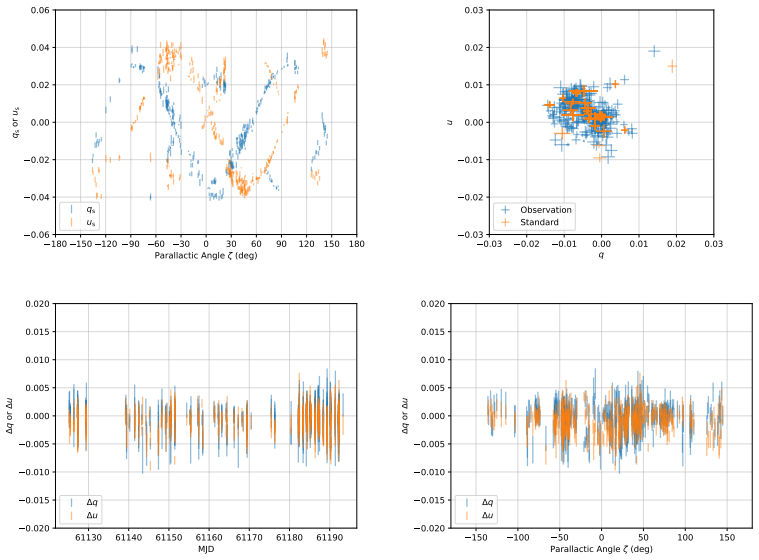
TEQUILA achieves absolute polarimetry with RMS uncertainties of 0.15 percent in pupil-tracking observations and 0.20 percent in field-tracking observations for point sources, with the pupil-tracking result fully explained by measurement and standard-star uncertainties and no additional calibration term required.
Load-bearing premise
The on-chip wire-grid micro-polarizer array and associated data reduction produce Stokes parameters whose only significant uncertainties are the reported measurement noise plus the 0.10 percent additional term for field-tracking; no unmodeled systematics from the observed flat-field polarimetric structure remain.
Editorial extensions
If this is right
- Pupil-tracking observations require no extra calibration term beyond measurement noise and standard-star values.
- Field-tracking observations need an added 0.10 percent uncertainty term to match observed scatter.
- The design supports seeing-limited imaging in a fixed band for transient sources on an alt-az telescope.
- Sensor characterization shows a polarimetric flat-field structure that must be handled in data reduction.
Reading between the lines
- The reported performance applies only to point sources; resolved-source polarimetry calibration is still pending.
- The mechanism-free approach may reduce operational complexity for rapid-response observations compared with instruments that require rotating components.
- Low quantum efficiency around 17 percent sets a practical brightness limit for useful observations despite the polarimetric precision.
Editorial analysis
A structured set of objections, weighed in public.
Referee Report
Summary. The manuscript presents TEQUILA, a mechanism-free imaging polarimeter for the 1.3-m COLIBRI telescope that employs a CMOS sensor with an on-chip wire-grid micro-polarizer array to obtain simultaneous single-exposure measurements of Stokes I, Q, and U. The paper covers the scientific motivation, instrument design and implementation using commercial components, calibration procedures, sensor characterization (including revelation of polarimetric structure in the flat field and an estimated QE of ~17%), and initial on-sky results. It reports absolute polarimetry performance for point sources of 0.15% RMS in pupil-tracking mode and 0.20% RMS in field-tracking mode, with the pupil-tracking RMS fully accounted for by measurement and standard-star uncertainties and an additional ~0.10% calibration term required for field-tracking; calibration for resolved sources is stated to remain in progress.
Significance. If the reported performance holds, the instrument provides a low-complexity, mechanism-free option for rapid polarimetric follow-up of transients such as GRB afterglows using only commercial parts, which is a practical contribution to astro-ph.IM. Strengths include the direct reporting of concrete numbers from both lab characterization and on-sky tests, plus the empirical observation that pupil-tracking RMS matches expected uncertainties with no evidence for extra terms.
major comments (1)
- [Abstract] Abstract: the central performance claims of 0.15% RMS (pupil-tracking) and 0.20% RMS (field-tracking) for point-source absolute polarimetry rest on the assumption that the reported polarimetric flat-field structure has been removed by the data-reduction pipeline to a level below the quoted uncertainties (plus the 0.10% field-tracking term); without explicit description of the correction method, residual maps after flat-fielding, or tests isolating any position- or wavelength-dependent residuals in the extracted Stokes parameters for point sources, it is not possible to confirm that unmodeled systematics do not contribute.
minor comments (2)
- The quantum-efficiency estimate of approximately 17% (including micro-polarizer losses) is stated without the supporting calculation or measurement details that would allow independent verification.
- The manuscript refers to 'initial science results' but the provided abstract does not include any example light curves or polarimetric time series from transients; if such data exist in the full text they should be cross-referenced to the performance claims.
Simulated Author's Rebuttal
We thank the referee for their careful and constructive review of our manuscript on TEQUILA. We address the single major comment below and agree that additional details are needed to fully support the performance claims.
read point-by-point responses
-
Referee: [Abstract] Abstract: the central performance claims of 0.15% RMS (pupil-tracking) and 0.20% RMS (field-tracking) for point-source absolute polarimetry rest on the assumption that the reported polarimetric flat-field structure has been removed by the data-reduction pipeline to a level below the quoted uncertainties (plus the 0.10% field-tracking term); without explicit description of the correction method, residual maps after flat-fielding, or tests isolating any position- or wavelength-dependent residuals in the extracted Stokes parameters for point sources, it is not possible to confirm that unmodeled systematics do not contribute.
Authors: We agree with the referee that the abstract and main text would be strengthened by an explicit description of how the polarimetric flat-field structure is corrected in the data-reduction pipeline, along with supporting residual maps and tests for residuals in the extracted Stokes parameters. The current manuscript reports the existence of this structure from sensor characterization but does not provide the level of detail requested. In the revised version we will: (1) add a concise statement in the abstract noting that a polarimetric flat-field correction is applied in the pipeline; (2) expand the data-reduction section with the precise correction method; (3) include residual maps after flat-fielding; and (4) present tests isolating any position- or wavelength-dependent residuals in point-source Stokes parameters. These additions will directly demonstrate that unmodeled systematics remain below the quoted uncertainties. revision: yes
Circularity Check
No significant circularity; empirical instrument report
full rationale
The paper is an instrument description, calibration report, and measurement summary with no mathematical derivations, model predictions, or fitted parameters presented as outputs. All quoted performance numbers (0.15% RMS pupil-tracking, 0.20% RMS field-tracking) are stated as direct results of on-sky observations and standard-star characterization rather than quantities obtained by solving equations whose inputs already embed the target result. No self-citation chains, ansatzes, or uniqueness theorems are invoked to justify the central claims. The derivation chain is therefore self-contained against external benchmarks.
Assumptions & free parameters
free parameters (1)
- additional calibration uncertainty for field-tracking =
0.10%
assumptions (1)
- domain assumption The on-chip wire-grid micro-polarizer array enables accurate single-exposure extraction of Stokes I, Q, and U parameters
Cite this review
Pith. "Pith review of TEQUILA: Mechanism-free polarimetry for astronomy." pith.science (2026). https://pith.science/paper/AKL35VHD
@misc{pith2026260701325,
  author       = {Pith},
  title        = {Pith review of: TEQUILA: Mechanism-free polarimetry for astronomy},
  year         = {2026},
  howpublished = {\url{https://pith.science/paper/AKL35VHD}},
  note         = {Machine review of arXiv:2607.01325}
}
abstract
TEQUILA (Transient Event $Q$, $U$, and $I$ Light Analyzer) is an optical imaging polarimeter developed for the second Nasmyth port of the 1.3-m COLIBR\'I altitude-azimuth telescope at Observatorio Astron\'omico Nacional in San Pedro M\'artir, M\'exico (OAN-SPM). TEQUILA uses a CMOS sensor with an on-chip wire-grid micro-polarizer array to obtain simultaneous, single-exposure measurements of the Stokes parameters $I$, $Q$, and $U$ without moving optical components. This mechanism-free instrument, built entirely from commercial components, delivers seeing-limited imaging in a fixed optical band and is optimized for early-time follow-up of transient sources, including gamma-ray burst afterglows, blazars, and variable young stellar objects. In this paper, we describe the scientific motivation, the instrument design and implementation, the calibration, and initial science results. Sensor characterization reveals a polarimetric structure in the flat field and a low quantum efficiency, which we estimate to be approximately 17%, including losses introduced by the micro-polarizer array. For point sources, TEQUILA achieves absolute polarimetry with RMS uncertainties of 0.15% in pupil-tracking observations and 0.20% in field-tracking observations. In pupil-tracking mode, the observed RMS is fully explained by the measurement and standard-star uncertainties, with no evidence for an additional calibration term. In contrast, field-tracking observations require an additional calibration uncertainty of approximately 0.10%. Calibration for resolved-source polarimetry remains in progress.
Figures


Figures from the paper (15 more)






Reference graph
Works this paper leans on
-
[1]
Arago, F., [Astronomie populaire], vol. 2, Gide et J. Baudry, Paris (1858). Livre XVII: “Les com` etes”
-
[2]
Th´ eorie de la double r´ efraction de la lumi` ere dans les substances cristallis´ ees,
´Etienne Louis Malus, “Th´ eorie de la double r´ efraction de la lumi` ere dans les substances cristallis´ ees,” M´ emoires de l’Institut Imp´ erial de France2, 143–158 (1810)
-
[3]
Appenzeller, I. e. a., “FORS2 at the VLT,” in [The Messenger], (1998)
work page 1998
-
[4]
HOWPol: Hiroshima optical and near-infrared camera,
Kawabata, K. S. e. a., “HOWPol: Hiroshima optical and near-infrared camera,” in [SPIE],7014(2008)
work page 2008
-
[5]
Ramaprakash, A. N. e. a., “The RoboPol instrument,”MNRAS485, 2355–2366 (2019)
work page 2019
-
[6]
YFPOL: A linear polarimeter of Lijiang 2.4 m telescope,
Xu, D. e. a., “YFPOL: A linear polarimeter of Lijiang 2.4 m telescope,”RAA22(2022)
work page 2022
-
[7]
RINGO3: A multi-colour fast response polarimeter,
Arnold, D. M. e. a., “RINGO3: A multi-colour fast response polarimeter,” in [SPIE],8446(2012)
work page 2012
-
[8]
MOPTOP: a new polarimeter for the Liverpool Telescope,
Jermak, H. e. a., “MOPTOP: a new polarimeter for the Liverpool Telescope,”MNRAS473, 1269–1284 (2018)
work page 2018
Show all 35 references
-
[9]
DIPOL-1: A double-image high-precision polarimeter,
Piirola, V. e. a., “DIPOL-1: A double-image high-precision polarimeter,”AJ167, 137 (2024)
2024
-
[10]
COLIBRI, a wide-field 1.3 m robotic telescope dedicated to the transient sky,
Basa, S., Lee, W. H., Dolon, F., Watson, A. M., Floriot, J., Atteia, J. L., et al., “COLIBRI, a wide-field 1.3 m robotic telescope dedicated to the transient sky,” in [Ground-Based and Airborne Telescopes IX], Marshall, H. K., Spyromilio, J., and Usuda, T., eds.,Proceedings of...
2022
-
[11]
COLIBRI (SVOM/FM-GFT): Instrumentation and Performances on the SVOM Alerts,
Basa, S., Lee, W. H., Watson, A. M., Dolon, F., Floriot, J., Atteia, J.-L., Dornic, D., Lugo-Ibarra, E. E., Figueroa, L., Langarica, R., Valentin, H., Ageron, M., Agneray, F., Alvarez Nunez, L. C., Angulo-Valdez, C., Antier, S., Auphan, T., Baumann, M., Bautista, L., Becerra, ...
2026 arXiv
-
[12]
The DDRAGO wide-field imager for the COLIBR ´I telescope,
Langarica, R., Watson, A. M., ´Alvarez N´ u˜ nez, L. C., Angeles, F., Atteia, J.-L., Basa, S., Cuevas, S., Dolon, F., Farah, A., Dornic, D., Floriot, J., Fuentes-Fern´ andez, J., Langlois, A., Lee, W. H., Lombardo, S., Pereyra, M., Ru´ ız D´ ıaz-Soto, J., Ronayette, S., Tinoco...
2024
-
[13]
Four-directional pixel-wise polarization CMOS image sensor using air-gap wire grid on 2.5-µm back-illuminated pixels,
Yamazaki, T., Maruyama, Y., Uesaka, Y., et al., “Four-directional pixel-wise polarization CMOS image sensor using air-gap wire grid on 2.5-µm back-illuminated pixels,” in [2016 IEEE International Electron Devices Meeting (IEDM)], 8.7.1–8.7.4, IEEE (2016)
2016
-
[14]
Micropolarizer array for infrared imaging polarimetry,
Nordin, G. P., Meier, J. T., Deguzman, P. C., and Jones, M. W., “Micropolarizer array for infrared imaging polarimetry,”Journal of the Optical Society of America A16(5), 1168–1174 (1999)
1999
-
[15]
QHY1253P data sheet,
QHYCCD, “QHY1253P data sheet,” (2025)
2025
-
[16]
Automation of the OAN/SPM 1.5-meter Johnson telescope for operations with RATIR,
Watson, A. M., Richer, M. G., Bloom, J. S., Butler, N. R., Cese˜ na, U., Clark, D., Colorado, E., C´ ordova, A., Farah, A., Fox-Machado, L., Fox, O. D., Garc´ ıa, B., Georgiev, L. N., Gonz´ alez, J. J., Guisa, G., Guti´ errez, L., Herrera, J., Klein, C. R., Kutyrev, A. S., Laz...
2012
-
[17]
Optical Design of COLIBR ´I: A Fast Follow-up Telescope for Transient Events,
Fuentes-Fern´ andez, J., Watson, A. M., Cuevas, S., Basa, S., Floriot, J., Dolon, F., Valentin, H., Challita, Z., and Vola, P., “Optical Design of COLIBR ´I: A Fast Follow-up Telescope for Transient Events,”Journal of Astronomical Instrumentation9, 2050001–280 (Jan. 2020)
2020
-
[18]
Sony polarization image sensor: IMX250MZR/MYR, IMX264MZR/MYR, IMX253MZR/MYR,
Sony Semiconductor Solutions, “Sony polarization image sensor: IMX250MZR/MYR, IMX264MZR/MYR, IMX253MZR/MYR,” (2021)
2021
-
[19]
Thirteen Years of Weather Statistics at San Pedro Martir Observatory,
Plauchu-Frayn, I., Colorado, E., Richer, M. G., and Herrera-V´ azquez, C., “Thirteen Years of Weather Statistics at San Pedro Martir Observatory,”Revista Mexicana de Astronom´ ıa y Astrof´ ısica56, 295–319 (Oct. 2020)
2020
-
[20]
Calibration method for division of focal plane polarimeters in the optical and near- infrared regime,
York, T. and Gruev, V., “Calibration method for division of focal plane polarimeters in the optical and near- infrared regime,” in [Infrared Technology and Applications XXXVII], Andresen, B. F., Fulop, G. F., and Norton, P. R., eds.,Society of Photo-Optical Instrumentation Eng...
2011
-
[21]
Characterization of a visible spectrum division-of-focal-plane polarimeter,
York, T. and Gruev, V., “Characterization of a visible spectrum division-of-focal-plane polarimeter,”Applied Optics51, 5392 (Aug. 2012)
2012
-
[22]
Calibration methods for division-of-focal-plane polarimeters,
Powell, S. B. and Gruev, V., “Calibration methods for division-of-focal-plane polarimeters,”Optics Ex- press21, 21039 (Sept. 2013)
2013
-
[23]
Calibration method for division of focal plane polarimeters,
Fei, H., Li, F.-M., Chen, W.-C., Zhang, R., and Chen, C.-S., “Calibration method for division of focal plane polarimeters,”Applied Optics57, 4992 (June 2018)
2018
-
[24]
Polarization properties at the Nasmyth focus of the alt-azimuth TNG telescope,
Giro, E., Bonoli, C., Leone, F., Molinari, E., Pernechele, C., and Zacchei, A., “Polarization properties at the Nasmyth focus of the alt-azimuth TNG telescope,” in [Polarimetry in Astronomy], Fineschi, S., ed., Society of Photo-Optical Instrumentation Engineers (SPIE) Conferen...
2003
-
[25]
Calibration of EFOSC2 Broadband Linear Imaging Polarimetry,
Wiersema, K., Higgins, A. B., Covino, S., and Starling, R. L. C., “Calibration of EFOSC2 Broadband Linear Imaging Polarimetry,”Publications of the Astronomical Society of Australia35, e012 (Mar. 2018)
2018
-
[26]
SPLOT: a snapshot survey for polarized light in optical transients,
Higgins, A. B., Wiersema, K., Covino, S., Starling, R. L. C., Stevance, H. F., Wyrzykowski, L., Hodgkin, S. T., Maund, J. R., O’Brien, P. T., and Tanvir, N. R., “SPLOT: a snapshot survey for polarized light in optical transients,”Monthly Notices of the Royal Astronomical Socie...
2019
-
[27]
The RoboPol sample of optical polarimetric standards,
Blinov, D., Maharana, S., Bouzelou, F., Casadio, C., Gjerløw, E., Jormanainen, J., Kiehlmann, S., Kyprio- takis, J. A., Liodakis, I., Mandarakas, N., Markopoulioti, L., Panopoulou, G. V., Pelgrims, V., Pouliasi, A., Romanopoulos, S., Skalidis, R., Anche, R. M., Angelakis, E., ...
2023
-
[28]
Photutils,
Bradley, L., Sip˝ ocz, B. M., Robitaille, T. P., Tollerud, E. J., Vin´ ıcius, Z., Deil, C., Barbary, K., Wilson, T. J., Busko, I., Donath, A., G¨ unther, H. M., Cara, M., Lim, P. L., Meßlinger, S., Conseil, S., Droettboom, M., Bostroem, K. A., Bray, E. M., Bratholm, L. A., Bur...
2026
-
[29]
Accurate Optical Polarimetry on the Nasmyth Platform,
Tinbergen, J., “Accurate Optical Polarimetry on the Nasmyth Platform,”Publications of the Astronomical Society of the Pacific119, 1371–1384 (Dec. 2007)
2007
-
[30]
Optical Polarimetry: Methods, Instruments and Calibration Techniques,
Berdyugin, A., Piirola, V., and Poutanen, J., “Optical Polarimetry: Methods, Instruments and Calibration Techniques,” in [Astronomical Polarisation from the Infrared to Gamma Rays], Mignani, R., Shearer, A., S lowikowska, A., and Zane, S., eds.,Astrophysics and Space Science L...
2019
-
[31]
Zernike polynomials and atmospheric turbulence.,
Noll, R. J., “Zernike polynomials and atmospheric turbulence.,”Journal of the Optical Society of America (1917-1983)66, 207–211 (Mar. 1976)
1917
-
[32]
Prospects for detecting X-ray polarization in blazar jets,
Liodakis, I., Peirson, A. L., and Romani, R. W., “Prospects for detecting X-ray polarization in blazar jets,” The Astrophysical Journal880(1), 7 (2019)
2019
-
[33]
Simultaneous X-ray and optical polarization observations of the blazar Mrk 421,
Bharathan, A. M., Stalin, C. S., Sahayanathan, S., Wani, K., Mandal, A. K., Chatterjee, R., Joshi, S., Pandey, J. C., Mathew, B., and Agrawal, V. K., “Simultaneous X-ray and optical polarization observations of the blazar Mrk 421,”arXiv preprint arXiv:2409.16745(2024)
2024
-
[34]
Sub-percent characterization and polarimetric performance analysis of commercial micro-polarizer array detectors,
Stockmans, T., Scheinowitz, N., van der Linden, E., Malysheva, I., Strelow, K., Smit, M., and Snik, F., “Sub-percent characterization and polarimetric performance analysis of commercial micro-polarizer array detectors,” in [Polarization: Measurement, Analysis, and Remote Sensi...
2024
-
[35]
STDPipe: Simple Transient Detection Pipeline
Karpov, S., “STDPipe: Simple Transient Detection Pipeline.” Astrophysics Source Code Library, record ascl:2112.006 (Dec. 2021)
2021
Reviewed July 3, 2026 · model on record in the stance chip above.
Discussion (0). Continue with ORCID to comment.