REVIEW 4 major objections 5 minor 60 references
Controlling single-photon scattering in a rectangular waveguide by a V-type three-level emitter
T0 review · 4 major / 5 minor · reviewed 2026-08-14 · deepseek-v4-flash
Pith's one-line read In a rectangular waveguide, a single photon can be perfectly reflected by a V-type three-level emitter only if the input is single-mode or a specially shaped coherent superposition, and even then only at a resonance frequency set by the…
desk verdict Multi-mode CSS condition in Eq. (22) is wrong because Eq. (19) drops the per-mode sign s_j; single-mode results are fine. read the letter →
The pith
A machine-rendered reading of the paper's core claim, the machinery that carries it, and where it could break.
The reading
What carries the argument
The central object is the complex function $f(E) = (E-\Omega_1)(E-\Omega_2) - (E-\Omega_2)h^{(1)}(E) - (E-\Omega_1)h^{(2)}(E)$, assembled from the two emitter transition frequencies $\Omega_i$ and the mode-summed self-energies $h^{(i)}(E)$. Its real part sets the Fano-resonance condition, its imaginary part is the total decay width, and the reflectivity formulas in Eqs. (19) and (23) are controlled by the ratio $\mathrm{Im}[f]/f$. The input-state factor in Eq. (19) collapses to 1 exactly for the single-mode and CSS inputs, which is why those are the only cases that can reach unit reflectivity.
What would settle it
Send single photons in the TM11 mode through a rectangular waveguide with a V-type three-level emitter, at energies between the second and third cutoff frequencies, and measure the reflected and transmitted light in each mode: the paper predicts no perfect reflection and equal reflected and transmitted probabilities in the TM31 mode; seeing perfect reflection or unequal TM31 probabilities would refute the central claim.
Extended reading notes
Core claim
For a single photon scattering off a V-type three-level emitter in a rectangular waveguide, the paper proves that complete transmission occurs exactly when the input superposition satisfies $\sum_{j=1}^{j_{\max}} c_j \omega_j = 0$ or the emitter parameters satisfy $\mathrm{Im}[f(\omega_{\mathrm{in}})] = 0$; complete reflection occurs exactly when the input is single-mode or a coherent superposition with $c_j \propto \omega_j/\sqrt{E^2-\omega_j^2}$ and simultaneously $\mathrm{Re}[f(\omega_{\mathrm{in}})] = 0$. In the multi-mode region with a single-mode input, the total reflectivity is $R = \Lambda_n(\omega_{\mathrm{in}})\Lambda(\omega_{\mathrm{in}})/|f(\omega_{\mathrm{in}})|^2$, which stays below 1 at Fano resonance, so the photon inevitably leaks into other TM modes. Thus the emitter's finite cross section changes the scattering from a one-channel problem into a multi-channel problem whose perfect-reflection solutions are restricted to specially prepared inputs.
Load-bearing premise
The derivation drops the red Lamb shift, a small frequency shift coming from virtual transitions to higher-frequency waveguide modes, when it computes the real part of the emitter self-energy; if that shift is not actually negligible, the predicted frequencies of perfect reflection would move.
Editorial extensions
If this is right
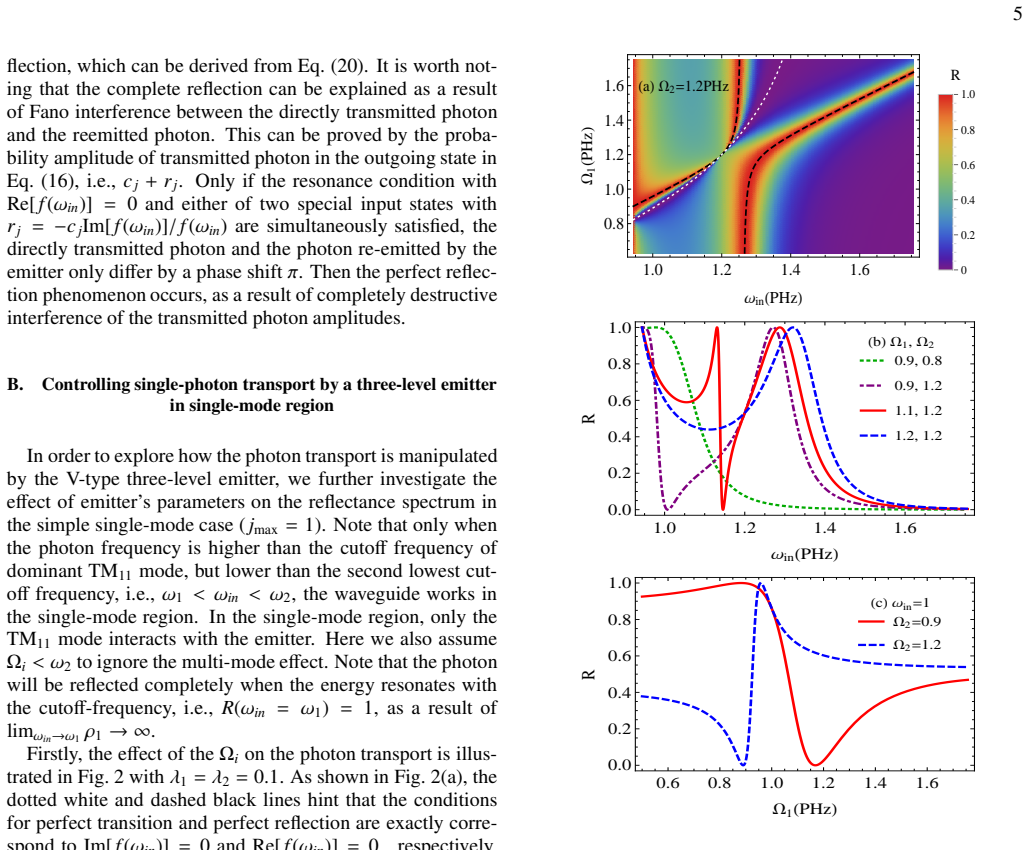
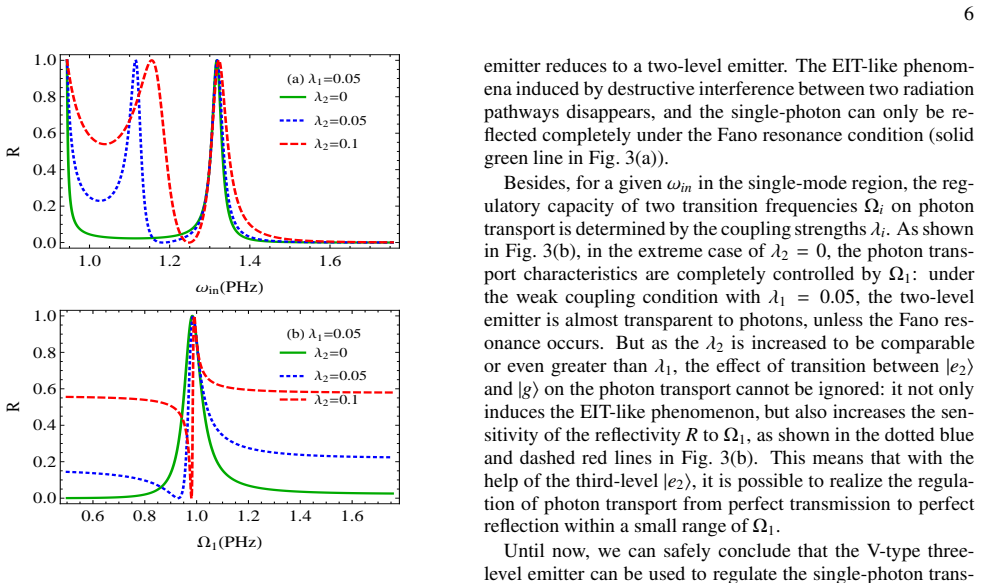
- In the single-mode frequency window, a non-degenerate V-type emitter can be tuned to give two distinct perfect-reflection peaks and one perfect-transmission dip, enabling narrow-band switching.
- In the multimode region, a single-mode input cannot be perfectly reflected even at Fano resonance, so an ideal mirror requires preparing the input as a coherent superposition state.
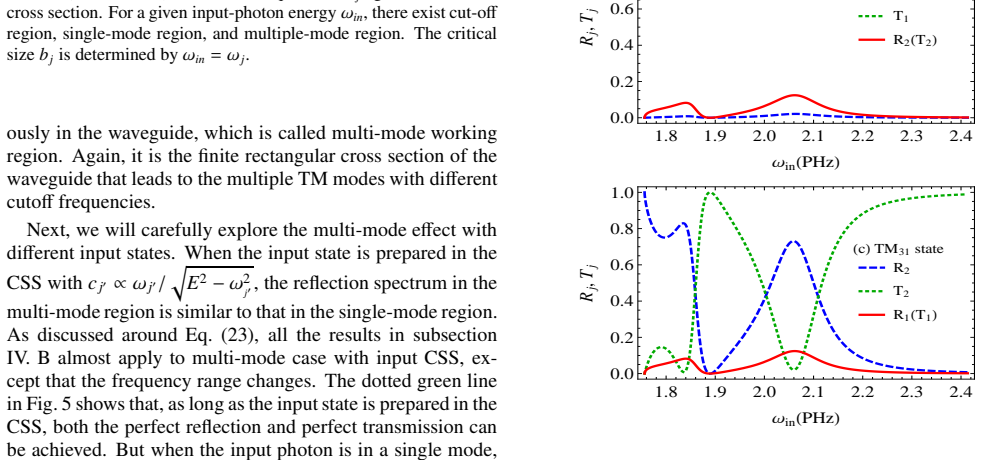
- Because an incident single-mode photon is redistributed into all energetically allowed TM modes, with equal reflected and transmitted components in each other mode, the emitter can act as a deterministic mode splitter.
- The finite cross section blueshifts the perfect-reflection resonances relative to the bare emitter frequencies, and tuning $\Omega_i$ or $\lambda_i$ moves the transmission and reflection features across the spectrum.
- At a cutoff frequency, the photon is perfectly reflected when its input mode matches the cutoff mode and perfectly transmitted when it enters a different mode.
Reading between the lines
- A direct experimental test would inject single photons into the TM$_{11}$ and TM$_{31}$ modes between the second and third cutoff frequencies and record the mode-resolved reflectance; the paper predicts no perfect reflection and $R_j = T_j$ for the other mode.
- The CSS condition $c_j \propto \omega_j/\sqrt{E^2-\omega_j^2}$ has the form of an impedance-matching condition; the same construction should generalize to multi-emitter or multi-level systems in multimode waveguides, where it would identify the input states that decouple from one decay channel.
- If the neglected red Lamb shift is included perturbatively, the resonance frequencies $\omega_{\mathrm{in}}$ solving $\mathrm{Re}[f]=0$ will shift; estimating this shift from the higher-mode contributions in Eq. (13) would quantify the approximation's effect on the predicted peak positions.
- The equality $R_j = T_j$ for $j\neq n$ suggests the emitter acts as a balanced beamsplitter between modes; measuring this ratio for different coupling strengths $\lambda_i$ would probe the multimode coupling constants directly.
Signed reviews
Editorial analysis
A structured set of objections, weighed in public.
Referee Report
Summary. The manuscript develops a Lippmann-Schwinger treatment of single-photon scattering by a V-type three-level emitter in a rectangular waveguide with finite cross section. The authors derive an effective scattering amplitude f(E), give formulas for the reflectivity and transmissivity, and state necessary and sufficient conditions for perfect transmission (via EIT and dark-state conditions) and perfect reflection (via Fano resonance with single-mode or coherent-superposition input). They further analyze the multi-mode region, finding that single-mode inputs cannot be perfectly reflected and that photons are redistributed among modes. The paper emphasizes the role of the finite cross section in producing mode-dependent coupling, nonlinear dispersion, and a cutoff-frequency effect.
Significance. The topic is timely and the question of how a finite waveguide cross section modifies waveguide-QED scattering is physically relevant. The paper is explicit in its derivation: the Hamiltonian is obtained from minimal coupling and the rotating-wave approximation, the scattering amplitudes are computed from the Lippmann-Schwinger equation, and the self-energy parts are given in closed form. The single-mode results, including the EIT-like transmission and Fano reflection peaks, are plausible and useful for potential single-photon devices. However, the central multi-mode superposition conditions are based on an algebraic sign error that changes the predicted state preparation. The framework appears correctable; with sign-corrected conditions the main qualitative conclusions may survive, but Eqs. (19), (21), (22), and Fig. 5 as printed need revision.
major comments (4)
- [Eqs. (7) and (17)-(19)] The per-mode sign s_j = sin(m_j pi/2) sin(n_j pi/2) appearing in the coupling g_j^{(i)} in Eq. (7) is lost in the derivation of Eq. (19). Substituting Eq. (7) into Eq. (17) gives, up to common factors, r_j proportional to rho_j s_j omega_j times sum_{j'} c_{j'} s_{j'} omega_{j'}, so the numerator of Eq. (19) should contain |sum_j c_j s_j omega_j|^2, not |sum_j c_j omega_j|^2. For the two-mode region with a = 1.5b, TM11 has s = +1 and TM31 has s = -1, so this is not a matter of convention; it changes the interference condition and the predicted reflectivity.
- [Eq. (22)] The perfect-reflection coherent-superposition-state condition in Eq. (22) is the Cauchy-Schwarz equality for the wrong inner product. The correct necessary and sufficient condition at Re[f(omega_in)] = 0 is c_j proportional to s_j omega_j / sqrt(E^2 - omega_j^2), not c_j proportional to omega_j / sqrt(E^2 - omega_j^2). A state prepared as printed in Eq. (22) will not reach R = 1 in the multi-mode region unless all relevant s_j happen to coincide; in the two-mode example of Fig. 5 the printed condition gives the wrong relative sign between the two modes.
- [Eq. (21)] The dark-state condition for perfect transmission is also sign-sensitive. The condition sum_j c_j omega_j = 0 should read sum_j c_j s_j omega_j = 0; otherwise the input-state superposition does not cancel the transition amplitudes sum_j c_j g_j^{(i)} in Eq. (17). The second branch Im[f(omega_in)] = 0 is unaffected, so the EIT-based transmission condition remains valid.
- [Fig. 5 and Sec. IV.C] The numerical curves for the 'CSS' input in Fig. 5 use the condition in Eq. (22) and therefore do not represent the true optimal superposition for the TM11 + TM31 two-mode case. After replacing the condition by the sign-corrected one, the dotted green curve must be recalculated. The qualitative claim that perfect reflection is achievable in the multi-mode region may survive, but the demonstrated state preparation and the associated quantitative curves are currently incorrect.
minor comments (5)
- [After Eq. (13)] The neglect of the red Lamb shift is stated but not quantitatively justified. Since Re[f(omega_in)] = 0 determines the perfect-reflection resonance frequencies, the paper should specify the parameter regime in which this neglect is safe, for example by estimating the size of the red Lamb-shift terms relative to the blue terms in the plotted examples.
- [Sec. IV.C and Fig. 5] The acronym 'SCC' appears in the text and in Fig. 5 where 'CSS' (coherent superposition state) is intended; please correct the typo.
- [Before Eq. (24)] The phrase 'insetting the input state parameter' should read 'inserting the input state parameter.'
- [Eq. (24)] The notation T_j = R_j for j not equal to n is correct for the illustrated two-mode case, but the sentence explaining it could be clearer: the equality holds for the reflected/transmitted components in other modes, not for the total probabilities.
- [Conclusion] The conclusion repeats the CSS condition c_j' proportional to omega_j' / sqrt(E^2 - omega_j'^2); this needs the same sign correction as Eq. (22).
Circularity Check
No circularity: the transmission and reflection conditions are derived from the stated model Hamiltonian via Lippmann-Schwinger scattering theory, not assumed or fitted.
full rationale
The paper's central claims, including the perfect-transmission conditions in Eq. (21), the perfect-reflection conditions in Eq. (22), and the multi-mode reflectivity formula in Eq. (26), are obtained by direct analytic derivation from the model Hamiltonian in Eqs. (1)-(7) through the Lippmann-Schwinger equation. The coupling strengths lambda_i and transition frequencies Omega_i are input parameters of the model, not quantities inferred from the scattering output. The coherence-superposition-state condition c_j proportional to omega_j/sqrt(E^2 - omega_j^2) is presented as a derived consequence of the Cauchy-Buniakowsky-Schwarz inequality applied to Eq. (19), not imported as an unexamined assumption. The self-citations to Refs. [50] and [51] provide background concepts (finite-cross-section multimode effects and the name 'coherent superposition state'), but they are not load-bearing: the mathematical conditions are re-derived within this paper from its own equations. The stated neglect of the red Lamb shift after Eq. (13) is a physical approximation that affects numerical resonance positions, not a circularity, because it is explicitly declared and does not reintroduce the target results as inputs. The skeptical concern about a sign factor s_j = sin(m_j*pi/2)sin(n_j*pi/2) between Eqs. (7) and (19) is an internal algebraic-consistency question, not a circularity, since even if valid it would show an error in the derived formula rather than a derivation that presupposes its conclusion. No fitted quantity is relabeled as a prediction, no uniqueness claim is justified solely by the authors' prior work, and no ansatz is smuggled in through citation. The derivation is self-contained and the central results are not equivalent to their inputs by construction.
Assumptions & free parameters
assumptions (5)
- standard math Lippmann-Schwinger equation (Eq. 9) is valid for the single-excitation scattering state.
- domain assumption Rotating-wave approximation and dipolar/long-wavelength approximations for the emitter-waveguide coupling.
- domain assumption The emitter's electric dipole is oriented along z and the emitter sits at the center of the cross section, so only TM modes couple.
- ad hoc to paper The red Lamb shift is negligible.
- standard math The single-excitation subspace is closed under scattering.
Cite this review
Pith. "Pith review of Controlling single-photon scattering in a rectangular waveguide by a V-type three-level emitter." pith.science (2026). https://pith.science/paper/AKQUPALL
@misc{pith2026190805903,
  author       = {Pith},
  title        = {Pith review of: Controlling single-photon scattering in a rectangular waveguide by a V-type three-level emitter},
  year         = {2026},
  howpublished = {\url{https://pith.science/paper/AKQUPALL}},
  note         = {Machine review of arXiv:1908.05903}
}
read the original abstract
The single-photon scattering in a rectangular waveguide by a V-type three-level emitter is studied for large range of input-photon energy beyond the single-mode region. By using Lippmann-Schwinger formalism, the necessary and sufficient conditions of complete transmission and complete reflection are derived analytically. In the single-mode region, the complete transmission caused by electromagnetically induced transparency (EIT) and the complete reflection due to Fano resonance can both be achieved by adjusting the emitter's parameters. But in the multi-mode region, except that the input-state is prepared in a coherent superposition state, the perfect reflection is absent, and the photon inevitably enters other propagation modes due to the indirectly interaction between waveguide modes mediated by the emitter. Other remarkable features in the photon transport induced by the finite cross section includes the blueshift of the reflection resonance and the cutoff-frequency effect.
Figures

Figures from the paper (2 more)

Reference graph
Works this paper leans on
-
[1]
It forecasts that the energy of perfect reflected pho- ton resonates with the re-normalized transition frequency be- tween |ei⟩and |g⟩. The frequency shift of the resonant fre- quency with respect to the bare frequency Ωi is determined by ∆(i)(ωin), which stems from the finite cross section and the nonlinear dispersion relation of the rectangular waveg - ui...
-
[2]
H. J. Kimble, The quantum internet, Nature(London) 453, 1023 (2008)
work page 2008
-
[3]
I.-C. Hoi, C. M. Wilson, G. Johansson, T. Palomaki, B. Per - opadre, and P . Delsing, Demonstration of a single-photon router in the microwave regime, Phys. Rev. Lett. 107, 073601 (2011)
work page 2011
-
[4]
L. Zhou, L.-P . Yang, Y . Li, and C.P . Sun, Quantum Routing o f Single Photons with a Cyclic Three-Level System, Phys. Rev. Lett. 111, 103604 (2013)
work page 2013
-
[5]
T. G. Tiecke, J. D. Thompson, N. P . de Leon, L. R. Liu, V . Vuleti´ c, and M. D. Lukin, Nanophotonic quantum phase switch with a single atom, Nature (London) 508, 241 (2014)
work page 2014
-
[6]
I. Shomroni, S. Rosenblum, Y . Lovsky, O. Bechler, G. Guen - delman, and B. Dayan, All-optical routing of single photons by a one-atom switch controlled by a single photon, Science 345, 903 (2014)
work page 2014
-
[7]
L. Garc ´ia- ´Alvarez, J. Casanova, A. Mezzacapo, I. L. Egusquiza, L. Lamata, G. Romero, and E. Solano, Fermion-fermion scat- tering in quantum field theory with superconducting circuit s, Phys. Rev. Lett. 114, 070502 (2015)
work page 2015
-
[8]
J. Claudon, J. Bleuse, N. S. Malik, M. Bazin, P . Ja ffrennou, N. Gregersen, C. Sauvan, P . Lalanne, and J.-M. G´ erard, A highly efficient single-photon source based on a quantum dot in a pho- 9 tonic nanowire, Nat. Photonics 4, 174 (2010)
work page 2010
Show all 60 references
-
[9]
Munsch, J
M. Munsch, J. Claudon, J. Bleuse, N. S. Malik, E. Dupuy, and J.-M. G´ erard, Linearly polarized, single-mode spontaneous emission in a photonic nanowire, Phys. Rev. Lett. 108, 077405 (2012)
2012
-
[10]
Huck and U
A. Huck and U. L. Andersen, Coupling single emitters to qu an- tum plasmonic circuits, Nanophotonics 5, 483 (2016)
2016
-
[11]
A. V . Akimov, A. Mukherjee, C. L. Y u, D. E. Chang, A. S. Zi- brov, P . R. Hemmer, H. Park, and M. D. Lukin, Generation of single optical plasmons in metallic nanowires coupled to qu an- tum dots, Nature(London) 450, 402 (2007)
2007
-
[12]
G. M. Akselrod, C. Argyropoulos, T. B. Hoang, C. Cirac `i, C. Fang, J. Huang, R. S. David, and M. H. Mikkelsen, Prob- ing the mechanisms of large Purcell enhancement in plasmoni c nanoantennas, Nat. Photonics 8, 835 (2014)
2014
-
[13]
M. A. V ersteegh, M. E. Reimer, K. D. J ¨0ns, D. Dalacu, P . J. Poole, A. Gulinatti, A. Giudice, and V . Zwiller, Observatio n of strongly entangled photon pairs from a nanowire quantum dot , Nat. commun. 5, 5298 (2014)
2014
-
[14]
Bajcsy, S
M. Bajcsy, S. Ho fferberth, V . Balic, T. Peyronel, M. Hafezi, A. S. Zibrov, V . Vuletic, and M. D. Lukin, E fficient all-optical switching using slow light within a Hollow fiber, Phys. Rev. Lett. 102, 203902 (2009)
2009
-
[15]
T. M. Babinec, B. J. Hausmann, M. Khan, Y . Zhang, J. R. Maze, P . R. Hemmer, and M. Lonˇ car, A diamond nanowire single- photon source, Nat. nanotechnology 5, 195 (2010)
2010
-
[16]
Astafiev, A
O. Astafiev, A. M. Zagoskin, A. A. Abdumalikov, Y . A. Pashkin, T. Yamamoto, K. Inomata, Y . Nakamura, and J. S. Tsai, Resonance fluorescence of a single artificial atom, Sci - ence 327, 840 (2010)
2010
-
[17]
A. F. V an Loo, A. Fedorov, K. Lalumi` ere, B. C. Sanders, A . Blais, and A. Wallra ff, Photon-mediated interactions between distant artificial atoms, Science 342, 1494 (2013)
2013
-
[18]
I.-C. Hoi, A. F. Kockum, T. Palomaki, T. M. Stace, B. Fan, L. Tornberg, S. R. Sathyamoorthy, G. Johansson, P . Delsing, and C. M. Wilson, Giant cross-Kerr e ffect for propagating mi- crowaves induced by an artificial atom, Phys. Rev. Lett. 111, 053601 (2013)
2013
-
[19]
I. C. Hoi, T. Palomaki, J. Lindkvist, G. Johansson, P . De lsing, and C. M. Wilson, Generation of nonclassical microwave stat es using an artificial atom in 1D open space, Phys. Rev. Lett. 108, 263601 (2012)
2012
-
[20]
I. C. Hoi, C. M. Wilson, G. Johansson, J. Lindkvist, B. Pe r- opadre, T. Palomaki, and P . Delsing, Microwave quantum op- tics with an artificial atom in one-dimensional open space, N ew. J. Phys. 15, 025011 (2013)
2013
-
[21]
O. V . Astafiev, A. A. Abdumalikov Jr., A. M. Zagoskin, Y u. A. Pashkin, Y . Nakamura, and J. S. Tsai, Ultimate on-chip quan- tum amplifier, Phys. Rev. Lett. 104, 183603 (2010)
2010
-
[22]
A. A. Abdumalikov Jr., O. Astafiev, A. M. Zagoskin, Y u. A. Pashkin, Y . Nakamura, and J. S. Tsai, Electromagnetically i n- duced transparency on a single artificial atom, Phys. Rev. Le tt. 104, 193601 (2010)
2010
-
[23]
Arcari, I
M. Arcari, I. S¨ ollner, A. Javadi, S. Lindskov Hansen, S . Mah- moodian, J. Liu, H. Thyrrestrup, E. H. Lee, J. D. Song, S. Sto- bbe, and P . Lodahl, Near-unity coupling efficiency of a quantum emitter to a photonic crystal waveguide, Phys. Rev. Lett. 113, 093603 (2014)
2014
-
[24]
Lund-Hansen, S
T. Lund-Hansen, S. Stobbe, B. Julsgaard, H. Thyrrestru p, T. S ¨unner, M. Kamp, A. Forchel, and P . Lodahl, Experimental Realization of Highly E fficient Broadband Coupling of Single Quantum Dots to a Photonic Crystal Waveguide, Phys. Rev. Lett. 101, 113903 (2008)
2008
-
[25]
Laucht, S
A. Laucht, S. P¨ utz, T. G¨ unthner, N. Hauke, R. Saive, S. Fr´ ed´ erick, M. Bichler, M.-C. Amann, A. W. Holleitner, M. Kaniber, and J. J. Finley, A waveguide-coupled on-chip sing le- photon source, Phys. Rev. X 2, 011014 (2012)
2012
-
[26]
Goban, C.-L
A. Goban, C.-L. Hung, S.-P . Y u, J. D. Hood, J. A. Muniz, J. H. Lee, M. J. Martin, A. C. McClung, K. S. Choi, D. E. Chang, O. Painter, and H. J. Kimble, AtomClight interactions in photo nic crystals, Nature Commun. 5, 3808 (2014)
2014
-
[27]
L. Zhou, Z. R. Gong, Y .-X. Liu, C.P . Sun, and F. Nori, Control- lable Scattering of a Single Photon inside a One-Dimensiona l ResonatorWaveguide, Phys. Rev. Lett. 101, 100501 (2008)
2008
-
[28]
D. E. Chang, A. S. Sørensen, E. A. Demler, and M. D. Lukin, A single-photon transistor using nanoscale surface plasmons, Nat. Phys. 3, 807 (2007)
2007
-
[29]
Z. H. Wang, L. Zhou, Y . Li, and C.P . Sun, Controllable sin gle- photon frequency converter via a one-dimensional waveguid e, Phys. Rev. A 89, 053813 (2014)
2014
-
[30]
D. Roy, C. M. Wilson, and O. Firstenberg, Colloquium: Strongly interacting photons in one-dimensional continuu m, Rev. Mod. Phys. 89, 021001(2017)
2017
-
[31]
Z. Liao, X. Zeng, H. Nha, and M. S. Zubairy, Photon trans- port in a one-dimensional nanophotonic waveguide QED sys- tem, Phys. Scripta 91, 063004 (2016)
2016
-
[32]
Shen and S
J.-T. Shen and S. Fan, Coherent photon transport from sp onta- neous emission in one-dimensional waveguides, Opt. Lett. 30, 2001 (2005)
2005
-
[33]
Shen and S
J.-T. Shen and S. Fan, Coherent single photon transport in a one-dimensional waveguide coupled with superconducting quantum bits, Phys. Rev. Lett. 95, 213001 (2005)
2005
-
[34]
J. R. Taylor, Scattering Theory: The Quantum Theory on Non- relativistic Collisions (Wiley, New Y ork, 1972)
1972
-
[35]
M. P . Schneider, T. Sproll, C. Stawiarski, P . Schmitteckert, and K. Busch, Greens-function formalism for waveguide QED ap- plications, Phys. Rev. A 93, 013828 (2016)
2016
-
[36]
Roy, Correlated few-photon transport in one-dimens ional waveguides: linear and nonlinear dispersions, Phys
D. Roy, Correlated few-photon transport in one-dimens ional waveguides: linear and nonlinear dispersions, Phys. Rev. A 83, 043823 (2011)
2011
-
[37]
Qiao, Single-photon transport through a waveguide c oupling to a quadratic optomechanical system, Phys
L. Qiao, Single-photon transport through a waveguide c oupling to a quadratic optomechanical system, Phys. Rev. A 96, 013860 (2017)
2017
-
[38]
S. Fan, S. E. Kocabas, and J.-T. Shen, Input-output form al- ism for few-photon transport in one-dimensional nanophoto nic waveguides coupled to a qubit, Phys. Rev. A82, 063821 (2010)
2010
-
[39]
Lalumi` ere, B
K. Lalumi` ere, B. C. Sanders, A. F. van Loo, A. Fedorov, A . Wallraff, and A. Blais, Input-output theory for waveguide QED with an ensemble of inhomogeneous atoms, Phys. Rev. A 88, 043806 (2013)
2013
-
[40]
Xu and S
S. Xu and S. Fan, Input-output formalism for few-photon trans- port: A systematic treatment beyond two photons, Phys. Rev. A 91, 043845 (2015)
2015
-
[41]
Shi and C
T. Shi and C. P . Sun, Lehmann-Symanzik-Zimmermann redu c- tion approach to multiphoton scattering in coupled-resonator ar- rays, Phys. Rev. B 79, 205111 (2009)
2009
-
[42]
Rephaeli, J.-T
E. Rephaeli, J.-T. Shen, and S. Fan, Full inversion of a t wo- level atom with a single-photon pulse in one-dimensional ge - ometries, Phys. Rev. A 82, 033804 (2010)
2010
-
[43]
T. Shi, D. E. Chang, and J. I. Cirac, Multiphoton-scatte ring the- ory and generalized master equations Tao, Phys. Rev. A 92, 053834 (2015)
2015
-
[44]
Z. Liao, H. Nha, and M. S. Zubairy, Dynamical theory of si ngle- photon transport in a one-dimensional waveguide coupled to identical and nonidentical emitters, Phys. Rev. A 94, 053842 (2016)
2016
-
[45]
Y . S. Greenberg, and A. A. Shtygashev, Non-Hermitian Ha mil- tonian approach to the microwave transmission through a one - 10 dimensional qubit chain, Phys. Rev. A 92, 063835 (2015)
2015
-
[46]
J. T. Shen and S. Fan, Theory of single-photon transport in a single-mode waveguide. I. Coupling to a cavity containing a two-level atom, Phys. Rev. A 79, 023837 (2009)
2009
-
[47]
Zheng, D
H. Zheng, D. J. Gauthier, and H. U. Baranger, Waveguide QED: Many-body bound-state e ffects in coherent and Fock- state scattering from a two-level system, Phys. Rev. A 82, 063816 (2010)
2010
-
[48]
Lombardo, F
F. Lombardo, F. Ciccarello, and G. M. Palma, Photon loca liza- tion versus population trapping in a coupled-cavity array, Phys. Rev. A 89, 053826 (2014)
2014
-
[49]
J. Y ou, Z. Liao, S. W. Li,and M. S. Zubairy, Waveguide qua n- tum electrodynamics in squeezed vacuum, Phys. Rev. A 97, 023810 (2018)
2018
-
[50]
Alexanian, Scattering of two coherent photons insid e a one- dimensional coupled-resonator waveguide, Phys
M. Alexanian, Scattering of two coherent photons insid e a one- dimensional coupled-resonator waveguide, Phys. Rev. A 81, 015805 (2010)
2010
-
[51]
J. F. Huang, T. Shi, C. P . Sun, and F. Nori, Controlling si ngle- photon transport in waveguides with finite cross section, Ph ys. Rev. A 88, 013836 (2013)
2013
-
[52]
Q. Li, L. Zhou, and C. P . Sun, Waveguide quantum electrod y- namics: controllable channel from quantum interference, P hys. Rev. A 89, 063810 (2014)
2014
-
[53]
H. X. Song, X. Q. Sun, J. Lu, and L. Zhou, Spatial depen- dent spontaneous emission of an atom in a semi-infinite waveg - uide of rectangular cross section, Commun. Theor. Phys. 69, 59 (2018)
2018
-
[54]
S´ anchez-Burillo, L
E. S´ anchez-Burillo, L. Martłn-Moreno, D. Zueco, and J . J. Garc´ia-Ripoll, One-and two-photon scattering from generalized V-type atoms, Phys. Rev. A 94, 053857 (2016)
2016
-
[55]
Witthaut and A
D. Witthaut and A. S. Sørensen, Photon scattering by a th ree- level emitter in a one-dimensional waveguide, New J. Phys. 12, 043052 (2010)
2010
-
[56]
S. Das, V . E. Elfving, F. Reiter, and A. S. Sørensen, Phot on scattering from a system of multilevel quantum emitters. I. For- malism, Phys. Rev. A 97, 043837 (2018)
2018
-
[57]
S. Das, V . E. Elfving, F. Reiter, and A. S. Sørensen, Phot on scattering from a system of multilevel quantum emitters. II. Ap- plication to emitters coupled to a one-dimensional wavegui de, Phys. Rev. A 97, 043838 (2018)
2018
-
[58]
L. Zhou, J. Lu, and C. P . Sun, Coherent control of photon t rans- mission: Slowing light in a coupled resonator waveguide dop ed with atoms, Phys. Rev. A 76, 012313 (2007)
2007
-
[59]
T. Y . Li, J. F. Huang, and C. K. Law, Scattering of two dis- tinguishable photons by a -type three-level atom in a one- dimensional waveguide, Phys. Rev. A 91, 043834 (2015)
2015
-
[60]
Z. R. Gong, H. Ian, L. Zhou, and C. P . Sun, Controlling quasibound states in a one-dimensional continuum through a n electromagnetically-induced-transparency mechanism, P hys. Rev. A 78, 053806 (2008)
2008
Reviewed August 14, 2026 · model on record in the stance chip above.
Discussion (0). Continue with ORCID to comment.