Density Wave Ordering with Disordered Ultracold Fermions in Optical Cavities
Pith reviewed 2026-07-01 01:49 UTC · model grok-4.3
The pith
Disorder in atom-light coupling renormalizes and lowers the superradiant threshold for density-wave order in cavity-coupled fermions.
A machine-rendered reading of the paper's core claim, the machinery that carries it, and where it could break.
Core claim
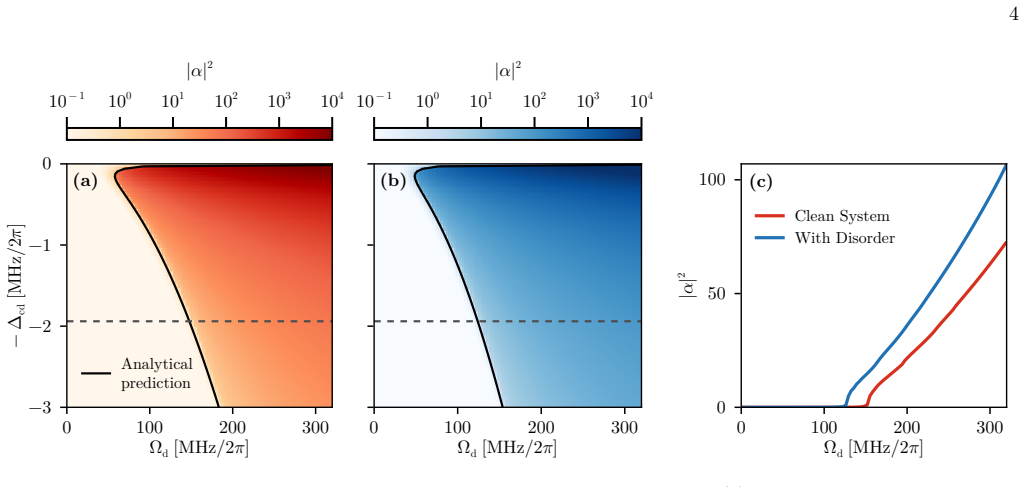
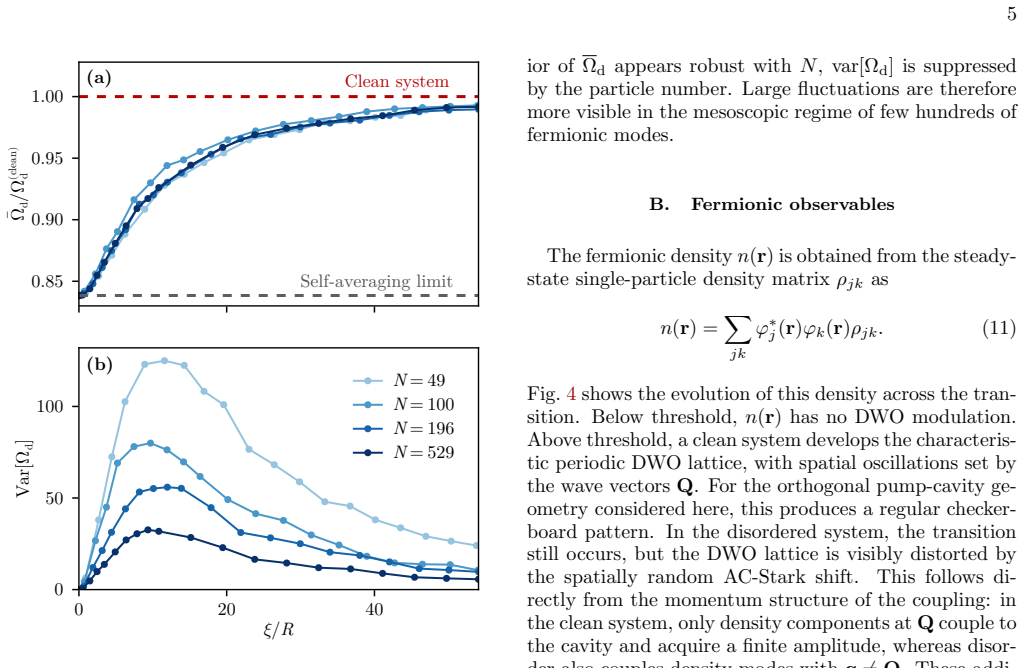
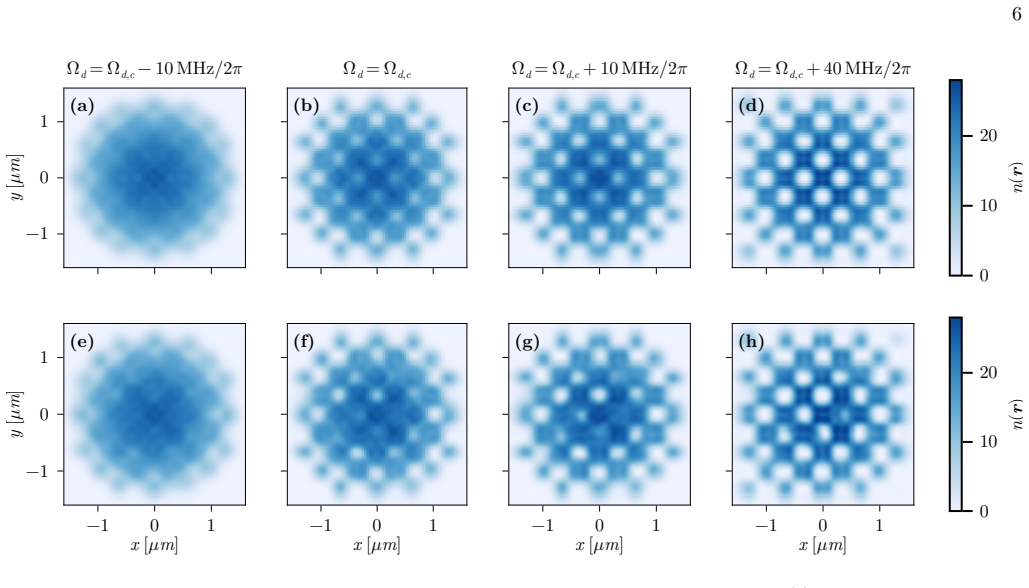
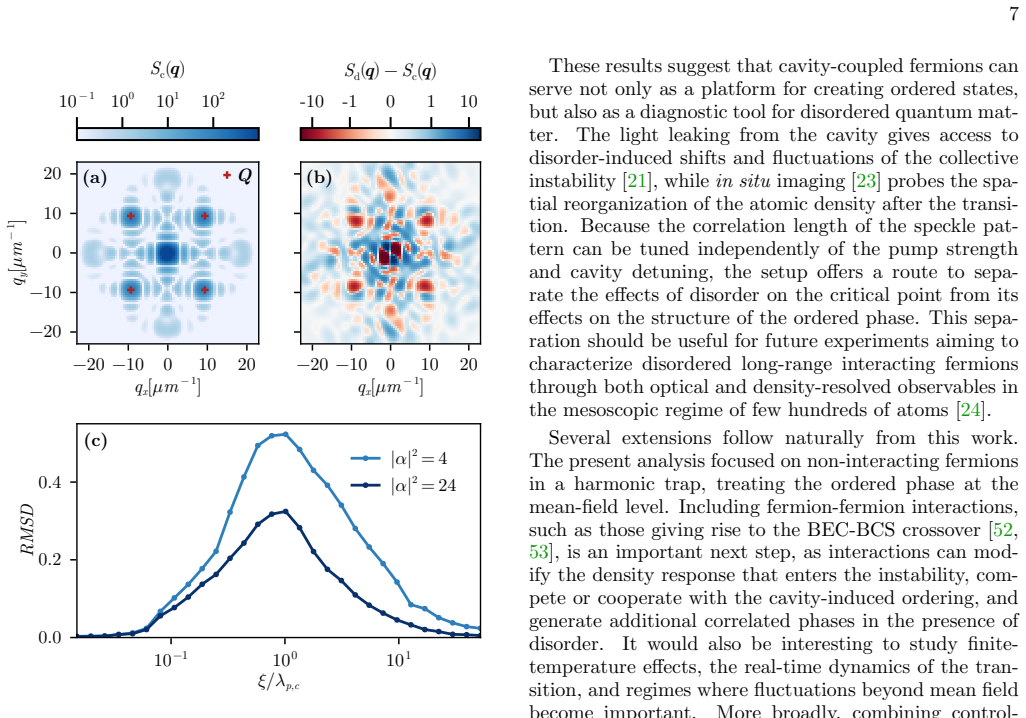
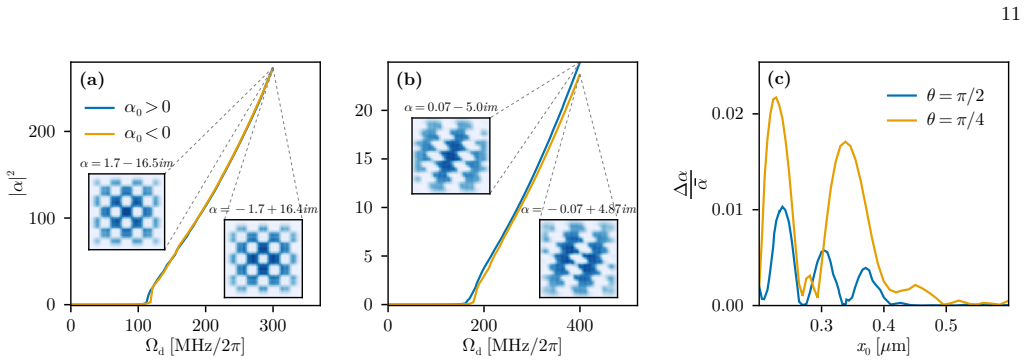
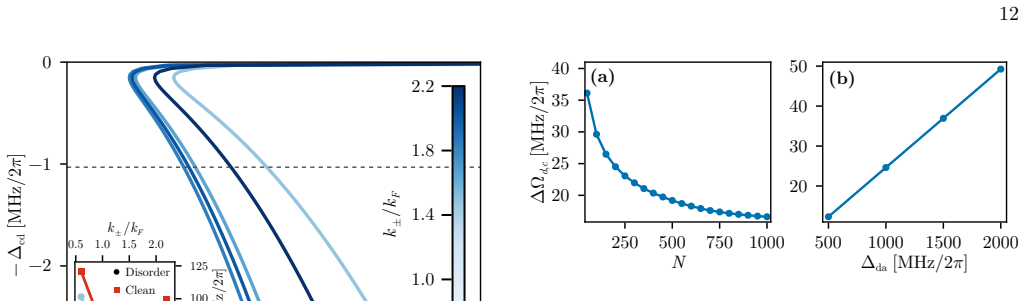
The disordered interaction renormalizes the effective light-matter coupling, lowering the critical pump strength on average, with the threshold becoming self-averaging for short speckle correlation lengths. This follows from linear response theory applied to the continuum of fermionic density modes created by the speckle, and is corroborated by numerical mean-field calculations of the intracavity photon number and real-space fermion density.
What carries the argument
Speckle-induced conversion of discrete density-wave Fourier couplings into a continuum weighted by the speckle spectrum, which renormalizes the effective light-matter coupling.
If this is right
- The critical pump strength for the superradiant transition decreases on average.
- For short speckle correlation lengths the threshold value is self-averaging across realizations.
- Above threshold the density-wave crystal is distorted by additional Fourier components beyond those of the clean cavity geometry.
- Emitted cavity light and in-situ density images both serve as experimental probes of the engineered disorder.
Where Pith is reading between the lines
- Similar renormalization might appear in other cavity QED geometries once the coupling is made spatially disordered.
- The self-averaging property could let engineered disorder stabilize ordered phases without precise tuning of the pump.
- Whether the effect survives beyond mean-field when particle interactions are added remains open for numerical or experimental test.
Load-bearing premise
Linear response theory remains valid for the superradiant threshold after the speckle converts the coupling into a continuum of modes.
What would settle it
Measure the critical pump strength as a function of speckle correlation length and check whether the threshold decreases on average and becomes independent of specific disorder realizations at short lengths.
Figures
read the original abstract
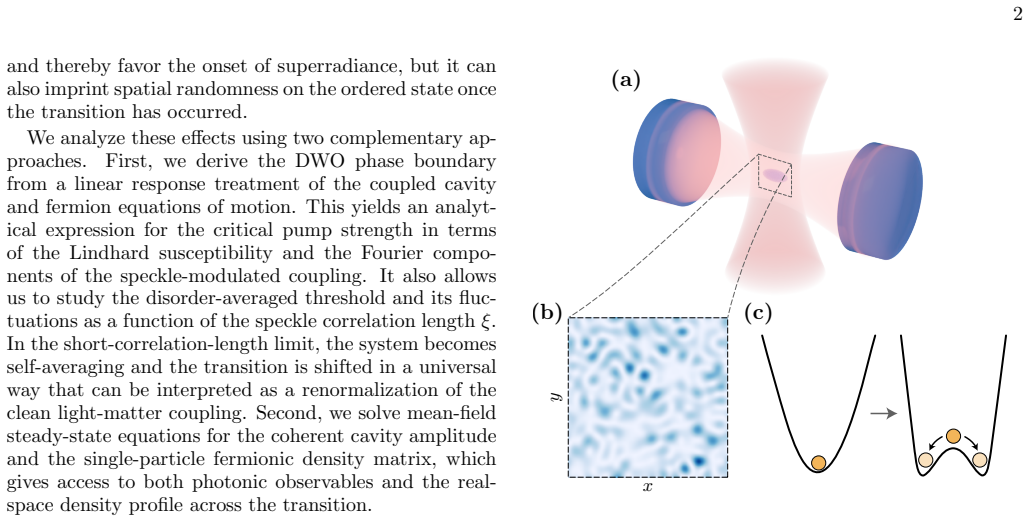
We investigate the interplay between cavity-induced density-wave ordering and controllable disorder in a trapped two-dimensional gas of ultracold fermions. The atoms are dispersively coupled to an optical cavity and transversely driven by a pump beam, while an additional speckle beam spatially modulates the atom-light coupling through an AC-Stark shift of the atomic transition. In momentum space, this disorder converts the usual coupling between the cavity mode and a discrete set of density-wave Fourier components into a coupling to a continuum of fermionic density modes, weighted by the spectrum of the speckle pattern. Using linear response theory, we derive the superradiant threshold and show that the disordered interaction renormalizes the effective light-matter coupling, lowering the critical pump strength on average, with the threshold becoming self-averaging for short speckle correlation lengths. We complement this analysis with a numerical mean-field treatment that gives access to the intracavity photon number and to the real-space fermion density across the transition. These results confirm that the disorder shifts the photonic phase boundary and, above threshold, distorts the density-wave crystal by populating Fourier components beyond those selected by the clean cavity geometry. Our findings identify both the emitted cavity light and in situ density images as probes of engineered disorder in fermionic matter coupled to optical cavities.
Editorial analysis
A structured set of objections, weighed in public.
Referee Report
Summary. The manuscript studies the effects of speckle-induced disorder on cavity-mediated density-wave ordering in a trapped 2D ultracold Fermi gas. The AC-Stark speckle converts the atom-cavity coupling from discrete Fourier components to a continuum weighted by the speckle power spectrum. Linear response theory is applied to the cavity field equation to obtain a renormalized effective coupling that lowers the superradiant threshold on average, with the threshold becoming self-averaging for short speckle correlation lengths. Mean-field numerics are used to compute the intracavity photon number and real-space density profiles, confirming the shift of the phase boundary and the population of additional Fourier components that distort the density-wave crystal above threshold.
Significance. If the central claims hold, the work provides a concrete route to engineering and probing disorder effects in cavity QED systems with fermions, with cavity emission and in-situ imaging identified as experimental observables. The combination of an analytical linear-response threshold calculation with numerical mean-field treatment of the ordered phase is a strength, as is the identification of self-averaging behavior for short correlation lengths.
major comments (1)
- [Linear response derivation] Linear response derivation (the section deriving the superradiant threshold after introducing the speckle-weighted continuum): the replacement of the discrete coupling g(q) by a continuous distribution set by the speckle spectrum is used to obtain a renormalized threshold via a zero crossing of 1 - g_eff² Χ(q,ω). No explicit demonstration is given that the continuum does not introduce additional imaginary parts to the pole or shift the real part outside the regime where the linear-response expansion remains controlled; this assumption is load-bearing for the claim that disorder lowers the threshold.
minor comments (1)
- [Abstract] The abstract states that linear response yields a renormalized threshold but does not reference the explicit expression for the effective coupling or the disorder-averaged denominator; adding a brief equation or pointer to the main-text formula would improve readability.
Simulated Author's Rebuttal
We thank the referee for their careful reading of the manuscript and for the positive assessment of its significance. We address the single major comment below and will revise the manuscript to strengthen the linear-response section as indicated.
read point-by-point responses
-
Referee: [Linear response derivation] Linear response derivation (the section deriving the superradiant threshold after introducing the speckle-weighted continuum): the replacement of the discrete coupling g(q) by a continuous distribution set by the speckle spectrum is used to obtain a renormalized threshold via a zero crossing of 1 - g_eff² Χ(q,ω). No explicit demonstration is given that the continuum does not introduce additional imaginary parts to the pole or shift the real part outside the regime where the linear-response expansion remains controlled; this assumption is load-bearing for the claim that disorder lowers the threshold.
Authors: We agree that an explicit demonstration strengthens the derivation. The cavity field is treated in the frequency domain with a static, real-valued speckle potential; the effective coupling is therefore obtained by a real-weighted integral over the speckle spectrum, and any imaginary component of the denominator originates exclusively from the fermionic susceptibility Χ(q,ω) evaluated at the relevant frequency (identical to the clean-system case). In the revised manuscript we will add a dedicated paragraph that (i) writes the pole condition explicitly as Re[1 − g_eff² Χ] = 0 with Im[1 − g_eff² Χ] kept finite only by the cavity linewidth, (ii) shows by direct numerical quadrature that, for the short-correlation-length regime where self-averaging holds, the imaginary part remains ≪ cavity decay rate near threshold, and (iii) verifies that the real-part renormalization stays inside the regime where the linear expansion is controlled by comparing the disordered threshold to the clean limit and to the subsequent mean-field numerics. These additions will be placed immediately after the definition of g_eff. revision: yes
Circularity Check
No circularity: threshold derived from linear response on disorder spectrum
full rationale
The abstract states the superradiant threshold is derived via linear response after the speckle converts the coupling to a weighted integral over a continuum of density modes. The renormalization of effective coupling follows directly from that spectrum without any fitting step, self-definition, or reduction to prior self-citations. No load-bearing ansatz or uniqueness claim is quoted that collapses the result to its own inputs. The derivation chain remains independent of the target quantity.
Axiom & Free-Parameter Ledger
axioms (1)
- domain assumption Linear response theory applies to the disordered light-matter coupling near the superradiant transition
Reference graph
Works this paper leans on
-
[1]
(6) from the cavity-QED Hamiltonian in Eq
Derivation of the DWO threshold In this section we detail the derivation of the phase-boundary condition in Eq. (6) from the cavity-QED Hamiltonian in Eq. (1). First, we write the interaction Hamiltonian in Eq. (2) in terms of single-particle momentum eigenstates, with annihilation (creation) operators ˆck (ˆc† k). Using ˆΨ(r) = R dk 2π eik·rˆck we obtain...
-
[2]
(7) and characterizing how the mean and variance of the critical point depend on the speckle correlation length
Disorder average and variance of the phase boundary We now study the statistics of the threshold over disorder realizations, with the goal of deriving Eq. (7) and characterizing how the mean and variance of the critical point depend on the speckle correlation length. We first decompose the disorder contribution as D(k) =F µ+ 1 1 +I(r)/⟨I(r)⟩ −µ (k) = 2πµδ...
-
[3]
T rap averaging To determine the critical threshold, we need the static (ω= 0) density-density response function. For free spin- 1/2 fermions in two dimensions, the static Lindhard func- tion is χfree(q) =− mat πℏ2 1−Θ(q−2k F ) s 1− 2kF q 2 , (A27) wherem at is the atomic mass (throughout the article, we assume 6Li atoms) andk F the Fermi wave vect...
-
[4]
To generate such a pattern numerically we follow the proce- dure outlined in Ref
Numerical construction of the speckle pattern A speckle pattern can be represented as a superpo- sition of plane waves with random relative phases. To generate such a pattern numerically we follow the proce- dure outlined in Ref. [54]. Considering aN x ×N y two- dimensional grid representing a real-space region of size Lx ×L y, the corresponding Fourier g...
2000
-
[5]
Bloch, J
I. Bloch, J. Dalibard, and W. Zwerger, Many-body physics with ultracold gases, Rev. Mod. Phys.80, 885 (2008)
2008
-
[6]
Gross and I
C. Gross and I. Bloch, Quantum simulations with ultra- cold atoms in optical lattices, Science357, 995 (2017)
2017
-
[7]
Esslinger, Fermi-Hubbard Physics with Atoms in an Optical Lattice, Annual Review of Condensed Matter Physics1, 129 (2010)
T. Esslinger, Fermi-Hubbard Physics with Atoms in an Optical Lattice, Annual Review of Condensed Matter Physics1, 129 (2010)
2010
-
[8]
R. A. Hart, P. M. Duarte, T.-L. Yang, X. Liu, T. Paiva, E. Khatami, R. T. Scalettar, N. Trivedi, D. A. Huse, and R. G. Hulet, Observation of antiferromagnetic cor- relations in the Hubbard model with ultracold atoms, Nature519, 211 (2015)
2015
-
[9]
Mazurenko, C
A. Mazurenko, C. S. Chiu, G. Ji, M. F. Parsons, M. Kan´ asz-Nagy, R. Schmidt, F. Grusdt, E. Demler, D. Greif, and M. Greiner, A cold-atom Fermi–Hubbard antiferromagnet, Nature545, 462 (2017)
2017
-
[10]
Polkovnikov, K
A. Polkovnikov, K. Sengupta, A. Silva, and M. Vengalat- tore,Colloquium: Nonequilibrium dynamics of closed interacting quantum systems, Rev. Mod. Phys.83, 863 (2011)
2011
-
[11]
Bloch, J
I. Bloch, J. Dalibard, and S. Nascimb` ene, Quantum sim- ulations with ultracold quantum gases, Nat. Phys.8, 267 (2012)
2012
-
[12]
Ritsch, P
H. Ritsch, P. Domokos, F. Brennecke, and T. Esslinger, Cold atoms in cavity-generated dynamical optical poten- tials, Rev. Mod. Phys.85, 553 (2013)
2013
-
[13]
Mivehvar, F
F. Mivehvar, F. Piazza, T. Donner, and H. Ritsch, Cavity QED with quantum gases: new paradigms in many-body physics, Adv. Phys.70, 1 (2021)
2021
-
[14]
Domokos and H
P. Domokos and H. Ritsch, Collective Cooling and Self- Organization of Atoms in a Cavity, Phys. Rev. Lett.89, 253003 (2002)
2002
-
[15]
A. T. Black, H. W. Chan, and V. Vuleti´ c, Observa- tion of Collective Friction Forces due to Spatial Self- Organization of Atoms: From Rayleigh to Bragg Scat- tering, Phys. Rev. Lett.91, 203001 (2003)
2003
-
[16]
Baumann, C
K. Baumann, C. Guerlin, F. Brennecke, and T. Esslinger, Dicke quantum phase transition with a superfluid gas in an optical cavity, Nature464, 1301 (2010)
2010
-
[17]
D. Nagy, G. K´ onya, G. Szirmai, and P. Domokos, Dicke- Model Phase Transition in the Quantum Motion of a Bose-Einstein Condensate in an Optical Cavity, Phys. Rev. Lett.104, 130401 (2010)
2010
-
[18]
L´ eonard, A
J. L´ eonard, A. Morales, P. Zupancic, T. Esslinger, and T. Donner, Supersolid formation in a quantum gas break- ing a continuous translational symmetry, Nature543, 87 (2017)
2017
-
[19]
A. J. Koll´ ar, A. T. Papageorge, V. D. Vaidya, Y. Guo, J. Keeling, and B. L. Lev, Supermode-density-wave- polariton condensation with a Bose–Einstein condensate in a multimode cavity, Nat. Commun.8, 14386 (2017)
2017
-
[20]
R. M. Kroeze, Y. Guo, V. D. Vaidya, J. Keeling, and B. L. Lev, Spinor Self-Ordering of a Quantum Gas in a Cavity, Phys. Rev. Lett.121, 163601 (2018)
2018
-
[21]
Keeling, M
J. Keeling, M. Bhaseen, and B. Simons, Fermionic Su- perradiance in a Transversely Pumped Optical Cavity, Phys. Rev. Lett.112, 143002 (2014)
2014
-
[22]
Piazza and P
F. Piazza and P. Strack, Umklapp Superradiance with a Collisionless Quantum Degenerate Fermi Gas, Phys. Rev. Lett.112, 143003 (2014)
2014
-
[23]
Y. Chen, Z. Yu, and H. Zhai, Superradiance of Degener- ate Fermi Gases in a Cavity, Phys. Rev. Lett.112, 143004 (2014)
2014
-
[24]
Zhang, Y
X. Zhang, Y. Chen, Z. Wu, J. Wang, J. Fan, S. Deng, and H. Wu, Observation of a superradiant quantum phase transition in an intracavity degenerate Fermi gas, Science 373, 1359 (2021)
2021
-
[25]
Helson, T
V. Helson, T. Zwettler, F. Mivehvar, E. Colella, K. Roux, H. Konishi, H. Ritsch, and J.-P. Brantut, Density-wave ordering in a unitary Fermi gas with photon-mediated interactions, Nature618, 716 (2023)
2023
-
[26]
Zwettler, F
T. Zwettler, F. Marijanovic, T. B¨ uhler, S. Chattopad- hyay, G. Del Pace, L. Skolc, V. Helson, S. Uchino, E. Demler, and J.-P. Brantut, Cavity-mediated charge and pair-density waves in a unitary Fermi gas, Nat. Com- mun.17, 496 (2025)
2025
-
[27]
B¨ uhler, A
T. B¨ uhler, A. Fabre, G. Bolognini, Z. Xue, T. Zwettler, G. Del Pace, and J.-P. Brantut, Microscopy of Cavity- Induced Density-Wave Ordering in Ultracold Gases, Phys. Rev. Lett.136, 143401 (2026)
2026
- [28]
-
[29]
Cl´ ement, A
D. Cl´ ement, A. F. Var´ on, M. Hugbart, J. A. Retter, P. Bouyer, L. Sanchez-Palencia, D. M. Gangardt, G. V. Shlyapnikov, and A. Aspect, Suppression of Transport of an Interacting Elongated Bose-Einstein Condensate in a Random Potential, Phys. Rev. Lett.95, 170409 (2005)
2005
-
[30]
Billy, V
J. Billy, V. Josse, Z. Zuo, A. Bernard, B. Hambrecht, P. Lugan, D. Cl´ ement, L. Sanchez-Palencia, P. Bouyer, and A. Aspect, Direct observation of Anderson localiza- tion of matter waves in a controlled disorder, Nature453, 891 (2008)
2008
-
[31]
Roati, C
G. Roati, C. D’Errico, L. Fallani, M. Fattori, C. Fort, M. Zaccanti, G. Modugno, M. Modugno, and M. In- guscio, Anderson localization of a non-interacting Bose–Einstein condensate, Nature453, 895 (2008)
2008
-
[32]
S. S. Kondov, W. R. McGehee, J. J. Zirbel, and B. De- Marco, Three-Dimensional Anderson Localization of Ul- tracold Matter, Science334, 66 (2011)
2011
-
[33]
Jendrzejewski, A
F. Jendrzejewski, A. Bernard, K. M¨ uller, P. Cheinet, V. Josse, M. Piraud, L. Pezz´ e, L. Sanchez-Palencia, 14 A. Aspect, and P. Bouyer, Three-dimensional localiza- tion of ultracold atoms in an optical disordered potential, Nat. Phys.8, 398 (2012)
2012
-
[34]
Schreiber, S
M. Schreiber, S. S. Hodgman, P. Bordia, H. P. L¨ uschen, M. H. Fischer, R. Vosk, E. Altman, U. Schneider, and I. Bloch, Observation of many-body localization of inter- acting fermions in a quasirandom optical lattice, Science 349, 842 (2015)
2015
-
[35]
J.-y. Choi, S. Hild, J. Zeiher, P. Schauß, A. Rubio- Abadal, T. Yefsah, V. Khemani, D. A. Huse, I. Bloch, and C. Gross, Exploring the many-body localization transition in two dimensions, Science352, 1547 (2016)
2016
-
[36]
H. P. L¨ uschen, P. Bordia, S. Scherg, F. Alet, E. Alt- man, U. Schneider, and I. Bloch, Observation of Slow Dynamics near the Many-Body Localization Transition in One-Dimensional Quasiperiodic Systems, Phys. Rev. Lett.119, 260401 (2017)
2017
-
[37]
Lukin, M
A. Lukin, M. Rispoli, R. Schittko, M. E. Tai, A. M. Kauf- man, S. Choi, V. Khemani, J. L´ eonard, and M. Greiner, Probing entanglement in a many-body–localized system, Science364, 256 (2019)
2019
-
[38]
Gopalakrishnan, B
S. Gopalakrishnan, B. L. Lev, and P. M. Goldbart, Frustration and Glassiness in Spin Models with Cavity- Mediated Interactions, Phys. Rev. Lett.107, 277201 (2011)
2011
-
[39]
B. P. Marsh, Y. Guo, R. M. Kroeze, S. Gopalakrish- nan, S. Ganguli, J. Keeling, and B. L. Lev, Enhancing Associative Memory Recall and Storage Capacity Using Confocal Cavity QED, Phys. Rev. X11, 021048 (2021)
2021
-
[40]
B. P. Marsh, R. M. Kroeze, S. Ganguli, S. Gopalakrish- nan, J. Keeling, and B. L. Lev, Entanglement and Replica Symmetry Breaking in a Driven-Dissipative Quantum Spin Glass, Phys. Rev. X14, 011026 (2024)
2024
-
[41]
R. M. Kroeze, B. P. Marsh, D. Atri Schuller, H. S. Hunt, A. N. Bourzutschky, M. Winer, S. Gopalakrishnan, J. Keeling, and B. L. Lev, Directly observing replica sym- metry breaking in a vector quantum-optical spin glass, Science389, 1122 (2025)
2025
-
[42]
B. P. Marsh, D. A. Schuller, Y. Ji, H. S. Hunt, G. Z. Socolof, D. P. Bowman, J. Keeling, and B. L. Lev, Mul- timode Cavity QED Ising Spin Glass, Phys. Rev. Lett. 135, 160403 (2025)
2025
-
[43]
Lippe, T
C. Lippe, T. Klas, J. Bender, P. Mischke, T. Niederpr¨ um, and H. Ott, Experimental realization of a 3D random hopping model, Nat. Commun.12, 6976 (2021)
2021
-
[44]
Periwal, E
A. Periwal, E. S. Cooper, P. Kunkel, J. F. Wienand, E. J. Davis, and M. Schleier-Smith, Programmable in- teractions and emergent geometry in an array of atom clouds, Nature600, 630 (2021)
2021
-
[45]
Sauerwein, F
N. Sauerwein, F. Orsi, P. Uhrich, S. Bandyopadhyay, F. Mattiotti, T. Cantat-Moltrecht, G. Pupillo, P. Hauke, and J.-P. Brantut, Engineering random spin models with atoms in a high-finesse cavity, Nat. Phys.19, 1128 (2023)
2023
-
[46]
F. Orsi, N. Sauerwein, R. P. Bhatt, J. Faltinath, E. Fe- dotova, N. Reiter, T. Cantat-Moltrecht, and J.-P. Bran- tut, Cavity Microscope for Micrometer-Scale Control of Atom-Photon Interactions, PRX Quantum5, 040333 (2024)
2024
- [47]
-
[48]
R. Baumgartner, P. Pelliconi, S. Bandyopadhyay, F. Orsi, N. Sauerwein, P. Hauke, J.-P. Brantut, and J. Sonner, Quantum simulation of the sachdev-ye-kitaev model us- ing time-dependent disorder in optical cavities (2024), arXiv:2411.17802 [quant-ph]
- [49]
-
[50]
D. P. Solis, A. Windey, S. Bandyopadhyay, A. Legra- mandi, and P. Hauke, From single-particle to many-body chaos in the Yukawa-Sachdev-Ye-Kitaev model: Theory and a cavity-QED proposal, Phys. Rev. B113, 184121 (2026)
2026
-
[51]
Marijanovi´ c, S
F. Marijanovi´ c, S. Chattopadhyay, L. Skolc, T. Zwettler, C.-M. Halati, S. B. J¨ ager, T. Giamarchi, J.-P. Brantut, and E. Demler, Quench Instabilities of a Strongly Inter- acting Quantum Gas in an Optical Cavity, Phys. Rev. Lett.136, 193401 (2026)
2026
-
[52]
Giuliani and G
G. Giuliani and G. Vignale,Quantum Theory of the Elec- tron Liquid, 1st ed. (Cambridge University Press, 2005)
2005
-
[53]
Helson, T
V. Helson, T. Zwettler, K. Roux, H. Konishi, S. Uchino, and J.-P. Brantut, Optomechanical response of a strongly interacting Fermi gas, Phys. Rev. Res.4, 033199 (2022)
2022
-
[54]
Z. Wu, J. Fan, X. Zhang, J. Qi, and H. Wu, Signatures of Prethermalization in a Quenched Cavity-Mediated Long- Range Interacting Fermi Gas, Phys. Rev. Lett.131, 243401 (2023)
2023
-
[55]
Zwettler, G
T. Zwettler, G. Del Pace, F. Marijanovic, S. Chattopad- hyay, T. B¨ uhler, C.-M. Halati, L. Skolc, L. Tolle, V. Hel- son, G. Bolognini, A. Fabre, S. Uchino, T. Giamarchi, E. Demler, and J.-P. Brantut, Nonequilibrium Dynamics of Long-Range Interacting Fermions, Phys. Rev. X15, 021089 (2025)
2025
-
[56]
Giorgini, L
S. Giorgini, L. P. Pitaevskii, and S. Stringari, Theory of ultracold atomic Fermi gases, Rev. Mod. Phys.80, 1215 (2008)
2008
-
[57]
Zwerger, ed.,The BCS-BEC Crossover and the Uni- tary Fermi Gas, Lecture Notes in Physics, Vol
W. Zwerger, ed.,The BCS-BEC Crossover and the Uni- tary Fermi Gas, Lecture Notes in Physics, Vol. 836 (Springer Berlin Heidelberg, Berlin, Heidelberg, 2012)
2012
-
[58]
D. D. Duncan and S. J. Kirkpatrick, Algorithms for sim- ulation of speckle (laser and otherwise), inComplex Dy- namics and Fluctuations in Biomedical Photonics V, Vol. 6855, edited by V. V. Tuchin and L. V. Wang, Interna- tional Society for Optics and Photonics (SPIE, 2008) p. 685505
2008
discussion (0)
Sign in with ORCID, Apple, or X to comment. Anyone can read and Pith papers without signing in.