REVIEW 2 major objections 1 minor 117 references
JWST spectra show that polycyclic aromatic hydrocarbons dominate the mid-IR emission in the inner CGM of NGC 891 out to 4 kpc.
Reviewed by Pith at T0; open to challenge. T0 means a machine referee read the full paper against a public rubric. the ladder, T0–T4 →
T0 review · grok-4.3
2026-06-29 17:19 UTC pith:ALJG72W4
load-bearing objection New JWST spectra show PAH features dominating mid-IR emission in NGC 891's inner CGM out to 4 kpc, but the PAHFIT decomposition lacks validation for low-density conditions. the 2 major comments →
Survival of very small carbonaceous dust grains in the inner-CGM of NGC 891 from JWST/MIRI MRS
The pith
A machine-rendered reading of the paper's core claim, the machinery that carries it, and where it could break.
Core claim
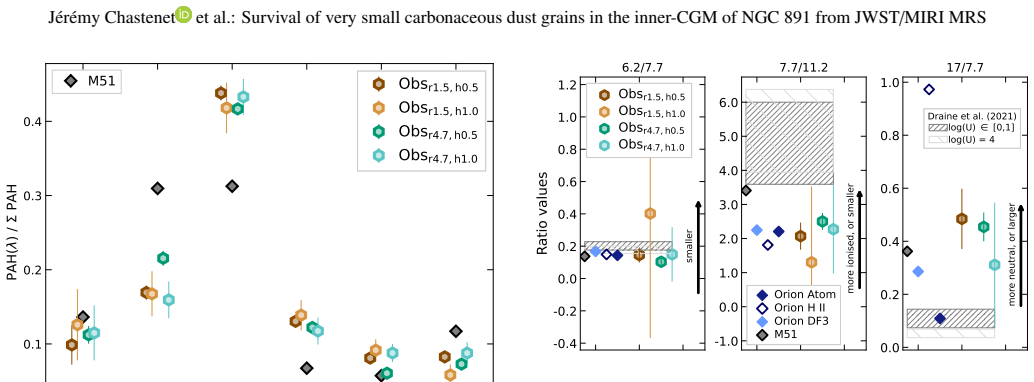
The spectra reveal that the earlier reported mid-IR emission out to 4 kpc is dominated by the emission of polycyclic aromatic hydrocarbons (PAHs), and not hot dust continuum, providing direct evidence of the survival of PAHs in the inner CGM of NGC 891. The 11.2 μm PAH feature dominates, implying more neutral large PAHs. PAH-to-continuum ratios show little variation with scale-height and radius, while feature strengths decrease with the [Ne III]/[Ne II] ratio. A tight correlation exists between H2 and PAH features, and a previously unidentified PAH feature is detected at 16.72 μm.
What carries the argument
The PAHFIT dust emission model applied to decompose 1D spectra and 3D cubes into PAH features versus continuum components across the observed positions.
Load-bearing premise
The PAHFIT model correctly assigns the observed spectral features to PAHs without substantial contamination from other sources or continuum in the low-density CGM.
What would settle it
Higher spatial or spectral resolution data or an alternative decomposition that attributes the same features primarily to hot dust continuum instead of PAHs would falsify the survival claim.
If this is right
- PAH emission in the CGM originates from cool dense cloudlets entrained in outflows, as shown by the H2 correlation.
- PAH processing increases with harder radiation fields, as indicated by the drop in feature strengths with the [Ne III]/[Ne II] ratio.
- The dominance of the 11.2 μm feature over 7.7 μm points to a population of larger neutral PAHs distinct from those in star-forming regions like Orion or M51.
- Minimal change in PAH-to-continuum ratios with height and radius implies limited additional processing during transport into the inner CGM.
Where Pith is reading between the lines
- If PAHs survive at these distances, similar small grains may remain intact in the halos of other edge-on galaxies and affect interpretations of diffuse mid-IR emission.
- The co-location with H2 suggests that dense phases within outflows can shield PAHs, which may alter models of dust and molecule survival during galactic feedback.
- The unidentified 16.72 μm feature could trace excitation conditions unique to the low-density CGM and warrants targeted searches in other outflow systems.
Editorial analysis
A structured set of objections, weighed in public.
Referee Report
Summary. The paper presents new JWST/MIRI MRS spectroscopic observations of the inner CGM of NGC 891 at four positions (two near the bulge, two at r~1.5 and 4.7 kpc). Using the PAHFIT dust emission model on 1D spectra and 3D cubes, the authors conclude that the previously reported mid-IR emission out to 4 kpc is dominated by PAH features rather than hot dust continuum. This is taken as direct evidence for PAH survival in the inner CGM. Additional findings include dominance of the 11.2 μm PAH band over 7.7 μm (suggesting more neutral, large PAHs), little variation in PAH-to-continuum ratios with scale height or radius, a decrease in PAH strengths with [Ne III]/[Ne II], a tight H2-PAH correlation, and detection of a new feature at 16.72 μm.
Significance. If the PAHFIT decomposition is reliable, the result would provide valuable direct spectroscopic evidence for the survival of very small carbonaceous grains in the CGM, with implications for dust processing in galactic outflows and the origin of CGM dust. The band-ratio comparisons to Orion and M51, the H2 correlation implying co-spatial emission from entrained cloudlets, and the new 16.72 μm feature are useful additions to the literature on PAH properties in varied environments. The work applies standard modeling tools to new JWST data in a novel setting.
major comments (2)
- [Spectral decomposition] Spectral decomposition (PAHFIT analysis): The manuscript applies the PAHFIT model, calibrated on denser star-forming regions, to the low-density CGM spectra without providing validation, sensitivity tests, or alternative continuum models to confirm that the decomposition correctly attributes flux to PAH bands rather than a smooth hot-dust continuum. This assumption is load-bearing for the central claim that PAHs dominate and survive in the inner CGM.
- [Results] Results section: No quantitative error bars, fit statistics (e.g., reduced χ²), or tabulated flux measurements for the individual PAH components and continuum are provided, preventing independent assessment of the robustness of the reported PAH dominance, band ratios, and the new 16.72 μm feature.
minor comments (1)
- [Abstract] Abstract: The statement that 'it is obvious that the 11.2 μm PAH feature dominates' should be replaced by a quantitative comparison (e.g., measured 11.2/7.7 ratios with uncertainties) to other environments.
Simulated Author's Rebuttal
We thank the referee for their careful and constructive review. We address the two major comments below and have revised the manuscript to incorporate additional validation and quantitative details as requested.
read point-by-point responses
-
Referee: [Spectral decomposition] Spectral decomposition (PAHFIT analysis): The manuscript applies the PAHFIT model, calibrated on denser star-forming regions, to the low-density CGM spectra without providing validation, sensitivity tests, or alternative continuum models to confirm that the decomposition correctly attributes flux to PAH bands rather than a smooth hot-dust continuum. This assumption is load-bearing for the central claim that PAHs dominate and survive in the inner CGM.
Authors: We agree that the applicability of PAHFIT to the low-density CGM requires explicit validation. Although the model has been applied across a range of environments in the literature, the current manuscript does not include dedicated sensitivity tests or alternative continuum comparisons for these spectra. In the revised version we will add such tests (varying continuum parameters, comparing with polynomial continua, and assessing residual structures) together with a discussion of the model's suitability for CGM conditions. revision: yes
-
Referee: [Results] Results section: No quantitative error bars, fit statistics (e.g., reduced χ²), or tabulated flux measurements for the individual PAH components and continuum are provided, preventing independent assessment of the robustness of the reported PAH dominance, band ratios, and the new 16.72 μm feature.
Authors: We accept that the absence of error bars, fit statistics, and tabulated fluxes limits independent evaluation. The revised manuscript will include reduced χ² values for all PAHFIT fits, uncertainties on individual PAH and continuum fluxes, and a supplementary table listing the measured fluxes with errors for the key features (including the 16.72 μm feature). revision: yes
Circularity Check
No circularity in observational spectral analysis
full rationale
The paper is a purely observational study that acquires new JWST/MIRI MRS spectra at multiple positions in the inner CGM of NGC 891 and applies the established external PAHFIT decomposition tool to separate PAH features from continuum. The headline conclusion that PAHs dominate (and therefore survive) follows directly from the fitted band strengths in the observed data, with supporting empirical comparisons to Orion and M51 and noted correlations with [Ne III]/[Ne II] and H2. No equations, predictions, or uniqueness arguments are present that reduce any result to its own inputs by construction, and no load-bearing self-citation chain is invoked. The analysis is self-contained against external benchmarks.
Axiom & Free-Parameter Ledger
read the original abstract
We present new spectroscopic observations of the inner circumgalactic medium (CGM) of NGC 891 taken with the Mid-Infrared Imager/Medium Resolution Spectroscopy instrument onboard JWST, in four positions: two near the bulge and two at galactocentric radii (r) of ~ 1.5, 4.7 kpc. Each pair of pointings has one position along the minor axis (h) at ~ 0.5 kpc and one at ~ 1 kpc away from the mid-plane. We analyse both 1D spectra and 3D cubes using the dust emission model PAHFIT to extract properties of typical mid-IR features. These spectra reveal that the earlier reported mid-IR emission out to 4 kpc is dominated by the emission of polycyclic aromatic hydrocarbons (PAHs), and not hot dust continuum, providing direct evidence of the survival of PAHs in the inner CGM of NGC 891. Comparing PAH band ratios with other environments (Orion, M51), it is obvious that the 11.2 $\mu$m PAH feature -- and not the usual 7.7 ${\mu}$m -- dominates in NGC 891, which seems to imply the presence of more neutral, large PAHs in the CGM. Overall, PAH-to-continuum ratios show little variations with scale-height and radius in NGC 891, which suggests little PAH processing. However, we do see a decrease in the PAH feature strengths with the [Ne III]/[Ne II] ratio, pointing at elevated dust processing with increased radiation field hardness. We also confirm a tight correlation between H2 and PAH features, suggesting that both tracers must be co-spatial and, hence, implying that PAH emission predominantly arises from cool dense parts of cloudlets entrained in galactic outflows. Finally, we report the clear detection of a previously unidentified PAH feature at 16.72 $\mu$m.
Figures




Reference graph
Works this paper leans on
-
[1]
J., Hudgins, D
Allamandola, L. J., Hudgins, D. M., & Sandford, S. A. 1999, ApJ, 511, L115
1999
-
[2]
J., Tielens, A
Allamandola, L. J., Tielens, A. G. G. M., & Barker, J. R. 1989, ApJS, 71, 733
1989
-
[3]
T., Hunt, L
Aniano, G., Draine, B. T., Hunt, L. K., et al. 2020, ApJ, 889, 150 Astropy Collaboration, Price-Whelan, A. M., Sip˝ocz, B. M., et al. 2018, AJ, 156, 123 Astropy Collaboration, Robitaille, T. P., Tollerud, E. J., et al. 2013, A&A, 558, A33
2020
-
[4]
M., Rosolowsky, E., et al
Baron, D., Sandstrom, K. M., Rosolowsky, E., et al. 2024, ApJ, 968, 24
2024
-
[5]
W., Peeters, E., & Allamandola, L
Bauschlicher, Jr., C. W., Peeters, E., & Allamandola, L. J. 2008, ApJ, 678, 316
2008
-
[6]
W., Peeters, E., & Allamandola, L
Bauschlicher, Jr., C. W., Peeters, E., & Allamandola, L. J. 2009, ApJ, 697, 311
2009
-
[7]
Bernard-Salas, J., Spoon, H. W. W., Charmandaris, V ., et al. 2009, ApJS, 184, 230
2009
-
[8]
& Xilouris, E
Bianchi, S. & Xilouris, E. M. 2011, A&A, 531, L11
2011
-
[9]
K., & Schneider, R
Bocchio, M., Bianchi, S., Hunt, L. K., & Schneider, R. 2016, A&A, 586, A8
2016
-
[10]
R., Gautier, A.-L., & Jones, A
Bocchio, M., Micelotta, E. R., Gautier, A.-L., & Jones, A. P. 2012, A&A, 545, A124
2012
-
[11]
M., Neves, R., Pilling, S., Lago, A
Boechat-Roberty, H. M., Neves, R., Pilling, S., Lago, A. F., & de Souza, G. G. B. 2009, MNRAS, 394, 810
2009
-
[12]
W., Allamandola, L
Boersma, C., Bauschlicher, C. W., Allamandola, L. J., et al. 2010, A&A, 511, A32
2010
-
[13]
Boersma, C., Bregman, J., & Allamandola, L. J. 2014, ApJ, 795, 110
2014
-
[14]
D., Levy, R
Bolatto, A. D., Levy, R. C., Tarantino, E., et al. 2024, ApJ, 967, 63
2024
-
[15]
Witteborn, F. C. 1989, ApJ, 344, 791
1989
-
[16]
N., Miller, E
Bregman, J. N., Miller, E. D., Seitzer, P., Cowley, C. R., & Miller, M. J. 2013, ApJ, 766, 57 Article number, page 17 of 21 A&A proofs:manuscript no. aa58757-25
2013
-
[17]
2020, A&A, 633, A100
Casasola, V ., Bianchi, S., De Vis, P., et al. 2020, A&A, 633, A100
2020
-
[18]
2022, A&A, 668, A130
Casasola, V ., Bianchi, S., Magrini, L., et al. 2022, A&A, 668, A130
2022
-
[19]
2024, A&A, 690, A348
Chastenet, J., De Looze, I., Relaño, M., et al. 2024, A&A, 690, A348
2024
-
[20]
2019, ApJ, 876, 62
Chastenet, J., Sandstrom, K., Chiang, I.-D., et al. 2019, ApJ, 876, 62
2019
-
[21]
K., et al
Chastenet, J., Sandstrom, K., Leroy, A. K., et al. 2025, ApJS, 276, 2
2025
-
[22]
2021, MNRAS, 500, 1261
Chown, R., Li, C., Parker, L., et al. 2021, MNRAS, 500, 1261
2021
-
[23]
2024, A&A, 685, A75
Chown, R., Sidhu, A., Peeters, E., et al. 2024, A&A, 685, A75
2024
-
[24]
2012, A&A, 540, A52
Cortese, L., Ciesla, L., Boselli, A., et al. 2012, A&A, 540, A52
2012
-
[25]
2019, MNRAS, 482, 1618
Cortzen, I., Garrett, J., Magdis, G., et al. 2019, MNRAS, 482, 1618
2019
-
[26]
I., Baes, M., Bianchi, S., et al
Davies, J. I., Baes, M., Bianchi, S., et al. 2017, PASP, 129, 044102 De Looze, I., Lamperti, I., Saintonge, A., et al. 2020, MNRAS, 496, 3668
2017
-
[27]
P., Lai, T
Donnelly, G. P., Lai, T. S. Y ., Armus, L., et al. 2025, ApJ, 983, 79
2025
-
[28]
T., Dale, D
Draine, B. T., Dale, D. A., Bendo, G., et al. 2007, ApJ, 663, 866
2007
-
[29]
Draine, B. T. & Li, A. 2007, ApJ, 657, 810
2007
-
[30]
T., Li, A., Hensley, B
Draine, B. T., Li, A., Hensley, B. S., et al. 2021, ApJ, 917, 3
2021
-
[31]
V ., Kreckel, K., Sandstrom, K
Egorov, O. V ., Kreckel, K., Sandstrom, K. M., et al. 2023, ApJ, 944, L16
2023
-
[32]
L., & Mac Low, M.-M
Emerick, A., Bryan, G. L., & Mac Low, M.-M. 2019, MNRAS, 482, 1304
2019
-
[33]
W., Gordon, K
Engelbracht, C. W., Gordon, K. D., Rieke, G. H., et al. 2005, ApJ, 628, L29
2005
-
[34]
Field, G. B. 1975, in The Dusty Universe, ed. G. B. Field & A. G. W. Cameron, 89–112
1975
-
[35]
B., Bolatto, A
Fisher, D. B., Bolatto, A. D., Chisholm, J., et al. 2025, MNRAS, 538, 3068
2025
-
[36]
2011, A&A, 531, A64
Fraternali, F., Sancisi, R., & Kamphuis, P. 2011, A&A, 531, A64
2011
-
[37]
2008, ApJ, 672, 214
Galliano, F., Dwek, E., & Chanial, P. 2008, ApJ, 672, 214
2008
-
[38]
2021, A&A, 649, A18
Galliano, F., Nersesian, A., Bianchi, S., et al. 2021, A&A, 649, A18
2021
-
[39]
2016, MNRAS, 456, 3432
Girichidis, P., Walch, S., Naab, T., et al. 2016, MNRAS, 456, 3432
2016
-
[40]
D., Engelbracht, C
Gordon, K. D., Engelbracht, C. W., Rieke, G. H., et al. 2008, ApJ, 682, 336
2008
-
[41]
2011, ApJS, 197, 27
Haan, S., Armus, L., Laine, S., et al. 2011, ApJS, 197, 27
2011
-
[42]
R., Millman, K
Harris, C. R., Millman, K. J., van der Walt, S. J., et al. 2020, Nature, 585, 357
2020
-
[43]
Heckman, T. M. 2002, in Astronomical Society of the Pacific Conference Se- ries, V ol. 254, Extragalactic Gas at Low Redshift, ed. J. S. Mulchaey & J. T. Stocke, 292
2002
-
[44]
Hensley, B. S. & Draine, B. T. 2023, ApJ, 948, 55
2023
-
[45]
S., Murray, C
Hensley, B. S., Murray, C. E., & Dodici, M. 2022, ApJ, 929, 23
2022
-
[46]
2001, A&A, 370, 1030
Hony, S., Van Kerckhoven, C., Peeters, E., et al. 2001, A&A, 370, 1030
2001
-
[47]
C., Lin, L., Lin, J
Hsieh, B. C., Lin, L., Lin, J. H., et al. 2017, ApJ, 851, L24
2017
-
[48]
Hunter, J. D. 2007, Computing In Science & Engineering, 9, 90
2007
-
[49]
A., Kennedy, H., Parkin, T., & Madden, S
Irwin, J. A., Kennedy, H., Parkin, T., & Madden, S. 2007, A&A, 474, 461
2007
-
[50]
Irwin, J. A. & Madden, S. C. 2006, A&A, 445, 123
2006
-
[51]
Joblin, C., Tielens, A. G. G. M., Allamandola, L. J., & Geballe, T. R. 1996, ApJ, 458, 610
1996
-
[52]
P., Köhler, M., Ysard, N., Bocchio, M., & Verstraete, L
Jones, A. P., Köhler, M., Ysard, N., Bocchio, M., & Verstraete, L. 2017, A&A, 602, A46
2017
-
[53]
Kaufman, M. J. & Neufeld, D. A. 1996, ApJ, 456, 611
1996
-
[54]
J., & Tielens, A
Kemper, F., Vriend, W. J., & Tielens, A. G. G. M. 2004, ApJ, 609, 826
2004
-
[55]
Kennicutt, R. C. & Evans, N. J. 2012, ARA&A, 50, 531
2012
-
[56]
2022, MNRAS, 513, 3663
Kerkeni, B., García-Bernete, I., Rigopoulou, D., et al. 2022, MNRAS, 513, 3663
2022
-
[57]
2025, A&A, 699, A133
Khan, B., Abbott, B., Peeters, E., et al. 2025, A&A, 699, A133
2025
-
[58]
S.-Y ., Duval, S., Smith, J
Lai, T. S.-Y ., Duval, S., Smith, J. D. T., et al. 2025, ApJ, 991, L56
2025
-
[59]
N., Gottesman, S
Laine, S., Appleton, P. N., Gottesman, S. T., Ashby, M. L. N., & Garland, C. A. 2010, AJ, 140, 753
2010
-
[60]
W., Irwin, J
Lee, S. W., Irwin, J. A., Dettmar, R. J., et al. 2001, A&A, 377, 759
2001
-
[61]
K., Sandstrom, K., Rosolowsky, E., et al
Leroy, A. K., Sandstrom, K., Rosolowsky, E., et al. 2023, ApJ, 944, L9
2023
-
[62]
K., Walter, F., Brinks, E., et al
Leroy, A. K., Walter, F., Brinks, E., et al. 2008, AJ, 136, 2782
2008
-
[63]
C., Bolatto, A
Levy, R. C., Bolatto, A. D., Sánchez, S. F., et al. 2019, ApJ, 882, 84
2019
-
[64]
C., Bolatto, A
Levy, R. C., Bolatto, A. D., Teuben, P., et al. 2018, ApJ, 860, 92
2018
-
[65]
L., et al
Lin, L., Pan, H.-A., Ellison, S. L., et al. 2019, ApJ, 884, L33
2019
-
[66]
K., et al
Lopez, S., Ring, C., Leroy, A. K., et al. 2026, ApJ, 999, L7
2026
-
[67]
J., et al
Lu, L.-Y ., Li, J.-T., Vargas, C. J., et al. 2024, A&A, 691, A217
2024
-
[68]
Madden, S. C. 2005, in American Institute of Physics Conference Series, V ol. 761, The Spectral Energy Distributions of Gas-Rich Galaxies: Confronting Models with Data, ed. C. C. Popescu & R. J. Tuffs, 223–230
2005
-
[69]
C., Galliano, F., Jones, A
Madden, S. C., Galliano, F., Jones, A. P., & Sauvage, M. 2006, A&A, 446, 877
2006
-
[70]
& Mannucci, F
Maiolino, R. & Mannucci, F. 2019, A&A Rev., 27, 3
2019
-
[71]
2010, MN- RAS, 408, 2115
Mannucci, F., Cresci, G., Maiolino, R., Marconi, A., & Gnerucci, A. 2010, MN- RAS, 408, 2115
2010
-
[72]
D., & Allamandola, L
Maragkoudakis, A., Boersma, C., Temi, P., Bregman, J. D., & Allamandola, L. J. 2022, ApJ, 931, 38
2022
-
[73]
2025, ApJ, 979, 90
Maragkoudakis, A., Boersma, C., Temi, P., et al. 2025, ApJ, 979, 90
2025
-
[74]
2020, MNRAS, 494, 642
Maragkoudakis, A., Peeters, E., & Ricca, A. 2020, MNRAS, 494, 642
2020
-
[75]
2023, MNRAS, 520, 5354
Maragkoudakis, A., Peeters, E., & Ricca, A. 2023, MNRAS, 520, 5354
2023
-
[76]
S., Mezger, P
Mathis, J. S., Mezger, P. G., & Panagia, N. 1983, A&A, 128, 212
1983
-
[77]
2026, A&A, 705, A75
Matsumoto, K., Sommovigo, L., Gebek, A., et al. 2026, A&A, 705, A75
2026
-
[78]
2024, MNRAS, 530, 2548
McCallum, L., Wood, K., Benjamin, R., et al. 2024, MNRAS, 530, 2548
2024
-
[79]
E., Huff, E
McCleary, J. E., Huff, E. M., Bartlett, J. G., & Hensley, B. S. 2026, ApJ, 1000, 313 Ménard, B., Scranton, R., Fukugita, M., & Richards, G. 2010, MNRAS, 405, 1025
2026
-
[80]
Min, M., Waters, L. B. F. M., de Koter, A., et al. 2008, A&A, 486, 779
2008
discussion (0)
Sign in with ORCID, Apple, or X to comment. Anyone can read and Pith papers without signing in.