REVIEW 4 major objections 6 minor 1 cited by
Shell effects in nuclear charge radii based on Skyrme density functionals
T0 review · 4 major / 6 minor · reviewed 2026-08-06 · deepseek-v4-flash
Pith's one-line read A single Cooper-pair-condensation correction to the Skyrme HFB charge-radius formula reproduces the measured shell-closure kinks at N=28, 82, and 126 and the shell quenching at N=50 in even-even Ca, Ni, Sn, and Pb isotopes.
desk verdict First Skyrme-HFB test of the pair-condensation charge-radius correction shows real kinks, but the unfitted constant a0 makes the result vulnerable; worth refereeing with a demand for sensitivity analysis. read the letter →
The pith
A machine-rendered reading of the paper's core claim, the machinery that carries it, and where it could break.
The reading
What carries the argument
The load-bearing object is the correction term $a_0\sqrt{A}\,|D_n-D_p|$ appended to the mean-square charge radius formula. Here $D_{n,p}=\sum_{k>0}u_kv_k$ is a sum over quasiparticle amplitudes in the canonical HFB basis, so it measures the occupancy spread, or Cooper-pair condensation, of neutrons and protons near the Fermi surface, and $|D_n-D_p|$ is the neutron-proton asymmetry of that pairing condensate. The $D$ values come directly from the HFB self-consistent solution, while the overall strength $a_0=0.561$ is a fixed phenomenological coefficient fitted earlier to potassium and calcium charge radii and transferred without adjustment to Skyrme HFB. The term adds extra charge radius where neutron and proton pairing differ most, which is exactly at and beyond shell closures, turning the smooth Skyrme HFB curves into curves with kinks and quenching.
What would settle it
Refit $a_0$ independently for each of the four isotopic chains and for each Skyrme force; if the best-fit values scatter well outside the uncertainty of 0.561, the universal transfer premise is false. A complementary experiment is a high-precision charge radius of $^{100}$Sn, where HFB$^*$ predicts a kink that plain HFB does not.
Extended reading notes
Core claim
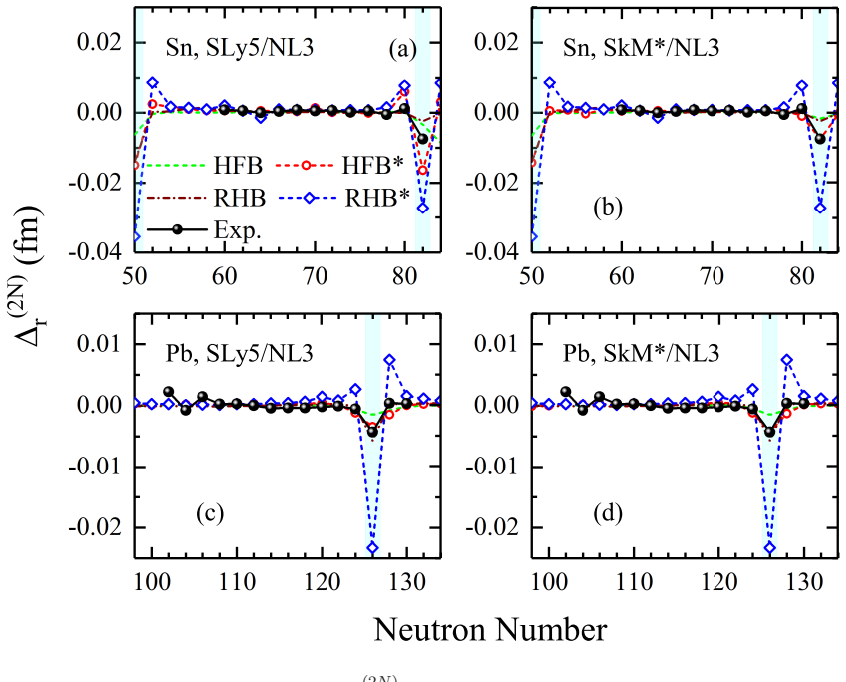
The central claim is that the modified charge-radius formula $R_{\rm ch}^2=\langle r_p^2\rangle+0.7056+a_0\sqrt{A}\,|D_n-D_p|$ with $a_0=0.561$ makes non-relativistic Skyrme HFB calculations reproduce the measured differential charge radii of even-even Ca, Ni, Sn, and Pb isotopes, whereas the same calculations without the extra term give smooth, monotonic curves that miss the shell closures. In the modified calculations, the kinks at $N=28$, 82, and 126 appear, the $N=50$ shell quenching appears in Ni and Sn, and the inverted parabolic-like shapes between filled shells are captured and weaken from Ca toward Pb. The authors take this as evidence that the difference between neutron and proton Cooper-pair condensation around the Fermi surface, computed self-consistently from the HFB wave functions, is the mechanism behind the discontinuous behaviour of nuclear charge radii.
Load-bearing premise
The argument rests on one fitted number: $a_0=0.561$, obtained from potassium and calcium charge radii in a relativistic model, must stay valid in Skyrme HFB and across Ca, Ni, Sn, and Pb.
Editorial extensions
If this is right
- The same formula and the same $a_0$ work in both relativistic and non-relativistic mean-field frameworks, so the correction offers a unified way to add shell effects to mean-field charge radii.
- Skyrme HFB acquires the ability to describe fine structure in charge radii, including the kinks at $N=28$, 82, and 126 and the $N=50$ quenching, without changing the energy functional.
- The inverted parabolic-like radii between filled shells are reproduced and are predicted to weaken progressively from Ca to Pb isotopic chains.
- A shell-closure kink at $^{100}$Sn is predicted by both HFB$^*$ and RHB$^*$, giving a falsifiable target for future precision measurements.
- The residual deviations in Ca and Pb show that the correction is not complete by itself; the authors attribute part of the Pb mismatch to the neglect of shape deformation toward neutron-deficient regions.
Reading between the lines
- Editorial inference: the natural next test is to apply the same $|D_n-D_p|$ term to odd-A and odd-odd nuclei, where the parent formula produces odd-even staggering in Ca and K; matching the Ni, Sn, and Pb staggering data would test whether the same mechanism covers both shell kinks and odd-even effects.
- Editorial inference: because $a_0$ is fixed and universal in the paper, the formula makes concrete predictions for other magic-adjacent chains, for example Kr, Sr, or Zr near $N=50$ and 82, before those radii are precisely measured.
- Editorial inference: the Pb failure toward neutron-deficient isotopes suggests a direct extension in which the same pair-condensation term is included on top of deformed Skyrme HFB; if the $N=126$ kink survives deformation, the mechanism is robust, and if not, the missing physics lies in the interplay of pairing and shape.
- Editorial inference: the self-consistent $D_{n,p}$ values could be used as a cheap diagnostic of pairing saturation in functional fits, separate from their role in charge radii.
Editorial analysis
A structured set of objections, weighed in public.
Referee Report
Summary. The manuscript extends a phenomenological correction to the nuclear charge radius formula, R_ch^2 = <r_p^2> + 0.7056 + a0 sqrt(A) |D_n - D_p| with a0 = 0.561, to Skyrme Hartree-Fock-Bogoliubov calculations with the SLy5 and SkM* functionals. The correction term, taken from Ref. [69], is intended to account for neutron and proton Cooper-pair condensation around the Fermi surface. The authors compute differential mean-square charge radii and the three-point indicator Delta_r^(2N) for even-even Ca, Ni, Sn, and Pb isotopic chains, compare with experimental data and with relativistic RHB(NL3) results, and conclude that the modified model reproduces the shell-closure kinks at N = 28, 82, and 126 and predicts shell quenching at N = 50 in Ni and Sn.
Significance. If the claimed result is robust, the paper provides a useful extension of a phenomenological pairing-condensation correction to non-relativistic energy density functionals, a class of models that has difficulty describing kinks and odd-even effects in charge radii. The manuscript is honest about several limitations, uses two Skyrme forces and a relativistic comparison, and explicitly identifies that a0 was fitted in Ref. [69]. The main value is as a systematic test; however, the central claim rests on an untested transfer of a fitted constant across frameworks and chains, and the evidence is presented only through visual comparison. No quantitative validation metric, no benchmark of the Delta D scales, and no code or reproducibility details are provided, so the improvement, while plausible, is not yet demonstrated. The paper would be significantly strengthened by adding transferability checks and error measures.
major comments (4)
- [Section II, Eq. (3) and Table I] The load-bearing assumption is that a0 = 0.561, fitted in Ref. [69] to potassium and calcium charge radii within a relativistic mean-field framework, transfers without renormalization to Skyrme HFB calculations that use chain-dependent pairing strengths V0. The quantity D_{n,p} = sum_{k>0} u_k v_k depends on the pairing interaction, the quasiparticle cutoff, and the mean-field model, so the scale of |D_n - D_p| in Skyrme HFB need not match the RMF scale that fixed a0. The manuscript does not compare D_n and D_p between HFB and RHB for common nuclei, does not refit a0 within Skyrme HFB, and does not test the sensitivity of the predicted kinks to the value of a0. Please add a transferability test, for example by varying a0 by +/-20% or by fitting a0 to one chain and checking the others, and report representative D_n and D_p values for the four chains.
- [Section III and Figs. 1-4] The central claims that HFB* 'reproduces' the trends, that deviations are 'slight', and that SkM* behaves better than SLy5 for tin are based entirely on visual inspection. No RMS deviation, mean absolute error, chi-square, or other quantitative metric is given for the differential charge radii or for Delta_r^(2N). Without such metrics the reader cannot judge whether the improvement over HFB is statistically meaningful, whether the overestimates in 46-50Ca and the Pb slopes are acceptable, or which force is more successful. Please add per-chain error measures for HFB, HFB*, RHB, and RHB* relative to the experimental data, and report the numerical slopes around N = 28, 50, 82, and 126.
- [Section III, calcium discussion] The calcium chain is presented as a validation of the model, but this is partly circular because a0 = 0.561 was adjusted in Ref. [69] to reproduce the inverted parabolic shape and the odd-even staggering in potassium and calcium charge radii. The authors state this in Section II and then in Section III interpret the Ca agreement as support for the model. The Ca results should be framed as a consistency check of the cross-framework transfer rather than as an independent test. The independent validation should rest on the Ni, Sn, and Pb chains, or the authors should refit a0 using Skyrme HFB on calcium and then judge the Ca comparison on that basis.
- [Section II, Eq. (4) and Section III, Table I] The numerical implementation lacks the details needed to reproduce D_{n,p}. The value of D_{n,p} depends on the quasiparticle energy cutoff, the spatial box or basis size, and the pairing strengths, but only the V0 values are listed in Table I. Since the correction term and its framework dependence are the core of the paper, please specify the HFB numerical parameters (cutoff, box size, number of basis states, and the neutron/proton pairing gaps used to fit V0). Reporting D_n, D_p, and Delta D for representative nuclei such as 40Ca, 48Ca, 68Ca, 100Sn, 132Sn, and 208Pb would also help the reader assess the transferability concern raised above.
minor comments (6)
- [Figs. 1 and 2 captions] In Figs. 1 and 2, HFB* and RHB* are both denoted by 'open diamond', so the two model families cannot be distinguished in black-and-white print; please use different markers or line styles and define them clearly in each caption.
- [Fig. 1 caption and Section III] The reference nucleus for the nickel chain is inconsistent: Fig. 1 says 'relative to the references 40Ca and 56Ni', while the text says 'with respect to reference nuclei 40Ca and 58Ni'. Please unify the definition.
- [Eq. (3)] The constant 0.7056 is the square of the proton charge radius, presumably r_p = 0.84 fm. Please state this explicitly so that the value is not a magic number, and give the relevant references at that point.
- [Throughout] There are numerous grammatical and typographical errors, such as 'gives raise to', 'the influence of new term', 'the theoretical results obtained by Eq. (3) are labeled by HFB*', and 'combining the existing literatures'. A careful language edit is needed.
- [Section IV] The summary states that shell closure effects are 'slightly distorted' in the Ca and Pb isotopes, but the body text describes overestimated 46-50Ca radii and deviating Pb slopes. Please quantify these deviations with the metrics requested in the major comments so that 'slightly' is meaningful.
- [Figs. 2 and 4] The text and captions refer to the lead reference nucleus as '182Pb'; please verify whether this is the intended experimental reference and state it consistently with the data compilation used.
Circularity Check
Calcium validation inherits the K/Ca-fitted a0; the Skyrme transfer and Ni/Sn/Pb kinks remain independent.
-
fitted input called prediction
[Eq. (3) and Section II (a0); Section IV (Ca claim)]
"The parameter set a0 = 0.561 is adjusted by reproducing the inverted parabolic-like shape and odd-even oscillation behaviors in charge radii of potassium and calcium isotopes [69]. In our calculations, the same parameter set a0 shown in Eq. (3) is further applied to depict the local variations of nuclear charge radii within Skyrme EDFs. ... The modified model can reproduce the trend of changes of differential charge radii in the calcium, nickel, tin, and lead isotopes."
The coefficient a0 in Eq. (3) is not derived here; it was fitted, in the same-author Ref. [69], to reproduce the inverted parabolic shape and odd-even staggering of K and Ca charge radii. The present paper then counts the Ca chain among the checks of the model and claims the modified model reproduces the Ca trend. For the Ca leg, the observable used as confirmation is the same observable that fixed a0, so the agreement is partly inherited from the fit rather than being an independent Skyrme prediction. This is only a partial reduction, not a full one, because the transfer from RMF to Skyrme HFB changes Delta D and a0 is not refit here; the Ni, Sn, Pb, and N=50/82/126 results remain independent checks.
full rationale
The central Skyrme-transfer claim has genuine independent content: a0 is fixed across all four chains, pairing strengths are anchored to empirical gaps (Table I), and the Ni, Sn, and Pb comparisons are out-of-sample relative to the K/Ca calibration. The N=50, 82, and 126 kinks are therefore not statistically forced by a fit performed in this paper. The one genuinely circular element is the use of Ca as a validation chain after a0 was adjusted to reproduce K and Ca charge radii in Ref. [69]; for that chain the success inherits the calibration. The paper itself acknowledges that the added term is phenomenological, so there is no hidden first-principles claim. Score 4 reflects this partial circularity while recognizing that the rest of the claimed phenomenology is independently tested.
Assumptions & free parameters
free parameters (4)
- a0 (global charge-radius correction amplitude) =
0.561
- V0, SLy5 pairing strength (per chain) =
Ca: 245.2, Ni: 362.8, Sn: 410.0, Pb: 468.0 MeV fm^3
- V0, SkM* pairing strength (per chain) =
Ca: 262.8, Ni: 313.5, Sn: 366.2, Pb: 396.0 MeV fm^3
- Pairing mixing parameter eta =
0.5 (mixed-type pairing)
assumptions (5)
- domain assumption Spherical symmetry and time-reversal symmetry are assumed; only even-even nuclei are studied.
- ad hoc to paper The charge radius correction term a0 sqrt(A) |Dn - Dp| is a valid phenomenological representation of pair condensation effects.
- domain assumption Dn,p = sum over canonical states u_k v_k measures Cooper-pair condensation relevant to charge radii.
- ad hoc to paper The globally fitted constant a0 = 0.561 transfers from relativistic K/Ca fits to Skyrme HFB for all four chains.
- domain assumption Mixed-type pairing (eta = 0.5) with a density-dependent zero-range force is appropriate for all chains.
Cite this review
Pith. "Pith review of Shell effects in nuclear charge radii based on Skyrme density functionals." pith.science (2026). https://pith.science/paper/ALR7CJXO
@misc{pith2026250620414,
  author       = {Pith},
  title        = {Pith review of: Shell effects in nuclear charge radii based on Skyrme density functionals},
  year         = {2026},
  howpublished = {\url{https://pith.science/paper/ALR7CJXO}},
  note         = {Machine review of arXiv:2506.20414}
}
abstract
A unified description of the charge radii throughout the entire nuclide chart plays an essential role for our understanding of nuclear structure and fundamental nuclear interactions. In this work, the influence of new term, which catches the spirit of neutron and proton pairs condensation around Fermi surface, on the charge radii has been investigated based on the Skyrme density functionals with the effective forces SLy5 and SkM$^{*}$. The differential charge radii of even-even Ca, Ni, Sn, and Pb isotopes are employed to evaluate the validity of this theoretical model. Meanwhile, the results obtained by the relativistic density functional with the effective Lagrangian NL3 are also shown for the quantitative comparison. The calculated results suggest that the modified model can improve the trend of changes of the differential charge radii along Ca, Ni, Sn, and Pb isotopic chains, especially the shell closure effect at the neutron numbers $N=28$, 82 and 126. The shell quenching phenomena of charge radii can also be predicted at the neutron number $N=50$ along the corresponding Ni and Sn isotopes, respectively. The inverted parabolic-like shapes between the two fully filled shells can also be observed, but the amplitude is gradually weakened from Ca to Pb isotopic chains. Combining the existing literatures, it suggests that the discontinuous behavior in nuclear charge radii can be described well by considering the influence of neutron Cooper pairs condensation around Fermi surface.
Figures


Figures from the paper (1 more)
Forward citations
Cited by 1 Pith paper
-
Octupole deformation properties in the actinides region using Fayans functionals
Fayans EDFs predict an octupole-deformed cluster in actinides similar to Skyrme UNEDF0, with roughly correct charge radii and separation energies but notable unquantified deviations.
Reference graph
Works this paper leans on
-
[69]
R. An, X. Jiang, N. Tang, L.-G. Cao, and F.-S. Zhang, Phys. Rev. C 109, 064302 (2024)
work page 2024
-
[1]
K¨ onig, J
K. K¨ onig, J. C. Berengut, A. Borschevsky, A. Brinson, B. A. Brown, A. Dockery, S. Elhatisari, E. Eliav, R. F. G. Ruiz, J. D. Holt, B.-S. Hu, J. Karthein, D. Le e, Y.-Z. Ma, U.-G. Meißner, 20 K. Minamisono, A. V. Oleynichenko, S. V. Pineda, S. D. Prosny ak, M. L. Reitsma, L. V. Skripnikov, A. Vernon, and A. Zaitsevskii, Phys. Rev. Lett. 132, 162502 (2024)
2024
-
[2]
S. V. Pineda, K. K¨ onig, D. M. Rossi, B. A. Brown, A. Incorv ati, J. Lantis, K. Minamisono, W. N¨ ortersh¨ auser, J. Piekarewicz, R. Powel, and F. Sommer, Phys. Rev. Lett. 127, 182503 (2021)
2021
-
[3]
Wang and T
N. Wang and T. Li, Phys. Rev. C 88, 011301(R) (2013)
2013
-
[4]
B. A. Brown, Phys. Rev. Lett. 119, 122502 (2017)
2017
-
[5]
B. A. Brown, K. Minamisono, J. Piekarewicz, H. Hergert, D . Garand, A. Klose, K. K¨ onig, J. D. Lantis, Y. Liu, B. Maaß, A. J. Miller, W. N¨ ortersh¨ ause r, S. V. Pineda, R. C. Powel, D. M. Rossi, F. Sommer, C. Sumithrarachchi, A. Teigelh¨ ofer , J. Watkins, and R. Wirth, Phys. Rev. Res. 2, 022035 (2020)
2020
-
[6]
Arnould and S
M. Arnould and S. Goriely, Prog. Part. Nucl. Phys. 112, 103766 (2020)
2020
-
[7]
P. Bano, S. P. Pattnaik, M. Centelles, X. Vi˜ nas, and T. R. Routray, Phys. Rev. C 108, 015802 (2023)
2023
Show all 136 references
-
[8]
Hofstadter, H
R. Hofstadter, H. R. Fechter, and J. A. McIntyre, Phys. Rev. 92, 978 (1953)
1953
-
[9]
R. G. Arnold, C. E. Carlson, and F. Gross, Phys. Rev. C 21, 1426 (1980)
1980
-
[10]
Engfer, H
R. Engfer, H. Schneuwly, J. L. Vuilleumier, H. K. Walter , and A. Zehnder, At. Data Nucl. Data Tables 14, 509 (1974)
1974
-
[11]
Fricke, C
G. Fricke, C. Bernhardt, K. Heilig, L. A. Schaller, L. Sc hellenberg, E. B. Shera, and C. W. Dejager, At. Data Nucl. Data Tables 60, 177 (1995)
1995
-
[12]
Bazzi, G
M. Bazzi, G. Beer, L. Bombelli, A. M. Bragadireanu, M. Ca rgnelli, G. Corradi, C. Curceanu (Petrascu), A. d’Uffizi, C. Fiorini, T. Frizzi, F. Ghio, B. Gir olami, C. Guaraldo, R. S. Hayano, M. Iliescu, T. Ishiwatari, M. Iwasaki, P. Kienle, P. Levi San dri, A. Longoni, J. Marton, ...
2011
-
[13]
H. A. Schuessler, A. Alousi, R. M. Evans, M. Brieger, F. B uchinger, and Y. F. Li, Phys. Rev. Lett. 65, 1332 (1990)
1990
-
[14]
Billowes and P
J. Billowes and P. Campbell, J. Phys. G 21, 707 (1995)
1995
-
[15]
Angeli, At
I. Angeli, At. Data Nucl. Data Tables 87, 185 (2004) . 21
2004
-
[16]
T. E. Cocolios, H. H. Al Suradi, J. Billowes, I. Budinˇ ce vi´ c, R. P. de Groote, S. De Schepper, V. N. Fedosseev, K. T. Flanagan, S. Franchoo, R. F. Garcia Rui z, H. Heylen, F. Le Blanc, K. M. Lynch, B. A. Marsh, P. J. R. Mason, G. Neyens, J. Papuga, T . J. Procter, M. M. Ra...
2013
-
[17]
A. R. Vernon, C. M. Ricketts, J. Billowes, T. E. Cocolios , B. S. Cooper, K. T. Flanagan, R. F. Garcia Ruiz, F. P. Gustafsson, G. Neyens, H. A. Perrett, B. K. Sahoo, Q. Wang, F. J. Waso, and X. F. Yang, Sci. Rept. 10, 12306 (2020)
2020
-
[18]
Campbell, I
P. Campbell, I. Moore, and M. Pearson, Prog. Part. Nucl. Phys. 86, 127 (2016)
2016
-
[19]
X. F. Yang, S. J. Wang, S. G. Wilkins, and R. F. G. Ruiz, Prog. Part. Nucl. Phys. 129, 104005 (2023)
2023
-
[20]
Angeli and K
I. Angeli and K. P. Marinova, At. Data Nucl. Data Tables 99, 69 (2013)
2013
-
[21]
T. Li, Y. Luo, and N. Wang, At. Data Nucl. Data Tables 140, 101440 (2021)
2021
-
[22]
Togashi, Y
T. Togashi, Y. Tsunoda, T. Otsuka, and N. Shimizu, Phys. Rev. Lett. 117, 172502 (2016)
2016
-
[23]
A. E. Barzakh, D. V. Fedorov, V. S. Ivanov, P. L. Molkanov , F. V. Moroz, S. Y. Orlov, V. N. Panteleev, M. D. Seliverstov, and Y. M. Volkov, Phys. Rev. C 95, 044324 (2017)
2017
-
[24]
S. Sels, T. Day Goodacre, B. A. Marsh, A. Pastore, W. Ryss ens, Y. Tsunoda, N. Althubiti, B. Andel, A. N. Andreyev, D. Atanasov, A. E. Barzakh, M. Bende r, J. Billowes, K. Blaum, T. E. Cocolios, J. G. Cubiss, J. Dobaczewski, G. J. Farooq-Sm ith, D. V. Fedorov, V. N. Fedosseev,...
2019
-
[25]
Barzakh, A
A. Barzakh, A. N. Andreyev, C. Raison, J. G. Cubiss, P. Va n Duppen, S. P´ eru, S. Hilaire, S. Goriely, B. Andel, S. Antalic, M. Al Monthery, J. C. Bereng ut, J. Biero´ n, M. L. Bissell, A. Borschevsky, K. Chrysalidis, T. E. Cocolios, T. Day Gooda cre, J.-P. Dognon, M. Elan- t...
2021
-
[26]
Geldhof, M
S. Geldhof, M. Kortelainen, O. Beliuskina, P. Campbell , L. Caceres, L. Ca˜ nete, B. Cheal, K. Chrysalidis, C. S. Devlin, R. P. de Groote, A. de Roubin, T. Eronen, Z. Ge, W. Gins, A. Koszorus, S. Kujanp¨ a¨ a, D. Nesterenko, A. Ortiz-Cortes , I. Pohjalainen, I. D. Moore, A. Ra...
2022
-
[27]
An, X.-X
R. An, X.-X. Dong, L.-G. Cao, and F.-S. Zhang, Commun. Theo. Phys. 75, 035301 (2023)
2023
-
[28]
Nakada, Phys
H. Nakada, Phys. Rev. C 100, 044310 (2019)
2019
-
[29]
Bagchi, R
S. Bagchi, R. Kanungo, W. Horiuchi, G. Hagen, T. D. Morri s, S. R. Stroberg, T. Suzuki, F. Ameil, J. Atkinson, Y. Ayyad, D. Cortina-Gil, I. Dillmann , A. Estrad´ e, A. Evdokimov, F. Farinon, H. Geissel, G. Guastalla, R. Janik, S. Kaur, R. Kn ¨ obel, J. Kurcewicz, Y. A. Litvino...
2019
-
[30]
S. Kaur, R. Kanungo, W. Horiuchi, G. Hagen, J. D. Holt, B. S. Hu, T. Miyagi, T. Suzuki, F. Ameil, J. Atkinson, Y. Ayyad, S. Bagchi, D. Cortina-Gil, I . Dillmann, A. Estrad´ e, A. Ev- dokimov, F. Farinon, H. Geissel, G. Guastalla, R. Janik, R. K n¨ obel, J. Kurcewicz, Y. A. Lit...
2022
-
[31]
U. C. Perera, A. V. Afanasjev, and P. Ring, Phys. Rev. C 104, 064313 (2021)
2021
-
[32]
S. J. Novario, G. Hagen, G. R. Jansen, and T. Papenbrock, Phys. Rev. C 102, 051303(R) (2020)
2020
-
[33]
Day Goodacre, A
T. Day Goodacre, A. V. Afanasjev, A. E. Barzakh, B. A. Mar sh, S. Sels, P. Ring, H. Nakada, A. N. Andreyev, P. Van Duppen, N. A. Althubiti, B. Andel, D. At anasov, J. Billowes, K. Blaum, T. E. Cocolios, J. G. Cubiss, G. J. Farooq-Smith, D. V. Fedorov, V. N. Fe- dosseev, K. T. ...
2021
-
[34]
R. An, X. Jiang, L.-G. Cao, and F.-S. Zhang, Phys. Rev. C 105, 014325 (2022)
2022
-
[35]
R. F. Garcia Ruiz and A. R. Vernon, Eur. Phys. J. A 56, 136 (2020)
2020
-
[36]
Kortelainen, Z
M. Kortelainen, Z. Sun, G. Hagen, W. Nazarewicz, T. Pape nbrock, and P.-G. Reinhard, Phys. Rev. C 105, L021303 (2022)
2022
-
[37]
Klein, B
A. Klein, B. A. Brown, U. Georg, M. Keim, P. Lievens, R. Ne ugart, M. Neuroth, R. E. Silverans, L. Vermeeren, and ISOLDE Collaboration, Nucl. Phys. A 607, 1 (1996)
1996
-
[38]
Touchard, P
F. Touchard, P. Guimbal, S. B¨ uttgenbach, R. Klapisch, M. De Saint Simon, J. M. Serre, C. Thibault, H. T. Duong, P. Juncar, S. Liberman, J. Pinard, a nd J. L. Vialle, Phys. Lett. B 108, 169 (1982)
1982
-
[39]
J. A. Behr, A. Gorelov, T. Swanson, O. H¨ ausser, K. P. Jac kson, M. Trinczek, U. Giesen, J. M. D’Auria, R. Hardy, T. Wilson, P. Choboter, F. Leblond, L . Buchmann, M. Dombsky, C. D. P. Levy, G. Roy, B. A. Brown, and J. Dilling, Phys. Rev. Lett. 79, 375 (1997)
1997
-
[40]
D. M. Rossi, K. Minamisono, H. B. Asberry, G. Bollen, B. A . Brown, K. Cooper, B. Isher- wood, P. F. Mantica, A. Miller, D. J. Morrissey, R. Ringle, J. A. Rodriguez, C. A. Ryder, A. Smith, R. Strum, and C. Sumithrarachchi, Phys. Rev. C 92, 014305 (2015)
2015
-
[41]
K¨ onig, S
K. K¨ onig, S. Fritzsche, G. Hagen, J. D. Holt, A. Klose, J . Lantis, Y. Liu, K. Minamisono, T. Miyagi, W. Nazarewicz, T. Papenbrock, S. V. Pineda, R. Pow el, and P.-G. Reinhard, Phys. Rev. Lett. 131, 102501 (2023)
2023
-
[42]
Bohr and B
A. Bohr and B. R. Mottelson, Nuclear structure (World Scientific Publishing Co. Pte. Ltd., 1969)
1969
-
[43]
S. Q. Zhang, J. Meng, S. G. Zhou, and J. Y. Zeng, Eur. Phys. J. A 13, 285 (2002)
2002
-
[44]
Sheng, G
Z. Sheng, G. Fan, J. Qian, and J. Hu, Eur. Phys. J. A 51, 40 (2015)
2015
-
[45]
L.-S. Geng, H. Toki, and J. Meng, Prog. Theo. Phys. 113, 785 (2005)
2005
-
[46]
Goriely, S
S. Goriely, S. Hilaire, M. Girod, and S. P´ eru, Phys. Rev. Lett. 102, 242501 (2009)
2009
-
[47]
Goriely, N
S. Goriely, N. Chamel, and J. M. Pearson, Phys. Rev. C 93, 034337 (2016)
2016
-
[48]
B. H. Sun, Y. Lu, J. P. Peng, C. Y. Liu, and Y. M. Zhao, Phys. Rev. C 90, 054318 (2014)
2014
-
[49]
M. Bao, Y. Lu, Y. M. Zhao, and A. Arima, Phys. Rev. C 94, 064315 (2016)
2016
-
[50]
B. H. Sun, C. Y. Liu, and H. X. Wang, Phys. Rev. C 95, 014307 (2017)
2017
-
[51]
M. Bao, Y. Y. Zong, Y. M. Zhao, and A. Arima, Phys. Rev. C 102, 014306 (2020) . 24
2020
-
[52]
Forss´ en, E
C. Forss´ en, E. Caurier, and P. Navr´ atil, Phys. Rev. C 79, 021303 (2009)
2009
-
[53]
Utama, W.-C
R. Utama, W.-C. Chen, and J. Piekarewicz, J. Phys. G 43, 114002 (2016)
2016
-
[54]
Y. Ma, C. Su, J. Liu, Z. Ren, C. Xu, and Y. Gao, Phys. Rev. C 101, 014304 (2020)
2020
-
[55]
D. Wu, C. L. Bai, H. Sagawa, and H. Q. Zhang, Phys. Rev. C 102, 054323 (2020)
2020
-
[56]
X.-X. Dong, R. An, J.-X. Lu, and L.-S. Geng, Phys. Rev. C 105, 014308 (2022)
2022
-
[57]
X.-X. Dong, R. An, J.-X. Lu, and L.-S. Geng, Phys. Lett. B 838, 137726 (2023)
2023
-
[58]
Angeli and K
I. Angeli and K. P. Marinova, J. Phys. G 42, 055108 (2015)
2015
-
[59]
G. A. Lalazissis and S. E. Massen, Phys. Rev. C 53, 1599 (1996)
1996
-
[60]
G. A. Miller, A. Beck, S. May-Tal Beck, L. B. Weinstein, E . Piasetzky, and O. Hen, Phys. Lett. B 793, 360 (2019)
2019
-
[61]
L. A. Souza, M. Dutra, C. H. Lenzi, and O. Louren¸ co, Phys. Rev. C 101, 065202 (2020)
2020
-
[62]
Cosyn and J
W. Cosyn and J. Ryckebusch, Phys. Lett. B 820, 136526 (2021)
2021
-
[63]
U. C. Perera and A. V. Afanasjev, Phys. Rev. C 107, 064321 (2023)
2023
-
[64]
R. F. Casten, D. S. Brenner, and P. E. Haustein, Phys. Rev. Lett. 58, 658 (1987)
1987
-
[65]
Angeli, J Phys
I. Angeli, J Phys. G 17, 439 (1991)
1991
-
[66]
A. E. L. Dieperink and P. Van Isacker, Eur. Phys. J. A 42, 269 (2009)
2009
-
[67]
An, L.-S
R. An, L.-S. Geng, and S.-S. Zhang, Phys. Rev. C 102, 024307 (2020)
2020
-
[68]
R. An, X. Jiang, L.-G. Cao, and F.-S. Zhang, Chin. Phys. C 46, 064101 (2022)
2022
-
[70]
Reinhard and W
P.-G. Reinhard and W. Nazarewicz, Phys. Rev. C 95, 064328 (2017)
2017
-
[71]
Gorges, L
C. Gorges, L. V. Rodr ´ ıguez, D. L. Balabanski, M. L. Biss ell, K. Blaum, B. Cheal, R. F. Garcia Ruiz, G. Georgiev, W. Gins, H. Heylen, A. Kanellakopo ulos, S. Kaufmann, M. Kowal- ska, V. Lagaki, S. Lechner, B. Maaß, S. Malbrunot-Ettenauer , W. Nazarewicz, R. Neugart, G. Neye...
2019
-
[72]
Bender, P.-H
M. Bender, P.-H. Heenen, and P.-G. Reinhard, Rev. Mod. Phys. 75, 121 (2003)
2003
-
[73]
Sharma, G
M. Sharma, G. Lalazissis, and P. Ring, Phys. Lett. B 317, 9 (1993)
1993
-
[74]
Malbrunot-Ettenauer, S
S. Malbrunot-Ettenauer, S. Kaufmann, S. Bacca, C. Barb ieri, J. Billowes, M. L. Bissell, K. Blaum, B. Cheal, T. Duguet, R. F. G. Ruiz, W. Gins, C. Gorges , G. Hagen, H. Heylen, J. D. Holt, G. R. Jansen, A. Kanellakopoulos, M. Kortelainen , T. Miyagi, P. Navr´ atil, 25 W. Nazar...
2022
-
[75]
Inakura, N
T. Inakura, N. Hinohara, and H. Nakada, Phys. Rev. C 110, 054315 (2024)
2024
-
[76]
Bennaceur and J
K. Bennaceur and J. Dobaczewski, Comput. Phys. Commun. 168, 96 (2005)
2005
-
[77]
Vautherin and D
D. Vautherin and D. M. Brink, Phys. Rev. C 5, 626 (1972)
1972
-
[78]
Sagawa and S
H. Sagawa and S. Yoshida, Nucl. Phys. A 688, 755 (2001)
2001
-
[79]
Grasso, N
M. Grasso, N. Van Giai, and N. Sandulescu, Phys. Lett. B 535, 103 (2002)
2002
-
[80]
Typel and B
S. Typel and B. A. Brown, Phys. Rev. C 67, 034313 (2003)
2003
-
[81]
V. E. Oberacker, A. S. Umar, E. Ter´ an, and A. Blazkiewic z, Phys. Rev. C 68, 064302 (2003)
2003
-
[82]
Col` o, N
G. Col` o, N. Van Giai, J. Meyer, K. Bennaceur, and P. Bonc he, Phys. Rev. C 70, 024307 (2004)
2004
-
[83]
Goriely, N
S. Goriely, N. Chamel, and J. M. Pearson, Phys. Rev. C 82, 035804 (2010)
2010
-
[84]
L.-G. Cao, H. Sagawa, and G. Col` o, Phys. Rev. C 86, 054313 (2012)
2012
-
[85]
J. C. Pei, Y. N. Zhang, and F. R. Xu, Phys. Rev. C 87, 051302 (2013)
2013
-
[86]
Roca-Maza, L.-G
X. Roca-Maza, L.-G. Cao, G. Col` o, and H. Sagawa, Phys. Rev. C 94, 044313 (2016)
2016
-
[87]
Zhang, Y
Y. Zhang, Y. Chen, J. Meng, and P. Ring, Phys. Rev. C 95, 014316 (2017)
2017
-
[88]
Chabanat, P
E. Chabanat, P. Bonche, P. Haensel, J. Meyer, and R. Scha effer, Nucl. Phys. A 627, 710 (1997)
1997
-
[89]
Chabanat, P
E. Chabanat, P. Bonche, P. Haensel, J. Meyer, and R. Scha effer, Nucl. Phys. A 635, 231 (1998)
1998
-
[90]
Ryssens, V
W. Ryssens, V. Hellemans, M. Bender, and P.-H. Heenen, Comput. Phys. Commun. 187, 175 (2015)
2015
-
[91]
Dobaczewski, W
J. Dobaczewski, W. Nazarewicz, T. R. Werner, J. F. Berge r, C. R. Chinn, and J. Decharg´ e, Phys. Rev. C 53, 2809 (1996)
1996
-
[92]
Garrido, P
E. Garrido, P. Sarriguren, E. Moya de Guerra, and P. Schu ck, Phys. Rev. C 60, 064312 (1999)
1999
-
[93]
Dobaczewski, W
J. Dobaczewski, W. Nazarewicz, and M. V. Stoitsov, Eur. Phys. J. A 15, 21 (2002)
2002
-
[94]
Matsuo, Phys
M. Matsuo, Phys. Rev. C 73, 044309 (2006)
2006
-
[95]
Matsuo, Y
M. Matsuo, Y. Serizawa, and K. Mizuyama, Nucl. Phys. A 788, 307c (2007) . 26
2007
-
[96]
E. Khan, M. Grasso, and J. Margueron, Phys. Rev. C 80, 044328 (2009)
2009
-
[97]
Bender, K
M. Bender, K. Rutz, P. G. Reinhard, and J. A. Maruhn, Eur. Phys. J. A 8, 59 (2000)
2000
-
[98]
Gambhir, P
Y. Gambhir, P. Ring, and A. Thimet, Ann. Phys. 198, 132 (1990)
1990
-
[99]
Tiesinga, P
E. Tiesinga, P. J. Mohr, D. B. Newell, and B. N. Taylor, Rev. Mod. Phys. 93, 025010 (2021)
2021
-
[100]
Lin, H.-W
Y.-H. Lin, H.-W. Hammer, and U.-G. Meißner, Phys. Rev. Lett. 128, 052002 (2022)
2022
-
[101]
G. G. Dussel, S. Pittel, J. Dukelsky, and P. Sarriguren , Phys. Rev. C 76, 011302 (2007)
2007
-
[102]
Potel, F
G. Potel, F. Barranco, E. Vigezzi, and R. A. Broglia, Phys. Rev. C 103, L021601 (2021)
2021
-
[103]
R. A. Broglia, F. Barranco, G. Potel, and E. Vigezzi, (2 021), arXiv:2103.13536 [nucl-th]
-
[104]
M. M. Sharma, G. Lalazissis, J. K¨ onig, and P. Ring, Phys. Rev. Lett. 74, 3744 (1995)
1995
-
[105]
Reinhard and H
P.-G. Reinhard and H. Flocard, Nucl. Phys. A 584, 467 (1995)
1995
-
[106]
Bartel, P
J. Bartel, P. Quentin, M. Brack, C. Guet, and H.-B. H ˚ ak ansson, Nucl. Phys. A 386, 79 (1982)
1982
-
[107]
Huang, X.-X
Y. Huang, X.-X. Sun, and L. Guo, Phys. Rev. C 110, 064318 (2024)
2024
-
[108]
L. W. Iskra, R. Mˇ arginean, S. Bottoni, N. Mˇ arginean, B. Fornal, S. Leoni, G. Col` o, L. Stan, R. Borcea, M. Boromiza, S. C˘ alinescu, N. Cieplicka-Ory´ nczak, C. Clisu-Stan, C. Costache, F. C. L. Crespi, D. Filipescu, N. Florea, I. Gheorghe, A. Ione scu, R. Lic˘ a, C. Miha...
2024
-
[109]
Z. Z. Li, Y. F. Niu, and G. Col` o, Phys. Rev. C 110, 064317 (2024)
2024
-
[110]
Naito, M
T. Naito, M. Kimura, and M. Sasano, Phys. Rev. Res. 7, 013050 (2025)
2025
-
[111]
Ebata and W
S. Ebata and W. Horiuchi, Phys. Rev. C 111, 014313 (2025)
2025
-
[112]
Kucharek and P
H. Kucharek and P. Ring, Z. Phys. A 339, 23 (1991)
1991
-
[113]
Meng, Nucl
J. Meng, Nucl. Phys. A 635, 3 (1998)
1998
-
[114]
S.-G. Zhou, J. Meng, P. Ring, and E.-G. Zhao, Phys. Rev. C 82, 011301(R) (2010)
2010
-
[115]
Yang, Y.-T
D. Yang, Y.-T. Rong, R. An, and R.-X. Shi, Phys. Rev. C 110, 064314 (2024)
2024
-
[116]
G. A. Lalazissis, J. K¨ onig, and P. Ring, Phys. Rev. C 55, 540 (1997)
1997
-
[117]
R. F. Garcia Ruiz, M. L. Bissell, K. Blaum, A. Ekstr¨ om, N. Fr¨ ommgen, G. Hagen, M. Ham- men, K. Hebeler, J. D. Holt, G. R. Jansen, M. Kowalska, K. Krei m, W. Nazarewicz, R. Neu- gart, G. Neyens, W. N¨ ortersh¨ auser, T. Papenbrock, J. Papuga, A. Schwenk, J. Simonis, K. A. W...
2016
-
[118]
Sommer, K
F. Sommer, K. K¨ onig, D. M. Rossi, N. Everett, D. Garand , R. P. de Groote, J. D. Holt, P. Imgram, A. Incorvati, C. Kalman, A. Klose, J. Lantis, Y. Li u, A. J. Miller, K. Minamisono, T. Miyagi, W. Nazarewicz, W. N¨ ortersh¨ auser, S. V. Pineda, R. Powel, P.-G. Reinhard, L. Re...
2022
-
[119]
Caurier, K
E. Caurier, K. Langanke, G. Mart ´ ınez-Pinedo, F. Nowacki, and P. Vogel, Phys. Lett. B 522, 240 (2001)
2001
-
[120]
P´ eru, S
S. P´ eru, S. Hilaire, S. Goriely, and M. Martini, Phys. Rev. C 104, 024328 (2021)
2021
-
[121]
B. A. Marsh, T. Day Goodacre, S. Sels, Y. Tsunoda, B. And el, A. N. Andreyev, N. A. Althubiti, D. Atanasov, A. E. Barzakh, J. Billowes, K. Blaum , T. E. Cocolios, J. G. Cu- biss, J. Dobaczewski, G. J. Farooq-Smith, D. V. Fedorov, V. N . Fedosseev, K. T. Flanagan, L. P. Gaffney,...
2018
-
[122]
Bhuyan, B
M. Bhuyan, B. Maheshwari, H. A. Kassim, N. Yusof, S. K. P atra, B. V. Carlson, and P. D. Stevenson, J. Phys. G 48, 075105 (2021)
2021
-
[123]
Naito, G
T. Naito, G. Col` o, H. Liang, X. Roca-Maza, and H. Sagaw a, Phys. Rev. C 105, L021304 (2022)
2022
-
[124]
Naito, X
T. Naito, X. Roca-Maza, G. Col` o, H. Liang, and H. Sagaw a, Phys. Rev. C 106, L061306 (2022)
2022
-
[125]
Naito, G
T. Naito, G. Col` o, H. Liang, X. Roca-Maza, and H. Sagaw a, Phys. Rev. C 107, 064302 (2023)
2023
-
[126]
Yang and J
J. Yang and J. Piekarewicz, Phys. Rev. C 97, 014314 (2018)
2018
-
[127]
R. An, S. Sun, L.-G. Cao, and F.-S. Zhang, Nucl. Sci. Tech. 35, 182 (2024)
2024
-
[128]
Reinhard, X
P.-G. Reinhard, X. Roca-Maza, and W. Nazarewicz, Phys. Rev. Lett. 129, 232501 (2022)
2022
-
[129]
Y¨ uksel and N
E. Y¨ uksel and N. Paar, Phys. Lett. B 836, 137622 (2023)
2023
-
[130]
Zhang and L.-W
Z. Zhang and L.-W. Chen, Phys. Rev. C 108, 024317 (2023)
2023
-
[131]
Miyatsu, M.-K
T. Miyatsu, M.-K. Cheoun, K. Kim, and K. Saito, Phys. Lett. B 843, 138013 (2023) . 28
2023
-
[132]
Zhang, B.-H
J.-C. Zhang, B.-H. Sun, I. Tanihata, R. Kanungo, C. Sch eidenberger, S. Terashima, F. Wang, F. Ameil, J. Atkinson, Y. Ayyad, S. Bagchi, D. Cortina-Gil, I . Dillmann, A. Estrad´ e, A. Ev- dokimov, F. Farinon, H. Geissel, G. Guastalla, R. Janik, S. K aur, R. Kn¨ obel, J. Kurcewi...
2024
-
[133]
J. W. Zhao, B.-H. Sun, I. Tanihata, S. Terashima, A. Pro chazka, J. Y. Xu, L. H. Zhu, J. Meng, J. Su, K. Y. Zhang, L. S. Geng, L. C. He, C. Y. Liu, G. S. L i, C. G. Lu, W. J. Lin, W. P. Lin, Z. Liu, P. P. Ren, Z. Y. Sun, F. Wang, J. Wang, M. Wang, S. T. Wang, X. L. Wei, X. D. ...
2023
-
[134]
Xu, Z.-Z
J.-Y. Xu, Z.-Z. Li, B.-H. Sun, Y.-F. Niu, X. Roca-Maza, H. Sagawa, and I. Tanihata, Phys. Lett. B 833, 137333 (2022)
2022
-
[135]
Reinhard and W
P.-G. Reinhard and W. Nazarewicz, Phys. Rev. C 105, L021301 (2022)
2022
-
[136]
Hu, Phys
B.-S. Hu, Phys. Lett. B 857, 138969 (2024) . 29
2024
Reviewed August 6, 2026 · model on record in the stance chip above.
Discussion (0). Continue with ORCID to comment.