REVIEW 5 major objections 6 minor 7 references
SynSeg: Feature Synergy for Multi-Category Contrastive Learning in End-to-End Open-Vocabulary Semantic Segmentation
T0 review · 5 major / 6 minor · reviewed 2026-08-05 · deepseek-v4-flash
Pith's one-line read This paper introduces SynSeg, a weakly-supervised open-vocabulary semantic segmentation method that combines four multi-category contrastive losses with an activation-map feature reconstruction and reports state-of-the-art zero-shot mIoU on
desk verdict Genuinely new loss design, but the CLIPSeg initialization confounds the 'CC12M-only' claim and the reporting is under-specified. read the letter →
The pith
A machine-rendered reading of the paper's core claim, the machinery that carries it, and where it could break.
The reading
What carries the argument
The two coupled mechanisms are Multi-Category Contrastive Learning (MCCL) and the Feature Synergy Structure (FSS). MCCL is a set of four cosine-similarity losses defined over foreground and background synergy features for every category present in an image: alignment with text, intra-category background separation, cross-category background alignment, and cross-category foreground separation. FSS is the feature reconstruction that feeds MCCL: it fuses text-conditioned image features with the decoder's semantic-activation maps (class-specific attention heatmaps) by flattening the map and multiplying it with the conditional visual features, producing category-specific foreground and background
What would settle it
Randomly reinitialize the transformer decoder (removing the CLIPSeg prior) and retrain SynSeg on CC12M with the same four losses; if the reported mIoU gains persist, the bootstrapping dependence on the initialization is not load-bearing; if performance collapses, the activation maps' initial quality is an essential precondition.
Extended reading notes
Core claim
The paper's central claim is that the missing ingredient in prior weakly-supervised OVSS is not more data or a larger backbone, but a training objective that explicitly separates and aligns multiple categories within the same image, paired with features that are reconstructed to be discriminative. The four-loss MCCL scheme treats each image as containing several categories, each with a foreground and background synergy feature. Lalign pulls each foreground feature to its text embedding; Lcont pushes a category's foreground away from its own background; Lback pulls backgrounds of different categories together, since they often overlap; and Lsep pushes foregrounds of different categories apart
Load-bearing premise
The training signal assumes the semantic-activation maps produced by the CLIPSeg-initialized decoder are accurate enough to define which features count as foreground and which as background before the model has been trained; if the initial maps are noisy, the contrastive losses could reinforce the decoder's own errors.
Editorial extensions
If this is right
- If correct, weakly-supervised OVSS can reach state-of-the-art on four benchmarks using only CC12M captions, a frozen CLIP ViT-B/16, a single epoch, and one RTX 4090 GPU per experiment.
- The explicit inter-category separation loss (Lsep) is the largest single contributor; removing it drops mIoU substantially (e.g., from 41.8 to 39.6 on Context), so modeling relations among categories matters more than mere alignment.
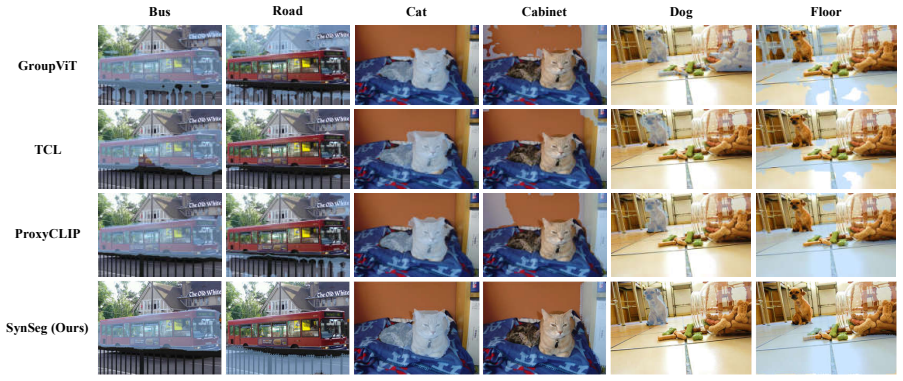
- The semantic-activation maps can be thresholded across a wide range (0.1–0.6) with visually stable results, indicating the trained model localizes semantics robustly.
- Because the method needs only captions and a frozen encoder, it is a lightweight, real-time-compatible alternative to methods that re-encode features with CLIP.
- The four losses are complementary; ablations show removing any one degrades performance on Context, Object, and Stuff.
Reading between the lines
- The reported gains may depend on the quality of the CLIPSeg-initialized decoder's activation maps: the training signal is built by multiplying conditional features with these same maps, so if the initial maps are noisy or category-confused, the contrastive pairs could reinforce the decoder's own errors. The paper does not analyze this bootstrapping dependence beyond one ablation.
- The finding that inter-category separation (Lsep) matters most suggests that dense, multi-object scenes are where weakly-supervised OVSS has the most to gain; methods that only align regions to text are leaving a large margin on the table.
- FSS could be applied outside segmentation, e.g., to weakly-supervised detection or referring expression segmentation, wherever a text-conditioned attention map can be used to reconstruct training features for contrastive learning.
- A natural testable extension is to replace the CLIPSeg initialization with other decoders or with random initialization to measure how much of the performance is due to the initialization prior versus the training objective itself.
Editorial analysis
A structured set of objections, weighed in public.
Referee Report
Summary. The manuscript presents SynSeg, a weakly supervised open-vocabulary semantic segmentation method trained on CC12M image-caption pairs. The main components are (i) Multi-Category Contrastive Learning (MCCL), which combines four losses—Lalign (foreground-text alignment), Lcont (foreground-background separation for the same category), Lback (background alignment across categories), and Lsep (foreground separation across categories)—and (ii) a Feature Synergy Structure (FSS) that reconstructs category-aware foreground/background features by multiplying conditional visual features with semantic-activation maps from a transformer decoder. The decoder is initialized with pretrained CLIPSeg weights and is fine-tuned together with a FiLM fusion module and projector, while CLIP encoders are frozen. Experiments report zero-shot mIoU of 62.2 on VOC, 41.8 on Context, 34.9 on COCO Object, 30.9 on Cityscapes, and 23.6 on COCO Stuff, claimed as SOTA on four of five benchmarks. An ablation study shows that removing any of the four losses decreases performance on Context/Object/Stuff.
Significance. If the causal contribution of MCCL+FSS were established, SynSeg would be a valuable addition to weakly supervised OVSS: it explicitly models inter-category relationships, avoids a second pass through the visual encoder, and is lightweight. The four-loss decomposition is well motivated and the ablation gives some internal support for each term. The paper's external evaluation across five benchmarks is a strength, and the reported numbers are large. However, the central 'only CC12M' claim is not yet supported, because the decoder is initialized from CLIPSeg, a mask-supervised segmentation model trained on data overlapping the evaluation benchmarks. The manuscript lacks the control experiments needed to attribute the gains to MCCL/FSS rather than to this initialization. This is the main barrier to acceptance.
major comments (5)
- [§Experiment Setup, Training Details; Table 1] The decoder is initialized with pretrained CLIPSeg weights, and CLIPSeg is trained with mask-level supervision on datasets that overlap the five evaluation benchmarks. The abstract's claim of using 'only CC12M captions' omits this transfer source. Since none of the baselines in Table 1 use a segmentation-pretrained decoder, the comparison is confounded. Please add (a) the mIoU of the CLIPSeg-initialized model before any SynSeg training, (b) a randomly initialized decoder trained with the same losses, and (c) a CLIPSeg-initialized decoder trained without MCCL/FSS (e.g., only Lalign). Without these, the marginal contribution of the proposed losses cannot be identified.
- [§Visual Effects, Fig. 3; §Main Results, Table 1] The final output comes from thresholding semantic-activation maps, but the quantitative threshold is never reported. Fig. 3 suggests results are stable between 0.1 and 0.6, which is too wide to identify the evaluation condition. Report the exact threshold used for Table 1 and a threshold sweep on at least one dataset; if per-dataset thresholds are used, state them.
- [§Technical Appendix, Experimental Setup] All reported results are averaged over three independent runs, but Table 1 gives only a single number per benchmark. Since the claimed improvements over the best baseline are between +2.0 and +7.9 mIoU (and -0.3 on Stuff), run-to-run variance could change the ranking. Report per-run values and standard deviations, or confidence intervals.
- [§Hyperparameter Configuration] λ3=10 is used without sensitivity analysis. Given Lback is one of the primary objectives and the loss is large, report mIoU for λ3 in {1,5,10,20} on a validation set. In addition, the manual exclusion list E used in Algorithm 2 is not provided; since it determines which noun phrases supervise training, it should be included for reproducibility.
- [§Approach, FSS/MCCL, Eq. (1)] The foreground/background features f_ci and \bar{f}_{ci} are constructed by weighting conditional visual features with the model's own semantic-activation maps. If the initial maps are inaccurate, MCCL may reinforce the decoder's errors. The paper does not analyze this bootstrapping dependence. Because the decoder starts from CLIPSeg, the risk may be lower than for a random init, but the authors should at least discuss and, if possible, measure the effect of the initial activation-map quality (e.g., by comparing the first-epoch loss with and without ground-truth-like masks on a small subset).
minor comments (6)
- [Abstract vs. Table 1] The abstract states gains from 0.6% up to 8.9%; Table 1's smallest improvement over the best baseline is +2.0 (Cityscapes), and on COCO Stuff SynSeg is below CoDe. Clarify the source of the 0.6% figure.
- [Approach vs. Training Details] Approach says 'the FiLM fusion module, transformer decoder and the projector stay trainable'; Training Details says 'only the decoder and the FiLM fusion module remain trainable.' This inconsistency should be resolved.
- [References] The reference list includes GroupViT, TCL, etc., but OVSegmentor in Table 1 is not cited; add the corresponding reference.
- [Eqs. (5) and (6)] N_pair^I = N_I^2 should be a binomial coefficient C(N_I,2); define the notation.
- [Abstract] The claim of 'real-time inference' is not supported by any runtime measurements; add latency/FLOPs or remove the claim.
- [General] Minor typos: 'CLIPseg' vs 'CLIPSeg', 'Enviroment' in the Technical Appendix.
Circularity Check
No significant circularity: the FSS self-referential feature construction is a bootstrapping training signal, and the CLIPSeg initialization is an experimental confound, not a derivation that reduces to its own inputs.
full rationale
The paper's claimed derivation chain—MCCL losses (Eqs. 3–6) defined on synergy features f_ci and \bar f_ci obtained by weighting conditional visual features with semantic-activation maps, with the final segmentation output obtained by thresholding the same maps—does contain a self-training/bootstrapping element, but this is not circularity in the sense of a prediction being equivalent to its inputs by construction. The text anchors t_ci come from a frozen CLIP encoder on benchmark category names, the losses are not fitted to the evaluation labels, and the benchmark mIoUs are external. The FSS feature construction shapes the decoder during training; it does not define the output as a renamed version of an input parameter. The most serious validity issue is the decoder initialization: the paper states in Training Details that 'the decoder follows the design of CLIPSeg (Lüddecke and Ecker 2022) and is initialized with the pre-trained weights from CLIPseg,' and CLIPSeg itself was trained with mask-level supervision on data that overlaps the evaluation benchmarks (e.g., COCO). The paper does not report a no-training or random-initialization control, so the contribution of the CLIPSeg prior versus the proposed losses cannot be separated from Table 1. This is an experimental-control gap and a fairness concern for the 'only CC12M' framing, but it is not a self-referential derivation. There are no load-bearing self-citations, no imported uniqueness theorems, and no fitted parameters renamed as predictions. Therefore the circularity score is 0.
Assumptions & free parameters
free parameters (3)
- Loss weights lambda1, lambda2, lambda3, lambda4 =
1, 1, 10, 1
- Segmentation threshold =
not reported
- Manual exclusion list E for noun phrases =
not published
assumptions (4)
- domain assumption The CLIP encoder's foreground bias makes second-pass visual features poorly suited for contrastive learning.
- domain assumption Noun phrases extracted from captions and filtered by list E are sufficient and correct weak supervision for segmentation.
- ad hoc to paper Background regions of different categories within an image are semantically similar enough to be aligned together.
- domain assumption The CLIPSeg-initialized decoder's semantic activation maps are reliable enough to define foreground and background training features.
Cite this review
Pith. "Pith review of SynSeg: Feature Synergy for Multi-Category Contrastive Learning in End-to-End Open-Vocabulary Semantic Segmentation." pith.science (2026). https://pith.science/paper/AM5O3CQ3
@misc{pith2026250806115,
  author       = {Pith},
  title        = {Pith review of: SynSeg: Feature Synergy for Multi-Category Contrastive Learning in End-to-End Open-Vocabulary Semantic Segmentation},
  year         = {2026},
  howpublished = {\url{https://pith.science/paper/AM5O3CQ3}},
  note         = {Machine review of arXiv:2508.06115}
}
read the original abstract
Semantic segmentation in open-vocabulary scenarios presents significant challenges due to the wide range and granularity of semantic categories. Existing weakly-supervised methods often rely on category-specific supervision and ill-suited feature construction methods for contrastive learning, leading to semantic misalignment and poor performance. In this work, we introduce a novel weakly-supervised approach, SynSeg, to address the challenges. SynSeg performs Multi-Category Contrastive Learning (MCCL) as a stronger training signal which robustly injecting intra- and inter-category knowledge during training. We also propose a new feature reconstruction framework named Feature Synergy Structure (FSS). FSS reconstructs discriminative features for contrastive learning through prior fusion and semantic-activation-map enhancement, effectively avoiding the foreground bias introduced by the visual encoder. Furthermore, SynSeg is a lightweight end-to-end solution capable for real-time inference. In general, SynSeg effectively improves the abilities in semantic localization and discrimination under weak supervision in an efficient manner. Extensive experiments on benchmarks demonstrate that our method outperforms state-of-the-art (SOTA) performance, with mIoU score gains ranging from 0.6% up to 8.9% across all reported benchmarks.
Figures


Figures from the paper (1 more)
Reference graph
Works this paper leans on
-
[5]
In Proceedings of the IEEE/CVF Conference on Computer Vision and Pattern Recognition (CVPR), 989–998
C2AM: Contrastive Learning of Class-Agnostic Acti- vation Map for Weakly Supervised Object Localization and Semantic Segmentation. In Proceedings of the IEEE/CVF Conference on Computer Vision and Pattern Recognition (CVPR), 989–998. Xing, Y .; Kang, J.; Xiao, A.; Nie, J.; Ling, S.; and Lu, S
-
[7]
A Brief Survey and an Application of Semantic Image Segmentation for Autonomous Driving
A Simple Framework for Text-Supervised Seman- tic Segmentation. In Proceedings of the IEEE/CVF Confer- ence on Computer Vision and Pattern Recognition (CVPR), 7071–7080. Zhang, P.; Li, X.; Hu, X.; Yang, J.; Zhang, L.; Wang, L.; Choi, Y .; and Gao, J. 2021. VinVL: Revisiting Visual Repre- sentations in Vision-Language Models. In 2021 IEEE/CVF Conference on...
work page Pith review arXiv 2021
-
[2016]
The Cityscapes Dataset for Semantic Urban Scene Understanding. In Proc. of the IEEE Conference on Com- puter Vision and Pattern Recognition (CVPR). Deng, S.; Zhuo, W.; Xie, J.; and Shen, L. 2023. QA- CLIMS: Question-Answer Cross Language Image Matching for Weakly Supervised Semantic Segmentation. InProceed- ings of the 31st ACM International Conference on...
arXiv 2023
-
[2021]
Conceptual 12M: Pushing Web-Scale Image-Text Pre-Training To Recognize Long-Tail Visual Concepts. arXiv:2102.08981. Chen, J.; Zhu, D.; Qian, G.; Ghanem, B.; Yan, Z.; Zhu, C.; Xiao, F.; Culatana, S. C.; and Elhoseiny, M. 2023. Exploring Open-V ocabulary Semantic Segmentation from CLIP Vision Encoder Distillation Only. In 2023 IEEE/CVF International Confere...
arXiv 2023
-
[2022]
Open-World Semantic Segmentation via Contrast- ing and Clustering Vision-Language Embedding. In Com- puter Vision – ECCV 2022: 17th European Conference, Tel Aviv, Israel, October 23–27, 2022, Proceedings, Part XX , 275–292. Berlin, Heidelberg: Springer-Verlag. ISBN 978- 3-031-20043-4. Liu, Y .; Ge, P.; Wang, G.; Liu, Q.; and Huang, D. 2025. Multi-Grained ...
arXiv 2022
-
[2023]
In Ad- vances in Neural Information Processing Systems
Rewrite Caption Semantics: Bridging Semantic Gaps for Language-Supervised Semantic Segmentation. In Ad- vances in Neural Information Processing Systems. Xu, J.; De Mello, S.; Liu, S.; Byeon, W.; Breuel, T.; Kautz, J.; and Wang, X. 2022. GroupViT: Semantic Segmenta- tion Emerges From Text Supervision. In Proceedings of the IEEE/CVF Conference on Computer V...
work page 2022
-
[2024]
Image-Text Co-Decomposition for Text-Supervised Semantic Segmentation. In Proceedings of the IEEE/CVF Conference on Computer Vision and Pattern Recognition (CVPR), 26794–26803. Xie, J.; Xiang, J.; Chen, J.; Hou, X.; Zhao, X.; and Shen, L
Reviewed August 5, 2026 · model on record in the stance chip above.
Discussion (0). Continue with ORCID to comment.