REVIEW 4 major objections 6 minor 1 cited by
Shadow-Based Framework for Estimating Transition Disk Geometries
T0 review · 4 major / 6 minor · reviewed 2026-08-15 · deepseek-v4-flash
Pith's one-line read A single near-infrared image of a shadowed transition disk can reveal the misalignment, thickness, and height profile of both its inner and outer disks.
desk verdict Solid incremental method paper: the new geometry is real, the orientation check against GRAVITY is genuine, and the missing synthetic recovery test is the one thing to fix before this framework becomes a general tool. read the letter →
The pith
A machine-rendered reading of the paper's core claim, the machinery that carries it, and where it could break.
The reading
What carries the argument
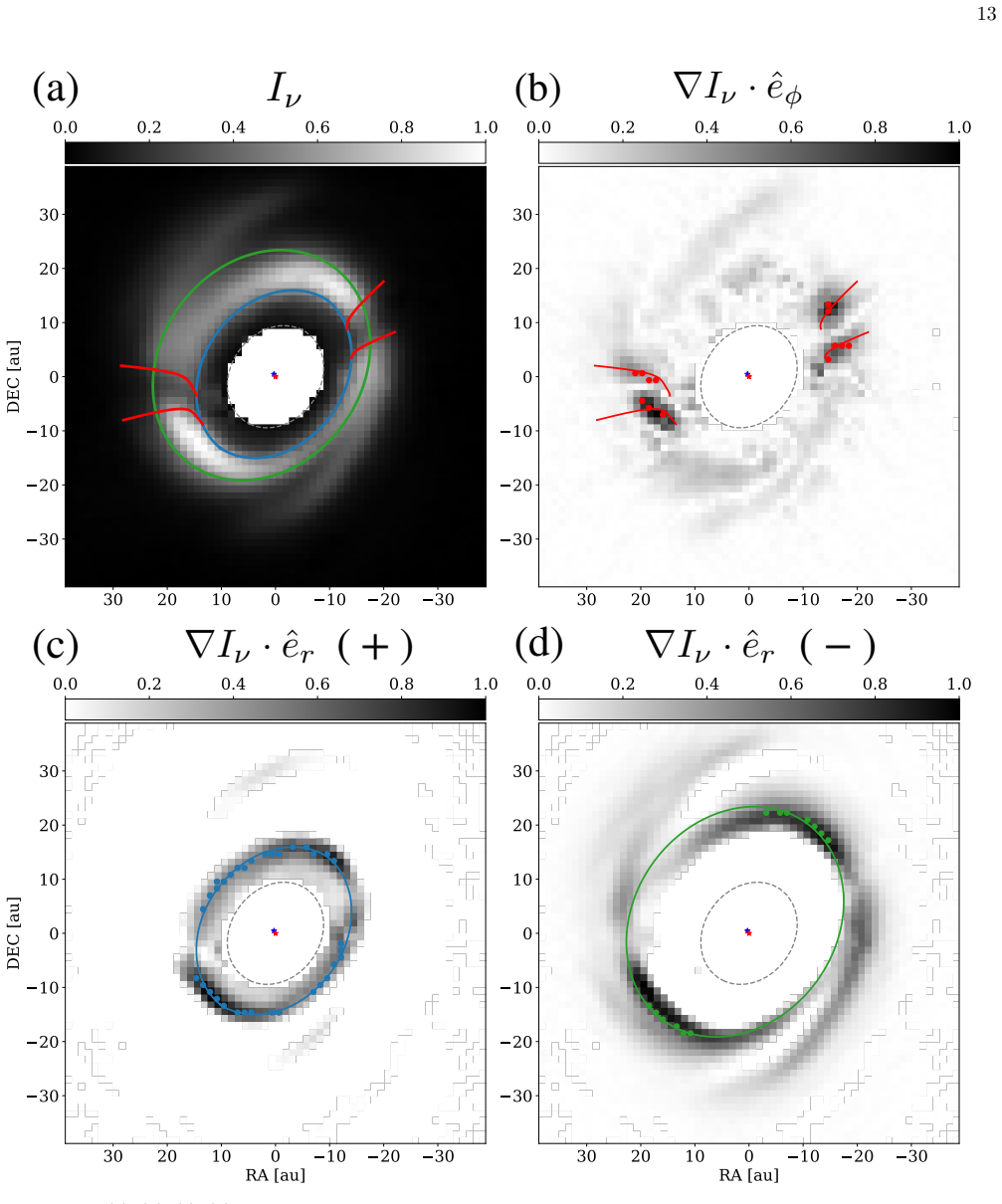
The load-bearing objects are two families of analytic curves on the outer disk surface. The horizon is defined by the condition $N_S \cdot \hat{e}_z = 0$, where $N_S$ is the surface normal of the outer disk, and takes the closed form $\phi_{o,\mathrm{Hor}} = \arcsin\big(\frac{dR}{dH} \frac{\hat{n}_o\cdot\hat{e}_z}{\hat{m}_o\cdot\hat{e}_z}\big)$ together with its supplement. The shadow boundary is the intersection of the outer surface with the inner disk's optically obscured slab $S_i = r(\cos\phi_i\,\hat{l}_i + \sin\phi_i\,\hat{m}_i) \pm h_r r\,\hat{n}_i + c_i$; eliminating $r$ and $\phi_i$ reduces this intersection to a quartic in $x = \sin(\phi_o)$ with coefficients $b_0, b_1, b_2$. These curves are fit to the image's gradient features, where radial gradients trace the horizon and azimuthal gradients trace the shadow edges, using parallel-tempered Markov chain Monte Carlo sampling. The framework converts a scattered-light image into a parameter estimation problem over the outer-disk center, inner edge, surface height and curvature, and the inner-disk inclination, position angle, and maximum aspect ratio.
What would settle it
Take a transition disk whose outer surface is known from independent data, such as resolved molecular-line emission or radiative-transfer fits, and whose inner disk is vertically asymmetric or warped; if the fitted shadow curves cannot reproduce the observed shadow edges to within the gradient uncertainties, or if the inferred $h_r$ disagrees with the surface height measured at the same radius by an independent tracer, the central assumption of a symmetric, single-valued surface is contradicted. A cheaper check is to measure the two shadow boundary widths in HD 100453 separately, since a vertically symmetric slab predicts nearly equal front and back widths while an MHD wind predicts a measurable difference.
Extended reading notes
Core claim
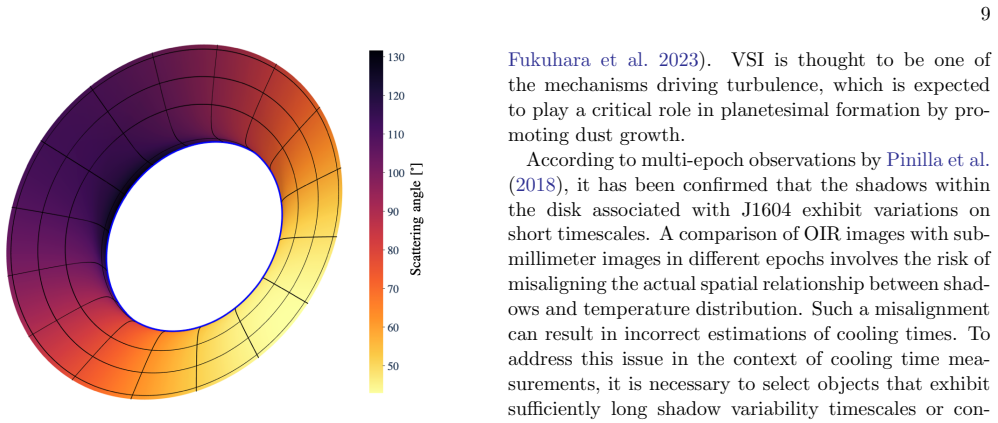
The central claim is that the boundary curves of a shadow and the horizon of the outer disk surface contain enough information to determine, simultaneously, the orientation and thickness of a misaligned inner disk and the full height profile of the outer disk's scattering surface. Earlier analytic shadow models neglected inner-disk thickness, producing infinitesimally narrow shadows and degeneracy between inclination and position angle, while treating the outer scattering surface as having a constant aspect ratio displaced the shadow positions. By modeling the inner disk as an optically thick slab of maximum aspect ratio $h_r$ and the outer disk as an axisymmetric surface with an empirical height profile $R(H)$ given by Eq. (6), the paper derives analytic expressions for both curve families: the horizon via $N_S \cdot \hat{e}_z = 0$, and the shadow boundary as the intersection of the two surfaces, which reduces to a quartic equation in $x = \sin(\phi_o)$. For HD 100453 the fit gives an inner inclination of $50.5^\circ$, position angle $88.3^\circ$, misalignment of about $70^\circ$, maximum aspect ratio $h_r = 0.17$, outer inner-edge radius $R_e = 16.8$ au, surface height $H_c = 6.6$ au at $R_c = 25$ au, and $\alpha \approx 4$, so the outer surface converges rapidly to $H \propto R$. The derived inner-disk orientation is consistent with independent interferometric measurements, and the $h_r$ value is roughly five times the gas pressure scale height, implying a dust scattering surface lofted well above the isothermal scale height.
Load-bearing premise
The outer disk is a single-valued, axisymmetric, optically thick surface whose height profile is fixed to the empirical family of Eq. (6), and the inner disk is a vertically symmetric slab with a single maximum aspect ratio; if either surface deviates from these shapes, the analytic shadow and horizon curves shift and all fitted parameters inherit the bias.
Editorial extensions
If this is right
- For any transition disk with a resolved shadow, the same fits can deliver the inner disk orientation and thickness without interferometric imaging of the inner disk itself.
- The method breaks the inclination–position-angle degeneracy that forced earlier shadow models to accept a wide range of inclinations, so the orientation estimates become usable inputs for dynamical and SED modeling.
- An inner-disk aspect ratio of 0.17 in HD 100453, well above the gas pressure scale height, indicates that the dust scattering surface is vertically extended; if typical, shadow-width measurements probe turbulent or wind-driven lofting rather than the thermal scale height.
- Outer disk surface height profiles inferred this way, with the HD 100453 surface converging to $H \propto R$, provide a direct comparison point for continuum emission bumps seen at millimeter wavelengths, linking the scattering surface to radial dust trapping.
- The horizon curve anchors the central position and inner-edge radius of the outer disk, which tightens the astrometric calibration of scattered-light images.
Reading between the lines
- Applying the same framework to the other known shadow-casting disks, such as HD 142527, CQ Tau, DoAr 44, and J1604, would test whether $h_r \sim 0.17$ is a characteristic of wind-lofted surfaces or specific to HD 100453; this extension is not carried out in the paper.
- Because the model supplies the scattering angle at every point of the outer surface, it turns the disk into a calibrated phase-function laboratory; combining the geometry with total-intensity images would allow grain properties to be fit as a function of radius, an extension the authors sketch but do not execute.
- A vertically asymmetric inner disk, as expected from MHD wind simulations, would make the front and back shadow boundaries differ in width; comparing the widths of the two fitted shadow curves in HD 100453's image is a direct test of the midplane-symmetry assumption that the paper's own limitation discussion invites.
Signed reviews
Editorial analysis
A structured set of objections, weighed in public.
Referee Report
Summary. This manuscript introduces an analytic framework for inferring the three-dimensional geometry of transition disks with misaligned inner disks. The outer disk is modeled as an axisymmetric, vertically single-valued surface with an empirical height profile (Eq. 6), and the inner disk shadow is modeled as a cone with a single maximum aspect ratio (Eq. 18). The horizon of the outer disk is defined by NS·ez=0 and yields Eq. (13); the shadow boundary is obtained as the solution of a quartic equation (Appendix B). The model is fitted to VLT/SPHERE J-band polarized-intensity images of HD 100453 using MCMC, yielding ii=50.5°, PAi=88.3°, misalignment ~70°, hr=0.17, and an outer surface that converges to H∝R. A flared extension (Section 4.2) gives beta≈1. The paper claims the method resolves parameter degeneracies and provides new constraints on the vertical structure of both disks.
Significance. If the framework works as claimed, it would be a useful addition to the transition-disk toolbox, because it extracts geometric information from scattered-light shadows without full radiative-transfer modeling. The analytic expressions for the horizon and shadow boundary are a genuine improvement over the thin-disk shadow model of Min et al. (2017). The recovered inner-disk inclination is consistent with an independent VLTI/GRAVITY measurement, which is a valuable external check. The main limitation is that the central inversion is validated on only one real object and never on synthetic images with known input geometry; the empirical outer-surface family (Eq. 6/A1) and the symmetric-cone inner disk (Eq. 18) are structural assumptions whose systematic effect on hr and the outer surface profile is not quantified. These issues, not the analytic geometry, are what stand between the current manuscript and a robust method paper.
major comments (4)
- [§2.4, Table 1] The likelihood used in the MCMC fit is never defined. The text states only that the model minimizes "the distance between these curves and the fast gradient points," but does not specify the data-point selection, the distance metric, the noise model, or the treatment of outliers. Without these definitions, the quoted posterior uncertainties (e.g., hr=0.170±0.001, PAi=88.3±0.5) and the claimed breaking of the PA–i degeneracy cannot be reproduced or interpreted. Please provide an explicit likelihood and data model.
- [§4.2, Tables 1 and 2] The flared model changes the recovered inner-disk orientation far beyond the statistical errors of the fiducial model: ii shifts from 50.5°±0.8° to 44.5°±1.0° and PAi from 88.3°±0.5° to 83.4°±0.8°. The text in §4.2 calls these results consistent, but the shifts are several times the reported uncertainties. This indicates that the inner-disk geometry is sensitive to the assumed outer-disk surface parameterization, and the current error bars do not capture the dominant systematic model uncertainty. The authors should reconcile this discrepancy or explicitly report the model-dependent range of ii and PAi.
- [§2.2, §4.3, Eq. (18)] The inner disk is modeled as vertically symmetric with a single maximum aspect ratio hr, and Section 4.3 itself notes that MHD winds can make the two surfaces asymmetric. If the upper and lower surfaces differ, the shadow boundary curves are displaced and the fitted ii, PAi, and hr will be biased. The paper does not test this sensitivity with synthetic images or with an asymmetric two-surface model. At minimum, the authors should quantify how much the inferred parameters shift when the front and back surfaces are allowed to have different heights, or when h(r) is replaced by a non-conical profile, before claiming that hr is constrained.
- [§3, Appendix A] No synthetic-image recovery experiment is presented. The paper's central claim—that shadow boundaries plus the horizon simultaneously determine ii, PAi, hr, and the outer surface profile (Re, Hc, alpha)—requires demonstrating that the inversion recovers known input values when applied to synthetic scattered-light images. This is especially important because Eq. (6)/(A1) is explicitly empirical and not derived from first principles; if the true outer surface deviates from this family, the analytic curves will be displaced and the MCMC will compensate by shifting other parameters. The GRAVITY check validates the inclination, but it does not validate hr or the outer surface height profile. Please add injection-recovery tests for at least the fiducial and flared families, and ideally for a surface generated by a different functional form.
minor comments (6)
- [§2.1, Eq. (1)] Equation (1) defines the outer-disk normal vector but the text says "where ii is the inclination of the outer disk"; this should be io, and the notation conflicts with the inner-disk inclination used in Eq. (14).
- [§2.3–2.4] The reproducibility of the pipeline is incomplete: the CLAHE and Canny parameters, the definition of the mask used to isolate shadows, and the MCMC chain settings (number of walkers, steps, burn-in, convergence diagnostics) are not reported.
- [Appendix B] The four roots of the quartic in Eq. (B4) are classified by signs, but the manuscript does not describe how the correct roots are tracked across the parameter space during the MCMC walk; a brief description or a figure showing all four candidate curves would help.
- [§4.2] The statement that beta≈1 "suggests that the disk is not significantly flared" should be tempered, because the fiducial model in Eq. (6) already asymptotes to H∝R; the flared model is nested, so beta close to 1 is partly built into the parameterization and is not an independent empirical result.
- [Figure 8 caption] The caption contains the typo "azimutal" instead of "azimuthal."
- [General] The manuscript does not state whether the MCMC code and data products will be made available; given the method's complexity, a public implementation or a detailed pseudocode appendix would materially aid reproducibility.
Circularity Check
No circularity: forward-model fit to shadow/horizon curves with an independent GRAVITY check; the empirical ansatz and missing recovery test are correctness risks, not circularity.
full rationale
The paper's method is a forward-model fit, not a derivation that reduces to its own inputs. The horizon curve is computed from the surface-normal condition NS·ez = 0 (Eqs. 11-13), and the shadow boundary curves are obtained by solving the intersection condition So − Si = 0 (Eq. 20, Appendix B), giving analytic curves that are then compared by MCMC to gradient features extracted from the SPHERE image. The reported quantities (ii, PAi, hr, Re, Hc, alpha) are free parameters of this forward model, not redefinitions of the measured curves, so recovering them from the image is ordinary parameter estimation rather than a self-fulfilling prediction. The inner-disk orientation is checked against an independent VLTI/GRAVITY measurement (Bohn et al. 2022), and the outer-disk PA and inclination are fixed from external ALMA-based work, which breaks any closed loop. Appendix A explicitly states that the outer surface profile is "not derived from first-principles or physical models" and is an empirical function, and Section 4.3 explicitly flags the vertical-symmetry assumption for the inner disk; these are structural modeling assumptions that could bias the results if violated, and the absence of a synthetic recovery test means that bias is not quantified. However, an acknowledged ansatz and an unquantified systematic error are not circularity: the model curves are not equivalent by construction to the fitted parameter values, and the central claim has independent content through the GRAVITY comparison. There are no load-bearing self-citations by the authors of this paper. The lack of a recovery test and the empirical surface family are therefore correctness and falsifiability concerns, not circular steps, so the circularity score is 0.
Assumptions & free parameters
free parameters (9)
- cox =
0.34 au
- coy =
0.46 au
- Re =
16.8 au
- Hc =
6.6 au
- alpha =
4.0
- ii =
50.5 degrees
- PAi =
88.3 degrees
- hr =
0.17
- Rc (reference radius) =
25 au (fixed)
assumptions (7)
- domain assumption The outer disk is optically thick at OIR wavelengths and its scattering surface is a single-valued, axisymmetric function So(H, phi) described by Eq. (4).
- domain assumption The inner disk is vertically symmetric and characterized by a single maximum aspect ratio hr in Eq. (18).
- domain assumption The star is at the center of the inner disk and on the outer midplane, so cix = ciy = 0 and ci dot no = 0 in Eq. (19).
- domain assumption The outer disk inclination and position angle are fixed to io = 34 degrees and PAo = 324 degrees from Bohn et al. (2022), and the distance is fixed to 103.78 pc from Gaia.
- ad hoc to paper The outer disk surface height profile is the empirical function Eq. (A1), which Appendix A explicitly states is not derived from first principles.
- domain assumption Variations in the degree of polarization across the image are negligible for locating shadow positions.
- domain assumption The computed image gradients after CLAHE and Canny trace the horizon and shadow boundary curves.
Cite this review
Pith. "Pith review of Shadow-Based Framework for Estimating Transition Disk Geometries." pith.science (2026). https://pith.science/paper/AMHCYJM7
@misc{pith2026250506044,
  author       = {Pith},
  title        = {Pith review of: Shadow-Based Framework for Estimating Transition Disk Geometries},
  year         = {2026},
  howpublished = {\url{https://pith.science/paper/AMHCYJM7}},
  note         = {Machine review of arXiv:2505.06044}
}
abstract
Some transition disks host misaligned inner disks with radii of several au. Understanding the geometric and physical properties of these misaligned disks is essential for advancing terrestrial planet formation models. This study introduces a novel method to infer the three-dimensional structures of both inner and outer disks by analyzing non-axisymmetric shadows and the horizon in optical and infrared scattered light images of the outer disk. This method was applied to the HD 100453 system, in which infrared scattered light images from the Very Large Telescope revealed disk shadows. These results indicate that the inner disk is misaligned by $\sim$70$^{\circ}$ relative to the outer disk, which is consistent with the results of previous studies. The aspect ratio of the inner disk surface was estimated to be 0.17, which may reflect the surface height of the optically thick dusty component due to vertical lofting by MHD winds or turbulence. In addition, the surface height distribution of the outer disk was characterized, providing novel insights into its vertical structure.
Figures


Figures from the paper (6 more)




Forward citations
Cited by 1 Pith paper
-
exoALMA. XVIII. Interpreting large scale kinematic structures as moderate warping
Moderate disk warps of about 0.5 to 2 degrees can reproduce the single-armed velocity patterns seen in many exoALMA disks, and may also explain spiral structures in scattered light and CO temperature.
Reference graph
Works this paper leans on
-
[1]
Astropy Collaboration, Robitaille, T. P., Tollerud, E. J., et al. 2013, A&A, 558, A33, doi: 10.1051/0004-6361/201322068 Astropy Collaboration, Price-Whelan, A. M., Sip˝ ocz, B. M., et al. 2018, AJ, 156, 123, doi: 10.3847/1538-3881/aabc4f
-
[2]
2017, in Astrophysics and Space Science Library, Vol
Bai, X.-N. 2017, in Astrophysics and Space Science Library, Vol. 445, Formation, Evolution, and Dynamics of Young Solar Systems, ed. M. Pessah & O. Gressel, 63, doi: 10.1007/978-3-319-60609-5 3
-
[3]
Bate, M. R. 2018, MNRAS, 475, 5618, doi: 10.1093/mnras/sty169
-
[4]
2017, A&A, 597, A42, doi: 10.1051/0004-6361/201629798
Benisty, M., Stolker, T., Pohl, A., et al. 2017, A&A, 597, A42, doi: 10.1051/0004-6361/201629798
-
[5]
2023, in Astronomical Society of the Pacific Conference Series, Vol
Benisty, M., Dominik, C., Follette, K., et al. 2023, in Astronomical Society of the Pacific Conference Series, Vol. 534, Protostars and Planets VII, ed. S. Inutsuka, Y. Aikawa, T. Muto, K. Tomida, & M. Tamura, 605, doi: 10.48550/arXiv.2203.09991
-
[6]
J., Benisty, M., Perraut, K., et al
Bohn, A. J., Benisty, M., Perraut, K., et al. 2022, A&A, 658, A183, doi: 10.1051/0004-6361/202142070
-
[7]
1999, A&A, 349, 619
Bouvier, J., Chelli, A., Allain, S., et al. 1999, A&A, 349, 619
1999
-
[8]
Canny, J. 1986, IEEE Transactions on Pattern Analysis and Machine Intelligence, PAMI-8, 679, doi: 10.1109/TPAMI.1986.4767851
arXiv 1986
Show all 38 references
-
[9]
2019, MNRAS, 486, L58, doi: 10.1093/mnrasl/slz059
Casassus, S., P´ erez, S., Osses, A., & Marino, S. 2019, MNRAS, 486, L58, doi: 10.1093/mnrasl/slz059
2019 doi
-
[10]
2018, MNRAS, 477, 5104, doi: 10.1093/mnras/sty894
Casassus, S., Avenhaus, H., P´ erez, S., et al. 2018, MNRAS, 477, 5104, doi: 10.1093/mnras/sty894
2018 doi
-
[11]
P., Henning, T., van Boekel, R., & Grady, C
Chen, X. P., Henning, T., van Boekel, R., & Grady, C. A. 2006, A&A, 445, 331, doi: 10.1051/0004-6361:20054122
2006 doi
-
[12]
2019, A&A, 622, A43, doi: 10.1051/0004-6361/201731732
Cuadra, J. 2019, A&A, 622, A43, doi: 10.1051/0004-6361/201731732
2019 doi
-
[13]
2014, in Protostars and Planets VI, ed
Espaillat, C., Muzerolle, J., Najita, J., et al. 2014, in Protostars and Planets VI, ed. H. Beuther, R. S. Klessen, C. P. Dullemond, & T. Henning, 497–520, doi: 10.2458/azu uapress 9780816531240-ch022
2014 doi
-
[14]
J., & Benisty, M
Flock, M., Fromang, S., Turner, N. J., & Benisty, M. 2016, ApJ, 827, 144, doi: 10.3847/0004-637X/827/2/144
2016 doi
-
[15]
J., Nelson, R
Flock, M., Turner, N. J., Nelson, R. P., et al. 2020, ApJ, 897, 155, doi: 10.3847/1538-4357/ab9641
2020 doi
-
[16]
W., Lang, D., & Goodman, J
Foreman-Mackey, D., Hogg, D. W., Lang, D., & Goodman, J. 2013, PASP, 125, 306, doi: 10.1086/670067
2013 doi
-
[17]
2020, ApJ, 892, 111, doi: 10.3847/1538-4357/ab7b63
Francis, L., & van der Marel, N. 2020, ApJ, 892, 111, doi: 10.3847/1538-4357/ab7b63
2020 doi
-
[18]
2023, PASJ, 75, 233, doi: 10.1093/pasj/psac107 Gaia Collaboration, Brown, A
Fukuhara, Y., Okuzumi, S., & Ono, T. 2023, PASJ, 75, 233, doi: 10.1093/pasj/psac107 Gaia Collaboration, Brown, A. G. A., Vallenari, A., et al. 2021, A&A, 649, A1, doi: 10.1051/0004-6361/202039657
2023 doi
-
[19]
2023, ApJ, 953, 92, doi: 10.3847/1538-4357/acdc97
Ginski, C., Tazaki, R., Dominik, C., & Stolker, T. 2023, ApJ, 953, 92, doi: 10.3847/1538-4357/acdc97
2023 doi
-
[20]
Hunter, J. D. 2007, Computing in Science and Engineering, 9, 90, doi: 10.1109/MCSE.2007.55
2007 doi
-
[21]
2015, ApJL, 798, L44, doi: 10.1088/2041-8205/798/2/L44
Marino, S., Perez, S., & Casassus, S. 2015, ApJL, 798, L44, doi: 10.1088/2041-8205/798/2/L44
2015 doi
-
[22]
2012, ApJL, 760, L26, doi: 10.1088/2041-8205/760/2/L26
Mayama, S., Hashimoto, J., Muto, T., et al. 2012, ApJL, 760, L26, doi: 10.1088/2041-8205/760/2/L26
2012 doi
-
[23]
2017, A&A, 604, L10, doi: 10.1051/0004-6361/201730949
Min, M., Stolker, T., Dominik, C., & Benisty, M. 2017, A&A, 604, L10, doi: 10.1051/0004-6361/201730949
2017 doi
-
[24]
K., & Inutsuka, S.-i
Miyake, T., Suzuki, T. K., & Inutsuka, S.-i. 2016, ApJ, 821, 3, doi: 10.3847/0004-637X/821/1/3
2016 doi
-
[25]
2016, ApJL, 823, L8, doi: 10.3847/2041-8205/823/1/L8
Montesinos, M., Perez, S., Casassus, S., et al. 2016, ApJL, 823, L8, doi: 10.3847/2041-8205/823/1/L8
2016 doi
-
[26]
2020, MNRAS, 499, 3857, doi: 10.1093/mnras/staa2721
Nealon, R., Cuello, N., Gonzalez, J.-F., et al. 2020, MNRAS, 499, 3857, doi: 10.1093/mnras/staa2721
2020 doi
-
[27]
2018, MNRAS, 481, 20, doi: 10.1093/mnras/sty2267
Nixon, C. 2018, MNRAS, 481, 20, doi: 10.1093/mnras/sty2267
2018 doi
-
[28]
2006, A Guide to NumPy (Trelgol Publishing)
Oliphant, T. 2006, A Guide to NumPy (Trelgol Publishing)
2006
-
[29]
2018, ApJ, 868, 85, doi: 10.3847/1538-4357/aae824
Pinilla, P., Benisty, M., de Boer, J., et al. 2018, ApJ, 868, 85, doi: 10.3847/1538-4357/aae824
2018 doi
-
[30]
2023, in Astronomical Society of the Pacific Conference Series, Vol
Pinte, C., Teague, R., Flaherty, K., et al. 2023, in Astronomical Society of the Pacific Conference Series, Vol. 534, Protostars and Planets VII, ed. S. Inutsuka, Y. Aikawa, T. Muto, K. Tomida, & M. Tamura, 645, doi: 10.48550/arXiv.2203.09528 Python Core Team. 2019, Python: A ...
-
[31]
P., Benisty, M., Juh´ asz, A., et al
Rosotti, G. P., Benisty, M., Juh´ asz, A., et al. 2020, MNRAS, 491, 1335, doi: 10.1093/mnras/stz3090
2020 doi
-
[32]
M., & Jayasree, V
Sasi, N. M., & Jayasree, V. K. 2013, Engineering, 5, 326, doi: 10.4236/eng.2013.510B066
2013 doi
-
[33]
2024, ApJ, 975, 126, doi: 10.3847/1538-4357/ad7581
Su, Z., & Bai, X.-N. 2024, ApJ, 975, 126, doi: 10.3847/1538-4357/ad7581
2024 doi
-
[34]
2017, ApJ, 843, 49, doi: 10.3847/1538-4357/aa74b5
Ueda, T., Okuzumi, S., & Flock, M. 2017, ApJ, 843, 49, doi: 10.3847/1538-4357/aa74b5
2017 doi
-
[35]
2020, AJ, 159, 118, doi: 10.3847/1538-3881/ab7006
Uyama, T., Muto, T., Mawet, D., et al. 2020, AJ, 159, 118, doi: 10.3847/1538-3881/ab7006
2020 doi
-
[36]
2024, ApJL, 974, L38, doi: 10.3847/2041-8213/ad815f
Zhang, S., & Zhu, Z. 2024, ApJL, 974, L38, doi: 10.3847/2041-8213/ad815f
2024 doi
-
[37]
2019, MNRAS, 483, 4221, doi: 10.1093/mnras/sty3358
Zhu, Z. 2019, MNRAS, 483, 4221, doi: 10.1093/mnras/sty3358
2019 doi
- [38]
Reviewed August 15, 2026 · model on record in the stance chip above.
Discussion (0). Continue with ORCID to comment.