REVIEW 4 major objections 5 minor 40 references
SepFormer: Coarse-to-fine Separator Regression Network for Table Structure Recognition
T0 review · 4 major / 5 minor · reviewed 2026-08-06 · deepseek-v4-flash
Pith's one-line read SepFormer shows that table structure recognition can be done in one shot by regressing separators, first as straight lines then as refined line-strips, reaching 25.6 FPS with accuracy near the best published methods on four benchmarks.
desk verdict A solid real-time TSR system with honest ablations; the stress-test's matching concern is already answered in Table 5, but no code and missing P ablation keep it from being a home run. read the letter →
The pith
A machine-rendered reading of the paper's core claim, the machinery that carries it, and where it could break.
The reading
What carries the argument
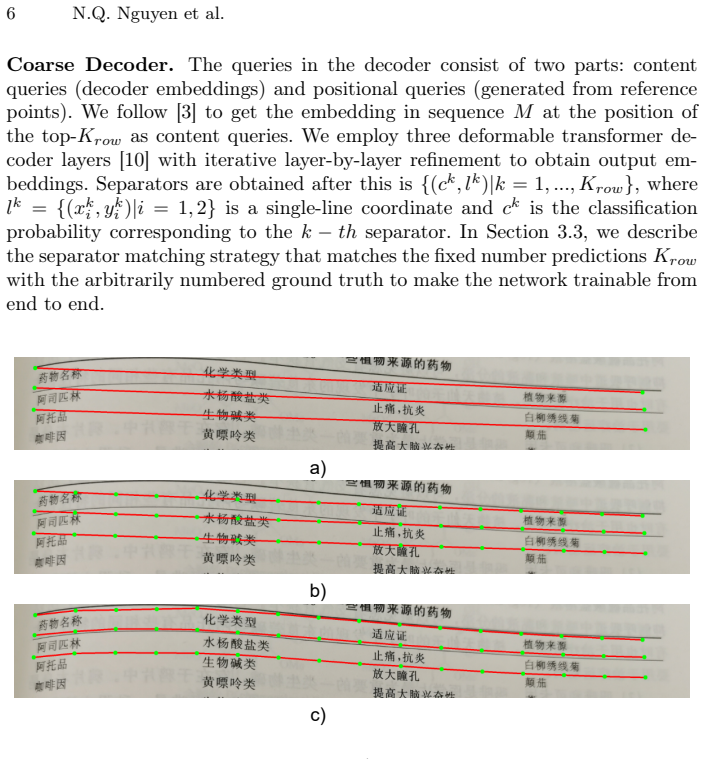
The carrier of the argument is the coarse-to-fine decoder stack. A deformable transformer decoder (an attention decoder that samples a few relevant feature locations per query instead of attending everywhere) first regresses each separator as a straight line in four-coordinate endpoint form, with an angle loss keeping the line's direction honest; then exactly P=16 points are evenly spaced along that line and fed as reference points to a second three-layer deformable decoder, which refines them into a 16-point line-strip. Query selection builds straight-line anchors from encoded multiscale features — horizontal proposals for rows, vertical for columns — which the paper argues sharpens the model's awareness of line prediction. The Hungarian matcher pairs the fixed number of predictions to a variable number of ground truths using single-line L1 distance, and this choice is load-bearing: substituting line-strip distance in the matcher degrades the ablation results.
What would settle it
Build a test set of strongly warped tables, such as photographs of pages bent into a curve, and compare line-strip predictions to ground truth at sub-segment resolution: if errors concentrate away from the sampled anchor points, the 16-point straight-line prior is the limiting assumption. Independently, count failure cases where two ground-truth separators lie closer than the matching resolution, since the paper's own analysis predicts precisely these cases produce merged or missed lines.
Extended reading notes
Core claim
The paper's central claim is that the split-and-merge approach to table recognition can be collapsed into one step: SepFormer regresses row and column separators straight from image features using two stacked transformer decoders. The coarse decoder treats every separator as a 4D single line (two endpoints), supervised by an L1 regression loss plus an angle loss that penalizes direction errors more heavily for short separators; sixteen points are then sampled evenly along each predicted line, and the fine decoder regresses those points into a line-strip separator that can represent slightly curved rows and columns. End-to-end training uses Hungarian bipartite matching on single-line L1 distance and classification confidence, and the paper finds that adding a line-strip-distance matching criterion hurts rather than helps. With this design, SepFormer reports 98.6 F1 on SciTSR-COMP, 96.8 TEDS-Struct on PubTabNet, 93.9 F1 on WTW, and 93.8 F1 on iFLYTAB, at an average 25.6 FPS, and its ablation shows the two-stage decoder outperforming one-stage decoders by 2.4 to 3.0 F1 points.
Load-bearing premise
The method assumes that sixteen evenly spaced sample points taken from a straight-line first guess give the fine stage enough reference points to represent curved or warped separators, and that matching predictions to true separators by straight-line distance never confuses two separators that lie close together — the paper itself notes in its error analysis that this L1 matching criterion can lack discrimination and cause merged or missed lines.
Editorial extensions
If this is right
- A production table-structure pipeline can drop segmentation masks and ROIAlign entirely, simplifying the system while keeping accuracy within roughly one point of the best published methods.
- Decoupling straight-line prediction from line-strip refinement is the key design choice: the two-stage decoder beats one-stage decoders by 2.4 to 3.0 F1 points in the iFLYTAB ablation.
- The angle loss, though it moves F1 by only 0.2 points, visibly stabilizes predictions of short separators, which are the ones most often misaligned.
- Real-time throughput is sustained across very different data domains — scanned documents, photographs, warped and rotated tables — with average processing at 25.6 FPS over four datasets.
- Because the paper reports that line-strip matching degrades performance, the single-line straight-line distance is the better supervision signal for this architecture.
Reading between the lines
- The same coarse-line-to-sampled-strip refinement could transfer to other line-regression tasks, such as lane detection or document ruling-line extraction, where a straight-line prior plus point refinement is a natural fit.
- The fine decoder only ever sees points sampled from the coarse straight line, so strongly curved separators are capped by the coarse stage; replacing the straight-line anchor with a curved prior such as a Bézier segment would be a direct testable extension.
- The paper's own failure analysis predicts that errors cluster where separators are tightly packed, so a matching cost that is aware of local line density could recover some of the merged or missed lines without retraining.
- The speed comparison against the slower high-accuracy systems is drawn from different published papers and hardware configurations; a shared-GPU re-measurement would be needed to confirm the exact speed-up factor in practice.
Editorial analysis
A structured set of objections, weighed in public.
Referee Report
Summary. SepFormer addresses Table Structure Recognition (TSR) by directly regressing row and column separators with a DETR-style architecture. The model uses a CNN backbone and hybrid encoder adapted from RT-DETR, a coarse transformer decoder that predicts straight single-line separators, P=16 sampled points per line, and a fine decoder that refines those points into line-strip separators. Training uses bipartite matching and a combined loss of classification, angle, single-line, and line-strip terms. The authors report an average of 25.6 FPS and accuracy comparable to state-of-the-art methods on SciTSR-COMP, PubTabNet, WTW, and iFLYTAB, with ablations on iFLYTAB for the two-stage decoder and angle loss.
Significance. If the reported speed and accuracy numbers hold, SepFormer is a useful contribution: it removes segmentation masks and ROIAlign, integrates split-and-merge into a single regression pass, and demonstrates a favorable speed-accuracy trade-off. The manuscript's strengths are its evaluation on four public benchmarks, comparison with both real-time and non-real-time methods, and ablations isolating the two-stage decoder and angle loss. The main limitations are the unquantified single-run results, underspecified FPS protocol, and a matching-cost equation that appears to have the wrong sign for the confidence term; these need to be fixed before the claims are fully supported.
major comments (4)
- [Section 3.3, Eq. (2)] In Eq. (2), the matching cost includes +λ_cls c_σ(i), where c_k is defined in Section 3.2 as a classification probability. Minimizing this cost would therefore prefer low-confidence predictions, which is opposite to the intended trade-off between distance and confidence. Please correct to -λ_cls c_σ(i) or λ_cls(1-c_σ(i)), or clarify if c denotes a cost rather than a probability, and verify that the reported results use the corrected form.
- [Section 4.2, Table 1] The FPS values in Table 1 are not reproducible as reported: no hardware details beyond 'RTX 3060', no batch size, input resolution, warm-up, number of runs, or post-processing steps, and no explanation of how per-dataset FPS values are aggregated into the 25.6 FPS average. Since the headline claim is real-time speed and the comparison with RTSR depends on an identical protocol, please specify the measurement setup and report variance across runs.
- [Tables 2-4] All benchmark numbers are from a single training run. The performance gaps to the best methods are 0.7%, 0.9%, 1.2%, and 0.6% on SciTSR-COMP, PubTabNet, WTW, and iFLYTAB, respectively; without multiple seeds or error bars, these differences are not statistically distinguishable from noise. Please report mean±std over at least three runs (or a paired comparison) for the main tables, or temper the 'comparable' claim accordingly.
- [Section 3.2, Eq. (1), Section 4.4] The coarse stage represents each separator as a straight line, samples P=16 points, and the matching in Eq. (2) uses only the coarse single-line L1 cost. The authors themselves attribute the failures in Fig. 5a-b to close or warped separators and to the L1 matching criterion. Since WTW and iFLYTAB are explicitly deformation-heavy, this is load-bearing for the 'comparable to SOTA' claim. Please add ablations on P (e.g., 8/16/32) and on the initial line representation (e.g., curved/chord or multiple candidate lines) to show the residual gaps are not caused by this design choice. Note that Table 5 already shows line-strip matching alone degrades performance, which is useful but does not address the P/initialization axis.
minor comments (5)
- [Eq. (5)] In the angle loss, c_n^gt and c_n are used as vectors in the cosine term and ||c_n^gt|| is a length penalty, but c was earlier defined as classification probability. Please use l_n^gt and l_n, or define c_n as the line vector; the notation currently conflates classification and geometry.
- [Section 4.3] The sentence 'iFLYTAB ... currently only has the results of the author group with many different versions' is inaccurate because Table 4 lists SEM, SEMv2, and SEMv3, which are from other research groups; please rephrase to state what is actually compared.
- [Section 3.2] The sentence 'This function only applies to a single-line separator in optimal matching in training and is filtered in the inference phase' is unclear: it is not obvious when sampling is applied during training and what 'filtered' means at inference. Please rewrite for clarity.
- [Table 5] The table rows use checkmarks without a clear mapping to the SL-M and LS-M columns; please make the column headers explicit (e.g., 'SL-M used', 'LS-M used') and ensure each row is unambiguous.
- [Throughout] There are minor text issues: 'T able 1' should be 'Table 1'; 'linestrip' and 'line-strip' are used inconsistently; some reference entries have inconsistent capitalization and formatting.
Circularity Check
SepFormer's central claims are empirical, benchmark-validated results with no derivation-level circularity; the only self-citation (RTSR) is a baseline comparison, not load-bearing.
full rationale
The paper's central claims are that SepFormer predicts row and column separators by coarse-to-fine regression and achieves real-time speed with accuracy comparable to state-of-the-art methods. These claims are validated empirically on four external public benchmarks (SciTSR-COMP, PubTabNet, WTW, iFLYTAB) with reported F1/TEDS scores and FPS measurements, so they do not reduce to the paper's own definitions or fitted parameters. The only self-citation is to the authors' previous RTSR method [31], used as a real-time baseline in Tables 1-4; it is not invoked to justify SepFormer's architecture or to support its accuracy claims. Equation (1) defines how P points are sampled from a single-line separator; this is a representational choice, not a prediction derived from an input. Equation (2) defines the Hungarian matching cost used for training supervision; it is an optimization objective, not a claimed theoretical derivation. The fine decoder's refinement of sampled points is an architectural mechanism, and the paper's ablation study (Table 5) compares variants on iFLYTAB, providing independent empirical evidence for the two-stage design. Section 4.4 explicitly notes a limitation: 'the L1 distance criterion used for single-line matching may lack sufficient discrimination,' leading to confusion with closely spaced separators. This is a recognized failure mode and correctness risk, not circularity. No equation is equivalent to another by construction, no fitted parameter is renamed as a prediction, and no load-bearing argument relies solely on a self-citation. Therefore no significant circularity is present.
Assumptions & free parameters
free parameters (7)
- Number of decoder queries K_row = K_col =
300
- Sampled points per separator P =
16
- Inference confidence thresholds tau_row and tau_col =
0.95
- Loss coefficients lambda1..lambda4 and matching weights lambda_cls, lambda_coord =
1, 1, 3, 1 and 2, 3
- Angle loss short-separator penalty scale =
4 times the ground-truth vector norm
- Training and test resize lengths =
train {864, 896, 928, 960}, test 896
- Learning rate and schedule =
3e-5, cosine annealing, 100 epochs (20 for PubTabNet)
assumptions (5)
- domain assumption Table separators can be represented as straight line segments in the coarse stage and as P-point line strips in the fine stage.
- domain assumption Ground-truth separators are available as endpoint pairs for training and matching.
- domain assumption Evaluation metrics (cell adjacency F1 and TEDS-struct) measure table structure recognition quality.
- standard math The pretrained ResNet-34 and deformable attention components behave as reported in the cited works.
- standard math Hungarian bipartite matching yields an optimal one-to-one assignment between predictions and ground truth.
Cite this review
Pith. "Pith review of SepFormer: Coarse-to-fine Separator Regression Network for Table Structure Recognition." pith.science (2026). https://pith.science/paper/AMKD7TOV
@misc{pith2026250621920,
  author       = {Pith},
  title        = {Pith review of: SepFormer: Coarse-to-fine Separator Regression Network for Table Structure Recognition},
  year         = {2026},
  howpublished = {\url{https://pith.science/paper/AMKD7TOV}},
  note         = {Machine review of arXiv:2506.21920}
}
read the original abstract
The automated reconstruction of the logical arrangement of tables from image data, termed Table Structure Recognition (TSR), is fundamental for semantic data extraction. Recently, researchers have explored a wide range of techniques to tackle this problem, demonstrating significant progress. Each table is a set of vertical and horizontal separators. Following this realization, we present SepFormer, which integrates the split-and-merge paradigm into a single step through separator regression with a DETR-style architecture, improving speed and robustness. SepFormer is a coarse-to-fine approach that predicts table separators from single-line to line-strip separators with a stack of two transformer decoders. In the coarse-grained stage, the model learns to gradually refine single-line segments through decoder layers with additional angle loss. At the end of the fine-grained stage, the model predicts line-strip separators by refining sampled points from each single-line segment. Our SepFormer can run on average at 25.6 FPS while achieving comparable performance with state-of-the-art methods on several benchmark datasets, including SciTSR, PubTabNet, WTW, and iFLYTAB.
Figures


Figures from the paper (3 more)


Reference graph
Works this paper leans on
-
[1]
In: 2019 International Conference on Document Analysis and Recognition, ICDAR 2019, pp
Tensmeyer, C., Morariu, V.I., Price, B.L., Cohen, S., Martinez, T.R.: Deep splitting and merging for table structure decomposition. In: 2019 International Conference on Document Analysis and Recognition, ICDAR 2019, pp. 114–121 (2019)
work page 2019
-
[2]
In: European conference on computer vision, pp
Carion, N., Massa, F., Synnaeve, G., Usunier, N., Kirillov, A., Zagoruyko, S: End- to-end object detection with transformers. In: European conference on computer vision, pp. 213-229 (2020) SepFormer: Coarse-to-fine Separator Regression Network 15
work page 2020
-
[3]
arXiv preprint arXiv:2203.03605 (2022)
Zhang, H., Li, F., Liu, S., Zhang, L., Su, H., Zhu, J., Ni, L.M., Shum, H.Y., : Dino: Detr with improved denoising anchor boxes for end-to-end object detection. arXiv preprint arXiv:2203.03605 (2022)
arXiv 2022
-
[4]
In: Proceedings of the IEEE/CVF conference on computer vision and pattern recognition, pp
Zhao, Y., Lv, W., Xu, S., Wei, J., Wang, G., Dang, Q., Liu, Y., Chen, J.: Detrs beat yolos on real-time object detection. In: Proceedings of the IEEE/CVF conference on computer vision and pattern recognition, pp. 16965-16974 (2024)
work page 2024
-
[5]
K. He, X. Zhang, S. Ren, J. Sun.: Deep residual learning for image recognition. In: Proceedings of the IEEE conference on computer vision and pattern recognition, pp.770–778 (2016)
work page 2016
-
[6]
In: 2019 International Conference on Document Analysis and Recognition, ICDAR 2019, pp
Khan, S.A., Khalid, S.M.D., Shahzad, M.A., Shafait, F.: Table structure extraction with bi-directional gated recurrent unit networks. In: 2019 International Conference on Document Analysis and Recognition, ICDAR 2019, pp. 1366–1371 (2019)
work page 2019
-
[7]
Wang, Y., Phillips, I. T., Haralick, R. M.: Table structure understanding and its performance evaluation. In: Pattern recognition, vol. 37(7), pp. 1479–1497 (2004)
work page 2004
-
[8]
In: 2012 International Conference on Frontiers in Handwriting Recognition, pp
Chen, J., Lopresti, D.: Model-based tabular structure detection and recognition in noisy handwritten documents. In: 2012 International Conference on Frontiers in Handwriting Recognition, pp. 75-80 (2012)
work page 2012
Show all 40 references
-
[9]
A., Tran, H
Tran, T. A., Tran, H. T., Na, I. S., Lee, G. S., Yang, H. J., Kim, S. H.: A mixture model using Random Rotation Bounding Box to detect table region in document image. Journal of Visual Communication and Image Representation, vol. 39, pp. 196-208 (2016)
2016
-
[10]
In International Conference on Learn- ing Representations (2020)
Zhu, X., Su, W., Lu, L., Li, B., Wang, X., Dai, J.: Deformable detr: Deformable transformers for end-to-end object detection. In International Conference on Learn- ing Representations (2020)
2020
-
[11]
In: Proceedings of the Twelfth Language Resources and Evaluation Conference, pp
Li, M., Cui, L., Huang, S., Wei, F., Zhou, M., Li, Z.: Tablebank: Table benchmark for image-based table detection and recognition. In: Proceedings of the Twelfth Language Resources and Evaluation Conference, pp. 1918-1925 (2020)
2020
-
[12]
In: Computer Vision–ECCV 2020: 16th European Con- ference, pp
Zhong, X., ShafieiBavani, E., Jimeno Yepes, A.: Image-based table recognition: data, model, and evaluation. In: Computer Vision–ECCV 2020: 16th European Con- ference, pp. 564-580 (2020)
2020
-
[13]
In: Document Analysis and Recognition–ICDAR 2021: 16th International Conference, Lausanne, Switzerland, September 5–10, 2021, Proceedings, Part II 16, pp
Li, Y., Huang, Y., Zhu, Z., Pan, L., Huang, Y., Du, L., Tang, Z., Gao, L.: Re- thinking table structure recognition using sequence labeling methods. In: Document Analysis and Recognition–ICDAR 2021: 16th International Conference, Lausanne, Switzerland, September 5–10, 2021, Pr...
2021
-
[14]
In: 2019 International Conference on Document Analysis and Recognition (ICDAR), pp
Deng, Y., Rosenberg, D., Mann, G.: Challenges in end-to-end neural scientific table recognition. In: 2019 International Conference on Document Analysis and Recognition (ICDAR), pp. 894-901 (2019)
2019
-
[15]
In: Pattern Recognition, vol
Zhang, Z., Zhang, J., Du, J., Wang, F.: Split, embed and merge: An accurate table structure recognizer. In: Pattern Recognition, vol. 126, pp. 108565 (2022)
2022
-
[16]
In: Pattern Recognition, pp
Zhang, Z., Hu, P., Ma, J., Du, J., Zhang, J., Yin, B., Yin, B., Liu, C.: SEMv2: Table separation line detection based on instance segmentation. In: Pattern Recognition, pp. 110279. (2024)
2024
-
[17]
and Du, J.: Semv3: A fast and robust approach to table separation line detection
Qin, C., Zhang, Z., Hu, P., Liu, C., Ma, J. and Du, J.: Semv3: A fast and robust approach to table separation line detection. In: Thirty-Third International Joint Conference on Artificial Intelligence, pp. 1191-1199. (2024)
2024
-
[18]
In: Proceedings of the 30th ACM Inter- national Conference on Multimedia, pp
Lin, W., Sun, Z., Ma, C., Li, M., Wang, J., Sun, L., Huo, Q.: TSRFormer: Table Structure Recognition with Transformers. In: Proceedings of the 30th ACM Inter- national Conference on Multimedia, pp. 6473-6482 (2022)
2022
-
[19]
In: arXiv preprint arXiv:2303.11615
Wang, J., Lin, W., Ma, C., Li, M., Sun, Z., Sun, L., Huo, Q.: Robust Table Struc- ture Recognition with Dynamic Queries Enhanced Detection Transformer. In: arXiv preprint arXiv:2303.11615. (2023) 16 N.Q. Nguyen et al
2023 arXiv
-
[20]
In: 2023 International Conference on Document Analysis and Recognition (ICDAR), pp
Lysak, M., Nassar, A., Livathinos, N., Auer, C., Staar, P.: Optimized Table To- kenization for Table Structure Recognition. In: 2023 International Conference on Document Analysis and Recognition (ICDAR), pp. 37–50 (2023)
2023
-
[21]
In: Pattern Recognition, vol
Ma, C., Lin, W., Sun, L., Huo, Q.: Robust Table Detection and Structure Recog- nition from Heterogeneous Document Images. In: Pattern Recognition, vol. 133, pp. 109006 (2023)
2023
-
[22]
R., Mahmood, H., Shafait, F.: Rethinking table recognition using graph neural networks
Qasim, S. R., Mahmood, H., Shafait, F.: Rethinking table recognition using graph neural networks. In: 2019 International Conference on Document Analysis and Recognition (ICDAR), pp. 142-147 (2019)
2019
-
[23]
D., Yu, H., Yin, W., Mao, X
Chi, Z., Huang, H., Xu, H. D., Yu, H., Yin, W., Mao, X. L.: Complicated table structure recognition. In: arXiv preprint arXiv:1908.04729 (2019)
2019 arXiv
-
[24]
R. Long, W. Wang, N. Xue, F. Gao, Z. Yang, Y. Wang, G.-S. Xia,: Parsing table structures in the wild. In: Proceedings of the IEEE/CVF International Conference on Computer Vision, pp. 944–952. (2021)
2021
-
[25]
and Kim, S.: TRACE: table reconstruction aligned to corner and edges
Baek, Y., Nam, D., Surh, J., Shin, S. and Kim, S.: TRACE: table reconstruction aligned to corner and edges. In: International Conference on Document Analysis and Recognition, pp. 472-489 (2023)
2023
-
[26]
In: 2019 international conference on document analysis and recognition (ICDAR) pp
Xue, W., Li, Q., Tao, D.: ReS2TIM: Reconstruct syntactic structures from table images. In: 2019 international conference on document analysis and recognition (ICDAR) pp. 749-755. (2019)
2019
-
[27]
H., Yin, F., Dai, H
Li, X. H., Yin, F., Dai, H. S., Liu, C. L.: Table structure recognition and form parsingbyend-to-endobjectdetectionandrelationparsing.In:PatternRecognition, 132, 108946. (2022)
2022
-
[28]
In: Proceedings of the 29th ACM International Conference on Multimedia, pp
Liu, H., Li, X., Liu, B., Jiang, D., Liu, Y., Ren, B., Ji, R.: Show, read and reason: Table structure recognition with flexible context aggregator. In: Proceedings of the 29th ACM International Conference on Multimedia, pp. 1084-1092. (2021)
2021
-
[29]
and Ren, B.: Neural collaborative graph machines for table structure recognition
Liu, H., Li, X., Liu, B., Jiang, D., Liu, Y. and Ren, B.: Neural collaborative graph machines for table structure recognition. In: Proceedings of the IEEE/CVF Confer- ence on Computer Vision and Pattern Recognition, pp. 4533-4542. (2022)
2022
-
[30]
Sun, X.: Grab What You Need: Rethinking Complex Table Structure Recognition with Flexible Components Deliberation
Liu, H., Li, X., Gong, M., Liu, B., Wu, Y., Jiang, D., ... Sun, X.: Grab What You Need: Rethinking Complex Table Structure Recognition with Flexible Components Deliberation. In: arXiv preprint arXiv:2303.09174. (2023)
2023 arXiv
-
[31]
and Tran, T.A.: RTSR: A Real-Time Table Structure Recognition Approach
Nguyen, N.Q., Pham, X.P. and Tran, T.A.: RTSR: A Real-Time Table Structure Recognition Approach. In: ECAI 2024, pp. 681-687. (2024)
2024
-
[32]
In: Proceedings of the IEEE/CVF Conference on Computer Vision and Pattern Recognition, pp
Smock, B., Pesala, R., Abraham, R.: PubTables-1M: Towards comprehensive ta- ble extraction from unstructured documents. In: Proceedings of the IEEE/CVF Conference on Computer Vision and Pattern Recognition, pp. 4634-4642 (2022)
2022
-
[33]
In: 2019 International Conference on Document Analysis and Recognition (ICDAR), pp
Paliwal, S.S., Vishwanath, D., Rahul, R., Sharma, M., Vig, L.,: Tablenet: Deep learning model for end-to-end table detection and tabular data extraction from scanned document images. In: 2019 International Conference on Document Analysis and Recognition (ICDAR), pp. 128-133 (2019)
2019
-
[34]
and Wang, J.: Gridformer: Towards accurate table structure recognition via grid prediction
Lyu, P., Ma, W., Wang, H., Yu, Y., Zhang, C., Yao, K., Xue, Y. and Wang, J.: Gridformer: Towards accurate table structure recognition via grid prediction. In Proceedings of the 31st ACM International Conference on Multimedia, pp. 7747- 7757 (2023)
2023
-
[35]
Raja, Sachin, Ajoy Mondal, and C. V. Jawahar: Table structure recognition us- ing top-down and bottom-up cues. In: Computer Vision–ECCV 2020: 16th Euro- pean Conference, Glasgow, UK, August 23–28, 2020, Proceedings, Part XXVIII 16. Springer International Publishing, pp. 70-86 ...
2020
-
[36]
In: 2017 14th IAPR International Conference on Document Analysis and recognition (ICDAR), pp
Schreiber, S., Agne, S., Wolf, I., Dengel, A., Ahmed, S.: Deepdesrt: Deep learning for detection and structure recognition of tables in document images. In: 2017 14th IAPR International Conference on Document Analysis and recognition (ICDAR), pp. 1162-1167 (2017)
2017
-
[37]
In: International Conference on Document Analysis and Recog- nition (ICDAR), pp
Kawakatsu,T.:Multi-celldecoderandmutuallearningfortablestructureandchar- acter recognition. In: International Conference on Document Analysis and Recog- nition (ICDAR), pp. 389-405 (2024)
2024
-
[38]
Q., Le, A
Nguyen, N. Q., Le, A. D., Lu, A. K., Mai, X. T., Tran, T. A.: Formerge: Recover spanning cells in complex table structure using transformer network. In: Interna- tional Conference on Document Analysis and Recognition, pp. 522-534 (2023)
2023
-
[39]
In: arXiv preprint arXiv:2208.14687
Guo,Z.,Yu,Y.,Lv,P.,Zhang,C.,Li,H.,Wang,Z.,Wang,J.:TRUST:AnAccurate and End-to-End Table structure Recognizer Using Splitting-based Transformers. In: arXiv preprint arXiv:2208.14687. (2022)
2022 arXiv
-
[40]
In: Pattern Recognition, 157, p.110816 (2025)
Long, R., Xing, H., Yang, Z., Zheng, Q., Yu, Z., Huang, F., Yao, C.: LORE++: Logical location regression network for table structure recognition with pre-training. In: Pattern Recognition, 157, p.110816 (2025)
2025
Reviewed August 6, 2026 · model on record in the stance chip above.
Discussion (0). Continue with ORCID to comment.