Orbital evolution of asymmetric binaries within accreting environments
Pith reviewed 2026-06-26 23:21 UTC · model grok-4.3
The pith
Disk-induced dissipation drives rapid orbital plane alignment followed by slower eccentricity damping in extreme mass-ratio inspirals, with relativistic effects causing deviations at large separations.
A machine-rendered reading of the paper's core claim, the machinery that carries it, and where it could break.
Core claim
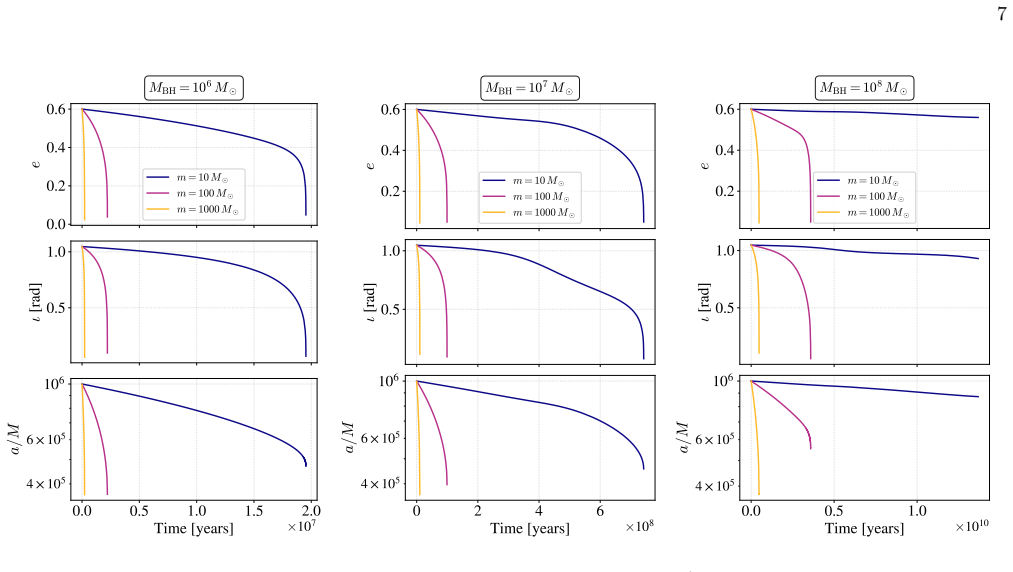
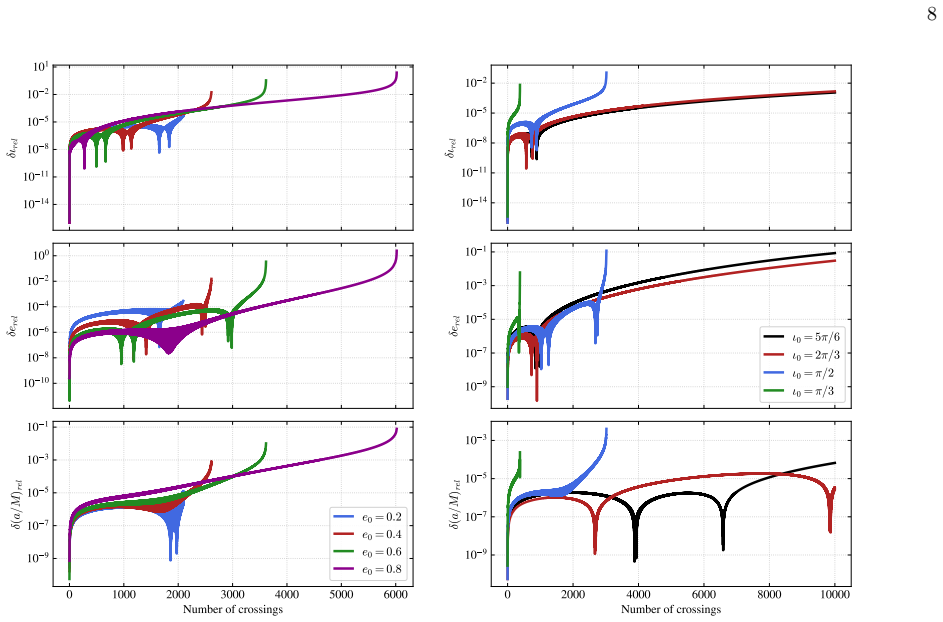
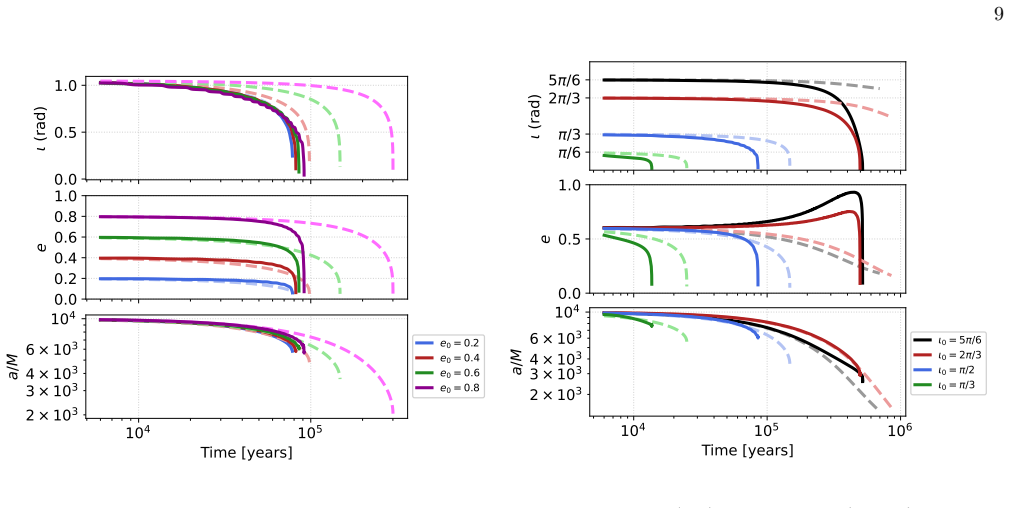
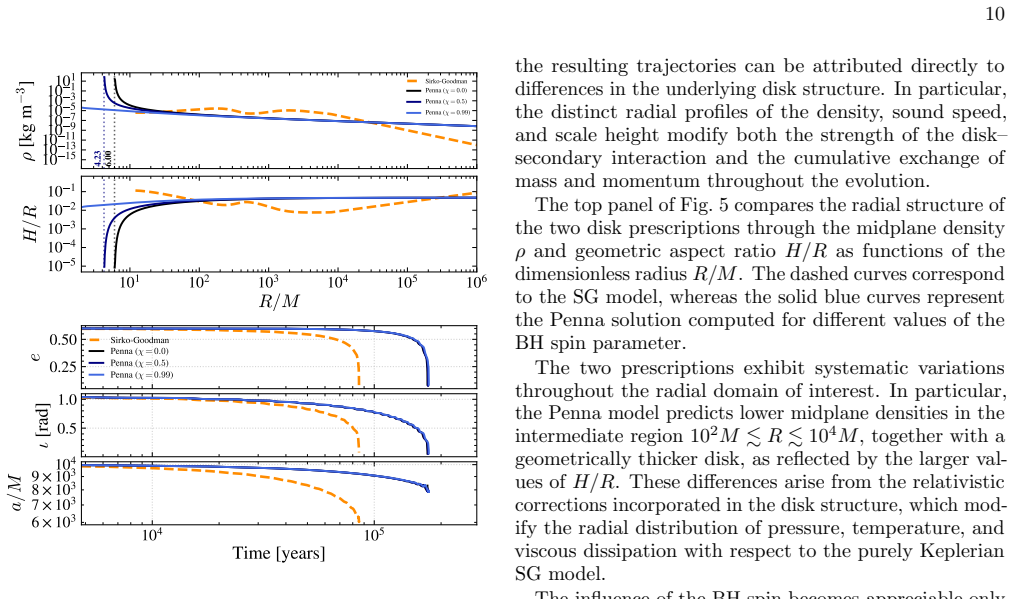
We find that disk-induced dissipation generically drives a two-stage evolution characterized by rapid alignment of the orbital plane with the disk, followed by slower eccentricity damping. By systematically comparing the dynamics with a purely Keplerian treatment, we show that cumulative relativistic effects produce deviations even at large orbital separations, where the Keplerian approximation would naively be expected to remain accurate. These discrepancies grow through repeated disk crossings and become increasingly pronounced in more relativistic orbital configurations. Relativistic disk structures predict systematically lower densities and larger scale heights, leading to weaker orbital
What carries the argument
Kerr geodesics combined with effective prescriptions for mass accretion and dynamical friction during repeated disk crossings
If this is right
- Rapid alignment of the orbital plane precedes significant eccentricity damping.
- Cumulative relativistic effects lead to growing deviations from Keplerian evolution over multiple disk crossings.
- Novikov-Thorne disk models result in weaker dissipation and slower evolution compared to Sirko-Goodman models.
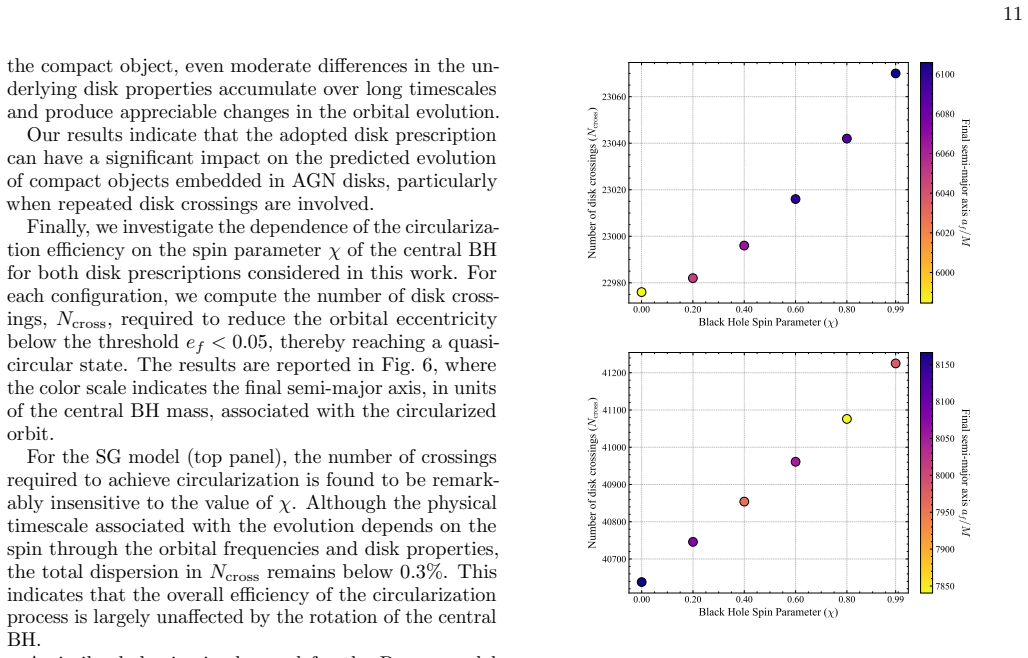
- The spin of the central black hole has only a minor effect on circularization efficiency.
Where Pith is reading between the lines
- Such evolution could connect to observed quasi-periodic eruptions if the timescales match observed variability patterns.
- Full hydrodynamic simulations of gas flow could refine the effective friction prescriptions and alter predicted timelines for alignment and damping.
- Observational signatures in electromagnetic counterparts might distinguish aligned from misaligned systems in active galactic nuclei.
Load-bearing premise
The effective prescriptions for mass accretion and dynamical friction accurately represent the net effect of repeated disk crossings without requiring full hydrodynamic simulations of the gas flow around the compact object.
What would settle it
A direct comparison between the secular evolution timelines predicted by the effective prescriptions and those from full hydrodynamic simulations of disk crossings would test the accuracy of the two-stage evolution model.
Figures
read the original abstract
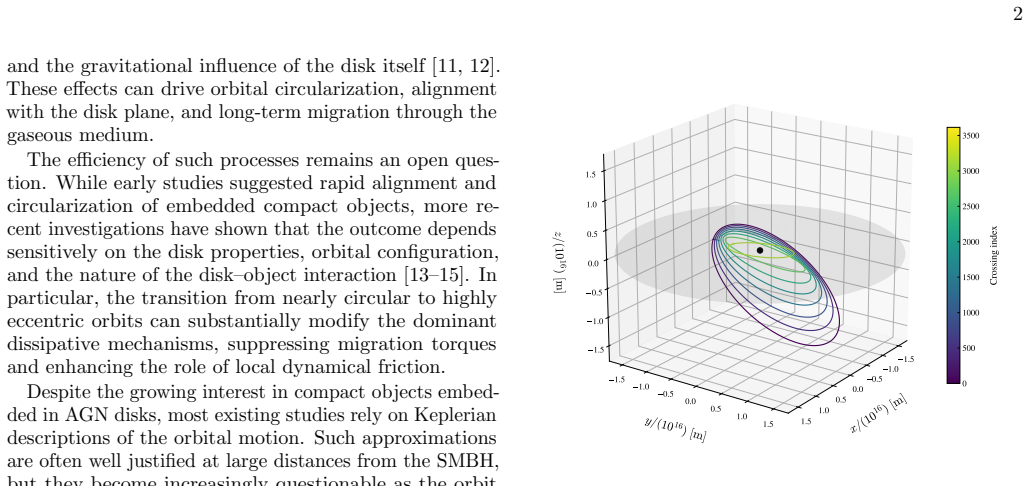
Extreme mass-ratio inspirals embedded in accretion disks provide a natural arena for studying the interplay between relativistic orbital dynamics and environmental effects. In this work, we develop a framework to investigate the secular evolution of compact objects repeatedly crossing an accretion disk around a supermassive black hole. The orbital motion is modeled through Kerr geodesics, while disk interactions are encoded through effective prescriptions for mass accretion and dynamical friction. We find that disk-induced dissipation generically drives a two-stage evolution characterized by rapid alignment of the orbital plane with the disk, followed by slower eccentricity damping. By systematically comparing the dynamics with a purely Keplerian treatment, we show that cumulative relativistic effects produce deviations even at large orbital separations, where the Keplerian approximation would naively be expected to remain accurate. These discrepancies grow through repeated disk crossings and become increasingly pronounced in more relativistic orbital configurations. We further investigate the impact of the accretion-disk model by comparing the Sirko-Goodman and Novikov-Thorne prescriptions. Relativistic disk structures predict systematically lower densities and larger scale heights, leading to weaker orbital dissipation and slower secular evolution. By contrast, the spin of the central black hole has only a minor effect on the overall circularization efficiency. Our results demonstrate the importance of consistently modeling both relativistic orbital dynamics and disk structure when studying compact objects embedded in AGN disks, and provide a framework for exploring their long-term evolution, as well as a possible connection to quasi-periodic eruptions.
Editorial analysis
A structured set of objections, weighed in public.
Referee Report
Summary. The paper develops a semi-analytic framework to study the secular evolution of extreme mass-ratio inspirals repeatedly crossing an accretion disk around a supermassive black hole. Orbital motion is modeled with Kerr geodesics while disk interactions are incorporated via effective prescriptions for mass accretion and dynamical friction. The central claims are that disk-induced dissipation drives a generic two-stage evolution (rapid orbital-plane alignment followed by slower eccentricity damping), that cumulative relativistic effects produce measurable deviations from a purely Keplerian treatment even at large orbital separations, and that relativistic disk models (Novikov-Thorne) yield weaker dissipation than Sirko-Goodman while black-hole spin has only a minor effect on circularization.
Significance. If the effective prescriptions are shown to be reliable, the work supplies a computationally efficient tool for tracking long-term EMRI evolution inside AGN disks and demonstrates that relativistic orbital dynamics cannot be neglected even at large radii because deviations accumulate over thousands of crossings. The systematic Kerr-versus-Keplerian comparison and the disk-model sensitivity study are useful for connecting to quasi-periodic eruption phenomenology.
major comments (2)
- [Framework and numerical implementation (near the description of the effective prescriptions)] The two-stage evolution and the reported cumulative relativistic deviations are obtained by integrating secular changes driven by the effective mass-accretion and dynamical-friction prescriptions applied at each Kerr-geodesic disk crossing. These prescriptions supply instantaneous Δm, ΔE, ΔL, and Δe without resolving local gas flow, shocks, or wake structure. Because any mismatch in torque or capture cross-section per crossing propagates over thousands of orbits, the manuscript must demonstrate that the prescriptions accurately represent the net effect of repeated crossings; otherwise the alignment timescale and the size of the Keplerian-vs-Kerr discrepancy remain uncertain.
- [Results section on Kerr vs. Keplerian comparison] The claim that relativistic effects produce deviations even at large separations rests on the comparison between Kerr geodesics and a purely Keplerian treatment. Without an explicit statement of the integration scheme for the secular equations, the number of crossings integrated, or an error analysis on the accumulated Δ quantities, it is difficult to assess whether the reported discrepancies are robust or sensitive to the details of the effective model.
minor comments (2)
- The title refers to 'asymmetric binaries' while the abstract and text focus on extreme mass-ratio inspirals; a brief clarification of the terminology would avoid confusion.
- A short table summarizing the two disk prescriptions (Sirko-Goodman vs. Novikov-Thorne) and their key parameters would improve readability of the model comparison.
Simulated Author's Rebuttal
We thank the referee for their careful reading and constructive comments on our manuscript. We address the major concerns point by point below.
read point-by-point responses
-
Referee: [Framework and numerical implementation (near the description of the effective prescriptions)] The two-stage evolution and the reported cumulative relativistic deviations are obtained by integrating secular changes driven by the effective mass-accretion and dynamical-friction prescriptions applied at each Kerr-geodesic disk crossing. These prescriptions supply instantaneous Δm, ΔE, ΔL, and Δe without resolving local gas flow, shocks, or wake structure. Because any mismatch in torque or capture cross-section per crossing propagates over thousands of orbits, the manuscript must demonstrate that the prescriptions accurately represent the net effect of repeated crossings; otherwise the alignment timescale and the size of the Keplerian-vs-Kerr discrepancy remain uncertain.
Authors: We agree that the effective prescriptions are approximations that omit detailed local gas dynamics, and that their cumulative accuracy over many crossings is important to assess. These prescriptions are drawn from established models in the literature on disk-embedded inspirals. A full hydrodynamical validation of net torques per crossing lies beyond the scope of this semi-analytic framework. In revision we will add an expanded discussion of the prescriptions' assumptions and limitations, cite supporting hydrodynamical results where available, and include a parameter-variation study to quantify sensitivity of the reported timescales. revision: partial
-
Referee: [Results section on Kerr vs. Keplerian comparison] The claim that relativistic effects produce deviations even at large separations rests on the comparison between Kerr geodesics and a purely Keplerian treatment. Without an explicit statement of the integration scheme for the secular equations, the number of crossings integrated, or an error analysis on the accumulated Δ quantities, it is difficult to assess whether the reported discrepancies are robust or sensitive to the details of the effective model.
Authors: We accept that these numerical details should be stated explicitly. The secular equations are integrated with an adaptive-step Runge-Kutta scheme, typically over several thousand disk crossings. In the revised manuscript we will insert a dedicated methods subsection describing the integrator, reporting the exact number of crossings for each case shown, and presenting an error analysis confirming that accumulated numerical errors remain well below the size of the reported Kerr-Keplerian differences. revision: yes
Circularity Check
No significant circularity; derivation self-contained
full rationale
The abstract and provided text describe a framework where Kerr geodesics supply the orbital motion and effective prescriptions for mass accretion and dynamical friction supply the instantaneous changes at each disk crossing. The reported two-stage evolution (rapid alignment then eccentricity damping) and the relativistic-vs-Keplerian deviations are stated to emerge from integrating those secular changes over many orbits. No equation or step is shown to define a quantity in terms of itself, to rename a fitted parameter as a prediction, or to rest the central claim on a self-citation chain whose content is unverified. The disk-model comparison (Sirko-Goodman vs. Novikov-Thorne) likewise compares two external prescriptions rather than deriving one from the other. The derivation therefore remains independent of its own outputs.
Axiom & Free-Parameter Ledger
free parameters (2)
- dynamical friction strength
- mass accretion efficiency
axioms (2)
- domain assumption Kerr geodesics accurately describe the orbital motion between disk crossings
- domain assumption Effective prescriptions for mass accretion and dynamical friction capture the essential disk interactions
Reference graph
Works this paper leans on
-
[1]
V. Cardoso and P. Pani, Living Rev. Rel.22, 4 (2019), arXiv:1904.05363 [gr-qc]
Pith/arXiv arXiv 2019
-
[2]
E. Barausse, V. Cardoso, and P. Pani, Physical Review D89, 104059 (2014), arXiv:1404.7149 [astro-ph.CO]
Pith/arXiv arXiv 2014
-
[3]
P. A. Seoaneet al.(LISA), Living Rev. Rel.26, 2 (2023), arXiv:2203.06016 [gr-qc]
Pith/arXiv arXiv 2023
-
[4]
K. G. Arunet al.(LISA), Living Rev. Rel.25, 4 (2022), arXiv:2205.01597 [gr-qc]
arXiv 2022
-
[5]
F. S. Broekgaarden, S. Banagiri, and E. Payne, Astrophys. J.969, 108 (2024), arXiv:2303.17628 [astro-ph.HE]
arXiv 2024
-
[6]
Toubiana, L
A. Toubiana, L. Sberna, A. Caputo, G. Cusin, S. Marsat, K. Jani, S. Babak, E. Barausse, C. Caprini, P. Pani, A. Sesana, and N. Tamanini, Phys. Rev. Lett.126, 101105 (2021)
2021
-
[7]
V. Cardoso and A. Maselli, Astron. Astrophys.644, A147 (2020), arXiv:1909.05870 [astro-ph.HE]
arXiv 2020
- [8]
-
[9]
P. Amaro-Seoane, Living Rev. Rel.21, 4 (2018), arXiv:1205.5240 [astro-ph.CO]
Pith/arXiv arXiv 2018
-
[10]
L. Baracket al., Class. Quant. Grav.36, 143001 (2019), arXiv:1806.05195 [gr-qc]
Pith/arXiv arXiv 2019
-
[11]
Barausse and L
E. Barausse and L. Rezzolla, Physical Review D77(2008)
2008
-
[12]
F. H. Nouri and A. Janiuk, Astronomy I& Astrophysics 669, 10.1051/0004-6361/20248796-23 (2024)
-
[13]
Cardoso, K
V. Cardoso, K. Destounis, F. Duque, R. P. Macedo, and A. Maselli, Phys. Rev. Lett.129, 241103 (2022)
2022
-
[14]
E. Grishin, S. Gilbaum, and N. C. Stone, Mon. Not. Roy. Astron. Soc.530, 2114 (2024), [Erra- tum: Mon.Not.Roy.Astron.Soc. 535, 1693–1694 (2024)], arXiv:2307.07546 [astro-ph.HE]
arXiv 2024
-
[15]
M. A. Sedda, S. Naoz, and B. Kocsis, Universe9, 138 (2023), arXiv:2302.14071 [astro-ph.GA]
arXiv 2023
-
[16]
I. Linial and B. D. Metzger, Astrophys. J.957, 34 (2023), arXiv:2303.16231 [astro-ph.HE]
arXiv 2023
-
[17]
A. Franchini, M. Bonetti, A. Lupi, G. Miniutti, E. Bor- tolas, M. Giustini, M. Dotti, A. Sesana, R. Arcodia, and T. Ryu, Astron. Astrophys.675, A100 (2023), arXiv:2304.00775 [astro-ph.HE]
arXiv 2023
-
[18]
T. F. M. Spieksma and E. Cannizzaro, Mon. Not. Roy. Astron. Soc.546, stag021 (2026), arXiv:2504.08033 [astro- ph.GA]
arXiv 2026
-
[19]
J. E. Pringle, Ann. Rev. Astron. Astrophys.19, 137 (1981)
1981
-
[20]
N. I. Shakura and R. A. Sunyaev, Astron. Astrophys.24, 337 (1973)
1973
-
[21]
N. I. Shakura and R. A. Sunyaev, Mon. Not. Roy. Astron. Soc.175, 613 (1976)
1976
-
[22]
P. C. Fragile and M. Liska, Tilted Accretion Disks (2025) arXiv:2404.10052 [astro-ph.HE]
arXiv 2025
-
[23]
I. K. Dihingia and C. Fendt, Thin Accretion Disks in GR- MHD Simulations (2025) arXiv:2404.06140 [astro-ph.HE]
arXiv 2025
-
[24]
M. A. Abramowicz and P. C. Fragile, Living Rev. Rel.16, 1 (2013), arXiv:1104.5499 [astro-ph.HE]
Pith/arXiv arXiv 2013
-
[25]
R. F. Penna, J. C. McKinney, R. Narayan, A. Tchekhovskoy, R. Shafee, and J. E. McClintock, Monthly Notices of the Royal Astronomical Society408, 752 (2010), https://academic.oup.com/mnras/article- pdf/408/2/752/18433142/mnras0408-0752.pdf
2010
-
[26]
Toomre, Astrophys
A. Toomre, Astrophys. J.139, 1217 (1964)
1964
-
[27]
Kratter and G
K. Kratter and G. Lodato, Annual Review of Astronomy and Astrophysics54, 271 (2016)
2016
-
[28]
D. N. Page and K. S. Thorne, Astrophys. J.191, 499 (1974)
1974
-
[29]
E. Agol and J. Krolik, Astrophys. J.528, 161 (2000), arXiv:astro-ph/9908049
Pith/arXiv arXiv 2000
-
[30]
J. H. Krolik and J. F. Hawley, Astrophys. J.573, 754 (2002), arXiv:astro-ph/0203289
Pith/arXiv arXiv 2002
-
[31]
W. Kley and R. P. Nelson, Ann. Rev. Astron. Astrophys. 50, 211 (2012), arXiv:1203.1184 [astro-ph.EP]
Pith/arXiv arXiv 2012
-
[32]
S. DeLaurentiis, M. Epstein-Martin, and Z. Haiman, Mon. Not. Roy. Astron. Soc.523, 1126 (2023), arXiv:2212.02650 [astro-ph.HE]
arXiv 2023
-
[33]
E. C. Ostriker, Astrophys. J.513, 252 (1999), arXiv:astro- ph/9810324
arXiv 1999
- [34]
- [35]
-
[36]
R. G. Edgar, New Astron. Rev.48, 843 (2004), arXiv:astro-ph/0406166
Pith/arXiv arXiv 2004
-
[37]
R. Fujita and W. Hikida, Class. Quant. Grav.26, 135002 (2009), arXiv:0906.1420 [gr-qc]
Pith/arXiv arXiv 2009
-
[38]
Carter, Commun
B. Carter, Commun. Math. Phys.10, 280 (1968)
1968
-
[39]
W. Schmidt, Class. Quant. Grav.19, 2743 (2002), arXiv:gr-qc/0202090
Pith/arXiv arXiv 2002
-
[40]
S. Park and Z. Nasipak, J. Open Source Softw.9, 6587 (2024), arXiv:2406.01413 [gr-qc]
arXiv 2024
-
[41]
G. Miniutti, R. D. Saxton, M. Giustini, K. D. Alexander, R. P. Fender, I. Heywood, I. Monageng, M. Coriat, A. K. Tzioumis, A. M. Read, C. Knigge, P. Gandhi, M. L. Pretorius, and B. Ag´ ıs-Gonz´ alez, Nature (London)573, 381 (2019), arXiv:1909.04693 [astro-ph.HE]
arXiv 2019
-
[42]
I. Zalamea, K. Menou, and A. M. Beloborodov, Mon. Not. Roy. Astron. Soc.409, 25 (2010), arXiv:1005.3987 [astro-ph.HE]
Pith/arXiv arXiv 2010
- [43]
- [44]
-
[45]
Nichollet al., Nature634, 804 (2024), arXiv:2409.02181 [astro-ph.HE]
M. Nichollet al., Nature634, 804 (2024), arXiv:2409.02181 [astro-ph.HE]
arXiv 2024
-
[46]
M. Sniegowska, B. Czerny, E. Bon, and N. Bon, Astron- omy I& Astrophysics641, A167 (2020), arXiv:2007.06441 [astro-ph.GA]
arXiv 2020
- [47]
- [48]
-
[49]
D. Syer, C. J. Clarke, and M. J. Rees, Monthly Notices of the Royal Astronomical Society250, 505 (1991)
1991
-
[50]
P. C. Peters, Phys. Rev.136, B1224 (1964)
1964
- [51]
discussion (0)
Sign in with ORCID, Apple, or X to comment. Anyone can read and Pith papers without signing in.