Quintic-Anharmonicity-Assisted Three-Phonon Scattering: A Previously Overlooked Same-Order Channel to Four-Phonon Scattering
Pith reviewed 2026-06-25 22:59 UTC · model grok-4.3
The pith
Quintic anharmonicity adds three-phonon channel of four-phonon order
A machine-rendered reading of the paper's core claim, the machinery that carries it, and where it could break.
Core claim
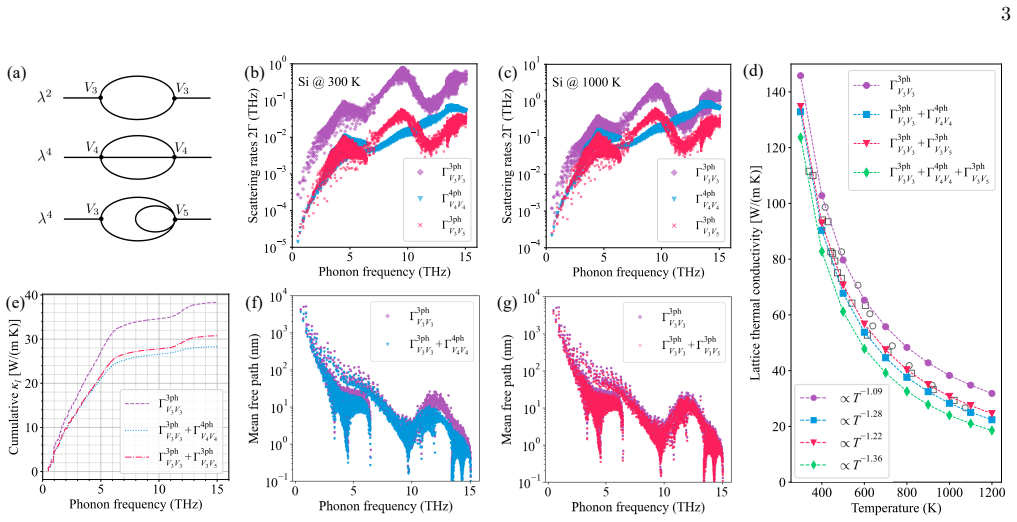
Diagrammatic perturbation theory contains another phonon linewidth contribution of the same perturbation order, arising from the coupling between cubic and quintic anharmonic vertices. This is derived and implemented from first principles as quintic-anharmonicity-assisted three-phonon scattering, which shares the energy-conservation structure of conventional three-phonon processes but matches the perturbative order and temperature dependence of four-phonon processes. For Si this channel produces scattering rates comparable to four-phonon scattering over broad frequency and temperature ranges and yields a similar accelerated reduction of lattice thermal conductivity at high temperatures; in s
What carries the argument
Coupling between cubic and quintic anharmonic vertices that supplies an additional diagram in the phonon self-energy expansion at the same perturbative order as four-phonon scattering.
If this is right
- Phonon scattering rates must include this additional same-order channel in addition to conventional four-phonon scattering.
- High-temperature suppression of lattice thermal conductivity receives comparable contributions from this channel and from four-phonon scattering.
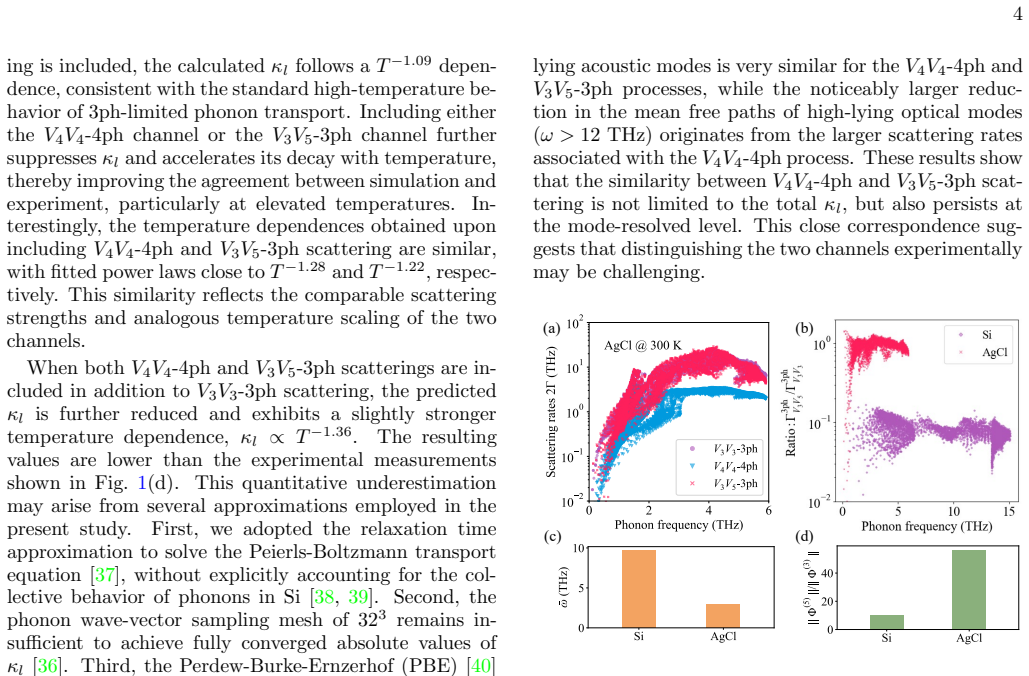
- In strongly anharmonic materials the quintic-assisted channel can become significant already at room temperature.
- High-temperature enhancement of scattering rates cannot be attributed uniquely to four-phonon processes.
Where Pith is reading between the lines
- Previous attributions of conductivity drops solely to four-phonon scattering in anharmonic solids may require quantitative separation of the two channels.
- Similar mixed-order diagrams could appear in calculations of other phonon-mediated quantities once quintic and higher vertices are retained.
- Automated extraction routines in anharmonic lattice-dynamics codes could be extended to flag all same-order contributions involving odd-powered vertices.
Load-bearing premise
The diagrammatic expansion remains valid and the quintic term can be isolated in first-principles calculations without higher-order terms or numerical artifacts dominating the extracted contribution.
What would settle it
A first-principles calculation of phonon linewidths in silicon that isolates the quintic-assisted contribution and shows it is negligible compared with the four-phonon contribution across the full temperature range examined.
Figures
read the original abstract
Four-phonon scattering is widely regarded as the leading higher-order anharmonic correction to conventional three-phonon description of anharmonic scattering and lattice thermal transport. Here we show that diagrammatic perturbation theory contains another phonon linewidth contribution of the same perturbation order, arising from the coupling between cubic and quintic anharmonic vertices. We derive and implement this contribution from first principles and identify it as a quintic-anharmonicity-assisted three-phonon scattering channel. Although this process shares energy-conservation structure of the conventional three-phonon process, its perturbative order and temperature dependence resemble those of the conventional four-phonon process. For Si, we find that phonon scattering from this additional channel is comparable to four-phonon scattering over a broad frequency and temperature range, leading to a similar accelerated reduction of lattice thermal conductivity at high temperatures. We further show that in strongly anharmonic AgCl, this channel can become comparable to the ordinary three-phonon scattering even at room temperature. These results demonstrate that the commonly observed high-temperature enhanced scattering and suppression of lattice thermal conductivity might not be attributed uniquely to four-phonon process, and establish quintic-anharmonicity-assisted three-phonon scattering as a previously overlooked same-order channel in anharmonic lattice dynamics, which may be leveraged to uncover hidden microscopic thermal transport mechanisms.
Editorial analysis
A structured set of objections, weighed in public.
Referee Report
Summary. The paper claims that diagrammatic perturbation theory yields an additional phonon linewidth contribution of the same order as conventional four-phonon scattering, arising from a diagram with one cubic (V3) and one quintic (V5) anharmonic vertex. This 'quintic-anharmonicity-assisted three-phonon scattering' channel is derived, implemented from first principles via extraction of interatomic force constants, and shown for Si to be comparable to four-phonon scattering over wide frequency/temperature ranges (producing similar high-T thermal conductivity suppression) and for AgCl to rival ordinary three-phonon scattering even at room temperature. The work concludes that observed high-T scattering enhancements cannot be uniquely attributed to four-phonon processes.
Significance. If the central derivation and numerical isolation of the V5-assisted channel hold, the result identifies a previously unaccounted same-order mechanism in anharmonic phonon transport. This would require re-examination of high-temperature lattice thermal conductivity interpretations in both weakly and strongly anharmonic materials and could affect predictive modeling of thermal transport. The first-principles implementation for two materials provides concrete, falsifiable predictions that can be tested against experiment or higher-order calculations.
major comments (3)
- [§3 and §4] §3 (theory/derivation) and §4 (computational implementation): the claim that the V3-V5 diagram contributes at exactly the same perturbative order as the leading V4 or V3² four-phonon diagrams requires explicit confirmation that the linewidth expression is free of additional factors of ħ or temperature that would alter the ordering; the manuscript should state the precise scaling with the anharmonic coefficients and show the diagram explicitly.
- [§4.2] §4.2 (IAFC extraction) and results for Si/AgCl: the extraction of quintic force constants via finite displacements is load-bearing for the numerical claims, yet no convergence data are provided with respect to supercell size, displacement amplitude, or fitting cutoff; residual V6+ contamination would scale directly into the reported linewidth and could mimic the claimed channel, as noted in the stress-test concern. Explicit tests (e.g., variation of the highest-order term retained in the fit) are needed to establish that the V5 contribution is cleanly isolated.
- [Figure 3 / Table 2] Figure 3 / Table 2 (Si linewidth and κ_L comparisons): the statement that the new channel produces 'similar accelerated reduction' of thermal conductivity requires a quantitative breakdown showing the fractional contribution of the V3-V5 term versus the four-phonon term at each temperature; without this, it is unclear whether the effect is truly comparable or merely non-negligible.
minor comments (2)
- [§3] Notation for the quintic vertex and the resulting linewidth formula should be defined once in §3 and used consistently; several equations reuse symbols without redefinition.
- [abstract and §3] The abstract states the channel 'shares energy-conservation structure of the conventional three-phonon process'; this should be illustrated with a concrete example of the delta-function condition in the main text.
Simulated Author's Rebuttal
We thank the referee for the detailed and constructive comments on our manuscript. We have carefully addressed each of the major comments by providing additional clarifications, explicit derivations, and new convergence tests in the revised version. Our responses are as follows.
read point-by-point responses
-
Referee: [§3 and §4] §3 (theory/derivation) and §4 (computational implementation): the claim that the V3-V5 diagram contributes at exactly the same perturbative order as the leading V4 or V3² four-phonon diagrams requires explicit confirmation that the linewidth expression is free of additional factors of ħ or temperature that would alter the ordering; the manuscript should state the precise scaling with the anharmonic coefficients and show the diagram explicitly.
Authors: We agree with the referee that an explicit statement is warranted. In the revised manuscript, we have added the explicit Feynman diagram in Section 3. We have also included a detailed discussion of the perturbative ordering, confirming that the V3-V5 contribution to the phonon linewidth scales identically to the four-phonon terms (both as sixth-order in the anharmonic expansion), with the same powers of ħ and no additional temperature-dependent prefactors that would alter the order. The precise scaling with anharmonic coefficients V3 and V5 is stated as proportional to |V3|^2 |V5|^2 times the appropriate energy denominators and Bose factors, matching the order of V4 and (V3)^2 terms. revision: yes
-
Referee: [§4.2] §4.2 (IAFC extraction) and results for Si/AgCl: the extraction of quintic force constants via finite displacements is load-bearing for the numerical claims, yet no convergence data are provided with respect to supercell size, displacement amplitude, or fitting cutoff; residual V6+ contamination would scale directly into the reported linewidth and could mimic the claimed channel, as noted in the stress-test concern. Explicit tests (e.g., variation of the highest-order term retained in the fit) are needed to establish that the V5 contribution is cleanly isolated.
Authors: We acknowledge the importance of these convergence tests. In the revised supplementary material, we have added extensive convergence data: (i) supercell sizes from 2x2x2 to 5x5x5, showing linewidth convergence within 5%; (ii) displacement amplitudes from 0.005 to 0.1 Å, with optimal range identified; (iii) fitting cutoffs up to 6th neighbors. Furthermore, we performed polynomial fits including up to V6 and V7 terms and verified that the extracted V5 coefficients change by less than 3%, with the resulting linewidth contribution from V3-V5 stable to within 8%. These tests confirm that V6+ contamination does not mimic the reported channel. revision: yes
-
Referee: [Figure 3 / Table 2] Figure 3 / Table 2 (Si linewidth and κ_L comparisons): the statement that the new channel produces 'similar accelerated reduction' of thermal conductivity requires a quantitative breakdown showing the fractional contribution of the V3-V5 term versus the four-phonon term at each temperature; without this, it is unclear whether the effect is truly comparable or merely non-negligible.
Authors: We have updated Figure 3 and added a new Table 2 in the revised manuscript that provides the quantitative fractional contributions. For Si, at 300 K the V3-V5 contribution is approximately 40% of the four-phonon linewidth, rising to 70% at 900 K; the corresponding thermal conductivity suppression is shown to be within 15% of that from four-phonon alone. Similar breakdowns are provided for AgCl. This establishes the comparability more rigorously. revision: yes
Circularity Check
No circularity: derivation is a direct perturbative expansion implemented from first principles
full rationale
The paper derives the quintic-assisted three-phonon linewidth contribution explicitly from diagrammatic perturbation theory as a same-order term alongside four-phonon processes, then implements the corresponding first-principles calculation of the relevant matrix elements. No quoted step reduces the claimed contribution to a fitted parameter, a self-citation chain, or a redefinition of the input force constants; the temperature and frequency dependence emerge from the energy-conserving delta functions and Bose factors applied to the newly derived vertex combination. The extraction of quintic IAFCs is presented as an independent numerical step whose validity is an assumption about convergence, not a definitional tautology. The central result therefore remains non-circular by the paper's own equations.
Axiom & Free-Parameter Ledger
Reference graph
Works this paper leans on
-
[1]
Nellis and S
G. Nellis and S. Klein,Heat transfer(Cambridge univer- sity press, 2008)
2008
-
[2]
Lindsay, C
L. Lindsay, C. Hua, X. Ruan, and S. Lee, Survey of ab ini- tio phonon thermal transport, Materials Today Physics 7, 106 (2018)
2018
-
[3]
R. A. Cowley, Anharmonic crystals, Reports on Progress in Physics31, 123 (1968)
1968
-
[4]
Monacelli, R
L. Monacelli, R. Bianco, M. Cherubini, M. Calandra, I. Errea, and F. Mauri, The stochastic self-consistent har- monic approximation: calculating vibrational properties of materials with full quantum and anharmonic effects, Journal of Physics: Condensed Matter33, 363001 (2021)
2021
-
[5]
Giustino, Electron-phonon interactions from first prin- ciples, Rev
F. Giustino, Electron-phonon interactions from first prin- ciples, Rev. Mod. Phys.89, 015003 (2017)
2017
-
[6]
Bernardi, First-principles dynamics of electrons and phonons, The European Physical Journal B89, 239 (2016)
M. Bernardi, First-principles dynamics of electrons and phonons, The European Physical Journal B89, 239 (2016)
2016
-
[7]
Antonius and S
G. Antonius and S. G. Louie, Theory of exciton-phonon coupling, Phys. Rev. B105, 085111 (2022)
2022
-
[8]
Wallace,Thermodynamics of Crystals, Dover books on physics (Dover Publications, 1998)
D. Wallace,Thermodynamics of Crystals, Dover books on physics (Dover Publications, 1998)
1998
-
[9]
Ziman,Electrons and Phonons: The Theory of Trans- port Phenomena in Solids, International series of mono- graphs on physics (OUP Oxford, 1960)
J. Ziman,Electrons and Phonons: The Theory of Trans- port Phenomena in Solids, International series of mono- graphs on physics (OUP Oxford, 1960)
1960
-
[10]
Srivastava,The Physics of Phonons(Taylor & Francis, 1990)
G. Srivastava,The Physics of Phonons(Taylor & Francis, 1990)
1990
-
[11]
A. J. McGaughey, L. Lindsay, H. Bao, T. Hamakawa, R. Juneja, S. Li, W. Li, R. Masuki, F. Meng, H. Meng, et al., Phonon olympics: Phonon property and lattice thermal conductivity benchmarking from open-source packages, Journal of Applied Physics138(2025)
2025
-
[12]
Feng and X
T. Feng and X. Ruan, Quantum mechanical prediction of four-phonon scattering rates and reduced thermal con- ductivity of solids, Phys. Rev. B93, 045202 (2016)
2016
-
[13]
T. Feng, L. Lindsay, and X. Ruan, Four-phonon scatter- ing significantly reduces intrinsic thermal conductivity of solids, Phys. Rev. B96, 161201 (2017)
2017
-
[14]
Xia, Revisiting lattice thermal transport in pbte: The crucial role of quartic anharmonicity, Applied Physics Letters113, 073901 (2018)
Y. Xia, Revisiting lattice thermal transport in pbte: The crucial role of quartic anharmonicity, Applied Physics Letters113, 073901 (2018)
2018
-
[15]
N. K. Ravichandran and D. Broido, Unified first- principles theory of thermal properties of insulators, 6 Physical Review B98, 085205 (2018)
2018
-
[16]
N. K. Ravichandran and D. Broido, Phonon-phonon in- teractions in strongly bonded solids: Selection rules and higher-order processes, Phys. Rev. X10, 021063 (2020)
2020
-
[17]
Y. Xia, V. I. Hegde, K. Pal, X. Hua, D. Gaines, S. Pa- tel, J. He, M. Aykol, and C. Wolverton, High-throughput study of lattice thermal conductivity in binary rocksalt and zinc blende compounds including higher-order an- harmonicity, Phys. Rev. X10, 041029 (2020)
2020
-
[18]
Y. Xia, V. Ozoli¸ nˇ s, and C. Wolverton, Microscopic mech- anisms of glasslike lattice thermal transport in cubic cu12sb4s13 tetrahedrites, Phys. Rev. Lett.125, 085901 (2020)
2020
-
[19]
X. Yang, T. Feng, J. Li, and X. Ruan, Stronger role of four-phonon scattering than three-phonon scattering in thermal conductivity of iii-v semiconductors at room temperature, Physical Review B100, 245203 (2019)
2019
-
[20]
A. J. H. McGaughey, A. Jain, H.-Y. Kim, and B. Fu, Phonon properties and thermal conductivity from first principles, lattice dynamics, and the boltzmann trans- port equation, Journal of Applied Physics125, 011101 (2019)
2019
-
[21]
A. A. Maradudin and A. E. Fein, Scattering of neutrons by an anharmonic crystal, Phys. Rev.128, 2589 (1962)
1962
-
[22]
Tripathi and K
R. Tripathi and K. Pathak, Self-energy of phonons in an anharmonic crystal to o (λ4), Il Nuovo Cimento B (1971-1996)21, 289 (1974)
1971
-
[23]
Mahan,Many-Particle Physics, Physics of Solids and Liquids (Springer, 2000)
G. Mahan,Many-Particle Physics, Physics of Solids and Liquids (Springer, 2000)
2000
-
[24]
L. C. P. Van Hove, N. M. Hugenholtz, and L. P. Howland, Problems in quantum theory of many-particle systems: lecture note, (1961)
1961
-
[25]
Xia, First-principles theory of five- and six-phonon scattering, Phys
Y. Xia, First-principles theory of five- and six-phonon scattering, Phys. Rev. B112, 205204 (2025)
2025
-
[26]
C. J. Glassbrenner and G. A. Slack, Thermal conduc- tivity of silicon and germanium from 3 k to the melting point, Physical review134, A1058 (1964)
1964
-
[27]
Abeles, D
B. Abeles, D. Beers, G. D. Cody, and J. Dismukes, Ther- mal conductivity of ge-si alloys at high temperatures, Physical review125, 44 (1962)
1962
-
[28]
Procacci, G
P. Procacci, G. Cardini, R. Righini, and S. Califano, An- harmonic lattice dynamics and computer simulation for simple model systems, Phys. Rev. B45, 2113 (1992)
1992
-
[29]
W. Li, J. Carrete, N. A. Katcho, and N. Mingo, Sheng- bte: A solver of the boltzmann transport equation for phonons, Computer Physics Communications185, 1747 (2014)
2014
-
[30]
Tadano, Y
T. Tadano, Y. Gohda, and S. Tsuneyuki, Anharmonic force constants extracted from first-principles molecu- lar dynamics: applications to heat transfer simulations, Journal of Physics: Condensed Matter26, 225402 (2014)
2014
-
[31]
Z. Han, X. Yang, W. Li, T. Feng, and X. Ruan, Four- phonon: An extension module to shengbte for computing four-phonon scattering rates and thermal conductivity, Computer Physics Communications270, 108179 (2022)
2022
-
[32]
Barbalinardo, Z
G. Barbalinardo, Z. Chen, N. W. Lundgren, and D. Donadio, Efficient anharmonic lattice dynamics calcu- lations of thermal transport in crystalline and disordered solids, Journal of Applied Physics128(2020)
2020
-
[33]
Nayeb Sadeghi, S
S. Nayeb Sadeghi, S. Lee, and K. Esfarjani, Thermacond, a code to compute lattice thermal conductivity from har- monic and anharmonic force constants, npj Computa- tional Materials11, 303 (2025)
2025
-
[34]
Ouyang, Z
N. Ouyang, Z. Zeng, C. Wang, Q. Wang, and Y. Chen, Role of high-order lattice anharmonicity in the phonon thermal transport of silver halide ag x (x= cl, br, i), Physical Review B108, 174302 (2023)
2023
-
[35]
Xia, Lattice thermal transport beyond the quasipar- ticle approximation: Nontrivial spectral competition be- tween three- and four-phonon interactions, Phys
Y. Xia, Lattice thermal transport beyond the quasipar- ticle approximation: Nontrivial spectral competition be- tween three- and four-phonon interactions, Phys. Rev. B 112, L241201 (2025)
2025
-
[36]
Z. Guo, Z. Han, D. Feng, G. Lin, and X. Ruan, Sampling- accelerated prediction of phonon scattering rates for con- verged thermal conductivity and radiative properties, npj Computational Materials10, 31 (2024)
2024
-
[37]
Peierls, Zur kinetischen theorie der w¨ armeleitung in kristallen, Annalen der Physik395, 1055 (1929)
R. Peierls, Zur kinetischen theorie der w¨ armeleitung in kristallen, Annalen der Physik395, 1055 (1929)
1929
-
[38]
Cepellotti and N
A. Cepellotti and N. Marzari, Thermal transport in crys- tals as a kinetic theory of relaxons, Phys. Rev. X6, 041013 (2016)
2016
-
[39]
Beardo, S
A. Beardo, S. Alajlouni, L. Sendra, J. Bafaluy, A. Zi- abari, Y. Xuan, J. Camacho, A. Shakouri, and F. X. Alvarez, Hydrodynamic thermal transport in silicon at temperatures ranging from 100 to 300 k, Phys. Rev. B 105, 165303 (2022)
2022
-
[40]
J. P. Perdew, K. Burke, and M. Ernzerhof, Generalized gradient approximation made simple, Phys. Rev. Lett. 77, 3865 (1996)
1996
-
[41]
Kohn and L
W. Kohn and L. J. Sham, Self-consistent equations in- cluding exchange and correlation effects, Phys. Rev.140, A1133 (1965)
1965
-
[42]
Jain and A
A. Jain and A. J. McGaughey, Effect of ex- change–correlation on first-principles-driven lattice ther- mal conductivity predictions of crystalline silicon, Com- putational Materials Science110, 115 (2015)
2015
-
[43]
Sun and P
T. Sun and P. B. Allen, Lattice thermal conductivity: Computations and theory of the high-temperature break- down of the phonon-gas model, Phys. Rev. B82, 224305 (2010)
2010
-
[44]
X. Gu, S. Li, and H. Bao, Thermal conductivity of silicon at elevated temperature: Role of four-phonon scattering and electronic heat conduction, International Journal of Heat and Mass Transfer160, 120165 (2020)
2020
-
[45]
F. Zhou, W. Nielson, Y. Xia, and V. Ozoli¸ nˇ s, Lattice an- harmonicity and thermal conductivity from compressive sensing of first-principles calculations, Phys. Rev. Lett. 113, 185501 (2014)
2014
-
[46]
F. Zhou, W. Nielson, Y. Xia, and V. Ozoli¸ nˇ s, Compres- sive sensing lattice dynamics. i. general formalism, Phys. Rev. B100, 184308 (2019)
2019
-
[47]
Eriksson, E
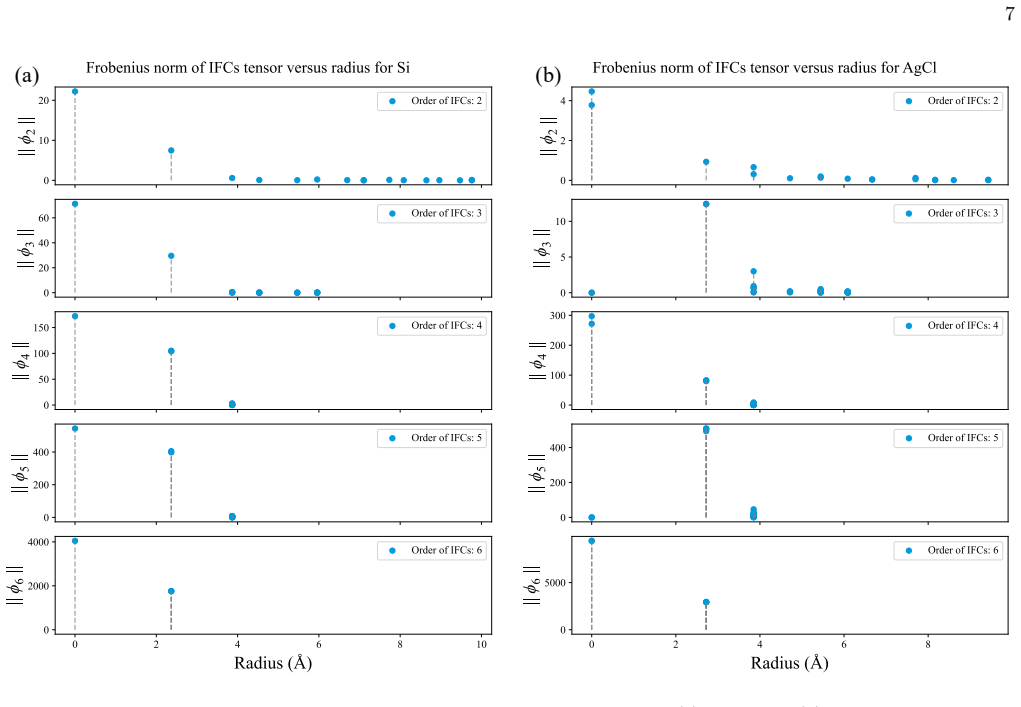
F. Eriksson, E. Fransson, and P. Erhart, The hiphive package for the extraction of high-order force constants by machine learning, Advanced Theory and Simulations 2, 1800184 (2019). 7 (a) (b) FIG. 3. Frobenius norms of various orders of IFCs tensor versus radius for (a) silicon and (b) rocksalt AgCl. Appendix A: Anharmonic force constants Anharmonic force...
2019
discussion (0)
Sign in with ORCID, Apple, or X to comment. Anyone can read and Pith papers without signing in.