Exotic Hadron Spectroscopy in Heavy-Flavor Systems
Pith reviewed 2026-06-29 17:08 UTC · model grok-4.3
The pith
Heavy-flavor systems show exotic hadron structures recurring across multiple experiments and flavor sectors.
A machine-rendered reading of the paper's core claim, the machinery that carries it, and where it could break.
Core claim
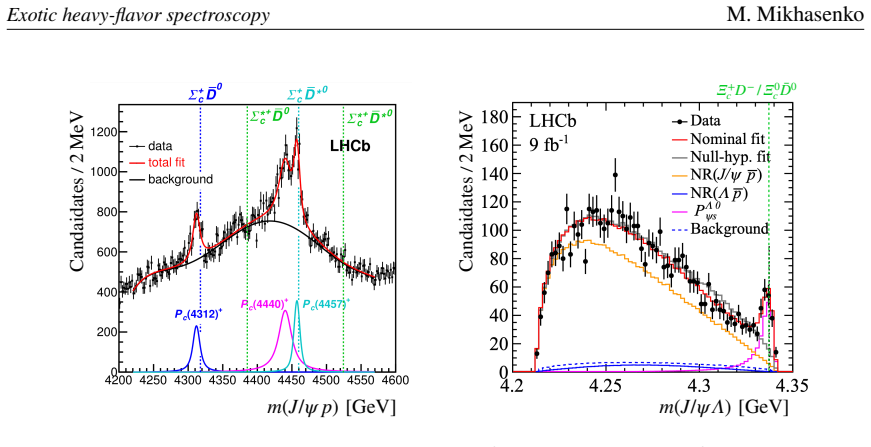
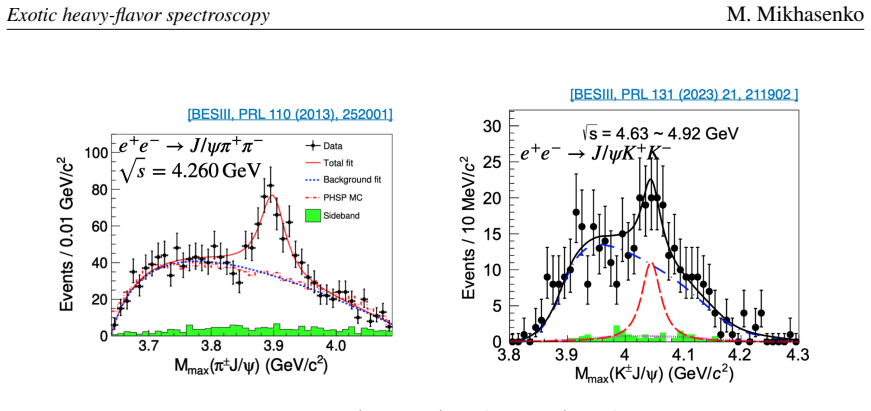
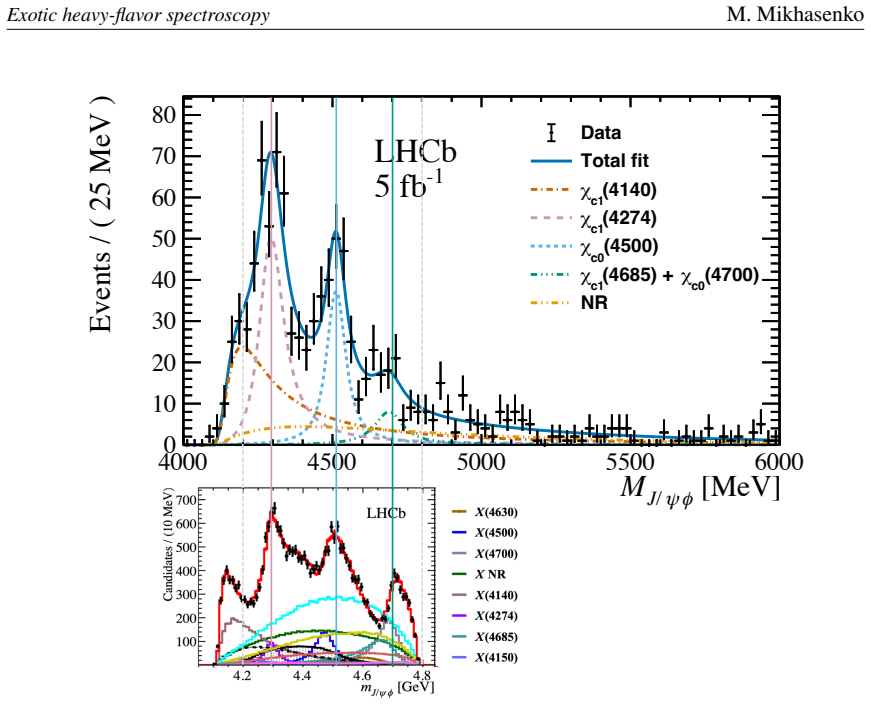
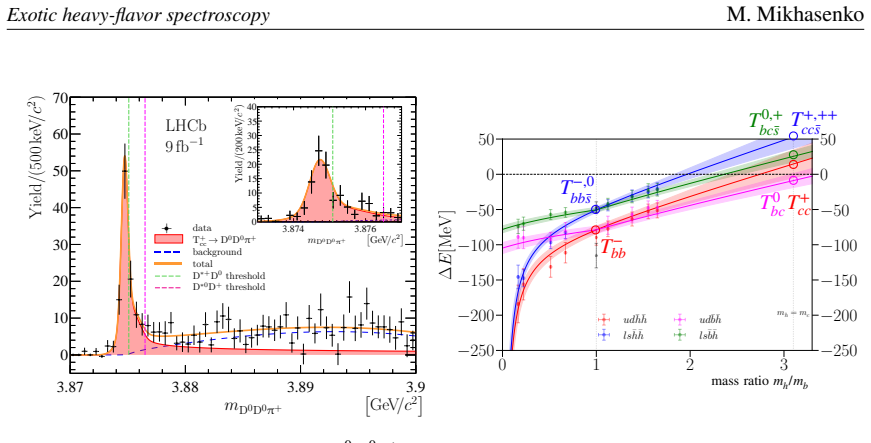
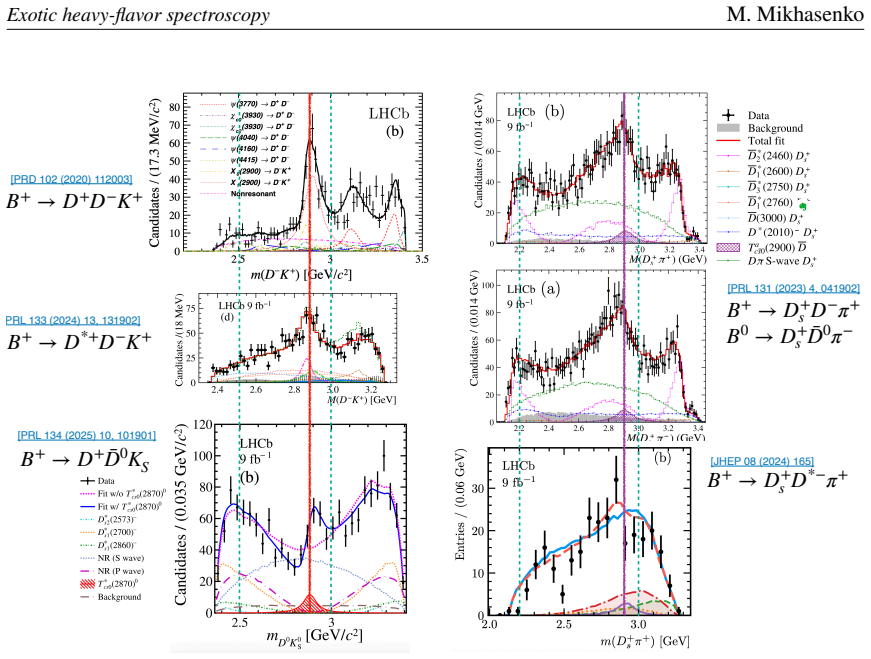
Heavy-flavor spectroscopy has entered a period in which new hadronic structures are no longer isolated surprises but recurring features across several flavor sectors, seen by multiple experiments in several decay environments. The defining classes are hidden-charm pentaquarks, charged charmonium-like structures, resonances in onia-onia systems, doubly-heavy tetraquarks, and open-flavor tetraquarks.
What carries the argument
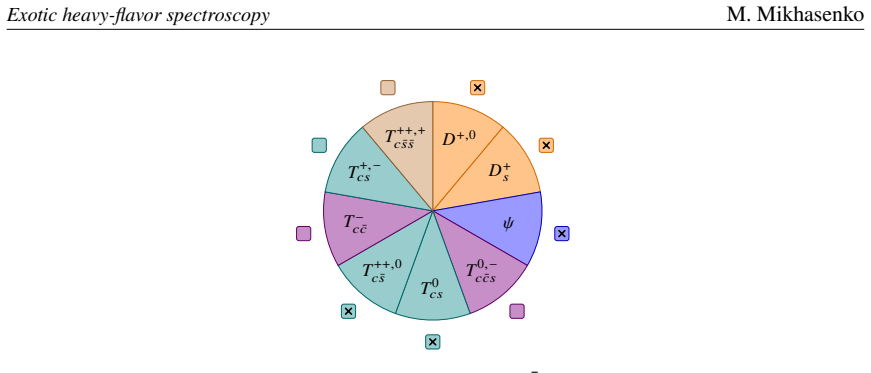
The five recurring classes of exotic states (hidden-charm pentaquarks, charged charmonium-like structures, resonances in onia-onia systems, doubly-heavy tetraquarks, and open-flavor tetraquarks) that organize the observed spectrum and expose regularities across flavor sectors.
If this is right
- The same mechanisms that produce hidden-charm pentaquarks should generate analogous states in bottom systems.
- Resonances in onia-onia systems become a standard search channel rather than an exception.
- Doubly-heavy and open-flavor tetraquarks should appear with predictable mass and width patterns across experiments.
- Theoretical models must now explain the recurrence across sectors instead of individual anomalies.
Where Pith is reading between the lines
- Experimental programs could prioritize searches for bottom analogs of the established charm states to test the recurrence directly.
- The pattern may constrain which QCD binding mechanisms operate at similar strengths in different flavor sectors.
- Lattice calculations could be guided to target the mass regions where these recurring states cluster.
Load-bearing premise
The observed peaks and structures can be reliably grouped into the listed exotic categories using their experimental signatures and flavor quantum numbers.
What would settle it
A sequence of new heavy-flavor peaks that appear in only one experiment or decay channel and fail to match any of the five listed classes would undermine the claim of recurring, systematic features.
Figures
read the original abstract
Recent years have brought a dense sequence of experimental discoveries in heavy-flavor hadron spectroscopy. Heavy-flavor spectroscopy has entered a period in which new hadronic structures are no longer isolated surprises but recurring features across several flavor sectors, seen by multiple experiments in several decay environments. For systems with charm and bottom quarks, smaller widths and cleaner signatures expose regularities that would be harder to isolate in the light-quark sector. This contribution focuses on the classes of states that now define the modern ``exotic'' landscape: hidden-charm pentaquarks, charged charmonium-like structures, resonances in onia-onia systems, doubly-heavy tetraquarks, and open-flavor tetraquarks.
Editorial analysis
A structured set of objections, weighed in public.
Referee Report
Summary. The manuscript is a review that characterizes the recent experimental landscape in heavy-flavor hadron spectroscopy. It asserts that new hadronic structures have become recurring features across charm and bottom sectors, observed by multiple experiments in varied decay channels, and organizes the discussion around five classes of exotic states: hidden-charm pentaquarks, charged charmonium-like structures, onia-onia resonances, doubly-heavy tetraquarks, and open-flavor tetraquarks. No new derivations, quantitative predictions, or model fits are presented.
Significance. As a descriptive synthesis of the experimental record, the review would be useful for consolidating the current consensus view of the exotic landscape in a field where smaller widths and cleaner signatures in heavy-flavor systems allow regularities to be identified more readily than in the light-quark sector. Its value is archival and contextual rather than predictive.
Simulated Author's Rebuttal
We thank the referee for the careful reading and the positive assessment of the manuscript as a descriptive synthesis of the experimental landscape. The recommendation to accept is appreciated, and the characterization of the review's archival and contextual value aligns with our goals.
Circularity Check
No significant circularity
full rationale
The paper is a review article that summarizes experimental discoveries in heavy-flavor spectroscopy without advancing any quantitative derivations, model equations, predictions, or fitted parameters. Its central claim is a descriptive characterization of recurring experimental structures across flavor sectors, based on reported data from multiple experiments. No load-bearing steps reduce to self-definitions, fitted inputs, or self-citation chains, as there are no derivations or predictions present.
Axiom & Free-Parameter Ledger
Reference graph
Works this paper leans on
-
[1]
Roel Aaij et al. Observation of𝐽/𝜓 𝑝resonances consistent with pentaquark states inΛ0 𝑏 → 𝐽/𝜓 𝐾 − 𝑝decays.Phys.Rev.Lett.,115:072001,2015.doi: 10.1103/PhysRevLett.115.072001
-
[2]
Model-independent evidence for𝐽/𝜓 𝑝contributions toΛ 0 𝑏 →𝐽/𝜓 𝑝 𝐾 − decays.Phys
Roel Aaij et al. Model-independent evidence for𝐽/𝜓 𝑝contributions toΛ 0 𝑏 →𝐽/𝜓 𝑝 𝐾 − decays.Phys. Rev. Lett., 117(8):082002, 2016. doi: 10.1103/PhysRevLett.117.082002
-
[3]
Observationofanarrowpentaquarkstate𝑃 𝑐 (4312) +andoftwo-peakstructure of the𝑃 𝑐 (4450) +.Phys
RoelAaijetal. Observationofanarrowpentaquarkstate𝑃 𝑐 (4312) +andoftwo-peakstructure of the𝑃 𝑐 (4450) +.Phys. Rev. Lett., 122(22):222001, 2019. doi: 10.1103/PhysRevLett.122. 222001. 10 Exotic heavy-flavor spectroscopyM. Mikhasenko
-
[4]
Dalitz-plotdecompositionforthree-bodydecays.Phys.Rev.D,101(3): 034033, 2020
M.Mikhasenkoetal. Dalitz-plotdecompositionforthree-bodydecays.Phys.Rev.D,101(3): 034033, 2020. doi: 10.1103/PhysRevD.101.034033
-
[5]
A novel method to test particle ordering and final state alignment in helicity formalism.Chin
Mengzhen Wang, Yi Jiang, Yinrui Liu, Wenbin Qian, Xiaorui Lyu, and Liming Zhang. A novel method to test particle ordering and final state alignment in helicity formalism.Chin. Phys. C, 45(6):063103, 2021. doi: 10.1088/1674-1137/abf139
-
[6]
Wignerrotationsforcascadereactions.Phys.Rev
KaiHabermannandMikhailMikhasenko. Wignerrotationsforcascadereactions.Phys.Rev. D, 111(5):056015, 2025. doi: 10.1103/PhysRevD.111.056015
-
[8]
Evidence for a new structure in the𝐽/𝜓 𝑝and𝐽/𝜓¯𝑝systems in𝐵0 𝑠 →𝐽/𝜓 𝑝¯𝑝 decays.Phys
Roel Aaij et al. Evidence for a new structure in the𝐽/𝜓 𝑝and𝐽/𝜓¯𝑝systems in𝐵0 𝑠 →𝐽/𝜓 𝑝¯𝑝 decays.Phys. Rev. Lett., 128(6):062001, 2022. doi: 10.1103/PhysRevLett.128.062001
-
[9]
Evidence of a𝐽/𝜓Λstructure and observation of excitedΞ− states in the Ξ− 𝑏 →𝐽/𝜓Λ𝐾 − decay.Sci
Roel Aaij et al. Evidence of a𝐽/𝜓Λstructure and observation of excitedΞ− states in the Ξ− 𝑏 →𝐽/𝜓Λ𝐾 − decay.Sci. Bull., 66:1278–1287, 2021. doi: 10.1016/j.scib.2021.02.030
-
[10]
R. Aaij et al. Observation of theΛ0 𝑏 →𝐽/𝜓Ξ −𝐾 + andΞ 0 𝑏 →𝐽/𝜓Ξ −𝜋+ decays.Eur. Phys. J. C, 85(7):812, 2025. doi: 10.1140/epjc/s10052-025-14129-6
-
[11]
First observation of the decayΛ0 𝑏 →𝜂 𝑐 (1𝑆)𝑝𝐾 −.Phys
Roel Aaij et al. First observation of the decayΛ0 𝑏 →𝜂 𝑐 (1𝑆)𝑝𝐾 −.Phys. Rev. D, 102(11): 112012, 2020. doi: 10.1103/PhysRevD.102.112012
-
[12]
Observation of theΛ0 𝑏 →𝜒 𝑐1 (3872)𝑝 𝐾 − decay.JHEP, 09:028, 2019
Roel Aaij et al. Observation of theΛ0 𝑏 →𝜒 𝑐1 (3872)𝑝 𝐾 − decay.JHEP, 09:028, 2019. doi: 10.1007/JHEP09(2019)028
-
[13]
FirstobservationoftheΛ 0 𝑏 →Λ + 𝑐 𝐷 − 𝑠 𝐾 +𝐾 − decayandsearchforpentaquarks in theΛ+ 𝑐 𝐷 − 𝑠 system.Phys
RoelAaijetal. FirstobservationoftheΛ 0 𝑏 →Λ + 𝑐 𝐷 − 𝑠 𝐾 +𝐾 − decayandsearchforpentaquarks in theΛ+ 𝑐 𝐷 − 𝑠 system.Phys. Rev. D, 112(5):052013, 2025
2025
-
[14]
Observation ofΛ0 𝑏 →Λ + 𝑐 ¯𝐷 (∗)0 𝐾 − andΛ 0 𝑏 →Λ + 𝑐 𝐷∗− 𝑠 decays.Eur
Roel Aaij et al. Observation ofΛ0 𝑏 →Λ + 𝑐 ¯𝐷 (∗)0 𝐾 − andΛ 0 𝑏 →Λ + 𝑐 𝐷∗− 𝑠 decays.Eur. Phys. J. C, 84(6):575, 2024. doi: 10.1140/epjc/s10052-024-12752-3
-
[15]
First observation ofΛ0 𝑏 →Σ (∗)++ 𝑐 𝐷 (∗) − 𝐾 − decays.Phys
Roel Aaij et al. First observation ofΛ0 𝑏 →Σ (∗)++ 𝑐 𝐷 (∗) − 𝐾 − decays.Phys. Rev. D, 110(3): L031104, 2024. doi: 10.1103/PhysRevD.110.L031104
-
[16]
Search for prompt production of pentaquarks in charm hadron final states
Roel Aaij et al. Search for prompt production of pentaquarks in charm hadron final states. Phys. Rev. D, 110(3):032001, 2024. doi: 10.1103/PhysRevD.110.032001
-
[17]
Navas et al
S. Navas et al. Review of particle physics.Phys. Rev. D, 110(3):030001, 2024. doi: 10.1103/ PhysRevD.110.030001
2024
-
[19]
Observation of the resonant character of the𝑍(4430)− state.Phys
Roel Aaij et al. Observation of the resonant character of the𝑍(4430)− state.Phys. Rev. Lett., 112(22):222002, 2014. doi: 10.1103/PhysRevLett.112.222002
-
[20]
Model-independentconfirmationofthe𝑍(4430) − state.Phys.Rev.D,92(11): 112009, 2015
RoelAaijetal. Model-independentconfirmationofthe𝑍(4430) − state.Phys.Rev.D,92(11): 112009, 2015. doi: 10.1103/PhysRevD.92.112009
-
[21]
Amplitude analysis of𝐵+ →𝜓(2𝑆)𝐾 +𝜋+𝜋− decays.JHEP, 01:054, 2025
Roel Aaij et al. Amplitude analysis of𝐵+ →𝜓(2𝑆)𝐾 +𝜋+𝜋− decays.JHEP, 01:054, 2025. doi: 10.1007/JHEP01(2025)054
-
[22]
PhD thesis, Syracuse U., 2 2023
Andy Beiter.Amplitude analysis of𝐵 0 decays to𝐽/𝜓 𝜋 −𝐾 + and𝜓(2𝑆)𝜋 −𝐾 +. PhD thesis, Syracuse U., 2 2023
2023
-
[23]
Observation and investigation of the𝑇 𝑐¯𝑐1(4430) + structure in𝐵 + → 𝜓(2𝑆)𝐾 0 S 𝜋+ decays.Phys
Roel Aaij et al. Observation and investigation of the𝑇 𝑐¯𝑐1(4430) + structure in𝐵 + → 𝜓(2𝑆)𝐾 0 S 𝜋+ decays.Phys. Rev. D, 113(7):L071101, 2026
2026
-
[24]
Observationofachargedcharmoniumlikestructurein𝑒 +𝑒− →𝜋 +𝜋− 𝐽/𝜓at√𝑠=4.26 GeV.Phys
M.Ablikimetal. Observationofachargedcharmoniumlikestructurein𝑒 +𝑒− →𝜋 +𝜋− 𝐽/𝜓at√𝑠=4.26 GeV.Phys. Rev. Lett., 110:252001, 2013. doi: 10.1103/PhysRevLett.110.252001
-
[25]
Multi-channel joint analysis of the exotic charmonium-like state 𝑇𝑐¯𝑐(4020).arXiv preprint, 3 2026
Medina Ablikim et al. Multi-channel joint analysis of the exotic charmonium-like state 𝑇𝑐¯𝑐(4020).arXiv preprint, 3 2026
2026
-
[26]
Ablikim et al
M. Ablikim et al. Observation of a vector charmoniumlike state at4.7 GeV/𝑐2 and search for𝑍 𝑐𝑠 in𝑒 +𝑒− →𝐾 +𝐾 − 𝐽/𝜓.Phys. Rev. Lett., 131(21):211902, 2023. doi: 10.1103/ PhysRevLett.131.211902
2023
-
[27]
Strange molecular partners of𝑍 𝑐 (3900)and𝑍 𝑐 (4020).Phys
Zhi Yang, Xu Cao, Feng-Kun Guo, Juan Nieves, and Manuel Pavon Valderrama. Strange molecular partners of𝑍 𝑐 (3900)and𝑍 𝑐 (4020).Phys. Rev. D, 103(7):074029, 2021. doi: 10.1103/PhysRevD.103.074029
-
[28]
Lu Meng, Bo Wang, and Shi-Lin Zhu.𝑍𝑐𝑠 (3985) − as the𝑈-spin partner of𝑍𝑐 (3900) − and implication of other states in theSU(3)𝐹 symmetry and heavy quark symmetry.Phys. Rev. D, 102(11):111502, 2020. doi: 10.1103/PhysRevD.102.111502
-
[29]
Polosa, and Verónica Riquer
Luciano Maiani, Antonio D. Polosa, and Verónica Riquer. The new resonances𝑍𝑐𝑠 (3985) and𝑍 𝑐𝑠 (4003)(almost)filltwotetraquarknonetsofbrokenSU(3) f.Sci.Bull.,66:1616–1619,
-
[30]
doi: 10.1016/j.scib.2021.04.040
-
[31]
Observation of𝐽/𝜓 𝜙structures consistent with exotic states from amplitude analysis of𝐵 + →𝐽/𝜓 𝜙 𝐾 + decays.Phys
Roel Aaij et al. Observation of𝐽/𝜓 𝜙structures consistent with exotic states from amplitude analysis of𝐵 + →𝐽/𝜓 𝜙 𝐾 + decays.Phys. Rev. Lett., 118(2):022003, 2017. doi: 10.1103/ PhysRevLett.118.022003
2017
-
[32]
Observation of new resonances decaying to𝐽/𝜓𝐾+ and𝐽/𝜓𝜙.Phys
Roel Aaij et al. Observation of new resonances decaying to𝐽/𝜓𝐾+ and𝐽/𝜓𝜙.Phys. Rev. Lett., 127(8):082001, 2021. doi: 10.1103/PhysRevLett.127.082001
-
[34]
R. Aaij et al. Observation of structure in the𝐽/𝜓-pair mass spectrum.Sci. Bull., 65(23): 1983–1993, 2020. doi: 10.1016/j.scib.2020.08.032
-
[35]
Observation of an Excess of Dicharmonium Events in the Four-Muon Final State with the ATLAS Detector.Phys
Georges Aad et al. Observation of an Excess of Dicharmonium Events in the Four-Muon Final State with the ATLAS Detector.Phys. Rev. Lett., 131(15):151902, 2023. doi: 10.1103/ PhysRevLett.131.151902
2023
-
[37]
Determinationofthespinandparityofall-charmtetraquarks.Nature, 648(8092):58–63, 2025
AramHayrapetyanetal. Determinationofthespinandparityofall-charmtetraquarks.Nature, 648(8092):58–63, 2025. doi: 10.1038/s41586-025-09711-7
-
[38]
Observation of a family of all-charm tetraquark states, 9 2025
Kai Yi. Observation of a family of all-charm tetraquark states, 9 2025. URLhttps: //indico.cern.ch/event/1371434/contributions/6649693/. Slides (CORFU2025)
-
[39]
Observation of an exotic narrow doubly charmed tetraquark.Nature Phys., 18:751–754, 2022
Roel Aaij et al. Observation of an exotic narrow doubly charmed tetraquark.Nature Phys., 18:751–754, 2022. doi: 10.1038/s41567-022-01614-y
-
[40]
Study of the doubly charmed tetraquarkT cc +˝
RoelAaijetal. Studyofthedoublycharmedtetraquark𝑇 + 𝑐𝑐.NatureCommun.,13:3351,2022. doi: 10.1038/s41467-022-30206-w
-
[41]
Improved analysis of strong-interaction-stable doubly bottom tetraquarks on the lattice.Phys
B.Colquhoun,A.Francis,R.J.Hudspith,R.Lewis,K.Maltman,andW.G.Parrott. Improved analysis of strong-interaction-stable doubly bottom tetraquarks on the lattice.Phys. Rev. D, 110(9):094503, 2024. doi: 10.1103/PhysRevD.110.094503
-
[42]
Search for𝑇 𝑏𝑐: prospects for Run 3, 10 2023
Ivan Polyakov. Search for𝑇 𝑏𝑐: prospects for Run 3, 10 2023. URL https://indico.cern.ch/event/1324964/contributions/5576264/attachments/ 2728384/4742426/Tbc_Search.pdf. Talk
-
[43]
Steven Blusk. Beyond𝑇𝑐𝑐:𝑇 𝑏𝑐 &𝑇 𝑏𝑏, 9 2021. URLhttps://indico.cern.ch/event/ 1065494/contributions/4481578/attachments/2308739/3928347/Beyond_Tcc. pdf. Talk
-
[44]
T. Gershon and A. Poluektov. Displaced𝐵− 𝑐 mesons as an inclusive signature of weakly decaying double-beauty hadrons.JHEP, 01:019, 2019. doi: 10.1007/JHEP01(2019)019
-
[45]
Amplitudeanalysisofthe𝐵 + →𝐷 +𝐷 −𝐾 + decay.Phys.Rev.D,102:112003,
RoelAaijetal. Amplitudeanalysisofthe𝐵 + →𝐷 +𝐷 −𝐾 + decay.Phys.Rev.D,102:112003,
-
[46]
doi: 10.1103/PhysRevD.102.112003
-
[47]
Observation of new charmonium(-like) states in𝐵+ →𝐷 ∗±𝐷∓𝐾 + decays
Roel Aaij et al. Observation of new charmonium(-like) states in𝐵+ →𝐷 ∗±𝐷∓𝐾 + decays. Phys. Rev. Lett., 133(13):131902, 2024. doi: 10.1103/PhysRevLett.133.131902
-
[48]
Roel Aaij et al. Observation of the open-charm tetraquark candidate𝑇∗ 𝑐𝑠0 (2870)0 in the 𝐵− →𝐷 − 𝐷0𝐾0 S decay.Phys. Rev. Lett., 134(10):101901, 2025. doi: 10.1103/PhysRevLett. 134.101901. 13 Exotic heavy-flavor spectroscopyM. Mikhasenko
-
[49]
J. P. Lees et al. Dalitz plot analyses of𝐵0 →𝐷 − 𝐷0𝐾 + and𝐵 + → 𝐷 0 𝐷0𝐾 + decays.Phys. Rev. D, 91(5):052002, 2015. doi: 10.1103/PhysRevD.91.052002
-
[50]
FirstObservationofaDoublyChargedTetraquarkandItsNeutralPartner.Phys
R.Aaijetal. FirstObservationofaDoublyChargedTetraquarkandItsNeutralPartner.Phys. Rev. Lett., 131(4):041902, 2023. doi: 10.1103/PhysRevLett.131.041902
-
[51]
Amplitude analysis and branching fraction measurement of𝐵+ →𝐷 ∗− 𝐷+ 𝑠 𝜋+ decays.JHEP, 08:165, 2024
Roel Aaij et al. Amplitude analysis and branching fraction measurement of𝐵+ →𝐷 ∗− 𝐷+ 𝑠 𝜋+ decays.JHEP, 08:165, 2024. doi: 10.1007/JHEP08(2024)165
-
[52]
A model-independent study of resonant structure in𝐵+ →𝐷 +𝐷 −𝐾 + decays
Roel Aaij et al. A model-independent study of resonant structure in𝐵+ →𝐷 +𝐷 −𝐾 + decays. Phys. Rev. Lett., 125:242001, 2020. doi: 10.1103/PhysRevLett.125.242001
-
[53]
Roel Aaij et al. Observation of a resonant structure near the𝐷+ 𝑠 𝐷 − 𝑠 threshold in the𝐵+ → 𝐷+ 𝑠 𝐷 − 𝑠 𝐾 + decay.Phys. Rev. Lett., 131(7):071901, 2023. doi: 10.1103/PhysRevLett.131. 071901
-
[54]
TowardsaHighLuminosityLHCwithevenhigherperformance.JACoW, IPAC2025:MOPM008, 2025
RogelioTomasetal. TowardsaHighLuminosityLHCwithevenhigherperformance.JACoW, IPAC2025:MOPM008, 2025. doi: 10.18429/JACoW-IPAC2025-MOPM008
-
[55]
Xiao-CongAietal.ConceptualdesignreportoftheSuperTau-CharmFacility: theaccelerator. Nucl. Sci. Tech., 36(12):242, 2025. doi: 10.1007/s41365-025-01833-x
-
[56]
Special Review Meeting of KEK B-factory Project Joint Committee of Accelerator and Experiment
KEK B-factory Project Joint Committee of Accelerator and Experiment. Special Review Meeting of KEK B-factory Project Joint Committee of Accelerator and Experiment. Report BELLE2-REPORT-2026-004, Belle II PubDB, March 2026. URLhttps://docs.belle2. org/pub_data/documents/5012/. Report by P. Craievich, M. Demarteau, R. Forty, T. Taylor, R. Tomás, N. Neufeld,...
2026
discussion (0)
Sign in with ORCID, Apple, or X to comment. Anyone can read and Pith papers without signing in.