REVIEW 2 major objections 4 minor 2 cited by
The optimal binding function for (cap, even hole)-free graphs
T0 review · 2 major / 4 minor · reviewed 2026-08-15 · deepseek-v4-flash
Pith's one-line read Every (cap, even hole)-free graph can be colored with at most 5/4 times its clique number; forbidding 5-holes lowers the multiplier to 7/6.
desk verdict Solves a 2018 open problem with a reusable reduction theorem, but Section 4.1 has an unproved existence claim for F that needs a fix. read the letter →
The pith
A machine-rendered reading of the paper's core claim, the machinery that carries it, and where it could break.
The reading
What carries the argument
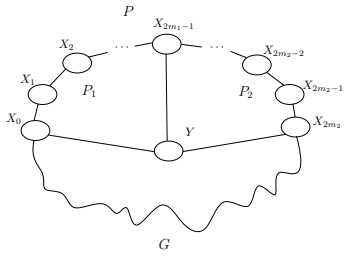
The engine of the proof is Theorem 1.1, a reduction principle for clique blowups. It says that to prove a bound of the form $\chi(G)\le \lceil\frac{p}{2q}\omega(G)\rceil$ for all clique blowups of a triangle-free graph $F$, it is enough to check the bound only on those blowups whose clique number is at most $\max\{\frac{2q(p-q-2)}{p-2q},2q\}$. The proof carves a small set $T$ of vertices out of each bag, splits the remainder into two parts $V_1$ and $V_2$ with controlled clique numbers, colors each part by induction, and recombines the colorings. To connect this to the target class, the paper uses two structural theorems as black boxes: Lemma 2.2, which expresses a (cap, 4-hole)-free graph with a hole and no clique cutset (a clique whose removal disconnects the graph) as a clique blowup of a maximal triangle-free induced subgraph together with a universal clique (a clique complete to the rest of the graph), and Lemma 2.1, which builds triangle-free odd-signable graphs from a hole by controlled ear additions called good ear additions. The base cases of small clique number are handled by a path-extension coloring technique, which greedily extends a partial coloring along blown-up paths.
What would settle it
Run an exact search over all (cap, even hole)-free graphs on up to fourteen vertices, computing $\chi(G)$ and $\omega(G)$; any output with $\chi(G)>\lceil\frac{5}{4}\omega(G)\rceil$ would refute the main theorem. The known equality cases—uniformly blown-up 5-holes and 7-holes—should appear with equality, and a violation of the analogous small-clique condition in Theorem 1.1 could be checked directly by constructing a triangle-free $F$ and choosing bag sizes just above the stated threshold.
Extended reading notes
Core claim
At the level of the paper's own claims, the central discovery is a reduction and two sharp bounds. Theorem 1.1 says that for positive integers $p>2q$ and any triangle-free graph $F$, the inequality $\chi(G)\le \lceil\frac{p}{2q}\omega(G)\rceil$ holds for every clique blowup $G$ of $F$ as soon as it holds for those blowups with clique number at most $\max\{\frac{2q(p-q-2)}{p-2q},2q\}$. The paper then proves, by induction and structural decomposition, that every (cap, even hole)-free graph satisfies $\chi(G)\le \lceil\frac{5}{4}\omega(G)\rceil$, answering a 2018 question in the affirmative, and that every such graph with no 5-hole satisfies $\chi(G)\le \lceil\frac{7}{6}\omega(G)\rceil$. Uniform clique blowups of a 5-hole and of a 7-hole show the constants cannot be lowered, so the binding functions are optimal.
Load-bearing premise
The load-bearing premise is that the two structural classifications imported from earlier work—one describing triangle-free odd-signable graphs as built from a hole by controlled ear additions, the other describing (cap, even hole)-free graphs as clique blowups of such a triangle-free graph plus a universal clique—hold for every graph in the class; if either fails, the coloring bound is not established.
Editorial extensions
If this is right
- Every (cap, even hole)-free graph can be colored with at most $\frac{5}{4}$ of its clique number; this is the exact linear binding function for the class.
- Adding the absence of 5-holes improves the guarantee to $\frac{7}{6}$ of the clique number, also tight.
- Theorem 1.1 reduces any $p/(2q)$ coloring bound for clique blowups of a triangle-free graph to the case of bounded clique number, which can make such bounds easier to verify.
- The reachability examples mean no smaller multiplier of $\omega$ can serve as a universal bound for either class.
Reading between the lines
- The closing remark suggests the pattern continues: for graphs whose shortest odd hole has length at least $2q+1$, the conjectured bound is $\chi\le \lceil\frac{2q+1}{2q}\omega\rceil$; this paper settles the cases $q=2$ and $q=3$, so $q=4$ is the immediate next test.
- Because Theorem 1.1 is stated for arbitrary triangle-free $F$, the same reduction could transfer coloring bounds between very different hereditary classes once a structural decomposition into clique blowups is known.
- The path-extension coloring argument is constructive, so the proof likely gives an efficient coloring algorithm when the clique number is bounded, though the paper does not claim this.
Signed reviews
Editorial analysis
A structured set of objections, weighed in public.
Referee Report
Summary. The paper studies χ-binding functions for (cap, even hole)-free graphs. It first proves a reduction theorem (Theorem 1.1) for clique blowups of a triangle-free graph F: with p>2q, proving χ(G)≤⌈p/(2q)ω(G)⌉ for all clique blowups of F is reduced to proving it only for blowups with clique number at most max{2q(p−q−2)/(p−2q), 2q}. The proof is by induction and removes a set T of size q from each bag, decomposing the remainder into two anticomplete parts. The paper then invokes structural characterizations of (cap, even hole)-free graphs without clique cutsets as clique blowups of triangle-free graphs obtainable by good ear additions, and proves by a lengthy case analysis (Lemma 4.1) the required bound for small clique number: χ≤⌈5/4ω⌉ for K5-free graphs and χ≤⌈7/6ω⌉ for (5-hole,K13)-free graphs. Theorem 1.2 follows by combining these pieces, and both bounds are shown tight by clique blowups of 5- and 7-holes, answering a question of Cameron et al.
Significance. If correct, this settles an open problem and improves the previous best bound for (cap, even hole)-free graphs. The reduction Theorem 1.1 is a clean and potentially reusable tool; the numerical inequalities in its proof are sound, and the ceiling slack is used correctly. The examples attaining the bounds are simple and convincing. The main caveats are two load-bearing presentation and support issues: the statement of Theorem 1.1 is misquantified, and the existence of a maximal triangle-free induced subgraph without a clique cutset is asserted rather than proved or cited. Both are fixable without changing the main idea.
major comments (2)
- [Theorem 1.1 and Abstract] The quantification of G′ is not the one used in the proof. As written, the theorem fixes one G′ with ω(G′)≤max{2q(p−q−2)/(p−2q), 2q} and asserts an equivalence between 'for every clique blowup G' and 'χ(G′)≤⌈p/(2q)ω(G′)⌉'. For a single fixed G′, the right-hand side cannot control all unbounded blowups. The proof and the applications in Section 4 require the hypothesis that every clique blowup G′ with ω(G′)≤M satisfies the inequality. Please restate Theorem 1.1 as a reduction: if every bounded-clique-number blowup of F satisfies the bound, then every clique blowup of F satisfies the bound, with the converse being immediate.
- [Section 4 and Section 4.1] The proof asserts, without proof or citation, that one may choose a maximal triangle-free induced subgraph F of G with no clique cutset. This appears in the proof of Theorem 1.2 ('we may choose a maximal triangle-free induced subgraph F of G which has no clique cutset') and again in both halves of Lemma 4.1. Lemmas 2.1 and 2.2 apply only to an F that already has no clique cutset; minimality of G and the absence of clique cutsets in G do not by themselves imply such an F exists. This assertion is the entry point for both the blowup structure and the good-ear decomposition, and hence for the entire case analysis. Please either prove this assertion or cite the precise theorem in [2] or [10] that guarantees it. If it is a known result, it should be stated in Section 2.
minor comments (4)
- [Lemma 4.2 and References] Lemma 4.2 is quoted from the authors' own arXiv preprint [4]. Since it is used both in the base case of Lemma 4.1 and in establishing reachability of the bounds, please include a short proof in the paper or cite a published source.
- [Claim 4.5] In the displayed formula before coloring X_{2m2−2}, the indices X_{2m1−1} and X_{2m1−3} appear where X_{2m2−1} and X_{2m2−3} are clearly intended; this makes the estimate hard to follow.
- [Section 3 and Section 4.1] The claim that V1\T is a union of pairwise anticomplete cliques is compressed; spelling out why a vertex of F cannot be incident with two V1-edges using ω(G)≥2q+1 would improve readability.
- [Throughout] There are several typos, including 'maximal triangle-free induced subgraph graph' in Section 4.1 and 'for for each odd integer' in Claim 4.3. Proofreading is needed.
Circularity Check
No circularity: the bounds follow from an independently proved reduction theorem plus external structural lemmas; the only self-citation is an auxiliary odd-hole blowup coloring result.
full rationale
The derivation chain is not circular. Theorem 1.1 is a self-contained reduction proved by induction on |V(G)|, showing that the bound for all clique blowups follows from the bound for clique blowups with bounded clique number. Theorem 1.2 then applies this reduction to a maximal triangle-free induced subgraph, using Lemma 4.1, which is proved separately by structural decomposition and greedy path-extension arguments. Lemma 4.1 itself invokes Lemmas 2.1 and 2.2, external structural results from Conforti et al. and Cameron et al., and does not assume the target inequality. The cited Lemma 4.2 from Chen and Xu is a self-citation, but it is a distinct specialized result about clique blowups of odd holes, not an encoding of the main theorem, so it does not make the argument circular. One genuine gap, flagged for correctness rather than circularity, is the unproved assertion in Section 4 that a maximal triangle-free induced subgraph F with no clique cutset exists; this is a missing justification but not a reduction of the conclusion to its own input. No equation in the paper identifies the target bound with an input assumption, and no fitted parameter is renamed as a prediction.
Assumptions & free parameters
assumptions (3)
- domain assumption Lemma 2.2 (Cameron et al.): every (cap, 4-hole)-free graph with a hole and no clique cutset is a clique blowup of a maximal triangle-free subgraph plus a universal clique.
- domain assumption Lemma 2.1 (Conforti et al.): triangle-free odd-signable graphs without clique cutsets, except the cube, are obtained from a hole by good ear additions.
- domain assumption Lemma 4.2 (Chen and Xu, self-cited): clique blowups of odd holes satisfy χ(G) ≤ ⌈(2q+1)/(2q)ω(G)⌉ and the t-clique blowup attains equality.
Cite this review
Pith. "Pith review of The optimal binding function for (cap, even hole)-free graphs." pith.science (2026). https://pith.science/paper/AN2WD5E4
@misc{pith2026250619580,
  author       = {Pith},
  title        = {Pith review of: The optimal binding function for (cap, even hole)-free graphs},
  year         = {2026},
  howpublished = {\url{https://pith.science/paper/AN2WD5E4}},
  note         = {Machine review of arXiv:2506.19580}
}
abstract
A {\em hole} is an induced cycle of length at least 4, an {\em even hole} is a hole of even length, and a {\em cap} is a graph obtained from a hole by adding an additional vertex which is adjacent exactly to two adjacent vertices of the hole. A graph $G$ obtained from a graph $H$ by blowing up all the vertices into cliques is said to be a clique blowup of $H$. Let $p, q$ be two positive integers with $p>2q$, let $F$ be a triangle-free graph, and let $G'$ be a clique blowup of $F$ with $\omega(G')\leq\max\{\frac{2q(p-q-2)}{p-2q}, 2q\}$. In this paper, we prove that for any clique blowup $G$ of $F$, $\chi(G)\leq\lceil\frac{p}{2q}\omega(G)\rceil$ if and only if $\chi(G')\leq\lceil\frac{p}{2q}\omega(G')\rceil$. As its consequences, we show that every (cap, even hole)-free graph $G$ satisfies $\chi(G)\leq\lceil\frac{5}{4}\omega(G)\rceil$, which affirmatively answers a question of Cameron {\em et al.} \cite{CdHV2018}, we also show that every (cap, even hole, 5-hole)-free graph $G$ satisfies $\chi(G)\leq\lceil\frac{7}{6}\omega(G)\rceil$, and the bound is reachable.
Figures


Forward citations
Cited by 2 Pith papers
-
Optimal binding function for (cap,even hole)-free graphs with no short odd holes
The authors attempt to confirm the optimal binding function conjecture for (cap, even hole)-free graphs with no short odd holes, extending known cases q≤3 to all q≥3, but the proof contains a concrete error in the odd...
-
Optimal coloring of $\{\mathrm{cap},\mathrm{even\ hole}\}$-free graphs with no short odd holes
For every q≥3, every {cap, even hole}-free graph with no odd hole of length at most 2q−1 satisfies χ(G)≤ceil((2q+1)/(2q)ω(G)), and this bound is tight.
Reference graph
Works this paper leans on
-
[2]
K. Cameron, M. V. G. da Silva, S. Huang and K. Vuˇ skovi´ c, Structure and algorithms for (cap, even hole)-free graphs, Disc. Math. 341 (2018) 463-473
work page 2018
-
[3]
K. Cameron, S. Chaplick and C. T. Ho ¨¤ng, On the structure of (pan, even hole)-free graphs, J. of Graph Theory 87 (2018) 108-129
work page 2018
-
[10]
M. Conforti, G. Cornu´ ejols, A. Kapoor and K. Vuˇ skovi´ c, Triangle-free graphs that are signable without even holes, J. Graph Theory 34 (2000) 204-220
work page 2000
-
[1]
J. A. Bondy and U. S. R. Murty, Graph Theory, Springer, New York, 2008
2008
-
[4]
Nearly optimal coloring of some C4-free graphs
R. Chen and B. Xu, Nearly optimal coloring of some C4-free graphs, arXiv:2409.06944, 2024
work page Pith review arXiv 2024
-
[5]
M. Chudnovsky, N. Robertson, P. Seymour and R. Thomas, The strong perfect graph theorem, Annals of Mathematics 164 (2006) 51–229
work page 2006
-
[6]
M. Chudnovsky, A. Scott and P. Seymour, Induced subgraphs of graphs with large chro- matic number. III Long holes, Combinatorica 37 (6) (2017) 1057-1072
work page 2017
-
[7]
M. Chudnovsky, A. Scott, P. Seymour and S. Spirkl, Induced subgraphs of graphs with large chromatic number. VIII Long odd holes, J. Comb. Theory B 140 (2020) 84-97
work page 2020
Show all 23 references
-
[8]
Chudnovsky and P
M. Chudnovsky and P. Seymour, Even-hole-free graphs still have bisimplicial vertices, J. Comb. Theory B 161 (2023) 331-381
2023
-
[9]
Conforti, G
M. Conforti, G. Cornu´ ejols, A. Kapoor and K. Vuˇ skovi´ c, Even and odd holes in cap-free graphs, J. Graph Theory 30 (1999) 289 ¨C308
1999
-
[11]
G. A. Dirac, On rigid circuit graphs, Abh. Math. Semin. Univ. Hambg. (1961) 71-76
1961
-
[12]
Erd˝ os, Graph theory and probability, Canad
P. Erd˝ os, Graph theory and probability, Canad. J. Math. 11 (1959) 34-38
1959
-
[13]
D. J. Fraser, A. M. Hamel and C. T. Hoang, On the structure of (even-hole, kite)-free graphs, Graphs and Combinatorics, 34 (2018) 989-999
2018
-
[14]
Gy´ arf´ as, On Ramsey covering-numbers, Infinite and Finite Sets 2 (1975) 801-816
A. Gy´ arf´ as, On Ramsey covering-numbers, Infinite and Finite Sets 2 (1975) 801-816
1975
-
[15]
Gy´ arf´ as, Problems from the world surrounding perfect graphs, Zastosow
A. Gy´ arf´ as, Problems from the world surrounding perfect graphs, Zastosow. Mat. 19 (1987) 413-441
1987
-
[16]
Kloks, H
T. Kloks, H. M¨ uller and K. Vuˇ skovi´ c, Even-hole-free graphs that do not contain diamonds: a structure theorem and its consequences, J. Combin. Theory Ser. B 99 (2009) 733-800. 14
2009
-
[17]
Ramirez-Alfonsin and B
J. Ramirez-Alfonsin and B. Reed (Eds.), Perfect Graphs, Wiley, Chichester, 2001, pp 130
2001
-
[18]
Schiermeyer and B
I. Schiermeyer and B. Randerath, Polynomial ¦ ¨O-binding functions and forbidden induced subgraphs: a survey, Graphs Comb. 35 (1) (2019) 1-31
2019
-
[19]
Scott and P
A. Scott and P. Seymour, Induced subgraphs of graphs with large chromatic number. I odd holes, J. Comb. Theory B 121 (2016) 68-84
2016
-
[20]
V. G. Vizing, The chromatic class of a multigraph, Kibernetika(kiev) 3 (1965) 29-39
1965
-
[21]
Vuˇ skovi´ c, Even-hole-free graphs: a survey, Appl
K. Vuˇ skovi´ c, Even-hole-free graphs: a survey, Appl. Anal. Discrete Math. 4 2 (2010) 219-240
2010
-
[22]
Wu and B
R. Wu and B. Xu, A note on chromatic number of (cap, even hole)-free graphs, Disc. Math. 342 (2019) 898-903
2019
-
[23]
Xu, A better upper bound on the chromatic number of (cap, even hole)-free graphs, Disc
Y. Xu, A better upper bound on the chromatic number of (cap, even hole)-free graphs, Disc. Math. 344 (2021) 112581. 15
2021
Reviewed August 15, 2026 · model on record in the stance chip above.
Discussion (0). Continue with ORCID to comment.