REVIEW 3 major objections 3 minor 42 references
SHReg: Strictly Rotation-Equivariant Point Cloud Registration via Spherical Harmonics
T0 review · 3 major / 3 minor · reviewed 2026-08-01 · deepseek-v4-flash
Pith's one-line read Point cloud registration can be made exactly rotation-invariant by encoding local geometry as irreducible SO(3) representations, and the paper shows the resulting pipeline beats methods that only approximate invariance.
desk verdict Clever closed-form pose from equivariant features, but the sign-disambiguation assumption is real and unexamined; the missing supplementary and modest gains make this a conditional, not a clean, accept. read the letter →
The pith
A machine-rendered reading of the paper's core claim, the machinery that carries it, and where it could break.
The reading
What carries the argument
The backbone is a spherical-harmonic convolution: each relative displacement is lifted into a spherical-harmonic angular basis with learnable radial weights, messages are combined through Clebsch-Gordan projection so the output channels remain valid SO(3) irrep blocks, and a scalar-gated nonlinearity preserves the transformation law. The second load-bearing piece is the per-correspondence hypothesis proposer: it collapses the second-order features to a symmetric trace-free tensor whose dominant eigenvector is an unsigned principal axis, uses the first-order direction feature to fix the axis sign, builds a right-handed frame, and reads the rotation between two matched frames. No local referen
What would settle it
Across the validation split of a rotated benchmark, compute, for every correspondence that produces a winning hypothesis, the angle between the predicted rotation and the ground-truth rotation; if there is a systematic cluster of near-180-degree errors on locally symmetric patches, or if flipping the sign heuristic changes failures into successes, the claim that the axis-plus-sign recovers orientation is falsified.
Extended reading notes
Core claim
The central claim is that representing point-wise features as a direct sum of SO(3) irreducible blocks — each transforming by Wigner-D matrices — gives exact equivariance without pose normalization, and that this equivariance is a usable asset, not just a constraint. The invariant readout, a per-channel norm of each irrep block, yields descriptors that are strictly rotation-invariant, while the raw equivariant features retain enough orientation to build an orthonormal frame per point from the dominant axis feature and a direction feature. A matched pair of such frames yields a rotation matrix and translation in closed form, so each correspondence votes one rigid pose hypothesis. On standard
Load-bearing premise
The closed-form pose assumes the learned direction feature is never orthogonal to the learned principal-axis feature, and that the sign of their dot product reliably fixes the axis orientation; that is a learned empirical habit, not a proven geometric guarantee, and the paper defers the degenerate cases to the supplement.
Editorial extensions
If this is right
- Registration under large, unseen rotations becomes reliable without rotation augmentation; augmentation-trained methods degrade on rotated benchmarks, while this one does not.
- Pose estimation cost drops: one closed-form hypothesis per correspondence instead of sampling triplets, so many fewer hypotheses are needed for the same or better registration recall.
- The same equivariant features serve two purposes at once — invariant matching descriptors and orientation-carrying pose features — removing the need for a separate pose regression head or SVD.
- Because equivariance is built into the architecture, results on arbitrarily rotated inputs do not depend on the training distribution, which helps cross-domain deployment such as indoor-to-outdoor transfer.
- Coarse-to-fine matching and pose estimation become decoupled from input orientation, simplifying use on sensors with arbitrary mounting poses.
Reading between the lines
- The 'frame from irreps' trick is a transferable template: any equivariant descriptor with a well-separated direction and axis component could be used the same way, so the idea may extend to object pose estimation or relative camera pose from per-point orientation.
- A natural stress test is locally symmetric geometry — planes, cylinders, repeated structure — where the principal axis is ambiguous and the sign heuristic may fail even when descriptor similarity is high; an extended method could fuse multiple correspondences or use higher-order terms to resolve the second ambiguous axis.
- The sign disambiguation could be trained or verified by a self-supervised consistency loss between frame axes of rotated copies, which would directly test the orientation property and possibly remove the reliance on ground-truth rotation supervision.
- If the one-correspondence-one-pose property holds robustly, the final verification step becomes a pure inlier check: a robot could accept the first hypothesis that passes a support threshold, changing the latency profile for real-time alignment.
Editorial analysis
A structured set of objections, weighed in public.
Referee Report
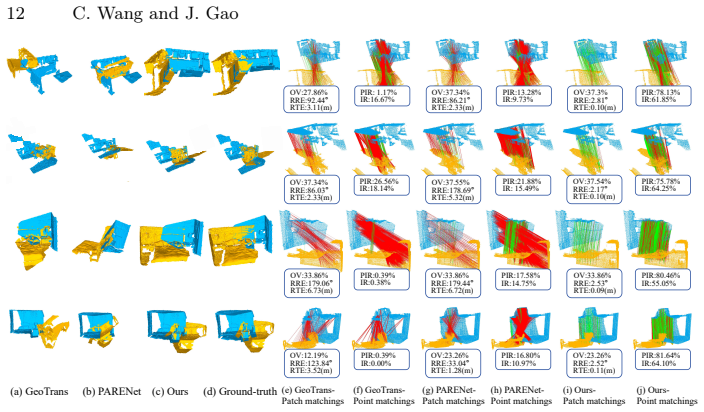
Summary. The paper proposes SHReg, a point cloud registration framework that uses spherical-harmonics-based irreducible representations of SO(3) to obtain strictly rotation-equivariant features. From these features it derives rotation-invariant descriptors for coarse-to-fine matching and rotation-equivariant ℓ=1 and ℓ=2 features that are used in a per-correspondence closed-form SE(3) hypothesis proposer. The best hypothesis is selected by a geometric inlier-count verification. Experiments on 3DMatch, 3DLoMatch, rotated 3DLoMatch, and KITTI show strong registration recall, especially on low-overlap and rotated benchmarks, with an ablation indicating that the single-correspondence proposer improves RR over triplet-based RANSAC and LGR.
Significance. If the equivariance proof and the per-correspondence pose construction are correct, the paper makes a useful contribution: it demonstrates that strict SO(3) equivariance can be used not only for invariant descriptors but also for closed-form pose hypothesis generation from individual correspondences, reducing the hypothesis search space. The paper's strengths are its clear irrep-based architecture, the internal consistency of the ablations, and the fact that the equivariant framework leads to measurable gains in TR on the rotated 3DLoMatch benchmark. The central technical risk is whether the sign-disambiguation rule in Eq. (17) is reliable; this is a learned, empirical assumption rather than a geometric guarantee, and the paper defers the relevant analysis to a supplementary that is not included in the arXiv submission.
major comments (3)
- [§3.4, Eqs. (17)–(18)] The closed-form pose R = A_q A_p^T hinges on the sign rule ã = sign(a^T v) a and on constructing e2 = normalize(v − (e1^T v)e1). This requires a^T v ≠ 0 and v not parallel to a. Neither condition is guaranteed by the architecture or by the losses described in §3.6: the contrastive rotation loss supervises consistency of equivariant features, not the non-degeneracy of the ℓ=1/ℓ=2 relative geometry. When a^T v is near zero or its sign flips, the axis is flipped by 180°, producing hypotheses that are grossly wrong; when v is parallel to a, e2 is undefined. The paper says degenerate cases are handled by 'degenerate-case checks' in the supplementary, but no supplementary material is present in the arXiv source. This is load-bearing: the claimed advantage of 'each correspondence directly hypothesizes a valid SE(3)' is not established. Please add the degenerate-case analysis to the paper and p
- [§3.2, equivariance proof] The paper states 'We provide a rigorous proof in the supplementary material that our spherical-harmonics encoding, tensor-product with Clebsch–Gordan projection, linear neighborhood aggregation, and scalar-gated nonlinearity jointly preserve SO(3)-equivariance across layers,' and similarly defers the 'derivation of the strict invariance of Eqs. (7)–(8)' to a supplement. No supplementary file is included in the arXiv submission. Since strict equivariance is the paper's central theoretical claim, the proof must be part of the reviewed material. Please include the supplementary or fold the proof into the main text, and specify the feature orientation convention (row vs column vectors) so that Eq. (2), Eq. (5), and Eq. (19) are mutually consistent.
- [§3.6, rotation loss Lr] The rotation loss Lr is only referenced to PARE-Net [36] and not specified. The sign-disambiguation rule in Eq. (17) depends on the learned relationship between the ℓ=2 eigenvector a and the ℓ=1 feature v. The paper does not state whether Lr or any other term encourages a^T v to be consistently non-zero and of stable sign for matched pairs. Without such a term or an analysis, the sign rule is an unsubstantiated post-hoc heuristic. Please clarify what Lr actually optimizes and, if it does not address the ℓ=1/ℓ=2 alignment, add an explicit analysis or ablation.
minor comments (3)
- [Abstract and §4.1, Table 2] The claim that SHReg 'consistently outperforms' rotation-robust baselines is slightly overstated: on Rotated 3DLoMatch, PARE-Net achieves RE 2.84° vs Ours 2.88° and TE 8.71 cm vs Ours 8.94 cm; only TR is higher (83.3 vs 81.8). Please qualify the claim to focus on registration recall or discuss the RE/TE trade-off.
- [Table 1 and §4.1] The text says SHReg 'maintains high efficiency,' but on 3DMatch/3DLoMatch Ours is 0.28 s, slower than PARE-Net (0.17 s) and GeoTrans (0.18 s). The efficiency claim is not directly supported by the table. Please either provide more careful wording or report the hypothesis-count reduction that motivates the efficiency claim.
- [§3.4, Eq. (14)] It would help to define w1 and w2 explicitly: are they learned channel-mixing vectors (shape C_1→1 and C_2→1) applied over the channel dimension? The notation 'w_2^T F_p^(2)' suggests this, but the dimension of F^(2) is not stated precisely in the main text.
Circularity Check
No significant circularity: the per-correspondence pose is a deterministic function of equivariant features, not a fitted value of the benchmark metrics; the only self-citation is non-load-bearing.
full rationale
I walked the derivation chain. The backbone equivariance is architectural: spherical-harmonic lifting, Clebsch–Gordan tensor products, and Wigner-D transformations give F^(ℓ)(R◦P)=F^(ℓ)(P)D^(ℓ)(R)^T by construction. The invariant descriptor readout (Eqs. 7–8) follows directly from orthogonality of D^(ℓ)(R). The per-correspondence pose (Eqs. 14–20) constructs local frames from the ℓ=1,2 features and sets R=A_q A_p^T; for matched points related by the true rotation, equivariance implies the frames transform together, so the closed-form rotation is derived, not fitted. The sign rule in Eq. 17 is a heuristic, but it is not circular—it defines an orientation from the learned ℓ=1 feature, and its failure mode (a^T v=0 or v parallel to a) is a robustness/support gap, not an equivalence to inputs. The only self-citation (ref [12], OAAFormer, by co-author Junjie Gao) appears in a related-work enumeration and is not load-bearing. The paper does defer the equivariance proof and degenerate-case checks to an absent supplementary, and the Lr loss/backbone follow PARE-Net [36] (an external citation); these are support gaps and overclaiming concerns, not circularity. No step reduces to its own input, and no benchmark statistic is used as a training target, so the central claim retains independent content.
Assumptions & free parameters
free parameters (3)
- w1, w2 channel-mixing readouts =
learned; values not reported
- Radial MLP weights a^(ℓ)(r) =
learned; values not reported
- Matching and training hyperparameters (top-k, thresholds τc/τr, loss weights) =
not reported; follows PARE-Net/prior work
assumptions (4)
- standard math Wigner-D matrices are orthogonal/unitary and Clebsch–Gordan coupling preserves SO(3) equivariance
- domain assumption Rotating an input cloud rotates all pairwise displacements consistently so that message passing over neighborhoods remains equivariant
- domain assumption Corresponding points in partially overlapping clouds have locally similar neighborhoods up to a common rigid transform; non-overlap context does not dominate
- ad hoc to paper The learned ℓ=1 feature v is not orthogonal to the dominant ℓ=2 eigenvector a, and sign(a^T v) consistently disambiguates the axis orientation
Cite this review
Pith. "Pith review of SHReg: Strictly Rotation-Equivariant Point Cloud Registration via Spherical Harmonics." pith.science (2026). https://pith.science/paper/ANNUYL4M
@misc{pith2026260723096,
  author       = {Pith},
  title        = {Pith review of: SHReg: Strictly Rotation-Equivariant Point Cloud Registration via Spherical Harmonics},
  year         = {2026},
  howpublished = {\url{https://pith.science/paper/ANNUYL4M}},
  note         = {Machine review of arXiv:2607.23096}
}
abstract
Point cloud registration critically depends on local features that are both distinctive and robust to arbitrary 3D rotations. Existing learning-based methods typically approximate rotation invariance via fragile local reference frames or extensive data augmentation, providing only empirical invariance and often degrading under unseen rotational transformations. In this paper, we propose SHReg, a strictly rotation-equivariant point cloud registration framework grounded in the representation theory of $SO(3)$. By representing local geometric features as irreducible representations of $SO(3)$, SHReg guarantees exact equivariance under arbitrary rotations without relying on local reference frames. Built upon a spherical-harmonics-based equivariant backbone, SHReg jointly learns rotation-invariant descriptors for robust correspondence matching and rotation-equivariant features that preserve fine-grained orientation information. The preserved equivariant structure enables each correspondence to directly hypothesize a rigid transformation, reducing reliance on large-scale hypothesis sampling in conventional RANSAC-based pipelines and leading to improved robustness under challenging rotational variations. Extensive experiments on 3DMatch, 3DLoMatch, and KITTI demonstrate that SHReg consistently outperforms state-of-the-art methods in registration accuracy, particularly under large rotational perturbations.
Figures


Figures from the paper (1 more)
Reference graph
Works this paper leans on
-
[36]
In: European Confer- ence on Computer Vision (2024),https://api.semanticscholar.org/CorpusID: 271212761
Yao, R., Du, S., Cui, W., Tang, C., Yang, C.: Pare-net: Position-aware rotation- equivariant networks for robust point cloud registration. In: European Confer- ence on Computer Vision (2024),https://api.semanticscholar.org/CorpusID: 271212761
2024
-
[1]
2023 IEEE/CVF Conference on Computer Vision and Pattern Recognition (CVPR) pp
Ao, S., Hu, Q., Wang, H., Xu, K., Guo, Y.: Buffer: Balancing accuracy, efficiency, and generalizability in point cloud registration. 2023 IEEE/CVF Conference on Computer Vision and Pattern Recognition (CVPR) pp. 1255–1264 (2023),https: //api.semanticscholar.org/CorpusID:260055164
2023
-
[2]
2021 IEEE/CVF Conference on Computer Vision and Pattern Recognition (CVPR) pp
Ao, S., Hu, Q., Yang, B., Markham, A., Guo, Y.: Spinnet: Learning a general surface descriptor for 3d point cloud registration. 2021 IEEE/CVF Conference on Computer Vision and Pattern Recognition (CVPR) pp. 11748–11757 (2020), https://api.semanticscholar.org/CorpusID:227151932
2021
-
[3]
2021 IEEE/CVF ConferenceonComputerVisionandPatternRecognition(CVPR)pp.15854–15864 (2021),https://api.semanticscholar.org/CorpusID:232168842
Bai, X., Luo, Z., Zhou, L., Chen, H., Li, L., Hu, Z., Fu, H., Tai, C.L.: Pointdsc: Robust point cloud registration using deep spatial consistency. 2021 IEEE/CVF ConferenceonComputerVisionandPatternRecognition(CVPR)pp.15854–15864 (2021),https://api.semanticscholar.org/CorpusID:232168842
2021
-
[4]
2020 IEEE/CVF Confer- ence on Computer Vision and Pattern Recognition (CVPR) pp
Bai, X., Luo, Z., Zhou, L., Fu, H., Quan, L., Tai, C.L.: D3feat: Joint learning of dense detection and description of 3d local features. 2020 IEEE/CVF Confer- ence on Computer Vision and Pattern Recognition (CVPR) pp. 6358–6366 (2020), https://api.semanticscholar.org/CorpusID:212628458
2020
-
[5]
2024 IEEE/CVF Conference on Computer Vi- sion and Pattern Recognition (CVPR) pp
Chen, H., Yan, P., Xiang, S., Tan, Y.: Dynamic cues-assisted transformer for robust point cloud registration. 2024 IEEE/CVF Conference on Computer Vi- sion and Pattern Recognition (CVPR) pp. 21698–21707 (2024),https://api. semanticscholar.org/CorpusID:272722265
2024
-
[6]
2022 IEEE/CVF Conference on Computer Vision and Pattern Recognition (CVPR) pp
Chen, Z., Sun, K., Yang, F., Tao, W.: Sc2-pcr: A second order spatial compatibil- ity for efficient and robust point cloud registration. 2022 IEEE/CVF Conference on Computer Vision and Pattern Recognition (CVPR) pp. 13211–13221 (2022), https://api.semanticscholar.org/CorpusID:252571579
2022
-
[7]
2019 IEEE/CVF International Conference on Computer Vision (ICCV) pp
Choy, C.B., Park, J., Koltun, V.: Fully convolutional geometric features. 2019 IEEE/CVF International Conference on Computer Vision (ICCV) pp. 8957–8965 (2019),https://api.semanticscholar.org/CorpusID:201686687
2019
Show all 42 references
-
[8]
ArXivabs/1808.10322(2018),https://api
Deng, H., Birdal, T., Ilic, S.: Ppf-foldnet: Unsupervised learning of rotation invariant 3d local descriptors. ArXivabs/1808.10322(2018),https://api. semanticscholar.org/CorpusID:52131369
2018 arXiv
-
[9]
2018 IEEE/CVF Conference on Computer Vision and Pattern Recognition pp
Deng, H., Birdal, T., Ilic, S.: Ppfnet: Global context aware local features for robust 3d point matching. 2018 IEEE/CVF Conference on Computer Vision and Pattern Recognition pp. 195–205 (2018),https://api.semanticscholar.org/CorpusID: 3703761
2018
-
[10]
Isprs Journal of Photogrammetry and Remote Sensing130, 431–452 (2017),https://api.semanticscholar.org/ CorpusID:125337993 16 C
Dong,Z.,Dong,Z.,Yang, B.,Liu,Y.,Liang,F.,junLi, B., Zang,Y.:Anovelbinary shape context for 3d local surface description. Isprs Journal of Photogrammetry and Remote Sensing130, 431–452 (2017),https://api.semanticscholar.org/ CorpusID:125337993 16 C. Wang and J. Gao
2017
-
[11]
Fischler, M.A., Bolles, R.C.: Random sample consensus: a paradigm for model fitting with applications to image analysis and automated cartography. Commun. ACM24, 381–395 (1981),https://api.semanticscholar.org/CorpusID:972888
1981
-
[12]
Journal of Computer Science and Technology39, 755 – 770 (2023), https://api.semanticscholar.org/CorpusID:264146030
Gao, J., Dong, Q., Wang, R., Chen, S., Xin, S., Tu, C., Wang, W.: Oaaformer: Robust and efficient point cloud registration through overlapping-aware attention in transformer. Journal of Computer Science and Technology39, 755 – 770 (2023), https://api.semanticscholar.org/Corpus...
2023
-
[13]
2012 IEEE Conference on Computer Vision and Pattern Recognition pp
Geiger, A., Lenz, P., Urtasun, R.: Are we ready for autonomous driving? the kitti vision benchmark suite. 2012 IEEE Conference on Computer Vision and Pattern Recognition pp. 3354–3361 (2012),https://api.semanticscholar.org/ CorpusID:6724907
2012
-
[14]
2019 IEEE/CVF Conference on Com- puter Vision and Pattern Recognition (CVPR) pp
Gojcic, Z., Zhou, C., Wegner, J.D., Wieser, A.: The perfect match: 3d point cloud matching with smoothed densities. 2019 IEEE/CVF Conference on Com- puter Vision and Pattern Recognition (CVPR) pp. 5540–5549 (2018),https: //api.semanticscholar.org/CorpusID:53670229
2019
-
[15]
2013 1st International Conference on Communications, Signal Processing, and their Applications (ICC- SPA) pp
Guo, Y., Sohel, F., Bennamoun, Wan, J., Lu, M.: Rops: A local feature descriptor for 3d rigid objects based on rotational projection statistics. 2013 1st International Conference on Communications, Signal Processing, and their Applications (ICC- SPA) pp. 1–6 (2013),https://api...
2013
-
[16]
Computer Graphics Forum33(2014),https: //api.semanticscholar.org/CorpusID:45860720
Hu, S., Mellado, N., Mitra, N.J., Aiger, D.: Super 4pcs fast global pointcloud registration via smart indexing. Computer Graphics Forum33(2014),https: //api.semanticscholar.org/CorpusID:45860720
2014
-
[17]
2021 IEEE/CVF Conference on Computer Vision and Pattern Recognition (CVPR) pp
Huang, S., Gojcic, Z., Usvyatsov, M.M., Wieser, A., Schindler, K.: Predator: Registration of 3d point clouds with low overlap. 2021 IEEE/CVF Conference on Computer Vision and Pattern Recognition (CVPR) pp. 4265–4274 (2020), https://api.semanticscholar.org/CorpusID:227209593
2021
-
[18]
ArXivabs/2410.10927(2024),https://api.semanticscholar.org/ CorpusID:273350603
Jaramillo, P., Sipiran, I.: Cultural heritage 3d reconstruction with diffusion net- works. ArXivabs/2410.10927(2024),https://api.semanticscholar.org/ CorpusID:273350603
2024 arXiv
-
[19]
2023 IEEE/CVF Conference on Computer Vision and Pattern Recognition (CVPR) pp
Jiang, H., Dang, Z., Wei, Z., Xie, J., Yang, J., Salzmann, M.: Robust outlier re- jection for 3d registration with variational bayes. 2023 IEEE/CVF Conference on Computer Vision and Pattern Recognition (CVPR) pp. 1148–1157 (2023), https://api.semanticscholar.org/CorpusID:257921545
2023
-
[20]
Acta Crystallographica Section A32, 922–923 (1976),https://api.semanticscholar
Kabsch, W.: A solution for the best rotation to relate two sets of vectors. Acta Crystallographica Section A32, 922–923 (1976),https://api.semanticscholar. org/CorpusID:97383637
1976
-
[21]
2021 IEEE/CVF International Conference on Computer Vision (ICCV) pp
Lee,J.,Kim,S.,Cho,M.,Park,J.:Deephoughvotingforrobustglobalregistration. 2021 IEEE/CVF International Conference on Computer Vision (ICCV) pp. 15974– 15983 (2021),https://api.semanticscholar.org/CorpusID:237453312
2021
-
[22]
ISPRS Journal of Photogrammetry and Remote Sensing (2020), https://api.semanticscholar.org/CorpusID:225238083
Li, J., Hu, Q., Ai, M.: Gesac: Robust graph enhanced sample consensus for point cloud registration. ISPRS Journal of Photogrammetry and Remote Sensing (2020), https://api.semanticscholar.org/CorpusID:225238083
2020
-
[23]
IEEE Transactions on Neural Networks and Learning Systems32(8), 3412–3432 (2020)
Li, Y., Ma, L., Zhong, Z., Liu, F., Chapman, M.A., Cao, D., Li, J.: Deep learning for lidar point clouds in autonomous driving: A review. IEEE Transactions on Neural Networks and Learning Systems32(8), 3412–3432 (2020)
2020
-
[24]
2023 IEEE/CVF International Conference on Computer Vision (ICCV) pp
Lindenberger, P., Sarlin, P.E., Pollefeys, M.: Lightglue: Local feature matching at light speed. 2023 IEEE/CVF International Conference on Computer Vision (ICCV) pp. 17581–17592 (2023),https://api.semanticscholar.org/CorpusID: 259243929 SHReg 17
2023
-
[25]
Proceedings of the 29th ACM International Conference on Multimedia (2021),https://api.semanticscholar
Liu, G., Rong, Y., Sheng, L.: Votehmr: Occlusion-aware voting network for robust 3d human mesh recovery from partial point clouds. Proceedings of the 29th ACM International Conference on Multimedia (2021),https://api.semanticscholar. org/CorpusID:239011881
2021
-
[26]
semanticscholar.org/CorpusID:115850593
Mattis, D.C.: Quantum theory of angular momentum (1981),https://api. semanticscholar.org/CorpusID:115850593
1981
-
[27]
IEEE Transactions on Pattern Analysis and Machine Intelligence45, 9806–9821 (2023), https://api.semanticscholar.org/CorpusID:257646283
Qin, Z., Yu, H., Wang, C., Guo, Y., Peng, Y., Ilic, S., Hu, D., Xu, K.: Geotrans- former: Fast and robust point cloud registration with geometric transformer. IEEE Transactions on Pattern Analysis and Machine Intelligence45, 9806–9821 (2023), https://api.semanticscholar.org/Co...
2023
-
[28]
2009 IEEE International Conference on Robotics and Automation pp
Rusu, R.B., Blodow, N., Beetz, M.: Fast point feature histograms (fpfh) for 3d registration. 2009 IEEE International Conference on Robotics and Automation pp. 3212–3217 (2009),https://api.semanticscholar.org/CorpusID:15022990
2009
-
[29]
Salti, S., Tombari, F., di Stefano, L.: Shot: Unique signatures of histograms for surface and texture description. Comput. Vis. Image Underst.125, 251–264(2014), https://api.semanticscholar.org/CorpusID:17799553
2014
-
[30]
2019 IEEE/CVF International Conference on Computer Vision (ICCV) pp
Thomas, H., Qi, C., Deschaud, J.E., Marcotegui, B., Goulette, F., Guibas, L.J.: Kpconv: Flexible and deformable convolution for point clouds. 2019 IEEE/CVF International Conference on Computer Vision (ICCV) pp. 6410–6419 (2019), https://api.semanticscholar.org/CorpusID:121328056
2019
-
[31]
Ullah, I., Adhikari, D., Khan, H., Anwar, M.S., Ahmad, S., Bai, X.: Mobile robot localization: Current challenges and future prospective. Comput. Sci. Rev.53, 100651 (2024),https://api.semanticscholar.org/CorpusID:271020621
2024
-
[32]
Proceedings of the 30th ACM International Conference on Multimedia (2021),https://api
Wang, H., Liu, Y., Dong, Z., Wang, W., Yang, B.: You only hypothesize once: Point cloud registration with rotation-equivariant descriptors. Proceedings of the 30th ACM International Conference on Multimedia (2021),https://api. semanticscholar.org/CorpusID:237371232
2021
-
[33]
IEEE Transactions on Pattern Analysis and Machine Intelligence45, 10376–10393 (2023),https://api.semanticscholar.org/CorpusID:256969892
Wang, H., Liu, Y., Hu, Q., Wang, B., Chen, J., Dong, Z., Guo, Y., Wang, W., Yang, B.: Roreg: Pairwise point cloud registration with oriented descriptors and local rotations. IEEE Transactions on Pattern Analysis and Machine Intelligence45, 10376–10393 (2023),https://api.semant...
2023
-
[34]
IEEE Transactions on Image Processing33, 2116–2130 (2024),https://api.semanticscholar.org/CorpusID:268373790
Xing, X., Lu, Z., Wang, Y., Xiao, J.: Efficient single correspondence voting for point cloud registration. IEEE Transactions on Image Processing33, 2116–2130 (2024),https://api.semanticscholar.org/CorpusID:268373790
2024
-
[35]
ArXivabs/2403.14621(2024),https://api.semanticscholar.org/ CorpusID:268554137
Xu, Y., Shi, Z., Yifan, W., Chen, H., Yang, C., Peng, S., Shen, Y., Wetzstein, G.: Grm: Large gaussian reconstruction model for efficient 3d reconstruction and generation. ArXivabs/2403.14621(2024),https://api.semanticscholar.org/ CorpusID:268554137
2024 arXiv
-
[37]
ArXivabs/1807.09413(2018),https://api.semanticscholar
Yew,Z.J.,Lee,G.H.:3dfeat-net:Weaklysupervisedlocal3dfeaturesforpointcloud registration. ArXivabs/1807.09413(2018),https://api.semanticscholar. org/CorpusID:50770050
2018 arXiv
-
[38]
In: Neural Information Processing Systems (2021),https://api.semanticscholar.org/CorpusID:239998094
Yu, H., Li, F., Saleh, M., Busam, B., Ilic, S.: Cofinet: Reliable coarse-to-fine corre- spondences for robust point cloud registration. In: Neural Information Processing Systems (2021),https://api.semanticscholar.org/CorpusID:239998094
2021
-
[39]
2023 IEEE/CVF Conference on Computer 18 C
Yu, H., Qin, Z., Hou, J., Saleh, M., Li, D., Busam, B., Ilic, S.: Rotation-invariant transformer for point cloud matching. 2023 IEEE/CVF Conference on Computer 18 C. Wang and J. Gao Vision and Pattern Recognition (CVPR) pp. 5384–5393 (2023),https://api. semanticscholar.org/Cor...
2023
-
[40]
2023 IEEE/CVF ConferenceonComputerVisionandPatternRecognition(CVPR)pp.17702–17711 (2023),https://api.semanticscholar.org/CorpusID:260964522
Yu, J., Ren, L., Zhou, W., Zhang, Y., Lin, L., Dai, G.: Peal: Prior-embedded ex- plicit attention learning for low-overlap point cloud registration. 2023 IEEE/CVF ConferenceonComputerVisionandPatternRecognition(CVPR)pp.17702–17711 (2023),https://api.semanticscholar.org/CorpusI...
2023
-
[41]
Proceedings of the 2018 ACM on International Conference on Multimedia Retrieval (2018), https://api.semanticscholar.org/CorpusID:4557768
Yue, X., Wu, B., Seshia, S.A., Keutzer, K., Sangiovanni-Vincentelli, A.L.: A lidar point cloud generator: from a virtual world to autonomous driving. Proceedings of the 2018 ACM on International Conference on Multimedia Retrieval (2018), https://api.semanticscholar.org/CorpusI...
2018
-
[42]
2017 IEEE Con- ference on Computer Vision and Pattern Recognition (CVPR) pp
Zeng, A., Song, S., Nießner, M., Fisher, M., Xiao, J., Funkhouser, T.A.: 3dmatch: Learning local geometric descriptors from rgb-d reconstructions. 2017 IEEE Con- ference on Computer Vision and Pattern Recognition (CVPR) pp. 199–208 (2016), https://api.semanticscholar.org/Corpu...
2017
Reviewed August 1, 2026 · model on record in the stance chip above.
Discussion (0). Sign in to comment.