REVIEW 3 major objections 6 minor 2 cited by
LabGuard: Grounding Natural-Language Laboratory Rules into Runtime Guards for Embodied Laboratory Agents
T0 review · 3 major / 6 minor · reviewed 2026-08-03 · deepseek-v4-flash
Pith's one-line read Natural-language laboratory safety rules can be grounded into typed executable specifications and compiled into runtime monitors that cut unsafe events from 39.5% to 23.8% while leaving task success intact.
desk verdict A credible, honest integration of NL grounding and runtime safety for lab agents, but the headline safety reduction is partly self-measured; oracle-based rescoring is needed before that number stands. read the letter →
The pith
A machine-rendered reading of the paper's core claim, the machinery that carries it, and where it could break.
The reading
What carries the argument
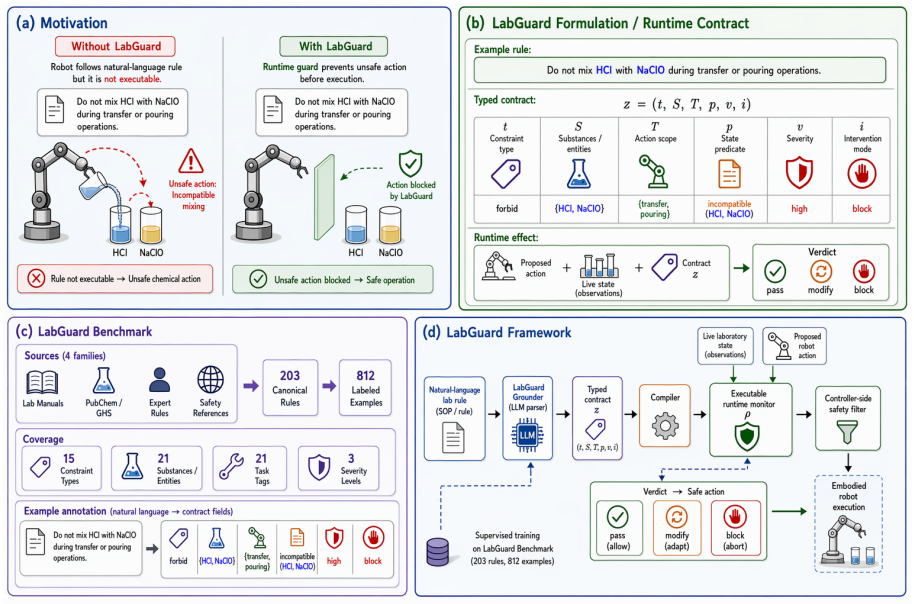
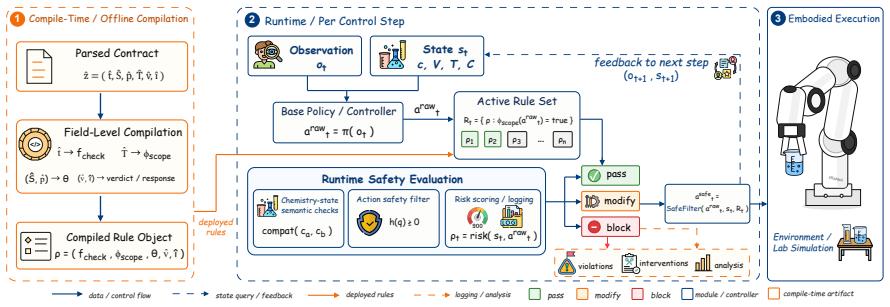
The central object is LabGuard-IR, a typed executable tuple: constraint type, substance or entity set, state predicate, action scope, severity, and intervention mode. The compiler lowers it into a runtime monitor consisting of a check function, an activation-scope predicate, monitor parameters, severity, and intervention mode; the runtime executor activates only monitors whose scope matches the proposed action. Material-compatibility checks are registry lookups over incompatible-substance lists, and other constraint types use semantic checks over live container state, a barrier-style action filter, and risk scoring. The design separates grounding from compilation, so imperfect predicate reco
What would settle it
Take the logged trajectories from the live-running experiments and replay them through an independent offline safety checker that does not use the runtime assurance layer; compare unsafe outcomes for the policy with and without compiled monitors. If the gap is much smaller than 39.5% to 23.8%, the live reduction is an artifact of self-measurement.
Extended reading notes
Core claim
The paper's central claim is that laboratory safety language can be transformed into executable runtime checks through a typed intermediate representation plus a trainable grounding step. An IR instance records what kind of constraint applies, which substances or entities are involved, the state or action predicate, which robot actions trigger the rule, severity, and intervention mode. The pipeline validates each IR instance, compiles it into a monitor with a check function, an activation-scope predicate, parameters, and a verdict policy, and runs active monitors at the controller boundary before an action executes. On held-out rule sources, the hybrid grounder achieves 79.4 F1 on action-sco
Load-bearing premise
The headline reduction assumes the safety layer's own logged events are a trustworthy count of unsafe outcomes in live runs, because those runs are not checked against an independent safety judge.
Editorial extensions
If this is right
- Natural-language safety rules can be turned into executable runtime monitors without a human writing formal specifications for each rule.
- A safety layer compiled from grounded rules can attach to a learned controller in simulation and reduce unsafe events by about 40 percent relative while keeping interventions below 0.5 percent of steps.
- Action-scope prediction and substance binding, more than exact predicate recovery, determine whether a grounded rule becomes an effective runtime guard.
- The monitor schema bounds coverage: hazards outside the 15 implemented constraint types are missed even by gold monitors, so schema expansion is the lever for broader safety.
Reading between the lines
- Beyond the paper: the typed-IR-plus-compiler pattern could transfer to other regulated text-to-execution domains—clinical protocols, aviation checklists, manufacturing SOPs—where safety language must become runtime checks without a formal specification step.
- Beyond the paper: a cheap ablation would train a grounder to predict only action tags and substances, fill predicates from gold, and measure how much of the 39.5-to-23.8 reduction survives; this would quantify the marginal value of predicate grounding.
- Beyond the paper: applying the paper's independent offline checker to all live-running episodes, not just the controlled-pour scenario, would directly test whether the self-logged violation counts support the headline reduction.
- Beyond the paper: the risk scorer uses fixed hand-designed weights, so a natural extension is to learn thresholds and weights per task or per constraint family from logged intervention outcomes.
Signed reviews
Editorial analysis
A structured set of objections, weighed in public.
Referee Report
Summary. The paper introduces LabGuard, a language-to-execution safety suite that converts natural-language laboratory safety rules into typed executable IR instances and compiles them into runtime monitors for embodied laboratory agents in simulation. The three core components are LabGuard-IR (a typed executable schema with constraint type, substance/entity set, state/action predicate, action scope, severity, and intervention mode), LabGuard-Bench (812 supervised annotations expanded from 203 seed rules from four source families), and LabGuard-Grounder (a LoRA fine-tuned Qwen3-8B with a hybrid regex-normalization variant). The LabGuard Pipeline compiles predicted IR into runtime monitors and executes them at the controller boundary. Experiments evaluate grounding under random, source-held-out, and chemistry-held-out splits; replay compiled monitors on a 100-scenario stress set with outcome-level ground truth; and run live LabUtopia L1–L4 tasks with ACT as the base policy. The paper reports 79.4 task-scope F1 under source-held-out grounding, a reduction in unsafe events from 39.5% to 23.8%, and intervention rates below 0.5% of controller steps with preserved task success.
Significance. If the reported runtime safety improvement is validated by an independent oracle, LabGuard would be a useful and fairly complete bridge from laboratory-safety text to executable runtime guards. The paper has several genuine strengths: the three-stage evaluation is clearly structured; the stress benchmark uses independent outcome-level labels; the controlled-pour ablation is rescored offline by an oracle independent of the active assurance layer; the schema-validation and compile-readiness checks are concrete; and the limitations (simulation-only, ACT-only, schema coverage) are stated candidly. The contribution of LabGuard-Bench and the typed IR could support follow-up work even if the live-runtime headline needs qualification.
major comments (3)
- [§5.4, Appendix C, Table 2] The live-runtime 'Unsafe Event' and VR rows are explicitly 'assurance-layer-logged' for L1–L4. The monitors are compiled from the same grounding configurations being compared, so a grounder with a false-negative check (wrong constraint type, wrong scope, or wrong substance binding) can simply fail to log an event. The 39.5%→23.8% reduction in Table 2 may therefore reflect differences in detector sensitivity rather than differences in actual unsafe outcomes. The independent outcome-level oracle is applied only to the controlled-pour ablation (Table 5), not to the L1–L4 episodes behind the headline. Please rescore all L1–L4 episodes offline with the same compiled-monitor checker or an independent oracle, and report both 'logged' and 'oracle-rescored' Unsafe Event/VR for every configuration, including the no-safety Base condition. If such a rescore is not feasible, the abstract and Section
- [Table 2 and Abstract] The headline 'reduces unsafe events from 39.5% to 23.8% after monitor compilation' is not a no-safety vs. safety-layer comparison. Both rows in Table 2 correspond to active monitors compiled from different grounders (Base Grounder vs. LabGuard-Hybrid). The actual no-safety baseline appears only in the controlled-pour ablation (Table 5), where Base has VR 2.8 under offline rescoring, and that baseline is not used in the source-held-out runtime rows. The current framing can be misread as a comparison of safety layer vs. no safety layer. Please state explicitly in the text and figure captions that the reduction is between two grounding configurations with active monitors, and give the corresponding no-safety rate under the same scoring protocol if available.
- [§5.3, Table 3] The stress benchmark shows that all configurations, including Gold, miss 16 of 70 unsafe scenarios because those scenarios require monitor types outside the implemented schema. This is acknowledged as a schema-coverage boundary, but it has direct consequences for the runtime claim: the 39.5%→23.8% reduction and the per-task VR numbers in Table 11 are only meaningful over hazards covered by the current monitor library. The paper should explicitly state which hazard categories in L1–L4 are covered by the implemented monitors and scope the safety claims accordingly. Without this, the reader cannot tell whether the live-runtime reduction generalizes across the hazard space or only across the in-schema subset used to construct the tasks.
minor comments (6)
- [§5.3, paragraph 3] There is a stray formatting artifact: 'Appendix I)·' should be 'Appendix I'.
- [Figure 2] The label 'FRANKA' appears under 'Embodied Execution' but is not defined or used elsewhere in the text. Either explain its role or remove it.
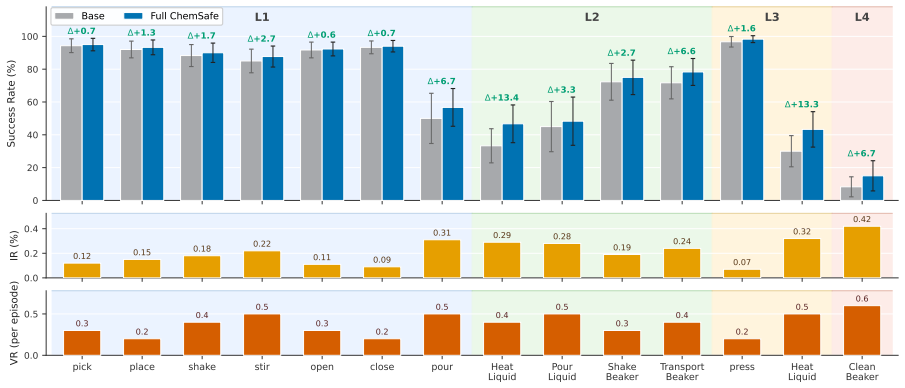
- [Figure 3] The right-hand delta values are labeled 'Full−Base' but it is not immediately clear which metric the delta refers to (ΔSR only, or also VR/IR). Please clarify in the caption or legend.
- [Appendix C] The definitions of 'Unsafe Event' and 'Violation Rate (VR)' are not fully aligned: Table 2 reports Unsafe Event as a percentage of episodes, while Table 11 reports VR as average violations per episode. Please make the relationship between these two quantities explicit and use consistent terminology.
- [Table 2 footnote] False Intervention is reported for L1–L4 runtime rows, but Appendix C says it is reported 'only when such safe-control labels are available.' Clarify what safe-control labels were available for the L1–L4 episodes.
- [References] Several references are arXiv preprints with no venue or version information (e.g., Black et al., 2026; Ji et al., 2026b; Zhang et al., 2026c). Please standardize the bibliography entries.
Circularity Check
Headline unsafe-event reduction is measured by the system's own assurance-layer logs; independent oracle only in controlled-pour ablation
-
self definitional
[Section 5.4 and Appendix C; claimed in Abstract and Section 5.2, Table 2]
"main-runtime VR/Unsafe Event are assurance-layer-logged (Appendix C), while an outcome-level oracle independent of the wrapper is applied only to the controlled pour ablation (Table 5). ... For L1-L4 LabUtopia runs, safety events are logged by the runtime assurance layer when that layer is active."
The headline safety reduction (39.5% to 23.8% unsafe events) is computed from events logged by the active assurance layer, i.e., the very compiled monitors whose grounding quality is varied across rows of Table 2. Each row's Unsafe Event is generated by monitors compiled from that row's grounding output, so a monitor with a false negative simply does not log a hazard and the episode is not counted as unsafe. The outcome metric is therefore defined by the system under test rather than by an independent outcome oracle, which is applied only to the controlled-pour ablation. The measured gradient can reflect detector sensitivity rather than true safety.
full rationale
Most of the paper's core evidence is externally benchmarked: the 79.4 task-scope F1 and the chemistry-held-out results are evaluated against held-out labels, and the stress benchmark (Tables 3-4, 13) uses an outcome-level oracle on scripted traces. The references to the authors' own prior work are contextual and do not carry the derivation of the safety numbers, so self-citation is not load-bearing. The circularity is confined to the live L1-L4 runtime unsafe-event reduction: the paper itself discloses that VR/Unsafe Event are 'assurance-layer-logged' and that an independent oracle was applied only to the controlled-pour ablation. For Table 2's runtime columns, each grounding configuration produces its own compiled monitors that also produce the outcome log, so the 39.5% -> 23.8% reduction is partly a self-measurement of the system under test rather than an externally established safety outcome. This transparency and the independent stress benchmark mitigate the issue, but one headline prediction nonetheless reduces by construction to the system's own detector output, warranting partial circularity.
Assumptions & free parameters
free parameters (4)
- Risk scoring weights =
0.25, 0.25, 0.30, 0.20
- Velocity bound margin alpha =
0.8
- Joint limit safety margin delta =
unspecified in main text
- Substance compatibility registry inc(·) =
curated table, not enumerated
assumptions (4)
- domain assumption The preregistered notion of unsafe event measured as assurance-layer logs (or offline replay of scripted states) faithfully captures real unsafe outcomes in the simulator.
- domain assumption Paraphrase augmentation saturates a 203-seed corpus into 812 sufficiently diverse examples for cross-source generalization.
- ad hoc to paper The task-scope tags and the 15 constraint types cover the semantics of the seed sources without systematic exclusion of duplicate or near-duplicate paraphrases.
- domain assumption LabUtopia's simulator state is a faithful enough proxy for real lab state that conclusions about intervention rates and safety-layer overhead transfer to embodied lab agents.
invented entities (3)
-
LabGuard-IR schema
-
LabGuard-Bench supervised corpus
-
Typed monitor library and compatibility registry
Cite this review
Pith. "Pith review of LabGuard: Grounding Natural-Language Laboratory Rules into Runtime Guards for Embodied Laboratory Agents." pith.science (2026). https://pith.science/paper/AP22JQ7T
@misc{pith2026260631045,
  author       = {Pith},
  title        = {Pith review of: LabGuard: Grounding Natural-Language Laboratory Rules into Runtime Guards for Embodied Laboratory Agents},
  year         = {2026},
  howpublished = {\url{https://pith.science/paper/AP22JQ7T}},
  note         = {Machine review of arXiv:2606.31045}
}
read the original abstract
Scientific embodied agents are increasingly capable of carrying out laboratory procedures, but executing these procedures safely in dynamic laboratory environments remains challenging. Current safety approaches often overlook the intermediate step of transforming laboratory natural language, including safety rules, manuals, protocols, and standard operating procedures, into machine-checkable runtime constraints. We introduce LabGuard (Laboratory Guard), a language-to-execution safety suite that grounds natural-language laboratory rules into executable specifications and deploys them as runtime guards. LabGuard includes three core components: LabGuard-IR, which defines a typed executable representation; LabGuard-Bench, which provides 812 supervised annotations expanded from 203 seed laboratory rules; and LabGuard-Grounder, which maps natural-language laboratory rules into LabGuard-IR. The resulting IR instances are handled by the LabGuard Pipeline, which compiles them into runtime monitors and applies them at the controller boundary. Experiments show that LabGuard generalizes to unseen laboratory-rule sources, achieves 79.4 task-scope F1, and reduces unsafe events from 39.5% to 23.8% after monitor compilation. In LabUtopia, its runtime monitors integrate with ACT, keeping interventions below 0.5% while preserving task success.
Figures
Forward citations
Cited by 2 Pith papers
-
Style Wins, Substance Loses: A Diagnosis of LLM-as-Judge in Idea Generation
LLM judges of scientific ideas are measurably swayed by writing style; a style-detecting module reduces but does not remove the bias.
-
Parametric Memory Decoding for Zero-Shot Routing in LoRA-Based External Parametric Memory
PMDRouter selects LoRAs zero-shot by decoding scale-normalized linear response energy from one adapter-free backbone prefill, and leads most internal-signal baselines on a new multi-granularity EPM bench.
Reference graph
Works this paper leans on
-
[1996]
Learning to Parse Database Queries Using Inductive Logic Pro- gramming. InProceedings of the Thirteenth National Conference on Artificial Intelligence and Eighth In- novative Applications of Artificial Intelligence Con- ference, AAAI 96, IAAI 96, Portland, Oregon, USA, August 4-8, 1996, Volume
1996
-
[2025]
InarXiv preprint arXiv:2412.04455
Code-as-Monitor: Constraint- Aware Visual Programming for Reactive and Proac- tive Robotic Failure Detection. InarXiv preprint arXiv:2412.04455. Yujun Zhou, Jingdong Yang, Kehan Guo, Pin-Yu Chen, Tian Gao, Werner Geyer, Nuno Moniz, Nitesh V . Chawla, and Xiangliang Zhang
Reviewed August 3, 2026 · model on record in the stance chip above.
Discussion (0). Continue with ORCID to comment.