REVIEW 4 major objections 4 minor 2 cited by
Targeted Adversarial Denoising Autoencoders (TADA) for Neural Time Series Filtration
T0 review · 4 major / 4 minor · reviewed 2026-08-10 · deepseek-v4-flash
Pith's one-line read Compact adversarial autoencoder strips EMG noise from EEG, beating classical filters and rivaling far larger deep networks.
desk verdict A compact adversarial AE plus a covariance rescaling heuristic that trains fast and runs small; but the advertised LC meta-targeting is never shown to affect the filter, so the central 'two-tiered targeting' claim is unsupported as written. read the letter →
The pith
A machine-rendered reading of the paper's core claim, the machinery that carries it, and where it could break.
The reading
What carries the argument
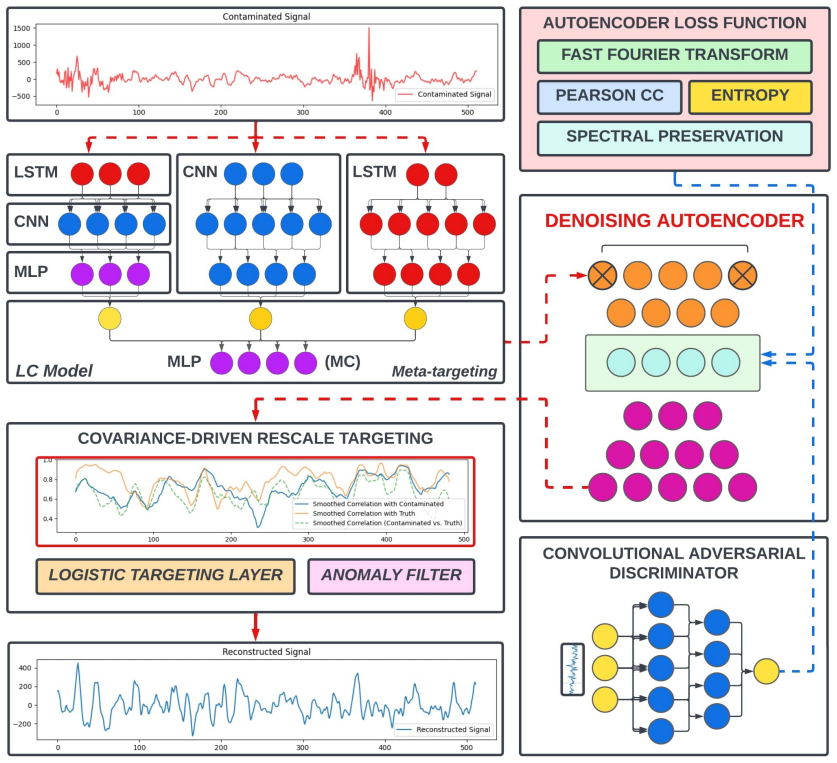
The covariance-driven logistic scale targeting algorithm (Algorithm 1) is the mechanism that carries the argument. It slides a window across the signal, computes the Pearson correlation between the original contaminated signal and the autoencoder's unscaled output, assigns logistic weights to windows whose correlation exceeds a threshold, and uses the weighted means and variances of those low-noise windows to compute an affine scale-and-offset mapping. This mapping converts the autoencoder's high-correlation but wrongly-scaled output into a final reconstruction that minimizes relative root mean squared error while preserving the correlation coefficient, all without access to ground truth.
What would settle it
Remove or randomize the LC meta-targeting layer's output during inference and re-measure CC, TRRMSE, and SRRMSE on the same test set; if the metrics do not change, the SNR prediction is not conditioning the filter as advertised.
Extended reading notes
Core claim
On the EEGdenoiseNet benchmark, TADA achieves mean correlation coefficients of 0.69 at −7 dB, 0.85 at −2.5 dB, and 0.94 at 2 dB with ground-truth EEG, while keeping temporal RRMSE at 0.82, 0.57, and 0.34 and spectral RRMSE at 0.90, 0.57, and 0.27 across the same SNR levels. The authors attribute this performance to a synergy of three components: an LSTM–CNN ensemble that predicts the contamination SNR, adversarial training that forces the autoencoder output to resemble authentic EEG, and a logistic covariance scale-targeting algorithm that rescales the autoencoder output by locating low-noise segments through running correlation with the contaminated input. The result, they argue, is a filtration system that outperforms conventional signal processing algorithms on all three standard metrics and is competitive with published deep-learning models at a fraction of their parameter count.
Load-bearing premise
The load-bearing premise is that the LSTM-CNN meta-targeting layer's predicted signal-to-noise ratio actually changes how strongly the autoencoder filters; the paper shows no equation or conditioning that passes that SNR value into the autoencoder, and without it the two-tiered targeting claim collapses to a plain adversarial autoencoder plus a rescaling step.
Editorial extensions
If this is right
- If the reported numbers hold, EEG denoising becomes practical on devices with limited compute, since the full model is under 400K parameters and infers in about 1.47 ms per segment.
- Roughly 140 seconds of training (plus about ten minutes of in-domain data) suggests models can be retrained online for new users or shifting noise conditions, a capability large multi-million-parameter networks lack.
- The covariance-driven rescaling is not EEG-specific; it could serve as a general post-processing layer for any single-channel denoiser that preserves waveform shape but misjudges amplitude.
- Outperforming the EEGdenoiseNet conventional baselines on all three metrics at low SNR gives the field a new lightweight benchmark for comparison.
Reading between the lines
- The authors do not test applying the logistic covariance scale-targeting layer on top of a frozen, larger pretrained denoiser; doing so could reveal whether the rescaling works as a universal adapter that lowers RRMSE without retraining.
- The advertised two-tiered targeting implies the predicted SNR should modulate how aggressively the autoencoder filters, but the manuscript never shows a conditioning mechanism; without one, the practical contribution may reduce to the adversarial autoencoder plus the rescaling layer alone.
- If the scale-targeting heuristic generalizes, it suggests a cheap alternative to training high-capacity networks: keep a small shape-preserving generator and correct amplitude biases with correlation-based statistics computed at inference time.
Editorial analysis
A structured set of objections, weighed in public.
Referee Report
Summary. The paper proposes TADA, a system for removing EMG artifacts from single-channel EEG time series, combining an LSTM-CNN ensemble for SNR prediction ('meta-targeting'), a convolutional denoising autoencoder trained with a custom correlation-based loss and an adversarial discriminator, and a post-hoc covariance-driven logistic scale-targeting algorithm. The authors evaluate TADA on the EEGdenoiseNet dataset at -7 dB, -2.5 dB, and 2 dB SNR, reporting correlation coefficients of 0.69-0.94, temporal RRMSE of 0.34-0.82, and spectral RRMSE of 0.27-0.90, with a model of roughly 393K trainable parameters and about 140 seconds of GPU training time. They claim TADA surpasses conventional filtration algorithms and is competitive with larger deep learning architectures.
Significance. If the results are reproducible, the paper demonstrates an unusually compact deep-learning solution for EEG-EMG denoising, with training time and model size an order of magnitude smaller than current deep networks while achieving competitive accuracy on the EEGdenoiseNet benchmark. The covariance-driven rescaling idea, presented as pseudocode, is a transparent post-processing step that could be transferred to other denoising autoencoders. The paper also provides a latency breakdown and a clear statement of the online retraining constraint. However, the significance is currently limited by missing formal specification of the custom loss function, an unverified role of the SNR-prediction branch, and a benchmark comparison that mixes protocols.
major comments (4)
- [§2.1, Figure 1, Figure 8, Algorithm 1] The LC meta-targeting branch is claimed to 'selectively determine the requisite level of filtration' and to 'calibrate the model,' but no mechanism is described by which the predicted SNR influences the autoencoder at inference. The AE architecture in Figure 8 takes only the contaminated signal as input, and Algorithm 1 takes only the AE output and the original signal; neither receives the LC prediction. The latency breakdown reports that the LC model executes at 71.7% of inference time, but execution without a data-dependent effect is not evidence of targeting. Either specify the conditioning mechanism (e.g., a gating operation, a learned SNR-dependent transformation, or a change in the rescaling step) and provide an ablation with and without the LC branch, or remove the 'two-tiered targeting' claim, which is the central advertised contribution.
- [Appendix, Figure 4] The custom loss function is referenced as 'see Appendix for details,' but Figure 4 shows only an unlabeled image and the appendix contains no equation or mathematical definition. The claimed performance gains of 4.20% for CC, 13.9% for TRRMSE, and 17.1% for SRRMSE are attributed to this loss, yet the loss cannot be reproduced or analyzed without a precise formula. The authors must provide the full loss expression, including the entropy-incentivization and spectral-preservation terms, and state the weighting of each component.
- [Table 2 and Discussion] The comparison with state-of-the-art deep learning models in Table 2 is not apples-to-apples: the TADA values are from the authors' test protocol, while several entries are 'best extrapolated from provided code (or documentation)' and others are 'unknown,' and the text notes that prior studies sometimes used different testing protocols. The Discussion acknowledges that TADA falls short of GCTNet on mid-SNR TRRMSE (0.57 vs. 0.31), yet the table is presented as evidence of competitive performance. For the stated claim of performing 'competitively against other deep learning architectures,' the authors should either rerun TADA under the exact evaluation protocols of the compared methods or clearly restrict the claim to the common protocol and report only directly comparable numbers.
- [§2.3, Scale Targeting and Edge Cases] The edge-case handling rules appear to be tuned on a test set: the text states that 'we achieved superior results on a 300-sample test set by reverting to a more conventional strategy' and then reports invocation frequencies of these rules 'in the final test set.' If the same data were used for tuning the correlation threshold, the dataset-average offset/amplitude ratio, and the anomaly filtration criterion, and for the final performance numbers, the reported metrics are optimistically biased. The authors should clarify whether a separate validation split was used, and, if not, re-evaluate on a held-out test set after fixing these hyperparameters.
minor comments (4)
- [Appendix, Algorithmic Details] There is a typo in the opening sentence: 'a core component component of the TADA system' should be 'a core component of the TADA system.'
- [§2.2 and Discussion] The training time is reported as 139.5 seconds in the Methods and 139.49 seconds in the Discussion; please reconcile this minor inconsistency.
- [Table 2] The entry '393K+' for TADA's estimated parameters is ambiguous; the abstract states 'less than 400,000 trainable parameters,' so please report the exact count or state the range precisely.
- [Appendix, Figure 4] The phrase 'Figure 4' is used to refer to the loss function, but the figure contains no equation and is not referenced in the main text with a number; ensure all supplementary figures are properly introduced and that the loss function is also given as a numbered equation in the text.
Circularity Check
Test-set selection of edge-case rescaling makes reported metrics partially in-sample; no other circular derivation found.
-
fitted input called prediction
[Section 2.3 (Covariance-Driven Logistic Scale Targeting), edge-case handling paragraph]
"Instead of overextending the targeting algorithm in the hopes of addressing the most underdetermined instance of a fundamentally underdetermined problem, we achieved superior results on a 300-sample test set by reverting to a more conventional strategy of mapping edge cases to a dataset-average offset and amplitude ratio. In the final test set, this handling mechanism was invoked at a frequency of 0% at high SNR (2 dB), 8.0% at mid SNR (-2.5 dB), and 14.0% at low SNR (-7 dB)."
The paper explicitly states that the edge-case handling strategy (fallback to a dataset-average offset/amplitude ratio) was adopted because it produced superior results on the 300-sample test set. The same 'final test set' is then used to report the system's headline metrics in Table 1 ('Evaluation on the test partition was conducted across the aforementioned -7, -2.5, and 2 dB SNR cases'). This means a component of the filtration pipeline was selected using the test labels, and the subsequent performance on that same test set is presented as an independent prediction. The reported CC/TRRMSE/SRRMSE are therefore partly an in-sample selection artifact rather than a purely out-of-sample forecast; the edge-case rule is a fitted input renamed as a prediction.
full rationale
The TADA paper's central derivation chain consists of three components: the LC meta-targeting model, the adversarial denoising autoencoder, and the covariance-driven logistic scale targeting algorithm. The reported metrics are experimental measurements on a held-out test partition, not algebraic derivations, so the core results are not circular by construction. The LC model is tested in this paper (100% SNR classification accuracy), and its architecture is borrowed from a self-citation (Choi & Liu 2025) that is not load-bearing for the central claim because the current paper independently evaluates the model. The covariance scale targeting algorithm uses only the contaminated signal and the AE output, not ground truth, so its rescaling is not equivalent to the reported metrics. However, one step does exhibit fitted-input-called-prediction circularity: the edge-case handling protocol was chosen by achieving 'superior results on a 300-sample test set,' and the same test set is then used for the final reported performance. This is a form of test-set selection that makes the reported CC/TRRMSE/SRRMSE partially in-sample rather than purely predictive. The effect is localized to the edge-case handling and threshold selection, not the entire model, so the central claim retains independent content. Thus the score is 4, reflecting partial circularity from fitting a component to the evaluation set.
Assumptions & free parameters
free parameters (6)
- correlation threshold tau =
unspecified (tuned iteratively)
- sliding window size w =
unspecified
- logistic steepness constant =
20 in Algorithm 1
- dataset-average offset and amplitude ratio =
unspecified
- anomaly filtration criterion =
unspecified
- loss function weights and training hyperparameters =
unspecified
assumptions (4)
- ad hoc to paper High running correlation between the contaminated original signal and the autoencoder output identifies low-noise segments.
- domain assumption EEGdenoiseNet's semi-synthetic EEG-EMG mixtures are a valid proxy for real-world EMG contamination.
- domain assumption The LC model's 100% accuracy on a 100-sample SNR test set indicates a solved meta-targeting problem that generalizes.
- domain assumption A single-channel convolutional autoencoder with adversarial training can separate EMG artifacts from EEG under the assumed mixture model.
Cite this review
Pith. "Pith review of Targeted Adversarial Denoising Autoencoders (TADA) for Neural Time Series Filtration." pith.science (2026). https://pith.science/paper/APAOOKDL
@misc{pith2026250104967,
  author       = {Pith},
  title        = {Pith review of: Targeted Adversarial Denoising Autoencoders (TADA) for Neural Time Series Filtration},
  year         = {2026},
  howpublished = {\url{https://pith.science/paper/APAOOKDL}},
  note         = {Machine review of arXiv:2501.04967}
}
read the original abstract
Current machine learning (ML)-based algorithms for filtering electroencephalography (EEG) time series data face challenges related to cumbersome training times, regularization, and accurate reconstruction. To address these shortcomings, we present an ML filtration algorithm driven by a logistic covariance-targeted adversarial denoising autoencoder (TADA). We hypothesize that the expressivity of a targeted, correlation-driven convolutional autoencoder will enable effective time series filtration while minimizing compute requirements (e.g., runtime, model size). Furthermore, we expect that adversarial training with covariance rescaling will minimize signal degradation. To test this hypothesis, a TADA system prototype was trained and evaluated on the task of removing electromyographic (EMG) noise from EEG data in the EEGdenoiseNet dataset, which includes EMG and EEG data from 67 subjects. The TADA filter surpasses conventional signal filtration algorithms across quantitative metrics (Correlation Coefficient, Temporal RRMSE, Spectral RRMSE), and performs competitively against other deep learning architectures at a reduced model size of less than 400,000 trainable parameters. Further experimentation will be necessary to assess the viability of TADA on a wider range of deployment cases.
Figures


Figures from the paper (6 more)


Forward citations
Cited by 2 Pith papers
-
Geometric Machine Learning on EEG Signals
An EEG pipeline combining transformer-based denoising with graph Ricci flow and a GCN reports 0.97 accuracy for digit versus non-digit thought classification, but without baselines or code.
-
Removing Neural Signal Artifacts with Autoencoder-Targeted Adversarial Transformers (AT-AT)
An autoencoder-gated adversarial transformer denoises EEG-EMG mixtures with reconstruction accuracy comparable to larger published models at a fraction of the model size.
Reference graph
Works this paper leans on
-
[1]
Ben Said, A.; Mohamed, A.; Elfouly, T.; Harras, K.; and Wang, Z. J. 2017. Multimodal Deep Learning Approach for Joint EEG-EMG Data Compression and Classification. In 2017 IEEE Wireless Communications and Networking Conference (WCNC), 1--6. San Francisco, CA, USA
work page 2017
-
[2]
D.; De Feudis, I.; Brunetti, A.; Carnimeo, L.; Dimauro, G.; and Bevilacqua, V
Buongiorno, D.; Cascarano, G. D.; De Feudis, I.; Brunetti, A.; Carnimeo, L.; Dimauro, G.; and Bevilacqua, V. 2021. Deep learning for processing electromyographic signals: A taxonomy-based survey. Neurocomputing, 452: 549--565
work page 2021
-
[3]
Choi, B. J.; and Liu, J. 2025. A Low-Cost Transhumeral Prosthesis Operated via an ML-Assisted EEG-Head Gesture Control System. The Journal of Neural Engineering. [In press]
work page 2025
-
[4]
Chou, C.-C.; Chen, T.-Y.; and Fang, W.-C. 2016. FPGA implementation of EEG system-on-chip with automatic artifacts removal based on BSS-CCA method. In 2016 IEEE Biomedical Circuits and Systems Conference (BioCAS), 224--227
work page 2016
-
[5]
Cui, H.; Li, C.; Liu, A.; Qian, R.; and Chen, X. 2024. A Dual-Branch Interactive Fusion Network to Remove Artifacts From Single-Channel EEG. IEEE Transactions on Instrumentation and Measurement, 73: 1--12. Art no. 4001912
work page 2024
-
[6]
Dasan, E.; and Gnanaraj, R. 2022. Joint ECG–EMG–EEG signal compression and reconstruction with incremental multimodal autoencoder approach. Circuits, Systems, and Signal Processing, 41: 6152--6181
work page 2022
-
[7]
Dong, Y.; Tang, X.; Li, Q.; Wang, Y.; Jiang, N.; Tian, L.; and Fang, P. 2023. An Approach for EEG Denoising Based on Wasserstein Generative Adversarial Network. IEEE Transactions on Neural Systems and Rehabilitation Engineering
work page 2023
-
[8]
Goodfellow, I.; Pouget-Abadie, J.; Mirza, M.; Xu, B.; Warde-Farley, D.; Ozair, S.; Courville, A.; and Bengio, Y. 2020. Generative adversarial networks. Communications of the ACM, 63(11): 139--144
2020
Show all 33 references
-
[9]
Justus, D.; Brennan, J.; Bonner, S.; and McGough, A. S. 2018. Predicting the Computational Cost of Deep Learning Models. In 2018 IEEE International Conference on Big Data (Big Data), 3873--3882. Seattle, WA, USA
2018
-
[10]
K.; Ozbay, E.; Yanar, H.; and Mishchenko, Y
Kaya, M.; Binli, M. K.; Ozbay, E.; Yanar, H.; and Mishchenko, Y. 2018. A large electroencephalographic motor imagery dataset for electroencephalographic brain computer interfaces. Scientific Data, 5: 180211
2018
-
[11]
Koelstra, S.; Muhl, C.; Soleymani, M.; Lee, J.-S.; Yazdani, A.; Ebrahimi, T.; Pun, T.; Nijholt, A.; and Patras, I. 2011. DEAP: a database for emotion analysis using physiological signals. IEEE Transactions on Affective Computing, 3: 18--31
2011
-
[12]
D.; Santhanam, G.; Kemere, C
Linderman, M. D.; Santhanam, G.; Kemere, C. T.; Gilja, V.; O'Driscoll, S.; Yu, B. M.; Afshar, A.; Ryu, S. I.; Shenoy, K. V.; and Meng, T. H. 2008. Signal Processing Challenges for Neural Prostheses. IEEE Signal Processing Magazine, 25: 18--28
2008
-
[13]
Luo, Y.; and Mesgarani, N. 2019. Conv-TasNet: Surpassing Ideal Time–Frequency Magnitude Masking for Speech Separation. In Proceedings of the IEEE/ACM Transactions on Audio, Speech, and Language Processing, volume 27, 1256--1266
2019
-
[14]
Makeig, S.; Kothe, C.; Mullen, T.; Bigdely-Shamlo, N.; Zhang, Z.; and Kreutz-Delgado, K. 2012. Evolving Signal Processing for Brain–Computer Interfaces. In Proceedings of the IEEE Special Centennial Issue, volume 100, 1567--1584
2012
-
[15]
Monga, V.; Li, Y.; and Eldar, Y. C. 2021. Algorithm Unrolling: Interpretable, Efficient Deep Learning for Signal and Image Processing. IEEE Signal Processing Magazine, 38(2): 18--44
2021
-
[16]
Purwins, H.; Li, B.; Virtanen, T.; Schlüter, J.; Chang, S.-Y.; and Sainath, T. 2019. Deep Learning for Audio Signal Processing. IEEE Journal of Selected Topics in Signal Processing, 13(2): 206--219
2019
-
[17]
J.; Hashmi, M
Rani, G. J.; Hashmi, M. F.; and Gupta, A. 2023. Surface Electromyography and Artificial Intelligence for Human Activity Recognition—A Systematic Review on Methods, Emerging Trends Applications, Challenges, and Future Implementation. IEEE Access, 11: 105140--105169
2023
-
[18]
Rehman, M. Z. u.; Gilani, S. O.; Waris, A.; Niazi, I. K.; Slabaugh, G.; Farina, D.; and Kamavuako, E. N. 2018. Stacked Sparse Autoencoders for EMG-Based Classification of Hand Motions: A Comparative Multi Day Analyses between Surface and Intramuscular EMG. Applied Sciences, 8(7): 1126
2018
-
[19]
Sainath, T.; Kingsbury, B.; and Ramabhadran, B. 2012. Improving training time of deep belief networks through hybrid pre-training and larger batch sizes. In Proceedings of the NIPS Workshop on Log-linear Models
2012
-
[20]
Shrestha, A.; and Mahmood, A. 2019. Review of Deep Learning Algorithms and Architectures. IEEE Access, 7: 53040--53065
2019
-
[21]
Z.; et al
Soroush, M. Z.; et al. 2022. EEG artifact removal using sub-space decomposition, nonlinear dynamics, stationary wavelet transform and machine learning algorithms. Frontiers in Physiology, 23
2022
-
[22]
Stergiadis, C.; Kostaridou, V.-D.; and Klados, M. A. 2022. Which BSS method separates better the EEG Signals? A comparison of five different algorithms. Biomedical Signal Processing and Control, 72(Part A): 103292
2022
-
[23]
C.; Greenewald, K.; Lee, K.; and Manso, G
Thompson, N. C.; Greenewald, K.; Lee, K.; and Manso, G. F. 2021. Deep Learning's Diminishing Returns: The Cost of Improvement is Becoming Unsustainable. IEEE Spectrum, 58(10): 50--55
2021
-
[24]
C.; and Congedo, M
Van Veen, G.; Barachant, A.; Andreev, A.; Cattan, G.; Rodrigues, P. C.; and Congedo, M. 2019. Building brain invaders: EEG data of an experimental validation. arXiv:1905.05182
2019 arXiv
-
[25]
Vergult, A.; De Clercq, W.; Palmini, A.; Vanrumste, B.; Dupont, P.; Van Huffel, S.; and Van Paesschen, W. 2007. Improving the Interpretation of Ictal Scalp EEG: BSS–CCA Algorithm for Muscle Artifact Removal. Epilepsia, 48(5): 950--958
2007
-
[26]
Vigario, R.; and Oja, E. 2008. BSS and ICA in Neuroinformatics: From Current Practices to Open Challenges. IEEE Reviews in Biomedical Engineering, 1: 50--61
2008
-
[27]
Xiong, W.; Ma, L.; and Li, H. 2024. A general dual-pathway network for EEG denoising. Frontiers in Neuroscience, 17
2024
-
[28]
Yadav, D.; Yadav, S.; and Veer, K. 2020. A comprehensive assessment of Brain Computer Interfaces: Recent trends and challenges. Journal of Neuroscience Methods, 346: 108918
2020
-
[29]
Yin, J.; Liu, A.; Li, C.; Qian, R.; and Chen, X. 2023. A GAN Guided Parallel CNN and Transformer Network for EEG Denoising. IEEE Journal of Biomedical and Health Informatics, 1--12. [Early Access]
2023
-
[30]
Zhang, H.; Wei, C.; Zhao, M.; Liu, Q.; and Wu, H. 2021 a . A Novel Convolutional Neural Network Model to Remove Muscle Artifacts from EEG. ICASSP 2021 - 2021 IEEE International Conference on Acoustics, Speech and Signal Processing (ICASSP), 1265--1269
2021
-
[31]
Zhang, H.; Zhao, M.; Wei, C.; Mantini, D.; Li, Z.; and Liu, Q. 2021 b . EEGdenoiseNet: a benchmark dataset for deep learning solutions of EEG denoising. Journal of Neural Engineering, 18: 056057
2021
-
[32]
, " * write output.state after.block = add.period write newline
ENTRY address archivePrefix author booktitle chapter edition editor eid eprint howpublished institution isbn journal key month note number organization pages publisher school series title type volume year label extra.label sort.label short.list INTEGERS output.state before.all...
-
[33]
write newline
" write newline "" before.all 'output.state := FUNCTION n.dashify 't := "" t empty not t #1 #1 substring "-" = t #1 #2 substring "--" = not "--" * t #2 global.max substring 't := t #1 #1 substring "-" = "-" * t #2 global.max substring 't := while if t #1 #1 substring * t #2 gl...
Reviewed August 10, 2026 · model on record in the stance chip above.
Discussion (0). Continue with ORCID to comment.