REVIEW 3 major objections 4 minor 38 references
Three-loop onset of the wormhole length in DSSYK
T0 review · 3 major / 4 minor · reviewed 2026-08-11 · deepseek-v4-flash
Pith's one-line read This paper computes the onset value of the two-sided wormhole length in the DSSYK model at $t=0$ through three loops, in closed form, thereby fixing an additive constant that holography leaves scheme-dependent.
desk verdict Solid two-loop derivation and an efficient recursion; the three-loop closed form is a well-tested fit, not a derivation, so the headline three-loop claim needs a caveat. read the letter →
The pith
A machine-rendered reading of the paper's core claim, the machinery that carries it, and where it could break.
The reading
What carries the argument
The central object is the normalized two-point function of a matter operator of dimension $\Delta$ at coincident insertion points, whose $\Delta$-derivative at $\Delta=0$ gives $L_0$, equivalently the average chord number of the thermal state. The two-loop calculation uses a saddle-point expansion of this correlator in which the regulator $\epsilon=\lambda\Delta$ must be treated as independent of $\lambda$, exposing cancellations of poles up to $1/\epsilon^3$. The three-loop calculation bypasses the saddle point via the exact recursion $Z_{n+1}(x)=2Z_n'(x)-(1-q^n)Z_{n-1}(x)$ for the chord-space amplitudes $Z_n(x)$, derived from the three-term recurrence of continuous $q$-Hermite polynomials; this generates long high-temperature expansions cheaply, and the closed form is fixed by the structural Ansatz $A_k(u,0) = (1+u\tan u)^{-(3k-1)}$ times polynomials in $u^2$ and $\tan u$, with degrees growing linearly in $k$.
What would settle it
A direct three-loop saddle-point calculation at a generic temperature (for instance $u=1$) should reproduce Eq. (6.7) term by term in $\tan u$; alternatively, extending the recursion-generated series past order $u^{180}$ should match the coefficients predicted by (6.7) if the Ansatz is exact.
Extended reading notes
Core claim
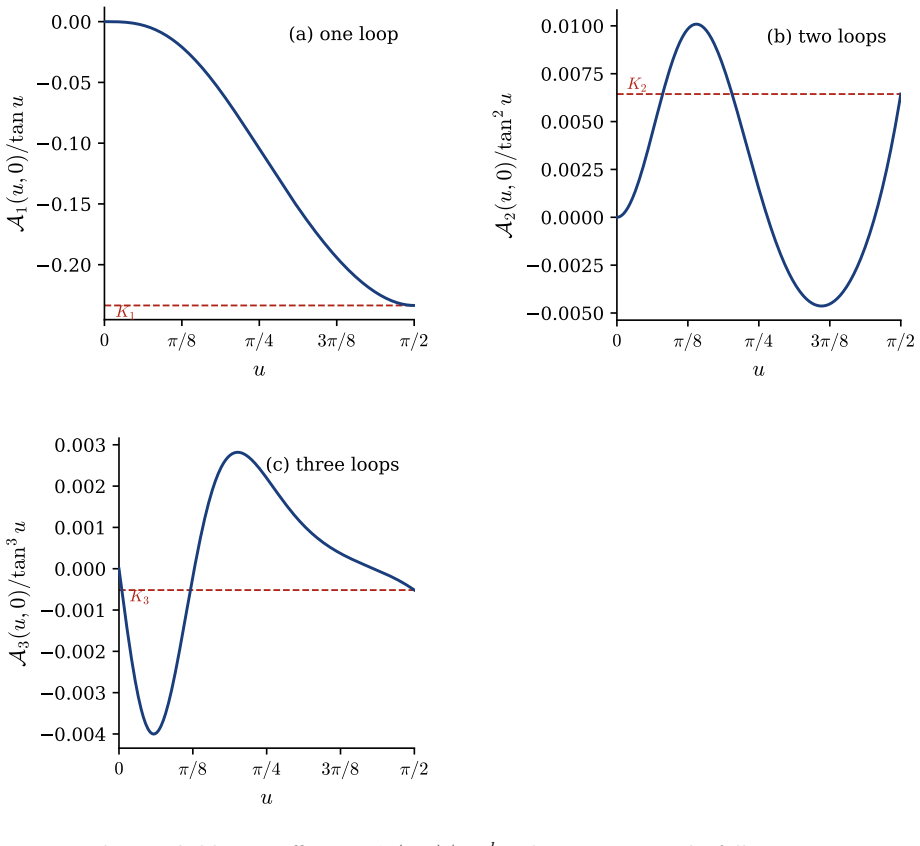
At $t=0$, the wormhole length takes the form $L_0 = -2\log\cos u - \sum_{k\ge 1} A_k(u,0)\,\lambda^k$, with $\beta = 4u/\cos u$, where $u$ covers the whole temperature range from infinite temperature ($u=0$) to zero temperature ($u=\pi/2$). The one-loop coefficient $A_1(u,0)$ reproduces known results, and the paper derives the two-loop coefficient $A_2(u,0)$ (Eq. 5.53) by a saddle-point evaluation of the DSSYK two-point function at coincident insertion points, where individually divergent pieces cancel only after assembly. It then obtains the three-loop coefficient $A_3(u,0)$ (Eq. 6.7) by combining an exact three-term recursion for the chord-space amplitudes with a structural Ansatz for the dependence on $u$ and $\tan u$, validated on a high-temperature series longer than needed to fix the Ansatz. In the low-temperature limit the series reorganizes as an expansion in the Schwarzian coupling $\lambda\beta$, and the leading coefficient matches an independent one-loop Schwarzian computation.
Load-bearing premise
The three-loop formula rests on the assumption that $A_3(u,0)$ has exactly the same rigid rational-trigonometric shape as the one- and two-loop coefficients, with the specific denominator power, polynomial degrees, and powers of $\tan u$ prescribed by the Ansatz; if the true coefficient contains any term outside that shape, the reported closed form is an interpolation rather than the exact answer.
Editorial extensions
If this is right
- $L_0$ is now fixed unambiguously at all temperatures through three loops, so future bulk computations of the wormhole length at rest can be compared order by order instead of being subtracted away.
- In the low-temperature limit, the expansion reorganizes as a series in the Schwarzian coupling $\lambda\beta$ with explicit leading coefficients, and a one-loop Schwarzian calculation reproduces the DSSYK result, confirming the holographic dictionary at this observable.
- The paper states that the same exact recursion plus Ansatz machinery extends in principle to four and higher loop orders, given a sufficiently long high-temperature series.
- The variance and third-order cumulant of the length at $t=0$ are now known through two loops, providing additional finite, scheme-independent data for the thermal state.
Reading between the lines
- If the structural pattern of degrees ($N_1=3k-1$, $N_2=4k-1$, $\deg P_p \le 2k-1$) persists, the four-loop coefficient should be fixed by the same Ansatz; a four-loop saddle-point or independent series calculation would test whether the pattern is exact or merely low-order numerology.
- The scheme-independence argument suggests that other normally subtracted bulk quantities at $t=0$, such as interior volume or complexity of formation, could be promoted to well-defined microscopic observables in the same chord-space language and compared against DSSYK loop by loop.
- A two-loop Schwarzian computation, analogous to the one-loop check in Section 7.1, should reproduce the coefficient of $(\lambda\beta)^2$ in the low-temperature expansion, providing a stronger test of the dictionary; the paper only performs the one-loop check.
- The all-order resummation of the $u^4$ coefficient (Eq. 4.5) predicts a definite value at every loop order, including $1/144$ at four loops, which is a cheap numerical target for future direct calculations.
Editorial analysis
A structured set of objections, weighed in public.
Referee Report
Summary. The paper computes the t=0 value of the wormhole length / Krylov spread complexity, L0(β), in double-scaled SYK as a power series in the double-scaling parameter λ, with β encoded in the variable u through β=4u/cos u. The central formula is Eq. (1.18), which collects the classical term -2 log cos u and loop coefficients A1(u,0), A2(u,0), A3(u,0). The paper reproduces the known one-loop coefficient, derives the two-loop coefficient (Eq. (5.53)) from a saddle-point expansion of the coincident-point two-point function, and obtains the three-loop coefficient (Eq. (6.7)) by fitting the structural Ansatz (6.1) to long high-temperature series generated by the exact recursion (6.6). It then derives the low-temperature reorganization into powers of the Schwarzian coupling λβ, matches the leading one-loop Schwarzian coefficient, and extends the same techniques to the variance and third cumulant of the length at t=0.
Significance. If the three-loop coefficient is exact, the paper provides a microscopic, scheme-independent determination of the additive constant of the Einstein-Rosen bridge length at t=0, together with its variance and skewness, and exhibits a striking structural pattern (1.19)-(1.20) that predicts the form of higher-loop corrections. The two-loop saddle-point calculation is a substantial technical achievement: it exposes the cancellation of poles in the regulator ε up to order 1/ε^3, and it is independently cross-checked by the short high-temperature series. The exact recursion (6.6) is elegant and efficient, and the Schwarzian one-loop match in Eq. (7.17) is a genuine independent check. The main weakness is that the headline three-loop closed form (6.7) is not derived: it is a rational Ansatz fitted to finite series data, and the available independent validation is only about 17 coefficients beyond the 72 fitted parameters.
major comments (3)
- [§6.2, Eq. (6.7)] The three-loop coefficient A3(u,0) is reconstructed rather than derived: the Ansatz (6.1) with N1=8, N2=11, and deg P_p ≤ 5 contains 72 free coefficients, and the paper fixes them by matching the series generated by the recursion (6.6), then validates on the remaining terms up to u^180. Since A3(u,0) starts at u^4, the available series contains about 89 even-power coefficients from u^4 to u^180; after fixing 72 parameters, only about 17 coefficients remain as truly independent validation data. A different rational function with a higher-degree numerator or a larger denominator power could pass this finite test and differ at higher orders. The minimality check in footnote 12 excludes smaller Ansatz shapes but does not prove that the exact A3 belongs to the chosen family. Because Eq. (1.18) is presented as the exact three-loop result, this is a load-bearing gap; the paper should either supply an independent derivation (or a convincing exactness argument) or explicitly label (6.7) as a conjecture verified to order u^180, and adjust the summary in Section 9 accordingly.
- [§1 and §7.1] The introduction states that the results are obtained by three independent methods that agree wherever they overlap, but this does not provide independent support for A3. The q-algebra expansion (4.3) is used only at low orders in u, the saddle-point analysis is carried out only to two loops, and the Schwarzian computation in Section 7.1 matches only the one-loop coefficient pK1 in Eq. (7.17), not A2 or A3. Therefore the three-loop coefficient (6.7) rests entirely on the recursion-plus-Ansatz procedure, and the paper should not present the mutual consistency of the three methods as a check on the three-loop result.
- [§7, Eqs. (1.23)-(1.24) and (7.3)] The low-temperature reorganization into powers of λβ and the coefficients pK1, pK2, pK3 are derived entirely from the closed forms (5.39), (5.53), and (6.7). In particular, pK3 inherits the uncertainty of the Ansatz-fixed A3(u,0). The statement that 'each loop order contributes one further power of β' is a consequence of the tan^k u asymptotics of the assumed closed forms, not an independent verification of the three-loop coefficient; this should be stated explicitly.
minor comments (4)
- [§4.1, Eq. (4.4)] The u^6 bracket in Eq. (4.4) begins with a constant term 2/3, whereas the classical expansion in Eq. (1.17) has 2u^6/45; please check whether this is a typo (the coefficient should presumably be 2/45) and confirm that the subsequent agreement with Eq. (4.3) is unaffected.
- [§5.3, Eqs. (5.44)-(5.53)] The cancellation of the 1/ε^3, 1/ε^2, and 1/ε poles in the assembly leading to Eq. (5.53) is asserted but not shown in detail. Since this two-loop result is a central new output, including the intermediate algebra or an ancillary notebook would make the cancellation mechanism directly reproducible.
- [§6.2, final paragraph] The phrase 'validated on many independent data points' overstates the ratio of validation to fitted parameters; please state the exact number of coefficients used to fix the 72 parameters and the number of independent higher-order coefficients used for validation (approximately 17), so that the reader can judge the strength of the check.
- [§9, Summary] The summary describes Eq. (6.7) as a result and says the same strategy 'extends straightforwardly' to four and higher loops; unless the Ansatz (6.1) is proven, these statements should be tempered to reflect that the three-loop coefficient is currently a well-tested rational reconstruction rather than a proven exact closed form.
Circularity Check
No significant circularity: the two-loop result is independently derived, and the three-loop Ansatz determination is explicitly labeled as a fit rather than a derivation.
full rationale
The derivation chain is self-contained and non-circular. L0 is defined from the chord-space matrix element in Eq. (2.8); the spectral representation (3.9) follows from the q-Mehler formula without assuming the answer. The one-loop coefficient is obtained by an explicit saddle point expansion in Section 5.2, cross-checked against the independent q-algebra expansion (4.3) and against the independent Schwarzian computation in Section 7.1. The two-loop coefficient A2(u,0) in Eq. (5.53) is derived from the saddle point expansion at coincident insertions, with explicit cancellation of the 1/epsilon singularities, and its small-u expansion (5.54) reproduces the lambda^2 terms of the q-algebra result (4.3). The three-loop coefficient A3(u,0) is not derived from a saddle point; the paper states that it uses the exact recursion (6.6) to generate a long high-temperature series and then fixes the structural Ansatz (6.1) by matching coefficients, with additional terms used for validation. This is a fit, and the paper describes it as such ("fixing and testing a proposed Ansatz"), so it is not a fitted parameter renamed as a prediction. The agreement with un-fitted series terms is a genuine check of the Ansatz, not a reduction of the result to its inputs by construction. The minimality statement in footnote 12 is the authors' own verification, not an imported uniqueness theorem. Self-citations such as [32] are motivational for the structural pattern, not load-bearing for the central numerical result. The only caveat is a correctness risk: if the rational Ansatz shape is not exact, Eq. (6.7) is an interpolant. That is a limitation of the three-loop determination, but it is not circularity.
Assumptions & free parameters
free parameters (1)
- Ansatz coefficients for A3(u,0) (and similarly for V2, C2) =
72 coefficients determined by matching high-temperature series; validated up to u^180
assumptions (5)
- domain assumption DSSYK/sine-dilaton duality at disk level, including the identification L0 = lambda * C_beta(0) and the bilocal operator dictionary
- standard math Spectral representation of the DSSYK two-point function and the q-Mehler formula
- ad hoc to paper Regularization: epsilon = lambda Delta is treated as an independent small parameter in the saddle point expansion
- ad hoc to paper Structural Ansatz (6.1) with degree bounds (6.2) for the loop coefficients A_k
- domain assumption Low-temperature dictionary beta = 4u/cos u and Schwarzian coupling b = lambda beta / 2 with J = 1/2
Cite this review
Pith. "Pith review of Three-loop onset of the wormhole length in DSSYK." pith.science (2026). https://pith.science/paper/APIOLP45
@misc{pith2026260807634,
  author       = {Pith},
  title        = {Pith review of: Three-loop onset of the wormhole length in DSSYK},
  year         = {2026},
  howpublished = {\url{https://pith.science/paper/APIOLP45}},
  note         = {Machine review of arXiv:2608.07634}
}
abstract
The length of the Einstein-Rosen bridge in sine-dilaton gravity at disk level equals the Krylov spread complexity of the dual double-scaled SYK (DSSYK) model, with the double-scaling parameter $\lambda$ controlling the semiclassical expansion. We compute the onset value, $L_{0}$, in the thermofield double state at $t=0$ and arbitrary inverse temperature $\beta$, through three loops and in closed form, extending the known one-loop result. The quantity $L_{0}$ represents the preparation complexity of the initial thermal Hartle-Hawking state. In DSSYK, $L_{0}$ is $\lambda$ times the average chord number of the thermal state, providing a microscopic, unambiguous determination of an additive constant otherwise fixed only by a choice of holographic renormalization scheme. The two-loop contribution follows from a saddle point evaluation of the DSSYK two-point function at coincident insertion points, where individually divergent contributions cancel only in their sum. At three loops, we bypass the saddle point analysis using an exact recursion relation that generates long high-temperature expansions at low cost, fixing and testing a proposed Ansatz against many independent data points. Finally, in the low-temperature regime each loop order contributes one further power of $\beta$, reorganizing the semiclassical series into an expansion in the Schwarzian coupling $\lambda\beta$, whose leading coefficient we check against an independent one-loop Schwarzian computation. The same methods, applied to the length variance and third-order cumulant at $t=0$, give their semiclassical expansion through two loops.
Figures
Reference graph
Works this paper leans on
-
[1]
S. Sachdev and J. Ye,Gapless Spin Fluid Ground State in a Random, Quantum Heisenberg Magnet,Phys. Rev. Lett.70(1993) 3339 [cond-mat/9212030]. S. Sachdev,Holographic Metals and the Fractionalized Fermi Liquid,Phys. Rev. Lett.105 (2010) 151602 [1006.3794]
arXiv 1993
-
[2]
J. Maldacena and D. Stanford,Remarks on the Sachdev-Ye-Kitaev Model,Phys. Rev. D94 (2016) 106002 [1604.07818]
arXiv 2016
-
[3]
J. Maldacena, S. H. Shenker and D. Stanford,A Bound on Chaos,JHEP08(2016) 106 [1503.01409]
arXiv 2016
-
[4]
J. S. Cotler, G. Gur-Ari, M. Hanada, J. Polchinski, P. Saad, S. H. Shenker et al.,Black Holes and Random Matrices,JHEP05(2017) 118 [1611.04650]
arXiv 2017
-
[5]
J. Maldacena, D. Stanford and Z. Yang,Conformal Symmetry and Its Breaking in Two Dimensional Nearly Anti-De-Sitter Space,PTEP2016(2016) 12C104 [1606.01857]
arXiv 2016
-
[6]
Jensen,Chaos in AdS2 Holography,Phys
K. Jensen,Chaos in AdS2 Holography,Phys. Rev. Lett.117(2016) 111601 [1605.06098]
arXiv 2016
-
[7]
Sárosi,AdS 2 holography and the SYK model,PoSModave2017(2018) 001 [1711.08482]
G. Sárosi,AdS 2 holography and the SYK model,PoSModave2017(2018) 001 [1711.08482]. 26
arXiv 2018
-
[8]
M. Berkooz, M. Isachenkov, V. Narovlansky and G. Torrents,Towards a Full Solution of the LargeNDouble-Scaled Syk Model,JHEP03(2019) 079 [1811.02584]
arXiv 2019
Show all 38 references
-
[9]
T. G. Mertens, G. J. Turiaci and H. L. Verlinde,Solving the Schwarzian via the Conformal Bootstrap,JHEP08(2017) 136 [1705.08408]
2017 arXiv
-
[10]
Engelsöy, T
J. Engelsöy, T. G. Mertens and H. Verlinde,An investigation of AdS2 backreaction and holography,JHEP07(2016) 139 [1606.03438]
2016 arXiv
-
[11]
T. G. Mertens and G. J. Turiaci,Solvable models of quantum black holes: a review on Jackiw–Teitelboim gravity,Living Rev. Rel.26(2023) 4 [2210.10846]
2023 arXiv
-
[12]
Berkooz, P
M. Berkooz, P. Narayan and J. Simon,Chord Diagrams, Exact Correlators in Spin Glasses and Black Hole Bulk Reconstruction,JHEP08(2018) 192 [1806.04380]
2018 arXiv
-
[13]
Berkooz and O
M. Berkooz and O. Mamroud,A Cordial Introduction to Double Scaled Syk,Rept. Prog. Phys. 88(2025) 036001 [2407.09396]
2025 arXiv
-
[14]
Blommaert, T
A. Blommaert, T. G. Mertens and S. Yao,Dynamical Actions and Q-Representation Theory for Double-Scaled Syk,JHEP02(2024) 067 [2306.00941]
2024 arXiv
-
[15]
Blommaert, T
A. Blommaert, T. G. Mertens and J. Papalini,The Dilaton Gravity Hologram of Double-Scaled Syk,JHEP06(2025) 050 [2404.03535]
2025 arXiv
-
[16]
Blommaert, A
A. Blommaert, A. Levine, T. G. Mertens, J. Papalini and K. Parmentier,An Entropic Puzzle in Periodic Dilaton Gravity and Dssyk,JHEP07(2025) 093 [2411.16922]
2025 arXiv
-
[17]
Rabinovici, A
E. Rabinovici, A. Sánchez-Garrido, R. Shir and J. Sonner,A bulk manifestation of Krylov complexity,JHEP08(2023) 213 [2305.04355]
2023 arXiv
-
[18]
Xu,On Chord Dynamics and Complexity Growth in Double-Scaled SYK,JHEP06(2025) 259 [2411.04251]
J. Xu,On Chord Dynamics and Complexity Growth in Double-Scaled SYK,JHEP06(2025) 259 [2411.04251]
2025 arXiv
-
[19]
Ambrosini, E
M. Ambrosini, E. Rabinovici, A. Sánchez-Garrido, R. Shir and J. Sonner,Operator K-complexity in DSSYK: Krylov complexity equals bulk length,JHEP08(2025) 059 [2412.15318]
2025 arXiv
-
[20]
Nandy, A
P. Nandy, A. S. Matsoukas-Roubeas, P. Martínez-Azcona, A. Dymarsky and A. del Campo, Quantum dynamics in Krylov space: Methods and applications,Phys. Rept.1125-1128 (2025) 1 [2405.09628]. S. Baiguera, V. Balasubramanian, P. Caputa, S. Chapman, J. Haferkamp, M. P. Heller et al....
2025 arXiv
-
[21]
J. M. Maldacena,Eternal Black Holes in Anti-de Sitter,JHEP04(2003) 021 [hep-th/0106112]
2003 arXiv
-
[22]
M. P. Heller, J. Papalini and T. Schuhmann,Krylov Spread Complexity as Holographic Complexity Beyond Jackiw-Teitelboim Gravity,Phys. Rev. Lett.135(2025) 151602 [2412.17785]. 27
2025
-
[23]
Blommaert, A
A. Blommaert, A. Levine, T. G. Mertens, J. Papalini and K. Parmentier,Wormholes, Branes and Finite Matrices in Sine Dilaton Gravity,JHEP09(2025) 123 [2501.17091]
2025
-
[24]
Collier, L
S. Collier, L. Eberhardt, B. Mühlmann and V. A. Rodriguez,Complex Liouville String,Phys. Rev. Lett.134(2025) 251602 [2409.17246]. S. Collier, L. Eberhardt, B. Mühlmann and V. A. Rodriguez,The complex Liouville string: The matrix integral,SciPost Phys.18(2025) 154 [2410.07345]....
2025 arXiv
-
[25]
H. W. Lin and D. Stanford,A Symmetry Algebra in Double-Scaled Syk,SciPost Phys.15 (2023) 234 [2307.15725]
2023 arXiv
-
[26]
A. Goel, V. Narovlansky and H. Verlinde,Semiclassical Geometry in Double-Scaled Syk, JHEP11(2023) 093 [2301.05732]
2023 arXiv
-
[27]
Okuyama and K
K. Okuyama and K. Suzuki,Correlators of Double Scaled Syk at One-Loop,JHEP05(2023) 117 [2303.07552]
2023 arXiv
-
[28]
Chapman, H
S. Chapman, H. Marrochio and R. C. Myers,Complexity of Formation in Holography,JHEP 01(2017) 062 [1610.08063]
2017 arXiv
-
[29]
J. L. F. Barbón and J. Martin-Garcia,Holographic Complexity of Cold Hyperbolic Black Holes,JHEP11(2015) 181 [1510.00349]
2015 arXiv
-
[30]
S. E. Aguilar-Gutierrez,Building the holographic dictionary of the DSSYK from chords, complexity & wormholes with matter,JHEP10(2025) 221 [2505.22716]
2025
-
[31]
L. V. Iliesiu, M. Mezei and G. Sárosi,The volume of the black hole interior at late times, JHEP07(2022) 073 [2107.06286]
2022 arXiv
-
[32]
Alfinito and M
E. Alfinito and M. Beccaria,Higher-Loop Wormhole Length in Sine-Dilaton Gravity from Dssyk Krylov Complexity,2606.20220
-
[33]
Fu, H.-S
Y. Fu, H.-S. Jeong, K.-Y. Kim and J. F. Pedraza,Toward Krylov-Based Holography in Double-Scaled Syk,JHEP05(2026) 056 [2510.22658]
2026 arXiv
-
[34]
H. W. Lin,The Bulk Hilbert Space of Double Scaled SYK,JHEP11(2022) 060 [2208.07032]
2022 arXiv
-
[35]
Erdős and D
L. Erdős and D. Schröder,Phase Transition in the Density of States of Quantum Spin Glasses,Math. Phys. Anal. Geom.17(2014) 441 [1407.1552]
2014 arXiv
-
[36]
Beccaria and E
M. Beccaria and E. Alfinito,Modular Structures in the Dssyk Partition Function,2607.11828
-
[37]
Kitaev and S
A. Kitaev and S. J. Suh,Statistical Mechanics of a Two-Dimensional Black Hole,JHEP05 (2019) 198 [1808.07032]. 28
2019 arXiv
-
[38]
Bossi, L
L. Bossi, L. Griguolo, J. Papalini, L. Russo and D. Seminara,Sine-Dilaton Gravity Vs Double-Scaled Syk: Exploring One-Loop Quantum Corrections,JHEP06(2025) 152 [2411.15957]. 29 0 π/8 π/4 3π/8 π/2 u 0.20 0.15 0.10 0.05 0.00 A1(u, 0)/tanu K1 (a) one loop 0 π/8 π/4 3π/8 π/2 u 0.0...
2025 arXiv
Reviewed August 11, 2026 · model on record in the stance chip above.
Discussion (0). Continue with ORCID to comment.