Escaping Iterative Parameter-Space Noise: Differentially Private Learning with a Hypernetwork
Pith reviewed 2026-06-26 05:06 UTC · model grok-4.3
The pith
A hypernetwork trained on public data generates target model parameters from one noisy low-dimensional embedding of private data, yielding higher utility than DP-SGD under fixed privacy budget.
A machine-rendered reading of the paper's core claim, the machinery that carries it, and where it could break.
Core claim
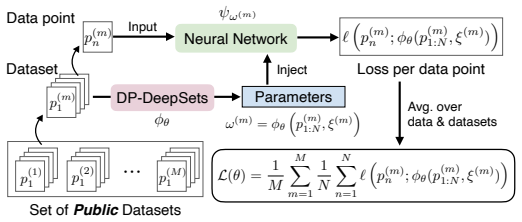
A hypernetwork trained solely on public datasets can map a single noisy low-dimensional embedding of private data to useful target-model parameters. The embedding is formed by aggregating private examples and adding privacy noise once; the hypernetwork then produces the full parameter set. Under a fixed privacy budget this single low-dimensional perturbation produces higher-utility models than the repeated high-dimensional noise of DP-SGD, both in a synthetic setting and when applied to LoRA fine-tuning of diffusion models.
What carries the argument
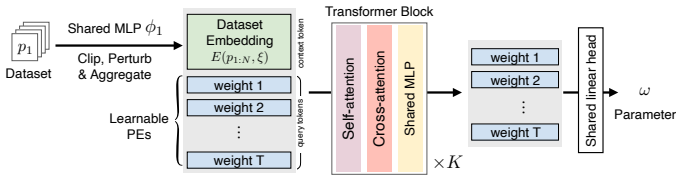
Hypernetwork that receives a DP-perturbed aggregate low-dimensional embedding of the private dataset and outputs the parameters of the target model.
Load-bearing premise
A hypernetwork trained only on public data can map a noisy embedding taken from private data to high-utility target parameters.
What would settle it
An experiment in which the hypernetwork method yields equal or lower utility than DP-SGD when the private data distribution differs substantially from the public data used to train the hypernetwork.
Figures

read the original abstract
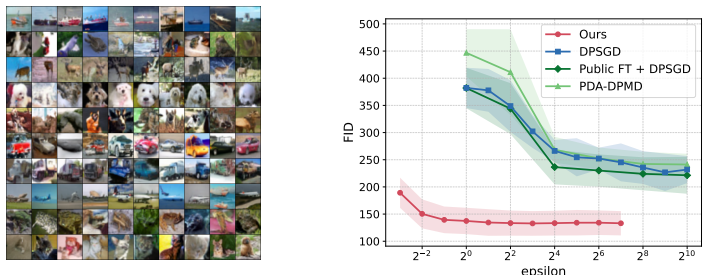
Differentially private (DP) training of neural networks is often hindered by the large amount of noise required by gradient-based methods such as DP-SGD, which repeatedly inject high-dimensional noise in parameter space throughout training. In this paper, we propose a new framework for DP learning that avoids iterative optimization in parameter space. Instead of updating the target model using privatized gradients, we employ a hypernetwork trained on public datasets to map a private dataset to the parameters of the target model. Specifically, each example is embedded into a low-dimensional representation, the embeddings are aggregated and perturbed to obtain a DP dataset embedding, and the hypernetwork generates the target model parameters from this noisy embedding. Because privacy noise is injected only once into a low-dimensional dataset representation, our approach can significantly reduce the adverse effect of noise. We theoretically show in a synthetic setting that, under a fixed privacy budget, models produced by our approach achieve higher utility than those trained with DP-SGD. Moreover, we apply our approach to LoRA fine-tuning of diffusion models and show that it achieves lower FID than LoRA models trained with DP-SGD and other public-data-guided methods.
Editorial analysis
A structured set of objections, weighed in public.
Referee Report
Summary. The manuscript proposes a hypernetwork-based framework for differentially private learning. Rather than applying iterative noise via DP-SGD in high-dimensional parameter space, a hypernetwork trained on public datasets maps a single noisy low-dimensional aggregate embedding of the private dataset to the parameters of the target model. The paper asserts a theoretical result in a synthetic setting showing higher utility than DP-SGD under a fixed privacy budget, and reports lower FID scores when the method is applied to LoRA fine-tuning of diffusion models compared with DP-SGD and other public-data-guided baselines.
Significance. If the hypernetwork mapping generalizes across the public-to-private distribution shift, the method could improve the privacy-utility tradeoff by confining noise injection to a single low-dimensional perturbation. The synthetic comparison and the diffusion-model application point to possible utility in privacy-sensitive fine-tuning scenarios.
major comments (3)
- [Abstract] Abstract: the theoretical claim that the approach achieves higher utility than DP-SGD under a fixed privacy budget is stated without any derivation, assumptions on the embedding space, or synthetic-setting details; this is load-bearing for the central utility claim.
- [Method] Method section (hypernetwork training and inference): the framework requires that a hypernetwork trained only on public data maps a noisy embedding of private data to high-utility parameters, yet no analysis, generalization bounds, or experiments quantify robustness to distribution shift between the public training distribution and the private target distribution; this assumption is load-bearing for both the theoretical and empirical results.
- [Experiments] Experiments (diffusion LoRA fine-tuning): the reported FID improvements are presented without error bars, number of runs, dataset sizes, or ablation controls on embedding dimension and hypernetwork capacity, weakening support for the claim of superiority over DP-SGD and other baselines.
minor comments (2)
- [Method] Clarify the precise form of the low-dimensional embedding, the aggregation operator, and the noise mechanism (e.g., which DP mechanism is used for the single perturbation).
- [Related Work] Add a short discussion of related hypernetwork-based parameter-generation methods and how the privacy mechanism differs from prior work.
Simulated Author's Rebuttal
We thank the referee for the constructive feedback on our manuscript. We address each major comment point by point below, providing clarifications where the details are already present in the paper and committing to revisions where additional reporting or discussion would strengthen the work.
read point-by-point responses
-
Referee: [Abstract] Abstract: the theoretical claim that the approach achieves higher utility than DP-SGD under a fixed privacy budget is stated without any derivation, assumptions on the embedding space, or synthetic-setting details; this is load-bearing for the central utility claim.
Authors: The abstract is intended as a concise summary. The synthetic setting (linear regression with Gaussian features), embedding assumptions (fixed low-dimensional linear projection), privacy budget allocation, and full derivation comparing the single low-dimensional perturbation to iterative DP-SGD noise are provided in Section 3, including the closed-form utility expressions. We will revise the abstract to include a one-sentence reference to the key assumptions and the synthetic linear model for improved clarity. revision: partial
-
Referee: [Method] Method section (hypernetwork training and inference): the framework requires that a hypernetwork trained only on public data maps a noisy embedding of private data to high-utility parameters, yet no analysis, generalization bounds, or experiments quantify robustness to distribution shift between the public training distribution and the private target distribution; this assumption is load-bearing for both the theoretical and empirical results.
Authors: We agree that explicit quantification of robustness to public-private distribution shift is a valuable addition. In the synthetic theory, the public and private distributions are identical by construction. For the LoRA diffusion experiments, the public pre-training data is drawn from the same broad image domain as the private fine-tuning sets. We will add a dedicated discussion subsection on this assumption and include new experiments that vary the degree of domain overlap between public and private data to measure sensitivity. revision: yes
-
Referee: [Experiments] Experiments (diffusion LoRA fine-tuning): the reported FID improvements are presented without error bars, number of runs, dataset sizes, or ablation controls on embedding dimension and hypernetwork capacity, weakening support for the claim of superiority over DP-SGD and other baselines.
Authors: We acknowledge that the current experimental presentation lacks these statistical details and controls. We will revise the experimental section to report FID scores with standard deviations over 5 independent runs, explicitly state the private dataset sizes used, and add ablation studies varying embedding dimension (e.g., 32, 64, 128) and hypernetwork capacity (number of layers and hidden units) while keeping the privacy budget fixed. revision: yes
Circularity Check
No significant circularity; theoretical result in synthetic setting is independent of fitted inputs.
full rationale
The paper's derivation chain consists of a proposed hypernetwork framework that injects noise once into a low-dimensional embedding, followed by a theoretical comparison to DP-SGD in a synthetic setting and empirical FID results on diffusion LoRA fine-tuning. No equations, self-citations, or ansatzes are quoted that reduce the claimed utility gain to a quantity defined by the method itself. The synthetic theoretical result is presented as a first-principles comparison under fixed privacy budget, without evidence of it being a fitted input renamed as prediction or dependent on self-referential definitions. The transferability assumption is a modeling choice but does not create circularity by construction.
Axiom & Free-Parameter Ledger
axioms (1)
- domain assumption Hypernetwork trained on public data generalizes to produce useful parameters from noisy private embeddings.
Reference graph
Works this paper leans on
-
[1]
Proceedings of the IEEE/CVF conference on computer vision and pattern recognition , pages=
Dreambooth: Fine tuning text-to-image diffusion models for subject-driven generation , author=. Proceedings of the IEEE/CVF conference on computer vision and pattern recognition , pages=
-
[2]
Proceedings of the IEEE/CVF conference on computer vision and pattern recognition , pages=
Hyperdreambooth: Hypernetworks for fast personalization of text-to-image models , author=. Proceedings of the IEEE/CVF conference on computer vision and pattern recognition , pages=
-
[3]
Advances in Neural Information Processing Systems , volume=
Scaling Up Parameter Generation: A Recurrent Diffusion Approach , author=. Advances in Neural Information Processing Systems , volume=
-
[4]
International Conference on Learning Representations , year=
HyperNetworks , author=. International Conference on Learning Representations , year=
-
[5]
arXiv preprint arXiv:2209.12892 , year=
Learning to learn with generative models of neural network checkpoints , author=. arXiv preprint arXiv:2209.12892 , year=
-
[6]
arXiv preprint arXiv:2402.13144 , year=
Neural network diffusion , author=. arXiv preprint arXiv:2402.13144 , year=
-
[7]
The Thirteenth International Conference on Learning Representations , year=
Diffusion-based Neural Network Weights Generation , author=. The Thirteenth International Conference on Learning Representations , year=
-
[8]
Advances in Neural Information Processing Systems , volume=
Drag-and-Drop LLMs: Zero-Shot Prompt-to-Weights , author=. Advances in Neural Information Processing Systems , volume=
-
[9]
Advances in neural information processing systems , volume=
Deep sets , author=. Advances in neural information processing systems , volume=
-
[10]
Proceedings of the 2016 ACM SIGSAC Conference on Computer and Communications Security , pages=
Deep Learning with Differential Privacy , author=. Proceedings of the 2016 ACM SIGSAC Conference on Computer and Communications Security , pages=. 2016 , organization=
2016
-
[11]
Proceedings of the AAAI conference on artificial intelligence , volume=
Tempered sigmoid activations for deep learning with differential privacy , author=. Proceedings of the AAAI conference on artificial intelligence , volume=
-
[12]
Annals of statistics , volume=
Nonparametric regression using deep neural networks with ReLU activation function , author=. Annals of statistics , volume=. 2020 , publisher=
2020
-
[13]
arXiv preprint arXiv:2408.01415 , year=
Conditional lora parameter generation , author=. arXiv preprint arXiv:2408.01415 , year=
-
[14]
Khan, Rana Muhammad Shahroz and Tang, Dongwen and Li, Pingzhi and Wang, Kai and Chen, Tianlong , booktitle=
-
[15]
Advances in Neural Information Processing Systems , volume=
Noise-aware differentially private regression via meta-learning , author=. Advances in Neural Information Processing Systems , volume=
-
[16]
Scalable Private Learning with
Papernot, Nicolas and Song, Shuang and Mironov, Ilya and Raghunathan, Ananth and Talwar, Kunal and Erlingsson, Ulfar , booktitle=. Scalable Private Learning with
-
[17]
International Conference on Machine Learning , pages=
Public data-assisted mirror descent for private model training , author=. International Conference on Machine Learning , pages=. 2022 , organization=
2022
-
[18]
The Twelfth International Conference on Learning Representations , year=
Differentially Private Synthetic Data via Foundation Model APIs 1: Images , author=. The Twelfth International Conference on Learning Representations , year=
-
[19]
International Conference on Machine Learning , pages=
Differentially Private Synthetic Data via Foundation Model APIs 2: Text , author=. International Conference on Machine Learning , pages=. 2024 , organization=
2024
-
[20]
Advances in Neural Information Processing Systems , volume=
Flocks of stochastic parrots: Differentially private prompt learning for large language models , author=. Advances in Neural Information Processing Systems , volume=
-
[21]
Proceedings of the IEEE/CVF International Conference on Computer Vision , pages=
Differentially private fine-tuning of diffusion models , author=. Proceedings of the IEEE/CVF International Conference on Computer Vision , pages=
-
[22]
International Conference on Learning Representations , year=
Semi-supervised Knowledge Transfer for Deep Learning from Private Training Data , author=. International Conference on Learning Representations , year=
-
[23]
International Conference on Learning Representations , year=
Adaptivity of deep ReLU network for learning in Besov and mixed smooth Besov spaces: optimal rate and curse of dimensionality , author=. International Conference on Learning Representations , year=
-
[24]
International conference on machine learning , pages=
Learning transferable visual models from natural language supervision , author=. International conference on machine learning , pages=. 2021 , organization=
2021
-
[25]
International conference on machine learning , pages=
Improved denoising diffusion probabilistic models , author=. International conference on machine learning , pages=. 2021 , organization=
2021
-
[26]
2009 , publisher=
Learning multiple layers of features from tiny images , author=. 2009 , publisher=
2009
-
[27]
Proceedings of the IEEE conference on computer vision and pattern recognition , pages=
Rethinking the inception architecture for computer vision , author=. Proceedings of the IEEE conference on computer vision and pattern recognition , pages=
-
[28]
Theory of cryptography conference , pages=
Calibrating noise to sensitivity in private data analysis , author=. Theory of cryptography conference , pages=. 2006 , organization=
2006
-
[29]
ICML 2025 Workshop on Collaborative and Federated Agentic Workflows , year=
DP-AdamW: Investigating Decoupled Weight Decay and Bias Correction in Private Deep Learning , author=. ICML 2025 Workshop on Collaborative and Federated Agentic Workflows , year=
2025
-
[30]
arXiv preprint arXiv:2006.13501 , year=
Private stochastic non-convex optimization: Adaptive algorithms and tighter generalization bounds , author=. arXiv preprint arXiv:2006.13501 , year=
arXiv 2006
-
[31]
International Conference on Machine Learning , pages=
Private adaptive optimization with side information , author=. International Conference on Machine Learning , pages=. 2022 , organization=
2022
-
[32]
International Conference on Learning Representations , year=
Differentially Private Learning Needs Better Features (or Much More Data) , author=. International Conference on Learning Representations , year=
-
[33]
32nd USENIX security symposium (USENIX Security 23) , pages=
Extracting training data from diffusion models , author=. 32nd USENIX security symposium (USENIX Security 23) , pages=
-
[34]
arXiv preprint arXiv:2210.00968 , year=
Membership inference attacks against text-to-image generation models , author=. arXiv preprint arXiv:2210.00968 , year=
-
[35]
Foundations and trends
The algorithmic foundations of differential privacy , author=. Foundations and trends. 2014 , publisher=
2014
-
[36]
International Conference on Learning Representations , year=
Do not let privacy overbill utility: Gradient embedding perturbation for private learning , author=. International Conference on Learning Representations , year=
-
[37]
International Conference on Learning Representations , year=
Bypassing the Ambient Dimension: Private SGD with Gradient Subspace Identification , author=. International Conference on Learning Representations , year=
-
[38]
Transactions on Machine Learning Research , year=
Improving differentially private SGD via randomly sparsified gradients , author=. Transactions on Machine Learning Research , year=
-
[39]
arXiv preprint arXiv:2601.11113 , year=
Differentially Private Subspace Fine-Tuning for Large Language Models , author=. arXiv preprint arXiv:2601.11113 , year=
-
[40]
University of California, Irvine , volume=
High-dimensional probability , author=. University of California, Irvine , volume=
-
[41]
High-Dimensional Statistics: A Non-Asymptotic Viewpoint , author=
discussion (0)
Sign in with ORCID, Apple, or X to comment. Anyone can read and Pith papers without signing in.