Parts-per-million-accurate determination of the K{α} photoionization resonance of Be-like oxygen with resolution of its ¹⁶O-¹⁸O isotopic shift
Pith reviewed 2026-07-02 01:39 UTC · model grok-4.3
The pith
Be-like oxygen Kα resonance energy is fixed at 554.372 eV with the 2.2 meV isotopic shift to oxygen-18 resolved
A machine-rendered reading of the paper's core claim, the machinery that carries it, and where it could break.
Core claim
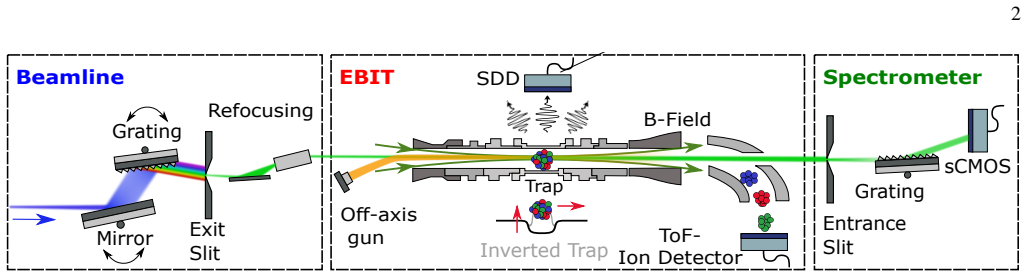
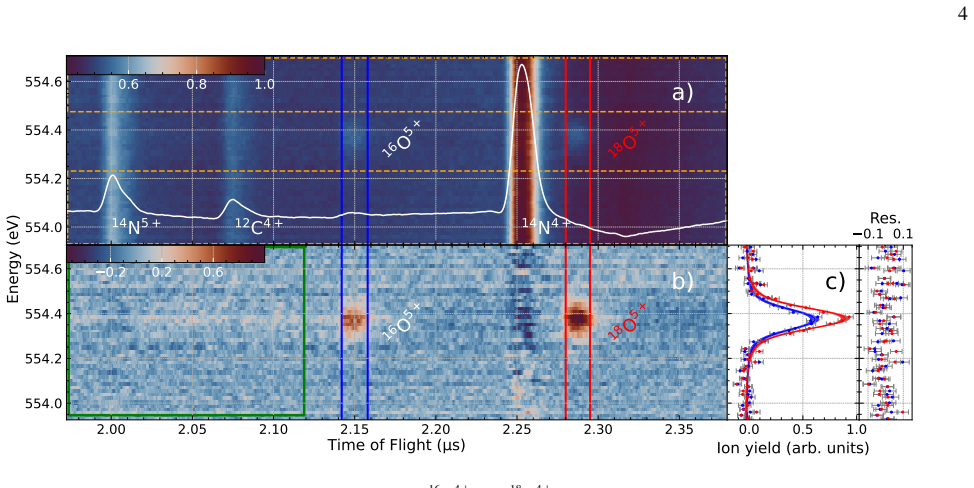
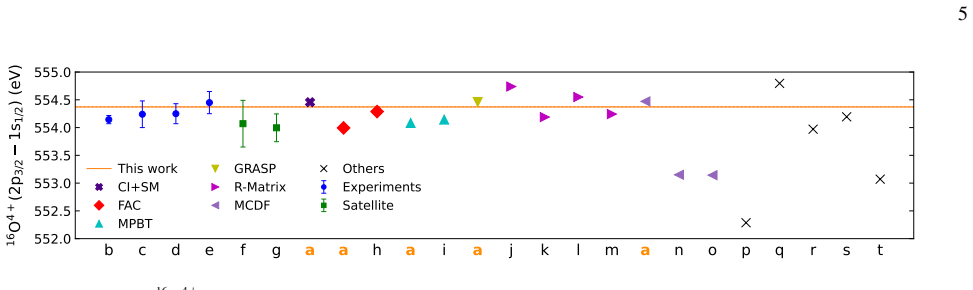
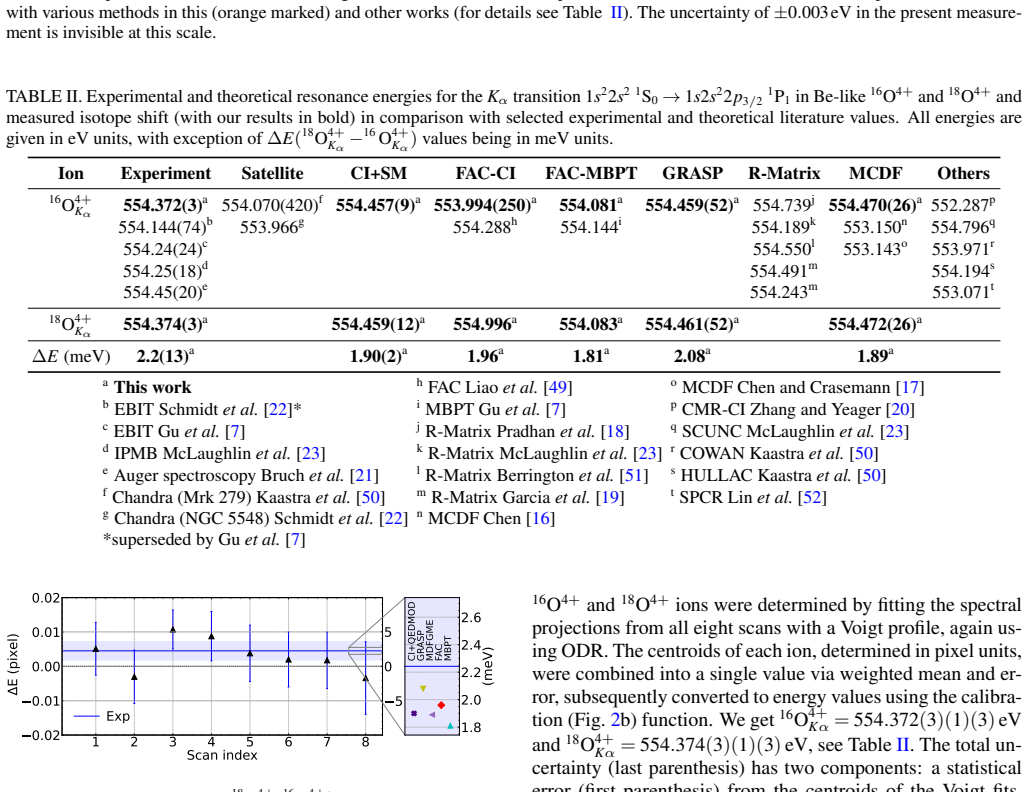
The transition 1s² 2s² ¹S₀ → 1s 2s² 2p_{3/2} ¹P₁ in ¹⁶O^{4+} occurs at 554.372(3) eV (wavelength 22.36480(12) Å), with a 2.2 ± 1.3 meV shift (Δλ = 0.089(52) mÅ) for the ¹⁸O isotope. Ions are generated and held in an electron beam ion trap, excited by monochromatic soft X-rays whose energies are corrected by a second spectrometer, and the resulting photoions of each isotope are distinguished by time-of-flight after autoionization.
What carries the argument
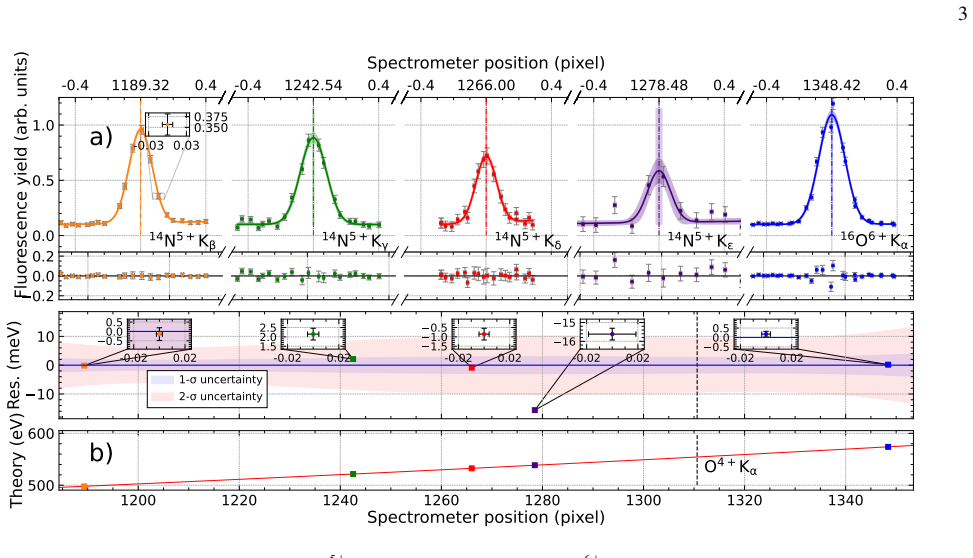
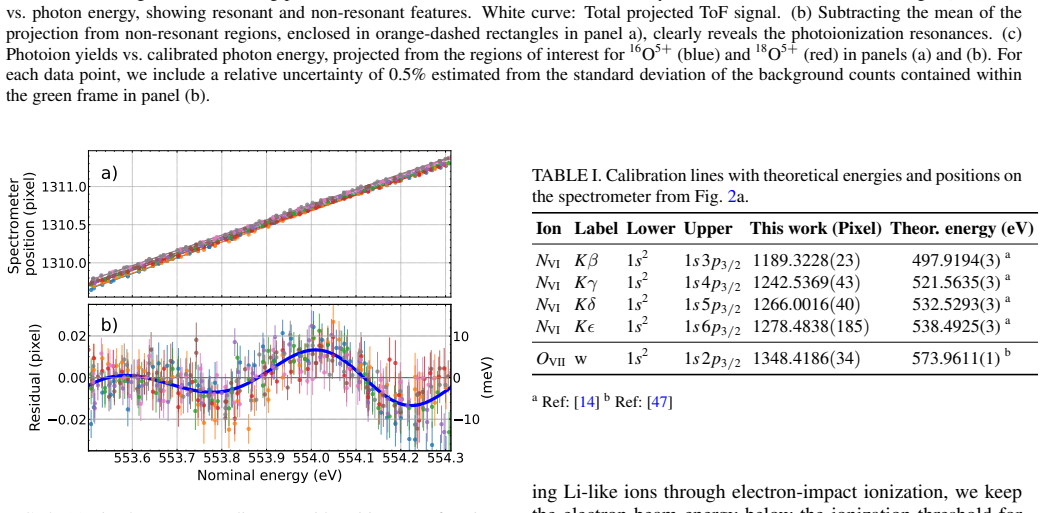
Resonant soft X-ray photoexcitation of trapped Be-like oxygen ions followed by autoionization, with auxiliary spectrometer calibration of photon energy and time-of-flight separation of isotopic photoions
If this is right
- Astrophysical models that use the blended O^{5+} Kα line for plasma diagnostics can be corrected using the measured O^{4+} position.
- Electronic-structure calculations for four-electron ions can be checked directly against this benchmark, including the size of QED contributions.
- The demonstrated technique shows that meV-scale isotopic shifts are measurable in soft X-ray transitions of light ions.
- Accurate data are supplied for an ion relevant to X-ray observations of cosmic plasmas.
Where Pith is reading between the lines
- The same trapped-ion plus synchrotron approach could map precise resonance positions across other few-electron light ions to build reference data.
- Persistent scatter in theory despite the new anchor points to the need for further refinement of many-electron QED treatments.
- With the blending quantified, re-analysis of existing X-ray spectra from astrophysical sources may shift inferred temperatures or abundances.
Load-bearing premise
The synchrotron photon energies are correctly adjusted by the auxiliary spectrometer and the time-of-flight measurement cleanly isolates each isotope without systematic offsets large enough to affect the few-meV shift.
What would settle it
An independent measurement at another facility with its own energy calibration that places the ¹⁶O transition energy outside the reported 3 meV uncertainty band would falsify the central value.
Figures
read the original abstract
We determine with high accuracy the energy of the inner-shell transition $1s^2 2s^2~{}^1\mathrm{S}_0 \rightarrow 1s~2s^2~2p_{3/2}~{}^1\mathrm{P}_1$ ${}^{16}\mathrm{O}_{K\alpha}^{4+}$ at $554.372(3)~\mathrm{eV}$ ($\lambda$ = $22.36480(12)~\unicode{x212B}$) as well as its small shift of $2.2 \pm 1.3~\mathrm{meV}$ ($\Delta \lambda$ = $0.089(52)~\mathrm{m}\unicode{x212B}$) for the ${}^{18}\mathrm{O}$ isotope. This transition blends with a $K_\alpha$ line of $\mathrm{O}^{5+}$ used in astrophysical diagnostics, potentially affecting its reliability. In contrast to our experimental uncertainty of $\pm 3~\mathrm{meV}$, advanced electronic structure predictions for this four-electron system, including quantum electrodynamic (QED) corrections on the order of $100~\mathrm{meV}$, still scatter by more than $\pm 250~\mathrm{meV}$. Ions generated and stored in an electron beam ion trap were excited at the ELETTRA synchrotron facility with monochromatic soft x rays, with photon energies corrected by an additional spectrometer. Upon resonant excitation of $\mathrm{O}^{4+}$ and subsequent autoionization, we separate the photoions of each isotope by a time-of-flight measurement. This way, we resolve soft x-ray isotopic shifts of a few meV, obtain very accurate data on an essential astrophysical ion, and test calculations down to the level of QED contributions.
Editorial analysis
A structured set of objections, weighed in public.
Referee Report
Summary. The manuscript reports a high-precision experimental measurement of the inner-shell Kα photoionization resonance 1s² 2s² ¹S₀ → 1s 2s² 2p_{3/2} ¹P₁ in Be-like oxygen, giving 554.372(3) eV (λ = 22.36480(12) Å) for ^{16}O and an isotopic shift of 2.2 ± 1.3 meV (Δλ = 0.089(52) mÅ) for ^{18}O. The experiment uses an electron-beam ion trap at the ELETTRA synchrotron with monochromatic soft x-rays, an auxiliary spectrometer for energy calibration, and time-of-flight separation of photoions to resolve the isotopes.
Significance. If the result holds, the measurement supplies a benchmark at the few-meV level for an astrophysically relevant transition that blends with an O^{5+} line used in diagnostics, and it constrains advanced many-body calculations (including QED terms of order 100 meV) that currently scatter by >250 meV. The ability to resolve a soft-x-ray isotopic shift at this scale is a technical strength.
major comments (2)
- [Results] Results section: the isotopic shift is reported as 2.2 ± 1.3 meV (≈1.7σ from zero). This marginal significance directly affects the central claim of having “resolved” the shift; the manuscript must clarify whether the data support a statistically robust detection or whether the result is better characterized as an upper limit.
- [Methods] Methods section: the photon-energy correction procedure with the auxiliary spectrometer and the TOF-based isotope separation are load-bearing for the claimed ±3 meV total uncertainty. A quantitative systematic-error budget (including possible cross-talk between isotopes and calibration residuals) is required to substantiate the ppm-level accuracy.
minor comments (2)
- The abstract and figure captions should use a consistent symbol for the angstrom unit (Å) rather than mixing unicode and text representations.
- A brief statement of the number of independent data sets or total ion counts underlying the fit would help readers assess the statistical foundation of the quoted uncertainties.
Simulated Author's Rebuttal
We thank the referee for the constructive comments on our manuscript. We address each major point below and indicate the revisions we will make.
read point-by-point responses
-
Referee: [Results] Results section: the isotopic shift is reported as 2.2 ± 1.3 meV (≈1.7σ from zero). This marginal significance directly affects the central claim of having “resolved” the shift; the manuscript must clarify whether the data support a statistically robust detection or whether the result is better characterized as an upper limit.
Authors: We agree that the reported isotopic shift of 2.2 ± 1.3 meV corresponds to a marginal 1.7σ significance. The value and uncertainty are statistically valid as a measurement, but we acknowledge that the language of 'resolved' may overstate the robustness. In the revised manuscript we will explicitly state the significance level, rephrase the claim to indicate a measurement at 1.7σ rather than a firm resolution, and note that the result can also serve as an upper limit on the shift magnitude. revision: yes
-
Referee: [Methods] Methods section: the photon-energy correction procedure with the auxiliary spectrometer and the TOF-based isotope separation are load-bearing for the claimed ±3 meV total uncertainty. A quantitative systematic-error budget (including possible cross-talk between isotopes and calibration residuals) is required to substantiate the ppm-level accuracy.
Authors: We agree that a detailed quantitative systematic-error budget is required to support the claimed uncertainty. The revised manuscript will include an expanded Methods section with a tabulated breakdown of all systematic contributions, explicitly addressing the auxiliary spectrometer calibration residuals, photon-energy correction procedure, TOF isotope separation efficiency, and any potential cross-talk or contamination between the 16O and 18O signals. revision: yes
Circularity Check
No significant circularity; direct experimental measurement with external calibration
full rationale
The paper reports a direct experimental determination of transition energy and isotopic shift using synchrotron photon energies (corrected by an independent spectrometer) and time-of-flight separation of photoions. No derivation chain, fitted parameters renamed as predictions, or self-citation load-bearing steps are present. The central result is an empirical measurement referenced to external standards, not reduced to its own inputs by construction.
Axiom & Free-Parameter Ledger
axioms (2)
- domain assumption The observed resonance corresponds to the specified 1s² 2s² ¹S₀ to 1s 2s² 2p_{3/2} ¹P₁ transition in Be-like oxygen.
- domain assumption The additional spectrometer provides accurate correction to the photon energies from the synchrotron.
Reference graph
Works this paper leans on
-
[1]
Beiersdorfer, Annual Review of Astronomy and Astrophysics 41, 343 (2003)
P. Beiersdorfer, Annual Review of Astronomy and Astrophysics 41, 343 (2003)
2003
-
[2]
Biffi, S
V . Biffi, S. Planelles, S. Borgani, E. Rasia, G. Murante, D. Fab- jan, and M. Gaspari, Monthly Notices of the Royal Astronomi- cal Society476, 2689 (2018)
2018
-
[3]
Nicastro, J
F. Nicastro, J. Kaastra, Y . Krongold, S. Borgani, E. Bran- chini, R. Cen, M. Dadina, C. W. Danforth, M. Elvis, F. Fiore, A. Gupta, S. Mathur, D. Mayya, F. Paerels, L. Piro, D. Rosa- Gonzalez, J. Schaye, J. M. Shull, J. Torres-Zafra, N. Wijers, and L. Zappacosta, Nature558, 406 (2018)
2018
-
[4]
Pinto, W
C. Pinto, W. Alston, M. L. Parker, A. C. Fabian, L. C. Gallo, D. J. K. Buisson, D. J. Walton, E. Kara, J. Jiang, A. Lohfink, and C. S. Reynolds, Monthly Notices of the Royal Astronomical Society476, 1021 (2018)
2018
-
[5]
Holczer, E
T. Holczer, E. Behar, and N. Arav, The Astrophysical Journal 708, 981 (2010)
2010
-
[6]
Nevalainen, B
J. Nevalainen, B. Wakker, J. Kaastra, M. Bonamente, S. Snow- den, F. Paerels, and C. de Vries, A&A605(2017)
2017
-
[7]
M. F. Gu, M. Schmidt, P. Beiersdorfer, H. Chen, D. B. Thorn, E. Trabert, E. Behar, and S. M. Kahn, The Astrophysical Jour- nal627, 1066 (2005)
2005
-
[8]
P. Micke, S. Kühn, L. Buchauer, J. R. Harries, T. M. Bück- ing, K. Blaum, A. Cieluch, A. Egl, D. Hollain, S. Krae- mer, T. Pfeifer, P. O. Schmidt, R. X. Schüssler, C. Schweiger, T. Stöhlker, S. Sturm, R. N. Wolf, S. Bernitt, and J. R. Crespo López-Urrutia, Review of Scientific Instruments89, 10.1063/1.5026961 (2018)
-
[9]
K. C. Prince, R. R. Blyth, R. Delaunay, M. Zitnik, J. Krem- pasky, J. Slezak, R. Camilloni, L. Avaldi, M. Coreno, G. Ste- fani, C. Furlani, M. de Simone, and S. Stranges, Journal of Syn- chrotron Radiation5, 565 (1998)
1998
-
[10]
Blyth, R
R. Blyth, R. Delaunay, M. Zitnik, J. Krempasky, R. Krempaska, J. Slezak, K. Prince, R. Richter, M. V ondracek, R. Camilloni, L. Avaldi, M. Coreno, G. Stefani, C. Furlani, M. de Simone, S. Stranges, and M.-Y . Adam, Journal of Electron Spectroscopy and Related Phenomena101-103, 959 (1999)
1999
-
[11]
G. W. Drake, Canadian Journal of Physics66, 586 (1988)
1988
-
[12]
V . A. Yerokhin and A. Surzhykov, Phys. Rev. A86, 42507 (2012)
2012
-
[13]
V . A. Yerokhin, A. Surzhykov, and A. Müller, Phys. Rev. A96, 042505 (2017), erratum: 96, 069901(E) (2017)
2017
-
[14]
V . A. Yerokhin and A. Surzhykov, Journal of Physical and Chemical Reference Data48, 10.1063/1.5121413 (2019)
-
[15]
V . A. Zaytsev, I. A. Maltsev, I. I. Tupitsyn, V . M. Shabaev, and V . Y . Ivanov, Optics and Spectroscopy128, 307 (2020)
2020
-
[16]
M. H. Chen, Physical Review A31, 1449 (1985)
1985
-
[17]
M. H. Chen and B. Crasemann, Atomic Data and Nuclear Data Tables37, 419 (1987)
1987
-
[18]
A. K. Pradhan, G. X. Chen, F. Delahaye, S. N. Nahar, and J. Oelgoetz, Monthly Notices of the Royal Astronomical So- ciety341, 1268 (2003)
2003
-
[19]
Garcia, C
J. Garcia, C. Mendoza, M. A. Bautista, T. W. Gorczyca, T. R. Kallman, and P. Palmeri, The Astrophysical Journal Supple- ment Series158, 68 (2005)
2005
-
[20]
S. B. Zhang and D. L. Yeager, Physical Review A85, 32515 (2012)
2012
-
[21]
Bruch, N
R. Bruch, N. Stolterfoht, S. Datz, P. D. Miller, P. L. Pepmiller, Y . Yamazaki, H. F. Krause, J. K. Swenson, K. T. Chung, and B. F. Davis, Physical Review A35, 4114 (1987)
1987
-
[22]
Schmidt, P
M. Schmidt, P. Beiersdorfer, H. Chen, D. B. Thorn, E. Trabert, and E. Behar, The Astrophysical Journal604, 562 (2004)
2004
-
[23]
B. M. McLaughlin, J.-M. Bizau, D. Cubaynes, S. Guilbaud, S. Douix, M. M. A. Shorman, M. O. A. E. Ghazaly, I. Sakho, and M. F. Gharaibeh, Monthly Notices of the Royal Astronom- ical Society465, 4690 (2016)
2016
-
[24]
J. Machado, C. I. Szabo, J. P. Santos, P. Amaro, M. Guerra, A. Gumberidze, G. Bian, J. M. Isac, and P. Indelicato, Physical Review A97, 10.1103/PhysRevA.97.032517 (2018)
-
[25]
S. W. Epp, J. R. Crespo López-Urrutia, G. Brenner, V . Mäckel, P. H. Mokler, R. Treusch, M. Kuhlmann, M. V . Yurkov, J. Feld- haus, J. R. Schneider, M. Wellhöfer, M. Martins, W. Wurth, and J. Ullrich, Phys. Rev. Lett.98, 183001 (2007)
2007
-
[26]
Bernitt, G
S. Bernitt, G. V . Brown, J. K. Rudolph, R. Steinbrugge, A. Graf, M. Leutenegger, S. W. Epp, S. Eberle, K. Kubicek, V . Mackel, et al., Nature492, 225 (2012)
2012
-
[27]
M. C. Simon, J. R. Crespo López-Urrutia, C. Beilmann, M. Schwarz, Z. Harman, S. W. Epp, B. L. Schmitt, T. M. Bau- mann, E. Behar, S. Bernitt, R. Follath, R. Ginzel, C. H. Kei- tel, R. Klawitter, K. Kubi ˇcek, V . Mäckel, P. H. Mokler, G. Re- ichardt, O. Schwarzkopf, and J. Ullrich, Phys. Rev. Lett.105, 183001 (2010)
2010
-
[28]
J. K. Rudolph, S. Bernitt, S. W. Epp, R. Steinbrügge, C. Beil- mann, G. V . Brown, S. Eberle, A. Graf, Z. Harman, N. Hell, 9 M. Leutenegger, A. Müller, K. Schlage, H.-C. Wille, H. Yava¸ s, J. Ullrich, and J. R. Crespo López-Urrutia, Physical Review Letters111, 103002 (2013)
2013
-
[29]
Steinbrügge, S
R. Steinbrügge, S. Bernitt, S. W. Epp, J. K. Rudolph, C. Beil- mann, H. Bekker, S. Eberle, A. Müller, O. O. Versolato, H.-C. Wille, H. ¸ s ¸ s, J. Ullrich, and J. R. Crespo López-Urrutia, Phys. Rev. A91, 32502 (2015)
2015
-
[30]
M. A. Leutenegger, S. Kühn, P. Micke, R. Steinbrügge, J. Stier- hof, C. Shah, N. Hell, M. Bissinger, M. Hirsch, R. Ballhausen, M. Lang, C. Gräfe, S. Wipf, R. Cumbee, G. L. Betancourt- Martinez, S. Park, V . A. Yerokhin, A. Surzhykov, W. C. Stolte, J. Niskanen, M. Chung, F. S. Porter, T. Stöhlker, T. Pfeifer, J. Wilms, G. V . Brown, J. R. Crespo López-Urru...
2020
-
[31]
C. Shah, M. Togawa, M. Botz, J. Danisch, J. J. Goes, S. Bernitt, M. Maxton, K. Köbnick, J. Buck, J. Seltmann, M. Hoesch, M. F. Gu, F. S. Porter, T. Pfeifer, M. A. Leutenegger, C. Che- ung, M. S. Safronova, and J. R. Crespo López-Urrutia, The As- trophysical Journal969, 52 (2024)
2024
-
[32]
Togawa, S
M. Togawa, S. Kühn, C. Shah, V . A. Zaytsev, N. S. Oreshkina, J. Buck, S. Bernitt, R. Steinbrügge, J. Seltmann, M. Hoesch, C. H. Keitel, T. Pfeifer, M. A. Leutenegger, and J. R. Crespo López-Urrutia, Physical Review A110, L030802 (2024)
2024
-
[33]
C. Shah, S. Dobrodey, S. Bernitt, R. Steinbrügge, J. R. Crespo López-Urrutia, L. Gu, and J. Kaastra, The Astrophysical Jour- nal833, 52 (2016)
2016
-
[34]
S. Kühn, C. Cheung, N. S. Oreshkina, R. Steinbrügge, M. To- gawa, S. Bernitt, L. Berger, J. Buck, M. Hoesch, J. Seltmann, F. Trinter, C. H. Keitel, M. G. Kozlov, S. G. Porsev, M. F. Gu, F. S. Porter, T. Pfeifer, M. A. Leutenegger, Z. Harman, M. S. Safronova, J. R. Crespo López-Urrutia, and C. Shah, Physical Review Letters129, 245001 (2022)
2022
-
[35]
C. Shah, S. Kühn, S. Bernitt, R. Steinbrügge, M. Togawa, L. Berger, J. Buck, M. Hoesch, J. Seltmann, M. G. Kozlov, S. G. Porsev, M. F. Gu, F. S. Porter, T. Pfeifer, M. A. Leutenegger, C. Cheung, M. S. Safronova, and J. R. Crespo López-Urrutia, Phys. Rev. A109, 063108 (2024)
2024
-
[36]
Schlesser, S
S. Schlesser, S. Boucard, D. S. Covita, J. M. F. D. Santos, H. Fuhrmann, D. Gotta, A. Gruber, M. Hennebach, A. Hirtl, P. Indelicato, E. O. L. Bigot, L. M. Simons, L. Stingelin, M. Trassinelli, J. F. C. A. Veloso, A. Wasser, and J. Zmeskal, Physical Review A88, 22503 (2013)
2013
-
[37]
B. M. Penetrante, J. N. Bardsley, D. DeWitt, M. Clark, and D. Schneider, Phys. Rev. A43, 4861 (1991)
1991
-
[38]
B. M. Penetrante, J. N. Bardsley, M. A. Levine, D. A. Knapp, and R. E. Marrs, Phys. Rev. A43, 4873 (1991)
1991
-
[39]
Mandal, G
P. Mandal, G. Sikler, and M. Mukherjee, Journal of Instrumen- tation6(02), P02004
-
[40]
Kreckel, H
H. Kreckel, H. Bruhns, K. A. Miller, E. Wåhlin, A. Davis, S. Höckh, and D. W. Savin, Review of Scientific Instruments 81, 063304 (2010)
2010
-
[41]
Melpignano, S
P. Melpignano, S. D. Fonzo, A. Bianco, and W. Jark, Review of Scientific Instruments66, 2125 (1995)
1995
-
[42]
Krempasky, R
J. Krempasky, R. Krempaska, A. G. Bianco, A. Abrami, R. Pugliese, F. Bille, J. A. Karvonen, M. Coreno, and M. de Si- mone, inGratings and Grating Monochromators for Syn- chrotron Radiation, edited by W. R. McKinney and C. A. Palmer (SPIE, 1997)
1997
-
[43]
Follath and A
R. Follath and A. Balzer, inAIP Conference Proceedings, V ol. 1234 (2010) pp. 657–660
2010
-
[44]
Krempaský, R
J. Krempaský, R. Follath, V . N. Strocov, T. Schmitt, and U. Flechsig, inAdvances in X-Ray/EUV Optics and Compo- nents VI, V ol. 8139 (SPIE, 2011) p. 81390K
2011
-
[45]
L. Poletto, F. Frassetto, P. Miotti, A. D. Cicco, P. Finetti, C. Grazioli, F. Iesari, A. Kivimäki, S. Stagira, and M. Coreno, Review of Scientific Instruments85, 10.1063/1.4898315 (2014)
-
[46]
Frassetto, S
F. Frassetto, S. Coraggia, N. Gerasimova, S. Dziarzhytski, T. Golz, H. Weigelt, and L. Poletto, Nuclear Instruments and Methods in Physics Research Section A: Accelerators, Spectrometers, Detectors and Associated Equipment635, S94 (2011)
2011
-
[47]
V . A. Yerokhin, V . c. v. Patkóš, and K. Pachucki, Phys. Rev. A 106, 022815 (2022)
2022
-
[48]
P. T. Boggs and J. E. Rogers, inStatistical Analysis of Mea- surement Error Models and Applications: Proceedings of the AMS-IMS-SIAM Joint Summer Research Conference held June 10–16, 1989, Contemporary Mathematics, V ol. 112 (American Mathematical Society, 1990) p. 186
1989
-
[49]
Liao, S.-N
J.-Y . Liao, S.-N. Zhang, and Y . Yao, The Astrophysical Journal 774, 116 (2013)
2013
-
[50]
J. S. Kaastra, A. J. J. Raassen, R. Mewe, N. Arav, E. Behar, E. Costantini, J. R. Gabel, G. A. Kriss, D. Proga, M. Sako, and K. C. Steenbrugge, Astronomy & Astrophysics428, 57 (2004)
2004
-
[51]
Berrington, L
K. Berrington, L. Quigley, and H. L. Zhang, Journal of Physics B: Atomic, Molecular and Optical Physics30, 5409 (1997)
1997
-
[52]
Lin, C.-S
H. Lin, C.-S. Hsue, and K. T. Chung, Phys. Rev. A65, 032706 (2002)
2002
-
[53]
Kramida, Y
A. Kramida, Y . Ralchenko, J. Reader, and N. A. Team, NIST Atomic Spectra Database (version 5.12) (2024), [Online] (Na- tional Institute of Standards and Technology, Gaithersburg, MD, 2024)
2024
-
[54]
M. F. Gu, Canadian Journal of Physics86, 675 (2008)
2008
-
[55]
M. F. Gu, T. Holczer, E. Behar, and S. M. Kahn, Astrophys. J. 641, 1227 (2006), arXiv:astro-ph/0512410 [astro-ph]
work page internal anchor Pith review Pith/arXiv arXiv 2006
-
[56]
Breit, Physical Review34, 553 (1929)
G. Breit, Physical Review34, 553 (1929)
1929
-
[57]
Shabaev, I
V . Shabaev, I. Tupitsyn, and V . Yerokhin, Computer Physics Communications189, 175 (2015)
2015
-
[58]
C. F. Fischer, G. Gaigalas, P. Jönsson, and J. Biero´n, Computer Physics Communications237, 184 (2019)
2019
-
[59]
J. P. Desclaux, Computer Physics Communications9, 31 (1975)
1975
-
[60]
Indelicato and J
P. Indelicato and J. P. Desclaux, Physical Review A42, 5139 (1990)
1990
-
[61]
J. Lowe, C. Chantler, and I. Grant, Radiation Physics and Chemistry85, 118 (2013)
2013
-
[62]
J. Li, C. Nazé, M. Godefroid, S. Fritzsche, G. Gaigalas, P. Indel- icato, and P. Jönsson, Physical Review A - Atomic, Molecular, and Optical Physics86, 10.1103/PhysRevA.86.022518 (2012)
-
[63]
N. J. Stone, Atomic Data and Nuclear Data Tables90, 75 (2005)
2005
-
[64]
M. Wang, W. J. Huang, F. G. Kondev, G. Audi, and S. Naimi, Chinese Physics C45, 30003 (2021)
2021
-
[65]
W. J. Huang, M. Wang, F. G. Kondev, G. Audi, and S. Naimi, Chinese Physics C45, 30002 (2021)
2021
-
[66]
Mandelshtam, T
V . Mandelshtam, T. Ravuri, and H. Taylor, Phys. Rev. Lett.70, 1932 (1993)
1932
-
[67]
V . A. Zaytsev, I. A. Maltsev, I. I. Tupitsyn, and V . M. Shabaev, Phys. Rev. A100, 052504 (2019)
2019
-
[68]
V . A. Zaytsev, A. V . Malyshev, and V . M. Shabaev, Phys. Rev. A107, 032801 (2023)
2023
discussion (0)
Sign in with ORCID, Apple, or X to comment. Anyone can read and Pith papers without signing in.