REVIEW 3 major objections 4 minor 46 references
Robust Causal Inference for Incremental Return on Ad Spend with Randomized Paired Geo Experiments
T0 review · 3 major / 4 minor · reviewed 2026-08-14 · deepseek-v4-flash
Pith's one-line read Randomized paired geo experiments turn iROAS estimation into a robust symmetry problem, and the Trimmed Match estimator solves it by discarding poorly matched pairs.
desk verdict A clean, practical estimator for a real advertising measurement problem, with one load-bearing assumption that the paper verifies only weakly. read the letter →
The pith
A machine-rendered reading of the paper's core claim, the machinery that carries it, and where it could break.
The reading
What carries the argument
The machinery is the residual identity $\epsilon_i(\theta) = Y_i - \theta X_i = (Z_{i1} - Z_{i2}) A_i$, where $A_i$ is the fair-coin sign deciding which geo in pair $i$ receives treatment. Because $Z_{i1}$ and $Z_{i2}$ are non-random under Assumption 0, multiplication by $A_i$ makes $\epsilon_i(\theta^*)$ symmetric about zero and independent across pairs; this licenses sign-test, Wilcoxon, and trimmed-mean estimating equations for $\theta^*$. The trimmed-mean equation $\bar{\epsilon}_{n\lambda}(\theta) = 0$ then does double duty: it defines the estimator as a ratio of trimmed sums of $Y_i$ and $X_i$, and it identifies poorly matched pairs through large $|\epsilon_i|$ values for removal. Lemma 2, stating that the ordering of the residuals changes only at $\theta_{ij} = (y_j - y_i)/(x_j - x_i)$, is what makes the computation $O(n^2 \log n)$.
What would settle it
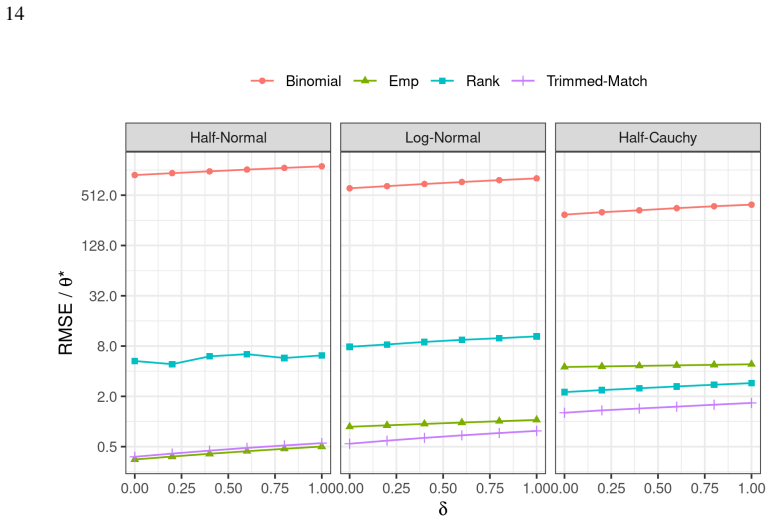
One direct test: simulate a randomized paired geo experiment with known heterogeneous unit-level iROAS values (alternating $\theta_g = \theta_0(1 \pm \delta)$ with $\delta$ near 1, as the paper's own sensitivity analysis does), compute the residuals $\epsilon_i(\theta^*)$ at the true $\theta^*$, and apply a Wilcoxon signed-rank symmetry test at the paper's sample sizes; the residual distribution will be detectably asymmetric, and the trimmed-mean estimate will shift with the realized assignment, showing that both the symmetry claim and the estimator's target depend on Assumption 1 holding.
Extended reading notes
Core claim
The central claim is Proposition 2: with randomized paired assignment, Assumption 0 (the uninfluenced response $Z_g = R_g - \theta^* S_g$ is invariant to all treatment assignments, so budget-constraint interference enters only through observed spend) and Assumption 1 (unit-level iROAS is constant, $\theta_g = \theta^*$ for all geos) imply that the residuals $\epsilon_i(\theta^*) = Y_i - \theta^* X_i$ are mutually independent and symmetrically distributed about zero. Consequently $\theta^*$ is the root of the trimmed-mean equation $\bar{\epsilon}_{n\lambda}(\theta) = 0$, and the Trimmed Match estimator $\hat{\theta}^{(\mathrm{trim})}_\lambda$ is defined as the root that minimizes symmetric deviation; when it exists it equals the ratio of the sums of $Y_i$ and $X_i$ over the untrimmed pairs. The paper also supplies a data-driven trim rate chosen by minimizing confidence-interval width, proves existence when the trimmed sum of $X_i$ is nonzero, and provides an $O(n^2 \log n)$ algorithm.
Load-bearing premise
The load-bearing premise is Assumption 1, that every geographic unit has the same true incremental return on ad spend; if unit-level returns differ, the residual symmetry that powers the whole estimator breaks and the method estimates an assignment-dependent weighted average rather than the population ratio, while the paper's own check of this premise is indirect because it tests residuals computed with the estimated value of that ratio.
Editorial extensions
If this is right
- Under the paper's two assumptions, iROAS inference becomes distribution-free: any symmetry-based estimating equation applied to $\epsilon_i(\theta)$ yields valid point and interval estimates without modeling the joint spend-response distribution.
- Trimmed Match can be more efficient than the empirical ratio, the sign-test estimator, and the Wilcoxon estimator when geo sizes are heavy-tailed; the simulated log-normal and half-Cauchy scenarios show the largest gains.
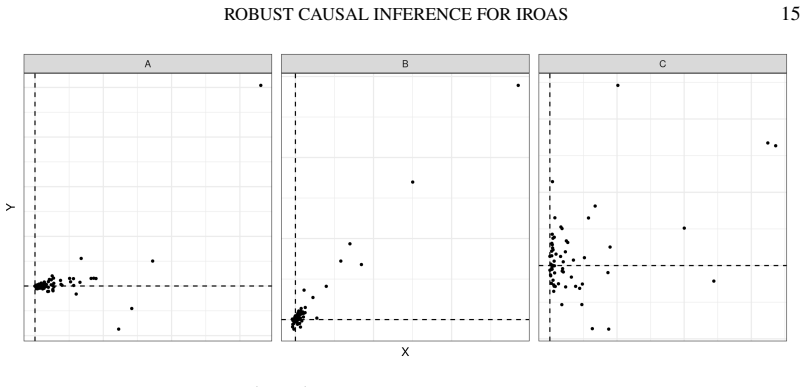
- The data-driven trim rate makes the method adaptive: in settings where trimming does not reduce variance, the method can select a trim rate of zero and reduce to the empirical estimator, as in case B of the real studies.
- The same framework applies to other matched-pairs effect-ratio problems, such as incremental cost-effectiveness ratios, because only the symmetry of residuals is used.
- An $O(n^2 \log n)$ algorithm and a studentized trimmed-mean $t$ approximation for confidence intervals make the method practical for routine advertiser experiments.
Reading between the lines
- If the symmetry reduction is as general as Proposition 2 suggests, other robust location estimators with higher efficiency at heavy tails—Huber-type M-estimators or adaptively weighted trimmed means—could be ported to effect-ratio estimation and would likely beat Trimmed Match in the same simulation designs.
- The paper's residual-based check of Assumption 1 is indirect, because it tests residuals built from the estimated $\hat{\theta}^{\mathrm{(trim)}}_{\hat{\lambda}}$; a direct test requires a holdout estimate of $\theta^*$ or a permutation distribution that accounts for the estimation step, and until then the constant-iROAS assumption is supported only indirectly.
- When Assumption 1 fails, Trimmed Match does not collapse but targets an assignment-dependent weighted average of geo-level iROAS values; a natural extension would let $\theta_g$ depend on geo covariates and use the same residual symmetry as a diagnostic instead of an assumption.
- Because the trim rate is chosen by minimizing confidence-interval width, the method implicitly trades coverage for power; with small $n$, reported intervals should be treated as optimistic unless calibrated by simulation, a point the paper itself raises when discussing undercoverage.
Signed reviews
Editorial analysis
A structured set of objections, weighed in public.
Referee Report
Summary. The paper develops a framework and estimator for the incremental return on ad spend (iROAS) in randomized paired geo experiments. It introduces Assumption 0, that an unobserved 'uninfluenced response' Z_g is invariant to treatment assignments even under budget-induced interference, and Assumption 1, that the unit-level iROAS is constant across geos. Under these assumptions, Proposition 2 shows that the residual ϵ_i(θ*) = Y_i - θ* X_i is symmetric about zero for each pair, reducing iROAS estimation to a univariate location problem. The proposed Trimmed Match estimator solves the trimmed mean equation ϵ̅_{nλ}(θ)=0, with a data-driven choice of trim rate based on confidence interval width. The paper reports simulations showing efficiency gains over empirical, sign-test, and Wilcoxon rank-based estimators, three real case studies, an O(n^2 log n) algorithm for computation, and an existence theorem for the estimator.
Significance. If the two assumptions hold, the paper makes a useful contribution: Proposition 2 is cleanly derived, the estimator is distribution-free and interpretable (it trims poorly matched pairs), and the simulation evidence supports efficiency gains in heavy-tailed settings. The connection to Rosenbaum's instrumental variable framework is insightful, and the availability of a Python implementation is a practical strength. However, the entire inferential edifice rests on Assumption 1, and the manuscript's verification of that assumption is circular, while the sensitivity analysis in Section 7.2 changes the estimand rather than addressing the identification failure. These issues materially affect whether the estimator can be claimed to target the θ* of equation (1.2) in realistic heterogeneous-geo settings.
major comments (3)
- [Section 8, footnote 4] The only empirical check of Assumption 1 is a Wilcoxon signed-rank test applied to residuals ϵ_i(θ̂_trim) computed at the estimated parameter. Footnote 4 concedes that these p-values may not be accurate because θ* is estimated, so the test is circular: the residuals are by construction centered at the estimator's root, and the test does not account for estimation uncertainty. This is not a valid verification of symmetry of the true residuals under Assumption 1. The authors should either use a split-sample or resampling procedure that accounts for parameter estimation, or present the Wilcoxon result only as an informal diagnostic, and explicitly state that Assumption 1 remains an untestable identifying assumption.
- [Section 7.2] The sensitivity analysis redefines the 'true' θ* via a virtual experiment in which all geos are assigned to treatment with a doubled total incremental budget. This is a different estimand from the θ* defined in equation (1.2) for the actual paired experiment, because under budget-constrained interference the average incremental response and spend in (1.2) are assignment-dependent. Consequently, the robustness claims in Section 7.2 and the abstract, that estimates remain reliable when Assumption 1 is violated, do not apply to the original target. The manuscript should either adopt the virtual-experiment θ* as the explicit parameter of interest throughout, or provide sensitivity results for a well-defined assignment-conditional parameter, with a formal statement of what the estimating equation identifies under heterogeneity.
- [Proposition 2 and equation (5.2)] When Assumption 1 is violated, the residual ϵ_i(θ*) includes the additional terms (θ_{i1}-θ*)S_{i1}A_i and (θ_{i2}-θ*)S_{i2}A_i, with roles depending on A_i, which depend on realized ad spend and treatment assignment. These terms are not generally symmetric about zero, so Proposition 2 fails and the trimmed mean equation (5.2) does not identify the population θ* of (1.2); instead, the root is an assignment-dependent weighted average of heterogeneous θ_g. This is a load-bearing gap because the paper's main claim, that Trimmed Match robustly estimates the overall iROAS, requires Assumption 1. The authors should provide a formal analysis of the bias as a function of the degree of heterogeneity and the spend distribution, or explicitly restrict the target to a random-coefficient model in which Assumption 1 is replaced by a defined aggregation.
minor comments (4)
- [Section 5.1] The set of untrimmed indices I in equation (5.5) depends on the estimated θ̂, but the manuscript does not specify how ties in ϵ_i(θ) at the trimming boundaries are handled in the point estimator; a tie-breaking rule would make the estimator fully defined.
- [Section 6] The data-driven choice of trim rate λ by minimizing confidence interval width is presented as a contribution of independent interest, but no theoretical justification is given for this criterion or for the recommended α0=0.5; the discussion would benefit from at least a heuristic argument or a small asymptotic analysis.
- [Appendix A] The proofs of Lemma 2 and Theorem 1 are omitted. Since the algorithm and the existence result are central to the computational and inferential claims, these proofs should be provided in the appendix or a supplementary file rather than referenced as 'straightforward' and 'omitted for conciseness'.
- [Section 1, Lemma 1] Lemma 1 is a direct rearrangement of the definition of θ_g in (1.1), so describing it as the basis of a 'novel statistical framework' is somewhat overstated; the novelty lies in the robust estimation strategy under Assumptions 0 and 1, not in the lemma itself.
Circularity Check
Central estimator is not circular, but the real-data check of the key homogeneity assumption is circular.
full rationale
Proposition 2 is a direct consequence of Assumptions 0 and 1, and the Trimmed Match estimator is derived from that proposition by solving a trimmed-mean estimating equation; it is not a renamed input or a fitted parameter masquerading as a prediction. The simulations compare estimators to a known simulation ground truth, so the central efficiency claims do not reduce to the paper's assumptions. The one genuine circularity is localized to Section 8: Assumption 1 is validated by testing symmetry of residuals at the estimated θ*, which is itself fit on the same data, and the paper's footnote admits the p-values may be inaccurate. The Section 7.2 sensitivity analysis changes the estimand (defining θ* through a virtual all-treated experiment when Assumption 1 is violated), which is a target-miss concern rather than a circularity. The data-driven trim-rate selection also uses the same data, but the paper explicitly discloses the resulting undercoverage risk; this is model-selection overfitting, not a circular derivation. Overall, the estimator's mathematical derivation is self-contained; the circularity affects only the empirical check of the most fragile assumption.
Assumptions & free parameters
free parameters (2)
- trim rate λ =
data-driven, varies by dataset
- α0 (level for trim-rate selection) =
0.5
assumptions (5)
- domain assumption Assumption 0: The uninfluenced response Z_g is invariant to both its own treatment assignment and the treatment assignment of other geos.
- domain assumption Assumption 1: The unit-level iROAS is constant, θ_g = θ* for all geos g.
- domain assumption Spillover interference across geo boundaries is ignorable.
- standard math The studentized trimmed mean statistic T_{nλ}(θ*) approximately follows a t-distribution with n-2m-1 degrees of freedom under mild conditions.
- ad hoc to paper The x_i values are distinct, or ties are broken by adding a small amount of random noise.
invented entities (1)
-
Uninfluenced response Z_g
Cite this review
Pith. "Pith review of Robust Causal Inference for Incremental Return on Ad Spend with Randomized Paired Geo Experiments." pith.science (2026). https://pith.science/paper/APWPWXBF
@misc{pith2026190802922,
  author       = {Pith},
  title        = {Pith review of: Robust Causal Inference for Incremental Return on Ad Spend with Randomized Paired Geo Experiments},
  year         = {2026},
  howpublished = {\url{https://pith.science/paper/APWPWXBF}},
  note         = {Machine review of arXiv:1908.02922}
}
read the original abstract
Evaluating the incremental return on ad spend (iROAS) of a prospective online marketing strategy (i.e., the ratio of the strategy's causal effect on some response metric of interest relative to its causal effect on the ad spend) has become increasingly more important. Although randomized ``geo experiments'' are frequently employed for this evaluation, obtaining reliable estimates of iROAS can be challenging as oftentimes only a small number of highly heterogeneous units are used. Moreover, advertisers frequently impose budget constraints on their ad spends, which further complicates causal inference by introducing interference between the experimental units. In this paper, we formulate a novel statistical framework for inferring the iROAS of online advertising from randomized paired geo experiment which further motivates and provides new insights into Rosenbaum's arguments on instrumental variables, and we propose and develop a robust, distribution-free and interpretable estimator ``Trimmed Match'', as well as a data-driven choice of the tuning parameter which may be of independent interest. We investigate the sensitivity of Trimmed Match to some violations of its assumptions and show that it can be more efficient than some alternative estimators based on simulated data. We then demonstrate its practical utility with real case studies.
Figures

Figures from the paper (1 more)

Reference graph
Works this paper leans on
-
[1]
barticle [author] Angrist , Joshua D. J. D. , Imbens , Guido W. G. W. Rubin , Donald B. D. B. ( 1996 ). Identification of causal effects using instrumental variables . Journal of the American statistical Association 91 444--455 . barticle
work page 1996
-
[2]
barticle [author] Athey , Susan S. , Eckles , Dean D. Imbens , Guido W. G. W. ( 2018 ). Exact p-Values for Network Interference . Journal of the American Statistical Association 113 230-240 . barticle
work page 2018
-
[3]
barticle [author] Baiocchi , Mike M. , Small , Dylan S. D. S. , Lorch , Scott S. Rosenbaum , Paul R. P. R. ( 2010 ). Building a stronger instrument in an observational study of perinatal care for premature infants . Journal of the American Statistical Association 105 1285--1296 . barticle
work page 2010
-
[4]
barticle [author] Bang , Heejung H. Zhao , Hongwei H. ( 2014 ). Cost-effective analysis: a proposal of new reporting standards in statistical analysis . Journal of Biopharmaceutical Statistics 24 443 -- 460 . barticle
work page 2014
-
[5]
barticle [author] Blair , Margaret H M. H. Kuse , Allan R A. R. ( 2004 ). Better practices in advertising can change a cost of doing business to wise investments in the business . Journal of Advertising Research 44 71--89 . barticle
work page 2004
-
[6]
barticle [author] Blake , Thomas T. , Nosko , Chris C. Tadelis , Steven S. ( 2015 ). Consumer Heterogeneity and Paid Search Effectiveness: A Large - Scale Field Experiment . Econometrica 83 155--174 . barticle
work page 2015
-
[7]
barticle [author] Bloniarz , Adam A. , Liu , Hanzhong H. , Zhang , Cun-Hui C.-H. , Sekhon , Jasjeet S. J. S. Yu , Bin B. ( 2016 ). Lasso adjustments of treatment effect estimates in randomized experiments . Proceedings of the National Academy of Sciences 113 7383--7390 . barticle
work page 2016
-
[8]
barticle [author] Brodersen , Kay H. K. H. , Gallusser , Fabian F. , Koehler , Jim J. , Remy , Nicolas N. Scott , Steven L. S. L. ( 2015 ). Inferring causal impact using Bayesian structural time-series models . Annals of Applied Statistics 9 247--274 . barticle
work page 2015
Show all 46 references
-
[9]
IAB Internet Advertising Report: 2017 Full Year Results
bmisc [author] Interactive Advertising Bureau ( 2018 ). IAB Internet Advertising Report: 2017 Full Year Results . bmisc
2018
-
[10]
barticle [author] Chaudhary , Mohammad A. M. A. Stearns , Sally C. S. C. ( 1996 ). Estimating confidence intervals for cost-effectiveness ratios: an example from a randomized trial . Statistics in Medicine 15 1447--1458 . barticle
1996
-
[11]
, Longfils , Marco M
bmisc [author] Chen , Aiyou A. , Longfils , Marco M. Best , Christoph C. ( 2020 ). The Python library for Trimmed Match and Trimmed Match Design . https://github.com/google/trimmed_match . [Online; accessed 21-April-2021] . bmisc
2020
-
[12]
, Chan , David D
btechreport [author] Chen , Aiyou A. , Chan , David D. , Perry , Mike M. , Jin , Yuxue Y. , Sun , Yunting Y. , Wang , Yueqing Y. Koehler , Jim J. ( 2018 ). Bias correction for paid search in media mix modeling Technical Report , Google Inc. https://ai.google/research/pubs/pub4...
2018
-
[13]
barticle [author] Dhar , Subhra Sankar S. S. Chaudhuri , Probal P. ( 2012 ). On the derivatives of the trimmed mean . Statistica Sinica 22 655--679 . barticle
2012
-
[14]
, Feller , Avi A
barticle [author] Ding , Peng P. , Feller , Avi A. Miratrix , Luke L. ( 2016 ). Randomization inference for treatment effect variation . Journal of the Royal Statistical Society: Series B 78 655--671 . barticle
2016
-
[15]
Tucker , Catherine C
bincollection [author] Goldfarb , Avi A. Tucker , Catherine C. ( 2011 ). Online Advertising . In Advances in Computers , ( Marvin V. M. V. Zelkowitz , ed.) 81 6 , 289--315 . Elsevier . bincollection
2011
-
[16]
, Zettelmeyer , Florian F
barticle [author] Gordon , Brett B. , Zettelmeyer , Florian F. , Bhargava , Neha N. Chapsky , Dan D. ( 2019 ). A Comparison of Approaches to Advertising Measurement: Evidence from Big Field Experiments at F acebook . Marketing Science 38 193--225 . barticle
2019
-
[17]
( 1981 )
barticle [author] Hall , Peter P. ( 1981 ). Large sample properties of Jaeckel's adaptive trimmed mean . Annals of the Institute of Statistical Mathematics 33 449--462 . barticle
1981
-
[18]
bbook [author] Huber , Peter J. P. J. Ronchetti , Elvezio E. ( 2009 ). Robust statistics . John Wiley & Sons, Inc. bbook
2009
-
[19]
barticle [author] Hudgens , Michael G M. G. Halloran , M Elizabeth M. E. ( 2008 ). Toward causal inference with interference . Journal of the American Statistical Association 103 832--842 . barticle
2008
-
[20]
bbook [author] Imbens , Guido W. G. W. Rubin , Donald B. D. B. ( 2015 ). Causal Inference for Statistics, Social, and Biomedical Sciences: An Introduction . Cambridge University Press , New York, NY, USA . bbook
2015
-
[21]
barticle [author] Jaeckel , Louis A. L. A. ( 1971 ). Some flexible estimates of location . The Annals of Mathematical Statistics 42 1540--1552 . barticle
1971
-
[22]
barticle [author] Johnson , Garrett A. G. A. , Lewis , Randall A. R. A. Nubbemeyer , Elmar I. E. I. ( 2017 ). Ghost ads: Improving the economics of measuring online ad effectiveness . Journal of Marketing Research 54 867--884 . barticle
2017
-
[23]
, McAteer , John J
barticle [author] Kalyanam , Kirthi K. , McAteer , John J. , Marek , Jonathan J. , Hodges , James J. Lin , Lifeng L. ( 2018 ). Cross channel effects of search engine advertising on brick & mortar retail sales: Meta analysis of large scale field experiments on Google.com . Quan...
2018
-
[24]
, Wang , Peng P
btechreport [author] Kerman , Jouni J. , Wang , Peng P. Vaver , Jon J. ( 2017 ). Estimating Ad Effectiveness using Geo Experiments in a Time-Based Regression Framework Technical Report , Google, Inc. https://ai.google/research/pubs/pub45950 . btechreport
2017
-
[25]
barticle [author] Klaassen , Chris AJ C. A. ( 1987 ). Consistent estimation of the influence function of locally asymptotically linear estimators . The Annals of Statistics 1548--1562 . barticle
1987
-
[26]
barticle [author] Kunzel , Soren R. S. R. , Sekhon , Jasjeet S. J. S. , Bickel , Peter J. P. J. Yu , Bin B. ( 2019 ). Metalearners for estimating heterogeneous treatment effects using machine learning . Proceedings of the National Academy of Sciences 116 4156--4165 . barticle
2019
-
[27]
bbook [author] Lehmann , Erich Leo E. L. ( 2006 ). Nonparametrics: statistical methods based on ranks . Springer . bbook
2006
-
[28]
barticle [author] Lewis , Randall A. R. A. Rao , Justin M. J. M. ( 2015 ). The Unfavorable Economics of Measuring the Returns to Advertising . The Quarterly Journal of Economics 130 1941-1973 . barticle
2015
-
[29]
( 2013 )
barticle [author] Lin , Winston W. ( 2013 ). Agnostic notes on regression adjustments to experimental data: Reexamining F reedman's critique . The Annals of Applied Statistics 7 295--318 . barticle
2013
-
[30]
, Small , Dylan S
barticle [author] Luo , Xi X. , Small , Dylan S. D. S. , Li , Chiang-Shan R. C.-S. R. Rosenbaum , Paul R. P. R. ( 2012 ). Inference With Interference Between Units in an fMRI Experiment of Motor Inhibition . Journal of the American Statistical Association 107 530-541 . barticle
2012
-
[31]
Wager , Stefan S
barticle [author] Nie , Xinkun X. Wager , Stefan S. ( 2017 ). Quasi-oracle estimation of heterogeneous treatment effects . arXiv preprint arXiv:1712.04912 . barticle
2017 arXiv
-
[32]
, Aydin , Kevin K
binproceedings [author] Rolnick , David D. , Aydin , Kevin K. , Pouget-Abadie , Jean J. , Kamali , Shahab S. , Mirrokni , Vahab V. Najmi , Amir A. ( 2019 ). Randomized Experimental Design via Geographic Clustering . In Proceedings of the 25th ACM International Conference on Kn...
2019
-
[33]
barticle [author] Rosenbaum , Paul R. P. R. ( 1996 ). Identification of causal effects using instrumental variables: Comment . Journal of the American Statistical Association 91 444--444 . barticle
1996
-
[34]
barticle [author] Rosenbaum , Paul R. P. R. ( 2002 ). Covariance adjustment in randomized experiments and observational studies . Statistical Science 17 286--327 . barticle
2002
-
[35]
barticle [author] Rosenbaum , Paul R P. R. ( 2007 ). Interference Between Units in Randomized Experiments . Journal of the American Statistical Association 102 191-200 . barticle
2007
-
[36]
bbook [author] Rosenbaum , Paul R. P. R. ( 2020 ). Design of Observational Studies, 2nd Edition . Springer Series in Statistics . bbook
2020
-
[37]
R andomization A nalysis of E xperimental D ata in the F isher R andomization T est
barticle [author] Rubin , Donald B. D. B. ( 1980 ). Discussion of " R andomization A nalysis of E xperimental D ata in the F isher R andomization T est" by B asu . Journal of the American Statistical Association 75 591-593 . barticle
1980
-
[38]
, Vaver , Jon J
btechreport [author] Sapp , Stephanie S. , Vaver , Jon J. , Schuringa , Jon J. Dropsho , Steven S. ( 2017 ). Near impressions for observational causal ad impact Technical Report , Google Inc. https://ai.google/research/pubs/pub46418 . btechreport
2017
-
[39]
Rosenbaum , Paul R
barticle [author] Small , Dylan D. Rosenbaum , Paul R. P. R. ( 2008 ). War and Wages: The Strength of Instrumental Variables and Their Sensitivity to Unobserved Biases . Journal of the American Statistical Association 103 924-933 . barticle
2008
-
[40]
barticle [author] Tukey , John W. J. W. McLaughlin , Donald H. D. H. ( 1963 ). Less vulnerable confidence and significance procedures for location based on a single sample: Trimming/Winsorization 1 . Sankhy \=a : The Indian Journal of Statistics, Series A 25 331--352 . barticle
1963
-
[41]
barticle [author] Varian , Hal R. H. R. ( 2009 ). Online Ad Auctions . American Economic Review 99 430-34 . 10.1257/aer.99.2.430 barticle
2009 doi
-
[42]
barticle [author] Varian , Hal R. H. R. ( 2016 ). Causal inference in economics and marketing . Proceedings of the National Academy of Sciences 113 7310--7315 . barticle
2016
-
[43]
Koehler , Jim J
btechreport [author] Vaver , Jon J. Koehler , Jim J. ( 2011 ). Measuring Ad Effectiveness Using Geo Experiments Technical Report , Google Inc. https://ai.google/research/pubs/pub38355 . btechreport
2011
-
[44]
Athey , Susan S
barticle [author] Wager , Stefan S. Athey , Susan S. ( 2018 ). Estimation and Inference of Heterogeneous Treatment Effects using Random Forests . Journal of the American Statistical Association 113 1228-1242 . 10.1080/01621459.2017.1319839 barticle
2018
-
[45]
( 2016 )
bbook [author] Wickham , Hadley H. ( 2016 ). ggplot2: Elegant Graphics for Data Analysis . Springer-Verlag New York . bbook
2016
-
[46]
, Malik , Saarthak S
binproceedings [author] Ye , Quinn Q. , Malik , Saarthak S. , Chen , Ji J. Zhu , Haijun H. ( 2016 ). The Seasonality Of Paid Search Effectiveness From A Long Running Field Test . In Proceedings of the 2016 ACM Conference on Economics and Computation . EC '16 515--530 . ACM , N...
2016
Reviewed August 14, 2026 · model on record in the stance chip above.
Discussion (0). Continue with ORCID to comment.