REVIEW 4 major objections 6 minor 58 references
Zero-Shot Crowd Behavior Recognition
T0 review · 4 major / 6 minor · reviewed 2026-08-14 · deepseek-v4-flash
Pith's one-line read Crowd behaviors with zero training videos become recognizable
desk verdict First multi-label ZSL for crowd behavior with a useful violence transfer, but the conditional probability is mis-normalized and the learned co-occurrence map never sees negative pairs. read the letter →
The pith
A machine-rendered reading of the paper's core claim, the machinery that carries it, and where it could break.
The reading
What carries the argument
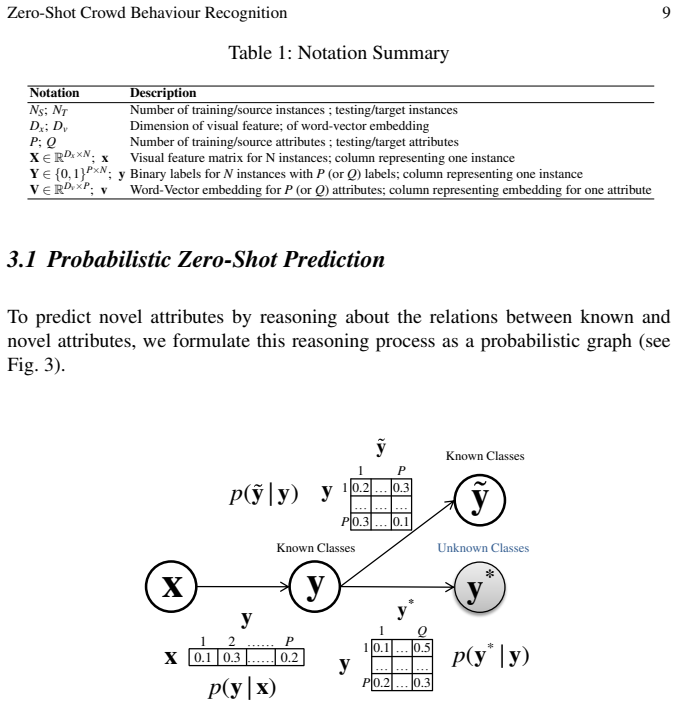
The load-bearing object is the bilinear map $M$ of Eq. (6), a matrix that takes a pair of word vectors $(v_i, v_j)$ and outputs the expected log visual co-occurrence $\log c_{ij}$ of the two attributes. It is fit by weighted ridge regression against the co-occurrence matrix $C = Y_S Y_S^\top$ computed from multi-label annotations of known attributes, with a weighting function that down-weights rare pairs. The same $M$ is then used in Eq. (8) to score conditional probabilities $p(y^*_q \mid y_p)$ for pairs that include a novel attribute, and those conditionals are marginalized over known-attribute confidences in Eq. (1) to predict novel labels. The map is the mechanism that lets word-vector semantics be corrected by and aligned with visual context, and then extrapolated to unseen attribute pairs.
What would settle it
Annotate a fresh set of crowd videos for the held-out novel attributes, compute their empirical co-occurrence with known attributes, and compare these counts against the conditional probabilities predicted by $M$; if the rank correlation is near zero or negative, the extrapolation at the core of the paper collapses.
Extended reading notes
Core claim
On its own terms, the paper claims that multi-label zero-shot crowd behavior recognition can be solved by marginalizing known-attribute predictions through estimated known-to-novel attribute relations. Its model, CoCAZSL, learns a probabilistic classifier for known attributes, then forms conditional probabilities between novel and known attributes from a bilinear mapping $M$ that predicts visual co-occurrence from word vectors. Setting $M$ to the identity recovers text-only relations; learning $M$ from annotated co-occurrence corrects cases where linguistic similarity mismatches visual context, such as indoor and outdoor. Experimentally, the paper reports that this context-aware marginalization improves label-based AUC and AP over four existing zero-shot models on the WWW dataset, and that transferring the learned relations to violence detection yields AUC 87.22, above the supervised ViF baseline's 85.00. The claim is that contextual co-occurrence, transferred through a learned word-pair map, is what makes zero-shot crowd behavior recognition work.
Load-bearing premise
The single bilinear rule learned from pairs of known attributes keeps predicting co-occurrence accurately for pairs that include a novel attribute.
Editorial extensions
If this is right
- Zero-shot crowd attribute prediction is feasible: on the WWW dataset all tested models beat random guessing, and the context-aware model reports the highest label-based AUC and AP.
- Adding visual co-occurrence context to a text-only semantic relation improves prediction: CoCAZSL reaches 0.69 AUC versus 0.65 for TexCAZSL.
- The learned relations transfer across domains: without any violence training examples, CoCAZSL reaches 87.22 AUC on Violent Flow, above the supervised ViF baseline's 85.00.
- Multi-label context is what supplies the missing statistics: because novel attributes cannot have annotated co-occurrence, the bilinear map generates those statistics from word pairs and known-attribute annotations.
Reading between the lines
- A natural extension the paper leaves implicit is learning separate co-occurrence maps for the 'where', 'who', and 'why' attribute groups, which could test whether group-specific context extrapolates better than a single global map.
- The same word-pair to co-occurrence transfer could apply to other multi-label zero-shot problems, such as tagging images with novel objects or actions, whenever word vectors and partial label co-occurrence are available.
- The indoor/outdoor failure of text-only relations suggests a general caution: any text-based semantic prior should be calibrated against visual annotation statistics before being trusted for visual prediction.
Signed reviews
Editorial analysis
A structured set of objections, weighed in public.
Referee Report
Summary. This manuscript proposes CoCAZSL, a zero-shot multi-label crowd behavior recognition method. The model first trains probabilistic classifiers for known attributes, then estimates relations from known to novel attributes via a bilinear map M that predicts visual co-occurrence from pairs of word vectors, and finally marginalizes known-attribute predictions through these relations in an IAP-style formulation given by Eq. (1). The authors also present a text-only variant (TexCAZSL). Experiments on the WWW crowd video dataset report improved label-based AUC and AP over four ZSL baselines, and a transfer experiment to Violence Flow suggests competitive zero-shot violence detection. The central claim is that modeling multi-attribute co-occurrence context improves zero-shot crowd behavior recognition and generalizes to novel behaviors cross-domain.
Significance. If the results hold, the paper makes a useful contribution by introducing zero-shot learning to multi-label crowd behavior recognition and by showing that co-occurrence context learned from known attributes can be transferred to novel attributes. The idea of learning a pairwise mapping from text embeddings to visual co-occurrence is interesting and the WWW dataset provides a challenging testbed. The reported AUC gains (0.69 vs 0.65 for TexCAZSL) and the cross-domain violence transfer are compelling. However, the two technical issues detailed below concern the probabilistic validity of the conditioning step and the mechanism by which visual compatibility is learned; both are load-bearing for the stated claims.
major comments (4)
- [§3.2.2, Eq. (8)] The quantity defined in Eq. (8) is not the conditional probability p(y*_q | y_p) used in Eq. (1). The denominator sums over the conditioning variable p (known attributes), producing a distribution over p for each fixed q, whereas a conditional p(y*_q | y_p) should sum over q to 1. This is also inconsistent with Eq. (5), where the normalization is over the conditioned variable j. Consequently, the marginalization in Eq. (1) does not yield calibrated probabilities over novel labels, and the relative scale of scores for different q is arbitrary. This scale arbitrariness affects the example-based metrics (e.g., example-based AP and ranking loss) though not the per-label AUC. Please clarify whether Eq. (8) is intended as an unnormalized affinity; if so, the probabilistic graphical model in §3.1 and the interpretation of Eq. (1) as a marginal conditional probability need to be revised.
- [§3.2.2, Eqs. (6)-(7)] The regression in Eq. (6) is trained only on known attribute pairs with positive co-occurrence because the weight function in Eq. (7) gives w(0)=0 for alpha>0. The stated motivation for using visual co-occurrence is that textually similar pairs such as "indoor" and "outdoor" have zero visual co-occurrence and should be suppressed, but the objective never presents such incompatible pairs to M. Thus, the learned mapping has no pressure to output low values for non-co-occurring pairs, and the improvement of CoCAZSL over TexCAZSL in Table 2 (AUC 0.69 vs 0.65) cannot be attributed to the "visual compatibility" mechanism as described. Please either include zero-co-occurrence pairs with a non-zero penalty in Eq. (6), or provide direct evidence (e.g., predicted co-occurrence for held-out known-known pairs) that M extrapolates to incompatible unseen pairs.
- [Table 2, §4.1.2] The reported gains of CoCAZSL over TexCAZSL (AUC 0.69 vs 0.65; label-based AP 0.27 vs 0.24) are the central empirical evidence for the contribution, but the paper gives no variance or significance information across the 50 random splits. Since the difference is modest and the baselines are also within 0.02-0.03 of each other, please report per-split mean±std or paired tests across the 50 splits to show that the improvement is systematic rather than due to a few favourable splits.
- [§4.2, Table 3] The claim that the zero-shot model "beats the fully supervised Linear SVM with ViF feature in AUC (87.22 vs 85.00)" compares CoCAZSL using ITF with a supervised baseline using ViF. The same-feature supervised ITF baseline achieves 98.72 AUC, which is substantially higher. Please reframe the claim to acknowledge the feature mismatch and, if possible, add a supervised ViF baseline or a zero-shot model using the same features to make the comparison apples-to-apples.
minor comments (6)
- [§3.1, Eq. (1)] The second line "p( ˜y ˜p|x)" appears to be a typo; it should presumably read p(\tilde{y}_{\tilde{p}}|x).
- [§3.2.2, Eq. (9)] The gradient in Eq. (9) uses f(c_ij) but the loss in Eq. (6) uses w(c_ij); please make the notation consistent.
- [§4.1.1] The parameter setting "λ = 1−3" should likely be "λ = 10^{-3}"; please clarify.
- [Table 3] The supervised baseline is cited as "[18]" in the table, but the text refers to "the best performance of [19]"; the citation appears inconsistent.
- [Fig. 9] The caption contains a typo: "Importantce" should be "Importance".
- [Section 2.2] In the phrase "Indirect Attribute Predici ton (IAP)", "Predici ton" should be "Prediction".
Circularity Check
No significant circularity: the bilinear co-occurrence map is fitted on known attributes only and is genuinely extrapolated to novel attributes and external benchmarks.
full rationale
The paper's derivation chain is self-contained and not circular. The key predictive quantity is p(y*_q | x) = sum_p p(y*_q | y_p) p(y_p | x) in Eq. (1). The known-to-novel conditional p(y*_q | y_p) is obtained in Eq. (8) by exponentiating v_q^T M v_p, where the bilinear map M is learned in Eq. (6) from word-vector pairs and visual co-occurrence statistics of the 85 known attributes only. Novel attribute annotations and test labels never enter the estimation of M; the only bridge to novel attributes is the external Google News word-vector embedding. Thus the reported WWW and Violence Flow results are not forced by construction: Eq. (6) solves a genuine regression on seen attribute pairs, and Eq. (8) applies the fitted map to unseen attribute pairs, which is extrapolation rather than a refitting of the target quantity. The weight function in Eq. (7) does zero out zero-co-occurrence pairs, so the model is not trained on negative visual co-occurrence evidence; this is a limitation of the extrapolation assumption, not a circular reduction, because the evaluated novel-attribute predictions are still not derived from the labels being predicted. Self-citations such as [12], [41], [52], and [53] are used as compared baselines, dataset references, or related prior work; none is invoked as an unverified uniqueness theorem or as the sole justification of the central transfer step. The central claim therefore has independent empirical content and no circular step was found.
Assumptions & free parameters
free parameters (4)
- lambda (ridge regularization for bilinear map M) =
printed as '1-3', likely 1e-3
- gamma (temperature in text softmax) =
0.1
- alpha and Cmax (co-occurrence weighting function) =
not reported
- SVM slack C for known-attribute classifiers =
1
assumptions (4)
- domain assumption Novel attribute scores are obtained by marginalizing over known attributes: p(y*_q | x) = sum_p p(y*_q | y_p) p(y_p | x).
- ad hoc to paper Visual co-occurrence of attribute pairs is a bilinear function of word vectors via a single global matrix M: exp(v_i^T M v_j) approximates c_ij.
- domain assumption Pre-trained skip-gram word vectors (Google News, 300-d) capture semantic relations that transfer to crowd-attribute co-occurrence.
- ad hoc to paper The normalized quantity in Eq. (8) can be used as p(y*_q | y_p) despite normalizing over the conditioning variable.
Cite this review
Pith. "Pith review of Zero-Shot Crowd Behavior Recognition." pith.science (2026). https://pith.science/paper/AQD4VQZJ
@misc{pith2026190805877,
  author       = {Pith},
  title        = {Pith review of: Zero-Shot Crowd Behavior Recognition},
  year         = {2026},
  howpublished = {\url{https://pith.science/paper/AQD4VQZJ}},
  note         = {Machine review of arXiv:1908.05877}
}
read the original abstract
Understanding crowd behavior in video is challenging for computer vision. There have been increasing attempts on modeling crowded scenes by introducing ever larger property ontologies (attributes) and annotating ever larger training datasets. However, in contrast to still images, manually annotating video attributes needs to consider spatiotemporal evolution which is inherently much harder and more costly. Critically, the most interesting crowd behaviors captured in surveillance videos (e.g., street fighting, flash mobs) are either rare, thus have few examples for model training, or unseen previously. Existing crowd analysis techniques are not readily scalable to recognize novel (unseen) crowd behaviors. To address this problem, we investigate and develop methods for recognizing visual crowd behavioral attributes without any training samples, i.e., zero-shot learning crowd behavior recognition. To that end, we relax the common assumption that each individual crowd video instance is only associated with a single crowd attribute. Instead, our model learns to jointly recognize multiple crowd behavioral attributes in each video instance by exploring multiattribute cooccurrence as contextual knowledge for optimizing individual crowd attribute recognition. Joint multilabel attribute prediction in zero-shot learning is inherently nontrivial because cooccurrence statistics does not exist for unseen attributes. To solve this problem, we learn to predict cross-attribute cooccurrence from both online text corpus and multilabel annotation of videos with known attributes. Our experiments show that this approach to modeling multiattribute context not only improves zero-shot crowd behavior recognition on the WWW crowd video dataset, but also generalizes to novel behavior (violence) detection cross-domain in the Violence Flow video dataset.
Figures


Figures from the paper (6 more)




Reference graph
Works this paper leans on
-
[1]
Evaluation of output embeddings for fine-grained image classification
Zeynep Akata, Scott Reed, Daniel Walter, Honglak Lee, and Bernt Schiele. Evaluation of output embeddings for fine-grained image classification. In CVPR, 2015
work page 2015
-
[2]
Exploring synonyms as context in zero-shot action recognition
Ioannis Alexiou, Tao Xiang, and Shaogang Gong. Exploring synonyms as context in zero-shot action recognition. In ICIP, 2016
work page 2016
-
[3]
Floor fields for tracking in high density crowd scenes
Saad Ali and Mubarak Shah. Floor fields for tracking in high density crowd scenes. In ECCV, 2008
work page 2008
-
[4]
Modelling crowd scenes for event detection
Ernesto L Andrade, Scott Blunsden, and Robert B Fisher. Modelling crowd scenes for event detection. In ICPR, 2006
work page 2006
-
[5]
Learning multi-label scene classification
Matthew R Boutell, Jiebo Luo, Xipeng Shen, and Christopher M Brown. Learning multi-label scene classification. Pattern recognition, 2004
work page 2004
-
[6]
LIBSVM: A library for support vector machines
Chih-Chung Chang and Chih-Jen Lin. LIBSVM: A library for support vector machines. ACM Transactions on Intelligent Systems and Technology, 2011. Software available at http:// www.csie.ntu.edu.tw/˜cjlin/libsvm
work page 2011
-
[7]
Feature mining for localised crowd counting
Ke Chen, Chen Change Loy, Shaogang Gong, and Tao Xiang. Feature mining for localised crowd counting. In BMVC, 2012
work page 2012
-
[8]
Histograms of oriented gradients for human detection
Navneet Dalal and Bill Triggs. Histograms of oriented gradients for human detection. In CVPR, 2005
2005
Show all 58 references
-
[9]
Christiane Fellbaum. WordNet. Wiley Online Library
-
[10]
Devise: A deep visual-semantic embedding model
Andrea Frome, Greg S Corrado, Jon Shlens, Samy Bengio, Jeff Dean, Tomas Mikolov, et al. Devise: A deep visual-semantic embedding model. In NIPS, 2013
2013
-
[11]
Transductive Multi- view Zero-Shot Learning
Yanwei Fu, Timothy M Hospedales, Tao Xiang, and Shaogang Gong. Transductive Multi- view Zero-Shot Learning. IEEE Transactions on Pattern Analysis and Machine Intelligence, 2015
2015
-
[12]
Trans- ductive Multi-Label Zero-shot Learning
Yanwei Fu, Yongxin Yang, Timothy M Hospedales, Tao Xiang, and Shaogang Gong. Trans- ductive Multi-Label Zero-shot Learning. In BMVC, 2014
2014
-
[13]
Multilabel classification via calibrated label ranking
Johannes F ¨urnkranz, Eyke H ¨ullermeier, Eneldo Loza Menc´ıa, and Klaus Brinker. Multilabel classification via calibrated label ranking. Machine learning, 2008
2008
-
[14]
Exploring semantic inter-class relationships (sir) for zero-shot action recognition
Chuang Gan, Ming Lin, Yi Yang, Yueting Zhuang, and Alexander G.Hauptmann. Exploring semantic inter-class relationships (sir) for zero-shot action recognition. In AAAI, 2015
2015
-
[15]
Devnet: A deep event network for multimedia event detection and evidence recounting
Chuang Gan, Naiyan Wang, Yi Yang, Dit-Yan Yeung, and Alex G Hauptmann. Devnet: A deep event network for multimedia event detection and evidence recounting. In CVPR, 2015
2015
-
[16]
Collective multi-label classification
Nadia Ghamrawi and Andrew McCallum. Collective multi-label classification. In ACM CIKM, 2005
2005
-
[17]
Security and surveillance
Shaogang Gong, Chen Change Loy, and Tao Xiang. Security and surveillance. In Moeslund, Hilton, Kruger, and Sigal, editors,Visual Analysis of Humans, pages 455–472. Springer, 2011
2011
-
[18]
Efficient max-margin multi-label classification with applications to zero-shot learning
Bharath Hariharan, SVN Vishwanathan, and Manik Varma. Efficient max-margin multi-label classification with applications to zero-shot learning. Machine learning, 2012
2012
-
[19]
Violent flows: Real-time detection of violent crowd behavior
Tal Hassner, Yossi Itcher, and Orit Kliper-Gross. Violent flows: Real-time detection of violent crowd behavior. In CVPR Workshop, 2012
2012
-
[20]
Yu-Gang Jiang, Guangnan Ye, Shih-Fu Chang, Daniel P. W. Ellis, and Alexander C. Loui. Consumer video understanding: a benchmark database and an evaluation of human and ma- chine performance. In ICMR, 2011. 28 Xun Xu, Shaogang Gong and Timothy M. Hospedales
2011
-
[21]
Anomaly detection in extremely crowded scenes using spatio- temporal motion pattern models
Louis Kratz and Ko Nishino. Anomaly detection in extremely crowded scenes using spatio- temporal motion pattern models. In CVPR, 2009
2009
-
[22]
Hmdb: A large video database for human motion recognition
H Kuehne, H Jhuang, E Garrote, T Poggio, and T Serre. Hmdb: A large video database for human motion recognition. In ICCV, 2011
2011
-
[23]
Lampert, H
C.H. Lampert, H. Nickisch, and S. Harmeling. Learning to detect unseen object classes by between-class attribute transfer. In CVPR, 2009
2009
-
[24]
Beyond bags of features: Spatial pyra- mid matching for recognizing natural scene categories
Svetlana Lazebnik, Cordelia Schmid, and Jean Ponce. Beyond bags of features: Spatial pyra- mid matching for recognizing natural scene categories. CVPR, 2006
2006
-
[25]
Learning behavioural context
Jian Li, Shaogang Gong, and Tao Xiang. Learning behavioural context. International journal of computer vision, 2012
2012
-
[26]
Multi-label image classification with a probabilistic label enhancement model
Xin Li, Feipeng Zhao, and Yuhong Guo. Multi-label image classification with a probabilistic label enhancement model. In UAI, 2014
2014
-
[27]
Crowd counting and profil- ing: Methodology and evaluation
Chen Change Loy, Ke Chen, Shaogang Gong, and Tao Xiang. Crowd counting and profil- ing: Methodology and evaluation. In Ali, Nishino, Manocha, and Shah, editors, Modeling, Simulation and Visual Analysis of Crowds. Springer, December 2013
2013
-
[28]
COSTA: Co-occurrence statistics for zero-shot classification
Thomas Mensink, Efstratios Gavves, and Cees G M Snoek. COSTA: Co-occurrence statistics for zero-shot classification. In CVPR, 2014
2014
-
[29]
Distributed Rep- resentations of Words and Phrases and their Compositionality
Tomas Mikolov, Ilya Sutskever, Kai Chen, Greg Corrado, and Jeffrey Dean. Distributed Rep- resentations of Words and Phrases and their Compositionality. In NIPS, 2013
2013
-
[30]
Modeling temporal structure of decom- posable motion segments for activity classification
Juan Carlos Niebles, Chih Wei Chen, and Li Fei-Fei. Modeling temporal structure of decom- posable motion segments for activity classification. In ECCV, 2010
2010
-
[31]
Modeling the shape of the scene: A holistic representation of the spatial envelope
Aude Oliva and Antonio Torralba. Modeling the shape of the scene: A holistic representation of the spatial envelope. International Journal of Computer Vision, 2001
2001
-
[32]
Deepid-net: multi-stage and deformable deep convolutional neural networks for object detection
Wanli Ouyang, Ping Luo, Xingyu Zeng, Shi Qiu, Yonglong Tian, Hongsheng Li, Shuo Yang, Zhe Wang, Yuanjun Xiong, Chen Qian, et al. Deepid-net: multi-stage and deformable deep convolutional neural networks for object detection. arXiv preprint arXiv:1409.3505, 2014
2014 arXiv
-
[33]
Glove: Global vectors for word representation
Jeffrey Pennington, Richard Socher, and Christopher D Manning. Glove: Global vectors for word representation. In EMNLP, 2014
2014
-
[34]
Improving the Fisher kernel for large-scale image classification
Florent Perronnin, Jorge S ´anchez, and Thomas Mensink. Improving the Fisher kernel for large-scale image classification. In ECCV, 2010
2010
-
[35]
Cor- relative multi-label video annotation
Guo-Jun Qi, Xian-Sheng Hua, Yong Rui, Jinhui Tang, Tao Mei, and Hong-Jiang Zhang. Cor- relative multi-label video annotation. In ACM Multimedia, 2007
2007
-
[36]
Data-driven crowd anal- ysis in videos
Mikel Rodriguez, Josef Sivic, Ivan Laptev, and Jean-Yves Audibert. Data-driven crowd anal- ysis in videos. In ICCV, 2011
2011
-
[37]
Evaluating knowledge transfer and zero- shot learning in a large-scale setting
Marcus Rohrbach, Michael Stark, and Bernt Schiele. Evaluating knowledge transfer and zero- shot learning in a large-scale setting. In CVPR, 2011
2011
-
[38]
What helps where - and why? Semantic relatedness for knowledge transfer
Marcus Rohrbach, Michael Stark, Gy ¨orgy Szarvas, Iryna Gurevych, and Bernt Schiele. What helps where - and why? Semantic relatedness for knowledge transfer. In CVPR, 2010
2010
-
[39]
An embarrassingly simple approach to zero-shot learning
Bernardino Romera-Paredes. An embarrassingly simple approach to zero-shot learning. In ICML, 2015
2015
-
[40]
Scene understanding by statistical mod- eling of motion patterns
Imran Saleemi, Lance Hartung, and Mubarak Shah. Scene understanding by statistical mod- eling of motion patterns. In CVPR, 2010
2010
-
[41]
Deeply learned attributes for crowded scene understanding
Jing Shao, Kai Kang, Chen Change Loy, and Xiaogang Wang. Deeply learned attributes for crowded scene understanding. In CVPR, 2015
2015
-
[42]
Scene-independent group profiling in crowd
Jing Shao, Chen Loy, and Xiaogang Wang. Scene-independent group profiling in crowd. In CVPR, 2014
2014
-
[43]
Zero-shot learning through cross-modal transfer
Richard Socher and Milind Ganjoo. Zero-shot learning through cross-modal transfer. In NIPS, 2013
2013
-
[44]
Ucf101: A dataset of 101 human actions classes from videos in the wild
Khurram Soomro, A R Zamir, and Mubarak Shah. Ucf101: A dataset of 101 human actions classes from videos in the wild. arXiv preprint arXiv:1212.0402, 2012
2012 arXiv
-
[45]
Random k-labelsets: An ensemble method for multilabel classification
Grigorios Tsoumakas and Ioannis Vlahavas. Random k-labelsets: An ensemble method for multilabel classification. In ECML, 2007
2007
-
[46]
Parametric mixture models for multi-labeled text
Naonori Ueda and Kazumi Saito. Parametric mixture models for multi-labeled text. In NIPS, 2002. Zero-Shot Crowd Behaviour Recognition 29
2002
-
[47]
A sequential topic model for mining recurrent activities from long term video logs
Jagannadan Varadarajan, Remi Emonet, and Jean-Marc Odobez. A sequential topic model for mining recurrent activities from long term video logs. International Journal of Computer Vision, 2013
2013
-
[48]
Action recognition by dense trajectories
Heng Wang, Alexander Kl ¨aser, Cordelia Schmid, and Cheng-Lin Liu. Action recognition by dense trajectories. In CVPR, 2011
2011
-
[49]
A robust and efficient video representation for action recog- nition
Heng Wang, Dan Oneata, Jakob Verbeek, Cordelia Schmid, Heng Wang, Dan Oneata, Jakob Verbeek, and Cordelia Schmid A. A robust and efficient video representation for action recog- nition. International Journal of Computer Vision, 2015
2015
-
[50]
Unsupervised activity perception in crowded and complicated scenes using hierarchical bayesian models
Xiaogang Wang, Xiaoxu Ma, and W Eric L Grimson. Unsupervised activity perception in crowded and complicated scenes using hierarchical bayesian models. IEEE Transactions on Pattern Analysis and Machine Intelligence, 2009
2009
-
[51]
X. Xu, T. M. Hospedales, and S. Gong. Discovery of shared semantic spaces for multi-scene video query and summarization. IEEE Transactions on Circuits and Systems for Video Tech- nology, 2016
2016
-
[52]
Cross-domain traffic scene understanding by motion model transfer
Xun Xu, Shaogang Gong, and Timothy Hospedales. Cross-domain traffic scene understanding by motion model transfer. In Proceedings of the 4th ACM/IEEE International Workshop on ARTEMIS, 2013
2013
-
[53]
Semantic embedding space for zero-shot action recognition
Xun Xu, Timothy Hospedales, and Shaogang Gong. Semantic embedding space for zero-shot action recognition. In ICIP, 2015
2015
-
[54]
Ml-knn: A lazy learning approach to multi-label learning
Min-Ling Zhang and Zhi-Hua Zhou. Ml-knn: A lazy learning approach to multi-label learning. Pattern recognition, 2007
2007
-
[55]
A review on multi-label learning algorithms
Min-Ling Zhang and Zhi-Hua Zhou. A review on multi-label learning algorithms. IEEE Transactions on Knowledge and Data Engineering, 2014
2014
-
[56]
Rotation-invariant image and video description with local binary pattern features
Guoying Zhao, Timo Ahonen, Ji ˇr´ı Matas, and Matti Pietik¨ainen. Rotation-invariant image and video description with local binary pattern features. IEEE Transactions on Image Processing, 2012
2012
-
[57]
Tracking using motion patterns for very crowded scenes
Xuemei Zhao, Dian Gong, and G ´erard Medioni. Tracking using motion patterns for very crowded scenes. In ECCV, 2012
2012
-
[58]
Coherent filtering: detecting coherent motions from crowd clutters
Bolei Zhou, Xiaoou Tang, and Xiaogang Wang. Coherent filtering: detecting coherent motions from crowd clutters. In ECCV, 2012
2012
Reviewed August 14, 2026 · model on record in the stance chip above.
Discussion (0). Continue with ORCID to comment.