REVIEW 2 major objections 6 minor 60 references
Spectroscopic Follow-Up of Discoveries from the NEOWISE Proper Motion Survey
T0 review · 2 major / 6 minor · reviewed 2026-08-14 · deepseek-v4-flash
Pith's one-line read Spectra of 65 proper-motion discoveries from the NEOWISE survey classify 60 new dwarfs, including three candidate T subdwarfs that would double the known early-type T subdwarf population.
desk verdict A solid observational census paper whose main novelty—three candidate T subdwarfs—is honestly labeled as unconfirmed; the rest of the classifications are probably right. read the letter →
The pith
A machine-rendered reading of the paper's core claim, the machinery that carries it, and where it could break.
The reading
What carries the argument
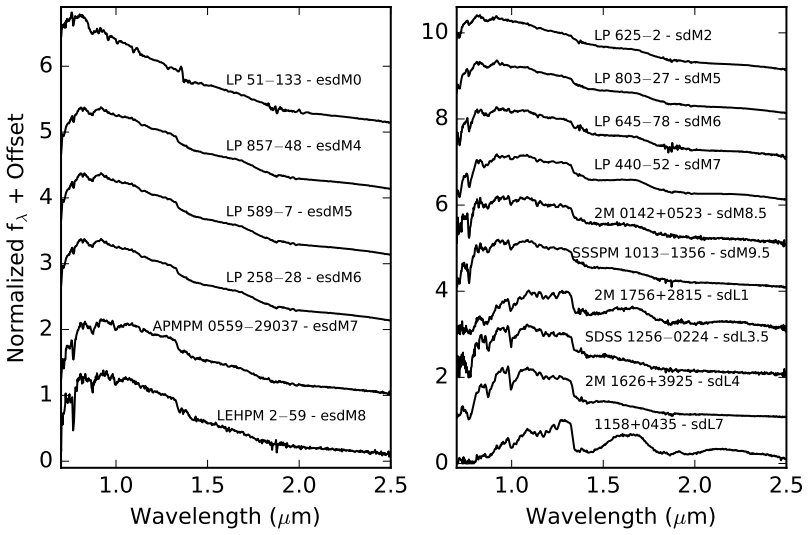
The central machinery is spectral classification by eye against a grid of near-infrared standards: the standard M, L, and T sequence plus a newly assembled set of sixteen M and L subdwarf standards. Low-metallicity subdwarfs are recognized by suppressed H- and K-band flux relative to the J band, a signature of collision-induced H2 absorption, together with brightening in the Y band; the same blue morphology in T dwarfs drives the sdT candidate assignments. Distances are computed from absolute-magnitude–spectral-type relations appropriate to each class—field dwarfs, early M dwarfs, and subdwarfs—with Monte Carlo propagation of the uncertainties in spectral type, photometry, and the relations themselves.
What would settle it
Take higher signal-to-noise spectra of WISE 0301−2319, WISE 0004−2604, and WISE 1019−3911 and fit them against synthetic T dwarf models spanning a grid of metallicities and surface gravities: a match at solar metallicity with low gravity or thick clouds would falsify the subdwarf assignments, while a match only at [Fe/H] ≲ −0.5 would support them.
Extended reading notes
Core claim
Using low-resolution near-infrared spectroscopy across the 0.8–2.5 µm range, the authors classify 65 high-proper-motion discoveries from the NEOWISE proper motion survey. They find 31 new M dwarfs, 18 new L dwarfs, and 11 new T dwarfs; 13 objects are confirmed subdwarfs, including one sdL1 and two sdL7, with another three candidate sdL5 and two candidate sdM4. Three objects—WISE 0301−2319, WISE 0004−2604, and WISE 1019−3911—show blue near-infrared colors with suppressed H- and K-band flux and are typed as candidate T subdwarfs sdT1, sdT2, and sdT3. Spectrophotometric distances, combined with Gaia parallaxes where available, place 11 objects within 25 pc, of which three T dwarfs lie within 15 pc.
Load-bearing premise
The three T subdwarf classifications rest on the assumption that blue near-infrared colors (suppressed H- and K-band flux relative to J band) reliably indicate low metallicity in T dwarfs, even though no T dwarf subdwarf standards exist; gravity, binarity, or clouds could in principle mimic that morphology.
Editorial extensions
If this is right
- If the three T subdwarf candidates are confirmed, the number of known early-type T subdwarfs would rise from two to five, a more than twofold increase.
- Eleven of the observed objects—nine T dwarfs, one M dwarf, and one L subdwarf—join the census of stellar and substellar systems within 25 pc of the Sun.
- The two new sdL7s and two new sdL1s add to the sparse known population of L subdwarfs, previously totalling roughly 66 objects.
- The parent survey's photometric typing misclassified several early T dwarfs as mid-L dwarfs, showing that spectroscopic follow-up is needed for a reliable census of nearby brown dwarfs.
Reading between the lines
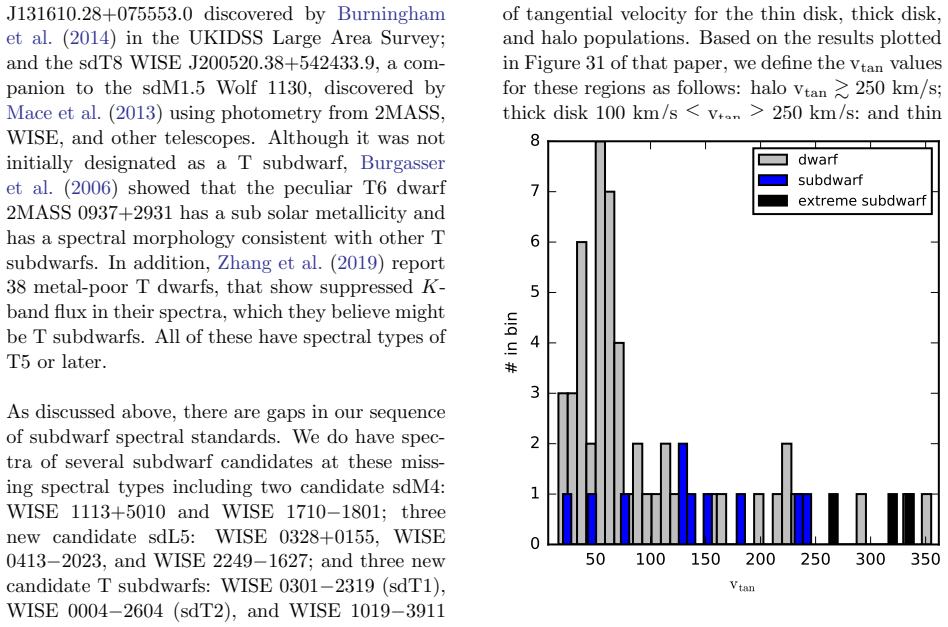
- A direct extension would be to check the three candidate T subdwarfs for parallax and space motion: halo-like kinematics would strengthen the metal-poor interpretation, while thin-disk motion would point to gravity or clouds as the cause of the blue colors.
- If confirmed, these objects could serve as the missing near-infrared subdwarf standards at T1–T3, filling the gap that currently prevents definitive classification of metal-poor T dwarfs.
- The documented overlap between early T and mid-L colors suggests that color-selected surveys may systematically underestimate the nearby T dwarf population, so proper-motion searches with spectroscopic confirmation are a promising route to a more complete local census.
Signed reviews
Editorial analysis
A structured set of objections, weighed in public.
Referee Report
Summary. The paper presents low-resolution near-infrared spectra of 65 proper-motion objects discovered in the NEOWISE/AllWISE survey of Schneider et al. (2016), focusing on candidate nearby objects, late-type brown dwarfs, and subdwarfs. The authors assign spectral types by visual comparison with near-infrared standards and with newly assembled M/L subdwarf standards, compute spectrophotometric distances using published absolute-magnitude relations, and cross-match to Gaia DR2 to validate distances and proper motions. They report 31 new M dwarfs, 18 new L dwarfs, and 11 new T dwarfs, of which 13 are classified as subdwarfs, and they propose three new early-type T subdwarf candidates (sdT1, sdT2, sdT3) that would increase the known number of such objects from two to five if confirmed. Eleven objects are predicted to lie within 25 pc, and three T dwarfs within 15 pc.
Significance. If the classifications hold, the paper adds a substantial sample of nearby low-mass stars and brown dwarfs and, in particular, the three candidate early-type T subdwarfs would be a notable advance for the sparse metal-poor brown dwarf population. The main strengths are the homogeneous SpeX/FIRE/ARCoIRIS data set, the explicit use of subdwarf standards with prior optical spectral types, the independent visual confirmation by two classifiers, and the Gaia cross-check that validates most spectroscopic distances. The paper is transparent about missing subdwarf standards and about the uncertain status of the T subdwarf candidates. The novelty of the paper, however, rests partly on candidate classifications that are not secured against gravity, binarity, or cloud effects, so the significance is conditional on follow-up confirmation or on a suitably softened presentation.
major comments (2)
- [Abstract and §5.3] The three candidate T subdwarfs (WISE 0301−2319, WISE 0004−2604, WISE 1019−3911) are presented in the abstract as increasing the number of early-type T subdwarfs from two to five, but their only diagnostic is blue H/K morphology, and the paper itself states in §5.3 that 'without subdwarf standards at the corresponding spectral types, we cannot be certain at this time.' Low surface gravity, unresolved L+T binarity, or condensate/cloud effects could plausibly produce similar blue near-infrared spectra, and no quantitative diagnostics (e.g., Y-band absorption, H-band peak shape, gravity-sensitive indices, or binary SED fitting) are presented to exclude these alternatives. Because this is the most novel part of the central claim, the authors should either add such diagnostics or move the sdT claim from the abstract into the discussion with a stronger caveat.
- [§4.1 and §5.3] For WISE 2249−1627, prior work classified this object as an L4/T1 binary (Robert et al. 2016), yet the present paper classifies it as a single L5 (blue) and lists it as a candidate sdL5 without discussing the binary interpretation. An unresolved L+T binary can produce suppressed H/K flux through the T component's collision-induced H2 absorption, mimicking the blue morphology used here to identify subdwarf candidates. The authors should explicitly address why the binary scenario is excluded, or remove this object from the sdL5 candidate list and from the associated discussion.
minor comments (6)
- [§2] The target selection counts do not reconcile: the listed category memberships (23 late-type, 21 nearby, 21 subdwarf) minus the 11 objects in multiple categories give 54 unique objects from the Schneider et al. (2016) list, not 53, and the subsequent additions (3 early subdwarf candidates, 7 gap objects, 2 poor-weather M dwarfs) appear to sum to 66 rather than 65. Please clarify the accounting.
- [§5.1] In the list of objects with distances between 25 and 30 pc, 'WISE 0328−5620' does not correspond to any object in Table 3 and appears to be a typo for WISE 0348−5620; the same sentence also calls WISE 0301−2319 'T0 (sl. blue)' whereas Tables 3 and 4 list it as T1 (sl. blue).
- [§5.3 vs Table 4] The text gives the distance of WISE 1019−3911 as 25.1 ± 0.32 pc, while Table 4 lists 23 ± 2.0 pc for the same object; these values should be reconciled.
- [Table 5] For WISE J223444.44−230916.1, the listed W2 magnitude of 16.121 ± 0.085 is inconsistent with W1 = 13.745 ± 0.037 for an L5 dwarf and is likely a typographical error.
- [§4.2] The unresolved 5 pc discrepancy between the spectroscopic distance of WISE 0323−5907 (19 ± 2.1 pc) and the Spitzer parallax distance (14.0 ± 0.84 pc) deserves at least a cautionary note in Table 4, since this object is included in the confident 'within 25 pc' list.
- [Abstract] There is a typo in the abstract: 'discovereies' should be 'discoveries.'
Circularity Check
No significant circularity: the classifications and distances rely on external standards and relations, and the tentative sdT candidates are presented as explicitly uncertain rather than as derived predictions.
full rationale
The paper's central products are spectral classifications and spectroscopic distances for 65 proper-motion discoveries. The spectral typing is done by comparing the new spectra to near-infrared standards from Kirkpatrick et al. (2010) and to the M/L subdwarf standards in Table 2. Those subdwarf standards had previously been assigned optical spectral types in independent references (Gizis 1997; Burgasser et al. 2007; Scholz et al. 2004; Kirkpatrick et al. 2010, etc.), so the classification chain is anchored outside the present paper's own fitted values. Distances are computed from published absolute-magnitude-versus-spectral-type relations (Dupuy & Liu 2012; Zhang et al. 2013, 2017), with Monte Carlo propagation of uncertainties; no distance parameter is fitted to the target objects, and 32 objects are cross-checked against Gaia DR2 parallaxes. The three early-type T subdwarf candidates are the most novel and most uncertain part of the paper, but they are explicitly labeled candidates: the authors state in Section 5.3 that 'without subdwarf standards at the corresponding spectral types, we cannot be certain at this time.' The blue H- and K-band morphology is used as a physical metallicity indicator, which may be wrong or incomplete, but that is a scientific assumption and a caveat, not a circular derivation in which an output is built into an input. The self-citations that occur (Schneider et al. 2016 for target selection, Kirkpatrick et al. 2010 for spectral standards) are prior surveys and standard references with independent content; they do not function as an unverified self-referential justification of the paper's conclusions. No equation or classification step reduces by construction to a fitted parameter or to a self-citation chain, so the circularity score is 0.
Assumptions & free parameters
assumptions (5)
- domain assumption The spectral standards of Kirkpatrick et al. (2010) and the subdwarf standards in Table 2 represent the intrinsic spectral classes assigned to the targets.
- domain assumption The absolute magnitude-spectral type relations of Dupuy & Liu (2012), Zhang et al. (2013), and Zhang et al. (2017) are valid for the observed objects.
- domain assumption A0 V telluric standards and Spextool reduction produce flux-calibrated spectra reliable enough for classification.
- domain assumption The Gaia DR2 cross-matches are correct after propagating proper motions to the Gaia epoch.
- domain assumption Blue near-infrared spectral morphology (suppressed H and K bands) is a reliable metallicity indicator for T dwarfs, even without T-dwarf subdwarf standards.
Cite this review
Pith. "Pith review of Spectroscopic Follow-Up of Discoveries from the NEOWISE Proper Motion Survey." pith.science (2026). https://pith.science/paper/AQGF5QG2
@misc{pith2026190810988,
  author       = {Pith},
  title        = {Pith review of: Spectroscopic Follow-Up of Discoveries from the NEOWISE Proper Motion Survey},
  year         = {2026},
  howpublished = {\url{https://pith.science/paper/AQGF5QG2}},
  note         = {Machine review of arXiv:1908.10988}
}
read the original abstract
We present low-resolution near-infrared spectra of discoveries from an all-sky proper motion search conducted using multi-epoch data from the Wide-field Infrared Survey Explorer. Using the data from NEOWISE, along with the AllWISE catalog, Schneider et al. (2016) conducted an all-sky proper motion survey to search for nearby objects with high proper motions. Here, we present a follow-up spectroscopic survey of 65 of their discoveries, which focused primarily on potentially nearby objects (d < 25 pc), candidate late-type brown dwarfs (>L7), and subdwarf candidates. We found 31 new M dwarfs, 18 new L dwarfs, and 11 new T dwarfs. Of these, 13 are subdwarfs, including one new sdL1 and two new sdL7s. Eleven of these discovereies, with spectral types ranging from M7 to T7 (including one subdwarf) are predicted to be within 25 pc, adding to the number of known objects in the solar neighborhood. We also discovered three new early-type T subdwarf candidates, one sdT1, one sdT2, and one sdT3, which would increase the number of known early-type T subdwarfs from two to five.
Figures


Figures from the paper (6 more)



Reference graph
Works this paper leans on
-
[1]
, " * write output.state after.block = add.period write newline
ENTRY address archivePrefix author booktitle chapter doi edition editor eprint howpublished institution journal key month number organization pages publisher school series title misctitle type volume year version url label extra.label sort.label short.list INTEGERS output.state before.all mid.sentence after.sentence after.block FUNCTION init.state.consts ...
-
[2]
write newline
" write newline "" before.all 'output.state := FUNCTION format.url url empty "" new.block "" url * "" * if FUNCTION format.eprint eprint empty "" archivePrefix empty "" archivePrefix "arXiv" = new.block " " eprint * " " * new.block " " eprint * " " * if if if FUNCTION format.doi doi empty "" " " doi * " " * if FUNCTION format.pid doi empty eprint empty ur...
-
[3]
j?Ar@ D? ϵc6* W?) S S 5G?z?7 'f-Z;o? 'Ͻ [?? ϟϿo ??ch) ? _o[kgױo -3Nskٌɪ1xQ߳q ĦƫZ 7V1 - ZJ`?]ZWp :Lx;wuIkLn--v0G'V!n7K썽xϾ 9Gĺu[zflw R n ζ N B ;qq\ 8얶9G*j阡cb 18 R 糷 / M#⛮VߪPy._
thebibliography [1] 20pt to REFERENCES 6pt =0pt 10pt plus 3pt =0pt =0pt =1pt plus 1pt =0pt =0pt -12pt =13pt plus 1pt =20pt =13pt plus 1pt \@M =10000 =-1.0em =0pt =0pt 0pt =0pt =1.0em @enumiv\@empty 10000 10000 `\.\@m \@noitemerr \@latex@warning Empty `thebibliography' environment \@ifnextchar \@reference \@latexerr Missing key on reference command Each re...
2019
-
[4]
Aganze , C., Burgasser , A. J., Faherty , J. K., et al. 2016, , 151, 46, 10.3847/0004-6256/151/2/46
-
[5]
Allers , K. N., & Liu , M. C. 2013, , 772, 79, 10.1088/0004-637X/772/2/79
-
[6]
Bailer-Jones , C. A. L., Rybizki , J., Fouesneau , M., Mantelet , G., & Andrae , R. 2018, , 156, 58, 10.3847/1538-3881/aacb21
-
[7]
Bastian , N., Covey , K. R., & Meyer , M. R. 2010, , 48, 339, 10.1146/annurev-astro-082708-101642
-
[8]
Best , W. M. J., Liu , M. C., Magnier , E. A., et al. 2015, , 814, 118, 10.1088/0004-637X/814/2/118
Show all 60 references
-
[9]
Burgasser , A. J. 2004, , 155, 191, 10.1086/424386
2004 doi
-
[10]
J., Burrows , A., & Kirkpatrick , J
Burgasser , A. J., Burrows , A., & Kirkpatrick , J. D. 2006, , 639, 1095, 10.1086/499344
2006 doi
-
[11]
J., Cruz , K
Burgasser , A. J., Cruz , K. L., & Kirkpatrick , J. D. 2007, , 657, 494, 10.1086/510148
2007 doi
-
[12]
J., & Kirkpatrick , J
Burgasser , A. J., & Kirkpatrick , J. D. 2006, , 645, 1485, 10.1086/504375
2006 doi
-
[13]
J., McElwain , M
Burgasser , A. J., McElwain , M. W., Kirkpatrick , J. D., et al. 2004, , 127, 2856, 10.1086/383549
2004 doi
-
[14]
J., Witte , S., Helling , C., et al
Burgasser , A. J., Witte , S., Helling , C., et al. 2009, , 697, 148, 10.1088/0004-637X/697/1/148
2009 doi
-
[15]
J., Gillon , M., Melis , C., et al
Burgasser , A. J., Gillon , M., Melis , C., et al. 2015, , 149, 104, 10.1088/0004-6256/149/3/104
2015 doi
-
[16]
V., et al
Burningham , B., Smith , L., Cardoso , C. V., et al. 2014, , 440, 359, 10.1093/mnras/stu184
2014 doi
-
[17]
C., Vacca , W
Cushing , M. C., Vacca , W. D., & Rayner , J. T. 2004, , 116, 362, 10.1086/382907
2004 doi
-
[18]
C., Kirkpatrick , J
Cushing , M. C., Kirkpatrick , J. D., Gelino , C. R., et al. 2011, , 743, 50, 10.1088/0004-637X/743/1/50
2011 doi
-
[19]
Cutri , R. M. e. 2014, VizieR Online Data Catalog, 2328
2014
-
[20]
J., Fattahi , A., Belokurov , V., et al
Deason , A. J., Fattahi , A., Belokurov , V., et al. 2019, , 485, 3514, 10.1093/mnras/stz623
2019 doi
-
[21]
J., & Liu, M
Dupuy, T. J., & Liu, M. C. 2012, The Astrophysical Journal Supplement Series, 201, 19. http://stacks.iop.org/0067-0049/201/i=2/a=19
2012
-
[22]
G., Hora , J
Fazio , G. G., Hora , J. L., Allen , L. E., et al. 2004, The Astrophysical Journal Supplement Series, 154, 10, 10.1086/422843
2004 doi
-
[23]
Gizis , J. E. 1997, , 113, 806, 10.1086/118302
1997 doi
- [24]
-
[25]
J., Jao , W.-C., Winters , J
Henry , T. J., Jao , W.-C., Winters , J. G., et al. 2018, , 155, 265, 10.3847/1538-3881/aac262
2018 doi
-
[26]
D., Metchev , S., Gagn \'e , J., & Faherty , J
Kellogg , K., Kirkpatrick , J. D., Metchev , S., Gagn \'e , J., & Faherty , J. K. 2018, , 155, 87, 10.3847/1538-3881/aaa3f2
2018 doi
-
[27]
D., Looper, D
Kirkpatrick, J. D., Looper, D. L., Burgasser, A. J., et al. 2010, The Astrophysical Journal Supplement Series, 190, 100. http://stacks.iop.org/0067-0049/190/i=1/a=100
2010
-
[28]
D., Gelino , C
Kirkpatrick , J. D., Gelino , C. R., Cushing , M. C., et al. 2012, , 753, 156, 10.1088/0004-637X/753/2/156
2012 doi
-
[29]
D., Schneider , A., Fajardo-Acosta , S., et al
Kirkpatrick , J. D., Schneider , A., Fajardo-Acosta , S., et al. 2014, , 783, 122, 10.1088/0004-637X/783/2/122
2014 doi
-
[30]
D., Kellogg , K., Schneider , A
Kirkpatrick , J. D., Kellogg , K., Schneider , A. C., et al. 2016, The Astrophysical Journal Supplement Series, 224, 36, 10.3847/0067-0049/224/2/36
2016 doi
-
[31]
D., Martin , E
Kirkpatrick , J. D., Martin , E. C., Smart , R. L., et al. 2019, , 240, 19, 10.3847/1538-4365/aaf6af
2019 doi
-
[32]
Luhman , K. L. 2013, , 767, L1, 10.1088/2041-8205/767/1/L1
2013 doi
-
[33]
2014 a , , 786, L18, 10.1088/2041-8205/786/2/L18
---. 2014 a , , 786, L18, 10.1088/2041-8205/786/2/L18
2014 doi
-
[34]
2014 b , The Astrophysical Journal, 781, 4
---. 2014 b , The Astrophysical Journal, 781, 4. http://stacks.iop.org/0004-637X/781/i=1/a=4
2014
-
[35]
L., & Sheppard, S
Luhman, K. L., & Sheppard, S. S. 2014, The Astrophysical Journal, 787, 126. http://stacks.iop.org/0004-637X/787/i=2/a=126
2014
-
[36]
L., & Sheppard , S
Luhman , K. L., & Sheppard , S. S. 2014, , 787, 126, 10.1088/0004-637X/787/2/126
2014 doi
-
[37]
N., Kirkpatrick , J
Mace , G. N., Kirkpatrick , J. D., Cushing , M. C., et al. 2013, , 777, 36, 10.1088/0004-637X/777/1/36
2013 doi
-
[38]
2011, , 731, 53, 10.1088/0004-637X/731/1/53
Mainzer , A., Bauer , J., Grav , T., et al. 2011, , 731, 53, 10.1088/0004-637X/731/1/53
2011 doi
-
[39]
M., et al
Mainzer , A., Bauer , J., Cutri , R. M., et al. 2014, , 792, 30, 10.1088/0004-637X/792/1/30
2014 doi
-
[40]
E., Barenfeld , S
Mamajek , E. E., Barenfeld , S. A., Ivanov , V. D., et al. 2015, , 800, L17, 10.1088/2041-8205/800/1/L17
2015 doi
-
[41]
N., Burningham , B., Jones , H
Murray , D. N., Burningham , B., Jones , H. R. A., et al. 2011, , 414, 575, 10.1111/j.1365-2966.2011.18424.x
2011
-
[42]
T., Toomey , D
Rayner , J. T., Toomey , D. W., Onaka , P. M., et al. 2003, , 115, 362, 10.1086/367745
2003 doi
- [43]
-
[44]
E., & Samaddar , D
Riaz , B., Gizis , J. E., & Samaddar , D. 2008, , 672, 1153, 10.1086/523931
2008 doi
-
[45]
L., Faherty , J
Rice , E. L., Faherty , J. K., Cruz , K., et al. 2011, in Astronomical Society of the Pacific Conference Series, Vol. 448, 16th Cambridge Workshop on Cool Stars, Stellar Systems, and the Sun, ed. C. Johns-Krull , M. K. Browning , & A. A. West , 481. 1101.4231
2011 arXiv
-
[46]
2016, , 830, 144, 10.3847/0004-637X/830/2/144
Robert , J., Gagn \'e , J., Artigau , \'E ., et al. 2016, , 830, 144, 10.3847/0004-637X/830/2/144
2016 doi
- [47]
-
[48]
C., Greco , J., Cushing , M
Schneider , A. C., Greco , J., Cushing , M. C., et al. 2016, , 817, 112, 10.3847/0004-637X/817/2/112
2016 doi
-
[49]
2014, , 561, A113, 10.1051/0004-6361/201323015
Scholz , R.-D. 2014, , 561, A113, 10.1051/0004-6361/201323015
2014 doi
-
[50]
2004, , 425, 519, 10.1051/0004-6361:20041059
Scholz , R.-D., Lehmann , I., Matute , I., & Zinnecker , H. 2004, , 425, 519, 10.1051/0004-6361:20041059
2004 doi
-
[51]
Schweitzer , A., Scholz , R.-D., Stauffer , J., Irwin , M., & McCaughrean , M. J. 1999, , 350, L62
1999
-
[52]
A., Burgasser , A
Simcoe , R. A., Burgasser , A. J., Schechter , P. L., et al. 2013, , 125, 270, 10.1086/670241
2013 doi
-
[53]
G., Kirkpatrick , J
Tinney , C. G., Kirkpatrick , J. D., Faherty , J. K., et al. 2018, The Astrophysical Journal Supplement Series, 236, 28, 10.3847/1538-4365/aabad3
2018 doi
-
[54]
D., Cushing , M
Vacca , W. D., Cushing , M. C., & Rayner , J. T. 2003, , 115, 389, 10.1086/346193
2003 doi
-
[55]
W., Roellig , T
Werner , M. W., Roellig , T. L., Low , F. J., et al. 2004, , 154, 1, 10.1086/422992
2004 doi
-
[56]
L., Eisenhardt , P
Wright , E. L., Eisenhardt , P. R. M., Mainzer , A. K., et al. 2010, , 140, 1868, 10.1088/0004-6256/140/6/1868
2010 doi
-
[57]
H., Burgasser , A
Zhang , Z. H., Burgasser , A. J., G \'a lvez-Ortiz , M. C., et al. 2019, , 735, 10.1093/mnras/stz777
2019 doi
-
[58]
H., Pinfield , D
Zhang , Z. H., Pinfield , D. J., Burningham , B., et al. 2013, , 434, 1005, 10.1093/mnras/stt1030
2013 doi
-
[59]
H., Pinfield , D
Zhang , Z. H., Pinfield , D. J., G \'a lvez-Ortiz , M. C., et al. 2017, , 464, 3040, 10.1093/mnras/stw2438
2017 doi
-
[60]
H., Galvez-Ortiz , M
Zhang , Z. H., Galvez-Ortiz , M. C., Pinfield , D. J., et al. 2018, , 480, 5447, 10.1093/mnras/sty2054
2018 doi
Reviewed August 14, 2026 · model on record in the stance chip above.
Discussion (0). Continue with ORCID to comment.