Bridging CAD and Data-Driven Design: Attributed Feature Graphs for Engineering Design
Pith reviewed 2026-06-27 22:53 UTC · model grok-4.3
The pith
Attributed Feature Graphs allow graph neural networks to learn from CAD designs while preserving parametric editability and interpretability.
A machine-rendered reading of the paper's core claim, the machinery that carries it, and where it could break.
Core claim
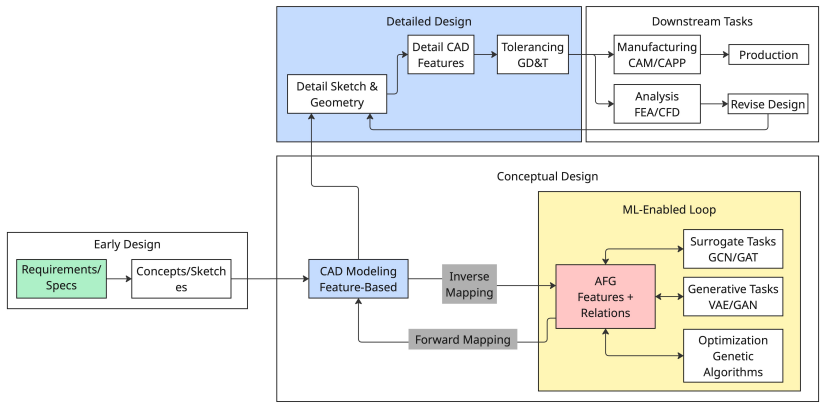
Attributed Feature Graphs (AFGs) represent designs by treating CAD features as nodes and their geometric or dependency relations as directed edges. This structure preserves design intent and parametric information, making it compatible with graph-based learning. When used with a Graph Neural Network on the CarHoods10K dataset, the model predicts performance metrics competitively while permitting mapping of results back to specific features for interpretation and enabling reevaluation after CAD edits.
What carries the argument
Attributed Feature Graphs (AFGs), a representation where CAD design features are nodes and geometric or dependency relations are directed edges, carrying parametric structure into graph learning.
If this is right
- Engineers can use the trained GNN as a fast evaluation engine during design iteration.
- Performance predictions can be attributed to individual design features for better understanding.
- Changes made to the CAD model can be directly reflected in the graph and reevaluated without additional preprocessing.
- The approach maintains compatibility with standard GNN methods while retaining feature-level semantics.
Where Pith is reading between the lines
- AFGs might extend to optimization loops where feature parameters are adjusted based on model gradients.
- Similar feature-graph approaches could apply to other simulation-heavy fields like structural analysis beyond automotive parts.
- By avoiding mesh conversion, this could lower computational overhead in design exploration compared to traditional geometric deep learning.
Load-bearing premise
That the information in the attributed feature graph from native CAD features is sufficient for a GNN to achieve accurate performance predictions without losing key details compared to direct geometric representations.
What would settle it
If a GNN trained on AFGs from the CarHoods10K dataset produces substantially less accurate predictions of hood performance metrics than equivalent models using voxel or mesh inputs, the claim of sufficient information retention would be falsified.
Figures
read the original abstract
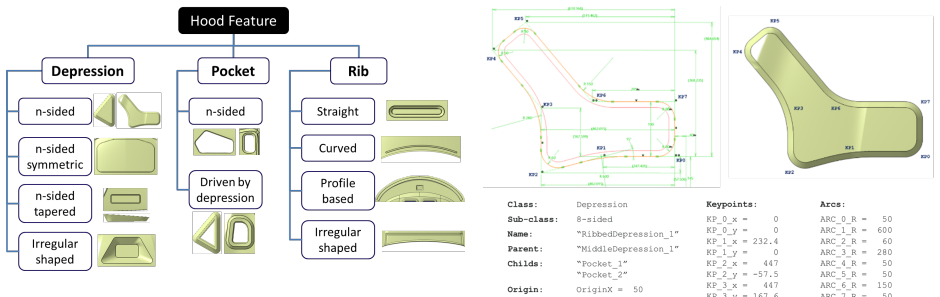
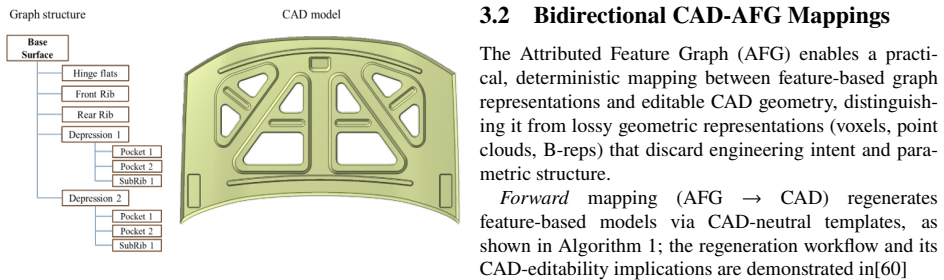
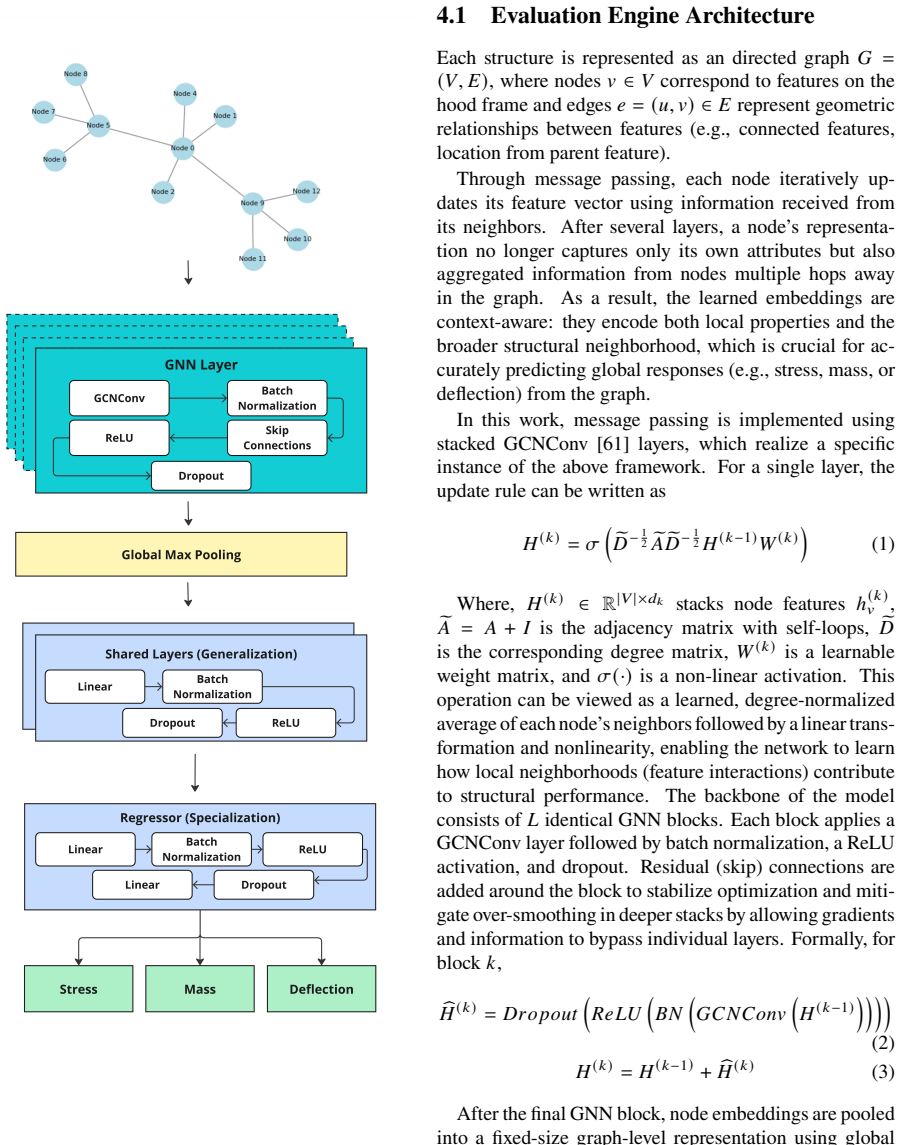
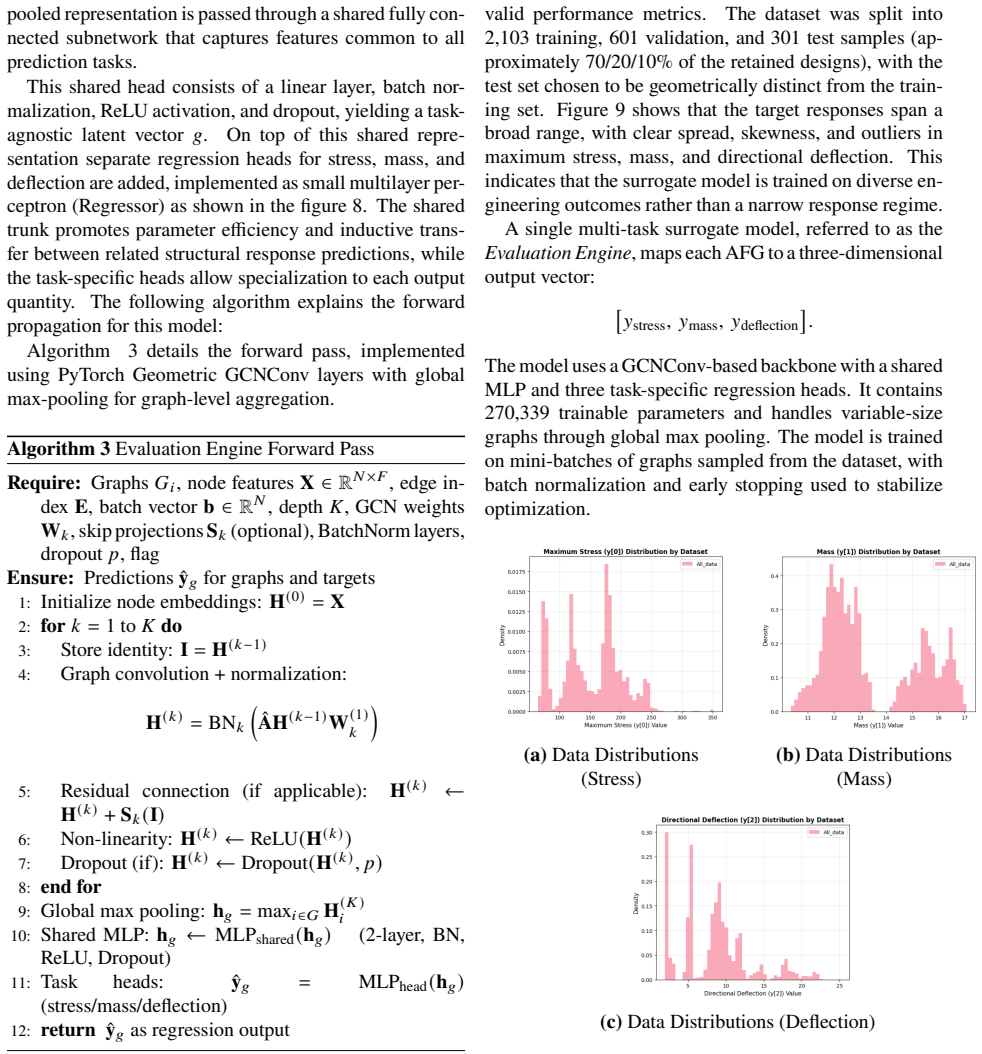
Engineering design is an iterative, simulation-driven process where traditional workflows rely heavily on computationally expensive analyses such as finite element and computational fluid dynamics. Although data-driven methods have accelerated design evaluation and optimization, most existing geometric representations discard parametric and feature-level semantics, limiting their integration with CAD-driven design workflows and reducing model interpretability. To address this gap, this work introduces Attributed Feature Graphs (AFGs), a feature-based representation that encodes design features, such as extrusions, ribs, and pockets, as nodes and their geometric or dependency relations as directed edges. AFGs preserve design intent and parametric structure while remaining compatible with standard graph-based learning methods, enabling end-to-end learning directly on CAD-derived feature graphs. The paper demonstrates the proposed representation through a surrogate-modeling case study on the CarHoods10K automotive hood frame dataset, where a Graph Neural Network (GNN) is trained as an evaluation engine to predict performance metrics from AFG inputs. The learned model achieves competitive surrogate performance compared with traditional data-driven approaches, but with the added benefit that engineers can map predictions back to specific CAD features and interpret how individual design elements influence system behavior. Furthermore, because AFGs are built from native CAD features, engineers can directly edit the underlying geometry in the CAD environment and reevaluate the design through the same learned model.
Editorial analysis
A structured set of objections, weighed in public.
Referee Report
Summary. The paper proposes Attributed Feature Graphs (AFGs) to represent engineering designs by encoding CAD features (e.g., extrusions, ribs, pockets) as nodes and their geometric or dependency relations as directed edges. It applies Graph Neural Networks to AFGs derived from the CarHoods10K automotive hood frame dataset to train a surrogate model predicting performance metrics, claiming competitive accuracy relative to traditional data-driven approaches together with improved interpretability (mapping predictions back to specific CAD features) and direct compatibility with CAD editing workflows.
Significance. If the central empirical claim holds, the work would provide a practical bridge between native CAD representations and graph-based machine learning, enabling interpretable, end-to-end surrogate modeling that preserves design intent and supports iterative CAD-driven optimization without requiring conversion to mesh or B-rep formats.
major comments (2)
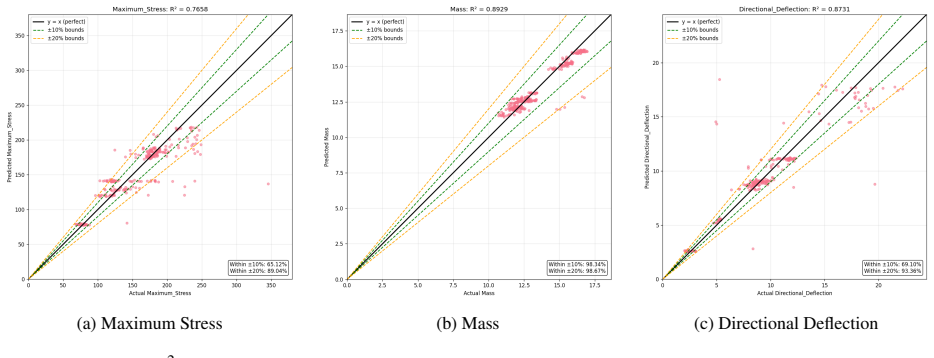
- [Abstract] Abstract: the assertion that the GNN 'achieves competitive surrogate performance' supplies no quantitative metrics (MAE, RMSE, R², etc.), no baseline comparisons (mesh-based, point-cloud, or B-rep surrogates), no error bars, and no statistical tests, so it is impossible to evaluate whether AFGs incur material geometric information loss on CarHoods10K as required by the central claim.
- [Abstract] Abstract: the description of AFG construction and the subsequent GNN training provides no information on node/edge attribute definitions, GNN architecture, loss function, training procedure, or data splits, all of which are load-bearing for assessing whether the reported performance is reproducible or actually competitive.
minor comments (1)
- The abstract would be strengthened by a single sentence stating the concrete performance numbers and the exact baselines used, even if full tables appear later in the manuscript.
Simulated Author's Rebuttal
We thank the referee for these precise observations on the abstract. Both comments correctly identify that the current abstract is insufficiently quantitative and lacks key methodological specifics, which limits evaluation of the central claims. We will revise the abstract to incorporate the requested information while preserving its brevity.
read point-by-point responses
-
Referee: [Abstract] Abstract: the assertion that the GNN 'achieves competitive surrogate performance' supplies no quantitative metrics (MAE, RMSE, R², etc.), no baseline comparisons (mesh-based, point-cloud, or B-rep surrogates), no error bars, and no statistical tests, so it is impossible to evaluate whether AFGs incur material geometric information loss on CarHoods10K as required by the central claim.
Authors: We agree that the abstract must supply concrete metrics to substantiate the claim. In the revision we will insert the key performance numbers (MAE, RMSE, R²) obtained on the CarHoods10K test set, together with the corresponding baseline results, error bars, and a brief statement on statistical significance. These values are already computed and reported in Section 4; the abstract will now summarize them explicitly. revision: yes
-
Referee: [Abstract] Abstract: the description of AFG construction and the subsequent GNN training provides no information on node/edge attribute definitions, GNN architecture, loss function, training procedure, or data splits, all of which are load-bearing for assessing whether the reported performance is reproducible or actually competitive.
Authors: We accept that the abstract omits these details. The full specifications appear in Sections 3.2 (AFG node/edge attributes), 4.1 (GNN architecture), 4.2 (loss and optimizer), 4.3 (training procedure), and 4.4 (data splits). For the revised abstract we will add a concise clause summarizing the attribute definitions, the GNN type and depth, the loss function, and the train/validation/test split ratios, thereby making the abstract self-contained for reproducibility assessment. revision: yes
Circularity Check
No significant circularity; AFG definition and GNN surrogate are independent constructions
full rationale
The paper defines Attributed Feature Graphs (AFGs) by encoding native CAD features (extrusions, ribs, pockets) as nodes with geometric/dependency edges, then applies standard GNNs for surrogate prediction on CarHoods10K. This is a representational choice followed by empirical evaluation, with no equations, fitted parameters, or self-citations that reduce any claimed prediction or uniqueness result back to the paper's own inputs by construction. The abstract and description contain no load-bearing self-references or ansatzes smuggled via citation; performance is asserted via experiment rather than tautology. This matches the default non-circular outcome.
Axiom & Free-Parameter Ledger
axioms (1)
- domain assumption Graph neural networks can learn mappings from attributed feature graphs to engineering performance metrics.
invented entities (1)
-
Attributed Feature Graph (AFG)
no independent evidence
Reference graph
Works this paper leans on
-
[1]
Single-view 3d reconstruction: A sur- vey of deep learning methods
George Fahim, Khalid Amin, and Sameh Zarif. Single-view 3d reconstruction: A sur- vey of deep learning methods. 94:164–190. ISSN 0097-8493. doi: 10.1016/j.cag.2020.12
-
[2]
URLhttps://www.sciencedirect.com/ science/article/pii/S0097849320301849
-
[3]
Pranav Milind Khanolkar, Ademir Vrolijk, and Alison Olechowski. Mapping artificial intelligence- based methods to engineering design stages: a focused literature review. 37:e25. ISSN 0890-0604, 1469-1760. doi: 10.1017/S0890060423000203. URLhttps://www.cambridge.org/core/ product/identifier/S0890060423000203/ type/journal_article
-
[4]
Camba, Manuel Contero, and Pedro Com- pany
Jorge D. Camba, Manuel Contero, and Pedro Com- pany. Parametric CAD modeling: An analy- sis of strategies for design reusability. 74:18–
-
[5]
ISSN 00104485. doi: 10.1016/j.cad.2016. 01.003. URLhttps://linkinghub.elsevier. com/retrieve/pii/S0010448516000051
-
[6]
A study on the extraction of geo- metrical parameters from flexible mechanical com- ponents and assemblies and their impact on per- formance: A machine learning approach
Prakash Kumar. A study on the extraction of geo- metrical parameters from flexible mechanical com- ponents and assemblies and their impact on per- formance: A machine learning approach. URL https://keep.lib.asu.edu/items/195239
-
[9]
De- veloping multi-modal machine learning model for predicting performance of automotive hood frames
Abhishek Indupally and Satchit Ramnath. De- veloping multi-modal machine learning model for predicting performance of automotive hood frames. American Society of Mechanical En- gineers Digital Collection. doi: 10.1115/ DETC2025-168841. URLhttps://dx.doi.org/ 10.1115/DETC2025-168841
-
[10]
A graph neural network approach for product rela- tionship prediction
Faez Ahmed, Yaxin Cui, Yan Fu, and Wei Chen. A graph neural network approach for product rela- tionship prediction. American Society of Mechan- ical Engineers Digital Collection. doi: 10.1115/ DETC2021-69462. URLhttps://dx.doi.org/ 10.1115/DETC2021-69462
-
[11]
SwapnilNagnathMahajan,KarthikKrishnaM.,and Ramanathan Muthuganapathy. OrthoCAD-322k: A cross-modal approach for retrieving 3d CAD mod- els from orthographic views using a graph-based framework on a developed large-scale dataset. 132: 104357. ISSN 00978493. doi: 10.1016/j.cag.2025. 104357. URLhttps://linkinghub.elsevier. com/retrieve/pii/S0097849325001980
-
[12]
GraphBRep: Explicit graph diffusion of b–rep topology for efficient CAD generation
Weilin Lai, Tie Xu, Ben Niu, and Hu Wang. GraphBRep: Explicit graph diffusion of b–rep topology for efficient CAD generation. 13(1): 259–274. ISSN 2288-5048. doi: 10.1093/jcde/ qwaf136. URLhttps://academic.oup.com/ jcde/article/13/1/259/8381229
-
[13]
BrepGPT: Au- toregressive b-rep generation with voronoi half- patch
Pu Li, Wenhao Zhang, Weize Quan, Biao Zhang, Peter Wonka, and Dongming Yan. BrepGPT: Au- toregressive b-rep generation with voronoi half- patch. 44(6):226:1–226:18, . ISSN 0730-0301. doi: 10.1145/3763323. URLhttps://dl.acm. org/doi/10.1145/3763323
-
[14]
Nor- malNet: A voxel-based CNN for 3d ob- ject classification and retrieval
Cheng Wang, Ming Cheng, Ferdous Sohel, Mo- hammed Bennamoun, and Jonathan Li. Nor- malNet: A voxel-based CNN for 3d ob- ject classification and retrieval. 323:139–147. ISSN 09252312. doi: 10.1016/j.neucom.2018. 09.075. URLhttps://linkinghub.elsevier. com/retrieve/pii/S0925231218311561
-
[15]
VoxNet: A 3d convolutional neural network for real-time object recognition
Daniel Maturana and Sebastian Scherer. VoxNet: A 3d convolutional neural network for real-time object recognition. In2015 IEEE/RSJ International Con- ference on Intelligent Robots and Systems (IROS), pages 922–928. IEEE. ISBN 978-1-4799-9994-1. doi: 10.1109/IROS.2015.7353481. URLhttp: //ieeexplore.ieee.org/document/7353481/
-
[16]
Shah, Duane Detwiler, and Stefan Menzel
Patricia Wollstadt, Mariusz Bujny, Satchit Ram- nath, Jami J. Shah, Duane Detwiler, and Stefan Menzel. CarHoods10k: An industry-grade data 15 set for representation learning and design opti- mization in engineering applications. 26(6):1221–
-
[17]
doi: 10.1109/TEVC.2022.3147013
ISSN 1089-778X, 1089-778X, 1941-0026. doi: 10.1109/TEVC.2022.3147013. URLhttps: //ieeexplore.ieee.org/document/9696004/
-
[18]
Dryad | data: OSU-honda automobile hood dataset (CarHoods10k),.URLhttps://datadryad.org/ dataset/doi:10.5061/dryad.2fqz612pt
-
[19]
PradeepKumarJayaraman,AdityaSanghi,JosephG. Lambourne, Karl D. D. Willis, Thomas Davies, Hooman Shayani, and Nigel Morris. UV-net: Learning from boundary representations. In2021 IEEE/CVF Conference on Computer Vision and Pattern Recognition (CVPR), pages 11698–11707. IEEE, . ISBN 978-1-6654-4509-2. doi: 10. 1109/CVPR46437.2021.01153. URLhttps:// ieeexplor...
arXiv 2021
-
[20]
Pradeep Kumar Jayaraman, Joseph George Lam- bourne, Nishkrit Desai, Karl Willis, Aditya Sanghi, and Nigel J. W. Morris. SolidGen: An autoregres- sive model for direct b-rep synthesis. . ISSN 2835-
-
[21]
URLhttps://openreview.net/forum? id=ZR2CDgADRo
-
[22]
Lambourne, Pradeep Kumar Jayaraman,ZhengqingWang,KarlD.D.Willis,and Yasutaka Furukawa
Xiang Xu, Joseph G. Lambourne, Pradeep Kumar Jayaraman,ZhengqingWang,KarlD.D.Willis,and Yasutaka Furukawa. BrepGen: A b-rep generative diffusion model with structured latent geometry, . URLhttp://arxiv.org/abs/2401.15563
-
[23]
Amin Heyrani Nobari, Justin Rey, Suhas Kodali, Matthew Jones, and Faez Ahmed. MeshPointNet: 3d surface classification using graph neural net- worksandconformalpredictionsonmesh-basedrep- resentations. 146(51712). ISSN 1050-0472. doi: 10.1115/1.4064673. URLhttps://doi.org/10. 1115/1.4064673
-
[24]
A hybrid GNN approach for predicting node data for 3d meshes
Shwetha Salimath, Francesca Bugiotti, and Frederic Magoules. A hybrid GNN approach for predicting node data for 3d meshes. URLhttp://arxiv. org/abs/2310.14707
-
[25]
MeshCNN: A network with an edge
Rana Hanocka, Amir Hertz, Noa Fish, Raja Giryes, Shachar Fleishman, and Daniel Cohen- Or. MeshCNN: A network with an edge. 38 (4):1–12. ISSN 0730-0301, 1557-7368. doi: 10.1145/3306346.3322959. URLhttp://arxiv. org/abs/1809.05910
-
[26]
Yawar Siddiqui, Antonio Alliegro, Alexey Artemov, TatianaTommasi,DanieleSirigatti,VladislavRosov, AngelaDai, andMatthiasNießner. MeshGPT:Gen- erating triangle meshes with decoder-only trans- formers. In2024 IEEE/CVF Conference on Com- puterVisionandPatternRecognition(CVPR),pages 19615–19625.IEEE.ISBN979-8-3503-5300-6.doi: 10.1109/CVPR52733.2024.01855. URL...
-
[27]
R.QiCharles,HaoSu,MoKaichun,andLeonidasJ. Guibas. PointNet: Deeplearningonpointsetsfor3d classification and segmentation. In2017 IEEE Con- ferenceonComputerVisionandPatternRecognition (CVPR), pages 77–85. IEEE. ISBN 978-1-5386- 0457-1. doi: 10.1109/CVPR.2017.16. URLhttp: //ieeexplore.ieee.org/document/8099499/
-
[28]
Mesh-drivenresamplingandregularizationfor robust point cloud-based flow analysis directly on scanned objects
Monu Jaiswal, Ashton M Corpuz, and Ming-Chen Hsu. Mesh-drivenresamplingandregularizationfor robust point cloud-based flow analysis directly on scanned objects
-
[29]
Xiaofang Liu, Zhichao Wang, Shreyes N. Melkote, and David W. Rosen. Manufacturing pro- cess identification from 3d point cloud mod- els using semantic segmentation. 82:858–873, . ISSN 02786125. doi: 10.1016/j.jmsy.2025. 07.023. URLhttps://linkinghub.elsevier. com/retrieve/pii/S0278612525001980
-
[30]
Chapman, Dongpu Cao, and Jonathan Li
Ying Li, Lingfei Ma, Zilong Zhong, Fei Liu, Michael A. Chapman, Dongpu Cao, and Jonathan Li. Deep learning for LiDAR point clouds in au- tonomous driving: A review. 32(8):3412–3432, . ISSN 2162-2388. doi: 10.1109/TNNLS.2020. 3015992.URLhttps://ieeexplore.ieee.org/ document/9173706/
-
[31]
Xuanchi Ren, Jiahui Huang, Xiaohui Zeng, Ken Museth,SanjaFidler,andFrancisWilliams. XCube: Large-scale 3d generative modeling using sparse voxel hierarchies. In2024 IEEE/CVF Confer- ence on Computer Vision and Pattern Recogni- tion (CVPR), pages 4209–4219. IEEE. ISBN 979- 8-3503-5300-6. doi: 10.1109/CVPR52733.2024. 00403. URLhttps://ieeexplore.ieee.org/ d...
-
[32]
A history-based parametric CAD sketch dataset with advanced engineering commands
Rubin Fan, Fazhi He, Yuxin Liu, and Jing Lin. A history-based parametric CAD sketch dataset with advanced engineering commands. 182:103848. ISSN 0010-4485. doi: 10.1016/j.cad.2025.103848. URLhttps://www.sciencedirect.com/ science/article/pii/S0010448525000107
-
[33]
AI-based knowl- edge extraction for automatic design proposals using design-related patterns
Carmen Krahe, Maksym Kalaidov, Markus Doel- lken, Thomas Gwosch, Andreas Kuhnle, Gisela 16 Lanza, and Sven Matthiesen. AI-based knowl- edge extraction for automatic design proposals using design-related patterns. 100:397–402, . ISSN 22128271. doi: 10.1016/j.procir.2021.05
-
[34]
com/retrieve/pii/S2212827121005618
URLhttps://linkinghub.elsevier. com/retrieve/pii/S2212827121005618
-
[35]
URL https://www.ntop.com/resources/blog/ implicit-modeling-for-mechanical-design/
Implicit modeling for engineering design, . URL https://www.ntop.com/resources/blog/ implicit-modeling-for-mechanical-design/
-
[36]
URL https://altair.com/blog/articles/ let-s-talk-about-implicit-modeling
Let’s talk about implicit modeling, . URL https://altair.com/blog/articles/ let-s-talk-about-implicit-modeling
-
[37]
DeepSDF: Learning continuous signed distance functions for shape representation
Jeong Joon Park, Peter Florence, Julian Straub, Richard Newcombe, and Steven Lovegrove. DeepSDF: Learning continuous signed distance functions for shape representation. URLhttp: //arxiv.org/abs/1901.05103
Pith/arXiv arXiv 1901
-
[38]
Mechanics simulation with implicit neural repre- sentations of complex geometries
Samundra Karki, Ming-Chen Hsu, Adarsh Kr- ishnamurthy, and Baskar Ganapathysubramanian. Mechanics simulation with implicit neural repre- sentations of complex geometries. 190:103978, . ISSN 00104485. doi: 10.1016/j.cad.2025. 103978. URLhttps://linkinghub.elsevier. com/retrieve/pii/S0010448525001393
-
[39]
Point2cad: Reverse engi- neering CAD models from 3d point clouds
Yujia Liu, Anton Obukhov, Jan Dirk Wegner, and Konrad Schindler. Point2cad: Reverse engi- neering CAD models from 3d point clouds. In 2024 IEEE/CVF Conference on Computer Vision and Pattern Recognition (CVPR), pages 3763–
2024
-
[40]
IEEE, . ISBN 979-8-3503-5300-6. doi: 10.1109/CVPR52733.2024.00361. URLhttps:// ieeexplore.ieee.org/document/10657440/
-
[41]
Fuyang Zhang, Pradeep Kumar Jayaraman, Xiang Xu, and Yasutaka Furukawa. B-rep distance func- tions (BR-DF): How to represent a b-rep model by volumetric distance functions?, . URLhttp: //arxiv.org/abs/2511.14870
-
[42]
Subeesh Vasu, Nicolas Talabot, Artem Lukoianov, Pierre Baqué, Jonathan Donier, and Pascal Fua. HybridSDF: Combining deep implicit shapes and geometric primitives for 3d shape representation and manipulation. In2022 In- ternational Conference on 3D Vision (3DV), pages 617–626. doi: 10.1109/3DV57658.2022. 00072. URLhttps://ieeexplore.ieee.org/ document/1004...
-
[43]
Reviewofresearchinfeature-based design
OWSalomons. Reviewofresearchinfeature-based design. 12(2)
-
[44]
Shah and Martti Mantyla.Parametric and Feature Based CAD/Cam: Concepts, Techniques, and Applications
Jami J. Shah and Martti Mantyla.Parametric and Feature Based CAD/Cam: Concepts, Techniques, and Applications. John Wiley & Sons, Inc., 1st edi- tion. ISBN 978-0-471-00214-7
-
[45]
A scheme to represent features, dimensions, and tolerances in ge- ometric modeling
Nanxin Wang and Tulga M Ozsoy. A scheme to represent features, dimensions, and tolerances in ge- ometric modeling. 10(3)
-
[46]
Feature- based simplification of boundary representa- tion models using sequential iterative volume decomposition
Byung Chul Kim and Duhwan Mun. Feature- based simplification of boundary representa- tion models using sequential iterative volume decomposition. 38:97–107. ISSN 0097-
-
[47]
URL https://www.sciencedirect.com/science/ article/pii/S0097849313001726
doi: 10.1016/j.cag.2013.10.031. URL https://www.sciencedirect.com/science/ article/pii/S0097849313001726
-
[48]
An implicit surface poly- gonizer
Jules Bloomenthal. An implicit surface poly- gonizer. InGraphics Gems, pages 324–
-
[49]
Elsevier. ISBN 978-0-12-336156-1. doi: 10.1016/B978-0-12-336156-1.50040-9. URLhttps://linkinghub.elsevier.com/ retrieve/pii/B9780123361561500409
-
[50]
Bloomenthal and B
J. Bloomenthal and B. Wyvill. In- troduction to implicit surfaces. URL https://www.semanticscholar.org/paper/ Introduction-to-Implicit-Surfaces-Bloomenthal-Wyvill/ 985c64b1b2dad262ba05ad88c6769bd68cf3fcbc
-
[51]
Neu- ral implicit representations for multi-view surface reconstruction: A survey
Xinyun Zhang, Ruiqi Yu, and Shuang Ren. Neu- ral implicit representations for multi-view surface reconstruction: A survey. 31(10):9444–9463, . ISSN 1941-0506. doi: 10.1109/TVCG.2025. 3582627.URLhttps://ieeexplore.ieee.org/ document/11051009/
-
[52]
C.M. Grimm. Simple manifolds for surface mod- eling and parameterization. InProceedings SMI. ShapeModelingInternational2002,pages237–277. doi: 10.1109/SMI.2002.1003551. URLhttps: //ieeexplore.ieee.org/document/1003551/
-
[53]
Neural implicit representations for engineering design - ProQuest
Jaya Manideep Rebbagondla. Neural implicit representations for engineering design - ProQuest. URLhttps://www.proquest.com/docview/ 3132852644?%20Theses&fromopenview= true&pq-origsite=gscholar&sourcetype= Dissertations%20
-
[54]
Direct flow simulations with implicit neural rep- resentation of complex geometry
Samundra Karki, Mehdi Shadkhah, Cheng-Hau Yang, Aditya Balu, Guglielmo Scovazzi, Adarsh Krishnamurthy, andBaskarGanapathysubramanian. Direct flow simulations with implicit neural rep- resentation of complex geometry. 446:118248, . ISSN 00457825. doi: 10.1016/j.cma.2025. 118248. URLhttps://linkinghub.elsevier. com/retrieve/pii/S0045782525005201. 17
-
[55]
Implicit geometry neural net- work for mesh generation
Ran Xu, Hongqiang Lyu, Jian Yu, Chenyu Bao, Hongfei Wang, Yufei Liu, and Xue- jun Liu. Implicit geometry neural net- work for mesh generation. 38(4):103315, . ISSN 1000-9361. doi: 10.1016/j.cja.2024.11
-
[56]
URLhttps://www.sciencedirect.com/ science/article/pii/S1000936124004692
-
[57]
Local deep im- plicit functions for 3d shape
Kyle Genova, Forrester Cole, Avneesh Sud, Aaron Sarna, and Thomas Funkhouser. Local deep im- plicit functions for 3d shape. In2020 IEEE/CVF Conference on Computer Vision and Pattern Recog- nition (CVPR), pages 4856–4865. IEEE. ISBN 978- 1-7281-7168-5. doi: 10.1109/CVPR42600.2020. 00491. URLhttps://ieeexplore.ieee.org/ document/9157823/
-
[58]
Neural sparse voxel fields.InAdvancesinNeuralInformationProcessing Systems, volume 33, pages 15651–15663
Lingjie Liu, Jiatao Gu, Kyaw Zaw Lin, Tat-Seng Chua, and Christian Theobalt. Neural sparse voxel fields.InAdvancesinNeuralInformationProcessing Systems, volume 33, pages 15651–15663. Curran Associates, Inc., . URLhttps://proceedings. neurips.cc/paper_files/paper/2020/hash/ b4b758962f17808746e9bb832a6fa4b8-Abstract. html
2020
-
[59]
Special issue: Artificial intelligence and engi- neering design. 144(2):020301. ISSN 1050- 0472, 1528-9001. doi: 10.1115/1.4053111. URLhttps://asmedigitalcollection. asme.org/mechanicaldesign/ article/144/2/020301/1128870/ Special-Issue-Artificial-Intelligence-and
-
[60]
Review of artificial intelligence applications in engineering design perspective
Nurullah Yüksel, Hüseyin Rıza Börklü, Hüseyin Kürşad Sezer, and Olcay Ersel Canyurt. Review of artificial intelligence applications in engineering design perspective. 118:105697. ISSN 09521976. doi: 10.1016/j.engappai.2022.105697. URLhttps://linkinghub.elsevier.com/ retrieve/pii/S095219762200687X
-
[61]
URLhttp://arxiv.org/abs/2511.20730
Nehal Afifi, Christoph Wittig, Lukas Paehler, An- dreas Lindenmann, Kai Wolter, Felix Leitenberger, Melih Dogru, Patric Grauberger, Tobias Düser, Al- bertAlbers,andSvenMatthiesen.Data-drivenmeth- odsandAIinengineeringdesign: Asystematicliter- ature review focusing on challenges and opportuni- ties. URLhttp://arxiv.org/abs/2511.20730
-
[62]
Deep learning in computational design synthesis: A comprehensive review
Shubhendu Kumar Singh, Rahul Rai, Raj Pradip Khawale, Darshil Patel, Dustin Bielecki, Ryan Nguyen, Jun Wang, and Zhibo Zhang. Deep learning in computational design synthesis: A comprehensive review. 24(4):040801. ISSN 1530-9827, 1944-7078. doi: 10.1115/1.4064215. URLhttps://asmedigitalcollection. asme.org/computingengineering/ article/24/4/040801/1179741/...
-
[63]
Carmen Krahe, Maximilian Iberl, Alexander Jacob, and Gisela Lanza. AI-based com- puter aided engineering for automated prod- uct design - a first approach with a multi- view based classification. 86:104–109, . ISSN 22128271. doi: 10.1016/j.procir.2020.01
-
[64]
com/retrieve/pii/S2212827120300524
URLhttps://linkinghub.elsevier. com/retrieve/pii/S2212827120300524
-
[65]
Deep genera- tive model for efficient 3d airfoil parameterization and generation
Wei Chen and Arun Ramamurthy. Deep genera- tive model for efficient 3d airfoil parameterization and generation. InAIAA Scitech 2021 Forum. doi: 10.2514/6.2021-1690. URLhttp://arxiv.org/ abs/2101.02744
-
[66]
Data- driven methods for stress field predictions in random heterogeneous materials
Enjamamul Hoq, Osama Aljarrah, Jun Li, Jing Bi, Alfa Heryudono, and Wenzhen Huang. Data- driven methods for stress field predictions in random heterogeneous materials. 123:106267. ISSN 09521976. doi: 10.1016/j.engappai.2023. 106267. URLhttps://linkinghub.elsevier. com/retrieve/pii/S0952197623004517
-
[67]
Deep generative tread pattern design framework for efficient conceptual design
Mingyu Lee, Youngseo Park, Hwisang Jo, Kibum Kim, Seungkyu Lee, and Ikjin Lee. Deep generative tread pattern design framework for efficient conceptual design. 144(7):071703. ISSN 1050-0472, 1528-9001. doi: 10.1115/1.4053469. URLhttps://asmedigitalcollection. asme.org/mechanicaldesign/ article/144/7/071703/1131073/ Deep-Generative-Tread-Pattern-Design-Fram...
-
[68]
ConceptNet5.5: Anopenmultilingualgraphofgen- eral knowledge
Robyn Speer, Joshua Chin, and Catherine Havasi. ConceptNet5.5: Anopenmultilingualgraphofgen- eral knowledge. URLhttp://arxiv.org/abs/ 1612.03975
-
[69]
Design representation for performance evaluation of 3d shapes in structure-aware generative design
XingangLi,CharlesXie,andZhenghuiSha. Design representation for performance evaluation of 3d shapes in structure-aware generative design. 9: e27, . ISSN 2053-4701. doi: 10.1017/dsj.2023.25. URLhttps://www.cambridge.org/core/ journals/design-science/article/ design-representation-for-performance-evaluation-of-3d-shapes-in-structureaware-generative-design/ 0...
- [70]
-
[71]
Ibraheem Alawadhi, Prakash Kumar, Satchit Ram- nath,AbhishekIndupally,AllenSheldon,andJamiJ. Shah. A comparative study of novel design genera- tionforthinwalledstructuralcomponents: Topology optimization vs ga vs gen-ai. InProceedings of the ASME2026InternationalDesignEngineeringTech- nical Conferences and Computers and Information in Engineering Conferen...
2026
-
[72]
Semi-supervised classification with graph convolutional networks
ThomasN.KipfandMaxWelling. Semi-supervised classification with graph convolutional networks. URLhttp://arxiv.org/abs/1609.02907. 19
discussion (0)
Sign in with ORCID, Apple, or X to comment. Anyone can read and Pith papers without signing in.