Strongly frustrated 2D magnetism in a 3D hexagonal perovskite
Pith reviewed 2026-07-02 06:03 UTC · model grok-4.3
The pith
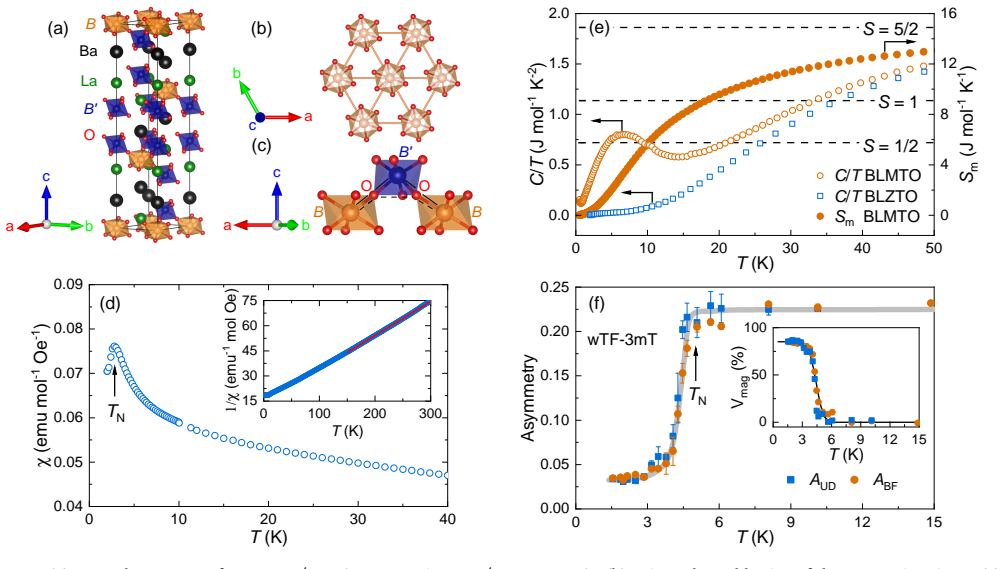
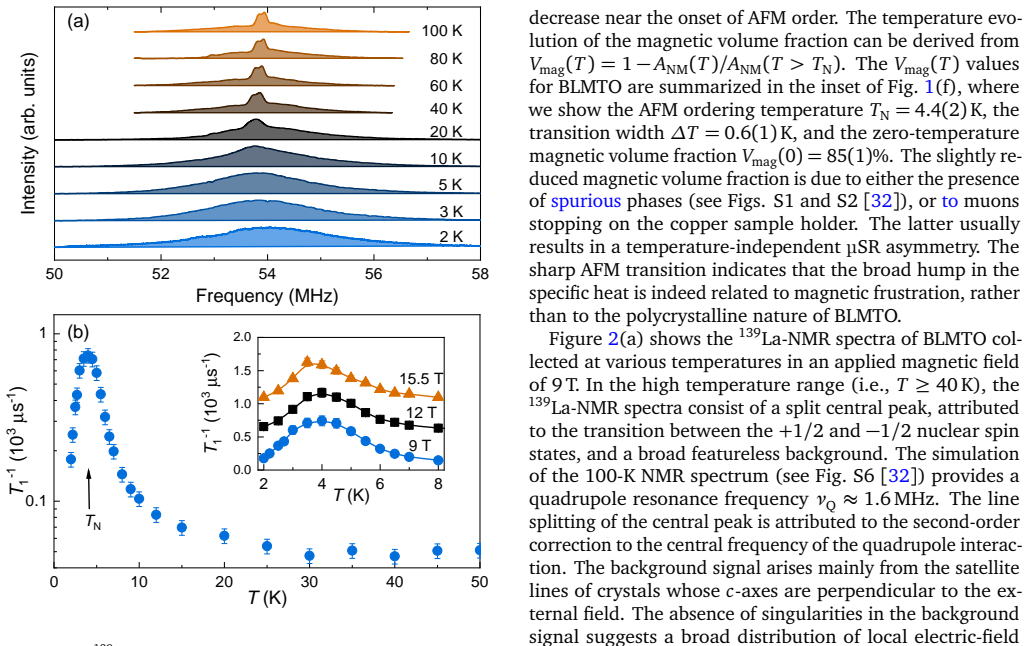
Ba₂La₂MnTe₂O₁₂ shows 120° antiferromagnetic order in ab-planes below 4.4 K while c-axis moments stay disordered.
A machine-rendered reading of the paper's core claim, the machinery that carries it, and where it could break.
Core claim
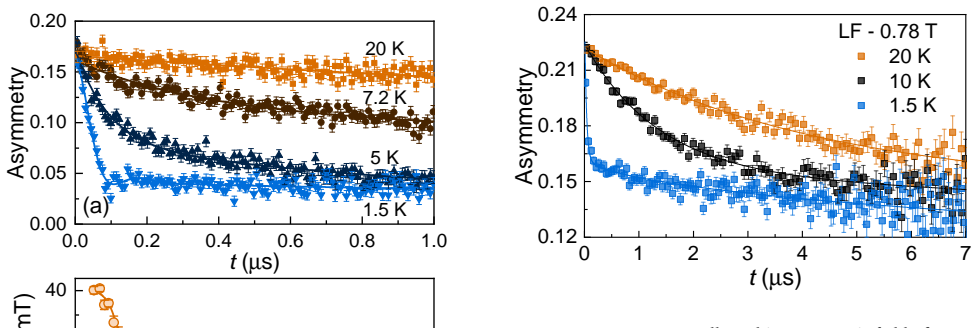
Ba₂La₂MnTe₂O₁₂ undergoes a magnetic transition at T_N ≈ 4.4 K, below which the manganese moments form a 120° AFM order within the ab-plane, while staying disordered along the c-axis. This exotic ground state exhibits ideal 2D magnetism, highly consistent with persistently strong spin fluctuations and large internal field distributions revealed by zero-field μSR, and produces a frustration parameter much larger than that of most known magnetically-ordered frustrated systems.
What carries the argument
The 120° antiferromagnetic order on the triangular lattice planes with c-axis disorder, established by neutron scattering and corroborated by NMR and zero-field μSR.
If this is right
- The 2D magnetism leads to a frustration level much larger than in most known ordered frustrated magnets.
- This ground state challenges interpretations of magnetic order reported in other 3D hexagonal perovskites.
- The combination of in-plane order and out-of-plane disorder produces persistently strong spin fluctuations visible in μSR.
- Dimensionality reduction in this crystal geometry enables exotic magnetic states not expected in fully three-dimensional systems.
Where Pith is reading between the lines
- Other 3D perovskites with triangular layers may hide similar 2D behavior if interplane exchange is comparably weak.
- Tuning the interlayer spacing or introducing controlled disorder could drive the system closer to a quantum spin liquid.
- The large internal field distribution seen by μSR suggests local probes may be needed to detect any subtle crossover to three-dimensional behavior at much lower temperatures.
Load-bearing premise
The chosen probes fully resolve any inter-plane coupling as negligible rather than merely weak and undetected at the accessed temperatures and time scales.
What would settle it
Detection of three-dimensional magnetic order or a further transition below 4.4 K that aligns moments along the c-axis.
Figures
read the original abstract
Exotic quantum phenomena are often found to occur in spin systems that exhibit low-dimensional magnetism. By combining nuclear magnetic resonance, neutron scattering, and muon-spin spectroscopy ($\mu$SR) techniques, we report a rare instance of strongly frustrated two-dimensional (2D) magnetism in a three-dimensional (3D) hexagonal perovskite. Here, Ba$_2$La$_2$MnTe$_2$O$_{12}$, a triangular-lattice magnet, is shown to undergo a magnetic transition at $T_\mathrm{N} \approx$ 4.4 K, below which the manganese moments form a 120$^{\circ}$ AFM order within the $ab$-plane, while staying disordered along the $c$-axis. This exotic ground state, which exhibits ideal 2D magnetism, is highly consistent with the persistently strong spin fluctuations and the large internal field distributions revealed by zero-field $\mu$SR. Further, the 2D magnetism also leads to a significant frustration, much larger than that of most known magnetically-ordered frustrated systems. Our work on Ba$_2$La$_2$MnTe$_2$O$_{12}$ not only challenges the interpretations of magnetic order in other 3D hexagonal perovskites, but it also provides insight into how the dimensionality affects the exotic magnetic states.
Editorial analysis
A structured set of objections, weighed in public.
Referee Report
Summary. The manuscript reports that Ba₂La₂MnTe₂O₁₂, a triangular-lattice antiferromagnet in a 3D hexagonal perovskite structure, undergoes a transition at T_N ≈ 4.4 K into a state with 120° AFM order confined to the ab-planes while remaining disordered along the c-axis. This is presented as an instance of ideal 2D magnetism, supported by consistency across NMR, neutron scattering, and zero-field μSR data showing persistent spin fluctuations and broad internal-field distributions, together with a frustration parameter larger than in most ordered frustrated magnets. The work also claims to challenge interpretations of magnetic order in other 3D hexagonal perovskites.
Significance. If the central claim of truly negligible interplane coupling holds, the result would provide a rare experimental realization of ideal 2D magnetism embedded in a 3D lattice, offering a platform to isolate dimensionality effects on frustration and fluctuations. The multi-technique consistency and the reported high frustration value would strengthen its utility as a benchmark system.
major comments (2)
- [Results and Discussion (neutron and μSR sections)] The assertion of ideal 2D magnetism with negligible interplane exchange J' requires a quantitative upper bound on J'/J rather than a qualitative statement of consistency with the probes. Neutron scattering and μSR have finite momentum and energy resolution; a weak but finite J' could produce c-axis correlations below the detection threshold while still permitting the observed T_N. No section derives such a limit from linewidths, diffuse scattering intensity, or the absence of a higher-temperature crossover.
- [Abstract and Discussion] The frustration parameter is stated to be 'much larger than that of most known magnetically-ordered frustrated systems,' yet the manuscript provides no explicit numerical value or comparison table with reference compounds (e.g., other triangular-lattice materials). This weakens the claim that the observed state is unusually frustrated.
minor comments (2)
- [Abstract] The abstract states consistency with three techniques but supplies no quantitative metrics (e.g., fitted exchange constants, χ² values, or error bars on T_N). Adding these would improve clarity.
- [Introduction and Experimental Methods] Notation for the crystal structure and magnetic propagation vector should be defined at first use and kept consistent between neutron and μSR sections.
Simulated Author's Rebuttal
We thank the referee for their thorough review and constructive comments on our manuscript. We address each major comment point by point below, indicating where revisions will be made.
read point-by-point responses
-
Referee: [Results and Discussion (neutron and μSR sections)] The assertion of ideal 2D magnetism with negligible interplane exchange J' requires a quantitative upper bound on J'/J rather than a qualitative statement of consistency with the probes. Neutron scattering and μSR have finite momentum and energy resolution; a weak but finite J' could produce c-axis correlations below the detection threshold while still permitting the observed T_N. No section derives such a limit from linewidths, diffuse scattering intensity, or the absence of a higher-temperature crossover.
Authors: We agree that the manuscript would be strengthened by an explicit upper bound on J'/J. The current presentation relies on the absence of detectable c-axis order or correlations across NMR, neutron, and μSR data, which is consistent with J' being negligible compared to the in-plane J. However, as the referee notes, this is qualitative. We will revise the Results and Discussion sections to include a rough quantitative estimate of the upper limit on J'/J, derived from the neutron scattering resolution limit and the lack of any higher-temperature crossover or 3D Bragg intensity. revision: yes
-
Referee: [Abstract and Discussion] The frustration parameter is stated to be 'much larger than that of most known magnetically-ordered frustrated systems,' yet the manuscript provides no explicit numerical value or comparison table with reference compounds (e.g., other triangular-lattice materials). This weakens the claim that the observed state is unusually frustrated.
Authors: The referee is correct that the claim would be more robust with an explicit value and direct comparisons. We will revise the Abstract and Discussion to report the numerical frustration parameter f = |θ_CW|/T_N and include a comparison table with other triangular-lattice antiferromagnets. revision: yes
Circularity Check
No circularity: experimental observations only
full rationale
The manuscript is a purely experimental report describing neutron scattering, NMR, and μSR measurements on Ba₂La₂MnTe₂O₁₂. No equations, derivations, fitted parameters renamed as predictions, or self-citation chains appear in the provided text. The central claim (in-plane 120° order with c-axis disorder) rests on direct diffraction and relaxation data rather than any reduction to prior inputs by construction. This is the normal, self-contained case for an experimental condensed-matter paper.
Axiom & Free-Parameter Ledger
axioms (1)
- domain assumption Standard interpretation of neutron scattering peaks as 120° AFM order and μSR relaxation as evidence of 2D fluctuations.
Reference graph
Works this paper leans on
-
[1]
Balents, Spin liquids in frustrated magnets, Nature464, 199 (2010)
L. Balents, Spin liquids in frustrated magnets, Nature464, 199 (2010)
2010
-
[2]
Broholm, R
C. Broholm, R. J. Cava, S. A. Kivelson, D. G. Nocera, M. R. Norman, and T . Senthil, Quantum spin liquids, Science367, eaay0668 (2020)
2020
-
[3]
Y . Zhou, K. Kanoda, and T .-K. Ng, Quantum spin liquid states, Rev. Mod. Phys.89, 025003 (2017)
2017
-
[4]
Savary and L
L. Savary and L. Balents, Quantum spin liquids: A review, Rep. Prog. Phys.80, 016502 (2017)
2017
-
[5]
S. H. Skjærvø, C. H. Marrows, R. L. Stamps, and L. J. Hey- derman, Advances in artificial spin ice, Nat. Rev. Phys2, 13 (2020)
2020
-
[6]
M. J. P . Gingras and P . A. McClarty , Quantum spin ice: A search for gapless quantum spin liquids in pyrochlore magnets, Rep. Prog. Phys.77, 056501 (2014)
2014
-
[7]
Heidarian and K
D. Heidarian and K. Damle, Persistent supersolid phase of hard-core bosons on the triangular lattice, Phys. Rev. Lett.95, 127206 (2005)
2005
-
[8]
Yamamoto, G
D. Yamamoto, G. Marmorini, and I. Danshita, Erratum: Quan- tum phase diagram of the triangular-lattice X X Z model in a magnetic field, Phys. Rev. Lett.112, 259901 (2014)
2014
-
[9]
Sellmann, X.-F
D. Sellmann, X.-F . Zhang, and S. Eggert, Phase diagram of the antiferromagnetic X X Z model on the triangular lattice, Phys. Rev. B91, 081104 (2015)
2015
-
[10]
Matsubara and H
T . Matsubara and H. Matsuda, A lattice model of liquid helium, I, Prog. Theor. Phys.16, 569 (1956)
1956
-
[11]
Giamarchi, C
T . Giamarchi, C. Rüegg, and O. Tchernyshyov, Bose-Einstein condensation in magnetic insulators, Nat. Phys.4, 198 (2008)
2008
-
[12]
V . Zapf, M. Jaime, and C. D. Batista, Bose-Einstein condensa- tion in quantum magnets, Rev. Mod. Phys.86, 563 (2014)
2014
-
[13]
J. A. M. Paddison, M. Daum, Z. Dun, G. Ehlers, Y. Liu, M. B. Stone, H. Zhou, and M. Mourigal, Continuous excitations of the triangular-lattice quantum spin liquid YbMgGaO 4, Nat. Phys.13, 117 (2017)
2017
-
[14]
N. Li, Q. Huang, X. Y. Yue, W . J. Chu, Q. Chen, E. S. Choi, X. Zhao, H. D. Zhou, and X. F . Sun, Possible itinerant exci- tations and quantum spin state transitions in the effective spin-1/2 triangular-lattice antiferromagnet Na2BaCo(PO4)2, Nat. Commun.11, 4216 (2020)
2020
-
[15]
J. G. Cheng, G. Li, L. Balicas, J. S. Zhou, J. B. Goodenough, C. Xu, and H. D. Zhou, High-pressure sequence of Ba3NiSb2O9 structural phases: New S =1 quantum spin liquids based on Ni2+, Phys. Rev. Lett.107, 197204 (2011)
2011
-
[16]
H. D. Zhou, C. Xu, A. M. Hallas, H. J. Silverstein, C. R. Wiebe, I. Umegaki, J. Q. Yan, T . P . Murphy , J.-H. Park, Y. Qiu, J. R. D. Copley , J. S. Gardner, and Y. Takano, Successive phase transi- tions and extended spin-excitation continuum in the S =1 /2 triangular-lattice antiferromagnet Ba 3CoSb2O9, Phys. Rev. Lett.109, 267206 (2012)
2012
-
[17]
Gao, Y.-C
Y. Gao, Y.-C. Fan, H. Li, F . Yang, X.-T . Zeng, X.-L. Sheng, R. Zhong, Y. Qi, Y. Wan, and W . Li, Spin supersolidity in nearly ideal easy-axis triangular quantum antiferromagnet Na2BaCo(PO4)2, npj Quantum Mater.7, 89 (2022)
2022
-
[18]
Sheng, J.-W
J. Sheng, J.-W . Mei, L. Wang, X. Xu, W . Jiang, L. Xu, H. Ge, N. Zhao, T . Li, A. Candini, B. Xi, J. Zhao, Y. Fu, J. Yang, Y. Zhang, G. Biasiol, S. Wang, J. Zhu, P . Miao, X. Tong, D. Yu, R. Mole, Y. Cui, L. Ma, Z. Zhang, Z. Ouyang, W . Tong, A. Podlesnyak, L. Wang, F . Ye, D. Yu, W . Yu, L. Wu, and Z. Wang, Bose-Einstein condensation of a two-magnon bou...
2025
-
[19]
M. M. Bordelon, E. Kenney, C. Liu, T . Hogan, L. Posthuma, M. Kavand, Y. Lyu, M. Sherwin, N. P . Butch, C. Brown, M. J. Graf, L. Balents, and S. D. Wilson, Field-tunable quantum dis- ordered ground state in the triangular-lattice antiferromagnet NaYbO2, Nat. Phys.15, 1058 (2019)
2019
-
[20]
Xiang, C
J. Xiang, C. Zhang, Y. Gao, W . Schmidt, K. Schmalzl, C.-W . Wang, B. Li, N. Xi, X.-Y. Liu, H. Jin, G. Li, J. Shen, Z. Chen, Y . Qi, Y . Wan, W . Jin, W . Li, P . Sun, and G. Su, Giant magnetocaloric effect in spin supersolid candidate Na2BaCo(PO4)2, Nature 625, 270 (2024)
2024
-
[21]
Ding, Y.-X
Z.-F . Ding, Y.-X. Yang, J. Zhang, C. Tan, Z.-H. Zhu, G. Chen, and L. Shu, Possible gapless spin liquid in the rare-earth kagome lattice magnet Tm 3Sb3Zn2O14, Phys. Rev. B98, 174404 (2018)
2018
-
[22]
B. Fåk, E. Kermarrec, L. Messio, B. Bernu, C. Lhuillier, F . Bert, P . Mendels, B. Koteswararao, F . Bouquet, J. Ollivier, A. D. Hillier, A. Amato, R. H. Colman, and A. S. Wills, Kapellasite: A kagome quantum spin liquid with competing interactions, Phys. Rev. Lett.109, 037208 (2012)
2012
-
[23]
J. S. Helton, K. Matan, M. P . Shores, E. A. Nytko, B. M. Bartlett, Y. Yoshida, Y. Takano, A. Suslov, Y. Qiu, J.-H. Chung, D. G. Nocera, and Y . S. Lee, Spin dynamics of the spin-1/2 kagome lattice antiferromagnet ZnCu3(OH)6Cl2, Phys. Rev. Lett.98, 107204 (2007)
2007
-
[24]
Singh, S
Y. Singh, S. Manni, J. Reuther, T . Berlijn, R. Thomale, W . Ku, S. Trebst, and P . Gegenwart, Relevance of the Heisenberg- Kitaev model for the honeycomb lattice iridates A2IrO3, Phys. Rev. Lett.108, 127203 (2012)
2012
-
[25]
Matsumoto, S
Y. Matsumoto, S. Schnierer, J. A. N. Bruin, J. Nuss, P . Reiss, G. Jackeli, K. Kitagawa, and H. Takagi, A quantum critical Bose gas of magnons in the quasi-two-dimensional antifer- romagnet YbCl3 under magnetic fields, Nat. Phys.20, 1131 (2024)
2024
-
[26]
Kojima, M
Y. Kojima, M. Watanabe, N. Kurita, H. Tanaka, A. Matsuo, K. Kindo, and M. Avdeev, Quantum magnetic properties of the spin- 1/2 triangular-lattice antiferromagnet Ba2La2CoTe2O12, Phys. Rev. B98, 174406 (2018)
2018
-
[27]
B. C. Yu, J. Y. Yang, D. J. Gawryluk, Y. Xu, Q. F . Zhan, T . Shi- roka, and T . Shang, Neutron scattering and muon-spin spec- troscopy studies of the magnetic triangular-lattice compounds A2La2NiW2O12(A =Sr, Ba), Phys. Rev. Mater.7, 074403 (2023)
2023
-
[28]
Saito, M
M. Saito, M. Watanabe, N. Kurita, A. Matsuo, K. Kindo, M. Avdeev, H. O. Jeschke, and H. Tanaka, Successive phase transitions and magnetization plateau in the spin-1 triangular- – 7 – lattice antiferromagnet Ba2La2NiTe2O12 with small easy-axis anisotropy , Phys. Rev. B100, 064417 (2019). [29]R. Rawl, M. Lee, E. S. Choi, G. Li, K. W . Chen, R. Baumbach, C. ...
2019
-
[29]
Y. Doi, M. Wakeshima, K. Tezuka, Y. J. Shan, K. Ohoyama, S. Lee, S. Torii, T . Kamiyama, and Y. Hinatsu, Crystal struc- tures, magnetic properties, and DFT calculation of B-site defected 12L-perovskites Ba2La2 MW2O12 (M =Mn, Co, Ni, Zn), J. Phys.: Condens. Matter29, 365802 (2017)
2017
-
[30]
P . Park, E. A. Ghioldi, A. F . May , J. A. Kolopus, A. A. Podlesnyak, S. Calder, J. A. M. Paddison, A. E. Trumper, L. O. Manuel, C. D. Batista, M. B. Stone, G. B. Halász, and A. D. Christianson, Anomalous continuum scattering and higher-order van Hove singularity in the strongly anisotropic S =1 /2 triangular lattice antiferromagnet, Nat. Commun.15, 7264 (2024)
2024
-
[31]
For details on the material synthesis, magnetic suscepti- bility, heat capacity, wTF- and LF- µSR spectra, neutron powder diffraction, theoretical simulations, as well as for the data analysis, see the Supplementary Material at http://link.aps.org/supplemental/XXX/PhysRevlett.XXX. [33]Q. Li, H. Li, J. Zhao, H.-G. Luo, and Z. Y. Xie, Magnetization of the s...
2022
-
[32]
Nishino and K
T . Nishino and K. Okunishi, Corner transfer matrix renormal- ization group method, J. Phys. Soc. Jpn.65, 891 (1996)
1996
-
[33]
Corboz, J
P . Corboz, J. Jordan, and G. Vidal, Simulation of fermionic lattice models in two dimensions with projected entangled- pair states: Next-nearest neighbor Hamiltonians, Phys. Rev. B82, 245119 (2010)
2010
-
[34]
Z. Tian, C. Zhu, Z. Ouyang, J. Wang, W . Tong, Y. Liu, Z. Xia, and S. Yuan, Susceptibility, high-field magnetization and ESR studies in a spin-5/2 triangular-lattice antiferromagnet Ba3MnSb2O9, J. Magn. Magn. Mater.360, 10 (2014)
2014
-
[35]
Z. Y . Xie, J. Chen, J. F . Yu, X. Kong, B. Normand, and T . Xiang, Tensor renormalization of quantum many-body systems using projected entangled simplex states, Phys. Rev. X4, 011025 (2014)
2014
-
[36]
Fischer, G
P . Fischer, G. Frey, M. Koch, M. Könnecke, V . Pomjakushin, J. Schefer, R. Thut, N. Schlumpf, R. Bürge, U. Greuter, S. Bondt, and E. Berruyer, High-resolution powder diffrac- tometer HRPT for thermal neutrons at SINQ, Phys. B: Con- dens. Matter276-278, 146 (2000)
2000
-
[37]
Suter and B
A. Suter and B. M. Wojek, Musrfit: A free platform- independent framework for µSR data analysis, Phys. Procedia 30, 69 (2012)
2012
-
[38]
X. Y. Zhu, H. Zhang, D. J. Gawryluk, Z. X. Zhen, B. C. Yu, S. L. Ju, W . Xie, D. M. Jiang, W . J. Cheng, Y. Xu, M. Shi, E. Pomjakushina, Q. F . Zhan, T . Shiroka, and T . Shang, Spin order and fluctuations in the EuAl 4 and EuGa4 topological antiferromagnets: A µSR study, Phys. Rev. B105, 014423 (2022)
2022
-
[39]
Y . Wang, Z. Zhen, J. Meng, I. Plokhikh, D. Wu, D. J. Gawryluk, Y. Xu, Q. Zhan, M. Shi, E. Pomjakushina, T . Shiroka, and T . Shang, Spin order and dynamics in the topological rare- earth germanide semimetals, Sci. China Phys., Mech. Astron. 67, 107512 (2024)
2024
-
[40]
Fennell, V
A. Fennell, V . Y. Pomjakushin, A. Uldry, B. Delley, B. Prévost, A. Désilets-Benoit, A. D. Bianchi, R. I. Bewley , B. R. Hansen, T . Klimczuk, R. J. Cava, and M. Kenzelmann, Evidence for SrHo2O4 and SrDy2O4 as model J1-J2 zigzag chain materials, Phys. Rev. B89, 224511 (2014)
2014
-
[41]
P . H. Conlon and J. T . Chalker, Absent pinch points and emer- gent clusters: Further neighbor interactions in the pyrochlore Heisenberg antiferromagnet, Phys. Rev. B81, 224413 (2010)
2010
-
[42]
L. Ding, F . Orlandi, D. Khalyavin, A. Boothroyd, D. Prab- hakaran, G. Balakrishnan, and P . Manuel, Coupling between spin and charge order driven by magnetic field in triangular Ising system LuFe2O4+δ, Crystals8, 88 (2018)
2018
-
[43]
J. Xing, L. D. Sanjeewa, J. Kim, G. R. Stewart, A. Podlesnyak, and A. S. Sefat, Field-induced magnetic transition and spin fluctuations in the quantum spin-liquid candidate CsYbSe2, Phys. Rev. B100, 220407 (2019)
2019
-
[44]
Kojima, N
Y. Kojima, N. Kurita, H. Tanaka, and K. Nakajima, Magnons and spinons in Ba 2CoTeO6: A composite system of iso- lated spin- 1 2 triangular Heisenberg-like and frustrated honey- comb Ising-like antiferromagnets, Phys. Rev. B105, L020408 (2022)
2022
-
[45]
Fritsch, K
K. Fritsch, K. A. Ross, G. E. Granroth, G. Ehlers, H. M. L. Noad, H. A. Dabkowska, and B. D. Gaulin, Quasi-two-dimensional spin correlations in the triangular lattice bilayer spin glass LuCoGaO4, Phys. Rev. B96, 094414 (2017)
2017
-
[46]
Anderson, Resonating valence bonds: A new kind of insula- tor?, Mater
P . Anderson, Resonating valence bonds: A new kind of insula- tor?, Mater. Res. Bull.8, 153 (1973)
1973
-
[47]
M. F . Collins and O. A. Petrenko, Triangular antiferromagnets, Can. J. Phys.75, 605 (1997)
1997
-
[48]
Shirata, H
Y . Shirata, H. Tanaka, A. Matsuo, and K. Kindo, Experimental realization of a spin-1/2 triangular-lattice Heisenberg anti- ferromagnet, Phys. Rev. Lett.108, 057205 (2012)
2012
-
[49]
O. A. Starykh, Unusual ordered phases of highly frustrated magnets: A review, Rep. Prog. Phys.78, 052502 (2015). [52]J. Alicea, A. V . Chubukov, and O. A. Starykh, Quantum stabi- lization of the 1/3-magnetization plateau in Cs2CuBr4, Phys. Rev. Lett.102, 137201 (2009)
2015
-
[50]
M. Shu, W . Dong, J. Jiao, J. Wu, G. Lin, Y. Kamiya, T . Hong, H. Cao, M. Matsuda, W . Tian, S. Chi, G. Ehlers, Z. Ouyang, H. Chen, Y. Zou, Z. Qu, Q. Huang, H. Zhou, and J. Ma, Static and dynamical properties of the spin-5/2 nearly ideal trian- gular lattice antiferromagnet Ba3MnSb2O9, Phys. Rev. B108, 174424 (2023)
2023
-
[51]
Fujihala, X
M. Fujihala, X. G. Zheng, S. Lee, T . Kamiyama, A. Matsuo, K. Kindo, and T . Kawae, Spin order in the Heisenberg kagome antiferromagnet MgFe3(OH)6Cl2, Phys. Rev. B96, 144111 (2017)
2017
-
[52]
Yang, C.-Y
Y.-X. Yang, C.-Y. Jiang, L.-L. Huang, Z.-H. Zhu, C.-S. Chen, Q. Wu, Z.-F . Ding, C. Tan, K.-W . Chen, P . K. Biswas, A. D. Hillier, Y.-G. Shi, C. Liu, L. Wang, F . Ye, J.-W . Mei, and L. Shu, Muon spin relaxation study of spin dynamics on a Kitaev honeycomb material H3LiIr2O6, npj Quantum Mater.9, 1 (2024)
2024
-
[53]
J. A. Sears, M. Songvilay, K. W . Plumb, J. P . Clancy, Y. Qiu, Y . Zhao, D. Parshall, and Y .-J. Kim, Magnetic order inα-RuCl3: A honeycomb-lattice quantum magnet with strong spin-orbit coupling, Phys. Rev. B91, 144420 (2015)
2015
-
[54]
F . Lang, P . J. Baker, A. A. Haghighirad, Y. Li, D. Prabhakaran, R. Valentí, and S. J. Blundell, Unconventional magnetism on a honeycomb lattice in α-RuCl3 studied by muon spin rotation, Phys. Rev. B94, 020407 (2016)
2016
-
[55]
Y . Li, D. Adroja, P . K. Biswas, P . J. Baker, Q. Zhang, J. Liu, A. A. Tsirlin, P . Gegenwart, and Q. Zhang, Muon spin relaxation evidence for the U(1)quantum spin-liquid ground state in the triangular antiferromagnet YbMgGaO4, Phys. Rev. Lett. 117, 097201 (2016)
2016
-
[56]
L. Ding, P . Manuel, S. Bachus, F . Grußler, P . Gegenwart, J. Sin- gleton, R. D. Johnson, H. C. Walker, D. T . Adroja, A. D. Hillier, and A. A. Tsirlin, Gapless spin-liquid state in the structurally disorder-free triangular antiferromagnet NaYbO2, Phys. Rev. B100, 144432 (2019)
2019
-
[57]
A. V . Chubukov and D. I. Golosov, Quantum theory of an antiferromagnet on a triangular lattice in a magnetic field, J. Phys.: Condens. Matter3, 69 (1991)
1991
-
[58]
Ye and A
M. Ye and A. V . Chubukov, Quantum phase transitions in the Heisenberg J1-J2 triangular antiferromagnet in a magnetic field, Phys. Rev. B95(2017)
2017
-
[59]
A. V . Chubukov and T . Jolicoeur, Order-from-disorder phenom- ena in Heisenberg antiferromagnets on a triangular lattice, Phys. Rev. B46, 11137 (1992)
1992
-
[60]
Nakano and T
H. Nakano and T . Sakai, Magnetization process of the spin- 1/2 triangular-lattice Heisenberg antiferromagnet with next- nearest-neighbor interactions - plateau or nonplateau, J. Phys. – 8 – Soc. Jpn.86, 114705 (2017). – 9 –
2017
discussion (0)
Sign in with ORCID, Apple, or X to comment. Anyone can read and Pith papers without signing in.