REVIEW 2 major objections 5 minor 29 references
An open, reproducible branch-and-cut for the capacitated profitable tour problem: a component study
T0 review · 2 major / 5 minor · reviewed 2026-07-11 · grok-4.5
Pith's one-line read Capacity cuts, not connectivity or fancy extras, drive almost all the gains in a branch-and-cut solver for capacitated profitable tours.
desk verdict Honest open reimplementation of Jepsen et al. with a clean ablation: capacity cuts do almost all the work; everything else is inert on this suite. read the letter →
The pith
A machine-rendered reading of the paper's core claim, the machinery that carries it, and where it could break.
The reading
What carries the argument
Capacity-class cuts (rounded capacity inequalities and multistar/generalized large multistar inequalities) separated from a shared Gomory–Hu cut tree on the fractional support graph. These node-coupled inequalities tighten the knapsack-plus-circuit polytope; the ablation isolates them as the only family that measurably reduces the search tree and increases the number of solved instances.
What would settle it
Re-run the same gating ablation on a larger or more strongly capacity-binding set (or on a directed arc-resource reformulation of classical resource-constrained shortest-path benchmarks) and check whether comb, rounded-GLM, SPI, or reduced-cost fixing begin to separate violated cuts and shrink the tree; if they do, the inertness claim fails.
Extended reading notes
Core claim
On a common modern open stack, capacity-class cuts account for essentially the entire benefit of the branch-and-cut: they lift the number of instances solved from 52 to 64 of 76 and shrink the search tree more than tenfold, while comb cuts, rounded generalized large multistar cuts, reduced-cost fixing, bound-based propagation, and the shortest-path-incompatibility cut contribute nothing measurable. The branch-and-cut and dynamic-programming labelling remain complementary rather than one dominating the other.
Load-bearing premise
The 76 undirected, single-capacity pricing instances used for the ablation are representative enough that the conclusions about which cuts and fixing routines help or fail will hold for the wider class of capacitated profitable-tour and elementary shortest-path problems.
Editorial extensions
If this is right
- A practical default for this problem class can keep only generalized subtour elimination plus rounded-capacity and multistar cuts; the remaining families can stay optional and nearly free.
- Open, scriptable baselines make future component studies and extensions (per-arc resources, directed graphs) directly comparable instead of locked inside proprietary stacks.
- Negative results on SPI and related node-precedence-style cuts discourage re-implementation of those families for the same instance regime.
- Complementarity with labelling implies that hybrid or portfolio solvers can close more of the hard tail than either method alone.
Reading between the lines
- Because the classical directed arc-resource benchmarks cannot be imported without a model change, the paper’s inertness conclusions are currently untested outside the undirected node-demand regime; an arc-resource reimplementation would be the natural next falsification test.
- The near-zero separation counts for comb, RGLM and SPI suggest the failure is one of separator design relative to the incumbent, not necessarily of theoretical strength; alternative separation heuristics might revive them.
- If capacity-class cuts remain decisive on larger instances, pricing engines inside column-generation vehicle-routing solvers could profitably expose the same cut families as user cuts rather than relying solely on labelling.
Editorial analysis
A structured set of objections, weighed in public.
Referee Report
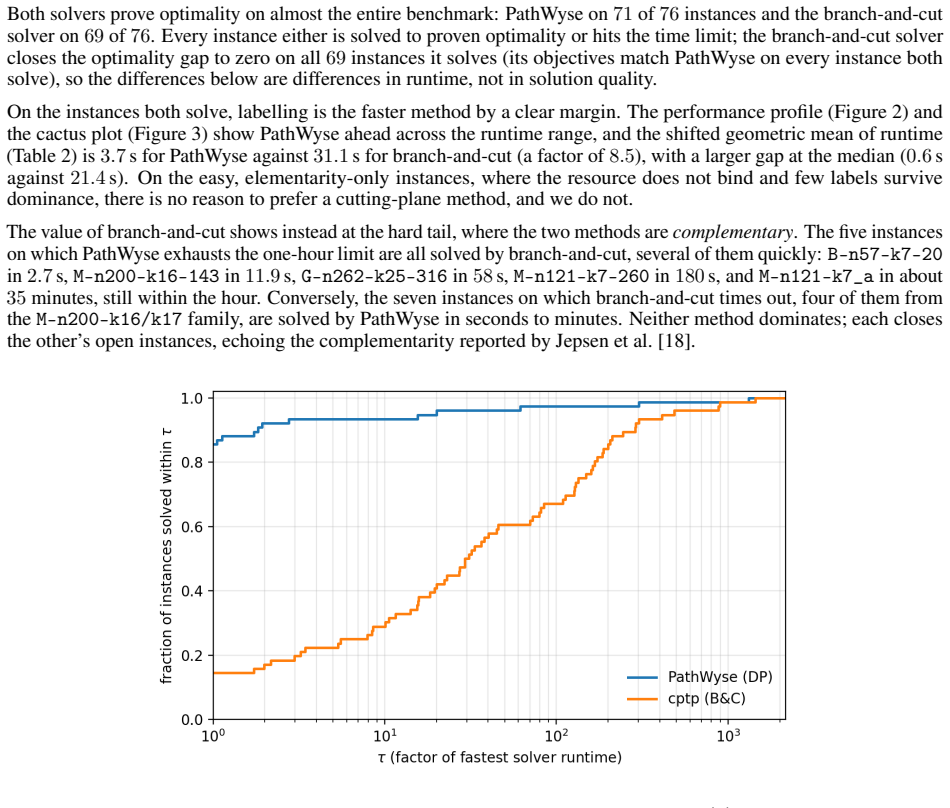
Summary. The paper re-implements the CPTP (and open s–t path) branch-and-cut of Jepsen et al. (2014) on a fully open HiGHS stack, adding bound-based preprocessing, domain propagation, and reduced-cost fixing, and releases the formulation, separators, and benchmark scripts. It claims no new method. The empirical contribution is a component study on 76 SPPRCLIB and Roberti pricing instances: capacity-class cuts (RCI and multistar) account for essentially the entire gain over a GSEC-only baseline (solved count 52→64/76; SGM nodes 2290→214), while comb, RGLM, reduced-cost fixing, bound-based propagation, and the SPI cut (a García-style node-precedence variant) add nothing measurable. Head-to-head with PathWyse labelling shows complementarity rather than dominance. All results are regenerated from released logs.
Significance. If the ablation holds, the paper supplies a rare, fully open, rerunnable B&C baseline for CPTP/ESPPRC pricing and a clear ranking of which classical cut families actually pay off on modern open MIP software. The negative SPI result and the near-zero separation rates for comb/RGLM are useful negative knowledge. The open artifact (code, scripts, committed CSVs) is a concrete infrastructural contribution that others can extend to directed/arc-resource models. The claims are modest, tightly scoped, and directly supported by the released experiments; that is a strength, not a weakness, for a computational study.
major comments (2)
- §4.3 and Table 3 use a 300 s limit for the gating ablation, while the head-to-head comparison in §4.2 uses 3600 s. Several hard instances (e.g. M-n200-k17-12, E-n101-k14-158) sit near or at the 300 s wall in the ablation ladder. The ranking of capacity cuts vs. the rest is unlikely to reverse, but the paper should either re-run the ablation at 3600 s for the unsolved tail or explicitly justify that the 300 s ranking is stable (e.g. by reporting the same ranking on the subset solved under both limits).
- §4.1 correctly notes that classical Beasley–Christofides and García arc-resource directed instances cannot be imported without a model change. The inertness claims for comb, RGLM, SPI, and reduced-cost fixing are therefore scoped to undirected single node-demand pricing instances. The abstract and conclusion should state this scope limit more prominently so that readers do not over-generalize the null results to the broader ESPPRC class the introduction targets.
minor comments (5)
- Table 7 reports mean wall-clock under the 3600 s limit for the default configuration; the ablation tables use 300 s. A short note that the component shares are qualitatively the same under both limits would avoid confusion.
- §3.1: the SPI description (Held–Karp over |S|≤15) is clear, but a one-sentence remark that the separator never fires (Table 5) could be cross-referenced already in the method section so the negative result is foreshadowed.
- Figures 2–3 are informative; adding the number of instances solved by each solver in the caption would make the performance profile self-contained.
- The hyperplane branching machinery (§3.3) is described but never exercised. A single sentence that it is off by default and unused in the experiments would prevent readers from looking for results that are not there.
- Minor typography: “opens–t path” in the conclusion should be “open s–t path”; a few long sentences in §1 and §4.3 would benefit from splitting for readability.
Circularity Check
No significant circularity: empirical ablation on fixed public instances; results do not reduce to inputs by construction.
full rationale
This is a computational component study, not a first-principles derivation. The load-bearing claim (capacity-class cuts drive essentially all measured gain: 52 o64/76 solved, SGM nodes 2290 o214; comb/RGLM/fixing/propagation/SPI add nothing) is an observed performance difference under controlled ablations on the fixed SPPRCLIB+Roberti suite, regenerated from released logs. It is not obtained by fitting a parameter and renaming the fit as a prediction, nor by defining X in terms of Y. Self-citations (Jepsen et al. 2014, of which the author is a co-author; the author’s own software archives) correctly identify the reimplemented method and the open artifact; they do not force the ablation ranking. The head-to-head with PathWyse and the negative SPI result are likewise measured, not definitional. Scope limits on instance representativeness are stated by the paper and do not create circularity. Score 0 is the honest finding.
Assumptions & free parameters
assumptions (3)
- domain assumption The undirected node-demand CPTP IP (degree, GSEC, knapsack) correctly models the capacitated profitable tour and its open s-t path variant.
- domain assumption Rounded capacity, multistar, GLM, RGLM, comb and SPI inequalities are valid for the node-capacitated circuit polytope.
- standard math Non-elementary capacity-aware labelling yields valid lower bounds for elimination and reduced-cost fixing.
Cite this review
Pith. "Pith review of An open, reproducible branch-and-cut for the capacitated profitable tour problem: a component study." pith.science (2026). https://pith.science/paper/ARKURCR5
@misc{pith2026260704497,
  author       = {Pith},
  title        = {Pith review of: An open, reproducible branch-and-cut for the capacitated profitable tour problem: a component study},
  year         = {2026},
  howpublished = {\url{https://pith.science/paper/ARKURCR5}},
  note         = {Machine review of arXiv:2607.04497}
}
read the original abstract
We present an open, reproducible branch-and-cut (B&C) algorithm for the capacitated profitable tour problem (CPTP) and its open s-t path variant, the capacity-constrained elementary shortest-path problem. The solver re-implements the formulation and cut families of Jepsen et al. (2014) on a fully open mixed-integer programming stack (HiGHS; Huangfu and Hall, 2018), and adds bound-based preprocessing, domain propagation, and reduced-cost variable fixing. We claim no new method; the contribution is twofold. First, an open, reproducible artifact: to our knowledge the first branch-and-cut for this problem class on a fully open stack, with the formulation, every separator, and all benchmark scripts released, so the results below can be rerun and the solver reused and extended as a baseline. Second, a component study on this common modern stack, benchmarked against a dynamic-programming/labelling reference, that decomposes which components pay off and where the running time goes. We find that the capacity-class cuts account for essentially the entire benefit (adding them to a connectivity-only baseline lifts the number of instances solved from 52 to 64 of 76 and shrinks the search tree more than tenfold), while comb and rounded generalized-large-multistar cuts, reduced-cost fixing, and bound-based propagation add nothing measurable. We also report a negative result: the shortest-path-incompatibility (SPI) cut, a variant of the node-precedence inequalities of Garc\'ia (2009), finds no violated inequality on any instance. The solver and all experiments are released as open, reproducible software (Spoorendonk, 2026).
Figures


Reference graph
Works this paper leans on
-
[1]
Y . P. Aneja, V . Aggarwal, and K. P. K. Nair. Shortest chain subject to side constraints.Networks, 13(2):295–302,
-
[2]
doi: 10.1002/net.3230130212
-
[3]
Pasquale Avella, Maurizio Boccia, and Antonio Sforza. Resource constrained shortest path problems in path planning for fleet management.Journal of Mathematical Modelling and Algorithms, 3(1):1–17, 2004. doi: 10.1023/B:JMMA.0000026675.50719.ce
-
[4]
Roberto Baldacci, Aristide Mingozzi, and Roberto Roberti. New route relaxation and pricing strategies for the vehicle routing problem.Operations Research, 59(5):1269–1283, 2011. doi: 10.1287/opre.1110.0975
-
[5]
The circuit polytope: facets.Mathematics of Operations Research, 22(1):110–145, 1997
Petra Bauer. The circuit polytope: facets.Mathematics of Operations Research, 22(1):110–145, 1997. doi: 10.1287/moor.22.1.110
-
[6]
J. E. Beasley and N. Christofides. An algorithm for the resource constrained shortest path problem.Networks, 19 (4):379–394, 1989. doi: 10.1002/net.3230190402
-
[7]
Luciano Costa, Claudio Contardo, and Guy Desaulniers. Exact branch-price-and-cut algorithms for vehicle routing.Transportation Science, 53(4):946–985, 2019. doi: 10.1287/trsc.2018.0878
-
[8]
Luigi Di Puglia Pugliese and Francesca Guerriero. A computational study of solution approaches for the resource constrained elementary shortest path problem.Annals of Operations Research, 201(1):131–157, 2012. doi: 10.1007/s10479-012-1162-x. 17
Show all 29 references
-
[9]
E. A. Dinic. Algorithm for solution of a problem of maximum flow in networks with power estimation.Soviet Mathematics Doklady, 11:1277–1280, 1970
1970
-
[10]
A note on the separation of subtour elimination constraints in elementary shortest path problems
Michael Drexl. A note on the separation of subtour elimination constraints in elementary shortest path problems. European Journal of Operational Research, 229(3):595–598, 2013. doi: 10.1016/j.ejor.2013.03.009
2013 doi
-
[11]
Solving elementary shortest-path problems as mixed-integer programs.OR Spectrum, 36(2):281–296, 2014
Michael Drexl and Stefan Irnich. Solving elementary shortest-path problems as mixed-integer programs.OR Spectrum, 36(2):281–296, 2014. doi: 10.1007/s00291-012-0302-7
2014 doi
-
[12]
An exact algorithm for the elementary shortest path problem with resource constraints: Application to some vehicle routing problems.Networks, 44(3): 216–229, 2004
Dominique Feillet, Pierre Dejax, Michel Gendreau, and Cyrille Gueguen. An exact algorithm for the elementary shortest path problem with resource constraints: Application to some vehicle routing problems.Networks, 44(3): 216–229, 2004. doi: 10.1002/net.20033
2004 doi
-
[13]
PhD thesis, Georgia Institute of Technology, Atlanta, GA, 2009
Renan Garcia.Resource Constrained Shortest Paths and Extensions. PhD thesis, Georgia Institute of Technology, Atlanta, GA, 2009. Ph.D. thesis, School of Industrial and Systems Engineering
2009
-
[14]
Very simple methods for all pairs network flow analysis.SIAM Journal on Computing, 19(1): 143–155, 1990
Dan Gusfield. Very simple methods for all pairs network flow analysis.SIAM Journal on Computing, 19(1): 143–155, 1990. doi: 10.1137/0219009
1990 doi
-
[15]
Michael Held and Richard M. Karp. A dynamic programming approach to sequencing problems.Journal of the Society for Industrial and Applied Mathematics, 10(1):196–210, 1962. doi: 10.1137/0110015
1962 doi
-
[16]
Solving resource constrained shortest path problems with lp-based methods
Markó Horváth and Tamás Kis. Solving resource constrained shortest path problems with lp-based methods. Computers & Operations Research, 73:150–164, 2016. doi: 10.1016/j.cor.2016.04.013
2016 doi
-
[17]
Qi Huangfu and J. A. J. Hall. Parallelizing the dual revised simplex method.Mathematical Programming Computation, 10(1):119–142, 2018. doi: 10.1007/s12532-017-0130-5
2018 doi
-
[18]
A branch-and-cut algorithm for the elementary shortest path problem with a capacity constraint
Mads Jepsen, Bjørn Petersen, and Simon Spoorendonk. A branch-and-cut algorithm for the elementary shortest path problem with a capacity constraint. Technical Report 08/01, DIKU, Department of Computer Science, University of Copenhagen, 2008
2008
-
[19]
Jepsen, Bjørn Petersen, Simon Spoorendonk, and David Pisinger
Mads K. Jepsen, Bjørn Petersen, Simon Spoorendonk, and David Pisinger. A branch-and-cut algorithm for the capacitated profitable tour problem.Discrete Optimization, 14:78–96, 2014. doi: 10.1016/j.disopt.2014.08.001
2014 doi
-
[20]
A branch and cut algorithm for the time-dependent profitable tour problem with resource constraints.European Journal of Operational Research, 289(3):879–896, 2021
Gonzalo Lera-Romero and Juan José Miranda-Bront. A branch and cut algorithm for the time-dependent profitable tour problem with resource constraints.European Journal of Operational Research, 289(3):879–896, 2021. doi: 10.1016/j.ejor.2019.07.014
2021 doi
-
[21]
Letchford and Juan-José Salazar-González
Adam N. Letchford and Juan-José Salazar-González. Projection results for vehicle routing.Mathematical Programming, 105(2–3):251–274, 2006. doi: 10.1007/s10107-005-0652-x
2006 doi
-
[22]
Medaglia
Leonardo Lozano, Daniel Duque, and Andrés L. Medaglia. An exact algorithm for the elementary shortest path problem with resource constraints.Transportation Science, 50(1):348–357, 2016. doi: 10.1287/trsc.2014.0582
2016 doi
-
[23]
A generic exact solver for ve- hicle routing and related problems.Mathematical Programming, 183(1–2):483–523, 2020
Artur Pessoa, Ruslan Sadykov, Eduardo Uchoa, and François Vanderbeck. A generic exact solver for ve- hicle routing and related problems.Mathematical Programming, 183(1–2):483–523, 2020. doi: 10.1007/ s10107-020-01523-z
2020
-
[24]
Symmetry helps: Bounded bi-directional dynamic programming for the elementary shortest path problem with resource constraints.Discrete Optimization, 3(3):255–273, 2006
Giovanni Righini and Matteo Salani. Symmetry helps: Bounded bi-directional dynamic programming for the elementary shortest path problem with resource constraints.Discrete Optimization, 3(3):255–273, 2006. doi: 10.1016/j.disopt.2006.05.007
2006 doi
-
[25]
A bucket graph-based labeling algorithm with application to vehicle routing.Transportation Science, 55(1):4–28, 2021
Ruslan Sadykov, Eduardo Uchoa, and Artur Pessoa. A bucket graph-based labeling algorithm with application to vehicle routing.Transportation Science, 55(1):4–28, 2021. doi: 10.1287/trsc.2020.0985
2021 doi
-
[26]
PathWyse: a flexible, open-source library for the resource constrained shortest path problem.Optimization Methods and Software, 39(2):298–320, 2024
Matteo Salani, Saverio Basso, and Vincenzo Giuffrida. PathWyse: a flexible, open-source library for the resource constrained shortest path problem.Optimization Methods and Software, 39(2):298–320, 2024. doi: 10.1080/10556788.2023.2296978
2024 doi
-
[27]
bucket-graph-spprc: an extensible C++ library for the shortest path problem with resource constraints, 2026
Simon Spoorendonk. bucket-graph-spprc: an extensible C++ library for the shortest path problem with resource constraints, 2026. URLhttps://arxiv.org/abs/2606.30847
2026 arXiv
-
[28]
cptp: a C++23 branch-and-cut solver for the capacitated profitable tour problem, 2026
Simon Spoorendonk. cptp: a C++23 branch-and-cut solver for the capacitated profitable tour problem, 2026. URL https://doi.org/10.5281/zenodo.21205088. Software (v0.2.0), archived on Zenodo
2026 doi
-
[29]
Integer programming formulations for the elementary shortest path problem.European Journal of Operational Research, 252(1):122–130, 2016
Leonardo Taccari. Integer programming formulations for the elementary shortest path problem.European Journal of Operational Research, 252(1):122–130, 2016. doi: 10.1016/j.ejor.2016.01.003. 18
2016 doi
Reviewed July 11, 2026 · model on record in the stance chip above.
Discussion (0). Continue with ORCID to comment.