REVIEW 3 major objections 5 minor 34 references
Optical tweezer-controlled entanglement gates with trapped ion qubits
T0 review · 3 major / 5 minor · reviewed 2026-08-07 · deepseek-v4-flash
Pith's one-line read An optical tweezer on a single trapped ion makes a global entangling laser pulse act conditionally on that ion's qubit state, giving a controlled entanglement gate in one pulse.
desk verdict A genuine, honestly reported proof-of-principle for a tweezer-mediated controlled gate in trapped ions; the coherent version for superposition controls remains unvalidated, but the paper deserves serious refereeing. read the letter →
The pith
A machine-rendered reading of the paper's core claim, the machinery that carries it, and where it could break.
The reading
What carries the argument
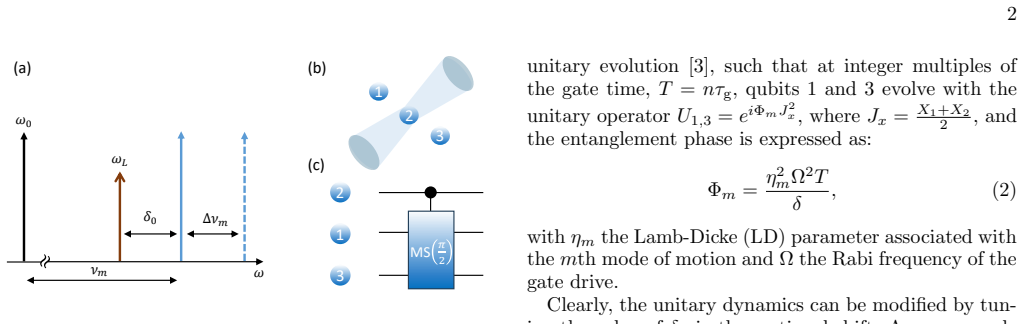
The load-bearing element is the state-dependent optical tweezer potential. A red-detuned Gaussian tweezer creates a harmonic potential for the ion with frequency $\omega_{\mathrm{o.p.}}=2\sqrt{\hbar\omega_{\mathrm{LS}}/(m w_0^2)}$, where $\omega_{\mathrm{LS}}$ is the induced light shift; the $|S\rangle$ state sees this potential while the $|D\rangle$ state does not. This on-site potential shifts the eigenfrequencies of the chain's axial modes by an amount linear in intensity, $\Delta\nu_m$, for modes in which the tweezed ion participates. The argument works by choosing the shift to equal the MS gate detuning, $\Delta\nu_m=\delta_0$, so that the entanglement phase $\Phi_m=\eta_m^2\Omega^2 T/\delta$ takes one of two values depending on the control state; the large light shift ($\omega_{\mathrm{LS}}\gg\Omega$) keeps the tweezed ion off-resonant so it does not participate in the gate. For the multi-control extension, the same machinery is combined with multi-tone drive fields to zero out the phase in all but one effective mode.
What would settle it
Initialize the control ion in an equal superposition such as $(|S\rangle+i|D\rangle)/\sqrt{2}$, apply the full gate pulse, and perform quantum process tomography on the three-ion system. If the reconstructed map deviates from the ideal controlled-MS operation $U_{\mathrm{CMS}}$ beyond the level expected from known technical noise, the coherent controlled gate is not realized; equivalently, measuring the control's Ramsey fringe decay during a 500 µs gate with the tweezer on would directly show whether superpositions survive the gate.
Extended reading notes
Core claim
On the paper's own terms, the central discovery is that a tightly focused, far-detuned optical tweezer on a single ion makes the motional mode spectrum of an ion chain depend on that ion's electronic state, and this can be exploited to make an entangling gate conditional on the qubit. In the demonstrated three-ion case, the tweezed central ion experiences an optical potential only in the $|S\rangle$ state; the resulting mode shift $\Delta\nu_m$ changes the detuning of a global bichromatic Mølmer-Sørensen drive from $\delta_0$ to $\delta_0+\Delta\nu_m$. Setting $\Delta\nu_m=\delta_0$ doubles the effective detuning for the $|S\rangle$ control state, so that at the gate time the entanglement phase on the outer ions is $\pi/2$ instead of $\pi$; up to single-qubit rotations this realizes the controlled-MS operator $U_{\mathrm{CMS}}=e^{-i\frac{\pi}{8}(\mathbb{I}_2-Z_2)X_1X_3}$, analogous to a Toffoli gate. The measured gate detunings, $\delta_D=(2\pi)\cdot4.05(2)$ kHz and $\delta_S=(2\pi)\cdot8.20(5)$ kHz, confirm the expected doubling, and the measured fidelities are $F_D=93.50(85)\%$ and $F_S=85.0(1.4)\%$. The authors are explicit that the demonstration is limited to control qubits in logical basis states because tweezer intensity fluctuations dephase superpositions by roughly 1 MHz, far faster than the 500 µs gate, and they propose dynamical decoupling and decoherence-free-subspace encodings as routes to a fully coherent gate.
Load-bearing premise
The load-bearing premise is that the tweezed control ion keeps its quantum coherence for the full duration of the gate; with the current 1–10% intensity fluctuations causing about 1 MHz of dephasing, the demonstrated gate only works for control qubits in fixed basis states, and the fully coherent controlled gate rests on noise-mitigation ideas that have not been validated.
Editorial extensions
If this is right
- A single-pulse controlled-MS gate, equivalent up to single-qubit rotations to a Toffoli gate, replaces the multi-gate decompositions normally needed for controlled entanglement operations.
- The protocol generalizes to $n$ control ions: with all ions participating equally in the center-of-mass mode, the shift depends only on how many controls are in the $|S\rangle$ state, giving $n+1$ effective mode configurations and a single-pulse, $n$-controlled MS gate.
- The gate time does not scale with the number of controls; it scales inversely with the per-ion frequency shift, so in the simulated 10-control example it remains comparable to the three-ion demonstration at about 644 µs.
- Required control Rabi frequency grows as the square root of chain size, similar to standard MS gates, so the method's resource overhead for many-control gates is modest.
Reading between the lines
- The same state-dependent mode-shift mechanism is not limited to MS-type drives: any gate or measurement whose detuning is set relative to a motional mode frequency could be made conditional on a tweezed ion's state, potentially enabling controlled-phase gates or state-dependent motional readout.
- The authors' proposed noise-mitigation routes (dynamical decoupling or a decoherence-free-subspace encoding of the control) remain untested; the decisive next experiment is to run the gate with the control in an equal superposition and verify that the process matrix matches a coherent controlled-MS gate.
- If the control-coherence problem is solved, the single-pulse $n$-controlled gate could substantially cut circuit depth for algorithms such as Grover search or quantum arithmetic that are dominated by multi-controlled operations, but this benefit is conditional on the unvalidated noise mitigation.
- The basis-state-only demonstration already establishes a useful primitive, since many classical-control applications (for example, compiling conditional resets or feed-forward operations) only need control in known states.
Editorial analysis
A structured set of objections, weighed in public.
Referee Report
Summary. Schwerdt et al. propose and experimentally test a method for making a Mølmer-Sørensen (MS) entangling gate conditional on the internal state of a trapped-ion control qubit. The control ion is illuminated by an optical tweezer: when it is in the S state, the tweezer induces a qubit-state-dependent optical potential that shifts the axial motional mode frequency by Δν_m, changing the MS gate detuning; when it is in the D state, the mode is unshifted. They set Δν_m equal to the gate detuning and demonstrate with a three-ion chain that the outer ions undergo different dynamics depending on whether the central ion is in |D⟩ (producing X1X3) or in |S⟩ (producing a maximally entangling operation). The extracted detunings, δ_D = 2π·4.05(2) kHz and δ_S = 2π·8.20(5) kHz, match the expected factor-of-two shift, and the reported fidelities are 93.5% and 85.0% for the two cases. Because tweezer intensity fluctuations dephase the control qubit on a timescale much shorter than the 500 µs gate, the experiment is limited to basis-state controls; the authors propose dynamical decoupling and decoherence-free-subspace schemes in the supplementary material for a future coherent version. The paper also outlines a generalization to n-controlled MS gates with gate time independent of n, supported by a simulation.
Significance. If the mechanism can be made coherent, it offers a new and compact route to multi-qubit controlled entangling gates in trapped-ion processors, with potential advantages in circuit compilation. The experimental demonstration, although confined to basis-state controls, is a first proof-of-principle that an optical-tweezer-induced motional shift can control a trap-ion entangling gate. The authors are commendably transparent about the coherence limitation and the need for noise mitigation, and the manuscript includes useful derivations of the mode shifts and the phase-space trajectories. The n-controlled generalization is interesting but remains speculative without experimental validation, and the proposed noise-mitigation schemes are not yet tested.
major comments (3)
- [Eq. (4) and Conclusion] The central claim that the protocol implements a coherent controlled entanglement gate is not supported by the experiment as presented. The control qubit is tested only in the logical basis states |S⟩ and |D⟩, not in a superposition, and the observed 1–10% tweezer intensity noise causes a light-shift dephasing of up to ~1 MHz, orders of magnitude faster than the 500 µs gate. The basis-state results verify the state-dependent motional shift and its effect on the MS dynamics, but they do not validate the coherent unitary U_CMS in Eq. (4). The abstract and main text acknowledge this, but the title and the conclusion ('demonstrated a protocol for controlled entanglement operations') overstate what is shown. I recommend the authors either add a demonstration with a superposition control (for example, using the dynamical decoupling sequence in SM C, even with reduced fidelity) or explicitly and consistently characterize the demonstrated operation as a classically controlled gate, with the coherent version left as a proposal.
- [SM C] The proposed decoherence-free-subspace encoding of the control qubit requires unequal tweezer strengths so that |SD⟩ and |DS⟩ produce different motional shifts. The manuscript then assumes that intensity noise is global and contributes only a global phase. If the tweezer intensities are unequal, the fractional intensity noise on the two beams need not be common-mode, and differential light-shift noise may not be cancelled. This trade-off is not analyzed. Since the DFS scheme is one of the two proposed routes toward a fully coherent gate, a quantitative assessment of noise rejection under unequal intensities is needed before this mitigation can be considered viable.
- [Generalizing the method, Fig. 3] The simulation of the n-controlled MS gate is presented without a sensitivity analysis. The three-ion experiment already shows that fluctuations of Δν_m degrade the S-branch fidelity to 85% (SM B: parity contrast A_p = 0.71(2)). In the multi-tone scheme, phase-space closure in each effective mode depends on the accuracy of the per-ion shifts and the tone amplitudes; any spread in Δν_m across ions would produce imperfect closure and gate errors. The authors should estimate the robustness of the n-controlled gate to realistic parameter errors, or explicitly state that the scaling claim assumes ideal parameters.
minor comments (5)
- [Fig. 1(b) caption] The caption states that 'the outer ions (qubits 2 and 3) undergo MS dynamics', but the central ion is qubit 2, so the outer ions are qubits 1 and 3.
- [Section 'Controlled entanglement gate', Eq. (2)] The operator J_x is defined as (X1+X2)/2, but the gate acts on qubits 1 and 3; the definition should be (X1+X3)/2.
- [Results and analysis] The statement that the case-D fidelity is 'comparable' to a standard MS gate would be more useful if it included the numerical value or a citation for that reference measurement.
- [Introduction] The claim that this is 'the first experimental realization of an entangling gate mediated by an optical tweezer' would benefit from a citation or a brief justification to avoid inadvertent omission of prior work.
- [Throughout] The analogy to the canonical Toffoli gate is loose: the gate in Fig. 1(c) has a single control and two targets, whereas a Toffoli gate has two controls and one target. Please clarify the sense of the analogy in the text.
Circularity Check
No significant circularity: the central experimental claim is self-contained, and the cited self-citations are not load-bearing.
full rationale
The derivation chain is self-contained. The state-dependent motional shift follows from standard dipole-trap physics (Eq. 1, citing Grimm et al.) and the normal-mode calculation in SM A; the MS phase (Eq. 2) is the standard Sørensen-Mølmer result. The choices Δν_m = δ0 and the stated T and Ω are design inputs, not predictions: they are selected so that the MS phase formula yields Φ = π or π/2 (Eq. 3), and the resulting UCMS (Eq. 4) is algebraically derived from those phases. The experiment then extracts δ_D and δ_S by fitting the measured dynamics; the fitted ratio near 2 confirms the model but is not presented as an independent prediction. Self-citations ([16], [17], [29]) appear in the multi-tone generalization and scaling discussion, but the central three-ion demonstration does not rely on them, and the comparison to a standard MS gate provides an external benchmark. The acknowledged limitation that superposition control states were not demonstrated affects the strength of the coherent CMS claim, but it is a validity limitation, not a circularity.
Assumptions & free parameters
free parameters (6)
- Motional shift Δν_m =
2π·4 kHz
- Gate detuning δ0 =
2π·4 kHz
- Rabi frequency Ω =
2π·47.4 kHz
- Light shift ω_LS =
2π·10.4 MHz
- Gate time T =
500 μs
- n=10 simulation parameters =
gate time 644 μs, Ω=2π·120 kHz, ω_LS=2π·20 MHz
assumptions (6)
- standard math Standard MS gate unitary and phase formula (Eq. 2)
- domain assumption Optical tweezer creates an on-site harmonic potential only when ion is in |S>, with negligible effect in |D>
- domain assumption Tweezed ion is decoupled from the drive because the light-shifted transition is far off-resonance (ω_LS >> Ω)
- domain assumption Adiabatic regime δ << ν, other modes decoupled
- domain assumption Harmonic axial potential and standard Coulomb interactions for mode structure
- domain assumption For generalization, total COM mode shift depends only on number of tweezed ions in |S>, not their positions
Cite this review
Pith. "Pith review of Optical tweezer-controlled entanglement gates with trapped ion qubits." pith.science (2026). https://pith.science/paper/ASFMAM2Q
@misc{pith2026250608565,
  author       = {Pith},
  title        = {Pith review of: Optical tweezer-controlled entanglement gates with trapped ion qubits},
  year         = {2026},
  howpublished = {\url{https://pith.science/paper/ASFMAM2Q}},
  note         = {Machine review of arXiv:2506.08565}
}
abstract
We propose an entanglement protocol where ions illuminated by optical tweezers serve as control qubits. We experimentally demonstrate this proposal with a controlled M$\o$lmer-S$\o$rensen operation on a three-ion chain, analogous to the canonical Toffoli gate. Our demonstration features cases in which the control qubit was in one of its logical basis states, and not in their superposition, due to dephasing by tweezer beam intensity fluctuations. Finally, we discuss how our protocol generalizes to a broad class of unitary operations and larger qubit systems, enabling a single-pulse implementation of $n$-controlled unitaries.
Figures


Figures from the paper (3 more)



Reference graph
Works this paper leans on
-
[1]
J. I. Cirac and P. Zoller, Quantum computations with cold trapped ions, Phys. Rev. Lett. 74, 4091 (1995)
1995
-
[2]
Sørensen and K
A. Sørensen and K. Mølmer, Quantum computation with ions in thermal motion, Phys. Rev. Lett. 82, 1971 (1999)
1999
-
[3]
Sørensen and K
A. Sørensen and K. Mølmer, Entanglement and quantum computation with ions in thermal motion, Phys. Rev. A 62, 022311 (2000)
2000
-
[4]
D. Leibfried, B. DeMarco, V. Meyer, D. Lucas, M. Bar- rett, J. Britton, W. M. Itano, B. Jelenkovi´ c, C. Langer, T. Rosenband, and D. J. Wineland, Experimental demonstration of a robust, high-fidelity geometric two ion-qubit phase gate, Nature 422, 412 (2003)
work page 2003
-
[5]
C. Ospelkaus, C. E. Langer, J. M. Amini, K. R. Brown, D. Leibfried, and D. J. Wineland, Trapped-ion quantum logic gates based on oscillating magnetic fields, Physical Review Letters 101, 090502 (2008)
work page 2008
-
[6]
C. Ballance, T. Harty, N. Linke, M. Sepiol, and D. Lu- cas, High-fidelity quantum logic gates using trapped- ion hyperfine qubits, Physical Review Letters 117, 10.1103/physrevlett.117.060504 (2016)
-
[7]
J. Gaebler, T. Tan, Y. Lin, Y. Wan, R. Bowler, A. Keith, S. Glancy, K. Coakley, E. Knill, D. Leibfried, and D. Wineland, High-fidelity universal gate set for 9be+ ion qubits, Physical Review Letters 117, 10.1103/phys- revlett.117.060505 (2016)
doi:10.1103/phys- 2016
-
[8]
T. Harty, M. Sepiol, D. Allcock, C. Ballance, J. Tarl- ton, and D. Lucas, High-fidelity trapped-ion quantum logic using near-field microwaves, Physical Review Let- ters 117, 10.1103/physrevlett.117.140501 (2016)
Show all 34 references
-
[9]
C. M. L¨ oschnauer, J. M. Toba, A. C. Hughes, S. A. King, M. A. Weber, R. Srinivas, R. Matt, R. Nour- shargh, D. T. C. Allcock, C. J. Ballance, C. Matthiesen, M. Malinowski, and T. P. Harty, Scalable, high- fidelity all-electronic control of trapped-ion qubits (2024), arXiv:24...
2024
-
[10]
Moses, C
S. Moses, C. Baldwin, M. Allman, R. Ancona, L. Ascar- runz, C. Barnes, J. Bartolotta, B. Bjork, P. Blanchard, M. Bohn, J. Bohnet, N. Brown, N. Burdick, W. Bur- ton, S. Campbell, J. Campora, C. Carron, J. Chambers, J. Chan, Y. Chen, A. Chernoguzov, E. Chertkov, J. Col- ina, J. ...
2023
-
[11]
Shapira, R
Y. Shapira, R. Shaniv, T. Manovitz, N. Akerman, and R. Ozeri, Robust entanglement gates for trapped-ion qubits, Phys. Rev. Lett. 121, 180502 (2018)
2018
-
[12]
P. H. Leung, K. A. Landsman, C. Figgatt, N. M. Linke, C. Monroe, and K. R. Brown, Robust 2-qubit gates in a linear ion crystal using a frequency-modulated driving force, Phys. Rev. Lett. 120, 020501 (2018)
2018
-
[13]
C. H. Valahu, I. Apostolatos, S. Weidt, and W. K. Hensinger, Quantum control methods for robust entan- glement of trapped ions, Journal of Physics B: Atomic, Molecular and Optical Physics 55, 204003 (2022)
2022
-
[14]
Shapira, S
Y. Shapira, S. Cohen, N. Akerman, A. Stern, and R. Ozeri, Robust two-qubit gates for trapped ions using spin-dependent squeezing, Physical Review Letters 130, 10.1103/physrevlett.130.030602 (2023)
2023 doi
-
[15]
Grzesiak, R
N. Grzesiak, R. Bl¨ umel, K. Wright, K. M. Beck, N. C. Pisenti, M. Li, V. Chaplin, J. M. Amini, S. Debnath, J.- S. Chen, and Y. Nam, Efficient arbitrary simultaneously entangling gates on a trapped-ion quantum computer, Nature Communications 11, 10.1038/s41467-020-16790- 9 (2020)
2020 doi
-
[16]
Shapira, R
Y. Shapira, R. Shaniv, T. Manovitz, N. Akerman, L. Pe- leg, L. Gazit, R. Ozeri, and A. Stern, Theory of robust multiqubit nonadiabatic gates for trapped ions, Phys. Rev. A 101, 032330 (2020)
2020
-
[17]
Shapira, L
Y. Shapira, L. Peleg, D. Schwerdt, J. Nemirovsky, N. Ak- erman, A. Stern, A. B. Kish, and R. Ozeri, Fast design and scaling of multi-qubit gates in large-scale trapped- ion quantum computers (2023), arXiv:2307.09566 [quant- ph]
2023
-
[18]
Maslov and Y
D. Maslov and Y. Nam, Use of global interactions in efficient quantum circuit constructions, New Journal of Physics 20, 033018 (2018)
2018
-
[19]
Bravyi, D
S. Bravyi, D. Maslov, and Y. Nam, Constant-cost imple- mentations of clifford operations and multiply-controlled gates using global interactions, Phys. Rev. Lett. 129, 230501 (2022)
2022
-
[20]
Nemirovsky, M
J. Nemirovsky, M. Chuchem, and Y. Shapira, Efficient compilation of quantum circuits using multi-qubit gates (2025), arXiv:2501.17246 [quant-ph]
2025 arXiv
-
[21]
Schwerdt, Y
D. Schwerdt, Y. Shapira, T. Manovitz, and R. Ozeri, Comparing two-qubit and multiqubit gates within the toric code, Phys. Rev. A 105, 022612 (2022)
2022
-
[22]
J. M. Martyn, Z. M. Rossi, A. K. Tan, and I. L. Chuang, Grand unification of quantum algorithms, PRX Quan- tum 2, 10.1103/prxquantum.2.040203 (2021)
2021 doi
-
[23]
Gily´ en, Y
A. Gily´ en, Y. Su, G. H. Low, and N. Wiebe, Quantum singular value transformation and beyond: exponential improvements for quantum matrix arithmetics, in Pro- ceedings of the 51st Annual ACM SIGACT Symposium on Theory of Computing, STOC ’19 (ACM, 2019) p. 193–204
2019
-
[24]
S. S. Ivanov, P. A. Ivanov, and N. V. Vitanov, Ef- ficient construction of three- and four-qubit quantum gates by global entangling gates, Physical Review A 91, 10.1103/physreva.91.032311 (2015)
2015 doi
-
[25]
Y. H. Teoh, M. Sajjan, Z. Sun, F. Rajabi, and R. Islam, Manipulating phonons of a trapped-ion system using op- tical tweezers, Phys. Rev. A 104, 022420 (2021)
2021
-
[26]
Mazzanti, R
M. Mazzanti, R. Gerritsma, R. J. C. Spreeuw, and A. Safavi-Naini, Trapped ions quantum logic gate with optical tweezers and the magnus effect, Phys. Rev. Res. 5, 033036 (2023)
2023
-
[27]
Mazzanti, R
M. Mazzanti, R. X. Sch¨ ussler, J. D. Arias Espinoza, Z. Wu, R. Gerritsma, and A. Safavi-Naini, Trapped ion quantum computing using optical tweezers and electric fields, Phys. Rev. Lett. 127, 260502 (2021)
2021
-
[28]
Olsacher, L
T. Olsacher, L. Postler, P. Schindler, T. Monz, P. Zoller, and L. M. Sieberer, Scalable and parallel tweezer gates for quantum computing with long ion strings, PRX Quan- tum 1, 020316 (2020)
2020
-
[29]
Schwerdt, L
D. Schwerdt, L. Peleg, Y. Shapira, N. Priel, Y. Florshaim, A. Gross, A. Zalic, G. Afek, N. Akerman, A. Stern, A. B. Kish, and R. Ozeri, Scalable architecture for trapped-ion quantum computing using rf traps and dynamic optical potentials, Phys. Rev. X 14, 041017 (2024)
2024
-
[30]
Grimm, M
R. Grimm, M. Weidem¨ uller, and Y. B. Ovchinnikov, Op- tical dipole traps for neutral atoms (Academic Press,
-
[31]
SM, Supplemental material, that include further techni- cal details
-
[32]
James, Quantum dynamics of cold trapped ions with application to quantum computation, Applied Physics B: Lasers and Optics 66, 181–190 (1998)
D. James, Quantum dynamics of cold trapped ions with application to quantum computation, Applied Physics B: Lasers and Optics 66, 181–190 (1998)
1998
-
[33]
M. J. Biercuk, H. Uys, A. P. VanDevender, N. Shiga, W. M. Itano, and J. J. Bollinger, Optimized dynamical decoupling in a model quantum memory, Nature 458, 996–1000 (2009). I. SUPPLEMENT AL MA TERIAL A. Effect of optical tweezers on motional mode structure We derive the effect...
2009
-
[34]
In this procedure, the gate is performed in N stages. In each stage we apply the gate drive for a time τ = T N followed by a bit flip on the illuminated ion, an idle du- ration of time τ where the optical tweezer remains on, and a final bit flip. Under reasonable assumptions o...
Reviewed August 7, 2026 · model on record in the stance chip above.
Discussion (0). Sign in to comment.