REVIEW 3 major objections 5 minor 70 references
Defurnishing with X-Ray Vision: Joint Removal of Furniture from Panoramas and Mesh
T0 review · 3 major / 5 minor · reviewed 2026-08-07 · deepseek-v4-flash
Pith's one-line read This paper claims that a simplified defurnished mesh, rendered into depth and normal edge maps, is the right control signal for removing furniture from both panoramas and 3D meshes, producing sharper and more accurate empty rooms than…
desk verdict A genuinely useful, practical defurnishing pipeline built on an SDM-guided ControlNet, but the headline quantitative claims rest on an in-distribution random-mask proxy and need stronger real-scene validation. read the letter →
The pith
A machine-rendered reading of the paper's core claim, the machinery that carries it, and where it could break.
The reading
What carries the argument
The simplified defurnished mesh (SDM) is the central object: a planar-approximated version of the original mesh with furniture faces removed and holes closed by extending neighboring wall and floor planes, representing the room as if empty. Rendered depth and normal images from the SDM, run through a Canny edge detector, become the control signal for a fine-tuned Canny ControlNet inpainter. The fine-tuning uses 50,000 unfurnished panoramas with random composite masks, and the paper adds an FFTMax loss during super-resolution that penalizes predicted high-frequency energy only when it exceeds the target, suppressing artefacts while restoring texture detail.
What would settle it
Take one real furnished scene, physically remove the furniture and scan the empty room as ground truth, then run the pipeline on the furnished panoramas and measure masked-region error against the empty-room ground truth; if the advantage over vanilla Stable Diffusion shrinks or disappears, the random-mask fine-tuning is the weak link.
Extended reading notes
Core claim
The central claim is that the geometry of the unfurnished room, not the pixel content, is the right control signal for furniture removal. The method obtains a simplified defurnished mesh (SDM) by removing furniture faces and filling holes with plane extensions, renders depth and normal maps from the SDM, extracts Canny edges from those maps, and feeds the edges as ControlNet conditioning to a Stable Diffusion inpainter. The geometric prior carries information hidden by furniture in any single panorama, so the inpaint follows true wall, floor, and ceiling edges rather than hallucinated content. The paper reports that this yields sharper panoramas and cleaner meshes than radiance-field inpainting, and better masked-region perceptual metrics than vanilla Stable Diffusion and off-the-shelf Canny ControlNet.
Load-bearing premise
The load-bearing premise is that random composite masks painted on unfurnished panoramas reproduce the statistics of real furniture removal, including long wardrobes and the shadows and reflections that the segmentation masks do not cover; the quantitative evaluations are built on this proxy task.
Editorial extensions
If this is right
- If the claim holds, defurnished digital twins can be produced at native panorama resolution with explicit clean meshes, avoiding the blur and volumetric blobs left by radiance-field methods.
- For downstream tasks requiring metric accuracy, the SDM provides an order-of-magnitude better geometry than radiance-field inpainting on the synthetic test: 2.3 cm versus 24.1 cm root mean squared error.
- Because the control signal is geometric rather than semantic, the same mesh-guided inpainting can be repurposed for related tasks such as clutter removal, as demonstrated on a ScanNet scene.
- The pipeline runs in roughly 10 minutes for a 30-panorama scene on a single A10G GPU, making it practical for real-estate-scale processing.
- The method remains vulnerable to hallucination, ignored control signals, spurious shadows, and view inconsistency in occluded regions, as the paper's failure cases show.
Reading between the lines
- An implication the authors leave implicit is that the random-composite-mask fine-tuning is a proxy for real furniture removal statistics; a testable next step is to collect real mask-shadow pairs and fine-tune on those instead.
- Because the SDM control is purely geometric, the same pipeline could plausibly extend to other structure-guided edits, such as removing built-in clutter or altering room layout, without retraining the inpainter beyond the control channel.
- A natural hybrid not tested here would feed the SDM edge maps into a multi-view transformer inpainter to enforce cross-view consistency, though current multi-view transformers operate at lower resolution.
- The 2.3 cm versus 24.1 cm geometry comparison is on synthetic data with inserted Objaverse objects; reproducing the same protocol on real furnished scans would show whether the gap persists outside synthetic settings.
Signed reviews
Editorial analysis
A structured set of objections, weighed in public.
Referee Report
Summary. The manuscript presents "Defurnishing with X-Ray Vision," a pipeline that jointly removes furniture from textured indoor meshes and their associated 360° panoramas. The method first segments furniture in panoramas with a semantic segmentation model, projects the masks onto the mesh, simplifies the mesh, removes furniture faces, and closes holes to obtain a simplified defurnished mesh (SDM). Depth and normal images rendered from the SDM are converted to Canny edge maps, which serve as control signals for ControlNet-based inpainting of the panoramas; the ControlNet is fine-tuned on 50,000 unfurnished panoramas with random composite masks. The inpainted panoramas are then super-resolved, blended, and used to texture the SDM. The paper reports ablations against base Stable Diffusion inpainting and an off-the-shelf Canny ControlNet, qualitative comparisons to NeRFiller and Wei et al., and a synthetic geometry experiment showing lower RMSE than NeRFiller.
Significance. If the empirical claims hold, the pipeline is practically valuable: it targets a real application, produces high-resolution defurnished panoramas and clean meshes at a modest runtime, and introduces a geometric prior that does not rely on semantic labels at inference time. The paper is also transparent about failure cases and includes a synthetic geometry test. The core idea of using SDM-rendered edges as global structure guidance for 2D inpainting is sensible and potentially useful. However, the quantitative validation currently centers on a proxy task that closely matches the training distribution, and the synthetic geometry test does not exercise the inpainting/control component; the significance of the X-ray control over standard inpainting is therefore not yet established.
major comments (3)
- [Section 4.1, Table 1] The ablation in Section 4.1 is computed on 700 unfurnished panoramas with random masks and SDM-derived Canny controls, which is the same task used to fine-tune the ControlNet in Section 3.4 (50,000 unfurnished panoramas, composite random-circle masks). The comparison therefore measures in-distribution performance on the synthetic training task rather than defurnishing of real furnished scenes, where furniture masks are elongated and correlated and where shadows and reflections are not covered by the masks. The observed gains over base SD and the off-the-shelf Canny ControlNet may reflect adaptation to equirectangular image statistics and to the SDM edge style rather than a generalizable advantage on real furniture removal. Furthermore, the paper states that all metrics are calculated before super-resolution or blending are applied, so Table 1 does not measure the final output quality. Please add an evaluation on real furnished scenes, ideally with manually refined masks and metrics on the final post-processed results, before claiming that the X-ray control improves defurnished asset quality.
- [Section 4.2 and Supplementary Section 8] The synthetic geometry result, 2.3 cm RMSE for the SDM versus 24.1 cm for NeRFiller, compares the SDM itself against a ground-truth unfurnished mesh in a procedurally furnished scene. Because the SDM is obtained by planar simplification and plane extension from the same type of mesh representation, this largely validates the mesh-processing construction on piecewise-planar scenes; it does not measure the effect of the ControlNet inpainting or the final textured asset. A reader cannot infer from this experiment that the X-ray control improves the output on real data. Please report geometry error for the full pipeline on real furnished scenes, or state explicitly in the main text that this number is for the SDM only and not for the final textured output.
- [Section 3.1, Figure 5, Figure 7c] The segmentation masks explicitly exclude shadows and reflections cast by furniture, and Figure 7c lists 'spurious shadows' as a failure mode. Yet the comparison to NeRFiller in Figure 5 is qualitative and claims that our method is 'trained to be robust' to light reflections and shadows. No quantitative evidence on real scenes supports this robustness, and the synthetic image metrics in Table 2 use procedurally inserted furniture with approximate shadows rather than the true shadow and reflection statistics of real panoramas. Please provide a real-scene evaluation that isolates shadow and reflection handling, or temper the robustness claim to match the available evidence.
minor comments (5)
- [Section 3.4] The composite mask generation ranges (number of circles, radii, center locations) are described only as 'predefined ranges'; please specify the actual values for reproducibility.
- [Supplementary Material, Figure 10 caption] The word 'perspetive' should be 'perspective'.
- [Supplementary Material, Section 8] There are typos in the final paragraph: 'on avergae' should be 'on average' and 'magniture' should be 'magnitude'.
- [Section 3.5, Eq. (1)] The FFTMax loss divides by X_T(x), which can be zero for frequency components that are absent in the target image; please define a guard or clarify how this case is handled.
- [Section 3.1, Reference [60]] The citation for ADE20K points to a paper on cooperative semantic segmentation; the standard ADE20K dataset reference would be more appropriate for the claim that the training data is 'similar to ADE20K'.
Circularity Check
No significant circularity: the in-distribution random-mask ablation is a proxy limitation, not a derivation, and the real-scene and synthetic comparisons provide independent support.
full rationale
The paper's central steps are constructive, not definitional: the SDM is produced from the furnished mesh via segmentation, face removal, and plane extension, and its claimed accuracy is checked against ground-truth unfurnished meshes in a synthetic insertion experiment (2.3 cm vs 24.1 cm RMSE). The image-side contribution is checked against external baselines, including off-the-shelf Canny ControlNet and NeRFiller, on Matterport3D and ScanNet. The Table 1 ablation is indeed an in-domain proxy: the model was fine-tuned on 50,000 unfurnished panoramas with random composite masks and SDM-derived Canny edges, and the 700-image ablation uses the same random-mask protocol and the same SDM Canny controls. This is a limitation of that specific experiment, because it does not test real, elongated furniture masks or unmasked shadows and reflections, but the paper labels it as a simulated-furniture-removal ablation and does not derive the real-scene claim from it alone. The self-citation [42] supplies the base SD weights and blending; it is a prior published pipeline component, and the SDM plus ControlNet contribution is independently evaluated, so the self-citation is not load-bearing. The FFTMax loss is asserted without an ablation, but a missing evaluation is not circularity. Overall, there is no significant circularity: the strongest claims rest on separate real-scene and synthetic benchmarks.
Assumptions & free parameters
free parameters (5)
- Furniture class ontology =
Predefined list including chairs, tables, sofas, decorations, humans, animals
- Composite mask generation ranges =
Not specified
- SDM simplification parameters =
Not specified
- Canny edge thresholds =
Not specified
- FFTMax and LoG loss weights =
Not specified
assumptions (5)
- domain assumption Semantic segmentation is accurate enough to delineate furniture from structure.
- ad hoc to paper Random circular masks on unfurnished panoramas approximate real furniture occlusion during training.
- domain assumption The SDM preserves the true geometric structure after planar simplification and hole filling.
- domain assumption Depth and normal Canny edges from the SDM provide sufficient global geometric guidance for the inpainter.
- domain assumption Training on unfurnished rooms with synthetic masks transfers to real furnished scenes.
Cite this review
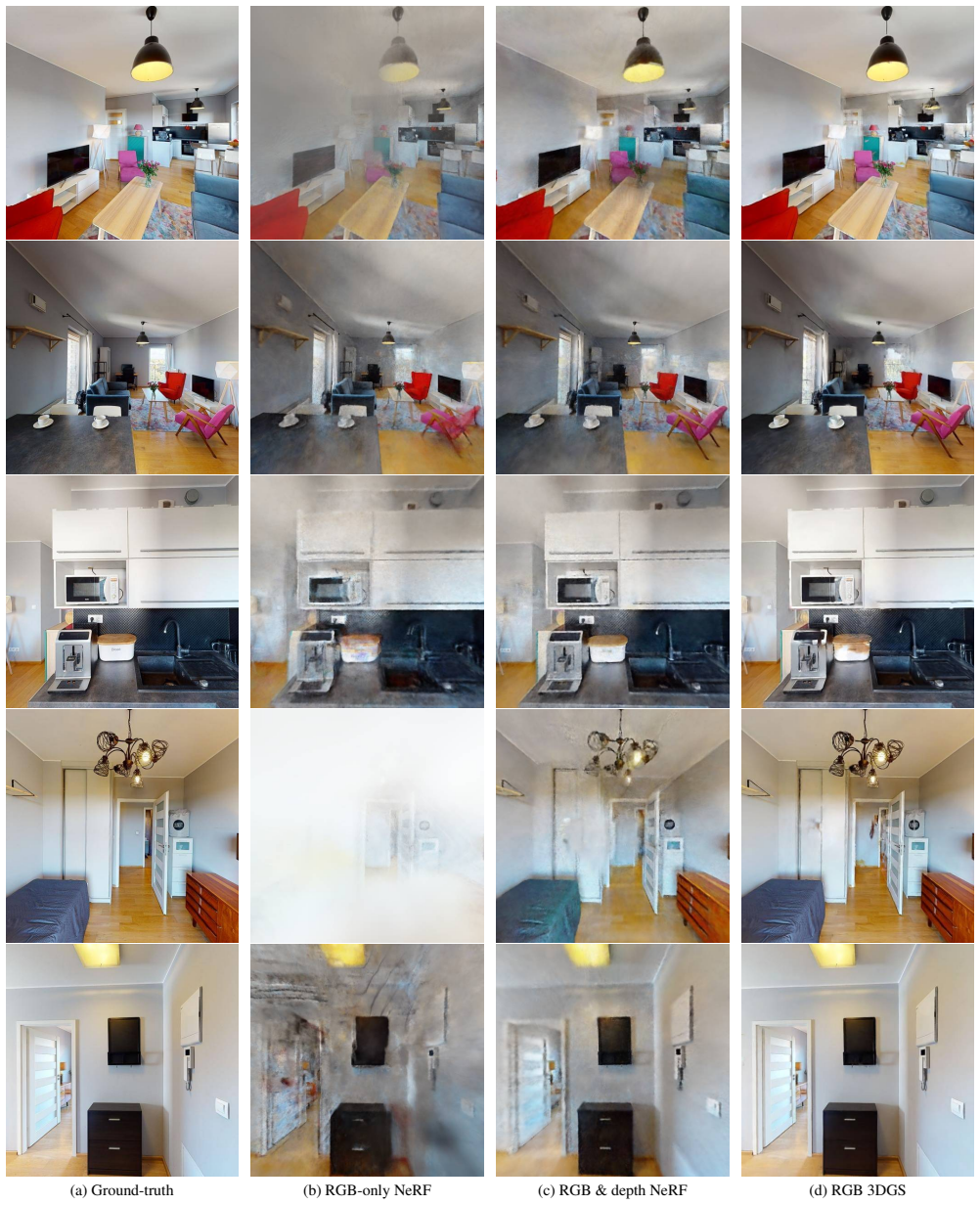
Pith. "Pith review of Defurnishing with X-Ray Vision: Joint Removal of Furniture from Panoramas and Mesh." pith.science (2026). https://pith.science/paper/ASHMRTJY
@misc{pith2026250605338,
  author       = {Pith},
  title        = {Pith review of: Defurnishing with X-Ray Vision: Joint Removal of Furniture from Panoramas and Mesh},
  year         = {2026},
  howpublished = {\url{https://pith.science/paper/ASHMRTJY}},
  note         = {Machine review of arXiv:2506.05338}
}
read the original abstract
We present a pipeline for generating defurnished replicas of indoor spaces represented as textured meshes and corresponding multi-view panoramic images. To achieve this, we first segment and remove furniture from the mesh representation, extend planes, and fill holes, obtaining a simplified defurnished mesh (SDM). This SDM acts as an ``X-ray'' of the scene's underlying structure, guiding the defurnishing process. We extract Canny edges from depth and normal images rendered from the SDM. We then use these as a guide to remove the furniture from panorama images via ControlNet inpainting. This control signal ensures the availability of global geometric information that may be hidden from a particular panoramic view by the furniture being removed. The inpainted panoramas are used to texture the mesh. We show that our approach produces higher quality assets than methods that rely on neural radiance fields, which tend to produce blurry low-resolution images, or RGB-D inpainting, which is highly susceptible to hallucinations.
Figures


Figures from the paper (13 more)




Reference graph
Works this paper leans on
-
[1]
Connelly Barnes, Eli Shechtman, Adam Finkelstein, and Dan B. Goldman. PatchMatch: a Randomized Correspon- dence Algorithm for Structural Image Editing.ACM SIG- GRAPH 2009 papers, 2009. 2
work page 2009
-
[2]
Kinetic shape reconstruction.ACM Transactions on Graphics (TOG), 39 (5):1–14, 2020
Jean-Philippe Bauchet and Florent Lafarge. Kinetic shape reconstruction.ACM Transactions on Graphics (TOG), 39 (5):1–14, 2020. 3
work page 2020
-
[3]
Marcelo Bertalmio, Guillermo Sapiro, Vincent Caselles, and Coloma Ballester. Image inpainting. InProceedings of the 27th Annual Conference on Computer Graphics and Interactive Techniques, page 417–424, USA, 2000. ACM Press/Addison-Wesley Publishing Co. 2
work page 2000
-
[4]
A computational approach to edge detection
John Canny. A computational approach to edge detection. IEEE Transactions on pattern analysis and machine intelli- gence, (6):679–698, 1986. 4
work page 1986
-
[5]
Angel Chang, Angela Dai, Thomas Funkhouser, Maciej Hal- ber, Matthias Niessner, Manolis Savva, Shuran Song, Andy Zeng, and Yinda Zhang. Matterport3D: Learning from RGB- D Data in Indoor Environments.International Conference on 3D Vision (3DV), 2017. 5, 6, 7, 1
work page 2017
-
[6]
Vision Transformer Adapter for Dense Predictions, 2023
Zhe Chen, Yuchen Duan, Wenhai Wang, Junjun He, Tong Lu, Jifeng Dai, and Yu Qiao. Vision Transformer Adapter for Dense Predictions, 2023. 3
work page 2023
-
[7]
MeshLab: an Open-Source Mesh Processing Tool
Paolo Cignoni, Marco Callieri, Massimiliano Corsini, Mat- teo Dellepiane, Fabio Ganovelli, and Guido Ranzuglia. MeshLab: an Open-Source Mesh Processing Tool. InEuro- graphics Italian Chapter Conference. The Eurographics As- sociation, 2008. 4, 3
work page 2008
-
[8]
Ob- ject Removal by Exemplar-Based Inpainting
Antonio Criminisi, Patrick P ´erez, and Kentaro Toyama. Ob- ject Removal by Exemplar-Based Inpainting. InIEEE/CVF Conference on Computer Vision and Pattern Recognition (CVPR), pages 721–728, 2003. 2
work page 2003
Show all 70 references
-
[9]
Chang, Manolis Savva, Maciej Hal- ber, Thomas Funkhouser, and Matthias Nießner
Angela Dai, Angel X. Chang, Manolis Savva, Maciej Hal- ber, Thomas Funkhouser, and Matthias Nießner. ScanNet: Richly-annotated 3D Reconstructions of Indoor Scenes. In Proc. Computer Vision and Pattern Recognition (CVPR), IEEE, 2017. 5, 8, 1
2017
-
[10]
Scancomplete: Large- scale scene completion and semantic segmentation for 3d scans
Angela Dai, Daniel Ritchie, Martin Bokeloh, Scott Reed, J¨urgen Sturm, and Matthias Nießner. Scancomplete: Large- scale scene completion and semantic segmentation for 3d scans. InProceedings of the IEEE Conference on Computer Vision and Pattern Recognition, pages 4578–4587, 2018. 2
2018
-
[11]
Sg-nn: Sparse generative neural networks for self-supervised scene completion of rgb-d scans
Angela Dai, Christian Diller, and Matthias Nießner. Sg-nn: Sparse generative neural networks for self-supervised scene completion of rgb-d scans. InProceedings of the IEEE/CVF Conference on Computer Vision and Pattern Recognition, pages 849–858, 2020. 2
2020
-
[12]
Spsg: Self-supervised photomet- ric scene generation from rgb-d scans
Angela Dai, Yawar Siddiqui, Justus Thies, Julien Valentin, and Matthias Nießner. Spsg: Self-supervised photomet- ric scene generation from rgb-d scans. InProceedings of the IEEE/CVF Conference on Computer Vision and Pattern Recognition, pages 1747–1756, 2021. 2
2021
-
[13]
Objaverse: A Universe of Annotated 3D Objects, 2022
Matt Deitke, Dustin Schwenk, Jordi Salvador, Luca Weihs, Oscar Michel, Eli VanderBilt, Ludwig Schmidt, Kiana Ehsani, Aniruddha Kembhavi, and Ali Farhadi. Objaverse: A Universe of Annotated 3D Objects, 2022. 7
2022
-
[14]
Diffusion Mod- els Beat GANs on Image Synthesis
Prafulla Dhariwal and Alexander Nichol. Diffusion Mod- els Beat GANs on Image Synthesis. InAdvances in Neu- ral Information Processing Systems. Curran Associates, Inc.,
-
[15]
Instruct-NeRF2NeRF: Editing 3D Scenes with Instructions
Ayaan Haque, Matthew Tancik, Alexei Efros, Aleksander Holynski, and Angjoo Kanazawa. Instruct-NeRF2NeRF: Editing 3D Scenes with Instructions. InIEEE/CVF Inter- national Conference on Computer Vision (ICCV), 2023. 2, 6, 1, 9
2023
-
[16]
James Hays and Alexei A. Efros. Scene Completion using Millions of Photographs.ACM Transactions on Graphics, 26(3):4–es, 2007. 2
2007
-
[17]
Globally and Locally Consistent Image Completion.ACM Transactions on Graphics, 36:1–14, 2017
Satoshi Iizuka, Edgar Simo-Serra, and Hiroshi Ishikawa. Globally and Locally Consistent Image Completion.ACM Transactions on Graphics, 36:1–14, 2017. 2
2017
-
[18]
Free-form 3D scene inpainting with dual-stream GAN
Ru-Fen Jheng, Tsung-Han Wu, Jia-Fong Yeh, and Winston H Hsu. Free-form 3D scene inpainting with dual-stream GAN. arXiv preprint arXiv:2212.08464, 2022. 2
2022 arXiv
-
[19]
Virtual Home Staging: Inverse Rendering and Editing an Indoor Panorama under Natural Illumination
Guanzhou Ji, Azadeh O Sawyer, and Srinivasa G Narasimhan. Virtual Home Staging: Inverse Rendering and Editing an Indoor Panorama under Natural Illumination. In International Symposium on Visual Computing, 2023. 2
2023
-
[20]
Poisson surface reconstruction
Michael Kazhdan, Matthew Bolitho, and Hugues Hoppe. Poisson surface reconstruction. InProceedings of the fourth Eurographics symposium on Geometry processing, 2006. 2
2006
-
[21]
Multi-view inpainting for rgb-d sequence
Feiran Li, Gustavo Alfonso Garcia Ricardez, Jun Takamatsu, and Tsukasa Ogasawara. Multi-view inpainting for rgb-d sequence. In2018 International Conference on 3D Vision (3DV), pages 464–473. IEEE, 2018. 2
2018
-
[22]
Magic3d: High-resolution text-to-3d content creation
Chen-Hsuan Lin, Jun Gao, Luming Tang, Towaki Takikawa, Xiaohui Zeng, Xun Huang, Karsten Kreis, Sanja Fidler, Ming-Yu Liu, and Tsung-Yi Lin. Magic3d: High-resolution text-to-3d content creation. InProceedings of the IEEE/CVF conference on computer vision and pattern recognition...
2023
-
[23]
Reda, Kevin J
Guilin Liu, Fitsum A. Reda, Kevin J. Shih, Ting-Chun Wang, Andrew Tao, and Bryan Catanzaro. Image Inpainting for Irregular Holes Using Partial Convolutions, 2018. 2
2018
-
[24]
RePaint: Inpainting using Denoising Diffusion Probabilistic Models, 2022
Andreas Lugmayr, Martin Danelljan, Andres Romero, Fisher Yu, Radu Timofte, and Luc Van Gool. RePaint: Inpainting using Denoising Diffusion Probabilistic Models, 2022. 2
2022
-
[25]
Mantiuk, Gyorgy Denes, Alexandre Chapiro, Anton Kaplanyan, Gizem Rufo, Romain Bachy, Trisha Lian, and Anjul Patney
Rafał K. Mantiuk, Gyorgy Denes, Alexandre Chapiro, Anton Kaplanyan, Gizem Rufo, Romain Bachy, Trisha Lian, and Anjul Patney. FovVideoVDP: a visible difference predictor for wide field-of-view video.ACM Transactions on Graphics (SIGGRAPH), 40(4), 2021. 5
2021
-
[26]
Nerf: Representing scenes as neural radiance fields for view syn- thesis.Communications of the ACM, 65(1):99–106, 2021
Ben Mildenhall, Pratul P Srinivasan, Matthew Tancik, Jonathan T Barron, Ravi Ramamoorthi, and Ren Ng. Nerf: Representing scenes as neural radiance fields for view syn- thesis.Communications of the ACM, 65(1):99–106, 2021. 2
2021
-
[27]
Reference-guided control- lable inpainting of neural radiance fields
Ashkan Mirzaei, Tristan Aumentado-Armstrong, Marcus A Brubaker, Jonathan Kelly, Alex Levinshtein, Konstantinos G Derpanis, and Igor Gilitschenski. Reference-guided control- lable inpainting of neural radiance fields. InProceedings of the IEEE/CVF international conference on co...
2023
-
[28]
Spin-nerf: Multiview segmentation and perceptual inpainting with neural radiance fields
Ashkan Mirzaei, Tristan Aumentado-Armstrong, Konstanti- nos G Derpanis, Jonathan Kelly, Marcus A Brubaker, Igor Gilitschenski, and Alex Levinshtein. Spin-nerf: Multiview segmentation and perceptual inpainting with neural radiance fields. InProceedings of the IEEE/CVF Conferenc...
-
[29]
Self-supervised point cloud completion via inpainting.arXiv preprint arXiv:2111.10701, 2021
Himangi Mittal, Brian Okorn, Arpit Jangid, and David Held. Self-supervised point cloud completion via inpainting.arXiv preprint arXiv:2111.10701, 2021. 2
2021 arXiv
-
[30]
3d pixmix: Image inpainting in 3d environments
Shohei Mori, Jan Herling, Wolfgang Broll, Norihiko Kawai, Hideo Saito, Dieter Schmalstieg, and Denis Kalkofen. 3d pixmix: Image inpainting in 3d environments. In2018 IEEE International Symposium on Mixed and Augmented Reality Adjunct (ISMAR-Adjunct), pages 1–2. IEEE, 2018. 2
2018
-
[31]
EdgeConnect: Structure Guided Im- age Inpainting using Edge Prediction
Kamyar Nazeri, Eric Ng, Tony Joseph, Faisal Qureshi, and Mehran Ebrahimi. EdgeConnect: Structure Guided Im- age Inpainting using Edge Prediction. InProceedings of the IEEE/CVF International Conference on Computer Vision (ICCV) Workshops, 2019. 2
2019
-
[32]
An Iterative Regularization Method for Total Variation-Based Image Restoration.Multiscale Modeling & Simulation, 4(2):460–489, 2005
Stanley Osher, Martin Burger, Donald Goldfarb, Jinjun Xu, and Wotao Yin. An Iterative Regularization Method for Total Variation-Based Image Restoration.Multiscale Modeling & Simulation, 4(2):460–489, 2005. 2
2005
-
[33]
Deepak Pathak, Philipp Krahenbuhl, Jeff Donahue, Trevor Darrell, and Alexei A. Efros. Context Encoders: Feature Learning by Inpainting, 2016. 2
2016
-
[34]
Shape as points: A dif- ferentiable poisson solver.Advances in Neural Information Processing Systems, 34:13032–13044, 2021
Songyou Peng, Chiyu Jiang, Yiyi Liao, Michael Niemeyer, Marc Pollefeys, and Andreas Geiger. Shape as points: A dif- ferentiable poisson solver.Advances in Neural Information Processing Systems, 34:13032–13044, 2021. 2
2021
-
[35]
Plane-based multi-view inpainting for image-based rendering in large scenes
Julien Philip and George Drettakis. Plane-based multi-view inpainting for image-based rendering in large scenes. InPro- ceedings of the ACM SIGGRAPH Symposium on Interactive 3D Graphics and Games, pages 1–11, 2018. 2
2018
-
[36]
Barron, and Ben Milden- hall
Ben Poole, Ajay Jain, Jonathan T. Barron, and Ben Milden- hall. DreamFusion: Text-to-3D using 2D Diffusion. InIn- ternational Conference on Learning Representations (ICLR),
-
[37]
Inpaint3D: 3D Scene Content Generation using 2D Inpainting Diffusion
Kira Prabhu, Jane Wu, Lynn Tsai, Peter Hedman, Dan B Goldman, Ben Poole, and Michael Broxton. Inpaint3D: 3D Scene Content Generation using 2D Inpainting Diffusion. arXiv preprint arXiv:2312.03869, 2023. 2
2023 arXiv
-
[38]
3D Paramet- ric Room Representation with RoomPlan.https : / / machinelearning
Apple Computer Vision Research. 3D Paramet- ric Room Representation with RoomPlan.https : / / machinelearning . apple . com / research / roomplan, 2022. 3
2022
-
[39]
High-Resolution Image Synthesis with Latent Diffusion Models.arXiv preprint arXiv:2112.10752, 2021
Robin Rombach, Andreas Blattmann, Dominik Lorenz, Patrick Esser, and Bj ¨orn Ommer. High-Resolution Image Synthesis with Latent Diffusion Models.arXiv preprint arXiv:2112.10752, 2021. 2
2021 arXiv
-
[40]
LAION-5B: An open large-scale dataset for training next generation image-text models
Christoph Schuhmann, Romain Beaumont, Richard Vencu, Cade Gordon, Ross Wightman, Mehdi Cherti, Theo Coombes, Aarush Katta, Clayton Mullis, Mitchell Worts- man, Patrick Schramowski, Srivatsa Kundurthy, Katherine Crowson, Ludwig Schmidt, Robert Kaczmarczyk, and Jenia Jitsev. LAI...
2022
-
[41]
Example-based 3d inpainting of point clouds using metric tensor and christof- fel symbols.Machine Vision and Applications, 29:329–343,
Shankar Setty and Uma Mudenagudi. Example-based 3d inpainting of point clouds using metric tensor and christof- fel symbols.Machine Vision and Applications, 29:329–343,
-
[42]
An Empty Room is All We Want: Au- tomatic Defurnishing of Indoor Panoramas
Mira Slavcheva, Dave Gausebeck, Kevin Chen, David Buch- hofer, Azwad Sabik, Chen Ma, Sachal Dhillon, Olaf Brandt, and Alan Dolhasz. An Empty Room is All We Want: Au- tomatic Defurnishing of Indoor Panoramas. InIEEE/CVF Conference on Computer Vision and Pattern Recognition Work...
2024
-
[43]
Yuhang Song, Chao Yang, Yeji Shen, Peng Wang, Qin Huang, and C. C. Jay Kuo. SPG-Net: Segmentation Pre- diction and Guidance Network for Image Inpainting, 2018. 2
2018
-
[44]
Resolution-robust Large Mask Inpainting with Fourier Convolutions
Roman Suvorov, Elizaveta Logacheva, Anton Mashikhin, Anastasia Remizova, Arsenii Ashukha, Aleksei Silvestrov, Naejin Kong, Harshith Goka, Kiwoong Park, and Victor Lempitsky. Resolution-robust Large Mask Inpainting with Fourier Convolutions. InWinter Conference on Applications ...
2022
-
[45]
Nerfstudio: A Modu- lar Framework for Neural Radiance Field Development
Matthew Tancik, Ethan Weber, Evonne Ng, Ruilong Li, Brent Yi, Justin Kerr, Terrance Wang, Alexander Kristof- fersen, Jake Austin, Kamyar Salahi, Abhik Ahuja, David McAllister, and Angjoo Kanazawa. Nerfstudio: A Modu- lar Framework for Neural Radiance Field Development. In ACM ...
2023
-
[46]
MVDiffusion: Enabling Holistic Multi- view Image Generation with Correspondence-Aware Diffu- sion
Shitao Tang, Fuyang Zhang, Jiacheng Chen, Peng Wang, and Yasutaka Furukawa. MVDiffusion: Enabling Holistic Multi- view Image Generation with Correspondence-Aware Diffu- sion. InConference on Neural Information Processing Sys- tems (NeurIPS), 2023. 8
2023
-
[47]
An Image Inpainting Technique Based on the Fast Marching Method.Journal of Graphics Tools, 9,
Alexandru Telea. An Image Inpainting Technique Based on the Fast Marching Method.Journal of Graphics Tools, 9,
-
[48]
Multi-view inpainting for image-based scene edit- ing and rendering
Theo Thonat, Eli Shechtman, Sylvain Paris, and George Drettakis. Multi-view inpainting for image-based scene edit- ing and rendering. In2016 Fourth International Conference on 3D Vision (3DV), pages 351–359. IEEE, 2016. 2
2016
-
[49]
Instruct-GS2GS: Edit- ing 3D Gaussian Splats with Instructions.https : / / instruct-gs2gs.github.io/, 2024
Cyrus Vachha and Ayaan Haque. Instruct-GS2GS: Edit- ing 3D Gaussian Splats with Instructions.https : / / instruct-gs2gs.github.io/, 2024. 2, 6, 1, 10
2024
-
[50]
Semantic UV Mapping to Improve Texture Inpainting for 3D Scanned Indoor Scenes
Jelle Vermandere, Maarten Bassier, Suzanna Cuypers, and Maarten Vergauwen. Semantic UV Mapping to Improve Texture Inpainting for 3D Scanned Indoor Scenes. InEG UK Computer Graphics and Visual Computing, 2024. 3
2024
-
[51]
Innerf360: Text-guided 3d-consistent object in- painting on 360-degree neural radiance fields
Dongqing Wang, Tong Zhang, Alaa Abboud, and Sabine S¨usstrunk. Innerf360: Text-guided 3d-consistent object in- painting on 360-degree neural radiance fields. InProceed- ings of the IEEE/CVF Conference on Computer Vision and Pattern Recognition, pages 12677–12686, 2024. 2
2024
-
[52]
3D model in- painting based on 3D deep convolutional generative adver- sarial network.IEEE Access, 8:170355–170363, 2020
Xinying Wang, Dikai Xu, and Fangming Gu. 3D model in- painting based on 3D deep convolutional generative adver- sarial network.IEEE Access, 8:170355–170363, 2020. 2
2020
-
[53]
Real-esrgan: Training real-world blind super-resolution with 10 pure synthetic data
Xintao Wang, Liangbin Xie, Chao Dong, and Ying Shan. Real-esrgan: Training real-world blind super-resolution with 10 pure synthetic data. InProceedings of the IEEE/CVF inter- national conference on computer vision, pages 1905–1914,
1905
-
[54]
Bovik, H.R
Zhou Wang, A.C. Bovik, H.R. Sheikh, and E.P. Simoncelli. Image Quality Assessment: From Error Visibility to Struc- tural Similarity.IEEE Transactions on Image Processing, 13 (4), 2004. 5
2004
-
[55]
Prolificdreamer: High-fidelity and diverse text-to-3d generation with variational score distilla- tion.Advances in Neural Information Processing Systems, 36:8406–8441, 2023
Zhengyi Wang, Cheng Lu, Yikai Wang, Fan Bao, Chongxuan Li, Hang Su, and Jun Zhu. Prolificdreamer: High-fidelity and diverse text-to-3d generation with variational score distilla- tion.Advances in Neural Information Processing Systems, 36:8406–8441, 2023. 2
2023
-
[56]
NeRFiller: Completing Scenes via Generative 3D Inpainting
Ethan Weber, Aleksander Holynski, Varun Jampani, Saurabh Saxena, Noah Snavely, Abhishek Kar, and Angjoo Kanazawa. NeRFiller: Completing Scenes via Generative 3D Inpainting. InIEEE/CVF Conference on Computer Vi- sion and Pattern Recognition (CVPR), 2024. 2, 6, 7, 1
2024
-
[57]
Removing Objects from Neural Radiance Fields
Silvan Weder, Guillermo Garcia-Hernando, ´Aron Monsz- part, Marc Pollefeys, Gabriel Brostow, Michael Firman, and Sara Vicente. Removing Objects from Neural Radiance Fields. InIEEE/CVF Conference on Computer Vision and Pattern Recognition (CVPR), 2023. 2
2023
-
[58]
Clutter Detection and Removal in 3D Scenes with View-Consistent Inpainting
Fangyin Wei, Thomas Funkhouser, and Szymon Rusinkiewicz. Clutter Detection and Removal in 3D Scenes with View-Consistent Inpainting. InIEEE/CVF International Conference on Computer Vision (ICCV), 2023. 2, 8
2023
-
[59]
ObjectDrop: Boot- strapping Counterfactuals for Photorealistic Object Removal and Insertion
Daniel Winter, Matan Cohen, Shlomi Fruchter, Yael Pritch, Alex Rav-Acha, and Yedid Hoshen. ObjectDrop: Boot- strapping Counterfactuals for Photorealistic Object Removal and Insertion. InEuropean Conference on Computer Vision (ECCV), 2024. 2, 5
2024
-
[60]
Cooperative Semantic Segmentation and Image Restoration in Adverse Environmental Conditions, 2020
Weihao Xia, Zhanglin Cheng, Yujiu Yang, and Jing-Hao Xue. Cooperative Semantic Segmentation and Image Restoration in Adverse Environmental Conditions, 2020. 3
2020
-
[61]
Jiahui Yu, Zhe Lin, Jimei Yang, Xiaohui Shen, Xin Lu, and Thomas S. Huang. Generative Image Inpainting with Con- textual Attention, 2018. 2
2018
-
[62]
Free-Form Image Inpainting with Gated Convolution, 2019
Jiahui Yu, Zhe Lin, Jimei Yang, Xiaohui Shen, Xin Lu, and Thomas Huang. Free-Form Image Inpainting with Gated Convolution, 2019. 2
2019
-
[63]
Finding Good Configurations of Planar Primitives in Unorganized Point Clouds
Mulin Yu and Florent Lafarge. Finding Good Configurations of Planar Primitives in Unorganized Point Clouds. InPro- ceedings of the IEEE/CVF Conference on Computer Vision and Pattern Recognition (CVPR), pages 6367–6376, 2022. 3
2022
-
[64]
Learning pyramid-context encoder network for high- quality image inpainting
Yanhong Zeng, Jianlong Fu, Hongyang Chao, and Baining Guo. Learning pyramid-context encoder network for high- quality image inpainting. InProceedings of the IEEE/CVF conference on computer vision and pattern recognition, pages 1486–1494, 2019. 2
2019
-
[65]
Adding Conditional Control to Text-to-Image Diffusion Models
Lvmin Zhang, Anyi Rao, and Maneesh Agrawala. Adding Conditional Control to Text-to-Image Diffusion Models. In IEEE/CVF International Conference on Computer Vision (ICCV), 2023. 2, 6
2023
-
[66]
The Unreasonable Effectiveness of Deep Features as a Perceptual Metric
Richard Zhang, Phillip Isola, Alexei A Efros, Eli Shechtman, and Oliver Wang. The Unreasonable Effectiveness of Deep Features as a Perceptual Metric. InCVPR, 2018. 5
2018
-
[67]
Multi-HexPlanes: A Lightweight Map Representa- tion for Rendering and 3D Reconstruction
Jianhao Zheng, G ´abor Valasek, Daniel Barath, and Iro Ar- meni1. Multi-HexPlanes: A Lightweight Map Representa- tion for Rendering and 3D Reconstruction. InWinter Con- ference on Applications of Computer Vision (WACV), 2025. 3 11 Defurnishing with X-Ray Vision: Joint Removal ...
2025
-
[68]
Figure 8 shows perspective images corresponding to our inpainted panoramas for easier evaluation of qualities like line straightness
Results We include higher-resolution versions and more examples for several of the figures in the main paper. Figure 8 shows perspective images corresponding to our inpainted panoramas for easier evaluation of qualities like line straightness. Figure 9 adds more viewpoints of ...
-
[69]
We ran these experiments on Matterport3D [5] and Scan- Net [9] data
Radiance Fields Methods Here we add details and results from our experiments with methods that rely on radiance fields for object removal. We ran these experiments on Matterport3D [5] and Scan- Net [9] data. For Matterport3D we show a small studio apartment, consisting of 180 ...
-
[70]
We be- gan with a dataset of unfurnished 3D spaces, represented as meshes and corresponding panos
Quantitative Evaluation on Synthetic Data To evaluate the performance of our method against Ner- filler, we conducted experiments using synthetically fur- nished 360° panoramas and corresponding mesh. We be- gan with a dataset of unfurnished 3D spaces, represented as meshes an...
Reviewed August 7, 2026 · model on record in the stance chip above.
Discussion (0). Continue with ORCID to comment.