REVIEW 4 major objections 5 minor 39 references
Bayesian Inverse Physics for Neuro-Symbolic Robot Learning
T0 review · 4 major / 5 minor · reviewed 2026-08-07 · deepseek-v4-flash
Pith's one-line read This position paper claims that robots need hybrid neuro-symbolic learning—differentiable physics, Bayesian inference, and program synthesis—rather than ever-larger deep learning models.
desk verdict A competent and honest position paper that repackages three established research lines into a plausible roadmap, but the 'essential' claim overreaches without any proof of concept. read the letter →
The pith
A machine-rendered reading of the paper's core claim, the machinery that carries it, and where it could break.
The reading
What carries the argument
The load-bearing mechanism is the inverse problem set up over a differentiable physics simulator, treated as a probabilistic forward model. The robot observes a measurement, such as an image or a contact state, and infers the physical parameters (mesh vertices, light sources, joint torques, contact properties) through Bayes' rule, using automatic differentiation to run gradient-based samplers. Program synthesis enters through a domain-specific language of reusable primitives; a transdimensional sampler such as reversible-jump MCMC can jump between program structures of different complexity, letting the robot grow its library of physical concepts. This arrangement is what makes generalization beyond training data possible in principle: the physics enforces consistency, the Bayesian posterior quantifies what is unknown, and the program library supplies an open-ended representation for new concepts.
What would settle it
Train a hybrid system using the paper's roadmap on a standard few-shot manipulation benchmark and compare success rate and the number of demonstrations needed against a current vision-language-action model; if the hybrid does not match or exceed the data efficiency, the central claim is false.
Extended reading notes
Core claim
On its own terms, the paper's central discovery is that the limitations of current robot foundation models—sample inefficiency, overconfident errors, and lack of physical knowledge—are not incidental but structural, and that a single alternative structure addresses all three: invert a differentiable physics simulator in a Bayesian way, and let program synthesis grow the model. The authors call this Bayesian inverse physics. They argue that because physics is the most accurate known predictive model of the world, using it directly is more sample-efficient than approximating it with a network; because Bayesian inference produces principled uncertainties, it supports trust and safety in human-robot collaboration; and because programs are composable and reusable, they allow the robot to keep learning without forgetting. The paper does not provide an implementation; it gives a conceptual framework and a research roadmap for building one.
Load-bearing premise
The central premise is that differentiable physics, Bayesian inference, and program synthesis can be combined into a single system that remains tractable in real time and keeps the promised sample-efficiency advantage; if integration proves intractable or the advantage vanishes when scaled to real robots, the claim that hybrids are essential collapses.
Editorial extensions
If this is right
- Robot learning could become dramatically more sample-efficient because known physics is encoded rather than re-learned from data.
- Reliable uncertainty estimates would let robots flag out-of-distribution states and behave safely in close proximity to humans.
- Program synthesis over a physical domain-specific language would allow a robot to add new concepts and tasks over its lifetime without catastrophic forgetting.
- A hybrid system could beat current vision-language-action models on data efficiency, since it does not need to rediscover physical laws from demonstrations.
Reading between the lines
- The argument implies that the current race to collect ever-larger robot demonstration datasets may be a dead end for autonomy, since the data bottleneck is a symptom of ignoring model structure; the field's scarce resource should be simulator development and Bayesian inference infrastructure, not additional trajectory data.
- A testable prediction follows: on a fixed demonstration budget, a physics-grounded hybrid should outperform a similarly sized black-box policy on unseen object shapes and contact-rich tasks; benchmarks that isolate few-shot generalization would directly measure this.
- If the roadmap is realized, the role of foundation models would shift from end-to-end controllers to auxiliary components, which suggests that investment in interpretable model-building tools, not scale, is the binding constraint for general-purpose robotics.
Editorial analysis
A structured set of objections, weighed in public.
Referee Report
Summary. This position paper argues that hybrid neuro-symbolic architectures, combining differentiable physics, Bayesian inference, and program synthesis, are essential for next-generation autonomous robots. It critiques deep learning and foundation models for high data and computational demands, safety concerns from overconfident black-box predictions, and a lack of integrated physical knowledge. It then surveys three building blocks—differentiable physics for perception and action, Bayesian inference for uncertainty quantification, and program synthesis for continual model expansion—and proposes a research roadmap that includes domain-specific languages, differentiable simulators, Bayesian probabilistic models, deep-learning-guided search, and continual library learning. The paper contains no experiments or formal analysis; instead, it offers a conceptual framework and explicitly acknowledges several open challenges in Section 4.
Significance. If the proposed integration is realized, the work could contribute to addressing real weaknesses of current robot learning, particularly sample efficiency, physical consistency, and interpretable uncertainty. The paper is valuable as a synthesis of three mature research threads and it is honest in Section 4 about the substantial difficulties of combining them. However, the central claim that hybrid architectures are 'essential' is not supported by any proof of concept, quantitative comparison, or formal argument; the paper itself concedes that seamless integration is a huge challenge. The significance is therefore prospective rather than demonstrated, though the roadmap could help focus future research if the overclaim is moderated.
major comments (4)
- [Abstract and Section 4] The central claim that hybrid neuro-symbolic architectures are 'essential' for the next generation of autonomous systems is not supported by the evidence presented in the paper. The paper is explicitly a position paper with a roadmap, and the last paragraph of Section 4 concedes that 'the seamless integration of symbolic program synthesis, neural networks and differentiable physics engines constitutes a huge challenge' and that 'Bayesian inverse physics demands extensive simulations and high-dimensional sampling.' Without a minimal proof of concept, a formal analysis, or a quantitative comparison against black-box baselines, the word 'essential' overstates what the paper establishes. I recommend either softening the claim to describe the hybrid direction as promising and worthy of investigation, or adding a concrete demonstration (even on a simplified benchmark) that the combined pipeline preserves the sample-efficiency advantages it invokes.
- [Section 3.2, in conjunction with Section 3.1] The paper suggests using Hamiltonian Monte Carlo (HMC) with differentiable physics simulations for Bayesian inference, but does not address the non-smoothness of contact-rich robot dynamics. HMC requires gradients of the target distribution, and differentiable simulators for contact-rich scenes often have discontinuous or highly stiff gradients at contact events; the paper mentions differentiable hydroelastic contact models in Section 3.1 without analyzing whether their gradients are suitable for HMC or whether the multi-modal posteriors that arise in contact-rich tasks will cause sampling difficulties. This is a load-bearing technical tension for the proposed inference pipeline. The roadmap should either restrict the claim to smooth dynamical domains, or discuss concrete remedies (e.g., smoothed contact models, reparameterization, surrogate gradients, or variational approximations) and their limitations.
- [Sections 2 and 4] The paper's efficiency argument is incomplete because it compares sample counts without accounting for total computational cost. Section 2 criticizes large black-box models on the grounds of data and compute, and Section 3.2 argues that Bayesian inference 'requires fewer samples and parameters' but admits that it is 'computationally complex'; Section 4 then acknowledges that inference is 'computationally expensive and challenging for real-time robotic decision-making.' A fair comparison should report the total resource cost (environment interactions plus compute time) for the hybrid pipeline versus a black-box policy learning baseline. Without such a comparison, the claim that the hybrid approach is more efficient in any practically meaningful sense is not established. At minimum, the roadmap should state the intended cost metric and propose benchmark tasks where this trade-off can be measured.
- [Section 3.3 and Section 4] The program synthesis component introduces a combinatorial discrete search whose cost is not analyzed in the proposed combination. Section 3.3 correctly notes that brute-force search over program trees is infeasible and that deep learning can guide the search, but the roadmap does not explain how the neural search cost scales with the DSL size, nor how Bayesian model selection over programs (e.g., via RJMCMC) interacts with the already expensive Bayesian inference over continuous physical parameters. The paper should include a discussion of the expected computational bottleneck of the combined search-and-inference process, or provide a small-scale experiment isolating the program synthesis cost, to support the feasibility of the proposed framework.
minor comments (5)
- [Section 2.3] There is a formatting artifact in 'use a physics functionp' where the mathematical symbol p is not properly separated from the word 'function'; this should be typeset consistently as 'function p'.
- [Section 3.1] The citation 'Pharretal.,2023' has missing spaces and should be formatted as 'Pharr et al., 2023' in the text.
- [References] The reference to 'Landau and Lifshifts' contains a typo; the correct author name is Landau and Lifshitz.
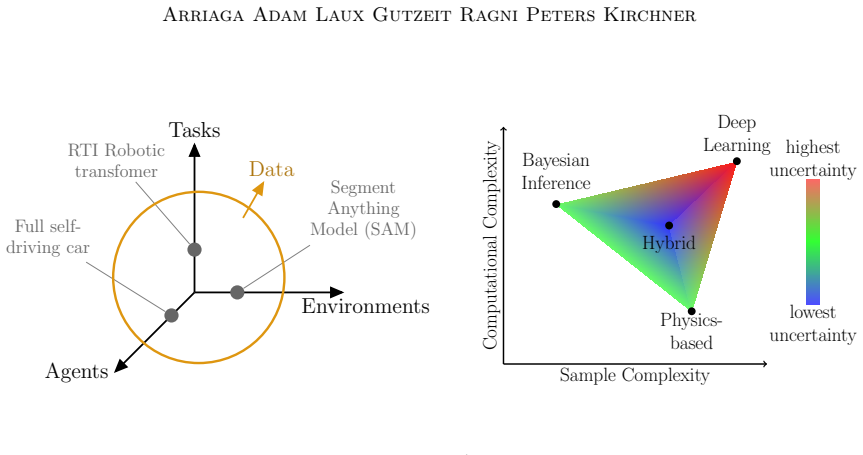
- [Figure 1] The right panel's caption states that the hybrid approach 'optimally minimizes uncertainty' and yields the 'best achievable compromise' between sample and computational complexity, but the paper provides no formal notion of optimality; this wording should be softened to avoid an unsupported quantitative claim.
- [Section 4] The roadmap would benefit from a concise formal definition of the Bayesian inverse problem that the framework intends to solve, including the specific priors, likelihoods, and latent variables for a canonical task such as tool use or object manipulation; this would make the connection between differentiable physics, Bayesian inference, and program synthesis more concrete.
Circularity Check
No circularity: the paper is a position/roadmap with no fitted parameters or derived predictions; its one self-citation is illustrative, not load-bearing.
full rationale
This is a position paper: it argues for a research direction combining differentiable physics, Bayesian inference, and program synthesis, and it provides a roadmap. There is no derivation chain, no fitted parameter called a prediction, and no equation whose output equals its input. The only self-citation is Arriaga et al. 2024, cited in Section 3.1 as an example of differentiable graphics engines used for object reconstruction; this is illustrative background, not load-bearing support for the paper's central claim. The roadmap's components are individually grounded in extensive external literature (e.g., MuJoCo, Brax, Gen, DreamCoder, BlackJAX), and the proposed DSL step explicitly draws on Pyro and JAX rather than on the authors' prior work. No uniqueness theorem or ansatz is imported from the authors' own publications. The paper's own concession in Section 4 that 'the seamless integration of symbolic program synthesis, neural networks and differentiable physics engines constitutes a huge challenge' is an honest limitation statement, not evidence of circularity. The central 'essential' claim is an unsupported opinion but not a circular one; concerns about feasibility belong to correctness risk, not circularity. Therefore the appropriate circularity score is 0.
Assumptions & free parameters
assumptions (3)
- domain assumption Physics simulators and differentiable physics models are accurate and fast enough to serve as world models for robotics.
- domain assumption Program synthesis with deep learning and RJMCMC can scale to real-time, continuous robot control.
- domain assumption Combining Bayesian inference with physics-based models yields acceptable sample and computational complexity tradeoffs.
Cite this review
Pith. "Pith review of Bayesian Inverse Physics for Neuro-Symbolic Robot Learning." pith.science (2026). https://pith.science/paper/ASRJNADT
@misc{pith2026250608756,
  author       = {Pith},
  title        = {Pith review of: Bayesian Inverse Physics for Neuro-Symbolic Robot Learning},
  year         = {2026},
  howpublished = {\url{https://pith.science/paper/ASRJNADT}},
  note         = {Machine review of arXiv:2506.08756}
}
read the original abstract
Real-world robotic applications, from autonomous exploration to assistive technologies, require adaptive, interpretable, and data-efficient learning paradigms. While deep learning architectures and foundation models have driven significant advances in diverse robotic applications, they remain limited in their ability to operate efficiently and reliably in unknown and dynamic environments. In this position paper, we critically assess these limitations and introduce a conceptual framework for combining data-driven learning with deliberate, structured reasoning. Specifically, we propose leveraging differentiable physics for efficient world modeling, Bayesian inference for uncertainty-aware decision-making, and meta-learning for rapid adaptation to new tasks. By embedding physical symbolic reasoning within neural models, robots could generalize beyond their training data, reason about novel situations, and continuously expand their knowledge. We argue that such hybrid neuro-symbolic architectures are essential for the next generation of autonomous systems, and to this end, we provide a research roadmap to guide and accelerate their development.
Figures

Reference graph
Works this paper leans on
-
[4]
Rt-1: Robotics transformer for real-world control at scale.arXiv preprint arXiv:2212.06817,
Anthony Brohan, Noah Brown, Justice Carbajal, Yevgen Chebotar, Joseph Dabis, Chelsea Finn, Keerthana Gopalakrishnan, Karol Hausman, Alex Herzog, Jasmine Hsu, et al. Rt-1: Robotics transformer for real-world control at scale.arXiv preprint arXiv:2212.06817,
-
[6]
Language models are few-shot learners.Advances in neural information processing systems, 33:1877–1901,
Tom Brown, Benjamin Mann, Nick Ryder, Melanie Subbiah, Jared D Kaplan, Prafulla Dhariwal, Arvind Neelakantan, Pranav Shyam, Girish Sastry, Amanda Askell, et al. Language models are few-shot learners.Advances in neural information processing systems, 33:1877–1901,
1901
-
[8]
The rising costs of training frontier ai models.arXiv preprint arXiv:2405.21015,
Ben Cottier, Robi Rahman, Loredana Fattorini, Nestor Maslej, Tamay Besiroglu, and David Owen. The rising costs of training frontier ai models.arXiv preprint arXiv:2405.21015,
-
[9]
Automating involutive mcmc using probabilistic and differentiable programming
Marco Cusumano-Towner, Alexander K Lew, and Vikash K Mansinghka. Automating involutive mcmc using probabilistic and differentiable programming. arXiv preprint arXiv:2007.09871,
arXiv 2007
-
[11]
The llama 3 herd of models.arXiv preprint arXiv:2407.21783,
Abhimanyu Dubey, Abhinav Jauhri, Abhinav Pandey, Abhishek Kadian, Ahmad Al-Dahle, Aiesha Letman, Akhil Mathur, Alan Schelten, Amy Yang, Angela Fan, et al. The llama 3 herd of models.arXiv preprint arXiv:2407.21783,
-
[13]
Dreamcoder: Growing generalizable, interpretable bayesian programs.arXiv preprint arXiv:2006.08381,
Kevin Ellis, Catherine Wong, Maxwell Nye, Mathias Sable-Meyer, Luc Cary, Lucas Morales, Luke Hewitt, Armando Solar-Lezama, and Joshua B Tenenbaum. Dreamcoder: Growing generalizable, interpretable bayesian programs.arXiv preprint arXiv:2006.08381,
arXiv 2006
-
[16]
Bayesian workflow.arXiv preprint arXiv:2011.01808,
Andrew Gelman, Aki Vehtari, Daniel Simpson, Charles C Margossian, Bob Carpenter, Yuling Yao, Lauren Kennedy, Jonah Gabry, Paul-Christian Burkner, and Martin Modrak. Bayesian workflow.arXiv preprint arXiv:2011.01808,
arXiv 2011
-
[17]
Adaptive Horizon Actor-Critic for Policy Learning in Contact-Rich Differentiable Simulation
Ignat Georgiev, Krishnan Srinivasan, Jie Xu, Eric Heiden, and Animesh Garg. Adaptive Horizon Actor-Critic for Policy Learning in Contact-Rich Differentiable Simulation. In Forty-First International Conference on Machine Learning, ICML 2024, Vienna, Austria, July 21-27,
work page 2024
Show all 39 references
-
[18]
Deepseek-coder: When the large language model meets programming–the rise of code intelligence.arXiv preprint arXiv:2401.14196,
13 Arriaga Adam Laux Gutzeit Ragni Peters Kirchner Daya Guo, Qihao Zhu, Dejian Yang, Zhenda Xie, Kai Dong, Wentao Zhang, Guanting Chen, Xiao Bi, Yu Wu, YK Li, et al. Deepseek-coder: When the large language model meets programming–the rise of code intelligence.arXiv preprint ar...
-
[19]
Training compute-optimal large language models.arXiv preprint arXiv:2203.15556,
Jordan Hoffmann, Sebastian Borgeaud, Arthur Mensch, Elena Buchatskaya, Trevor Cai, Eliza Rutherford, Diego de Las Casas, Lisa Anne Hendricks, Johannes Welbl, Aidan Clark, et al. Training compute-optimal large language models.arXiv preprint arXiv:2203.15556,
-
[20]
doi: 10.1177/0278364920987859
ISSN 1741-3176. doi: 10.1177/0278364920987859. Mahdi Javadi, Daniel Harnack, Paula Stocco, Shivesh Kumar, Shubham Vyas, Daniel Pizzutilo, and Frank Kirchner. Acromonk: A minimalist underactuated brachiating robot. IEEE Robotics and Automation Letters, 8(6):3637–3644,
-
[21]
doi: 10.1109/LRA.2023. 3269296. Edwin T Jaynes.Probability theory: The logic of science. Cambridge university press,
2023 doi
-
[22]
doi: 10.1145/3571730
ISSN 0360-0300. doi: 10.1145/3571730. URL https://doi.org/10.1145/3571730. Jared Kaplan, Sam McCandlish, Tom Henighan, Tom B Brown, Benjamin Chess, Rewon Child, Scott Gray, Alec Radford, Jeffrey Wu, and Dario Amodei. Scaling laws for neural language models. arXiv preprint arXi...
-
[23]
Highly dynamic quadruped locomotion via whole-body impulse control and model predictive control
Donghyun Kim, Jared Di Carlo, Benjamin Katz, Gerardo Bledt, and Sangbae Kim. Highly dynamic quadruped locomotion via whole-body impulse control and model predictive control. arXiv preprint arXiv:1909.06586,
1909 arXiv
-
[24]
Openvla: An open-source vision-language-action model.arXiv preprint arXiv:2406.09246,
Moo Jin Kim, Karl Pertsch, Siddharth Karamcheti, Ted Xiao, Ashwin Balakrishna, Suraj Nair, Rafael Rafailov, Ethan Foster, Grace Lam, Pannag Sanketi, et al. Openvla: An open-source vision-language-action model.arXiv preprint arXiv:2406.09246,
-
[26]
A differentiable newton euler algorithm for multi-body model learning.arXiv preprint arXiv:2010.09802,
Michael Lutter, Johannes Silberbauer, Joe Watson, and Jan Peters. A differentiable newton euler algorithm for multi-body model learning.arXiv preprint arXiv:2010.09802,
2010 arXiv
-
[27]
Igor Mordatch, Zoran Popović, and Emanuel Todorov
doi: 10.1561/2200000086. Igor Mordatch, Zoran Popović, and Emanuel Todorov. Contact-invariant optimization for hand manipulation. InProceedings of the ACM SIGGRAPH/Eurographics symposium on computer animation, pages 137–144, 2012a. Igor Mordatch, Emanuel Todorov, and Zoran Pop...
-
[28]
doi: 10.3389/fmars.2019.00580
ISSN 2296-7745. doi: 10.3389/fmars.2019.00580. URL https://www. frontiersin.org/articles/10.3389/fmars.2019.00580. Maxime Oquab, Timothée Darcet, Théo Moutakanni, Huy Vo, Marc Szafraniec, Vasil Khali- dov, Pierre Fernandez, Daniel Haziza, Francisco Massa, Alaaeldin El-Nouby, e...
2019
-
[29]
Theoretical impediments to machine learning with seven sparks from the causal revolution
Judea Pearl. Theoretical impediments to machine learning with seven sparks from the causal revolution. arXiv preprint arXiv:1801.04016,
-
[30]
Composable effects for flexible and accelerated probabilistic programming in numpyro.arXiv preprint arXiv:1912.11554,
16 Bayesian Inverse Physics for Neuro-Symbolic Robot Learning Du Phan, Neeraj Pradhan, and Martin Jankowiak. Composable effects for flexible and accelerated probabilistic programming in numpyro.arXiv preprint arXiv:1912.11554,
1912 arXiv
-
[32]
Neil Rabinowitz, Frank Perbet, Francis Song, Chiyuan Zhang, SM Ali Eslami, and Matthew Botvinick
doi: 10.1109/ICFPT56656.2022.9974330. Neil Rabinowitz, Frank Perbet, Francis Song, Chiyuan Zhang, SM Ali Eslami, and Matthew Botvinick. Machine theory of mind. InInternational conference on machine learning, pages 4218–4227. PMLR,
2022
-
[33]
Accelerating 3d deep learning with pytorch3d.arXiv preprint arXiv:2007.08501,
Nikhila Ravi, Jeremy Reizenstein, David Novotny, Taylor Gordon, Wan-Yen Lo, Justin Johnson, and Georgia Gkioxari. Accelerating 3d deep learning with pytorch3d.arXiv preprint arXiv:2007.08501,
2007 arXiv
-
[34]
Progressive neural networks
Andrei A Rusu, Neil C Rabinowitz, Guillaume Desjardins, Hubert Soyer, James Kirkpatrick, Koray Kavukcuoglu, Razvan Pascanu, and Raia Hadsell. Progressive neural networks. arXiv preprint arXiv:1606.04671,
-
[35]
URL https://doi.org/10.1080/10447318.2020.1741118
doi: 10.1080/ 10447318.2020.1741118. URL https://doi.org/10.1080/10447318.2020.1741118. 17 Arriaga Adam Laux Gutzeit Ragni Peters Kirchner David Silver, Aja Huang, Chris J Maddison, Arthur Guez, Laurent Sifre, George Van Den Driessche, Julian Schrittwieser, Ioannis Antonoglou,...
2020
-
[37]
Will we run out of data? limits of llm scaling based on human-generated data
Pablo Villalobos, Anson Ho, Jaime Sevilla, Tamay Besiroglu, Lennart Heim, and Marius Hobbhahn. Will we run out of data? limits of llm scaling based on human-generated data. arXiv preprint arXiv:2211.04325,
-
[38]
Narang, Fabio Ramos, Wojciech Matusik, Animesh Garg, and Miles Macklin
18 Bayesian Inverse Physics for Neuro-Symbolic Robot Learning Jie Xu, Viktor Makoviychuk, Yashraj S. Narang, Fabio Ramos, Wojciech Matusik, Animesh Garg, and Miles Macklin. Accelerated Policy Learning with Parallel Differentiable Simula- tion. In The Tenth International Confer...
2022
-
[39]
Advances in variational inference.IEEE transactions on pattern analysis and machine intelligence, 41 (8):2008–2026,
Cheng Zhang, Judith Bütepage, Hedvig Kjellström, and Stephan Mandt. Advances in variational inference.IEEE transactions on pattern analysis and machine intelligence, 41 (8):2008–2026,
2008
-
[1965]
Brax–a differentiable physics engine for large scale rigid body simulation.arXiv preprint arXiv:2106.13281,
C Daniel Freeman, Erik Frey, Anton Raichuk, Sertan Girgin, Igor Mordatch, and Olivier Bachem. Brax–a differentiable physics engine for large scale rigid body simulation.arXiv preprint arXiv:2106.13281,
-
[1984]
Efficient Reinforcement Learning Framework for Automated Logic Synthesis Exploration
Yu Qian, Xuegong Zhou, Hao Zhou, and Lingli Wang. Efficient Reinforcement Learning Framework for Automated Logic Synthesis Exploration. InInternational Conference on Field-Programmable Technology, (IC)FPT 2022, Hong Kong, December 5-9, 2022, pages 1–6. IEEE,
2022
-
[2011]
Mujoco: A physics engine for model-based control
Emanuel Todorov, Tom Erez, and Yuval Tassa. Mujoco: A physics engine for model-based control. In 2012 IEEE/RSJ international conference on intelligent robots and systems, pages 5026–5033. IEEE,
2012
-
[2013]
Samuli Laine, Janne Hellsten, Tero Karras, Yeongho Seol, Jaakko Lehtinen, and Timo Aila
doi: 10.1177/0278364913495721. Samuli Laine, Janne Hellsten, Tero Karras, Yeongho Seol, Jaakko Lehtinen, and Timo Aila. Modular primitives for high-performance differentiable rendering.ACM Transactions on Graphics (ToG), 39(6):1–14,
-
[2017]
On the opportunities and risks of foundation models.arXiv preprint arXiv:2108.07258,
Rishi Bommasani, Drew A Hudson, Ehsan Adeli, Russ Altman, Simran Arora, Sydney von Arx, Michael S Bernstein, Jeannette Bohg, Antoine Bosselut, Emma Brunskill, et al. On the opportunities and risks of foundation models.arXiv preprint arXiv:2108.07258,
-
[2018]
Blackjax: Composable bayesian inference in jax.arXiv preprint arXiv:2402.10797,
11 Arriaga Adam Laux Gutzeit Ragni Peters Kirchner Alberto Cabezas, Adrien Corenflos, Junpeng Lao, Rémi Louf, Antoine Carnec, Kaustubh Chaudhari, Reuben Cohn-Gordon, Jeremie Coullon, Wei Deng, Sam Duffield, et al. Blackjax: Composable bayesian inference in jax.arXiv preprint a...
-
[2019]
Tensorflow distribu- tions
Joshua V Dillon, Ian Langmore, Dustin Tran, Eugene Brevdo, Srinivas Vasudevan, Dave Moore, Brian Patton, Alex Alemi, Matt Hoffman, and Rif A Saurous. Tensorflow distribu- tions. arXiv preprint arXiv:1711.10604,
-
[2020]
Pathnet: Evolution channels gradient descent in super neural networks.arXiv preprint arXiv:1701.08734,
12 Bayesian Inverse Physics for Neuro-Symbolic Robot Learning Chrisantha Fernando, Dylan Banarse, Charles Blundell, Yori Zwols, David Ha, Andrei A Rusu, Alexander Pritzel, and Daan Wierstra. Pathnet: Evolution channels gradient descent in super neural networks.arXiv preprint a...
-
[2021]
doi: 10.1007/s10994-021-05961-4
ISSN 1573-0565. doi: 10.1007/s10994-021-05961-4. Ryan Elandt, Evan Drumwright, Michael Sherman, and Andy Ruina. A pressure field model for fast, robust approximation of net contact force and moment between nominally rigid objects. in 2019 ieee. InRSJ International Conference o...
-
[2022]
Rt-2: Vision-language-action models transfer web knowledge to robotic control.arXiv preprint arXiv:2307.15818,
Anthony Brohan, Noah Brown, Justice Carbajal, Yevgen Chebotar, Xi Chen, Krzysztof Choromanski, Tianli Ding, Danny Driess, Avinava Dubey, Chelsea Finn, et al. Rt-2: Vision-language-action models transfer web knowledge to robotic control.arXiv preprint arXiv:2307.15818,
-
[2023]
A conceptual introduction to hamiltonian monte carlo.arXiv preprint arXiv:1701.02434,
Michael Betancourt. A conceptual introduction to hamiltonian monte carlo.arXiv preprint arXiv:1701.02434,
-
[2024]
Deepcoder: Learning to write programs.arXiv preprint arXiv:1611.01989,
10 Bayesian Inverse Physics for Neuro-Symbolic Robot Learning Matej Balog, Alexander L Gaunt, Marc Brockschmidt, Sebastian Nowozin, and Daniel Tarlow. Deepcoder: Learning to write programs.arXiv preprint arXiv:1611.01989,
Reviewed August 7, 2026 · model on record in the stance chip above.
Discussion (0). Sign in to comment.