Higher-dimensional quantum-corrected Oppenheimer-Snyder model with a cosmological constant
Pith reviewed 2026-06-27 19:29 UTC · model grok-4.3
The pith
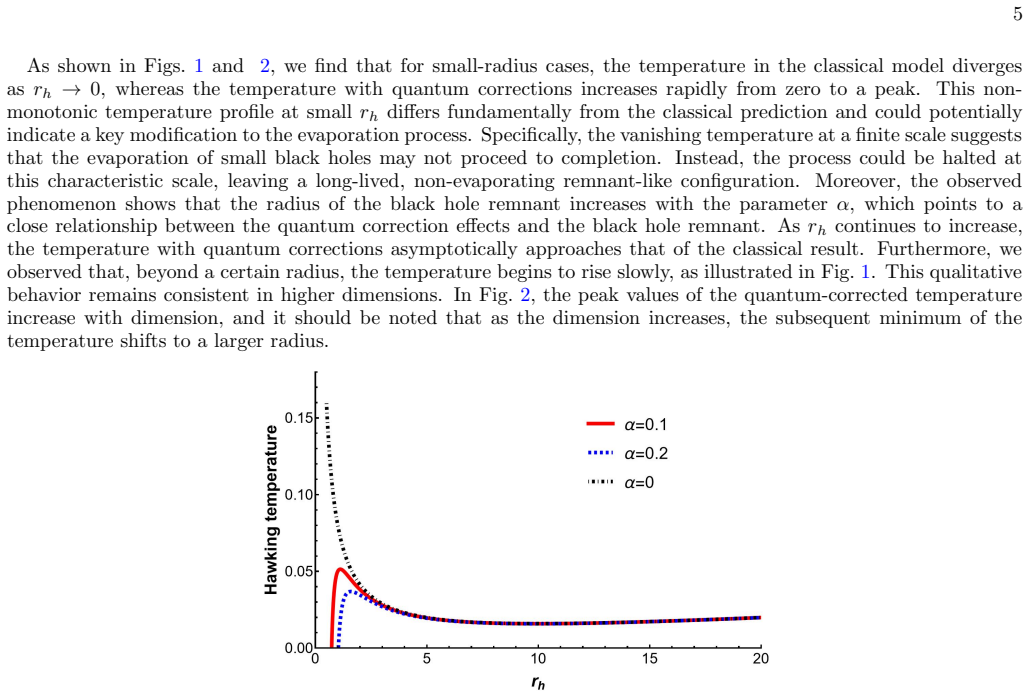
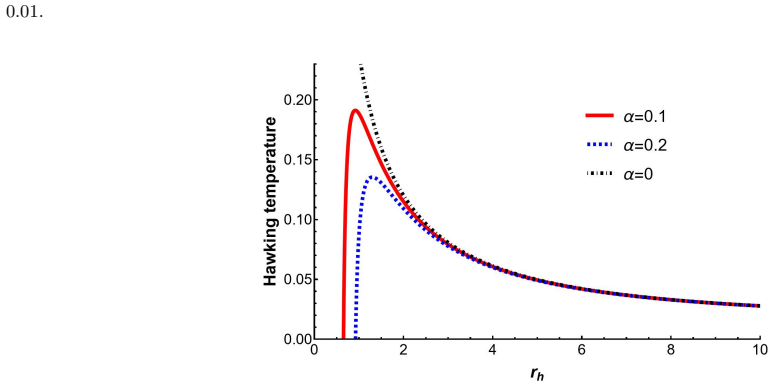
Quantum corrections make temperature of small AdS black holes tend to zero and add an extra phase transition in heat capacity.
A machine-rendered reading of the paper's core claim, the machinery that carries it, and where it could break.
Core claim
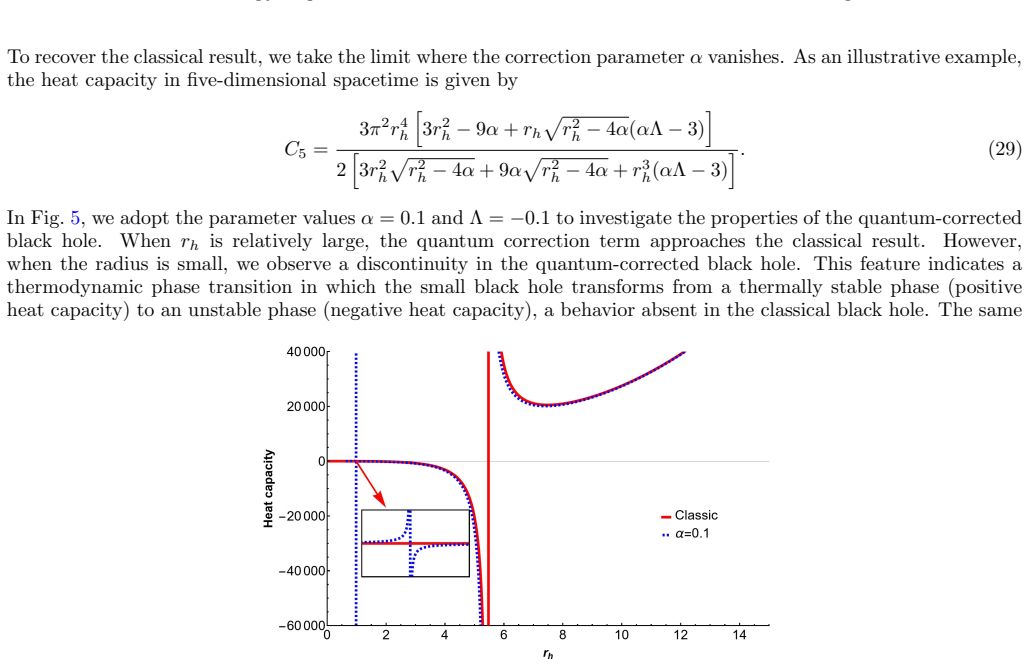
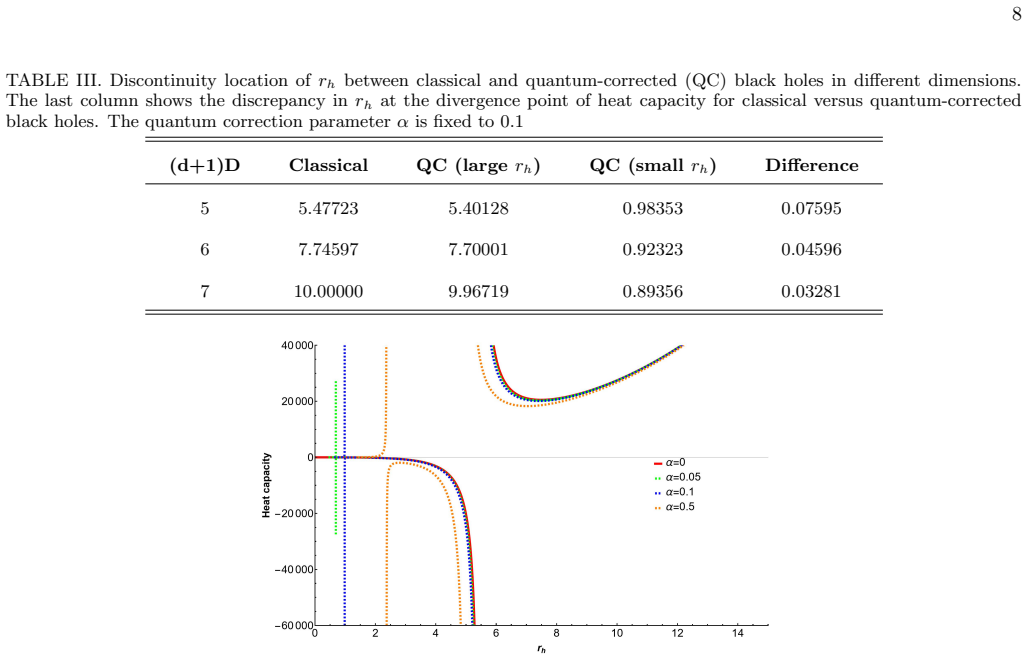
Incorporating a cosmological constant into the higher-dimensional quantum-corrected Oppenheimer-Snyder model yields modified thermodynamics in AdS spacetime: the temperature of small quantum-corrected black holes tends to zero rather than diverging, while the heat capacity exhibits characteristic behavior that indicates an extra phase transition induced by the quantum corrections.
What carries the argument
The higher-dimensional quantum-corrected Oppenheimer-Snyder model extended by a cosmological constant, with thermodynamic quantities evaluated in the extended phase space formalism.
If this is right
- Temperature of small quantum-corrected black holes in AdS tends to zero instead of diverging.
- Heat capacity displays behavior consistent with an extra phase transition from quantum corrections.
- Thermodynamic quantities differ from those of classical black holes under the same extended phase space treatment.
- Quantum effects produce a measurable impact on black hole thermodynamics in higher dimensions with nonzero cosmological constant.
Where Pith is reading between the lines
- The temperature stabilization at small scales may alter the expected endpoint of black hole evaporation in AdS.
- The same extension procedure could be applied to the de Sitter case to check whether the extra phase transition persists.
- If the model holds, thermodynamic stability criteria for small black holes would need revision in the presence of quantum corrections.
Load-bearing premise
The quantum correction from the original higher-dimensional Oppenheimer-Snyder model applies unchanged once a cosmological constant is added and thermodynamics are computed in extended phase space.
What would settle it
A direct computation showing that temperature still diverges for small quantum-corrected black holes in AdS or that heat capacity lacks any signature of the additional phase transition would disprove the reported thermodynamic changes.
Figures
read the original abstract
We extended the higher-dimensional quantum Oppenheimer-Snyder model to the case with a cosmological constant. For AdS case, we discuss its thermodynamic properties in extend phase space formalism and make comparison with classical black holes. For quantum-corrected small black holes in AdS spacetime, the temperature no longer diverges but tends to zero. Additionally, the heat capacity exhibits characteristic behavior indicative of an extra phase transition induced by quantum corrections, highlighting the profound impact of quantum effects on black hole thermodynamics.
Editorial analysis
A structured set of objections, weighed in public.
Referee Report
Summary. The manuscript extends a prior higher-dimensional quantum-corrected Oppenheimer-Snyder collapse model to include a nonzero cosmological constant. For the AdS case it computes thermodynamic quantities in the extended phase-space formalism and compares them to the classical (uncorrected) black-hole case, claiming that the quantum correction causes the Hawking temperature of small black holes to approach zero instead of diverging and produces an additional phase transition in the heat capacity.
Significance. If the central construction is valid, the work would demonstrate that quantum corrections can qualitatively change the thermodynamic stability and phase structure of higher-dimensional AdS black holes, removing the usual small-black-hole temperature divergence and adding a new transition. Such results would be of interest for quantum-gravity-inspired modifications of black-hole thermodynamics.
major comments (2)
- [Construction of the quantum-corrected metric (likely §3 or §4)] The headline claims (T → 0 for small AdS black holes; extra phase transition in C) rest on the assumption that the quantum correction term previously derived for the Λ = 0 higher-D OS model remains form-invariant when a cosmological constant is introduced. The junction conditions, interior dust solution, and effective mass function all acquire additional curvature terms once Λ ≠ 0; the manuscript does not demonstrate that the correction is unmodified under this change. This assumption is load-bearing for both thermodynamic results.
- [Thermodynamic analysis in extended phase space (likely §5)] The temperature and heat-capacity expressions in the extended phase space must be derived explicitly from the modified metric; without the intermediate steps showing how the quantum term enters the surface gravity and the first law, it is impossible to confirm that the claimed T → 0 behavior and the additional C discontinuity are not artifacts of an inconsistent insertion of the correction.
minor comments (2)
- [Abstract] The abstract contains the typographical error 'extend phase space' instead of 'extended phase space'.
- [Results section] A side-by-side table or plot comparing the classical and quantum-corrected temperature and heat-capacity curves for several values of the quantum parameter and Λ would make the claimed differences easier to assess.
Simulated Author's Rebuttal
We thank the referee for the careful reading and for identifying the need for explicit derivations. We address both major comments below and will revise the manuscript to supply the missing steps.
read point-by-point responses
-
Referee: [Construction of the quantum-corrected metric (likely §3 or §4)] The headline claims (T → 0 for small AdS black holes; extra phase transition in C) rest on the assumption that the quantum correction term previously derived for the Λ = 0 higher-D OS model remains form-invariant when a cosmological constant is introduced. The junction conditions, interior dust solution, and effective mass function all acquire additional curvature terms once Λ ≠ 0; the manuscript does not demonstrate that the correction is unmodified under this change. This assumption is load-bearing for both thermodynamic results.
Authors: We agree that the manuscript does not explicitly re-derive the junction conditions with nonzero Λ to confirm form-invariance of the quantum correction. The correction originates from a quantum modification to the interior dust energy density in the higher-dimensional OS collapse; because this modification is introduced at the level of the interior stress-energy tensor before matching, it remains additive to the classical mass function even after the exterior is changed to include Λ. In the revision we will add the explicit junction-condition calculation for the Λ ≠ 0 case, showing that the quantum term enters the effective mass function in the same functional form as in the Λ = 0 paper. revision: yes
-
Referee: [Thermodynamic analysis in extended phase space (likely §5)] The temperature and heat-capacity expressions in the extended phase space must be derived explicitly from the modified metric; without the intermediate steps showing how the quantum term enters the surface gravity and the first law, it is impossible to confirm that the claimed T → 0 behavior and the additional C discontinuity are not artifacts of an inconsistent insertion of the correction.
Authors: We acknowledge that the intermediate steps relating the quantum-corrected metric to surface gravity and the extended first law were omitted. The temperature is obtained from the surface gravity of the modified metric function f(r) = 1 - 2M/r^{D-3} + (quantum term) - (Λ r^2)/(D-1)(D-2); the quantum term prevents the usual 1/r divergence as r → 0, yielding T → 0. The heat capacity follows by differentiating the enthalpy with respect to T at fixed pressure. In the revision we will insert these explicit derivations, including the modified first-law verification, to substantiate the reported T → 0 limit and the additional discontinuity in C. revision: yes
Circularity Check
No significant circularity; extension uses prior correction as starting point but computes new thermodynamics independently
full rationale
The paper takes the quantum correction term from earlier Lambda=0 work and inserts it into a metric now containing a cosmological constant, then derives thermodynamic quantities in extended phase space. This is an explicit modeling assumption rather than a self-definitional loop, fitted-input prediction, or reduction by construction. No equations are shown that force the new temperature or heat-capacity results to equal the input correction term; the claimed T->0 behavior and extra phase transition emerge from the new junction conditions and extended-phase-space analysis. Self-citations to the prior model are present but supply an independent ansatz that is then applied to a distinct geometry, satisfying the criteria for non-circularity.
Axiom & Free-Parameter Ledger
Reference graph
Works this paper leans on
-
[1]
After expandingk T in powers of ˜v, we find that the expression is proportional to 1 ˜t , i.e.λ= 1
To findk T , we need to change the parameters in (37) into ˜vand ˜p ∂P ∂V = ∂P ∂˜v ∂˜v ∂V = Pc Vc ∂˜p ∂˜v,(44) thenk T becomes kT =− 1 ˜v+ 1· 1 Pc ∂˜p ∂˜v .(45) We can also ignore the 1 Pc term in expression since it is a constant. After expandingk T in powers of ˜v, we find that the expression is proportional to 1 ˜t , i.e.λ= 1. Eq. (38) can also be writ...
-
[2]
R. Carballo-Rubio, F. Di Filippo, S. Liberati, and M. Visser, Phenomenological aspects of black holes beyond general relativity, Phys. Rev. D98, 124009 (2018), arXiv:1809.08238 [gr-qc]
Pith/arXiv arXiv 2018
-
[3]
C. A. Z. Vasconcellos, D. Hadjimichef, M. Razeira, G. Volkmer, and B. Bodmann, Pushing the limits of General Relativity beyond the Big Bang singularity, Astron. Nachr.340, 857 (2019)
2019
-
[4]
Thiemann, Introduction to Modern Canonical Quantum General Relativity, (2001), arXiv:gr-qc/0110034
T. Thiemann, Introduction to Modern Canonical Quantum General Relativity, (2001), arXiv:gr-qc/0110034
Pith/arXiv arXiv 2001
-
[5]
A. Ashtekar and J. Lewandowski, Background independent quantum gravity: A Status report, Class. Quant. Grav.21, R53 (2004), arXiv:gr-qc/0404018
Pith/arXiv arXiv 2004
-
[6]
M. Han, W. Huang, and Y. Ma, Fundamental structure of loop quantum gravity, Int. J. Mod. Phys. D16, 1397 (2007), arXiv:gr-qc/0509064
Pith/arXiv arXiv 2007
-
[7]
A. Ashtekar, J. Baez, A. Corichi, and K. Krasnov, Quantum geometry and black hole entropy, Phys. Rev. Lett.80, 904 (1998), arXiv:gr-qc/9710007
Pith/arXiv arXiv 1998
-
[8]
A. Ashtekar and M. Bojowald, Quantum geometry and the Schwarzschild singularity, Class. Quant. Grav.23, 391 (2006), arXiv:gr-qc/0509075
Pith/arXiv arXiv 2006
-
[9]
Rovelli, Black hole entropy from loop quantum gravity, Phys
C. Rovelli, Black hole entropy from loop quantum gravity, Phys. Rev. Lett.77, 3288 (1996), arXiv:gr-qc/9603063
Pith/arXiv arXiv 1996
-
[10]
Zhang, Loop Quantum Black Hole, Universe9, 313 (2023), arXiv:2308.10184 [gr-qc]
X. Zhang, Loop Quantum Black Hole, Universe9, 313 (2023), arXiv:2308.10184 [gr-qc]
arXiv 2023
-
[11]
J. Lin, X. Zhang, and M. Bravo-Gaete, Mass inflation and strong cosmic censorship conjecture in the covariant quantum black hole, Phys. Rev. D111, 106025 (2025), arXiv:2412.01448 [gr-qc]
arXiv 2025
-
[12]
Y. Du, Y. Liu, and X. Zhang, Spinning particle dynamics and the innermost stable circular orbit in covariant loop quantum gravity, JCAP05, 045, arXiv:2411.13316 [gr-qc]
- [13]
-
[14]
J. R. Oppenheimer and H. Snyder, On Continued gravitational contraction, Phys. Rev.56, 455 (1939)
1939
-
[15]
R. C. Tolman, Static solutions of Einstein’s field equations for spheres of fluid, Phys. Rev.55, 364 (1939). 12
1939
-
[16]
J. Lewandowski, Y. Ma, J. Yang, and C. Zhang, Quantum Oppenheimer-Snyder and Swiss Cheese Models, Phys. Rev. Lett.130, 101501 (2023), arXiv:2210.02253 [gr-qc]
arXiv 2023
-
[17]
M. Han, C. Rovelli, and F. Soltani, Geometry of the black-to-white hole transition within a single asymptotic region, Phys. Rev. D107, 064011 (2023), arXiv:2302.03872 [gr-qc]
arXiv 2023
-
[18]
Z. Shi, X. Zhang, and Y. Ma, Higher-dimensional quantum Oppenheimer-Snyder model, Phys. Rev. D110, 104074 (2024), arXiv:2408.15821 [gr-qc]
arXiv 2024
-
[19]
S. W. Hawking, Black hole explosions, Nature248, 30 (1974)
1974
-
[20]
S. W. Hawking, Particle Creation by Black Holes, Commun. Math. Phys.43, 199 (1975), [Erratum: Commun.Math.Phys. 46, 206 (1976)]
1975
-
[21]
J. M. Bardeen, B. Carter, and S. W. Hawking, The Four laws of black hole mechanics, Commun. Math. Phys.31, 161 (1973)
1973
-
[22]
J. D. Bekenstein, Black holes and entropy, Phys. Rev. D7, 2333 (1973)
1973
-
[23]
A. Strominger and C. Vafa, Microscopic origin of the Bekenstein-Hawking entropy, Phys. Lett. B379, 99 (1996), arXiv:hep- th/9601029
arXiv 1996
-
[24]
A. G. Riesset al.(Supernova Search Team), Observational evidence from supernovae for an accelerating universe and a cosmological constant, Astron. J.116, 1009 (1998), arXiv:astro-ph/9805201
Pith/arXiv arXiv 1998
-
[25]
Weinberg, The Cosmological Constant Problem, Rev
S. Weinberg, The Cosmological Constant Problem, Rev. Mod. Phys.61, 1 (1989)
1989
-
[26]
P. J. E. Peebles and B. Ratra, The Cosmological Constant and Dark Energy, Rev. Mod. Phys.75, 559 (2003), arXiv:astro- ph/0207347
arXiv 2003
-
[27]
J. M. Maldacena, The LargeNlimit of superconformal field theories and supergravity, Adv. Theor. Math. Phys.2, 231 (1998), arXiv:hep-th/9711200
Pith/arXiv arXiv 1998
-
[28]
Witten, Anti de Sitter space and holography, Adv
E. Witten, Anti de Sitter space and holography, Adv. Theor. Math. Phys.2, 253 (1998), arXiv:hep-th/9802150
Pith/arXiv arXiv 1998
-
[29]
D. Kubiznak and R. B. Mann, P-V criticality of charged AdS black holes, JHEP07, 033, arXiv:1205.0559 [hep-th]
-
[30]
R.-G. Cai, L.-M. Cao, L. Li, and R.-Q. Yang, P-V criticality in the extended phase space of Gauss-Bonnet black holes in AdS space, JHEP09, 005, arXiv:1306.6233 [gr-qc]
-
[31]
S.-W. Wei and Y.-X. Liu, Triple points and phase diagrams in the extended phase space of charged Gauss-Bonnet black holes in AdS space, Phys. Rev. D90, 044057 (2014), arXiv:1402.2837 [hep-th]
Pith/arXiv arXiv 2014
-
[32]
S.-W. Wei, B. Liang, and Y.-X. Liu, Critical phenomena and chemical potential of a charged AdS black hole, Phys. Rev. D96, 124018 (2017), arXiv:1705.08596 [gr-qc]
Pith/arXiv arXiv 2017
-
[33]
S. W. Hawking and D. N. Page, Thermodynamics of Black Holes in anti-De Sitter Space, Commun. Math. Phys.87, 577 (1983)
1983
-
[34]
Li and J
R. Li and J. Wang, Thermodynamics and kinetics of Hawking-Page phase transition, Phys. Rev. D102, 024085 (2020)
2020
-
[35]
Israel, Singular hypersurfaces and thin shells in general relativity, Il Nuovo Cimento B (1965-1970)44, 1 (1966)
W. Israel, Singular hypersurfaces and thin shells in general relativity, Il Nuovo Cimento B (1965-1970)44, 1 (1966)
1965
- [36]
-
[37]
Zhang, Higher dimensional Loop Quantum Cosmology, Eur
X. Zhang, Higher dimensional Loop Quantum Cosmology, Eur. Phys. J. C76, 395 (2016), arXiv:1506.05597 [gr-qc]
Pith/arXiv arXiv 2016
-
[38]
Ashtekar, Loop Quantum Cosmology: An Overview, Gen
A. Ashtekar, Loop Quantum Cosmology: An Overview, Gen. Rel. Grav.41, 707 (2009), arXiv:0812.0177 [gr-qc]
Pith/arXiv arXiv 2009
-
[39]
S. F. Mirekhtiary and I. Sakalli, Hawking Radiation of Grumiller Black Hole, Commun. Theor. Phys.61, 558 (2014), arXiv:1402.5514 [gr-qc]
Pith/arXiv arXiv 2014
-
[40]
B. P. Dolan, The cosmological constant and black-hole thermodynamic potentials, Class. Quant. Grav.28, 125020 (2011)
2011
-
[41]
Eslam Panah, Super-entropy bumblebee AdS black holes, Phys
B. Eslam Panah, Super-entropy bumblebee AdS black holes, Phys. Lett. B861, 139273 (2025), arXiv:2501.09317 [gr-qc]
arXiv 2025
-
[42]
T. V. Fernandes and J. P. S. Lemos, Grand canonical ensemble of a d-dimensional Reissner-Nordstr¨ om black hole in a cavity, Phys. Rev. D108, 084053 (2023), arXiv:2309.12388 [hep-th]
arXiv 2023
-
[43]
Witten, Introduction to black hole thermodynamics, Eur
E. Witten, Introduction to black hole thermodynamics, Eur. Phys. J. Plus140, 430 (2025), arXiv:2412.16795 [hep-th]
arXiv 2025
-
[44]
N. Chatzifotis, P. Dorlis, N. E. Mavromatos, and E. Papantonopoulos, Thermal stability of hairy black holes, Phys. Rev. D107, 084053 (2023), arXiv:2302.03980 [gr-qc]
arXiv 2023
-
[45]
H. E. Stanley and V. K. Wong, Introduction to phase transitions and critical phenomena, American Journal of Physics 40, 927 (1972)
1972
- [46]
-
[47]
S. Li, Y. Ma, F. Yuan, and X. Zhang, Effective dynamics of loop quantum Kaluza-Klein cosmology, Phys. Rev. D113, L041503 (2026), arXiv:2508.07962 [gr-qc]
arXiv 2026
-
[48]
I. H. Belfaqih, M. Bojowald, S. Brahma, and E. I. Duque, Hawking Evaporation and the Fate of Black Holes in Loop Quantum Gravity, Phys. Rev. Lett.135, 161501 (2025), arXiv:2504.11998 [gr-qc]
arXiv 2025
discussion (0)
Sign in with ORCID, Apple, or X to comment. Anyone can read and Pith papers without signing in.