On Parallel and Batch-Cutting Strategies for Norm-Minimization-Based Convex Vector Optimization
Pith reviewed 2026-06-28 00:37 UTC · model grok-4.3
The pith
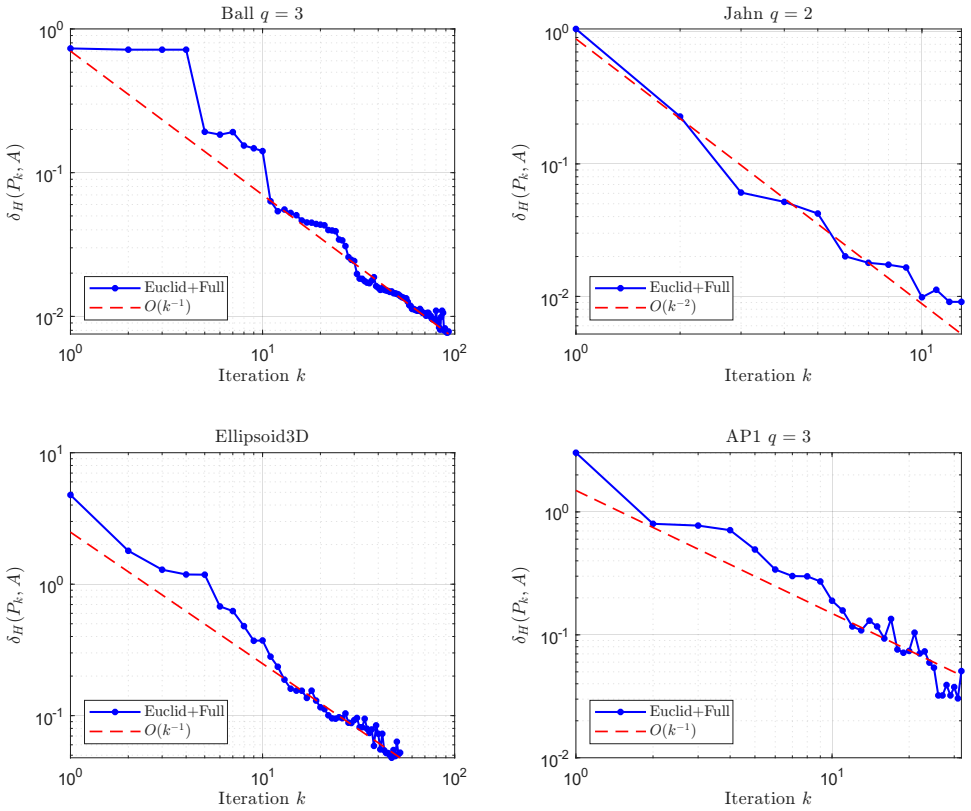
Batch-cutting variants of the norm-minimization outer approximation algorithm for convex vector optimization inherit the standard O(k^{2/(1-q)}) convergence rate.
A machine-rendered reading of the paper's core claim, the machinery that carries it, and where it could break.
Core claim
The batch-cutting variant adds up to K supporting halfspaces per iteration using information from all solved subproblems rather than discarding most of it, and this variant inherits the convergence rate O(k^{2/(1-q)}) of the standard single-cut algorithm, where k is the number of outer iterations and q is the number of objectives.
What carries the argument
The batch-cutting strategy that adds multiple supporting halfspaces simultaneously from the solved subproblems in the norm-minimization-based outer approximation scheme.
If this is right
- The batch-cutting variant achieves the same convergence rate O(k^{2/(1-q)}) as the single-cut version.
- Parallelization across 8 workers increases speed by a factor between 1.1 and 4.2.
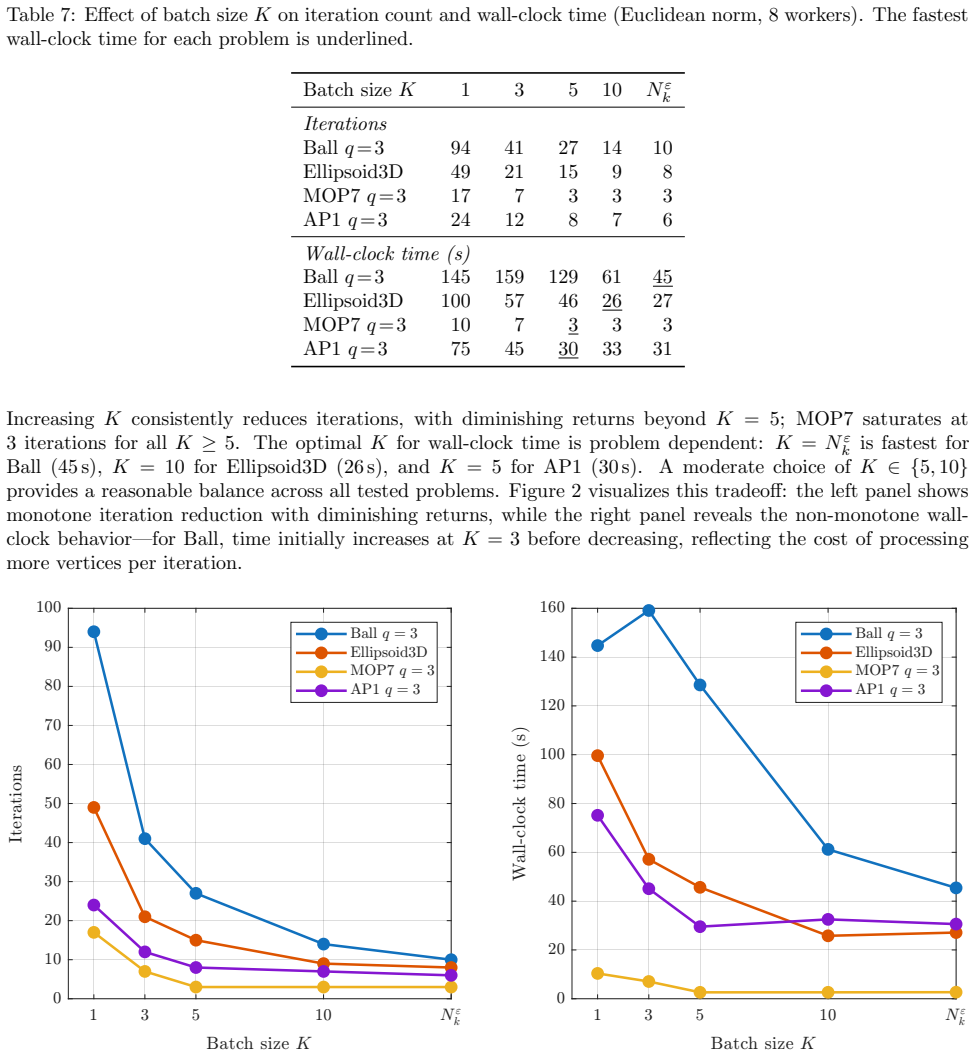
- Batch cutting reduces the iteration count by 62 to 80 percent on the tested problems.
- The wall-clock benefit of batch cutting is largest when the cost of solving per-vertex subproblems dominates.
- Batch cutting accelerates vertex count growth in the polyhedral approximation.
Where Pith is reading between the lines
- This strategy could extend to other cutting-plane methods in multi-objective convex optimization.
- Parallelism may yield greater speedups on problems with higher subproblem costs or more workers.
- The trade-off between fewer iterations and faster-growing vertex sets suggests tuning the batch size based on problem size.
- Similar batch approaches might improve efficiency in related norm-minimization algorithms for other optimization classes.
Load-bearing premise
That every supporting halfspace from the solved subproblems remains valid when added simultaneously without changing the convergence properties of the single-cut scheme.
What would settle it
A numerical test on a convex vector optimization problem where the batch-cutting algorithm requires asymptotically more than O(k^{2/(1-q)}) iterations to reach a fixed approximation tolerance.
Figures
read the original abstract
We develop parallel and batch-cutting variants of the norm-minimization-based outer approximation algorithm for convex vector optimization. The standard algorithm solves $N_k$ independent subproblems at each iteration~$k$ to evaluate all vertices of the current polyhedral approximation, but processes only the single best cut. We propose two improvements. First, we parallelize the \revise{subproblem evaluations} across $\nw$ workers, reducing per-iteration wall-clock time. Second, we introduce a batch-cutting strategy that adds up to $K$ supporting halfspaces per iteration, using information from all solved subproblems rather than discarding it. We prove that the batch-cutting variant inherits the convergence rate $O(k^{2/(1-q)})$ of the standard algorithm, where $k$ is the number of outer iterations and $q$ is the number of objectives. Computational experiments on eight test problems with $q \in \{2,3,4,5\}$ show that parallelism on 8 cores \revise{increases the speed by a factor of 1.1 to 4.2}, and batch cutting consistently reduces the iteration count by 62--80\%. However, the wall-clock benefit of batch cutting is problem-dependent: the additional cuts per iteration accelerate vertex count growth, so batch cutting is most effective when per-vertex subproblem cost dominates.
Editorial analysis
A structured set of objections, weighed in public.
Referee Report
Summary. The paper develops parallel and batch-cutting variants of the norm-minimization-based outer approximation algorithm for convex vector optimization. The standard algorithm solves multiple independent subproblems per outer iteration but retains only the single best supporting halfspace; the proposed variants parallelize the subproblem solves across workers and add up to K cuts per iteration. The central theoretical claim is that the batch-cutting variant inherits the O(k^{2/(1-q)}) convergence rate of the single-cut scheme (k outer iterations, q objectives). Numerical experiments on eight test problems with q=2..5 report 62-80% fewer iterations with batch cutting and wall-clock speedups of 1.1-4.2 from parallelism on 8 cores, though wall-clock gains are problem-dependent due to faster growth in vertex count.
Significance. If the convergence inheritance is rigorously established, the work would supply both a practical acceleration technique and a theoretical guarantee for an existing class of convex vector optimization methods. The numerical results on a range of problem sizes and objective counts provide concrete evidence of iteration savings; the parallel implementation addresses a common computational bottleneck. These elements would be of interest to researchers working on multi-objective convex programs in operations research and engineering.
major comments (1)
- [Convergence analysis] The proof that the batch-cutting variant inherits the O(k^{2/(1-q)}) rate (stated in the abstract and presumably in the convergence analysis section) relies on the single-cut outer-approximation analysis extending unchanged when up to K valid supporting halfspaces are inserted simultaneously. Adding multiple cuts produces a strictly finer polyhedral approximation than a single cut, which can change the per-iteration improvement factor or the constants appearing in the recurrence. The manuscript must explicitly re-derive the key inequalities, potential-function decrease, or error-reduction bound under the batch-update rule rather than invoking the single-cut lemmas verbatim.
minor comments (1)
- [Abstract] The abstract contains LaTeX revision markers (\revise{...}) that should be removed before final submission.
Simulated Author's Rebuttal
We thank the referee for the careful and constructive review. The single major comment is addressed point-by-point below. We agree that the convergence proof requires explicit re-derivation for the batch case and will revise accordingly.
read point-by-point responses
-
Referee: The proof that the batch-cutting variant inherits the O(k^{2/(1-q)}) rate (stated in the abstract and presumably in the convergence analysis section) relies on the single-cut outer-approximation analysis extending unchanged when up to K valid supporting halfspaces are inserted simultaneously. Adding multiple cuts produces a strictly finer polyhedral approximation than a single cut, which can change the per-iteration improvement factor or the constants appearing in the recurrence. The manuscript must explicitly re-derive the key inequalities, potential-function decrease, or error-reduction bound under the batch-update rule rather than invoking the single-cut lemmas verbatim.
Authors: We thank the referee for highlighting this point. The current proof establishes that all K cuts are valid supporting halfspaces generated by the norm-minimization subproblems at the evaluated vertices, so the updated polyhedron remains a valid outer approximation. However, we agree that the effect of multiple simultaneous cuts on the per-iteration improvement and recurrence constants is not derived in full detail. In the revised manuscript we will expand the convergence section to re-derive the key error-reduction inequality and potential-function decrease explicitly under the batch-update rule, confirming that the same asymptotic rate O(k^{2/(1-q)}) is retained (with possibly adjusted constants). revision: yes
Circularity Check
No circularity: convergence inheritance is a claimed proof, not a reduction to fitted inputs or self-citation
full rationale
The paper's central claim is a mathematical proof that the batch-cutting variant inherits the O(k^{2/(1-q)}) rate from the standard single-cut outer-approximation scheme. The abstract states this inheritance explicitly but supplies no equations or steps that reduce the rate to a self-defined quantity, a fitted parameter renamed as a prediction, or a load-bearing self-citation whose validity depends on the present work. No ansatz is smuggled, no uniqueness theorem is invoked from overlapping authors, and no known empirical pattern is merely renamed. The derivation chain is therefore self-contained as an extension of prior analysis, with experiments serving as separate validation rather than the source of the rate itself.
Axiom & Free-Parameter Ledger
axioms (1)
- domain assumption The standard norm-minimization-based outer approximation algorithm converges at rate O(k^{2/(1-q)})
Reference graph
Works this paper leans on
-
[1]
A Norm Minimization-Based Convex Vector Optimization Algorithm,
C ¸ . Ararat, F. Ulus, and M. Umer, “A Norm Minimization-Based Convex Vector Optimization Algorithm,” en,Journal of Optimization Theory and Applications, vol. 194, no. 2, pp. 681–712, Aug. 2022.doi:10. 1007/s10957-022-02045-8
2022
-
[2]
Convergence Analysis of a Norm Minimization-Based Convex Vector Optimization Algorithm,
C ¸ . Ararat, F. Ulus, and M. Umer, “Convergence Analysis of a Norm Minimization-Based Convex Vector Optimization Algorithm,”SIAM Journal on Optimization, vol. 34, no. 3, pp. 2700–2728, Sep. 2024.doi: 10.1137/23M1574580
-
[3]
Asymptotic estimates for best and stepwise approximation of convex bodies II,
P. M. Gruber, “Asymptotic estimates for best and stepwise approximation of convex bodies II,”Forum Mathematicum, vol. 5, no. Jahresband, pp. 521–538, 1993.doi:10.1515/form.1993.5.521
-
[4]
Asymptotic estimates for best and stepwise approximation of convex bodies III,
S. Glasauer and P. M. Gruber, “Asymptotic estimates for best and stepwise approximation of convex bodies III,” en,Forum Mathematicum, vol. 9, no. 9, pp. 383–404, 1997.doi:10.1515/form.1997.9.383
-
[5]
Adaptive Metrics for Norm-Minimization-Based Outer Approximation in Convex Vector Optimization
M. Alshahrani,Adaptive Metrics for Norm-Minimization-Based Outer Approximation in Convex Vector Optimization, May 2026.doi:10.48550/arXiv.2605.14320
work page internal anchor Pith review Pith/arXiv arXiv doi:10.48550/arxiv.2605.14320 2026
-
[6]
Convergence Rates for $\ell_p$ Norm Minimization in Convex Vector Optimization
M. Alshahrani,Convergence Rates for$\ell p$Norm Minimization in Convex Vector Optimization, arXiv:2605.14324 [math.OC], May 2026.doi:10.48550/arXiv.2605.14324
work page internal anchor Pith review Pith/arXiv arXiv doi:10.48550/arxiv.2605.14324 2026
-
[7]
H. P. Benson, “An Outer Approximation Algorithm for Generating All Efficient Extreme Points in the Outcome Set of a Multiple Objective Linear Programming Problem,”Journal of Global Optimization, vol. 13, no. 1, pp. 1–24, Jan. 1998.doi:10.1023/A:1008215702611 16
-
[8]
An Approximation Algorithm for Convex Multi-Objective Pro- gramming Problems,
M. Ehrgott, L. Shao, and A. Sch¨ obel, “An Approximation Algorithm for Convex Multi-Objective Pro- gramming Problems,” en,Journal of Global Optimization, vol. 50, no. 3, pp. 397–416, Jul. 2011.doi: 10.1007/s10898-010-9588-7
-
[9]
L¨ ohne,Vector Optimization with Infimum and Supremum(Vector Optimization), en
A. L¨ ohne,Vector Optimization with Infimum and Supremum(Vector Optimization), en. Berlin, Heidel- berg: Springer Berlin Heidelberg, 2011.doi:10.1007/978-3-642-18351-5
-
[10]
Primal and Dual Approximation Algorithms for Convex Vector Optimization Problems,
A. L¨ ohne, B. Rudloff, and F. Ulus, “Primal and Dual Approximation Algorithms for Convex Vector Optimization Problems,” en,Journal of Global Optimization, vol. 60, no. 4, pp. 713–736, Dec. 2014.doi: 10.1007/s10898-013-0136-0
-
[11]
Outer Approximation Algorithms for Convex Vector Optimization Problems,
˙I. N. Keskin and F. Ulus, “Outer Approximation Algorithms for Convex Vector Optimization Problems,” Optimization Methods and Software, vol. 38, no. 4, pp. 723–755, Jul. 2023.doi:10 . 1080 / 10556788 . 2023.2167994
arXiv 2023
-
[12]
A Class of Adaptive Algorithms for Approximating Convex Bodies by Polyhedra,
G. K. Kamenev, “A Class of Adaptive Algorithms for Approximating Convex Bodies by Polyhedra,” Computational Mathematics and Mathematical Physics, vol. 32, no. 1, pp. 114–127, 1992
1992
-
[13]
Conjugate Adaptive Algorithms for Polyhedral Approximation of Convex Bodies,
G. K. Kamenev, “Conjugate Adaptive Algorithms for Polyhedral Approximation of Convex Bodies,” Computational Mathematics and Mathematical Physics, vol. 42, no. 9, pp. 1301–1316, 2002
2002
-
[14]
A. V. Lotov, V. A. Bushenkov, and G. K. Kamenev,Interactive Decision Maps(Applied Optimization), P. M. Pardalos and D. W. Hearn, Eds. Boston, MA: Springer US, 2004, vol. 89.doi:10.1007/978-1- 4419-8851-5
-
[15]
The Cutting-Plane Method for Solving Convex Programs,
J. E. Kelley Jr., “The Cutting-Plane Method for Solving Convex Programs,”Journal of the Society for Industrial and Applied Mathematics, vol. 8, no. 4, pp. 703–712, Dec. 1960.doi:10.1137/0108053
-
[16]
Newton’s method for convex programming and Tchebycheff approx- imation,
E. W. Cheney and A. A. Goldstein, “Newton’s method for convex programming and Tchebycheff approx- imation,” en,Numerische Mathematik, vol. 1, no. 1, pp. 253–268, Dec. 1959.doi:10.1007/BF01386389
-
[17]
J.-B. Hiriart-Urruty and C. Lemar´ echal,Convex Analysis and Minimization Algorithms II: Advanced Theory and Bundle Methods(Grundlehren der mathematischen Wissenschaften), en, M. Artin et al., Eds. Berlin, Heidelberg: Springer, 1993, vol. 306.doi:10.1007/978-3-662-06409-2
-
[18]
K. Deb, A. Pratap, S. Agarwal, and T. Meyarivan, “A fast and elitist multiobjective genetic algorithm: NSGA-II,”IEEE Transactions on Evolutionary Computation, vol. 6, no. 2, pp. 182–197, Apr. 2002.doi: 10.1109/4235.996017
-
[19]
MOEA/D: A Multiobjective Evolutionary Algorithm Based on Decomposition,
Q. Zhang and H. Li, “MOEA/D: A Multiobjective Evolutionary Algorithm Based on Decomposition,” IEEE Transactions on Evolutionary Computation, vol. 11, no. 6, pp. 712–731, Dec. 2007.doi:10.1109/ TEVC.2007.892759
arXiv 2007
-
[20]
Mplrs: A scalable parallel vertex/facet enumeration code,
D. Avis and C. Jordan, “Mplrs: A scalable parallel vertex/facet enumeration code,” en,Mathematical Programming Computation, vol. 10, no. 2, pp. 267–302, Jun. 2018.doi:10.1007/s12532-017-0129-y
-
[21]
Jahn,Vector Optimization: Theory, Applications, and Extensions, en
J. Jahn,Vector Optimization: Theory, Applications, and Extensions, en. Berlin, Heidelberg: Springer, 2011.doi:10.1007/978-3-642-17005-8
-
[22]
Multicriteria optimization using a genetic algorithm for determining a Pareto set,
R. VIENNET, C. FONTEIX, and I. MARC, “Multicriteria optimization using a genetic algorithm for determining a Pareto set,”International Journal of Systems Science, vol. 27, no. 2, pp. 255–260, Feb. 1996.doi:10.1080/00207729608929211
-
[23]
A modified Quasi-Newton method for vector optimization problem,
M. Ansary and G. Panda, “A modified Quasi-Newton method for vector optimization problem,”Optimiza- tion, vol. 64, no. 11, pp. 2289–2306, Nov. 2015, eprint: https://doi.org/10.1080/02331934.2014.947500. doi:10.1080/02331934.2014.947500
-
[24]
Validity of the single processor approach to achieving large scale computing capabilities,
G. M. Amdahl, “Validity of the single processor approach to achieving large scale computing capabilities,” inProceedings of the April 18-20, 1967, spring joint computer conference, ser. AFIPS ’67 (Spring), New York, NY, USA: Association for Computing Machinery, Apr. 1967, pp. 483–485.doi:10.1145/1465482. 1465560
-
[25]
Grant and S
M. Grant and S. Boyd,CVX: MATLAB Software for Disciplined Convex Programming, Version 2.2, Mar. 2020
2020
-
[26]
SDPT3 — A Matlab software package for semidefinite programming, Version 1.3,
K. C. Toh, M. J. Todd, and R. H. T¨ ut¨ unc¨ u, “SDPT3 — A Matlab software package for semidefinite programming, Version 1.3,”Optimization Methods and Software, vol. 11, no. 1-4, pp. 545–581, Jan. 1999. doi:10.1080/10556789908805762 17
-
[27]
A. L¨ ohne and B. Weißing, “The Vector Linear Program Solver Bensolve – Notes on Theoretical Back- ground,”European Journal of Operational Research, vol. 260, no. 3, pp. 807–813, 2017.doi:10.1016/j. ejor.2016.02.039 18
work page doi:10.1016/j 2017
discussion (0)
Sign in with ORCID, Apple, or X to comment. Anyone can read and Pith papers without signing in.