REVIEW 2 major objections 1 cited by
Revisiting spin Hamiltonian parameters in a Kitaev material via Bayesian optimization of magnetization curves
T0 review · 2 major / 0 minor · reviewed 2026-06-30 · grok-4.3
Pith's one-line read Bayesian optimization of magnetization curves selects a spin Hamiltonian for α-RuCl₃ that favors large positive Γ over the small-g_c alternative.
desk verdict Magnetization data leaves K undetermined so the authors fix it by hand at -6 meV while the fit favors large positive Γ; the paper is honest about this limit but the thermodynamic checks may not be robust to it. read the letter →
The pith
A machine-rendered reading of the paper's core claim, the machinery that carries it, and where it could break.
The reading
What carries the argument
Bayesian optimization of a cost function built from experimental magnetization curves, evaluated with low-energy numerical solvers for each candidate parameter set.
What would settle it
A direct measurement of specific heat or magnetic susceptibility at temperatures and fields where the optimized parameters predict a clear mismatch with existing data.
Extended reading notes
Core claim
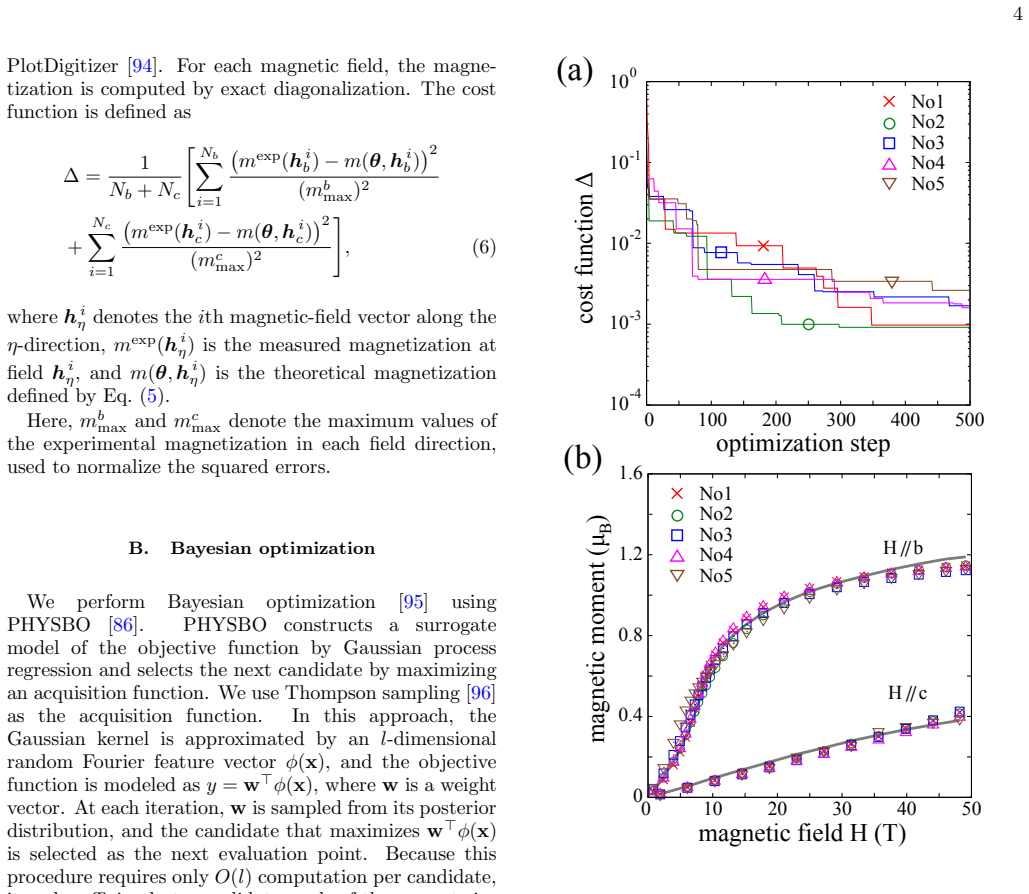
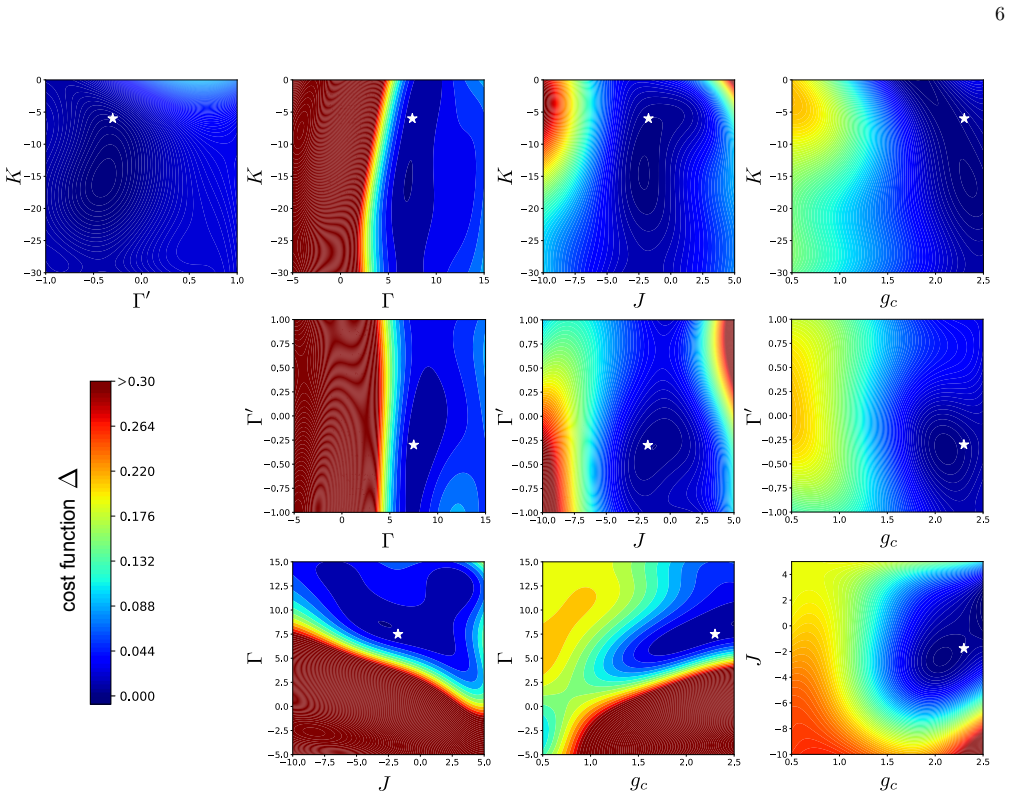
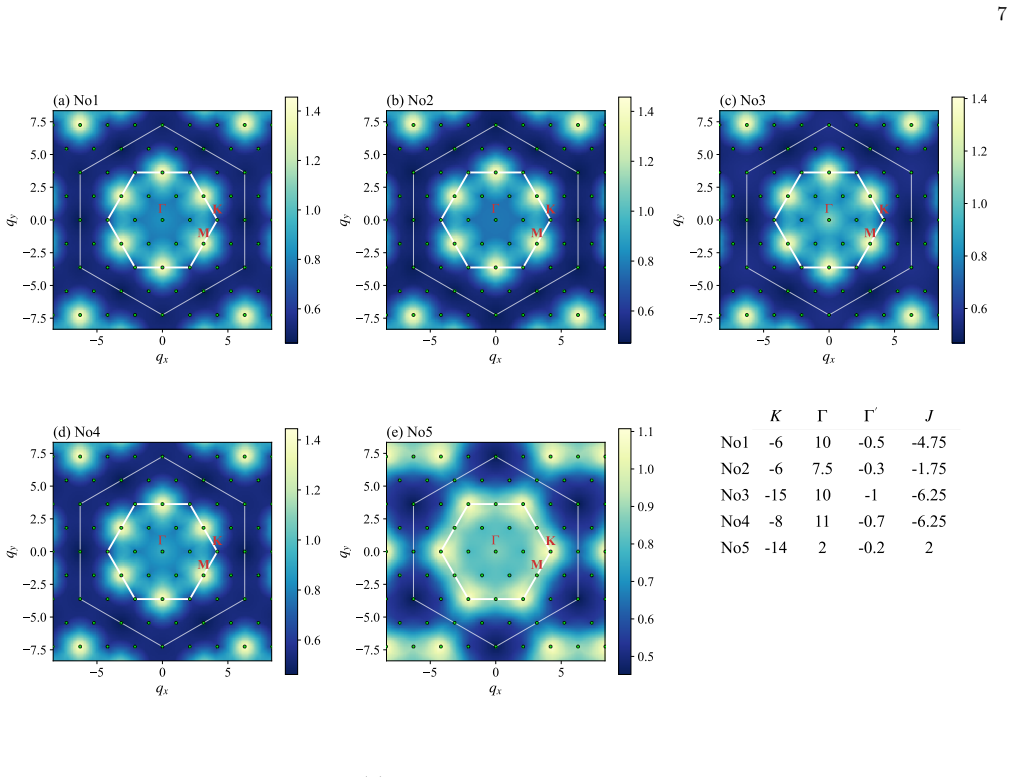
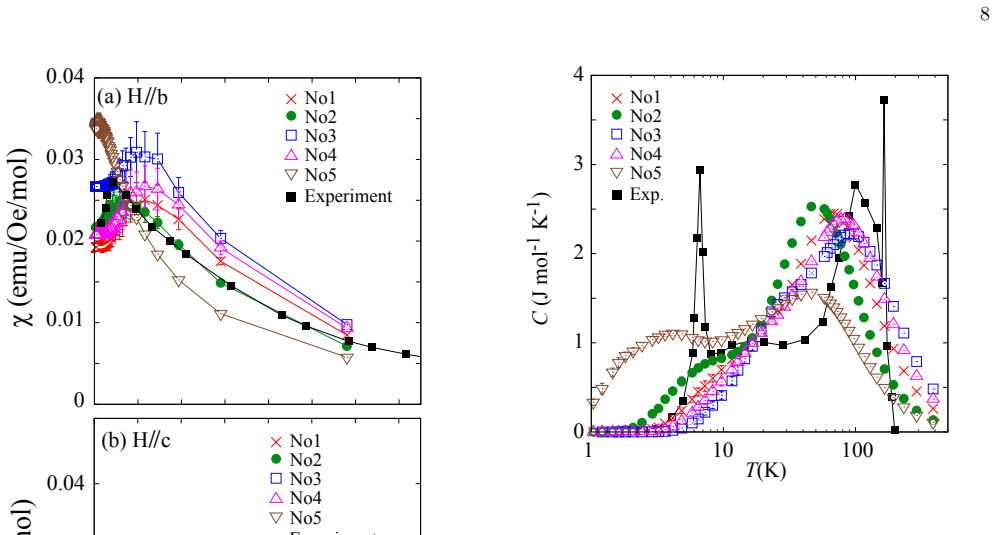
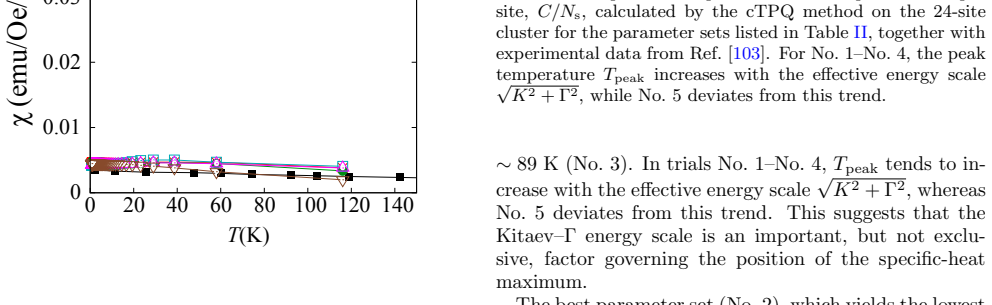
The parameter set that minimizes the cost function defined on b- and c-axis magnetization curves is (K,Γ,Γ',J,g_c)=(-6.0, 7.5, -0.3, -1.75, 2.3) meV. Magnetization data alone do not fix the energy scale of the Kitaev interaction K. The optimization favors a large positive Γ. When the static spin structure factor, magnetic susceptibility, and specific heat are computed from this set, they match experiment and support the large-Γ scenario over the small-g_c scenario.
Load-bearing premise
The spin Hamiltonian is completely captured by the five fitted terms and the numerical solvers accurately reproduce the magnetization curves for any values of those terms.
Editorial extensions
If this is right
- The optimized parameters reproduce the measured b- and c-axis magnetization curves.
- Static spin structure factor, susceptibility, and specific heat computed from the same set agree with experiment.
- These thermodynamic and structural quantities distinguish the large-Γ regime from the small-g_c regime.
- Magnetization data by themselves leave the absolute Kitaev scale undetermined.
- The combination of Bayesian optimization and accurate solvers offers a systematic route to Hamiltonian parameters from experimental data.
Reading between the lines
- Additional observables such as neutron scattering intensities would be needed to constrain the Kitaev coupling scale that magnetization leaves free.
- The same optimization workflow could be applied to other quantum magnets once magnetization curves along principal axes are available.
- If the five-term form is incomplete, the apparent preference for large Γ could shift when further interaction terms are included.
Signed reviews
Editorial analysis
A structured set of objections, weighed in public.
Referee Report
Summary. The paper proposes using Bayesian optimization to fit five parameters of the spin Hamiltonian for α-RuCl₃ (K, Γ, Γ', J, g_c) directly to experimental magnetization curves along the b- and c-axes. The minimizing set is reported as (K, Γ, Γ', J, g_c) = (-6.0, 7.5, -0.3, -1.75, 2.3) meV; the cost function is insensitive to |K| and depends only weakly on Γ' and J while favoring large positive Γ. The authors then evaluate the static spin structure factor, magnetic susceptibility, and specific heat for this set, claiming it yields good agreement with experiment and supports the large-Γ scenario over the small-g_c alternative.
Significance. A reliable data-driven route to spin-Hamiltonian parameters would usefully complement ab-initio methods whose results can vary with methodological details. The explicit use of Bayesian optimization together with low-energy solvers, the transparent reporting of cost-function insensitivity, and the cross-validation on three additional observables constitute concrete strengths that, if the numerical procedures are shown to be robust, would make the methodology transferable to other quantum magnets.
major comments (2)
- [Abstract] Abstract: the cost function is stated to be insensitive to the absolute value of K, yet the reported minimizing set fixes K = -6.0 meV. Because specific heat, susceptibility and the structure factor depend on the overall energy scale, it is necessary to show that the reported agreement with experiment and the preference for large Γ remain stable when K is varied over the range that keeps the magnetization cost function comparably low.
- [Abstract] Abstract (and the description of the optimization procedure): the central claim that the fitted parameters yield good agreement with experiment rests on the premise that the low-energy numerical solvers inside the cost function accurately reproduce the b- and c-axis magnetization for arbitrary parameter values. No convergence tests, error estimates, or cross-checks against exact diagonalization on small clusters are referenced, leaving the reliability of the entire optimization chain unquantified.
Simulated Author's Rebuttal
We thank the referee for the careful reading of the manuscript and the recommendation for minor revision. The two major comments identify important aspects of robustness that we address point by point below. Both can be resolved with targeted additions to the manuscript.
read point-by-point responses
-
Referee: [Abstract] Abstract: the cost function is stated to be insensitive to the absolute value of K, yet the reported minimizing set fixes K = -6.0 meV. Because specific heat, susceptibility and the structure factor depend on the overall energy scale, it is necessary to show that the reported agreement with experiment and the preference for large Γ remain stable when K is varied over the range that keeps the magnetization cost function comparably low.
Authors: We agree that, although the manuscript already states the insensitivity of the magnetization cost function to |K|, it is necessary to demonstrate that the conclusions drawn from the other observables remain stable. In the revised manuscript we will add calculations for several values of K lying within the low-cost region of parameter space and show that both the preference for large positive Γ and the level of agreement with the static structure factor, susceptibility, and specific heat are preserved. This will make explicit that the support for the large-Γ scenario is independent of the precise overall energy scale chosen for K. revision: yes
-
Referee: [Abstract] Abstract (and the description of the optimization procedure): the central claim that the fitted parameters yield good agreement with experiment rests on the premise that the low-energy numerical solvers inside the cost function accurately reproduce the b- and c-axis magnetization for arbitrary parameter values. No convergence tests, error estimates, or cross-checks against exact diagonalization on small clusters are referenced, leaving the reliability of the entire optimization chain unquantified.
Authors: We acknowledge that explicit convergence tests, error estimates, and cross-checks against exact diagonalization were not included in the original manuscript. In the revised version we will add a dedicated subsection (or appendix) that reports convergence tests of the low-energy solvers with respect to bond dimension, truncation error, and cluster size, together with direct comparisons to exact diagonalization on small clusters for representative parameter points. Quantitative error estimates on the magnetization curves will also be provided to quantify the reliability of the cost function. revision: yes
Circularity Check
No circularity: standard fitting to magnetization data followed by independent validation on other observables
full rationale
The paper defines a cost function over experimental b- and c-axis magnetization curves and uses Bayesian optimization to minimize it with respect to five Hamiltonian parameters. The resulting parameter set is then used to compute static spin structure factor, magnetic susceptibility, and specific heat, which are compared to separate experimental data. These computed quantities are not part of the cost function and are not forced by construction to match the fitted magnetization; the procedure is therefore a conventional fit-plus-validation workflow. The noted insensitivity of the cost to |K| (and weak dependence on Γ', J) is an explicit limitation of the data, not a hidden self-definition. No self-citation chain, ansatz smuggling, or renaming of known results is present in the provided text. The central claim therefore rests on external experimental benchmarks rather than reducing to its own inputs.
Assumptions & free parameters
free parameters (5)
- K =
-6.0 meV
- Γ =
7.5 meV
- Γ' =
-0.3 meV
- J =
-1.75 meV
- g_c =
2.3
assumptions (1)
- domain assumption The magnetic interactions in α-RuCl₃ are described by a spin Hamiltonian containing Kitaev (K), Heisenberg (J), and off-diagonal (Γ, Γ') terms.
Cite this review
Pith. "Pith review of Revisiting spin Hamiltonian parameters in a Kitaev material via Bayesian optimization of magnetization curves." pith.science (2026). https://pith.science/paper/AU373QEA
@misc{pith2026260524857,
  author       = {Pith},
  title        = {Pith review of: Revisiting spin Hamiltonian parameters in a Kitaev material via Bayesian optimization of magnetization curves},
  year         = {2026},
  howpublished = {\url{https://pith.science/paper/AU373QEA}},
  note         = {Machine review of arXiv:2605.24857}
}
abstract
Determining the spin Hamiltonian of a magnetic compound is crucial for understanding its magnetic properties. A standard approach is to derive model parameters from $ab$ $initio$ calculations based on the crystal structure. However, the resulting Hamiltonian can depend sensitively on methodological details of the $ab$ $initio$ procedure. This issue is particularly evident in $\alpha$-RuCl$_3$, a candidate Kitaev material. Here, we present an alternative, data-driven approach to determine the spin Hamiltonian parameters of $\alpha$-RuCl$_3$ by Bayesian optimization of experimental magnetization curves along the $b$- and $c$-axis directions. We optimize five parameters, namely the Kitaev interaction $K$, off-diagonal interactions $\Gamma$ and $\Gamma'$, the Heisenberg interaction $J$, and the $c$-axis $g$-factor $g_c$. The parameter set that minimizes the cost function is $(K,\Gamma,\Gamma',J,g_c)=(-6.0,\,7.5,\,-0.3,\,-1.75,\,2.3)$, where the exchange couplings are in meV. We find that the cost function is insensitive to the absolute value of the Kitaev coupling $K$. Thus, the magnetization data alone do not determine its energy scale. The cost function also depends only weakly on $\Gamma'$ and $J$, while the optimization favors a large positive $\Gamma$. By computing the static spin structure factor, magnetic susceptibility, and specific heat, we show that these quantities favor the large-$\Gamma$ scenario over the small-$g_c$ scenario and that the parameter set that minimizes the cost function yields good agreement with experiment. The combination of Bayesian optimization and accurate low-energy solvers provides an effective approach for determining parameters of spin Hamiltonians. This methodology opens a systematic route to determining spin Hamiltonians in quantum magnets from experimental data.
Figures
Figures from the paper (4 more)
Forward citations
Cited by 1 Pith paper
-
Observation geometry for uncertainty-aware Hamiltonian inference and experimental design in quantum magnets
An AI surrogate plus Bayesian inference maps neutron-scattering data into uncertainty over spin-Hamiltonian parameters and picks the next measurement angle that most reduces that uncertainty.
Reference graph
Works this paper leans on
-
[1]
Auerbach,Interacting Electrons and Quantum Mag- netism(Springer, 1994)
A. Auerbach,Interacting Electrons and Quantum Mag- netism(Springer, 1994)
1994
-
[2]
Fazekas,Lecture Notes on Electron Correlation and Magnetism(World Scientific, 1999)
P. Fazekas,Lecture Notes on Electron Correlation and Magnetism(World Scientific, 1999)
1999
-
[3]
Tasaki,Physics and Mathematics of Quantum Many- Body Systems(Springer, 2020)
H. Tasaki,Physics and Mathematics of Quantum Many- Body Systems(Springer, 2020)
2020
-
[4]
Imada, A
M. Imada, A. Fujimori, and Y. Tokura, Metal-insulator transitions, Rev. Mod. Phys.70, 1039 (1998)
1998
-
[5]
P. A. Lee, N. Nagaosa, and X.-G. Wen, Doping a Mott insulator: Physics of high-temperature superconductiv- ity, Rev. Mod. Phys.78, 17 (2006)
2006
-
[6]
Imada and T
M. Imada and T. Miyake, Electronic Structure Calcula- tion by First Principles for Strongly Correlated Electron Systems, J. Phys. Soc. Jpn.79, 112001 (2010)
2010
-
[7]
Aryasetiawan, M
F. Aryasetiawan, M. Imada, A. Georges, G. Kotliar, S. Biermann, and A. I. Lichtenstein, Frequency- Dependent Local Interactions and Low-Energy Effective Models from Electronic Structure Calculations, Phys. Rev. B70, 195104 (2004)
2004
-
[8]
Nakamura, T
K. Nakamura, T. Koretsune, and R. Arita, Ab initio derivation of the low-energy model for alkali-cluster- loaded sodalites, Phys. Rev. B80, 174420 (2009)
2009
Show all 102 references
-
[9]
Nohara, K
Y. Nohara, K. Nakamura, and R. Arita, Ab initio derivation of correlated superatom model for potassium loaded zeolite a, J. Phys. Soc. Jpn.80, 124705 (2011)
2011
-
[10]
T. O. Wehling, E. S ¸a¸ sıo˘ glu, C. Friedrich, A. I. Lichten- stein, M. I. Katsnelson, and S. Bl¨ ugel, Strength of Ef- fective Coulomb Interactions in Graphene and Graphite, Phys. Rev. Lett.106, 236805 (2011)
2011
-
[11]
S ¸a¸ sıo˘ glu, C
E. S ¸a¸ sıo˘ glu, C. Friedrich, and S. Bl¨ ugel, Strength of the Effective Coulomb Interaction at Metal and Insulator Surfaces, Phys. Rev. Lett.109, 146401 (2012)
2012
-
[12]
Nomura, K
Y. Nomura, K. Nakamura, and R. Arita, Ab initio derivation of electronic low-energy models for C 60 and aromatic compounds, Phys. Rev. B85, 155452 (2012)
2012
-
[13]
Vaugier, H
L. Vaugier, H. Jiang, and S. Biermann, HubbardUand Hund exchangeJin transition metal oxides: Screen- ing versus localization trends from constrained random phase approximation, Phys. Rev. B86, 165105 (2012)
2012
-
[14]
Arita, J
R. Arita, J. Kuneˇ s, A. V. Kozhevnikov, A. G. Eguiluz, and M. Imada, Ab initio Studies on the Interplay be- tween Spin-Orbit Interaction and Coulomb Correlation in Sr 2IrO4 and Ba 2IrO4, Phys. Rev. Lett.108, 086403 (2012)
2012
-
[15]
Nilsson, R
F. Nilsson, R. Sakuma, and F. Aryasetiawan, Ab ini- tio calculations of the HubbardUfor the early lan- thanides using the constrained random-phase approx- imation, Phys. Rev. B88, 125123 (2013)
2013
-
[16]
Hansmann, L
P. Hansmann, L. Vaugier, H. Jiang, and S. Biermann, What about U on surfaces? Extended Hubbard mod- els for adatom systems from first principles, J. Phys. Condens. Matter25, 094005 (2013)
2013
-
[17]
Yamaji, Y
Y. Yamaji, Y. Nomura, M. Kurita, R. Arita, and M. Imada, First-Principles Study of the Honeycomb- Lattice Iridates Na2IrO3 in the Presence of Strong Spin- Orbit Interaction and Electron Correlations, Phys. Rev. Lett.113, 107201 (2014)
2014
-
[18]
Okamoto, W
S. Okamoto, W. Zhu, Y. Nomura, R. Arita, D. Xiao, and N. Nagaosa, Correlation effects in (111) bilayers of perovskite transition-metal oxides, Phys. Rev. B89, 195121 (2014)
2014
-
[19]
Amadon, T
B. Amadon, T. Applencourt, and F. Bruneval, Screened Coulomb interaction calculations: cRPA implementa- tion and applications to dynamical screening and self- consistency in uranium dioxide and cerium, Phys. Rev. B89, 125110 (2014)
2014
-
[20]
M. Kim, Y. Nomura, M. Ferrero, P. Seth, O. Parcollet, and A. Georges, Enhancing superconductivity inA 3C60 fullerides, Phys. Rev. B94, 155152 (2016)
2016
-
[21]
P. Seth, P. Hansmann, A. van Roekeghem, L. Vaugier, and S. Biermann, Towards a First-Principles Deter- mination of Effective Coulomb Interactions in Corre- lated Electron Materials: Role of Intershell Interactions, Phys. Rev. Lett.119, 056401 (2017)
2017
-
[22]
Mor´ ee and B
J.-B. Mor´ ee and B. Amadon, First-principles calcula- tion of Coulomb interaction parameters for lanthanides: Role of self-consistence and screening processes, Phys. Rev. B98, 205101 (2018)
2018
-
[23]
Nomura, M
Y. Nomura, M. Hirayama, T. Tadano, Y. Yoshimoto, K. Nakamura, and R. Arita, Formation of a two- dimensional single-component correlated electron sys- tem and band engineering in the nickelate superconduc- tor NdNiO2, Phys. Rev. B100, 205138 (2019)
2019
-
[24]
Hirayama, T
M. Hirayama, T. Tadano, Y. Nomura, and R. Arita, Materials design of dynamically stabled 9 layered nick- elates, Phys. Rev. B101, 075107 (2020)
2020
-
[25]
Nakamura, R
K. Nakamura, R. Arita, and M. Imada, Ab initio deriva- tion of low-energy model for iron-based superconductors LaFeAsO and LaFePO, J. Phys. Soc. Jpn.77, 093711 (2008)
2008
-
[26]
Miyake, K
T. Miyake, K. Nakamura, R. Arita, and M. Imada, Comparison of ab initio low-energy models for LaFePO, LaFeAsO, BaFe2As2, LiFeAs, FeSe, and FeTe: electron correlation and covalency, J. Phys. Soc. Jpn.79, 044705 (2010)
2010
-
[27]
Misawa, K
T. Misawa, K. Nakamura, and M. Imada, Magnetic 11 Properties ofAb initioModel of Iron-Based Supercon- ductors LaFeAsO, J. Phys. Soc. Jpn.80, 023704 (2011)
2011
-
[28]
Misawa and M
T. Misawa and M. Imada, Superconductivity and its mechanism in an ab initio model for electron-doped LaFeAsO, Nat. Commun.5, 6738 (2014)
2014
-
[29]
Hirayama, T
M. Hirayama, T. Misawa, T. Miyake, and M. Imada, Ab initio Studies of Magnetism in the Iron Chalcogenides FeTe and FeSe, J. Phys. Soc. Jpn.84, 093703 (2015)
2015
-
[30]
Hirayama, Y
M. Hirayama, Y. Yamaji, T. Misawa, and M. Imada, Ab initio effective Hamiltonians for cuprate supercon- ductors, Phys. Rev. B98, 134501 (2018)
2018
-
[31]
Tadano, Y
T. Tadano, Y. Nomura, and M. Imada, Ab ini- tio derivation of an effective Hamiltonian for the La2CuO4/La1.55Sr0.45CuO4 heterostructure, Phys. Rev. B99, 155148 (2019)
2019
-
[32]
Hirayama, T
M. Hirayama, T. Misawa, T. Ohgoe, Y. Yamaji, and M. Imada, Effective Hamiltonian for cuprate supercon- ductors derived from multiscale ab initio scheme with level renormalization, Phys. Rev. B99, 245155 (2019)
2019
-
[33]
Nakamura, Y
K. Nakamura, Y. Yoshimoto, T. Kosugi, R. Arita, and M. Imada, Ab initio derivation of low-energy model for κ-ET type organic conductors, J. Phys. Soc. Jpn.78, 083710 (2009)
2009
-
[34]
Nakamura, Y
K. Nakamura, Y. Yoshimoto, and M. Imada, Ab ini- tio two-dimensional multiband low-energy models of EtMe3Sb[Pd(dmit)2]2 andκ-(BEDT-TTF) 2Cu(NCS)2 with comparisons to single-band models, Phys. Rev. B 86, 205117 (2012)
2012
-
[35]
Shinaoka, T
H. Shinaoka, T. Misawa, K. Nakamura, and M. Imada, Mott Transition and Phase Diagram ofκ-(BEDT- TTF)2Cu(NCS)2 Studied by Two-Dimensional Model Derived fromAb initioMethod, J. Phys. Soc. Jpn.81, 034701 (2012)
2012
-
[36]
Misawa, K
T. Misawa, K. Yoshimi, and T. Tsumuraya, Electronic correlation and geometrical frustration in molecular solids: A systematic ab initio study ofβ ′-X[Pd(dmit)2]2, Phys. Rev. Res.2, 032072 (2020)
2020
-
[37]
Yoshimi, T
K. Yoshimi, T. Tsumuraya, and T. Misawa, Ab ini- tio derivation and exact diagonalization analysis of low-energy effective Hamiltonians forβ ′-X[Pd(dmit)2]2, Phys. Rev. Res.3, 043224 (2021)
2021
-
[38]
K. Ido, K. Yoshimi, T. Misawa, and M. Imada, Uncon- ventional dual 1D–2D quantum spin liquid revealed by ab initio studies on organic solids family, npj Quantum Mater.7, 48 (2022)
2022
-
[39]
D. Ohki, K. Yoshimi, A. Kobayashi, and T. Mis- awa, Gap opening mechanism for correlated Dirac elec- trons in organic compoundsα-(BEDT-TTF) 2I3 andα- (BEDT-TSeF)2I3, Phys. Rev. B107, L041108 (2023)
2023
-
[40]
Yoshimi, T
K. Yoshimi, T. Misawa, T. Tsumuraya, and H. Seo, Comprehensive Ab Initio Investigation of the Phase Dia- gram of Quasi-One-Dimensional Molecular Solids, Phys. Rev. Lett.131, 036401 (2023)
2023
-
[41]
Kawamura, K
T. Kawamura, K. Yoshimi, K. Hashimoto, A. Kobayashi, and T. Misawa, Compensated Fer- rimagnets with Colossal Spin Splitting in Organic Compounds, Phys. Rev. Lett.132, 156502 (2024)
2024
-
[42]
M. Itoi, K. Yoshimi, H. Ma, T. Misawa, T. Tsumuraya, D. Bhoi, T. Komatsu, H. Mori, Y. Uwatoko, and H. Seo, Combined x-ray diffraction, electrical resistivity, and ab initio study of (TMTTF) 2PF6 under pressure: Implica- tions for the unified phase diagram, Phys. Rev. Res.6, 04...
2024
-
[43]
T. Kato, H. Ma, K. Yoshimi, T. Misawa, S. Kumagai, Y. Iida, Y. Sasaki, M. Sawada, J. Gouchi, T. Kobayashi, H. Taniguchi, Y. Uwatoko, H. Sato, N. Matsunaga, A. Kawamoto, and K. Nomura, Pressure-induced nearly perfect rectangular lattice and superconductivity in the organic mole...
2025
-
[44]
I. V. Solovyev, V. V. Mazurenko, and A. A. Katanin, Validity and limitations of the superexchange model for the magnetic properties of Sr 2IrO4 and Ba 2IrO4 medi- ated by the strong spin-orbit coupling, Phys. Rev. B92, 235109 (2015)
2015
-
[45]
Eichstaedt, Y
C. Eichstaedt, Y. Zhang, P. Laurell, S. Okamoto, A. G. Eguiluz, and T. Berlijn, Deriving models for the Kitaev spin-liquid candidate materialα-RuCl 3 from first prin- ciples, Phys. Rev. B100, 075110 (2019)
2019
-
[46]
J. W. Villanova, A. O. Scheie, D. A. Tennant, S. Okamoto, and T. Berlijn, First-principles derivation of magnetic interactions in the triangular quantum spin liquid candidates KYbCh2 (Ch = S, Se, Te) and AYbSe2 (A = Na, Rb), Phys. Rev. Res.5, 033050 (2023)
2023
-
[47]
A. I. Liechtenstein, M. I. Katsnelson, V. P. Antropov, and V. A. Gubanov, Local spin density functional ap- proach to the theory of exchange interactions in ferro- magnetic metals and alloys, J. Magn. Magn. Mater.67, 65 (1987)
1987
-
[48]
Udvardi, L
L. Udvardi, L. Szunyogh, K. Palot´ as, and P. Weinberger, First-principles relativistic study of spin waves in thin magnetic films, Phys. Rev. B68, 104436 (2003)
2003
-
[49]
M. I. Katsnelson, Y. O. Kvashnin, V. V. Mazurenko, and A. I. Lichtenstein, Correlated band theory of spin and orbital contributions to Dzyaloshinskii–Moriya in- teractions, Phys. Rev. B82, 100403(R) (2010)
2010
-
[50]
Szilva, Y
A. Szilva, Y. Kvashnin, E. A. Stepanov, L. Nordstr¨ om, O. Eriksson, A. I. Lichtenstein, and M. I. Katsnelson, Quantitative theory of magnetic interactions in solids, Rev. Mod. Phys.95, 035004 (2023)
2023
-
[51]
K. W. Plumb, J. P. Clancy, L. J. Sandilands, V. V. Shankar, Y. F. Hu, K. S. Burch, H.-Y. Kee, and Y.-J. Kim,α-RuCl 3: A spin-orbit assisted Mott insulator on a honeycomb lattice, Phys. Rev. B90, 041112 (2014)
2014
-
[52]
J. A. Sears, M. Songvilay, K. W. Plumb, J. P. Clancy, Y. Qiu, Y. Zhao, D. Parshall, and Y.-J. Kim, Magnetic order inα-RuCl 3: A honeycomb-lattice quantum mag- net with strong spin-orbit coupling, Phys. Rev. B91, 144420 (2015)
2015
-
[53]
Kitaev, Anyons in an exactly solved model and be- yond, Annals Phys.321, 2 (2006)
A. Kitaev, Anyons in an exactly solved model and be- yond, Annals Phys.321, 2 (2006)
2006
-
[54]
Jackeli and G
G. Jackeli and G. Khaliullin, Mott insulators in the strong spin-orbit coupling limit: From Heisenberg to a quantum compass and Kitaev models, Phys. Rev. Lett. 102, 017205 (2009)
2009
-
[55]
Motome and J
Y. Motome and J. Nasu, Hunting Majorana Fermions in Kitaev Magnets, J. Phys. Soc. Jpn.89, 012002 (2020)
2020
-
[56]
Matsuda, T
Y. Matsuda, T. Shibauchi, and H.-Y. Kee, Kitaev quan- tum spin liquids, Rev. Mod. Phys.97, 045003 (2025)
2025
-
[57]
Kasahara, T
Y. Kasahara, T. Ohnishi, Y. Mizukami, O. Tanaka, S. Ma, K. Sugii, N. Kurita, H. Tanaka, J. Nasu, Y. Mo- tome,et al., Majorana quantization and half-integer thermal quantum Hall effect in a Kitaev spin liquid, Nature559, 227 (2018)
2018
-
[58]
Yokoi, S
T. Yokoi, S. Ma, Y. Kasahara, S. Kasahara, T. Shibauchi, N. Kurita, H. Tanaka, J. Nasu, Y. Mo- tome, C. Hickey, S. Trebst, and Y. Matsuda, Half- integer quantized anomalous thermal Hall effect in the 12 Kitaev material candidateα-RuCl 3, Science373, 568 (2021)
2021
-
[59]
Czajka, T
P. Czajka, T. Gao, M. Hirschberger, P. Lampen-Kelley, A. Banerjee, J. Yan, D. G. Mandrus, S. E. Nagler, and N. P. Ong, Oscillations of the thermal conductivity in the spin-liquid state ofα-RuCl 3, Nat. Phys.17, 915 (2021)
2021
-
[60]
J. A. N. Bruin, R. R. Claus, Y. Matsumoto, N. Kurita, H. Tanaka, and H. Takagi, Robustness of the thermal Hall effect close to half-quantization inα-RuCl 3, Nature Physics18, 401 (2022)
2022
-
[61]
Kim and H.-Y
H.-S. Kim and H.-Y. Kee, Crystal structure and mag- netism inα-RuCl 3: An ab initio study, Phys. Rev. B 93, 155143 (2016)
2016
-
[62]
S. M. Winter, Y. Li, H. O. Jeschke, and R. Valent´ ı, Challenges in design of Kitaev materials: Magnetic in- teractions from competing energy scales, Phys. Rev. B 93, 214431 (2016)
2016
-
[63]
Yadav, N
R. Yadav, N. A. Bogdanov, V. M. Katukuri, S. Nishi- moto, J. van den Brink, and L. Hozoi, Kitaev exchange and field-induced quantum spin-liquid states in honey- combα-RuCl 3, Sci. Rep.6, 37925 (2016)
2016
-
[64]
K. Ran, J. Wang, W. Wang, Z.-Y. Dong, X. Ren, S. Bao, S. Li, Z. Ma, Y. Gan, Y. Zhang, J. T. Park, G. Deng, S. Danilkin, S.-L. Yu, J.-X. Li, and J. Wen, Spin-Wave Excitations Evidencing the Kitaev Interaction in Sin- gle Crystallineα-RuCl 3, Phys. Rev. Lett.118, 107203 (2017)
2017
-
[65]
Wang, Z.-Y
W. Wang, Z.-Y. Dong, S.-L. Yu, and J.-X. Li, Theo- retical investigation of magnetic dynamics inα-RuCl 3, Phys. Rev. B96, 115103 (2017)
2017
-
[66]
S. M. Winter, K. Riedl, D. Kaib, R. Coldea, and R. Va- lent´ ı, Probingα-RuCl3 beyond magnetic order: Effects of temperature and magnetic field, Phys. Rev. Lett. 120, 077203 (2018)
2018
-
[67]
Suzuki and S.-i
T. Suzuki and S.-i. Suga, Effective model with strong Ki- taev interactions forα-RuCl 3, Phys. Rev. B97, 134424 (2018)
2018
-
[68]
I. O. Ozel, C. A. Belvin, E. Baldini, I. Kimchi, S. Do, K.-Y. Choi, and N. Gedik, Magnetic field-dependent low-energy magnon dynamics inα-RuCl 3, Phys. Rev. B100, 085108 (2019)
2019
-
[69]
Laurell and S
P. Laurell and S. Okamoto, Dynamical and thermal magnetic properties of the Kitaev spin liquid candidate α-RuCl3, npj Quantum Mater.5, 2 (2020)
2020
-
[70]
P. A. Maksimov and A. L. Chernyshev, Rethinkingα- RuCl3, Phys. Rev. Res.2, 033011 (2020)
2020
-
[71]
J. A. Sears, L. E. Chern, S. Kim, P. J. Bereciartua, S. Francoual, Y. B. Kim, and Y.-J. Kim, Ferromag- netic Kitaev interaction and the origin of large magnetic anisotropy inα-RuCl 3, Nat. Phys.16, 837 (2020)
2020
-
[72]
Li, H.-K
H. Li, H.-K. Zhang, J. Wang, H.-Q. Wu, Y. Gao, D.- W. Qu, Z.-X. Liu, S.-S. Gong, and W. Li, Identification of magnetic interactions and high-field quantum spin liquid inα-RuCl 3, Nat. Commun.12, 4007 (2021)
2021
-
[73]
Suzuki, H
H. Suzuki, H. Liu, J. Bertinshaw, K. Ueda, H. Kim, S. Laha, D. Weber, Z. Yang, L. Wang, H. Takahashi, K. F¨ ursich, M. Minola, B. V. Lotsch, B. J. Kim, H. Yava¸ s, M. Daghofer, J. Chaloupka, G. Khaliullin, H. Gretarsson, and B. Keimer, Proximate ferromagnetic state in the Kita...
2021
-
[74]
A. M. Samarakoon, P. Laurell, C. Balz, A. Baner- jee, P. Lampen-Kelley, D. Mandrus, S. E. Nagler, S. Okamoto, and D. A. Tennant, Extraction of inter- action parameters forα-RuCl 3 from neutron data using machine learning, Phys. Rev. Res.4, L022061 (2022)
2022
-
[75]
M¨ oller, P
M. M¨ oller, P. A. Maksimov, S. Jiang, S. R. White, R. Valent´ ı, and A. L. Chernyshev, Rethinkingα-RuCl3: Parameters, models, and phase diagram, Phys. Rev. B 112, 104403 (2025)
2025
-
[76]
Singh and P
Y. Singh and P. Gegenwart, Antiferromagnetic Mott in- sulating state in single crystals of the honeycomb lattice material Na2IrO3, Phys. Rev. B82, 064412 (2010)
2010
-
[77]
R. D. Johnson, S. C. Williams, A. A. Haghighirad, J. Singleton, V. Zapf, P. Manuel, I. I. Mazin, Y. Li, H. O. Jeschke, R. Valent´ ı, and R. Coldea, Monoclinic crystal structure ofα-RuCl 3 and the zigzag antiferromagnetic ground state, Phys. Rev. B92, 235119 (2015)
2015
-
[78]
Gohlke, G
M. Gohlke, G. Wachtel, Y. Yamaji, F. Pollmann, and Y. B. Kim, Quantum spin liquid signatures in kitaev-like frustrated magnets, Phys. Rev. B97, 075126 (2018)
2018
-
[79]
Miyahara and K
S. Miyahara and K. Ueda, Theory of the orthogonal dimer Heisenberg spin model for SrCu 2(BO3)2, Journal of Physics: Condensed Matter15, R327 (2003)
2003
-
[80]
Takigawa and F
M. Takigawa and F. Mila, Magnetization Plateaus, in Introduction to Frustrated Magnetism: Materials, Ex- periments, Theory(Springer, 2011) pp. 241–267
2011
-
[81]
H. K. Yoshida, Frustrated Kagome Antiferromagnets under High Magnetic Fields, Journal of the Physical Society of Japan91, 101003 (2022)
2022
-
[82]
Kawamura, K
M. Kawamura, K. Yoshimi, T. Misawa, Y. Yamaji, S. Todo, and N. Kawashima, Quantum lattice model solverHΦ, Computer Physics Communications217, 180 (2017)
2017
-
[83]
K. Ido, M. Kawamura, Y. Motoyama, K. Yoshimi, Y. Yamaji, S. Todo, N. Kawashima, and T. Misawa, Update ofHΦ: Newly added functions and methods in versions 2 and 3, Comp. Phys. Commun.298, 109093 (2024). [84]HΦ website,https://www.pasums.issp.u-tokyo.ac. jp/hphi/en/. [85]HΦ GitH...
2024
-
[84]
Motoyama, R
Y. Motoyama, R. Tamura, K. Yoshimi, K. Terayama, T. Ueno, and K. Tsuda, Bayesian optimization pack- age: PHYSBO, Computer Physics Communications 278, 108405 (2022)
2022
-
[85]
u-tokyo.ac.jp/physbo/en/
PHYSBO website,https://www.pasums.issp. u-tokyo.ac.jp/physbo/en/
-
[86]
PHYSBO GitHub repository,https://github.com/ issp-center-dev/PHYSBO
-
[87]
H. B. Cao, A. Banerjee, J.-Q. Yan, C. A. Bridges, M. D. Lumsden, D. G. Mandrus, D. A. Tennant, B. C. Chak- oumakos, and S. E. Nagler, Low-temperature crystal and magnetic structure ofα-RuCl 3, Phys. Rev. B93, 134423 (2016)
2016
-
[88]
S. Kim, E. Horsley, J. P. C. Ruff, B. D. Moreno, and Y.- J. Kim, Structural transition and magnetic anisotropy inα-RuCl 3, Phys. Rev. B109, L140101 (2024)
2024
-
[89]
J. G. Rau, E. K.-H. Lee, and H.-Y. Kee, Generic Spin Model for the Honeycomb Iridates beyond the Kitaev Limit, Phys. Rev. Lett.112, 077204 (2014)
2014
-
[90]
Kubota, H
Y. Kubota, H. Tanaka, T. Ono, Y. Narumi, and K. Kindo, Successive magnetic phase transitions inα- RuCl3: XY-like frustrated magnet on the honeycomb lattice, Phys. Rev. B91, 094422 (2015)
2015
-
[91]
A. N. Ponomaryov, E. Schulze, J. Wosnitza, P. Lampen- 13 Kelley, A. Banerjee, J.-Q. Yan, C. A. Bridges, D. G. Mandrus, S. E. Nagler, A. K. Kolezhuk, and S. A. Zvya- gin, Unconventional spin dynamics in the honeycomb- lattice materialα-RuCl 3: High-field electron spin reso- nan...
2017
-
[92]
WebPlotDigitizer,https://automeris.io
-
[93]
C. E. Rasmussen and C. K. I. Williams,Gaussian Pro- cesses for Machine Learning(MIT Press, 2005)
2005
-
[94]
D. J. Russo, B. Van Roy, A. Kazerouni, I. Osband, and Z. Wen, A Tutorial on Thompson Sampling, Found. Trends Mach. Learn.11, 1 (2018)
2018
-
[95]
S. M. Winter, A. A. Tsirlin, M. Daghofer, J. van den Brink, Y. Singh, P. Gegenwart, and R. Valent´ ı, Mod- els and materials for generalized Kitaev magnetism, J. Phys.: Condens. Matter29, 493002 (2017)
2017
-
[96]
Janssen, E
L. Janssen, E. C. Andrade, and M. Vojta, Magnetiza- tion processes of zigzag states on the honeycomb lattice: Identifying spin models forα-RuCl 3 and Na2IrO3, Phys. Rev. B96, 064430 (2017)
2017
-
[97]
V. V. Belikov, V. D. Ivanov, V. K. Kontorovich, S. A. Korytnik, and A. Y. Semenov, The non-Sibsonian inter- polation: A new method of interpolation of the values of a function on an arbitrary set of points, Computational Mathematics and Mathematical Physics37, 9 (1997)
1997
-
[98]
Banerjee, J
A. Banerjee, J. Yan, J. Knolle, C. A. Bridges, M. B. Stone, M. D. Lumsden, D. G. Mandrus, D. A. Tennant, R. Moessner, and S. E. Nagler, Neutron scattering in the proximate quantum spin liquidα-RuCl 3, Science356, 1055 (2017)
2017
-
[99]
Sugiura and A
S. Sugiura and A. Shimizu, Thermal Pure Quantum States at Finite Temperature, Phys. Rev. Lett.108, 240401 (2012)
2012
-
[100]
Lampen-Kelley, S
P. Lampen-Kelley, S. Rachel, J. Reuther, J. Yan, A. Banerjee, C. A. Bridges, H. B. Cao, S. E. Nagler, and D. Mandrus, Anisotropic susceptibilities in the honey- comb Kitaev systemα-RuCl 3, Phys. Rev. B98, 100403 (2018)
2018
-
[101]
Do, S.-Y
S.-H. Do, S.-Y. Park, J. Yoshitake, J. Nasu, Y. Motome, Y. S. Kwon, D. T. Adroja, D. J. Voneshen, K. Kim, T.- H. Jang, J.-H. Park, K.-Y. Choi, and S. Ji, Majorana fermions in the Kitaev quantum spin systemα-RuCl 3, Nat. Phys.13, 1079 (2017)
2017
-
[102]
Widmann, V
S. Widmann, V. Tsurkan, D. A. Prishchenko, V. G. Mazurenko, A. A. Tsirlin, and A. Loidl, Thermody- namic evidence of fractionalized excitations inα-RuCl 3, Phys. Rev. B99, 094415 (2019)
2019
Reviewed June 30, 2026 · model on record in the stance chip above.
Discussion (0). Continue with ORCID to comment.