REVIEW 4 major objections 4 minor 63 references
NeISF++: Neural Incident Stokes Field for Polarized Inverse Rendering of Conductors and Dielectrics
T0 review · 4 major / 4 minor · reviewed 2026-08-12 · deepseek-v4-flash
Pith's one-line read NeISF++ introduces a polarized inverse rendering pipeline that, for the first time, reconstructs geometry and material for scenes containing both conductors and dielectrics using a general polarimetric BRDF and DoLP-based geometry…
desk verdict A sensible incremental extension of NeISF to conductors, but the paper overclaims material accuracy: the imaginary refractive index is weakly constrained and the evaluation is too thin to support the 'surpasses' claims. read the letter →
The pith
A machine-rendered reading of the paper's core claim, the machinery that carries it, and where it could break.
The reading
What carries the argument
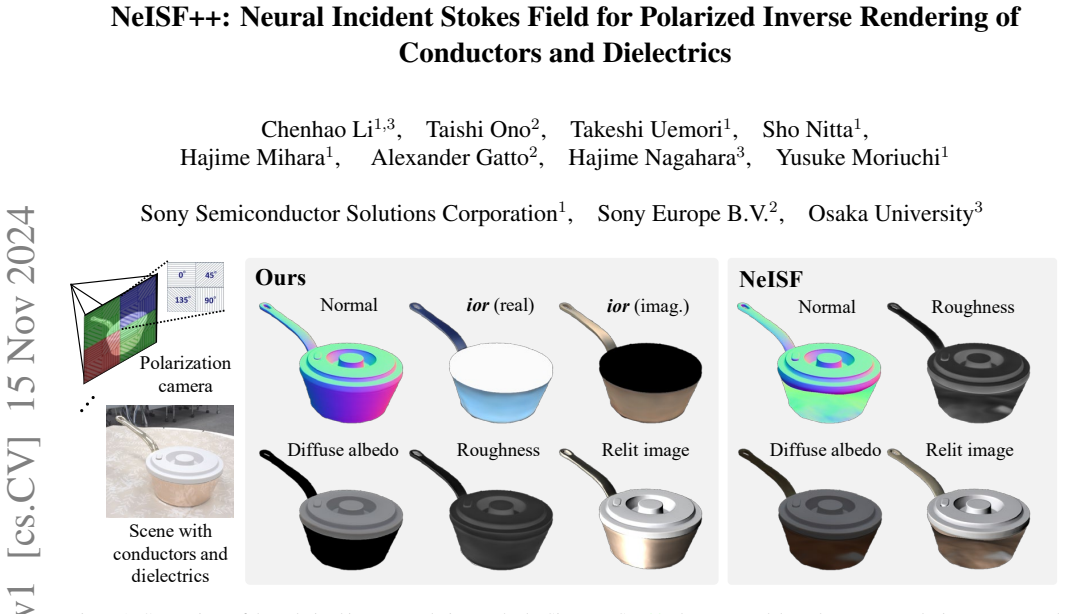
The key machinery is the generalized polarimetric BRDF: a sum of a diffuse Mueller term gated by the binary mask m and a specular microfacet term whose Fresnel reflection matrix FR supports complex refractive indices. The diffuse term is m·(a/π cosθi) FT o · D · FT i, and the specular term is ksD G/(4 cosθo) FR, with FR computed from Fresnel wave theory so that reflection coefficients and phase delay are correct for conductors. Alongside this, the geometry initialization replaces intensity-only volume rendering with a DoLP field, training an MLP to predict per-point DoLP values that are alpha-blended along rays and supervised by the captured DoLP images, which are intensity-invariant and geometry-related.
What would settle it
Run NeISF++ on a mixed scene with a deliberately corrupted mask (for example, labeling part of a metal object as dielectric) and compare the resulting normal-error and complex-refractive-index error to the correct-mask run; if the errors do not rise substantially, the mask assumption is not load-bearing, whereas a sharp rise confirms it is.
Extended reading notes
Core claim
The paper's discovery is that the dielectric-only Baek pBRDF can be extended to conductors by making two changes: multiplying the diffuse polarization term by a binary indicator m (set to 0 for conductors, where subsurface scattering is absent, and 1 for dielectrics), and replacing the fixed real-index Fresnel reflection term with one derived from Fresnel wave theory that accepts a complex refractive index η - ki. With these changes, the renderer produces correct Stokes-vector predictions for both material classes, and the optimization simultaneously estimates SDF geometry, roughness, diffuse albedo, and the two components of the conductor's complex refractive index. The paper also establishes that a DoLP-based initialization of the SDF, which is invariant to light intensity, gives better geometry for glossy objects than intensity-only initialization.
Load-bearing premise
The load-bearing assumption is that the conductor-versus-dielectric mask is correct and given by the user; if the mask is wrong, the diffuse term is switched incorrectly and the reconstructed geometry, complex refractive index, and relighting results are corrupted.
Editorial extensions
If this is right
- The method reconstructs complex refractive indices of conductors, enabling physically plausible relighting with metallic gloss.
- DoLP-based geometry initialization improves normal estimation for glossy and specular objects compared to intensity-only initialization.
- The same pipeline handles both conductors and dielectrics within one optimization, removing the need to treat them separately.
- The proposed synthetic and real HDR datasets provide a benchmark for polarized inverse rendering of mixed material scenes.
- Downstream tasks such as material editing can use the estimated complex refractive index and roughness for realistic appearance changes.
Reading between the lines
- If the conductor-dielectric mask could be predicted automatically, the pipeline would extend to unconstrained scenes; the paper itself suggests data-driven and error-driven mask generation as future work.
- The binary mask is a discrete material prior; a continuous metallic parameter (like Disney's) might blur the physical distinction, but the paper argues discrete is more physical—this is a testable design choice.
- The robustness of DoLP to intensity could transfer to other inverse rendering settings where specular highlights corrupt intensity-based geometry initialization.
- The complex-Fresnel implementation should match laboratory measurements of known conductors (e.g., gold at a given wavelength); validating this on a calibrated target would strengthen the physical correctness claim.
Signed reviews
Editorial analysis
A structured set of objections, weighed in public.
Referee Report
Summary. NeISF++ proposes a polarized inverse rendering pipeline that extends the dielectric-only NeISF framework to scenes containing both conductors and dielectrics. The material model modifies Baek's pBRDF by inserting a binary conductor/dielectric indicator in front of the diffuse polarization term and by computing the Fresnel reflection Mueller matrix with a complex refractive index. Geometry is initialized with a VolSDF trained jointly on DoLP and intensity images, followed by joint optimization of the SDF, BRDF fields (roughness, albedo, complex IOR), and incident Stokes fields. The authors also contribute a synthetic and real multi-view polarimetric dataset and report normal/material metrics on two synthetic scenes, qualitative real-data and relighting results, and an ablation of the proposed DoLP initialization.
Significance. If the results hold, this is a useful step beyond NeISF: it is the first polarized inverse rendering treatment of conductors with a pBRDF, and the DoLP-based geometry initialization is a simple idea that could transfer to other inverse rendering pipelines. The proposed dataset, with ground-truth complex IOR, roughness, and conductor/dielectric masks, is a potentially valuable resource for the community. The quantitative evidence, however, is narrow (two synthetic scenes, no error bars), and the complex-Fresnel derivation and the relighting protocol are not present in the main paper. The contribution is plausible and worth developing, but the broad claims of accurate conductor material decomposition and improved relighting need stronger support before acceptance.
major comments (4)
- [Table 2, Sec. 5.3] The material decomposition claim is not adequately supported by Table 2 as reported. The mean absolute errors for K (0.4300 and 0.6526) are much larger in absolute value than those for Eta (0.0685 and 0.0717), but the real and imaginary parts of the refractive index have very different physical scales for metals (for example, gold at 633 nm has eta around 0.18 and k around 3.4). Reporting absolute MAE alone does not tell the reader whether the K estimates are accurate in relative terms. Please report relative errors, per-material ground-truth IOR values, or error maps for both synthetic scenes, and state whether the reported numbers are raw or normalized.
- [Sec. 4.1, Eq. (5)] The central ingredient of the paper, namely the general Fresnel reflection term supporting complex refractive indices, is described only by a pointer to the supplementary document after Eq. (5). Since this term is what makes the proposed pBRDF applicable to conductors, the manuscript should include the complex-Fresnel Mueller matrix derivation, or at least the final expressions for R+, R-, R×, and the phase delay Delta, in the main text or in an appendix included with the submission. Without this, Eq. (4) and the central claim cannot be independently checked.
- [Sec. 5.3, Relighting and Fig. 7] The relighting comparison in Fig. 7 is presented without a description of how relighting is performed. The paper does not state whether the estimated geometry and material are re-rendered with a new illumination environment, whether the incident Stokes field is reused or replaced, or how the 'Relit1' and 'Relit2' results are generated. Since improved downstream relighting is one of the central claims, the evaluation protocol should be specified and preferably accompanied by quantitative metrics.
- [Sec. 5.1, Tables 1 and 2; Sec. 6] The quantitative evaluation is restricted to two synthetic scenes with no error bars or multiple runs, and the real-data results are qualitative only. Given the broad claim of surpassing existing polarized inverse rendering methods for geometry and material decomposition, the evidence is thin. Additional scenes, especially with different conductor materials and with imperfect conductor/dielectric masks, would materially strengthen the claim. The mask-sensitivity point is acknowledged in Sec. 6 but is never tested, despite the fact that an incorrect binary indicator m directly corrupts the estimated complex IOR and geometry.
minor comments (4)
- [Sec. 4.2, Eq. (6)] The notation in Eq. (6) is a little confusing: the MLP fDoLP is defined on sampled points along a ray, but the input list (x_j, omega_o, n_j, v_j) is not fully explained; please clarify what v_j is and how the per-point DoLP values are alpha-blended.
- [Figures 3 and 4] There are two captions labeled 'Figure 4' in the manuscript, one for the geometry initialization pipeline and one for the joint optimization stage; the figure numbering should be corrected.
- [Sec. 2.1] In the material paragraph, 'support conducts' should read 'support conductors'.
- [Sec. 5.2] The phrase 'NeISF [33] is the second best choice' is unclear; presumably it means 'the best available baseline' given the absence of a direct conductor-aware competitor.
Circularity Check
No significant circularity: NeISF++ is a self-supervised inverse rendering pipeline whose geometry and material outputs are fitted to multi-view Stokes observations and evaluated on held-out views, not derived from its own outputs by construction.
full rationale
The paper presents a self-supervised analysis-by-synthesis inverse rendering method. Geometry, roughness, albedo, and complex refractive index are all free parameters of neural fields optimized against multi-view Stokes and DoLP observations via differentiable rendering (Eqs. 4, 7, 8). This is a fitting procedure, not a derivation that defines a predicted quantity in terms of the fitted constants; errors are reported on held-out test views, which provides an independent check. The key material-model contribution, the complex-refractive-index Fresnel term, is grounded in external Fresnel wave theory (ref. [13]) rather than in a self-citation. The user-specified conductor-dielectric mask m is an explicitly stated input assumption and acknowledged limitation, not a fitted parameter renamed as a prediction. The paper does inherit the incident Stokes field representation from the authors' prior NeISF [33], but that is an architectural choice from prior work, and the novel claims—general pBRDF and DoLP-based geometry initialization—are implemented and compared against NeISF and other baselines on synthetic and real datasets. No equation reduces the claimed result to its own inputs, and no uniqueness theorem or ansatz is smuggled in via self-citation. Thus there is no circular step; any concerns about reconstruction accuracy (e.g., larger K errors) are correctness/robustness issues, not circularity.
Assumptions & free parameters
free parameters (4)
- Complex refractive index (eta, k) for conductors =
Optimized per scene; synthetic MAE: eta 0.0685/0.0717, k 0.4300/0.6526 (Table 2)
- Roughness r and diffuse albedo a =
Optimized per scene; synthetic MAE: roughness 0.0706/0.0161, albedo 0.0468/0.0615 (Table 2)
- Incident Stokes field network weights =
Optimized per scene
- Dielectric refractive index constant =
1.5
assumptions (6)
- ad hoc to paper A user-provided conductor-dielectric mask m is available and correct during optimization.
- domain assumption Visible light does not penetrate conductors, so diffuse polarization is absent there; a hard binary switch between diffuse and no-diffuse is physically adequate.
- domain assumption The GGX microfacet distribution with Smith G and a single-bounce mirror reflection is a sufficient model of specular polarization for both material classes.
- standard math The Fresnel wave theory formulas for complex refractive index correctly give reflection coefficients and phase delay at all incident angles.
- domain assumption DoLP is sufficiently independent of intensity and sufficiently coupled to geometry to be a good geometry-initialization signal.
- domain assumption The incident Stokes field representation can capture multi-bounce polarized light.
Cite this review
Pith. "Pith review of NeISF++: Neural Incident Stokes Field for Polarized Inverse Rendering of Conductors and Dielectrics." pith.science (2026). https://pith.science/paper/AU7ICGLF
@misc{pith2026241110189,
  author       = {Pith},
  title        = {Pith review of: NeISF++: Neural Incident Stokes Field for Polarized Inverse Rendering of Conductors and Dielectrics},
  year         = {2026},
  howpublished = {\url{https://pith.science/paper/AU7ICGLF}},
  note         = {Machine review of arXiv:2411.10189}
}
read the original abstract
Recent inverse rendering methods have greatly improved shape, material, and illumination reconstruction by utilizing polarization cues. However, existing methods only support dielectrics, ignoring conductors that are found everywhere in life. Since conductors and dielectrics have different reflection properties, using previous conductor methods will lead to obvious errors. In addition, conductors are glossy, which may cause strong specular reflection and is hard to reconstruct. To solve the above issues, we propose NeISF++, an inverse rendering pipeline that supports conductors and dielectrics. The key ingredient for our proposal is a general pBRDF that describes both conductors and dielectrics. As for the strong specular reflection problem, we propose a novel geometry initialization method using DoLP images. This physical cue is invariant to intensities and thus robust to strong specular reflections. Experimental results on our synthetic and real datasets show that our method surpasses the existing polarized inverse rendering methods for geometry and material decomposition as well as downstream tasks like relighting.
Figures


Figures from the paper (4 more)


Reference graph
Works this paper leans on
-
[1]
Adobe photoshop
Adobe Inc. Adobe photoshop. 6
-
[2]
T ¨orf: Time-of-flight radiance fields for dynamic scene view synthesis
Benjamin Attal, Eliot Laidlaw, Aaron Gokaslan, Changil Kim, Christian Richardt, James Tompkin, and Matthew O’Toole. T ¨orf: Time-of-flight radiance fields for dynamic scene view synthesis. NeurIPS, 34:26289–26301, 2021. 2
work page 2021
-
[3]
High-res facial appearance cap- ture from polarized smartphone images
Dejan Azinovi ´c, Olivier Maury, Christophe Hery, Matthias Nießner, and Justus Thies. High-res facial appearance cap- ture from polarized smartphone images. In CVPR, pages 16836–16846, 2023. 3
work page 2023
-
[4]
Simultaneous acquisition of polarimetric svbrdf and normals
Seung-Hwan Baek, Daniel S Jeon, Xin Tong, and Min H Kim. Simultaneous acquisition of polarimetric svbrdf and normals. ACM TOG, 37(6):268–1, 2018. 2, 3, 4
work page 2018
-
[5]
Eikonal fields for refractive novel-view synthesis
Mojtaba Bemana, Karol Myszkowski, Jeppe Revall Frisvad, Hans-Peter Seidel, and Tobias Ritschel. Eikonal fields for refractive novel-view synthesis. In SIGGRAPH, pages 1–9,
-
[6]
Bar- ron, Ce Liu, and Hendrik P.A
Mark Boss, Raphael Braun, Varun Jampani, Jonathan T. Bar- ron, Ce Liu, and Hendrik P.A. Lensch. Nerd: Neural re- flectance decomposition from image collections. In ICCV,
-
[7]
Mark Boss, Varun Jampani, Raphael Braun, Ce Liu, Jonathan T. Barron, and Hendrik P.A. Lensch. Neural-pil: Neural pre-integrated lighting for reflectance decomposition. In NeurIPS, 2021. 3
work page 2021
-
[8]
Physically-based shading at disney
Brent Burley and Walt Disney Animation Studios. Physically-based shading at disney. In SIGGRAPH, volume 2012, pages 1–7, 2012. 3, 4
work page 2012
Show all 63 references
-
[9]
Pbir- nie: Glossy object capture under non-distant lighting
Guangyan Cai, Fujun Luan, Milo ˇs Ha ˇsan, Kai Zhang, Sai Bi, Zexiang Xu, Iliyan Georgiev, and Shuang Zhao. Pbir- nie: Glossy object capture under non-distant lighting. arXiv preprint arXiv:2408.06878, 2024. 3
2024 arXiv
-
[10]
Multi-view azimuth stereo via tangent space consis- tency
Xu Cao, Hiroaki Santo, Fumio Okura, and Yasuyuki Mat- sushita. Multi-view azimuth stereo via tangent space consis- tency. In CVPR, pages 825–834, 2023. 2, 3, 6
2023
-
[11]
Pisr: Polarimetric neural implicit surface reconstruction for textureless and specular objects
Guangcheng Chen, Yicheng He, Li He, and Hong Zhang. Pisr: Polarimetric neural implicit surface reconstruction for textureless and specular objects. arXiv preprint arXiv:2409.14331, 2024. 2, 3, 6
2024 arXiv
-
[12]
Wildlight: In- the-wild inverse rendering with a flashlight
Ziang Cheng, Junxuan Li, and Hongdong Li. Wildlight: In- the-wild inverse rendering with a flashlight. In CVPR, pages 4305–4314, 2023. 3
2023
-
[13]
Field guide to polarization
Edward Collett. Field guide to polarization. Spie Belling- ham, 2005. 2, 4, 5
2005
-
[14]
Pan- dora: Polarization-aided neural decomposition of radiance
Akshat Dave, Yongyi Zhao, and Ashok Veeraraghavan. Pan- dora: Polarization-aided neural decomposition of radiance. In ECCV, pages 538–556, 2022. 2, 3, 4, 6, 7, 8
2022
-
[15]
Deep polarization imaging for 3d shape and svbrdf acqui- sition
Valentin Deschaintre, Yiming Lin, and Abhijeet Ghosh. Deep polarization imaging for 3d shape and svbrdf acqui- sition. In CVPR, pages 15567–15576, 2021. 3
2021
-
[16]
End-to-end neural network for pbrdf estima- tion of object to reconstruct polarimetric reflectance
Jin Duan, Youfei Hao, Ju Liu, Cai Cheng, Qiang Fu, and Huilin Jiang. End-to-end neural network for pbrdf estima- tion of object to reconstruct polarimetric reflectance. Optics Express, 31(24):39647–39663, 2023. 3
2023
-
[17]
Ref-neus: Ambiguity-reduced neural implicit surface learning for multi-view reconstruction with reflection
Wenhang Ge, Tao Hu, Haoyu Zhao, Shu Liu, and Ying-Cong Chen. Ref-neus: Ambiguity-reduced neural implicit surface learning for multi-view reconstruction with reflection. In ICCV, pages 4251–4260, 2023. 3
2023
-
[18]
Implicit geometric regularization for learning shapes
Amos Gropp, Lior Yariv, Niv Haim, Matan Atzmon, and Yaron Lipman. Implicit geometric regularization for learning shapes. In Proceedings of the 37th International Conference on Machine Learning, pages 3789–3799, 2020. 6
2020
-
[19]
Neu- ral radiosity
Saeed Hadadan, Shuhong Chen, and Matthias Zwicker. Neu- ral radiosity. ACM TOG, 40(6):1–11, 2021. 3
2021
-
[20]
Nersp: Neural 3d reconstruction for reflective objects with sparse polarized images
Yufei Han, Heng Guo, Koki Fukai, Hiroaki Santo, Boxin Shi, Fumio Okura, Zhanyu Ma, and Yunpeng Jia. Nersp: Neural 3d reconstruction for reflective objects with sparse polarized images. In CVPR, pages 11821–11830, 2024. 2, 3
2024
-
[21]
Shape, light, and material decomposition from images using monte carlo rendering and denoising
Jon Hasselgren, Nikolai Hofmann, and Jacob Munkberg. Shape, light, and material decomposition from images using monte carlo rendering and denoising. NeurIPS, 35:22856– 22869, 2022. 3
2022
-
[22]
2d gaussian splatting for geometrically ac- curate radiance fields
Binbin Huang, Zehao Yu, Anpei Chen, Andreas Geiger, and Shenghua Gao. 2d gaussian splatting for geometrically ac- curate radiance fields. In SIGGRAPH, pages 1–11, 2024. 3
2024
-
[23]
Sparse ellipsome- try: portable acquisition of polarimetric svbrdf and shape with unstructured flash photography
Inseung Hwang, Daniel S Jeon, Adolfo Munoz, Diego Gutierrez, Xin Tong, and Min H Kim. Sparse ellipsome- try: portable acquisition of polarimetric svbrdf and shape with unstructured flash photography. ACM TOG, 41(4):1– 14, 2022. 3
2022
-
[24]
Fresnel microfacet brdf: Unification of polari- radiometric surface-body reflection
Tomoki Ichikawa, Yoshiki Fukao, Shohei Nobuhara, and Ko Nishino. Fresnel microfacet brdf: Unification of polari- radiometric surface-body reflection. In CVPR, pages 16489– 16497, 2023. 3
2023
-
[25]
Dr.jit: A just-in-time compiler for differentiable rendering
Wenzel Jakob, S ´ebastien Speierer, Nicolas Roussel, and De- lio Vicini. Dr.jit: A just-in-time compiler for differentiable rendering. ACM TOG, 41(4), 2022. 6
2022
-
[26]
Tensoir: Tensorial inverse rendering
Haian Jin, Isabella Liu, Peijia Xu, Xiaoshuai Zhang, Song- fang Han, Sai Bi, Xiaowei Zhou, Zexiang Xu, and Hao Su. Tensoir: Tensorial inverse rendering. In CVPR, pages 165– 174, 2023. 3
2023
-
[27]
The rendering equation
James T Kajiya. The rendering equation. In Proceedings of the 13th annual conference on Computer graphics and inter- active techniques, pages 143–150, 1986. 4
1986
-
[28]
3d gaussian splatting for real-time radiance field rendering
Bernhard Kerbl, Georgios Kopanas, Thomas Leimk ¨uhler, and George Drettakis. 3d gaussian splatting for real-time radiance field rendering. ACM TOG, 42(4):139–1, 2023. 3
2023
-
[29]
Neural spectro-polarimetric fields
Youngchan Kim, Wonjoon Jin, Sunghyun Cho, and Seung- Hwan Baek. Neural spectro-polarimetric fields. In SIG- GRAPH Asia, pages 1–11, 2023. 3
2023
-
[30]
Accurate polarimetric brdf for real po- larization scene rendering
Yuhi Kondo, Taishi Ono, Legong Sun, Yasutaka Hirasawa, and Jun Murayama. Accurate polarimetric brdf for real po- larization scene rendering. In ECCV, pages 220–236, 2020. 3
2020
-
[31]
Glossygs: Inverse rendering of glossy objects 9 with 3d gaussian splatting.arXiv preprint arXiv:2410.13349,
Shuichang Lai, Letian Huang, Jie Guo, Kai Cheng, Bowen Pan, Xiaoxiao Long, Jiangjing Lyu, Chengfei Lv, and Yan- wen Guo. Glossygs: Inverse rendering of glossy objects 9 with 3d gaussian splatting.arXiv preprint arXiv:2410.13349,
-
[32]
Deep polarization cues for single-shot shape and subsurface scat- tering estimation
Chenhao Li, Trung Thanh Ngo, and Hajime Nagahara. Deep polarization cues for single-shot shape and subsurface scat- tering estimation. arXiv preprint arXiv:2407.08149 , 2024. 3
2024 arXiv
-
[33]
Neisf: Neural incident stokes field for geometry and material estimation
Chenhao Li, Taishi Ono, Takeshi Uemori, Hajime Mihara, Alexander Gatto, Hajime Nagahara, and Yusuke Moriuchi. Neisf: Neural incident stokes field for geometry and material estimation. In CVPR, pages 21434–21445, 2024. 1, 2, 3, 4, 5, 6, 7, 8, 9
2024
-
[34]
Multimodal material segmentation
Yupeng Liang, Ryosuke Wakaki, Shohei Nobuhara, and Ko Nishino. Multimodal material segmentation. InCVPR, pages 19800–19808, 2022. 7
2022
-
[35]
Fisheye-gs: Lightweight and extensible gaus- sian splatting module for fisheye cameras
Zimu Liao, Siyan Chen, Rong Fu, Yi Wang, Zhongling Su, Hao Luo, Linning Xu, Bo Dai, Hengjie Li, Zhilin Pei, et al. Fisheye-gs: Lightweight and extensible gaus- sian splatting module for fisheye cameras. arXiv preprint arXiv:2409.04751, 2024. 2
2024 arXiv
-
[36]
Nero: Neural geometry and brdf reconstruction of reflective objects from multiview images
Yuan Liu, Peng Wang, Cheng Lin, Xiaoxiao Long, Jiepeng Wang, Lingjie Liu, Taku Komura, and Wenping Wang. Nero: Neural geometry and brdf reconstruction of reflective objects from multiview images. ACM TOG, 42(4):1–22, 2023. 3, 6, 7, 8
2023
-
[37]
Specnerf: Gaussian directional encoding for spec- ular reflections
Li Ma, Vasu Agrawal, Haithem Turki, Changil Kim, Chen Gao, Pedro Sander, Michael Zollh ¨ofer, and Christian Richardt. Specnerf: Gaussian directional encoding for spec- ular reflections. In CVPR, pages 21188–21198, 2024. 3
2024
-
[38]
Nerf: Representing scenes as neural radiance fields for view syn- thesis
Ben Mildenhall, Pratul P Srinivasan, Matthew Tancik, Jonathan T Barron, Ravi Ramamoorthi, and Ren Ng. Nerf: Representing scenes as neural radiance fields for view syn- thesis. In ECCV, pages 405–421, 2020. 1, 2, 3
2020
-
[39]
Objects as volumes: A stochastic geometry view of opaque solids
Bailey Miller, Hanyu Chen, Alice Lai, and Ioannis Gkioulekas. Objects as volumes: A stochastic geometry view of opaque solids. In CVPR, pages 87–97, 2024. 3
2024
-
[40]
Extracting triangular 3d models, materials, and lighting from images
Jacob Munkberg, Jon Hasselgren, Tianchang Shen, Jun Gao, Wenzheng Chen, Alex Evans, Thomas M¨uller, and Sanja Fi- dler. Extracting triangular 3d models, materials, and lighting from images. In CVPR, pages 8280–8290, 2022. 3
2022
-
[41]
Automatic differentiation in pytorch
Adam Paszke, Sam Gross, Soumith Chintala, Gregory Chanan, Edward Yang, Zachary DeVito, Zeming Lin, Al- ban Desmaison, Luca Antiga, and Adam Lerer. Automatic differentiation in pytorch. In NIPS-W, 2017. 6
2017
-
[42]
pcon: Po- larimetric coordinate networks for neural scene representa- tions
Henry Peters, Yunhao Ba, and Achuta Kadambi. pcon: Po- larimetric coordinate networks for neural scene representa- tions. In CVPR, pages 16579–16589, 2023. 3
2023
-
[43]
Cross- spectral neural radiance fields
Matteo Poggi, Pierluigi Zama Ramirez, Fabio Tosi, Samuele Salti, Luigi Di Stefano, and Stefano Mattoccia. Cross- spectral neural radiance fields. In 3DV, pages 606–616,
-
[44]
E2nerf: Event enhanced neural radiance fields from blurry images
Yunshan Qi, Lin Zhu, Yu Zhang, and Jia Li. E2nerf: Event enhanced neural radiance fields from blurry images. In ICCV, pages 13254–13264, 2023. 2
2023
-
[45]
Eventnerf: Neural radiance fields from a single colour event camera
Viktor Rudnev, Mohamed Elgharib, Christian Theobalt, and Vladislav Golyanik. Eventnerf: Neural radiance fields from a single colour event camera. In CVPR, pages 4992–5002,
-
[46]
Transparent shape from a single view polarization image
Mingqi Shao, Chongkun Xia, Zhendong Yang, Junnan Huang, and Xueqian Wang. Transparent shape from a single view polarization image. In ICCV, pages 9277–9286, 2023. 3
2023
-
[47]
A deep learning approach for pixel-level mate- rial classification via hyperspectral imaging
Savvas Sifnaios, George Arvanitakis, Fotios K Konstantini- dis, Georgios Tsimiklis, Angelos Amditis, and Panayiotis Frangos. A deep learning approach for pixel-level mate- rial classification via hyperspectral imaging. arXiv preprint arXiv:2409.13498, 2024. 7
2024 arXiv
-
[48]
Ref-nerf: Struc- tured view-dependent appearance for neural radiance fields
Dor Verbin, Peter Hedman, Ben Mildenhall, Todd Zickler, Jonathan T Barron, and Pratul P Srinivasan. Ref-nerf: Struc- tured view-dependent appearance for neural radiance fields. In CVPR, pages 5481–5490. IEEE, 2022. 3
2022
-
[49]
Microfacet models for refraction through rough surfaces
Bruce Walter, Stephen R Marschner, Hongsong Li, and Ken- neth E Torrance. Microfacet models for refraction through rough surfaces. In Proceedings of the 18th Eurographics conference on Rendering Techniques, pages 195–206, 2007. 4
2007
-
[50]
Inverse rendering of glossy objects via the neural plenoptic function and radiance fields
Haoyuan Wang, Wenbo Hu, Lei Zhu, and Rynson WH Lau. Inverse rendering of glossy objects via the neural plenoptic function and radiance fields. In CVPR, pages 19999–20008,
-
[51]
Neus: Learning neural implicit surfaces by volume rendering for multi-view reconstruction
Peng Wang, Lingjie Liu, Yuan Liu, Christian Theobalt, Taku Komura, and Wenping Wang. Neus: Learning neural implicit surfaces by volume rendering for multi-view reconstruction. NeurIPS, 34:27171–27183, 2021. 1, 3
2021
-
[52]
Nefii: Inverse rendering for reflectance decomposition with near-field indirect illumina- tion
Haoqian Wu, Zhipeng Hu, Lincheng Li, Yongqiang Zhang, Changjie Fan, and Xin Yu. Nefii: Inverse rendering for reflectance decomposition with near-field indirect illumina- tion. In CVPR, pages 4295–4304, 2023. 3
2023
-
[53]
Factorized inverse path tracing for efficient and accurate material-lighting esti- mation
Liwen Wu, Rui Zhu, Mustafa B Yaldiz, Yinhao Zhu, Hong Cai, Janarbek Matai, Fatih Porikli, Tzu-Mao Li, Manmo- han Chandraker, and Ravi Ramamoorthi. Factorized inverse path tracing for efficient and accurate material-lighting esti- mation. In ICCV, pages 3848–3858, 2023. 3, 7
2023
-
[54]
Neilf: Neural incident light field for physically-based ma- terial estimation
Yao Yao, Jingyang Zhang, Jingbo Liu, Yihang Qu, Tian Fang, David McKinnon, Yanghai Tsin, and Long Quan. Neilf: Neural incident light field for physically-based ma- terial estimation. In ECCV, pages 700–716, 2022. 1, 3
2022
-
[55]
V olume rendering of neural implicit surfaces
Lior Yariv, Jiatao Gu, Yoni Kasten, and Yaron Lipman. V olume rendering of neural implicit surfaces. NeurIPS, 34:4805–4815, 2021. 2, 3, 5, 6, 7, 8
2021
-
[56]
Bakedsdf: Meshing neural sdfs for real- time view synthesis
Lior Yariv, Peter Hedman, Christian Reiser, Dor Verbin, Pratul P Srinivasan, Richard Szeliski, Jonathan T Barron, and Ben Mildenhall. Bakedsdf: Meshing neural sdfs for real- time view synthesis. In SIGGRAPH, pages 1–9, 2023. 1
2023
-
[57]
Multiview neu- ral surface reconstruction by disentangling geometry and ap- pearance
Lior Yariv, Yoni Kasten, Dror Moran, Meirav Galun, Matan Atzmon, Basri Ronen, and Yaron Lipman. Multiview neu- ral surface reconstruction by disentangling geometry and ap- pearance. NeurIPS, 33:2492–2502, 2020. 3
2020
-
[58]
Thermal-nerf: Neural radiance fields from an infrared cam- era
Tianxiang Ye, Qi Wu, Junyuan Deng, Guoqing Liu, Liu Liu, Songpengcheng Xia, Liang Pang, Wenxian Yu, and Ling Pei. Thermal-nerf: Neural radiance fields from an infrared cam- era. arXiv preprint arXiv:2403.10340, 2024. 2
2024 arXiv
-
[59]
Neilf++: Inter-reflectable light fields for geometry and material esti- mation
Jingyang Zhang, Yao Yao, Shiwei Li, Jingbo Liu, Tian Fang, David McKinnon, Yanghai Tsin, and Long Quan. Neilf++: Inter-reflectable light fields for geometry and material esti- mation. In ICCV, pages 3601–3610, 2023. 2, 3, 5 10
2023
-
[60]
Physg: Inverse rendering with spherical gaus- sians for physics-based material editing and relighting
Kai Zhang, Fujun Luan, Qianqian Wang, Kavita Bala, and Noah Snavely. Physg: Inverse rendering with spherical gaus- sians for physics-based material editing and relighting. In CVPR, pages 5453–5462, 2021. 3
2021
-
[61]
Nerfac- tor: Neural factorization of shape and reflectance under an unknown illumination
Xiuming Zhang, Pratul P Srinivasan, Boyang Deng, Paul De- bevec, William T Freeman, and Jonathan T Barron. Nerfac- tor: Neural factorization of shape and reflectance under an unknown illumination. ACM TOG, 40(6):1–18, 2021. 3
2021
-
[62]
Modeling indirect illumination for inverse rendering
Yuanqing Zhang, Jiaming Sun, Xingyi He, Huan Fu, Rongfei Jia, and Xiaowei Zhou. Modeling indirect illumination for inverse rendering. In CVPR, pages 18643–18652, 2022. 3
2022
-
[63]
Po- larimetric multi-view inverse rendering
Jinyu Zhao, Yusuke Monno, and Masatoshi Okutomi. Po- larimetric multi-view inverse rendering. IEEE TPAMI, 2022. 3 11
2022
Reviewed August 12, 2026 · model on record in the stance chip above.
Discussion (0). Continue with ORCID to comment.