REVIEW 5 major objections 5 minor 26 references
This paper claims that in evolving systems with a bipartite interaction structure, asymmetric initial connectivities between the two partitions markedly enhance robustness, shifting the collapse transition to higher connectivity and even pr
Reviewed by Pith at T0; open to challenge. T0 means a machine referee read the full paper against a public rubric. the ladder, T0–T4 →
T0 review · deepseek-v4-flash
2026-08-01 08:52 UTC pith:AUT3ZVKQ
load-bearing objection Core simulation result is new and credible: asymmetric bipartite topology shifts the phase boundary and produces a re-entrant transition. The mean-field explanation is suggestive but relies on fits and observed simulation outputs, and Eqs. (20)-(21) contain a real exponent error. the 5 major comments →
Enhanced robustness of evolving systems with bipartite topology
The pith
A machine-rendered reading of the paper's core claim, the machinery that carries it, and where it could break.
Core claim
The central discovery is that the robustness phase diagram of an evolving bipartite network is controlled not by the input degrees m_alpha and m_beta but by the emergent degrees k_alpha and k_beta, which can deviate strongly from the inputs when the inputs are asymmetric. Under asymmetry, the handshaking relation N_alpha k_alpha = N_beta k_beta, together with the link balance m_alpha + m_beta = k_alpha + k_beta and the empirical extinction law E(k) = c k^{-nu}, implies a self-consistent degree shift, given by Eqs. (20)-(21), in which the side with the smaller input degree gets a disproportionately large emergent degree. This degree elevation suppresses extinction probabilities across the com
What carries the argument
The argument is carried by three coupled ingredients: (i) the bipartite handshaking constraint N_alpha k_alpha = N_beta k_beta, which ties population ratios to degree ratios; (ii) the balance condition m_alpha + m_beta = k_alpha + k_beta, which closes the system and yields explicit formulas for the emergent degrees k_alpha and k_beta as functions of the input degrees; and (iii) the approximate extinction-probability law E(k) = c k^{-nu} with c about 1/2 and nu about 2/3, which converts higher degree into lower extinction probability. The corrected mean-field estimate further separates the extinction probability for species introduction from that for species deletion, capturing the concentrat
Load-bearing premise
The load-bearing premise is that the extinction probability of a node obeys E(k) = c k^{-nu} with c about 1/2 and nu about 2/3, fitted on the same class of simulations and then assumed unchanged in the evolving bipartite system, and that the link-balance condition m_alpha + m_beta = k_alpha + k_beta closes the mean-field equations; if either fails, the predicted degree elevation and the robustness enhancement do not follow from the argument, even if the raw simulation phase d
What would settle it
Measure the extinction probability E(k) directly within the evolving bipartite model at the emergent degrees k_alpha and k_beta predicted by Eqs. (20)-(21). If E(k) deviates measurably from c k^{-nu} with nu about 2/3, or if the link-balance condition does not hold in the growing phase, the degree-shift explanation collapses. Alternatively, run the same model with a different extinction law, such as an exponential in k, and check whether the phase-boundary shift and the re-entrant transition disappear; the claim predicts they would.
If this is right
- For any bipartite evolving system with asymmetric insertion rates, the collapse threshold is higher than for the corresponding unstructured system with the same average input degree; the two thresholds coincide only in the symmetric limit.
- The diverging growing phase can persist even when both insertion degrees lie above the unstructured critical point, so robustness is not bounded by the single-community transition.
- There exists a regime where increasing the input connectivity of one side drives the system from growing to finite and back to growing: a re-entrant transition absent in unstructured systems.
- The mechanism is universal in that it depends only on the handshaking constraint, the balance of link gain and loss, and a monotonically decreasing extinction probability, not on the details of fitness or rewiring.
- The extended mean-field framework with degree shift and separate introduction and deletion extinction probabilities can quantitatively predict the phase boundary, making it a usable tool for other bipartite assembly models.
Where Pith is reading between the lines
- Because the mechanism rests only on topology-induced degree elevation and extinction concentration, it should also apply when the two partitions have different intrinsic extinction functions, not just different insertion degrees: a testable extension the paper does not pursue.
- In empirical bipartite communities with asymmetric interaction counts, one could look for signatures of the re-entrant transition: communities with strongly asymmetric interaction rates should show enhanced persistence compared with symmetric ones at the same mean interaction count.
- The paper treats the extinction law as input; measuring E(k) directly inside the evolving bipartite system, rather than transferring it from the unstructured model, would either confirm or require modification of the predicted degree shift.
- The re-entrant transition suggests that in engineered two-sided platforms, increasing activity asymmetry can act as a robustness lever, though the paper makes no engineering claim.
Editorial analysis
A structured set of objections, weighed in public.
Referee Report
Summary. The manuscript studies a directed bipartite extension of Shimada's evolving open-system model. New species of two types arrive with prescribed input degrees m_alpha and m_beta and random interaction weights; cascading extinctions are resolved before the next introduction. Simulations indicate that when m_alpha = m_beta the divergence-to-finite transition is unchanged from the unstructured case, whereas for asymmetric input degrees the system remains/grows in a much larger parameter region and exhibits a re-entrant transition back to the diverging phase (e.g., along m_beta = 16 with m_alpha near 40-45). The authors propose a mean-field explanation based on a shift of the emergent average degrees (k_alpha, k_beta) away from (m_alpha, m_beta), an empirical extinction law E(k) = c k^{-nu}, and modified cascade sums, and claim that this theory quantitatively reproduces the observed phase boundaries, including the re-entrant transition.
Significance. If correct, the finding that mere bipartite topology plus asymmetric input connectivity can enhance robustness and produce a re-entrant transition is a novel and potentially universal mechanism, relevant to plant-pollinator, microbial, trade, and other bipartite systems. The symmetric-case check against the known unstructured result is a useful internal validation, and the raw simulation evidence appears plausible. However, the theoretical part is not yet at the same standard: the central degree-shift argument rests on an unproven link-balance condition, an exponent error in the closed-form solution, and an empirically fitted extinction law. These issues must be fixed before the claim that the mean-field analysis 'identifies the origin' of the effect can be accepted.
major comments (5)
- [§III.C.1, Eqs. (18)-(21)] Eq. (18) gives k_beta/k_alpha = (m_alpha/m_beta)^{1/nu}. Therefore k_alpha = (m_alpha+m_beta)/[1+(m_alpha/m_beta)^{1/nu}] and k_beta = (m_alpha+m_beta)/[1+(m_alpha/m_beta)^{-1/nu}], not the expressions with exponent nu in Eqs. (20)-(21). With nu=2/3 and (m_alpha,m_beta)=(45,16), the corrected formula gives k_alpha approximately 10.7 instead of 20.4. This materially changes the theoretical curves in Fig. 7 and the quantitative degree-shift prediction, so the error should be corrected and the figure re-examined.
- [§III.C.1, Eq. (19)] The condition m_alpha + m_beta = k_alpha + k_beta is asserted without derivation. In a persistent state, each introduction adds m_chi links, while each extinction removes a number of links equal to the degree of the extinct node; the correct balance involves the average degree of extinct species, not the sum k_alpha+k_beta. In the diverging phase there is net link accumulation, so the equality is not generally expected. Since Eqs. (20)-(21) depend on Eq. (19), the predicted degree shift is not established. A proper link-budget derivation is needed.
- [§III.A, Eq. (14)] The inequality N_E(m_alpha,m_beta) < mu_I/(1-mu_I) may be correct, but the identification mu_I/(1-mu_I) = N_E(mu_m, mu_m) is not: mu_I is the arithmetic mean of I_alpha and I_beta evaluated at the actual m_alpha, m_beta, and this is generally not equal to mu_m E(mu_m)/2 for mu_m = (m_alpha+m_beta)/2. Therefore the claim that an asymmetric bipartite system is more robust than the symmetric system with the same average degree is not proven by this equation, even if it is supported by the simulations.
- [§III.C.2–C.3, Eqs. (17), (29)-(33), Fig. 9] The 'quantitative explanation' is largely an empirical consistency check. The extinction law E(k)=c k^{-nu} is fitted (Eq. 17), the boundary in Fig. 9 uses the observed average degrees k_chi and observed extinction out-degrees, and the separate functions E_i, E_e for introduction and deletion are introduced without specifying how they are obtained. Feeding simulation outputs back into the mean-field formulas can reproduce a phase boundary without independently explaining it. To support the explanatory claim, the authors should either derive E(k) or demonstrate its stability across parameters, and show that the corrected degree-shift formulas together with a parameter-free E predict the phase boundary without using the measured k_chi.
- [§III.B, Figs. 4–6] The phase classification relies on the threshold lim_{t->inf} N_chi(t)/t >= 0.0006 (Fig. 4 caption), and the re-entrant transition is the headline claim. It should be checked that the detected growing/finite strips are robust to reasonable threshold choices (e.g., 0.0001 and 0.001) and to simulation duration. Without such a check, a slowly diverging phase could be misclassified as finite, affecting the reported re-entrant boundary.
minor comments (5)
- [§III.C.2, Eqs. (24)-(27)] The notation here is ambiguous. If only the initial introduction event carries the m_chi/k_chi factor and all later cascade events use the resident degree k_chi, then the factored geometric-series forms are correct; the denominator need not change. The text should state this convention explicitly, because Eqs. (22)-(23) describe the direct impacts of 'an inclusion or extinction', which would suggest a different series.
- [Abstract and §III.B.2] The abstract states that the diverging phase persists even when both initial degrees individually exceed the critical point, but the illustrative sweep m_beta=16 has m_beta < m_c. Please point to a specific (m_alpha,m_beta) region in Fig. 6 where both m_alpha and m_beta exceed m_c and the system is in the diverging phase.
- [Fig. 9 and surrounding text] The text refers to dash-dotted lines in Fig. 9, but the caption describes solid lines for the improved estimate. Clarify which curves correspond to Eqs. (24)-(27) and which to Eqs. (29)-(32).
- [Eq. (33) and Fig. 8] The quantities k_check_out_alpha and k_check_out_beta are used in Eq. (33), but §III.C.3 only discusses the extinction bias in group beta. Define both quantities and state how they are measured.
- [General] No code or data availability statement is included; providing this would strengthen reproducibility. Minor wording: 'making it lying entirely outside' in the abstract should be revised.
Circularity Check
The re-entrant-boundary 'prediction' in Fig. 9 is evaluated at the simulation's own measured degrees and extinction degrees, making the theoretical explanation partially circular; the simulated phase diagram itself is independent.
specific steps
-
fitted input called prediction
[Sec. III.C.3, Eqs. (29)-(32), and Fig. 9 caption]
"Expected numbers of extinctions ̌N^{χη} obtained using the extended mean-field estimate with the observed average degrees k_χ, the average out-degree of species going extinct in group β, and the extinction probability function E(k) (Eqs. 29-32), with the initial degree m_β fixed at 16. The improved estimate captures ̌N^{χη} for all (χ, η) pairs well, and hence the resulting average ̌N_E provides a quantitative explanation for the re-entrant transition to the growing phase at around m_α = 40."
The 'quantitative explanation' is not derived from the model parameters m_α, m_β alone. Eqs. (29)-(32) are evaluated by inserting the observed emergent average degrees k_χ, the observed average out-degree of extinct species, and the empirically fitted extinction law E(k)=c k^{-ν} into the geometric series. Since the geometric series is monotone in these inputs, feeding in the measured high k_β and low extinction-degree of group β forces the average extinction count to dip below 1 near m_α≈40. The paper itself admits the un-corrected mean-field estimate fails ('This difference is the remaining problem which hinders us to explain the re-entrance to growing phase at around m_α = 40'), and the correction then uses measured quantities as inputs. Thus the advertised 'identification of the origin
full rationale
The central simulation results (Figs. 4-6) are self-contained and not circular: the symmetric transition and the asymmetric re-entrant transition are read directly from the model dynamics, and the symmetric case is checked against the original unstructured model. The circularity is confined to the theoretical apparatus presented as 'identifying the origin.' In Sec. III.C.3 and Fig. 9, the extended mean-field estimate uses the observed average degrees, the observed average out-degree of extinct species, and the empirically fitted extinction law E(k)=c k^{-ν} to compute the extinction numbers and then claims a quantitative explanation of the re-entrant boundary. That agreement is partly guaranteed by construction because the inputs are measured from the same simulation whose phase boundary is being explained. The self-citations to Refs. [20,21] are not counted as load-bearing circularity here, because the baseline transition is independently confirmed in the paper's own simulations and the re-entrant phenomenon comes from the present model. Separately, the algebraic slips noted in Eqs. (18)-(21) and (24)-(27) are correctness risks rather than circularity. Overall, the simulation finding is robust and non-circular, but the paper's central theoretical claim overstates its independence, giving a partial circularity score of 6.
Axiom & Free-Parameter Ledger
free parameters (4)
- exponent ν in E(k)=c k^{-ν} =
≈ 2/3
- prefactor c in E(k)=c k^{-ν} =
≈ 1/2
- divergence-speed threshold =
0.0006
- extinction probability functions E_i, E_e for introduction/deletion =
measured from simulation
axioms (5)
- domain assumption A species survives iff fitness f_i = Σ_j a_{ij} > 0; otherwise it is removed with its links, possibly triggering cascading extinctions.
- domain assumption New species are introduced with equal probability to either group and connect with m_α or m_β random links of random direction with weights from N(0,1).
- domain assumption The extinction probability function E(k)=c k^{-ν} has the same form in bipartite and unstructured systems and for both groups.
- ad hoc to paper The average degree balance m_α + m_β = k_α + k_β holds for emergent networks.
- standard math The handshaking condition N_α k_α = N_β k_β and the ratio k_α/k_β = g_β/g_α in the diverging phase.
read the original abstract
Evolving open systems, in which new entities are continually introduced and those turning unfit go extinct, exhibit a phase transition between a diverging phase, where the system size grows indefinitely, and a finite phase, where it remains bounded. We show that imposing a bipartite interaction topology alone leaves this transition unchanged when the two partitions are introduced with equal initial connectivity. In contrast, when the initial degrees are asymmetric, the robustness of the system is markedly enhanced such that the transition shifts to higher connectivity and the diverging phase persists even when both initial degrees individually exceed the critical point of the corresponding unstructured system. In addition, we find a re-entrant transition, i.e. a return to the diverging phase as asymmetry is increased while the initial degree of one of the partitions is fixed, making it lying entirely outside the original mean-field picture. An extended mean-field analysis identifies the origin of these effects such that in the asymmetric regime, a feedback between the bipartite handshaking constraint and different extinction rates drives the mean degree of emergent network far above the initially assigned connectivity. This degree elevation suppresses extinction probabilities across the community while simultaneously concentrating extinctions among recently introduced, low-degree nodes. The interplay of these two effects constitutes a simple and universal robustness mechanism for evolving systems with asymmetric bipartite structure.
Figures





Reference graph
Works this paper leans on
-
[1]
In this case, we can confirm the prediction from the mean-field argument that having a bipartite topology makes no difference, as shown in Fig
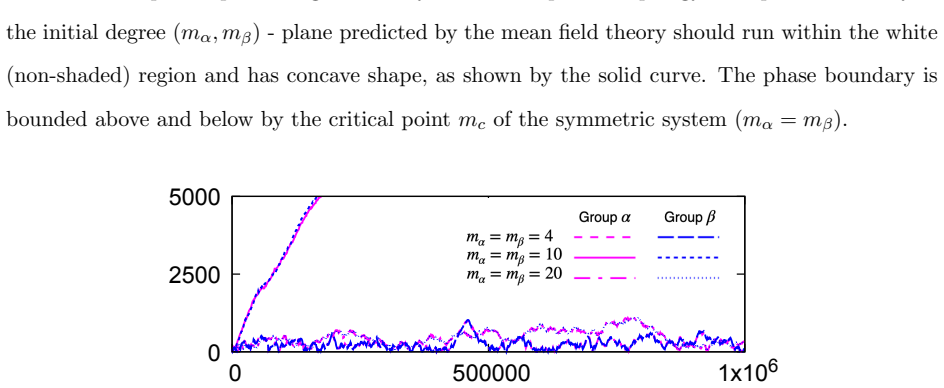
Symmetric case (m α =m β =m) We first investigate the case of symmetric initial degree, i.e.,m α =m β =m. In this case, we can confirm the prediction from the mean-field argument that having a bipartite topology makes no difference, as shown in Fig. 3 and Fig. 4
-
[2]
This produces a phase diagram that is qualitatively different from the mean-field prediction (FIG
Asymmetric case (m α ̸=m β) Next, we investigate the case in which the initial degrees of the newly introduced species are asymmetric, i.e.,m α ̸=m β. This produces a phase diagram that is qualitatively different from the mean-field prediction (FIG. 6) as well as demonstrated in FIG. 5 by the section inm β = 16. For this sweep, we see that the system size...
-
[3]
handshaking condition
The cause and the condition for the degree shift of emergent networks For emergent networks withN α andN β nodes in theαandβgroups, respectively, the relationN αkα =N βkβ must hold for the average degrees of each sidek α andk β due to trivial “handshaking condition”. In the divergent phase, in which both groups increase linearly in time with growth ratesg...
-
[4]
Let us examine the impact of this shift on the robustness of the emerging system
The impact of the degree shift to the system As we have seen above, the actual mean degrees of the emerging systemk α andk β in the current bipartite model can be considerably shifted from that of the newly introduced species,m α mβ. Let us examine the impact of this shift on the robustness of the emerging system. Under the degree shift, the direct impact...
-
[5]
re-entrant
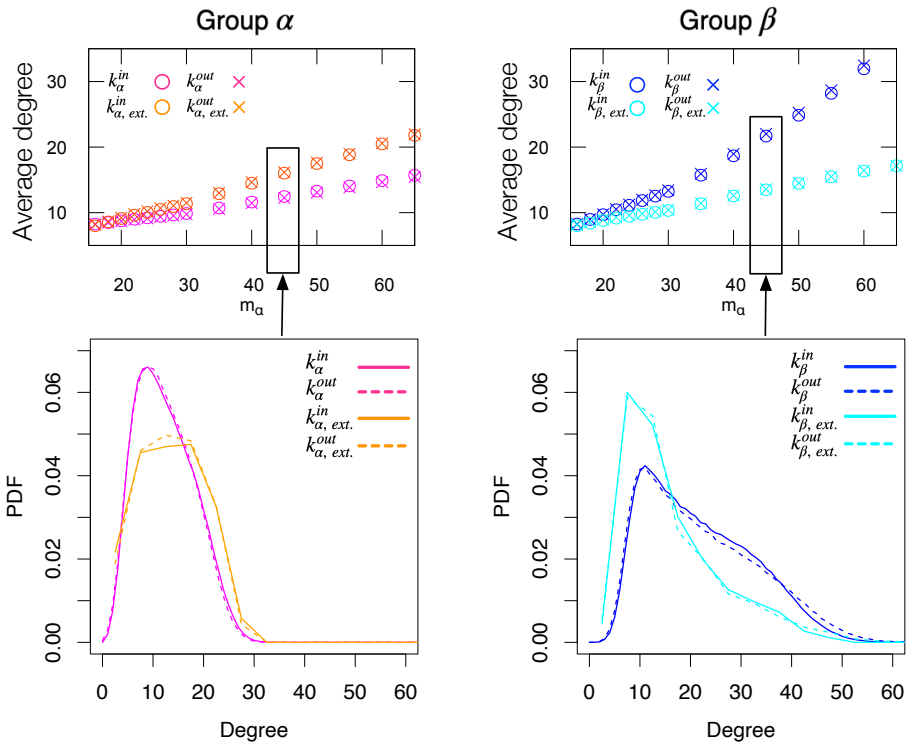
Strong reinforcement effect due to the structuring in groupβ. The overestimation ofn αα E suggests a further reinforcement mechanism onβgroup. In- deed, in this group, we find that the average degree of the species going to extinct is con- siderably smaller than the average of entire population:k ext. β ≈m β < kβ (FIG. 8). This happens basically because t...
-
[6]
Guillaume and M
J.-L. Guillaume and M. Latapy, Bipartite graphs as models of complex networks, Physica A: Statistical Mechanics and Its Applications371, 795 (2006)
2006
-
[7]
Z. P. Neal, A. Cadieux, D. Garlaschelli, N. J. Gotelli, F. Saracco, T. Squartini, S. T. Shutters, W. Ulrich, G. Wang, and G. Strona, Pattern detection in bipartite networks: A review of terminology, applications, and methods, PLOS Complex Systems1, e0000010 (2024)
2024
-
[8]
Bascompte and P
J. Bascompte and P. Jordano, Plant-animal mutualistic networks: The architecture of biodi- versity, Annual Review of Ecology, Evolution, and Systematics38, 567 (2007)
2007
-
[9]
S. E. Maeng, J. W. Lee, and D.-S. Lee, Interspecific competition underlying mutualistic net- works, Phys. Rev. Lett.108, 108701 (2012)
2012
-
[10]
L. A. Burkle, J. C. Marlin, and T. M. Knight, Plant-pollinator interactions over 120 years: Loss of species, co-occurrence, and function, Science339, 1611 (2013), https://www.science.org/doi/pdf/10.1126/science.1232728
-
[11]
N. Wei, R. L. Kaczorowski, G. Arceo-G´ omez, E. M. O’Neill, R. A. Hayes, and T.-L. Ashman, Pollinators contribute to the maintenance of flowering plant diversity, Nature597, 688 (2021)
2021
-
[12]
D’Souza, S
G. D’Souza, S. Shitut, D. Preussger, G. Yousif, S. Waschina, and C. Kost, Ecology and evolution of metabolic cross-feeding interactions in bacteria, Nat. Prod. Rep.35, 455 (2018)
2018
-
[13]
J. F. Yamagishi, N. Saito, and K. Kaneko, Adaptation of metabolite leakiness leads to symbi- otic chemical exchange and to a resilient microbial ecosystem, PLoS Computational Biology 17, e1009143 (2021)
2021
-
[14]
Moran and M
J. Moran and M. Tikhonov, Defining coarse-grainability in a model of structured microbial ecosystems, Phys. Rev. X12, 021038 (2022). 17
2022
-
[15]
T. Clegg and T. Gross, Cross-feeding creates tipping points in microbiome diver- sity, Proceedings of the National Academy of Sciences122, e2425603122 (2025), https://www.pnas.org/doi/pdf/10.1073/pnas.2425603122
-
[16]
T. Shimada and K. Kaneko, Cross-feeding yields high-dimensional chaos and coexistence of species beyond exclusion principle (2026), arXiv:2601.22564 [physics.bio-ph]
arXiv 2026
-
[17]
M. Quayle, Social identity networks: People holding attitudes are a collective social identity information system and bipartite networks are a useful way to represent them, European Review of Social Psychology , 1 (2025)
2025
-
[18]
Cremers, B
J. Cremers, B. Kohler, B. F. Maier, S. N. Eriksen, J. Einsiedler, F. K. Christensen, S. Lehmann, D. D. Lassen, L. H. Mortensen, and A. Bjerre-Nielsen, Unveiling the social fabric through a temporal, nation-scale social network and its characteristics, Scientific Reports15, 18383 (2025)
2025
-
[19]
Ogushi, J
F. Ogushi, J. Kert´ esz, K. Kaski, and T. Shimada, Ecology of the digital world of wikipedia, Scientific Reports11, 18371 (2021)
2021
-
[20]
Shimada, F
T. Shimada, F. Ogushi, J. T¨ or¨ ok, J. Kert´ esz, and K. Kaski, A simple model of edit activity in wikipedia, Physica A: Statistical Mechanics and its Applications630, 129253 (2023)
2023
-
[21]
C. A. Hidalgo and R. Hausmann, The building blocks of economic complexity, Proceedings of the National Academy of Sciences106, 10570 (2009)
2009
-
[22]
Tacchella, M
A. Tacchella, M. Cristelli, G. Caldarelli, A. Gabrielli, and L. Pietronero, A new metrics for countries’ fitness and products’ complexity, Scientific reports2, 723 (2012)
2012
-
[23]
Tacchella, D
A. Tacchella, D. Mazzilli, and L. Pietronero, A dynamical systems approach to gross domestic product forecasting, Nature Physics14, 861 (2018)
2018
-
[24]
J. T¨ or¨ ok, T. Shimada, F. Ogushi, K. Tunyogi, J. Kert´ esz, and K. Kaski, Convergence criteria for self-consistent measures in bipartite networks (2026), arXiv:2601.04030 [physics.soc-ph]
arXiv 2026
-
[25]
Shimada, A universal transition in the robustness of evolving open systems, Scientific Reports4, 4082 (2014)
T. Shimada, A universal transition in the robustness of evolving open systems, Scientific Reports4, 4082 (2014)
2014
-
[26]
Ogushi, J
F. Ogushi, J. Kert´ esz, K. Kaski, and T. Shimada, Enhanced robustness of evolving open systems by the bidirectionality of interactions between elements, Scientific Reports7, 6978 (2017). 18
2017
discussion (0)
Sign in with ORCID, Apple, or X to comment. Anyone can read and Pith papers without signing in.