REVIEW 4 major objections 5 minor 54 references
Querying Climate Knowledge: Semantic Retrieval for Scientific Discovery
T0 review · 4 major / 5 minor · reviewed 2026-08-04 · deepseek-v4-flash
Pith's one-line read A climate knowledge graph answers research queries that keyword search cannot, by retrieving papers through typed relations among models, regions, datasets, and weather phenomena.
desk verdict A use-case sketch for the authors' existing ClimatePub4KG, with no query results, no evaluation, and placeholder references; the central retrieval claim is asserted but not demonstrated. read the letter →
The pith
A machine-rendered reading of the paper's core claim, the machinery that carries it, and where it could break.
The reading
What carries the argument
The load-bearing object is the entity–relation schema of ClimatePub4KG: typed nodes for climate models, datasets, locations, weather events, variables, and teleconnection patterns, connected by typed edges such as Mention and TargetsLocation. The queries are written in Cypher, the graph query language of Neo4j, which matches graph patterns; for instance, one query asks for papers whose Mention sentences contain 'CAOs' or 'WW' and whose weather event node targets NORTH_AMERICA. This pattern-matching over explicit relations is what converts a literature search into a structured knowledge-discovery operation, and it is the same machinery that could later be driven by an LLM translating natural
What would settle it
Run the three example Cypher queries against the actual ClimatePub4KG and have a domain expert judge every returned paper: does it really mention, say, a CMIP5 model, the North Atlantic Oscillation, and the southeastern U.S.? If a large fraction are false positives, the semantic-retrieval claim collapses. Also compare against plain full-text keyword search on the same corpus: if a simple keyword query returns the same relevant papers, the graph is not adding retrieval value.
Extended reading notes
Core claim
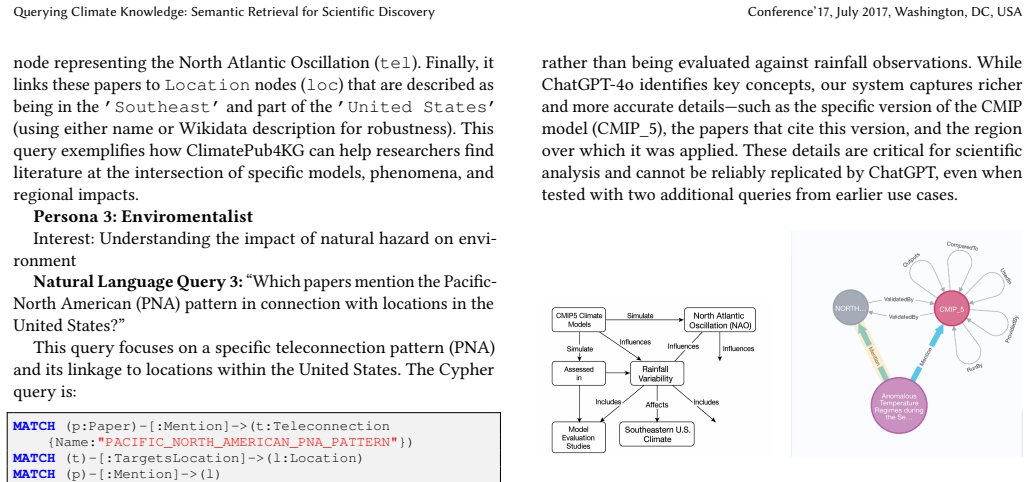
The paper's central claim is that ClimatePub4KG, populated by the earlier ClimateIE and SciER pipelines, can answer precise, multi-hop scientific questions by graph traversal rather than keyword matching. The worked examples show the query pattern: a paper node is connected to nodes for models, teleconnection patterns, locations, and weather events through typed edges like Mention and TargetsLocation, and a Cypher query filters on each dimension at once. The paper also reports a direct comparison: for the same natural-language question, a general-purpose conversational AI produced a graph with wrong relation directions (e.g., CMIP models 'influencing' rainfall instead of being evaluated agai
Load-bearing premise
The central claim depends on the reliability of the entity and relation extraction (ClimateIE, SciER) that populates the graph; the paper reports no precision or recall figures, so a correct query can still return wrong or incomplete results.
Editorial extensions
If this is right
- Researchers can combine several dimensions in a single query—model generation, teleconnection pattern, region—and return only papers that mention all of them, with the supporting sentence.
- The graph can act as a factual grounding source for LLM-based question answering, so answers can be traced to specific publications rather than generated from parametric memory.
- Systematic reviews can be partially automated by programmatically selecting studies by structured criteria.
- The comparison with an unaided chatbot suggests that KG-backed retrieval is more reliable for directional relations and for providing citations.
- Since the KG combines Wikidata descriptions with entity names, queries can handle synonyms and variant phrasings more robustly than exact keyword matching.
Reading between the lines
- If extraction accuracy is not high (the paper gives no precision/recall numbers), a perfect Cypher query can still return irrelevant or missing papers; the example results should be read as illustrative until extraction quality is measured.
- The paper flags model genealogy—shared code among CMIP models—as a key challenge but does not claim to solve it; without explicit lineage or similarity edges, ensemble-bias questions like 'which models are truly independent' cannot be answered from the graph as presented.
- A natural-language-to-Cypher interface would widen the user base well beyond programmers; the paper says it is in progress but shows no working demo.
- The reference list contains several placeholder entries ('Author, A. A.'), so parts of the related-work scaffolding are not verifiable in this version; the argument itself does not depend on them.
Editorial analysis
A structured set of objections, weighed in public.
Referee Report
Summary. The paper introduces ClimatePub4KG, a climate-science knowledge graph built from prior extraction systems (ClimateIE, SciER) and a taxonomy-driven construction pipeline. The authors argue that, unlike keyword-based search, this KG supports structured semantic queries that let researchers discover precise connections among climate models, datasets, regions, teleconnection patterns, and papers. The manuscript presents three natural-language queries with Cypher translations (Listings 1–3), a qualitative comparison against ChatGPT-4o for one of these queries, and a discussion of RAG integration, systematic reviews, and future evaluation plans. The central claim is that the KG enables precise, context-aware retrieval for climate research.
Significance. If substantiated, a domain-specific climate KG with reliable entity/relation extraction and semantic query support would be genuinely useful for literature discovery, model evaluation, and RAG grounding. The three query scenarios (cold-air outbreaks over North America, CMIP5+NAO in the Southeast U.S., PNA targeting U.S. locations) are well chosen and illustrate the kind of multi-faceted questions climate researchers ask. However, the paper provides no query results, no precision/recall numbers, no user study, no released graph or code, and no quantitative comparison with baseline retrieval. The only evidence is a single anecdotal ChatGPT comparison. The manuscript explicitly states 'Evaluation will be key' and that benchmark queries are still being developed, which is an admission that the central claim is untested. As a proposal or vision statement the paper has merit, but as a demonstration of a working retrieval backend it is not yet supported.
major comments (4)
- [Use Case: Querying the Climate Knowledge Graph; Conclusion] The central claim that ClimatePub4KG 'supports structured, semantic queries' is not demonstrated. Listings 1–3 show only Cypher fragments; no output rows, result counts, executed query traces, or example result graphs are presented. Figure 2 is referenced as the KG output, but the figure is either absent or schematic and does not provide machine-readable results. The conclusion states, 'Evaluation will be key: we are developing benchmark queries with domain experts to assess performance and usability,' which explicitly defers evaluation. Without any retrieval results, the paper cannot support the abstract's claim of enabling precise discovery.
- [Use Case: Querying the Climate Knowledge Graph; Background] The retrieval quality depends entirely on the accuracy of the entity and relation extraction that constructed the graph, but no precision/recall or error analysis is reported here. The paper cites ClimateIE and SciER as the foundation, yet gives no evidence that the required nodes and edges exist with sufficient accuracy in the graph. For example, Listing 2 requires nodes labeled `Model|Project` whose names contain 'CMIP5', a `Teleconnection` node named 'NORTH_ATLANTIC_OSCILLATION', and `Location` nodes with specific Wikidata descriptions; Listing 3 depends on `TargetsLocation` edges from the PNA pattern to U.S. locations. If the extraction mislabeled or omitted these, the Cypher would silently return empty or incomplete results. The manuscript needs at least extraction-quality figures from the cited prior work, or an end-to-end evaluation on a held-out set of queries.
- [A comparison to ChatGPT-4o] The ChatGPT comparison is anecdotal and does not provide quantitative or reproducible evidence. It compares a single query (the paper's Query 1) and states that ChatGPT's graph lacks citations and has incorrect relationship directions, but no evaluation protocol, metrics, or full output is shown. The two figures are referenced but not included in the text in a usable form. Even if the ChatGPT output is flawed, one example cannot establish that ClimatePub4KG produces precise, accurate, and complete results. A systematic comparison with a query set and correctness judgments would be required.
- [Applications and Implications for IR] Section 5 claims that the KG offers 'enhanced precision and recall,' supports 'multi-hop queries,' and 'excels' at certain query types, but these are assertions of potential, not demonstrated capabilities. No experiments, baselines, or comparison to keyword search or other KG-based systems are provided. These claims should be reframed as research hypotheses or supported by empirical evidence.
minor comments (5)
- [Use Case: Querying the Climate Knowledge Graph] Typography and terminology: 'Cipher' should be 'Cypher'; 'Devloper' should be 'Developer'; 'Enviromentalist' should be 'Environmentalist'; 'combining through' should be 'combing through'; 'Here were present example queries' should be 'Here we present example queries.'
- [Use Case: Querying the Climate Knowledge Graph] The query numbering is inconsistent: 'Natural Language Query 3' appears twice (for Persona 2 and Persona 3). The second should be Query 3 and the first Query 2, or the numbering should be sequential.
- [References] The reference list contains placeholders that should not appear in a submitted manuscript: [41]–[45] and [50] read 'Author, A. A. (Year). Title of More Reference...' and must be completed or removed. Several entries also contain editorial notes such as '(Example, actual citation details may vary...)' and '(Note: This seems to be a duplicate or very similar...)' which need to be cleaned.
- [Figures] Figures 1 and 2 (ChatGPT vs. ClimatePub4KG graphs) are referenced but not visible in the provided text. Please ensure the figures are included with clear captions, and ideally show the actual output of the Cypher queries rather than schematic diagrams.
- [General] The paper states 'This paper is not about how we built the ClimatePub4KG but rather about how it can now be used for domain-specific search and climate information retrieval.' This is fine, but the use-case demonstration requires actual retrieval results. If the paper is intended as a vision/position statement, that should be stated explicitly, and the central claim should be softened accordingly.
Circularity Check
No circular derivation found: the paper demonstrates hand-written Cypher queries over a previously built KG; missing evaluation is an evidence gap, not a circularity.
full rationale
The paper's central claim is that ClimatePub4KG enables structured semantic queries. This is presented as a demonstration, not as a derived prediction. The three queries are hand-written Cypher statements; the paper does not fit any parameter and then 'predict' a related quantity, nor does it define an entity in terms of the query result. The KG's content rests on the authors' prior extraction systems (ClimateIE, SciER, taxonomy-driven construction), but that is a lineage citation, not a load-bearing circular argument: the queries are not justified by those citations, and the cited prior work is external, published work with its own annotations and taxonomies. The absence of query results, precision/recall numbers, or an executed benchmark is a serious lack of empirical support, and the paper itself concedes 'Evaluation will be key: we are developing benchmark queries with domain experts.' However, this is an evidence/correctness concern, not a circularity: no step in the paper reduces by construction to its inputs. The ChatGPT comparison is anecdotal but does not define the KG's content in terms of the comparison. Overall, the paper is self-referential in relying on the authors' prior KG construction, but no derivation chain is circular. Score 1 reflects the presence of normal self-citation without any load-bearing circular step.
Assumptions & free parameters
assumptions (3)
- domain assumption The ClimateIE and SciER pipelines produce entities and relations accurate enough to support the presented queries.
- domain assumption The three Cypher queries correctly capture the intended natural-language questions.
- domain assumption The underlying corpus of climate publications is representative and adequately covered.
Cite this review
Pith. "Pith review of Querying Climate Knowledge: Semantic Retrieval for Scientific Discovery." pith.science (2026). https://pith.science/paper/AV6X7LCB
@misc{pith2026250910087,
  author       = {Pith},
  title        = {Pith review of: Querying Climate Knowledge: Semantic Retrieval for Scientific Discovery},
  year         = {2026},
  howpublished = {\url{https://pith.science/paper/AV6X7LCB}},
  note         = {Machine review of arXiv:2509.10087}
}
read the original abstract
The growing complexity and volume of climate science literature make it increasingly difficult for researchers to find relevant information across models, datasets, regions, and variables. This paper introduces a domain-specific Knowledge Graph (KG) built from climate publications and broader scientific texts, aimed at improving how climate knowledge is accessed and used. Unlike keyword based search, our KG supports structured, semantic queries that help researchers discover precise connections such as which models have been validated in specific regions or which datasets are commonly used with certain teleconnection patterns. We demonstrate how the KG answers such questions using Cypher queries, and outline its integration with large language models in RAG systems to improve transparency and reliability in climate-related question answering. This work moves beyond KG construction to show its real world value for climate researchers, model developers, and others who rely on accurate, contextual scientific information.
Figures
Reference graph
Works this paper leans on
-
[41]
Author, A. A. (Year). Title of More Reference 1. *Journal of More References*, Vol(Iss), Pages
-
[45]
Author, E. E. (Year). Title of More Reference 5. *Yet Another Conference*
-
[50]
Author, F. F. (Year). Title of More Reference 6. *Final Reference Journal*
-
[39]
Sahlab, N., Kahoul, H., Jazdi, N., & Weyrich, M. (2022). A Knowledge Graph- Based Method for Automating Systematic Literature Reviews. *arXiv preprint arXiv:2208.02334*
arXiv 2022
-
[40]
Liang, K., Meng, L., Liu, M., et al. (2023). A Survey on Knowledge Graph Reasoning. *arXiv preprint arXiv:2212.05767*
arXiv 2023
-
[1]
Retrieval-augmented generation with knowledge graphs for customer service question answering
Xu, Zhentao, et al. "Retrieval-augmented generation with knowledge graphs for customer service question answering. " Proceedings of the 47th International ACM SIGIR Conference on Research and Development in Information Retrieval. 2024
2024
-
[2]
From local to global: A graph rag approach to query-focused summarization
Edge, Darren, et al. "From local to global: A graph rag approach to query-focused summarization. " arXiv preprint arXiv:2404.16130 (2024)
arXiv 2024
-
[3]
Pan, G., Zhang, Y., Wang, S., et al. (2024). ClimateNER: Climate Science Informa- tion Extraction. *Prior Work Reference 1*
2024
Show all 54 references
-
[4]
Zhang, Y., Pan, G., Li, J., et al. (2024). SciER: An Entity and Relation Extraction Dataset for Datasets, Methods, and Tasks in Scientific Documents. *Prior Work Reference 2*
2024
-
[5]
L., Neumann, M., Kinney, R., and Weld, D
Lo, K., Wang, L. L., Neumann, M., Kinney, R., and Weld, D. S. (2019). S2ORC: The Semantic Scholar Open Research Corpus. *Proceedings of the 2019 Conference on Empirical Methods in Natural Language Processing and the 9th International Joint Conference on Natural Language Proces...
2019
-
[6]
P., and Wang, K
Sinha, A., Shen, Z., Song, Y., Ma, H., Eide, D., Hsu, B. P., and Wang, K. (2015). An Overview of Microsoft Academic Graph. *Proceedings of the 24th International Conference on World Wide Web (WWW ’15 Companion)*
2015
-
[7]
Tang, J., Zhang, J., Yao, L., Li, J., Zhang, L., and Su, Z. (2008). ArnetMiner: Extrac- tion and Mining of Academic Social Networks. *Proceedings of the 14th ACM SIGKDD International Conference on Knowledge Discovery and Data Mining (KDD ’08)*
2008
-
[8]
and Radev, D
Yu, T., Zhang, R., Yang, K., Yasunaga, M., Wang, D., Li, Z., ... and Radev, D. (2018). Spider: A Large-Scale Human-Labeled Dataset for Complex and Cross-Domain Semantic Parsing and Text-to-SQL Task. *arXiv preprint arXiv:1809.08887*
2018 arXiv
-
[9]
Höffner, K., Walter, S., Marx, E., Usbeck, R., Lehmann, J., & Ngonga Ngomo, A. C. (2017). Survey on challenges of question answering in the web of data. *Semantic Web*, 8(6), 895-920
2017
-
[10]
W., & Wang, W
Cui, W., Xiao, Y., Wang, H., Song, Y., Hwang, S. W., & Wang, W. (2020). KBQA: Learning to Answer Questions over Knowledge Bases with Entity-Centric Graph Convolutions. *arXiv preprint arXiv:2002.00972*
2020 arXiv
-
[11]
Ge, R.; Xia, Y.; Ge, L.; Li, F. (2025). Knowledge Graph Analysis in Climate Action Research. *Sustainability*, 17, 371. https://doi.org/10.3390/su17010371
2025 doi
-
[12]
S., Proma, A., Zhou, S., Hoque, E., & Chen, L
Islam, M. S., Proma, A., Zhou, S., Hoque, E., & Chen, L. (2022). ClimateKB: A Semantic KBS for Climate Change Related Knowledge Discovery. *Proceedings Querying Climate Knowledge: Semantic Retrieval for Scientific Discovery Conference’17, July 2017, Washington, DC, USA of the ...
2022
-
[13]
Wu, J., Orlandi, F., O’Sullivan, D., and Devlin, K. (2022). A knowledge graph based approach for climate change literature review. *Computers and Geosciences*, 167, 105198. https://doi.org/10.1016/j.cageo.2022.105198
2022
-
[14]
Tu, S., Zhuang, W., & Ren, F. (2024). Construction of Knowledge Graph for Climate Change and Its Application in Q&A System. In: Gervasi, O., Murgante, B., Misra, S., Rocha, A.M.A.C., Garau, C. (eds) Computational Science and Its Applications – ICCSA 2024. ICCSA 2024. Lecture N...
2024 doi
-
[15]
Zhu, R., Shimizu, C., Stephen, J., et al. (2025). ClimateKG: A Climate Science Knowledge Graph. *arXiv preprint arXiv:2502.13874v1*
2025 arXiv
-
[16]
Zhao, Y., Guo, J., Bao, C., Li, Y., & Wang, B. (2024). Climate Change Knowledge Graph Construction and Application: A Survey. *Semantic Scholar*. (Example, ac- tual citation details may vary for preprints/surveys on Semantic Scholar without formal publication venues yet)
2024
-
[17]
Wu, J., Orlandi, F., O’Sullivan, D., & Devlin, K. (2024). A Knowledge Graph-Based Approach for Climate Change Literature Review. *IEEE Access*, 12, 10719340. (Note: This seems to be a duplicate or very similar to the Computers & Geo- sciences one, common in pre-print to journa...
2024
-
[18]
Fotopoulou, E., Mandilara, I., Tsalis, N., et al. (2022). Knowledge graphs for climate change and health nexus: A systematic review. *Frontiers in Environmental Science*, 10, 1003599. https://doi.org/10.3389/fenvs.2022.1003599
2022
-
[19]
Peng, C., Xia, F., Naseriparsa, M., & Osborne, F. (2023). Knowledge Graphs: Opportunities and Challenges. *Artificial Intelligence Review*, 56, 13071–13102. https://doi.org/10.1007/s10462-023-10465-9
2023 doi
-
[20]
Kejriwal, M. (2022). Knowledge Graphs: A Practical Review of the Research Landscape. *Information*, 13(4), 161. https://doi.org/10.3390/info13040161
2022 doi
-
[21]
Abu-Salih, B., & Alotaibi, S. (2024). Knowledge graph for enhancing sci- entific research: A systematic literature review. *Heliyon*, 10(8), e29034. https://doi.org/10.1016/j.heliyon.2024.e29034
2024 doi
-
[22]
J., Tripodi, I
Callahan, T. J., Tripodi, I. J., et al. (2024). The Biomedical Data Translator knowl- edge graph. *Scientific Data*, 11, 317. https://doi.org/10.1038/s41597-024-03171-w
2024 doi
-
[23]
Manghi, P., Atzori, C., Bardi, A., et al. (2024). Challenges in building scholarly knowledge graphs. *Quantitative Science Studies*, 5(4), 991-1020. https://doi.org/10.1162/qss_a_00328
2024 doi
-
[24]
d’Aquin, M. (2025). On the role of knowledge graphs in AI- based scientific discovery. *Journal of Web Semantics*, 84, 100854. https://doi.org/10.1016/j.websem.2024.100854
2025
-
[25]
Xu, M., Du, J., Xue, Z., Kou, G., & Zhang, C. (2022). Semantic information retrieval for scientific literature: A review. *Neurocomputing*, 492, 336-351. https://doi.org/10.1016/j.neucom.2021.11.063
2022 doi
-
[26]
Sharma, S., & Jain, S. (2023). Comprehensive Review on Semantic Information Retrieval and Ontology Engineering. *arXiv preprint arXiv:2307.13427*
2023 arXiv
-
[27]
J., Caragea, C., & Dragut, E
Zhang, Q., Pan, H., Chen, Z., Latecki, L. J., Caragea, C., & Dragut, E. (2025, April). DynClean: Training Dynamics-based Label Cleaning for Distantly-Supervised Named Entity Recognition. In Findings of the Association for Computational Linguistics: NAACL 2025 (pp. 2540-2556)
2025
-
[28]
Zhu, Y., Wang, X., Chen, J., Qin, Y., & Liu, K. (2024). A Survey on Knowledge Graph Construction and Reasoning. *arXiv preprint arXiv:2305.13168v2*. (Note: Year might be 2023 for original submission, using 2024 for v2 as an example if it was updated then)
2024 arXiv
-
[31]
Pan, H., Zhang, Q., Adamu, M., Dragut, E., & Latecki, L. J. (2024). ClimateNER: Climate Science Information Extraction. *Proceedings of the 2024 Conference on Empirical Methods in Natural Language Processing (EMNLP)*
2024
-
[32]
J., & Dragut, E
Zhang, Q., Chen, Z., Pan, H., Caragea, C., Latecki, L. J., & Dragut, E. (2024). SciER: An Entity and Relation Extraction Dataset for Datasets, Methods, and Tasks in Scientific Documents. *Proceedings of the 2024 Conference on Empirical Methods in Natural Language Processing (E...
2024
-
[33]
Wu, J., Orlandi, F., O’Sullivan, D., & Dev, S. (2022). LinkClimate: An Interopera- ble Knowledge Graph Platform for Climate Data. *Environmental Modelling & Software*, 152, 105384
2022
-
[34]
Reinanda, R., Meij, E., & de Rijke, M. (2020). Knowledge Graphs: An Information Retrieval Perspective. *arXiv preprint arXiv:2003.02320*
2020 arXiv
-
[35]
Defila, R., & Di Giulio, A. (2011). Defining Terms for Integrated (Multi-Inter- Trans-Disciplinary) Sustainability Research. *Sustainability*, 3(8), 1090–1113
2011
-
[36]
Met Office. (2022). An Interdisciplinary Approach for Climate Risk Analysis and Communication. Retrieved from https://www.metoffice.gov.uk/
2022
-
[37]
Schmidt, G. (2018). Reproducibility and Replication in Climate Science. Retrieved from https://www.realclimate.org/
2018
-
[38]
Rupprecht, D., et al. (2020). Improving Reproducibility of Data Science Pipelines through Transparent Provenance Collection. *Proceedings of the VLDB Endow- ment*, 13(12), 3354–3368
2020
-
[42]
Author, B. B. (Year). Title of More Reference 2. *Conference on More References*
-
[43]
Author, C. C. (Year). Title of More Reference 3. *Book Chapter in More References Book*
-
[44]
Author, D. D. (Year). Title of More Reference 4. *Another Journal*, Vol(Iss), Pages
-
[46]
A.-M., & Jönsson, A
Kuma, P., Bender, F. A.-M., & Jönsson, A. R. (2023). Climate model code genealogy and its relation to climate feedbacks and sensitivity.Journal of Advances in Mod- eling Earth Systems, 15, e2022MS003588. https://doi.org/10.1029/2022MS003588
2023 doi
-
[47]
L., Neumann, M., Kinney, R., & Weld, D
Lo, K., Wang, L. L., Neumann, M., Kinney, R., & Weld, D. S. (2019). S2ORC: The Semantic Scholar Open Research Corpus.Proceedings of the 2019 Conference on Empirical Methods in Natural Language Processing
2019
-
[48]
Priem, J., & Piwowar, H. (2022). OpenAlex: A fully-open catalog of the global research system. Retrieved from https://docs.openalex.org/
2022
-
[49]
Tang, J., Zhang, J., Yao, L., Li, J., Zhang, L., & Su, Z. (2008). ArnetMiner: Extraction and Mining of Academic Social Networks.Proceedings of the 14th ACM SIGKDD International Conference on Knowledge Discovery and Data Mining, 990–998
2008
-
[51]
Graph-constrained reasoning: Faithful reasoning on knowl- edge graphs with large language models
Luo, Linhao, et al. "Graph-constrained reasoning: Faithful reasoning on knowl- edge graphs with large language models. " arXiv preprint arXiv:2410.13080 (2024)
2024 arXiv
-
[52]
Text2Cypher: Bridging Natural Language and Graph Databases
Ozsoy, Makbule Gulcin, et al. "Text2Cypher: Bridging Natural Language and Graph Databases. " arXiv preprint arXiv:2412.10064 (2024)
2024 arXiv
-
[53]
Dragut, E., Latecki, L., Rudko, M., Adamu, M., Zhang, Q., & Pan, J. (2024). Cli- matePub4KG: Toward a Knowledge Graph to Support Evaluation and Develop- ment of Climate Models. *AGU Fall Meeting Abstracts*, IN11A-01
2024
-
[54]
Kruger, A., Lawrence, R., & Dragut, E. C. (2006). Building a terabyte NEXRAD radar database for hydrometeorology research. *Computers & Geosciences*, 32(2), 247–258
2006
-
[55]
C., & Latecki, L
Pan, H., Zhang, Q., Adamu, M., Dragut, E. C., & Latecki, L. J. (2025). Taxonomy- Driven Knowledge Graph Construction for Domain-Specific Scientific Applica- tions. *Findings of the Association for Computational Linguistics: ACL 2025*
2025
-
[56]
C., & Latecki, L
Pan, H., Adamu, M., Zhang, Q., Dragut, E. C., & Latecki, L. J. (2025). ClimateIE: A Dataset for Climate Science Information Extraction. *Proceedings of the Cli- mateNLP Workshop at ACL 2025*
2025
Reviewed August 4, 2026 · model on record in the stance chip above.
Discussion (0). Sign in to comment.