REVIEW 3 major objections 5 minor 10 references
Speed-up of Vision Transformer Models by Attention-aware Token Filtering
T0 review · 3 major / 5 minor · reviewed 2026-08-07 · deepseek-v4-flash
Pith's one-line read A token filtering module inserted between the tokenizer and the encoder speeds up SigLIP by 2.8x on text-to-image retrieval while holding recall nearly constant.
desk verdict A clean no-fine-tune token filtering method with plausible 2.8x speedup, but the attention-selection claim is untested and the evaluation is a single dataset. read the letter →
The pith
A machine-rendered reading of the paper's core claim, the machinery that carries it, and where it could break.
The reading
What carries the argument
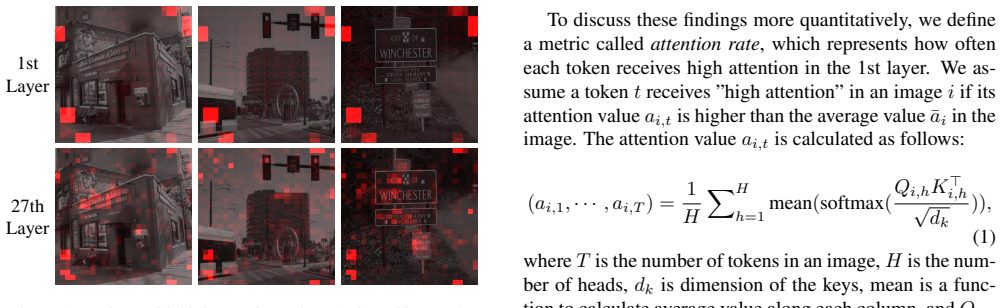
The central object is the token filtering module $f((x_1,\ldots,x_T),(m_1,\ldots,m_T))$, a mask-application layer placed between the tokenizer and the transformer encoder that keeps token $x_t$ when $m_t=1$. Its mask is the logical OR $s \lor D(i)$ of a static region mask and a dynamic object mask: the static mask $s$ is precomputed from first-layer attention values on 128 sample images, marking tokens whose average attention exceeds the uniform baseline, and the dynamic mask $D(i)$ marks tokens in patches where a trained detector finds the target object. Because attention's cost scales as $O(T^2)$, cutting tokens from 2,916 to 1,190 gives a larger time reduction than the token count alone would suggest. The module itself contains no learned parameters and requires no modification of the pretrained ViT.
What would settle it
Replace the attention-based static mask with a random mask of the same size on the TextOCR retrieval task: if Recall@10 remains roughly as high as with the attention mask, then the first-layer attention pattern is not what preserves accuracy, and ATF's mechanism is not confirmed.
Extended reading notes
Core claim
The paper's central claim is that a ViT used for embedding extraction can be made much faster without retraining by filtering its input tokens before the transformer encoder, because most image tokens contribute little to the final embedding. ATF keeps two token sets: a static mask drawn from first-layer attention values averaged over 128 sample images, and a dynamic mask from a lightweight object detector that locates the regions relevant to the task. Feeding these tokens alone (about 1,190 instead of 2,916) makes SigLIP process a TextOCR image in 94.4 ms rather than 268.0 ms, a 2.8x speed-up, while text-to-image average recall moves from 92.7% to 92.6% and image-to-text recall stays at 92.0%. The encoder and tokenizer remain completely untouched.
Load-bearing premise
The method rests on the assumption that the patches the first transformer layer attends to most are the patches whose removal would most change the embedding, and that a mask learned from 128 training images stays valid for every test image.
Editorial extensions
If this is right
- Any pretrained ViT can be accelerated by inserting the module between tokenizer and encoder; no fine-tuning or architectural change is required.
- The static mask is computed once from 128 sample images, so deciding which tokens to keep adds essentially no per-image latency beyond the object detector.
- Because transformer attention scales as $O(T^2)$, cutting the token count from 2,916 to 1,190 reduces encoder time by a larger factor (3.4x) than the token ratio (2.5x).
- The object detector is pluggable, so the same filtering strategy can serve other object-centric embedding tasks such as industrial anomaly detection.
Reading between the lines
- A natural stress test is whether a static mask learned from 128 TextOCR images transfers to datasets with different object layouts; if it does not, the reported parity on TextOCR would not generalize.
- Because the paper reports a single evaluation without variance, the 92.7%-to-92.6% recall change should be read as a point estimate; repeated runs or confidence intervals would establish whether the two configurations are truly equivalent.
- The speed-up could be pushed further by replacing the ResNet-based detector with a faster or non-learned region cue, or by combining the pre-encoder filter with in-encoder token pruning methods, since the two mechanisms reduce token counts independently.
Editorial analysis
A structured set of objections, weighed in public.
Referee Report
Summary. The paper proposes Attention-aware Token Filtering (ATF), a plug-in speed-up module inserted between the tokenizer and the transformer encoder of a frozen ViT. ATF keeps tokens inside detected object regions and tokens in 'static attention regions' defined from first-layer self-attention averaged over 128 training images (Eq. 2). On the TextOCR retrieval task with a SigLIP model fine-tuned to 768x768, the authors report a 2.8x total speed-up (268.0 ms to 94.4 ms per image) while text-to-image average Recall@1/5/10 changes from 92.7% to 92.6% and image-to-text recall remains 92.0%. An ablation shows that removing the static-region tokens degrades average recall to 62.9%.
Significance. The proposed module is simple, requires no fine-tuning of the ViT encoder, and the empirical observation that shallow-layer attention is spatially static (Figure 2) is interesting and potentially useful. The reported speed-up is plausible given the quadratic attention complexity and the measured token reduction (2916 to 1190). The main contributions are clearly stated and the evaluation protocol is reproducible in principle. However, the evidence that 'attention-aware' selection is the cause of the recall maintenance is missing, and the evaluation rests on a single dataset, a single model, and point estimates without error bars. If the additional experiments requested below confirm robustness, the paper would be a reasonable empirical contribution to efficient ViT inference.
major comments (3)
- [Section 3.1 and Eq. (2), Table 2] The paper asserts that tokens with higher first-layer attention have larger impact on the embeddings if removed, but this causal link is never tested. Table 2 only shows that adding the attention-selected static tokens recovers recall relative to the object-region-only mask; it does not show that attention-based selection is better than, say, a size-matched central mask, a random static mask, or the object-region mask expanded by a few extra pixels. Because the method's name and its advantage over plain detection-plus-crop rest on this assumption, please include equal-budget ablations over alternative static masks and report the corresponding Recall@K values. In addition, the mask is computed from the full-token attention (Eq. 2) but applied after tokens have already been removed; the authors should verify that the selected tokens still receive high attention in the filtered model.
- [Section 4.2, Table 1] The central quantitative claim of maintaining retrieval recall is supported by a single evaluation on TextOCR with SigLIP and with no confidence intervals or multiple seeds. A drop from 92.7% to 92.6% in average text-to-image recall is within the sampling error typical of retrieval evaluations of this size (3104 images), so the paper should report per-run results, variance, or a statistical test, and ideally a second dataset and/or a second ViT (e.g., ViT-B/16) to show generalization.
- [Section 4.1] Several free parameters are set without sensitivity analysis: the softmax threshold of 0.4, the max-pooling expansion of 12 pixels, the average threshold in Eq. (2), and the choice of 128 sample images. Since the recall-maintenance result may depend on these values, please report at least a small sensitivity sweep (e.g., threshold values around 0.4 and expansion sizes around 12 px) and state whether the parameters were selected on the validation set.
minor comments (5)
- [Eq. (1)] The notation \bar{a}_i is used before being defined, and 'mean(softmax(...))' should specify whether the mean is taken over columns or over heads; please clarify the exact tensor dimensions.
- [Figure 2] The color maps and the term 'attention rate' should be defined in the caption; currently the reader must infer the scale from the color bar.
- [Section 4.1] Please state the exact filtering criterion for the 18 omitted images ('too large resolution' is not defined) and report whether any of the 3104 evaluation images contain text regions truncated by the resizing procedure.
- [Section 3.2] The phrase 'higher than the value if all tokens receive the same attention equally' in Eq. (2) is imprecise; the inequality is against the mean attention, so please phrase it as 'above the average attention per token'.
- [Section 2] The related work mentions only A-ViT; since ATF is a token-pruning method, please discuss and compare with existing token pruning/merging approaches such as DynamicViT, EViT, and ToMe, at least in the related work section.
Circularity Check
No significant circularity: ATF's speed-up and recall maintenance are measured on held-out validation images against an unfiltered baseline.
full rationale
The paper's central claim is empirical: inserting ATF between tokenizer and transformer encoder reduces tokens from 2916 to 1190 and processing time from 268.0 ms to 94.4 ms/image, while keeping text-to-image average recall at 92.6% versus 92.7% without ATF (Table 1). This claim is not circular because the static-region mask is estimated from 128 training images (Eq. 2, Section 3.2) and then applied to held-out validation images; the recall numbers are not fitted to the test set. The ablation in Table 2 compares ATF with and without static region tokens, and again evaluates on the same held-out set, so it is an experimental comparison rather than a construction. The paper's assumption in Section 3.1 that high-attention tokens have larger impact if removed is an untested causal hypothesis, but that is a correctness or generalization risk, not circularity: the method's speed-up and recall are directly measured rather than derived from the assumption. There are no load-bearing self-citations, no imported uniqueness theorems, and no renamed known result presented as prediction. The conclusion's admission that more sophisticated static-region selection may improve generality is a stated limitation, not a circular step. The derivation chain is therefore self-contained and empirically evaluated.
Assumptions & free parameters
free parameters (5)
- Static region threshold =
average attention over tokens in sample images (mean)
- Object detection softmax threshold =
0.4
- Max pooling expansion =
12 pixels
- Cross-entropy loss weights =
1:20 (non-text:text)
- Sample images for mask =
128
assumptions (3)
- domain assumption Tokens with high attention in shallow layers contribute more to the final embedding than low-attention tokens.
- domain assumption Static attention regions measured on 128 training images generalize to all test images of the task.
- domain assumption The external object detector finds all and only the regions needed for the retrieval embedding.
Cite this review
Pith. "Pith review of Speed-up of Vision Transformer Models by Attention-aware Token Filtering." pith.science (2026). https://pith.science/paper/AVJFMOGB
@misc{pith2026250601519,
  author       = {Pith},
  title        = {Pith review of: Speed-up of Vision Transformer Models by Attention-aware Token Filtering},
  year         = {2026},
  howpublished = {\url{https://pith.science/paper/AVJFMOGB}},
  note         = {Machine review of arXiv:2506.01519}
}
abstract
Vision Transformer (ViT) models have made breakthroughs in image embedding extraction, which provide state-of-the-art performance in tasks such as zero-shot image classification. However, the models suffer from a high computational burden. In this paper, we propose a novel speed-up method for ViT models called Attention-aware Token Filtering (ATF). ATF consists of two main ideas: a novel token filtering module and a filtering strategy. The token filtering module is introduced between a tokenizer and a transformer encoder of the ViT model, without modifying or fine-tuning of the transformer encoder. The module filters out tokens inputted to the encoder so that it keeps tokens in regions of specific object types dynamically and keeps tokens in regions that statically receive high attention in the transformer encoder. This filtering strategy maintains task accuracy while filtering out tokens inputted to the transformer encoder. Evaluation results on retrieval tasks show that ATF provides $2.8\times$ speed-up to a ViT model, SigLIP, while maintaining the retrieval recall rate.
Figures


Reference graph
Works this paper leans on
-
[1]
An image is worth 16x16 words: Transformers for image recognition at scale
Alexey Dosovitskiy, Lucas Beyer, Alexander Kolesnikov, Dirk Weissenborn, Xiaohua Zhai, Thomas Unterthiner, Mostafa Dehghani, Matthias Minderer, Georg Heigold, Syl- vain Gelly, Jakob Uszkoreit, and Neil Houlsby. An image is worth 16x16 words: Transformers for image recognition at scale. International Conference on Learning Representa- tions (ICLR), 2021. 1, 2
work page 2021
-
[2]
Self- support few-shot semantic segmentation
Qi Fan, Wenjie Pei, Yu-Wing Tai, and Chi-Keung Tang. Self- support few-shot semantic segmentation. In European Con- ference on Computer Vision (ECCV), pages 701–719, 2022. 3
work page 2022
-
[3]
Deep residual learning for image recognition
Kaiming He, Xiangyu Zhang, Shaoqing Ren, and Jian Sun. Deep residual learning for image recognition. In Proceed- ings of the IEEE Conference on Computer Vision and Pattern Recognition (CVPR), 2016. 4
2016
-
[4]
TextOCR: Towards large- scale end-to-end reasoning for arbitrary-shaped scene text
Amanpreet Singh, Guan Pang, Mandy Toh, Jing Huang, Wo- jciech Galuba, and Tal Hassner. TextOCR: Towards large- scale end-to-end reasoning for arbitrary-shaped scene text. In Proceedings of the IEEE/CVF Conference on Computer Vision and Pattern Recognition (CVPR) , pages 8802–8812,
-
[5]
Training data-efficient image transformers & distillation through at- tention
Hugo Touvron, Matthieu Cord, Matthijs Douze, Francisco Massa, Alexandre Sablayrolles, and Herve Jegou. Training data-efficient image transformers & distillation through at- tention. In Proceedings of the 38th International Conference on Machine Learning (ICML), pages 10347–10357, 2021. 1, 2
work page 2021
-
[6]
Ashish Vaswani, Noam Shazeer, Niki Parmar, Jakob Uszko- reit, Llion Jones, Aidan N Gomez, Ł ukasz Kaiser, and Illia Polosukhin. Attention is all you need. In Advances in Neural Information Processing Systems (NeurIPS), 2017. 1
work page 2017
-
[7]
Alvarez, Arun Mallya, Jan Kautz, and Pavlo Molchanov
Hongxu Yin, Arash Vahdat, Jose M. Alvarez, Arun Mallya, Jan Kautz, and Pavlo Molchanov. A-ViT: Adaptive to- kens for efficient vision transformer. In Proceedings of the IEEE/CVF Conference on Computer Vision and Pattern Recognition (CVPR), pages 10809–10818, 2022. 1, 2
work page 2022
-
[8]
Xiaohua Zhai, Alexander Kolesnikov, Neil Houlsby, and Lu- cas Beyer. Scaling vision transformers. In Proceedings of the IEEE/CVF Conference on Computer Vision and Pattern Recognition (CVPR), pages 12104–12113, 2022. 1
work page 2022
Show all 10 references
-
[9]
Sigmoid loss for language image pre-training
Xiaohua Zhai, Basil Mustafa, Alexander Kolesnikov, and Lucas Beyer. Sigmoid loss for language image pre-training. In Proceedings of the IEEE/CVF International Conference on Computer Vision (ICCV), pages 11975–11986, 2023. 1, 2, 3, 4
2023
-
[10]
Pyramid scene parsing network
Hengshuang Zhao, Jianping Shi, Xiaojuan Qi, Xiaogang Wang, and Jiaya Jia. Pyramid scene parsing network. InPro- ceedings of the IEEE Conference on Computer Vision and Pattern Recognition (CVPR), 2017. 3 5
2017
Reviewed August 7, 2026 · model on record in the stance chip above.
Discussion (0). Sign in to comment.