REVIEW 3 minor 6 references
Nonconservation of Energy and Loss of Determinism I. Infinitely Many Balls
T0 review · 0 major / 3 minor · reviewed 2026-08-14 · deepseek-v4-flash
Pith's one-line read Infinite collision chain erases kinetic energy in finite time
desk verdict A clean, honest paper that makes the supertask case for energy nonconservation and indeterminism as sharply as it has been made, with an explicit general solution; the main caveat is the completed-supertask assumption, which the authors openly acknowledge. read the letter →
The pith
A machine-rendered reading of the paper's core claim, the machinery that carries it, and where it could break.
The reading
What carries the argument
The load-bearing object is the 'intermediate energy-momentum' of the $n$th ball: its momentum and energy after its first collision and before its second. Global conservation fails exactly when the $n\to\infty$ limit of this quantity is nonzero. The argument is carried by two recurrence relations. Classically, with $\mu_n=m_{n+1}/m_n$ and $u_n$ the velocity of the $n$th ball before its last collision, the forward process obeys $u_{n+1}=2u_n/(1+\mu_n)$, while the reverse process has a homogeneous solution $\tilde u_n=\prod_{k=0}^{n-1}(1+\mu_k)/(2\mu_k)$ whose arbitrary multiplier $\gamma$ is the free parameter. Relativistically, the same structure is written in terms of $\epsilon(v)=\sqrt{(1-v)/(1+v)}$, and the arbitrary parameter appears as the asymptotic constant $\sigma$ (or $\omega$) in the backward iteration. This homogeneous solution is what converts a supposedly complete mechanical history into a one-parameter family of histories.
What would settle it
For the example mass sequence $m_n = 24m_0/[(n+1)(n+2)(n+3)(n+4)]$ with initial speed $\beta_0$, the paper's recurrence gives $2\lim_{n\to\infty} T_n = m_0\beta_0^2/6$; iterating the recurrence numerically for large $n$ and checking whether the intermediate energy of ball $n$ approaches that value would test the calculation. A second check: for equal masses, the final total kinetic energy is predicted to be exactly zero; if any exact treatment finds a nonzero remainder after the completed Zeno process, the claim is wrong.
Extended reading notes
Core claim
On the paper's own terms, the central discovery is that energy-momentum conservation and determinism are not theorems of mechanics once infinitely many bodies are involved. Arrange balls of masses $m_n$ at the Zeno points $2^{-n}$ on a finite line segment, with total mass $\sum_n m_n$ finite, and give only the zeroth ball a leftward speed $\beta_0$. Each adjacent pair collides elastically, so every single collision conserves momentum and kinetic energy. Nonetheless, the paper shows, the global result is governed by the limit of the intermediate energy-momentum carried by the $n$th ball between its first and second collision; if that limit does not vanish, the corresponding energy (classically) or energy-momentum (relativistically) is lost at the point of accumulation of the balls. In the equal-mass example, the limit equals the full initial energy and all motion ceases after a finite time with no energy left. The general solution of the reverse collision chain contains an arbitrary real parameter $\gamma$, so the evolution is not unique: energy may be injected at the accumulation point in any amount, at any time, and the exact time-reversed motion is only one among many solutions.
Load-bearing premise
The argument works only if the infinite sequence of collisions is treated as a completed process within a finite time, so that the state after all collisions and the 'energy at the accumulation point' are meaningful physical quantities rather than mathematical idealizations.
Editorial extensions
If this is right
- For any finite initial segment of the chain, ordinary conservation holds; the violation is a property of the completed infinite limit, so the results concern supertasks, not finite collisions.
- A finitely massive collection of progressively smaller balls can lose a definite fraction of its kinetic energy (classically) or energy-momentum (relativistically) at the spatial accumulation point; in the constant-recoil case this loss equals the energy-momentum that would appear as light in a single inelastic collision of the same masses.
- Specifying all positions and velocities at one time does not determine the future for the infinite system; the arbitrary injection parameter must be fixed for all times, otherwise spontaneous waves of arbitrary energy may emerge from the origin.
- Forbidding energy injection at the accumulation point restores uniqueness, but it also imposes a time-asymmetric boundary condition, so determinism would be recovered only at the price of a built-in arrow of time.
- The time-reversed process inherits the same indeterminism: the exact reversal is just one member of a one-parameter family of solutions, so time-reversal invariance of the equations holds while uniqueness of evolution does not.
Reading between the lines
- Editorial inference: the recurrence shows that any finite truncation will always conserve energy, so experimental falsification of the claim requires an actual infinite accumulation; no finite array of real balls can distinguish the two worldviews by direct observation.
- Editorial inference: the relativistic equality of lost energy and momentum in the constant-recoil case suggests that at the accumulation point mechanical energy-momentum converts into zero-rest-mass radiation; the paper mentions this as a way to restore conservation but does not model it dynamically.
- Editorial inference: the same one-parameter homogeneous solution should appear in continuous analogues, such as an infinitely fine chain of coupled oscillators or a wave hitting a singular boundary; the discrete recursion here gives an exact toy model for that class.
- Editorial inference: one could use the closed-form lost-energy fraction for a given mass sequence as a benchmark for numerical methods that handle singular boundaries, checking whether codes reproduce the predicted accumulation-point loss.
Signed reviews
Editorial analysis
A structured set of objections, weighed in public.
Referee Report
Summary. The paper studies an infinite one-dimensional array of point masses placed at Zeno points, with a single initially moving ball triggering an infinite sequence of elastic collisions. The authors derive general recurrence relations for both nonrelativistic and special-relativistic collisions. They show that global energy (and, in the relativistic case, energy-momentum) need not be conserved even when each individual collision conserves it, including cases with finite total mass and finite spatial/temporal extent. They also exhibit a one-parameter family of reverse-process solutions, demonstrating that the post-collision evolution is indeterministic unless one specifies an extra boundary condition at the accumulation point. Specific mass sequences illustrate energy loss (e.g., one-sixth of the energy in the example of Eq. (13)) and the constant-recoil limiting cases in both classical and relativistic settings.
Significance. If the results stand, this is a substantial contribution to the supertask literature and to discussions of the status of conservation laws and determinism in infinite idealizations. The derivations are explicit and transparent: the central claims are supported by concrete recurrence relations, closed-form mass sequences, and numerical tables, rather than by qualitative arguments alone. The paper also provides a constructive resolution of the apparent tension between time-reversal invariance and irreversible energy loss by showing that the time-reversed dynamics admits a whole family of solutions, parametrized by the injected energy. The authors are honest about the interpretive dependence on completing an infinite sequence of collisions in finite time, and they state this limitation in Section 5. The treatment of open-set collisions is deferred to a sequel, which is a reasonable scope decision.
minor comments (3)
- [Section 4.4, Table 1 and surrounding text] The text states that for ε0 = 0.4 and η = 0.6 the total mass is M = m0/2, but Eq. (30) gives M = (1 − ε0)/(1 − η) m0 = 0.6/0.4 m0 = 1.5 m0. This numerical inconsistency should be corrected, although it does not affect the energy-loss formulas or the qualitative conclusions.
- [Sections 3.2 and 3.3] The domain of the arbitrary parameter γ is not stated explicitly. The paper shows that for γ ≤ β0 (or γ ≤ v in the constant-recoil case) the reverse process involves no further collisions, while for larger γ additional collisions are expected but are not analyzed. Since the central indeterminism and energy-injection claims are already established for a continuum of values with γ ≤ β0, the unanalyzed regime does not undermine the paper's conclusions, but a short statement to this effect would improve clarity.
- [Section 4.3, first paragraph after Eq. (32)] There is a typo in the sentence 'we seek insight by considering a a simple collision'; 'a a' should be 'a'.
Circularity Check
No significant circularity: central results are derived from elastic-collision recurrences and genuine free parameters, with only peripheral self-citations.
full rationale
The derivation chain is self-contained. Section 3.1 starts from elastic collision conservation laws, derives recurrence (2) and partial-sum identities (5), and takes the n→∞ limit in (6); the energy loss is exactly lim T_n, with no parameter fitted to produce loss. Section 3.2's reverse process introduces the arbitrary γ as the constant of integration of the homogeneous equation (9), and Eq. (12) is obtained by direct substitution, not by imposing the desired result. The constant-recoil sections solve for mass ratios under the stated lock-step condition and compute momentum/energy losses algebraically (Eqs. 14-18 and 28-31). The relativistic section similarly defines κ, σ, ω as limits or free parameters and shows that special choices reproduce time reversal; these are mathematical identities, not predictions forced by fitting. The citations to Atkinson (2007, 2008) in the introduction and for the convergence lemma μn ≤ 1−a/(n+1) ⇒ ε(un)→0 supply background and one auxiliary fact, but the main examples and general solution are re-derived in this paper, so the self-citation is not load-bearing for the central claim. The completed-supertask assumption is explicitly stated in Sections 2 and 3.1 and is a philosophical boundary condition, not a circular import. The M = m0/2 remark in Section 4.4 is inconsistent with Eq. (30), which gives M = 1.5 m0, but this is a numerical typo and does not affect the energy-loss formulas. Overall, no significant circularity is present.
Assumptions & free parameters
free parameters (6)
- gamma (classical reverse process)
- sigma (relativistic reverse process)
- omega (relativistic constant-recoil reverse)
- lambda (classical constant recoil)
- eta (relativistic constant recoil)
- Example mass sequence (Eq. 13)
assumptions (5)
- standard math Two-body elastic collisions conserve momentum and kinetic energy (classically) or energy-momentum (relativistically).
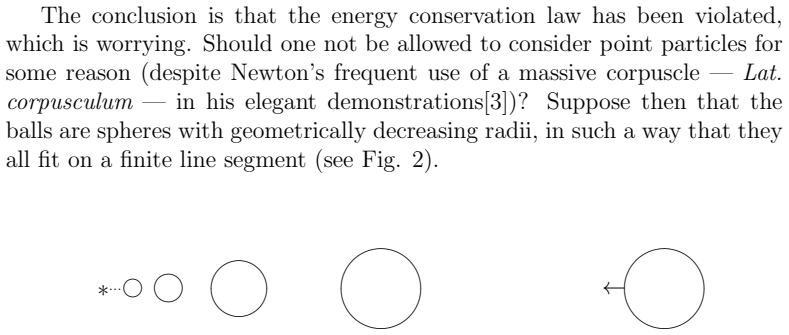
- domain assumption The balls are point masses or perfectly hard spheres with geometrically decreasing radii, and collisions are instantaneous and sequential.
- domain assumption The infinite sequence of collisions completes in a finite time and the post-process state is defined by the limits as n→∞.
- domain assumption The total mass of the balls is finite and the spatial extent is bounded.
- domain assumption Limits of sums of momenta and energies represent the global quantities of the infinite system.
Cite this review
Pith. "Pith review of Nonconservation of Energy and Loss of Determinism I. Infinitely Many Balls." pith.science (2026). https://pith.science/paper/AVK44N6L
@misc{pith2026190810458,
  author       = {Pith},
  title        = {Pith review of: Nonconservation of Energy and Loss of Determinism I. Infinitely Many Balls},
  year         = {2026},
  howpublished = {\url{https://pith.science/paper/AVK44N6L}},
  note         = {Machine review of arXiv:1908.10458}
}
read the original abstract
An infinite number of elastically colliding balls is considered in a classical, and then in a relativistic setting. Energy and momentum are not necessarily conserved globally, even though each collision does separately conserve them. This result holds in particular when the total mass of all the balls is finite, and even when the spatial extent and temporal duration of the process are also finite. Further, the process is shown to be indeterministic: there is an arbitrary parameter in the general solution that corresponds to the injection of an arbitrary amount of energy (classically), or energy-momentum (relativistically), into the system at the point of accumulation of the locations of the balls. Specific examples are given that illustrate these counter-intuitive results, including one in which all the balls move with the same velocity after every collision has taken place.
Figures

Reference graph
Works this paper leans on
-
[1]
Mind 22, 318-319 (1913); Thomson, J.: Tasks and Super-Tasks
Broad, C.D.: Note on Achilles and the Tortoise. Mind 22, 318-319 (1913); Thomson, J.: Tasks and Super-Tasks. Analysis 15, 1-13 (1954- 55); Benacerraf, P.: Tasks, Super-Tasks, and the Modern Eleat ics. Jour. of Phil. 59, 765-784 (1962); Vlastos, G.: Zeno’s Race Course. With an Appendix on the Achilles. Jour. Hist. Phil. 4, 95-108 (1966); Gr¨ unbaum, A.: Mo...
work page 1913
-
[2]
P´ erez Laraudogoitia, J.: A Beautiful Supertask. Mind 105, 81-83 (1996); Earman, J., Norton, J.D.: Comments on Laraudogoitia’s ‘Classical Par - ticle Dynamics, Indeterminism and a Supertask’. Brit. Jour. Phil. Sci. 49, 123-33 (1998). P´ erez Laraudogoitia, J.: Earman and Norton on Su- pertasks that Generate Indeterminism. Brit. Jour. Phil. Sci. 50, 137-41 (1999)
work page 1996
-
[3]
Newton I.: Philosophiæ Naturalis Principia Mathematica. Samuel Pepys, London (1686)
-
[4]
Atkinson, D.: Losing energy in classical, relativistic and quantum me - chanics. Stud. Hist. Phil. Mod. Phys. 38, 170-180 (2007). Atkinson, D.: A relativistic Zeno process. Synthese 160, 5-12 (2008)
2007
-
[5]
Earman, J.: A Primer on Determinism. D. Reidel, Dordrecht (1986)
work page 1986
-
[6]
Alper, J.S., Bridger, M.: Newtonian Supertasks: A Critical Analysis . Synthese 114, 335-369 (1998). 26
work page 1998
Reviewed August 14, 2026 · model on record in the stance chip above.
Discussion (0). Continue with ORCID to comment.