REVIEW 3 major objections 5 minor 32 references
Measurements of Nonequilibrium Interatomic Forces in Photoexcited Bismuth
T0 review · 3 major / 5 minor · reviewed 2026-08-14 · deepseek-v4-flash
Pith's one-line read This paper reports the first experimental determination of the photoexcited interatomic forces in bismuth, showing that the softening of the A1g and transverse acoustic modes comes primarily from weakening of the nearest-neighbor dimer…
desk verdict First experimental transient interatomic forces in bismuth: plausible qualitative result, model-dependent numbers that need robustness checks. read the letter →
The pith
A machine-rendered reading of the paper's core claim, the machinery that carries it, and where it could break.
The reading
What carries the argument
The load-bearing object is the excited-state phonon dispersion extracted from time-resolved x-ray diffuse scattering, converted to forces through a Born-von Karman model: a fixed set of pair-wise interatomic force matrices whose Fourier transform gives the dynamical matrix, with phonon frequencies as the square roots of its eigenvalues. The fit uses the observation that diffuse-scattering intensity oscillations appear at twice the phonon frequency, so each detector pixel yields a phonon frequency at a known wavevector, and branch assignment is done by computing the thermal diffuse scattering intensity. The central constraint is that photoexcitation changes only the eigenvalues of the force matrices, never their eigenvectors, so the adjustable parameters are force eigenvalues per symmetry-inequivalent atom pair, and only the three largest force matrices actually need to be varied. The zone-center A1g frequency is added to the least-squares objective as a constraint, analogous to including a Raman frequency in a ground-state dispersion fit.
What would settle it
Extend the measurement to fluences above 8 mJ/cm2 and include a momentum range where the LO and TO branches are observable: the model predicts the nearest-neighbor bond eigenvalue continues falling linearly toward zero near 16 mJ/cm2 while the A1g and transverse acoustic softenings remain proportional to it. Observing a plateau in the bond force, or dispersion changes that require rotating the force-matrix eigenvectors, would settle the claim.
Extended reading notes
Core claim
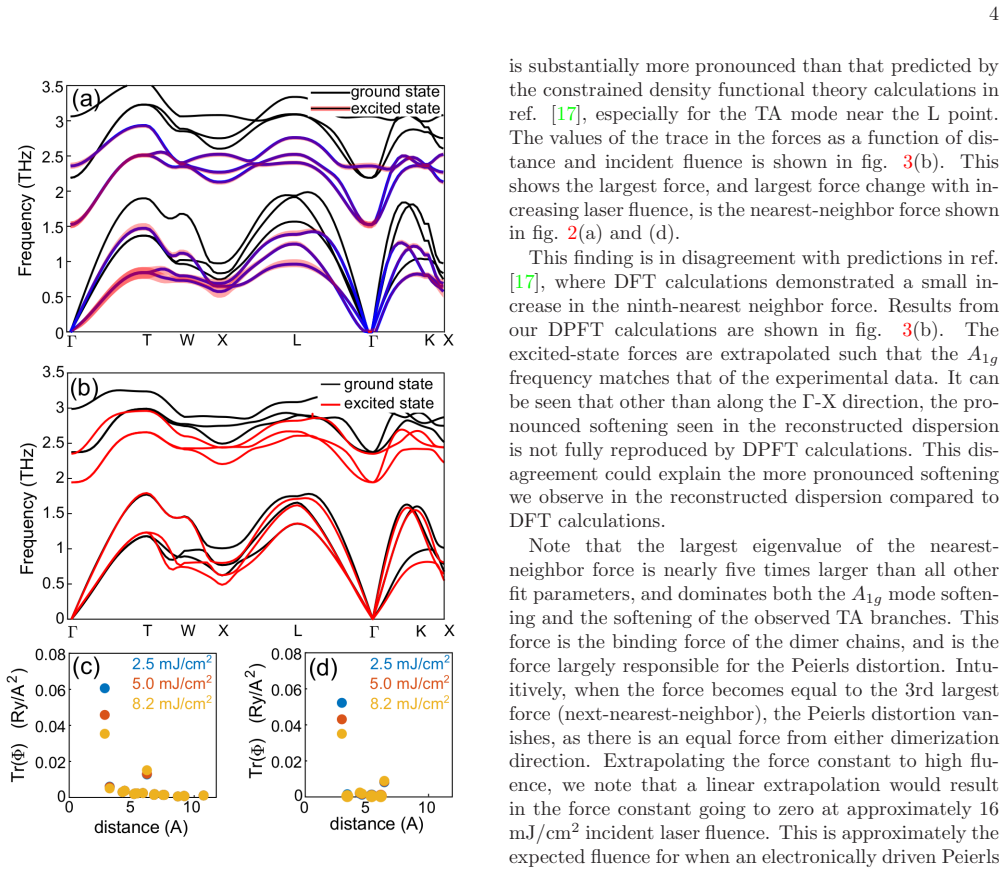
On the paper's own terms, the discovery is that photoexcitation renormalizes bismuth's interatomic force landscape in a highly local way: the largest eigenvalue of the first-nearest-neighbor force matrix, the restoring force along the dimer bond, is weakened to almost 50% of its ground-state value at the highest fluence studied, 8 mJ/cm2. This single force change dominates both the zone-center A1g mode softening and the softening of the transverse acoustic branches that the diffuse-scattering signal is most sensitive to. The second- and ninth-nearest-neighbor forces change only weakly or not at all within uncertainty, so the observed partial reversal of the Peierls distortion is attributed to the near-neighbor dimer bond rather than to a general lattice softening. A linear extrapolation of the bond force to zero lands near 16 mJ/cm2, close to the fluence at which theory expects the electronically driven Peierls distortion to vanish. The measured dispersion softening is stronger than constrained density-functional predictions, especially for the TA mode near the L point.
Load-bearing premise
The fit assumes that laser excitation leaves the directions of the chemical bonds unchanged, changing only the strength of the restoring forces along those directions; if the bond directions rotate or the force-matrix eigenvectors renormalize, the reported bonding-direction force is a biased measure.
Editorial extensions
If this is right
- The A1g mode's 2.95-to-2 THz softening at 8 mJ/cm2 is dominated by the nearest-neighbor bond force, so time-resolved measurements of that mode can serve as a proxy for the bond force in bismuth.
- Extrapolating the measured bond-force drop to zero implies the Peierls-distorted structure should become unstable near 16 mJ/cm2, matching the fluence range where the symmetric high-symmetry phase is expected.
- The observed acoustic softening is more pronounced than constrained density-functional predictions, meaning the microscopic force renormalization in the hot-carrier state is stronger than current excited-state calculations capture.
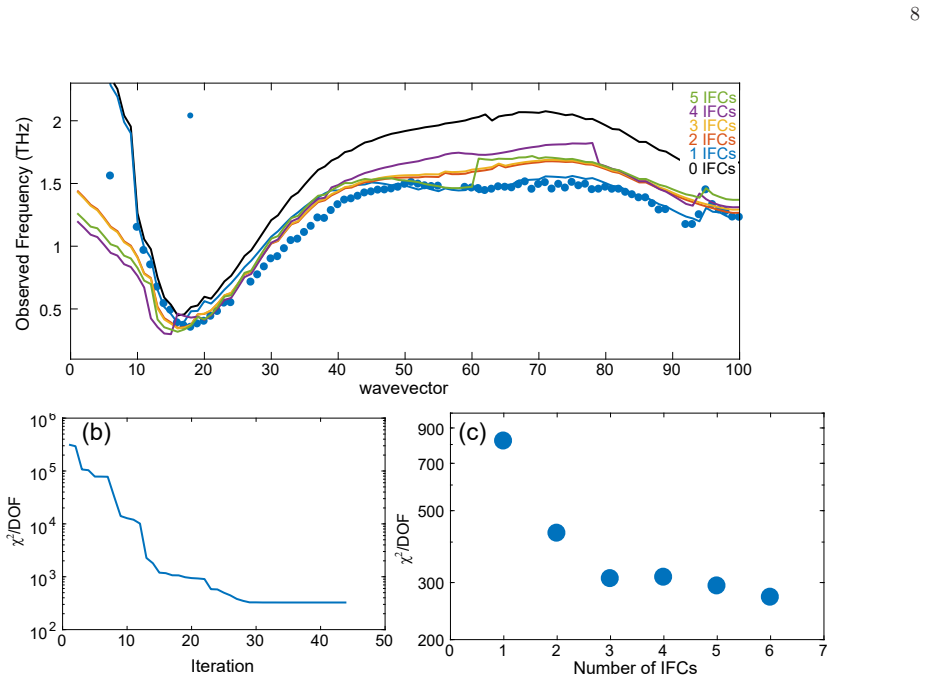
- Adding more than three adjustable force matrices does not significantly improve the fit, indicating that the dominant nonequilibrium response is localized on the nearest-neighbor dimer bond.
Reading between the lines
- The same diffuse-scattering and force-matrix fitting route should transfer to other Peierls and charge-density-wave systems as long as a sizable fraction of the Brillouin zone shows resolvable frequency shifts; the requirement is many q-resolved frequencies, not just a zone-center mode.
- If time-resolved measurements can isolate phonon polarizations or detect off-specular scattering, the fixed-eigenvector assumption could be tested directly; any observed rotation of the bond directions would mean the reported bond-force eigenvalue is a projected rather than a true measure.
- The near-50% bond softening at moderate fluence implies strong anharmonicity in the excited-state potential, so measuring fluence-dependent higher-order force constants, such as mode coupling and three-phonon decay, could check whether the harmonic Born-von Karman picture holds deeper into the nonequilibrium state.
- The discrepancy with density-functional predictions suggests a benchmark: comparing measured excited-state force matrices against hot-carrier calculations could identify which part of the electronic-structure approximation, such as carrier screening or exchange-correlation, needs revision.
Signed reviews
Editorial analysis
A structured set of objections, weighed in public.
Referee Report
Summary. The manuscript reports time-resolved x-ray diffuse scattering measurements on photoexcited bismuth at laser fluences of 2.5–8.2 mJ/cm2. Oscillations in the diffuse scattering at twice the phonon frequency are used to extract the momentum-resolved excited-state phonon dispersion, which is then fit with a Born–von Karman model containing 21 independent force matrices. The authors fix 18 matrices to ground-state DFPT values, assume that photoexcitation changes only the eigenvalues (not the eigenvectors) of the force matrices, and fit the eigenvalues of the first-, second-, and ninth-nearest-neighbor force matrices, with an additional constraint from the A1g zone-center mode. Their central finding is that the first nearest-neighbor eigenvalue along the bonding direction is softened to roughly 50% of its ground-state value at 8 mJ/cm2 and that this softening dominates the observed A1g and transverse-acoustic mode softening. They also compare their reconstructed forces with constrained DFT calculations and note a disagreement for the ninth-nearest-neighbor force.
Significance. If correct, this is a significant experimental advance: it is one of the first direct, momentum-resolved measurements of nonequilibrium interatomic forces, moving beyond zone-center optical-mode probes and providing a microscopic picture of the photoinduced partial reversal of the Peierls distortion in bismuth. The manuscript is clearly written and unusually candid about its assumptions and limitations (fixed eigenvectors, reduced chi-square of about 300, geometry-only error bars). The paper also includes convergence tests for the number of fitted force matrices, which is good practice. The main significance risk is that the key quantitative claim—the ~50% nearest-neighbor softening—is the output of a heavily constrained fit whose identifiability has not been demonstrated; the fit quality and error treatment need strengthening before the central claim is fully established.
major comments (3)
- [Supplement: Fitting Routine for Interatomic Forces; Eq. (4)] The fit reaches a reduced chi-square of about 300, which the text attributes to geometry systematics and model incompleteness. This is a load-bearing issue because the central claim is a ~50% reduction of the first nearest-neighbor eigenvalue (Fig. 2(a)). The error bars in Fig. 2 are obtained by varying the crystal alignment, so they do not include model error. The plateau in Fig. 5(c) with increasing number of adjustable IFCs is evidence against adding individual shells, but it does not rule out correlated changes across several omitted shells. I request a synthetic recovery test: generate synthetic frequency maps from models with, e.g., changes in the 4th–5th shells or with rotated eigenvectors, and show that the constrained three-matrix fit recovers the true first-shell eigenvalue within quoted uncertainties. Without such a test, the 50% figure is not established as an identifiable parameter of the data.
- [Main text, after Eq. (2)] The assumption that the photoexcitation changes only the eigenvalues, not the eigenvectors, of each force matrix is stated explicitly, and it underpins the interpretation of the fitted first eigenvalue as the force along the bonding direction. If the bond directions themselves rotate or the force-matrix eigenvectors change in the excited state, the fitted eigenvalue is a mixture of ground-state components and the extracted bonding-direction softening is biased. The paper does not provide evidence for this assumption, such as a DFPT calculation of the excited-state force matrices showing small eigenvector rotation, or a synthetic test where the fitting is applied to data generated with rotated eigenvectors. This point is not a circularity but a correctness-risk that should be addressed before the central claim can be taken at face value.
- [Supplement: Fitting Routine for Phonon Frequencies / branch assignment] The observed diffuse-scattering frequency is the second harmonic of the phonon frequency, and each pixel is assigned to a phonon branch by the maximum computed TDS intensity. The text states that this assumes similar excitation amplitude relative to equilibrium for all phonon modes. If the actual excitation amplitudes are mode-dependent, some pixels will be assigned to the wrong branch, and the fitted force eigenvalues will be biased. The paper should test the sensitivity of the fitted forces to branch assignment, for example by repeating the fit with a different TDS weighting threshold or by excluding pixels near branch crossings.
minor comments (5)
- [Title] The title contains a stray space: 'Phot oexcited' should be 'Photoexcited'.
- [Main text, first paragraph of results] In the sentence 'a 30% reduction in freuency', 'freuency' should be 'frequency'.
- [Fig. 3 caption and main text] The acronym 'DPFT' appears in the Fig. 3(b) caption and once in the main text; it should be 'DFPT' for consistency.
- [Main text, paragraph on observed branches] The sentence 'The second harmonic of the LO and TO phonon branches were not observed' should use 'was' instead of 'were', since the subject is 'the second harmonic'.
- [Supplement: Fitting Routine for Interatomic Forces] Equation (4) defines the chi-square with a prefactor 1/(N−nX), but the symbols N and nX are not defined explicitly on first use; please define them in the text or equation.
Circularity Check
No significant circularity: the extracted interatomic forces are fit outputs, the A1g frequency is an explicit constraint rather than a predicted quantity, and the reported interpretation is a model-based attribution.
full rationale
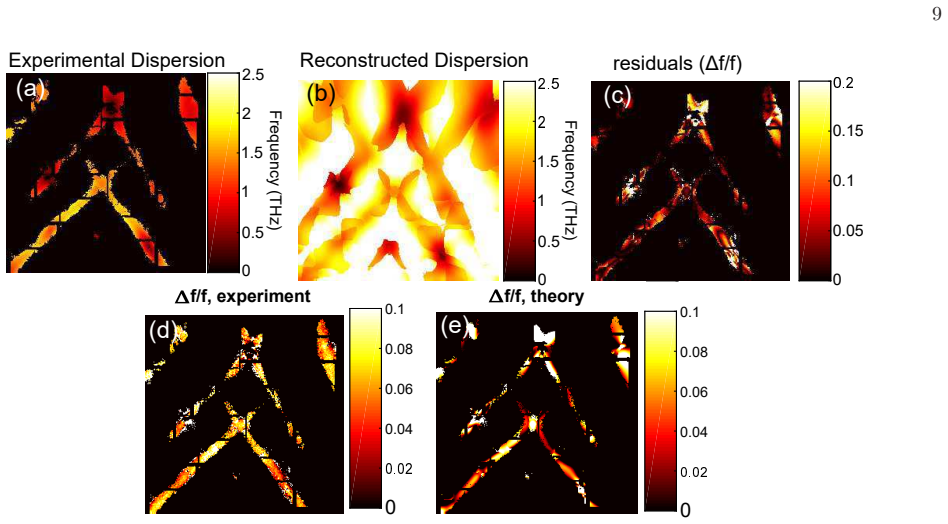
The derivation chain is an inverse-problem parameter estimation, not a self-referential derivation. Measured time-resolved diffuse-scattering frequencies at roughly 7,080 pixels and the zone-center A1g frequency enter Eq. (4) as data terms; the optimizer adjusts a small set of interatomic-force eigenvalues to minimize that chi-square. The reported nearest-neighbor, second-neighbor, and ninth-neighbor force changes in Fig. 2(a)-(c) are the fit parameters themselves, not predictions deduced from those parameters. The abstract's claim that the A1g and TA softenings are 'primarily due to' nearest-neighbor bond weakening is an interpretation of the fitted model; the A1g term is explicitly incorporated as an additional optimization constraint ('The A1g frequency was incorporated as an additional term in the optimization function'), so the paper does not present the A1g softening as an independent prediction. The extrapolation to zero force near 16 mJ/cm2 is explicitly labeled a 'linear extrapolation,' not a derived first-principles result. Self-citations (refs. 16-18, 21) provide the experimental method, prior DFT comparison, and Peierls-distortion context; none is used as an external uniqueness theorem or to forbid alternative force models. The fixed-eigenvector assumption and the reported reduced chi-square of about 300 are model limitations that affect identifiability and systematic uncertainty, and the paper acknowledges them, but they do not make any step reduce to its inputs by construction. No fitted quantity is renamed as a prediction, and no load-bearing step is equivalent to its own input.
Assumptions & free parameters
free parameters (4)
- Largest eigenvalue of 1st nearest-neighbor force matrix =
~0.08 Ry/A^2 (ground state) to ~0.04 Ry/A^2 at 8 mJ/cm2
- Other two eigenvalues of 1st nearest-neighbor force matrix
- Three eigenvalues of 2nd nearest-neighbor force matrix
- Three eigenvalues of 9th nearest-neighbor force matrix
assumptions (5)
- domain assumption Photoexcitation does not significantly change the eigenvectors of the interatomic force matrices.
- domain assumption All interatomic forces other than the three fitted force matrices remain at their ground-state DFPT values.
- standard math The observed diffuse scattering oscillations are proportional to the variance of the phonon displacements and oscillate at twice the phonon frequency.
- domain assumption Each detector pixel's observed frequency is assigned to the phonon branch with the highest computed thermal diffuse scattering intensity, assuming equal excitation amplitude for all branches.
- domain assumption DFPT provides accurate ground-state force constants for the initial guess and for the unadjusted force matrices.
Cite this review
Pith. "Pith review of Measurements of Nonequilibrium Interatomic Forces in Photoexcited Bismuth." pith.science (2026). https://pith.science/paper/AVNU4DUF
@misc{pith2026190807161,
  author       = {Pith},
  title        = {Pith review of: Measurements of Nonequilibrium Interatomic Forces in Photoexcited Bismuth},
  year         = {2026},
  howpublished = {\url{https://pith.science/paper/AVNU4DUF}},
  note         = {Machine review of arXiv:1908.07161}
}
abstract
We determine experimentally the excited-state interatomic forces in photoexcited bismuth. The forces are obtained by a constrained least-squares fit of the excited-state dispersion obtained by femtosecond time-resolved x-ray diffuse scattering to a fifteen-nearest neighbor Born-von Karman model. We find that the observed softening of the zone-center $A_{1g}$ optical mode and transverse acoustic modes with photoexcitation are primarily due to a weakening of three nearest neighbor forces along the bonding direction. This provides a more complete picture of what drives the partial reversal of the Peierls distortion previously observed in photoexcited bismuth.
Figures


Figures from the paper (3 more)

Reference graph
Works this paper leans on
-
[1]
The incident fluence of the 800 nm p-polarized, 65 fs excitation laser was varied between 2
(binary axis). The incident fluence of the 800 nm p-polarized, 65 fs excitation laser was varied between 2 . 5 − 8. 0 mJ / cm2. A pixel array detector (CSPAD [ 25]) was used to simul- taneously collect scattered x rays over a wide range of momentum transfer Q. The procedure for obtaining the phonon frequencies 2 0 1 2 3 4 Time (ps) 0 0.1 0.2 0.3I/I 2.5 mJ/...
work page 2015
-
[2]
D. M. Fritz, D. A. Reis, B. Adams, R. A. Akre, J. Arthur, C. Blome, P. H. Bucksbaum, A. L. Cav- alieri, S. Engemann, S. Fahy, R. W. Falcone, P. H. Fuoss, K. J. Gaffney, M. J. George, J. Hajdu, M. P. Hertlein, P. B. Hillyard, M. Horn-von Hoegen, M. Kamm- ler, J. Kaspar, R. Kienberger, P. Krejcik, S. H. Lee, A. M. Lindenberg, B. McFarland, D. Meyer, T. Mon- ...
work page 2007
-
[3]
P. Beaud, A. Caviezel, S. O. Mariager, L. Rettig, G. Ingold, C. Dornes, S.-W. Huang, J. A. John- son, M. Radovic, T. Huber, T. Kubacka, A. Ferrer, H. T. Lemke, M. Chollet, D. Zhu, J. M. Glownia, M. Sikorski, A. Robert, H. Wadati, M. Nakamura, M. Kawasaki, Y. Tokura, S. L. Johnson, and U. Staub, Nature materials 13, 923 (2014)
work page 2014
-
[4]
F. Schmitt, P. S. Kirchmann, U. Bovensiepen, R. G. Moore, L. Rettig, M. Krenz, J.-H. Chu, N. Ru, L. Per- fetti, D. H. Lu, M. Wolf, I. R. Fisher, and Z.-X. Shen, Science 321, 1649 (2008)
work page 2008
-
[5]
A. M. Lindenberg, J. Larsson, K. Sokolowski-Tinten, K. J. Gaffney, C. Blome, O. Synnergren, J. Sheppard, C. Caleman, A. G. MacPhee, D. Weinstein, D. P. Lowney, T. K. Allison, T. Matthews, R. W. Falcone, A. L. Cava- lieri, D. M. Fritz, S. H. Lee, P. H. Bucksbaum, D. A. Reis, J. Rudati, P. H. Fuoss, C. C. Kao, D. P. Siddons, R. Pahl, J. Als-Nielsen, S. Duest...
work page 2005
-
[6]
M. F¨ orst, C. Manzoni, S. Kaiser, Y. Tomioka, Y. Tokura, R. Merlin, and a. Cavalleri, Nature Physics 7, 854 (2011)
work page 2011
-
[7]
D. N. Basov, R. D. Averitt, and D. Hsieh, Nature Materials 16, 1077 EP (2017)
work page 2017
-
[8]
M. Born and K. Huang, Dynamical Theory of Crystal Lattices , Oxford clas- sic texts in the physical sciences (Oxford University Press, 1954)
work page 1954
Show all 32 references
-
[9]
B. N. Brockhouse and A. T. Stewart, Phys. Rev. 100, 756 (1955)
1955
-
[10]
R. A. Cowley, Phys. Rev. 134, A981 (1964)
1964
-
[11]
High-resolution inelas- tic x-ray scattering ii: Scattering theory, harmonic phonons, and calculations,
A. Q. R. Baron, “High-resolution inelas- tic x-ray scattering ii: Scattering theory, harmonic phonons, and calculations,” in Synchrotron Light Sources and Free-Electron Lasers: Accel erator Physics, Instrumentation and Science Applications , edited by E. Jaeschke, S. Khan, J. ...
-
[12]
High-resolution inelas- tic x-ray scattering i: Context, spectrom- eters, samples, and superconductors,
A. Q. R. Baron, “High-resolution inelas- tic x-ray scattering i: Context, spectrom- eters, samples, and superconductors,” in Synchrotron Light Sources and Free-Electron Lasers: Accel erator Physics, Instrumentation and Science Applications , edited by E. Jaeschke, S. Khan, J. ...
-
[13]
Inelastic x-ray scattering from phonons,
M. Krisch and F. Sette, “Inelastic x-ray scattering from phonons,” in Light Scattering in Solid IX , edited by M. Cardona and R. Merlin (Springer Berlin Heidel- berg, Berlin, Heidelberg, 2007) pp. 317–370
2007
-
[14]
Trigo, M
M. Trigo, M. Fuchs, J. Chen, M. P. Jiang, M. Cam- marata, S. Fahy, D. M. Fritz, K. Gaffney, S. Ghimire, A. Higginbotham, S. L. Johnson, M. E. Kozina, J. Larsson, H. Lemke, A. M. Lindenberg, G. Nd- abashimiye, F. Quirin, K. Sokolowski-Tinten, C. Uher, G. Wang, J. S. Wark, D. Zhu...
2013
-
[15]
D. Zhu, A. Robert, T. Henighan, H. T. Lemke, M. Chol- let, J. M. Glownia, D. A. Reis, and M. Trigo, Physical Review B 92, 054303 (2015)
2015
-
[16]
M. P. Jiang, M. Trigo, I. Savic, S. Fahy, ´E. D. Mur- ray, C. Bray, J. Clark, T. Henighan, M. Kozina, M. Chollet, J. M. Glownia, M. C. Hoffmann, D. Zhu, O. Delaire, A. F. May, B. C. Sales, A. M. Linden- berg, P. Zalden, T. Sato, R. Merlin, and D. A. Reis, Nature Communications ...
2016
-
[17]
S. W. Teitelbaum, T. Henighan, Y. Huang, H. Liu, M. P. Jiang, D. Zhu, M. Chollet, T. Sato, E. D. Murray, S. Fahy, S. O’Mahony, T. P. Bailey, C. Uher, M. Trigo, and D. A. Reis, Phys. Rev. Lett. 121, 125901 (2018)
2018
-
[18]
Murray, S
´E. Murray, S. Fahy, D. Prendergast, T. Ogitsu, D. Fritz, and D. Reis, Physical Review B 75, 184301 (2007)
2007
-
[19]
Murray, D
´E. Murray, D. Fritz, J. Wahlstrand, S. Fahy, and D. Reis, Physical Review B 72, 60301 (2005)
2005
-
[20]
S. L. Johnson, P. Beaud, E. Vorobeva, C. J. Milne, ´E. D. Murray, S. Fahy, and G. Ingold, Physical Review Letters 102, 175503 (2009)
2009
-
[21]
T. K. Cheng, S. D. Brorson, a. S. Kazeroonian, J. S. Moodera, G. Dresselhaus, M. S. Dresselhaus, and E. P. Ippen, Applied Physics Letters 57, 1004 (1990)
1990
-
[23]
M. Hase, K. Mizoguchi, H. Harima, S.-I. Nakashima, and K. Sakai, Phys. Rev. B 58, 5448 (1998)
1998
-
[24]
Sokolowski-Tinten, C
K. Sokolowski-Tinten, C. Blome, J. Blums, A. Cavalleri , C. Dietrich, A. Tarasevitch, I. Uschmann, E. F¨ orster, M. Kammler, M. Horn-von Hoegen, and D. von der Linde, Nature 422, 287 (2003)
2003
-
[25]
Chollet, R
M. Chollet, R. Alonso-Mori, M. Cammarata, D. Dami- ani, J. Defever, J. T. Delor, Y. Feng, J. M. Glownia, J. B. Langton, S. Nelson, K. Ramsey, A. Robert, M. Sikorski, S. Song, D. Stefanescu, V. Srini- vasan, D. Zhu, H. T. Lemke, and D. M. Fritz, Journal of Synchrotron Radiation...
2015
-
[26]
Herrmann, S
S. Herrmann, S. Boutet, B. Duda, D. Fritz, G. Haller, P. Hart, R. Herbst, C. Ken- ney, H. Lemke, M. Messerschmidt, J. Pines, A. Robert, M. Sikorski, and G. Williams, 6 Nuclear Instruments and Methods in Physics Research 718, 550 (2013)
2013
-
[27]
Barkhuijsen, R
H. Barkhuijsen, R. de Beer, W. Bove, and D. van Ormondt, Journal of Magnetic Resonance (1969) 61, 465 (1985)
1969
-
[28]
See supplemental information for a map of the fitted fre- quencies on the detector, the fit convergence as a function of the number of fit parameters
-
[29]
Henighan, M
T. Henighan, M. Trigo, M. Chollet, J. N. Clark, S. Fahy, J. M. Glownia, M. P. Jiang, M. Koz- ina, H. Liu, S. Song, D. Zhu, and D. A. Reis, Physical Review B 94, 020302 (2016)
2016
-
[30]
Xu and T
R. Xu and T. C. Chiang, Zeitschrift fr Kristallographie - Crystalline Materials 220, 1009 (2005)
2005
-
[31]
C. B. Walker, Phys. Rev. 103, 547 (1956)
1956
-
[32]
S. W. Teitelbaum, T. Shin, J. W. Wolfson, Y.-H. Cheng, I. J. Porter, M. Kandyla, and K. A. Nelson, Phys. Rev. X 8, 031081 (2018)
2018
-
[33]
Mitrano, A
M. Mitrano, A. Cantaluppi, D. Nicoletti, S. Kaiser, A. Perucchi, S. Lupi, P. Di Pietro, D. Pontiroli, M. Ricc` o, S. R. Clark, D. Jaksch, and A. Cavalleri, Nature 530, 461 (2016) . 7 Frequency (THz) 0 0.5 1 1.5 2 2.5 | f/f| 0 0.15 0.10 0.05 (a) (b) (1 2 2) (0 1 1) (1 1 1) (2 3...
2016
Reviewed August 14, 2026 · model on record in the stance chip above.
Discussion (0). Continue with ORCID to comment.