REVIEW 2 major objections 5 minor 53 references
Universal linear manipulation via routing and projective measurements
T0 review · 2 major / 5 minor · reviewed 2026-08-06 · deepseek-v4-flash
Pith's one-line read The paper establishes that the full output statistics of any unitary transformation on classical coherent light or a single photon can be obtained from a minimal $N-1$-MZI routing mesh with one detector across $N$ temporal settings, and…
desk verdict Single-photon routing with closed-form phases is solid; the multi-photon equivalence overclaims collision statistics and needs a fix. read the letter →
The pith
A machine-rendered reading of the paper's core claim, the machinery that carries it, and where it could break.
The reading
What carries the argument
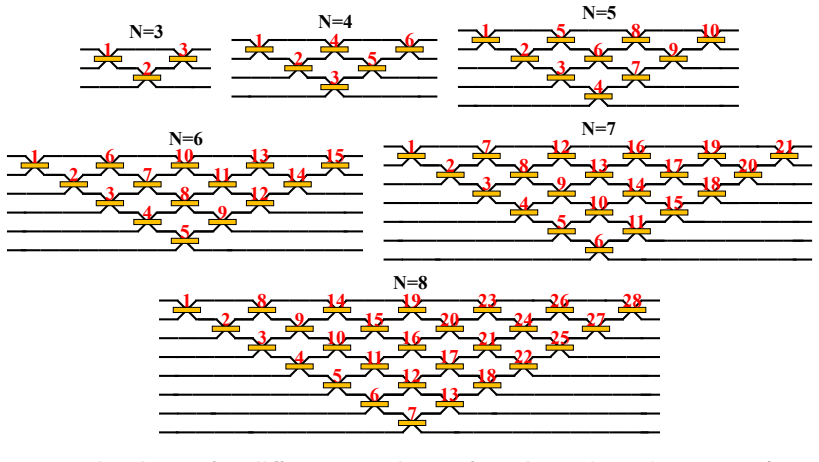
The central object is the unitary router: a rank-one router $R^u_{k,r}$ built from the $k$-th row of $U$, embedded in a unitary $U_{k,r}$ whose only observable effect is to send the state $U^\dagger|k\rangle$ to the reference mode $|r\rangle$. It carries the equivalence because the detection probability on $|r\rangle$ after $U_{k,r}$ equals the probability on $|k\rangle$ after $U$. The constructive part uses the routing property of a single Mach-Zehnder interferometer, namely that any two-mode superposition can be steered to either output, to eliminate components of $U^\dagger|k\rangle$ one by one, yielding $N-1$ MZIs. Multi-routers generalize the same object to $m$ orthogonal target vectors, costing $m\left(N-\tfrac{m+1}{2}\right)$ Mach-Zehnder interferometers.
What would settle it
Run the same unitary $U$ and the same input state on two setups: one universal $N$-port interferometer with detectors on all outputs, and one routing mesh with a single reference detector cycled through the $N$ router settings. If the estimated probabilities $|\langle k|U|\psi\rangle|^2$ and $|\langle r|U_{k,r}|\psi\rangle|^2$ disagree beyond counting statistics for any $k$, the equivalence in Eq. (13) fails. For the multi-photon claim, compare the permanent-based click distributions of Eq. (16) and Eq. (17) in the same way.
Extended reading notes
Core claim
For a unitary $U$ and a fixed reference mode $|r\rangle$, define routers $R^u_{k,r}=\sum_n u_{k,n}|r\rangle\langle n|$, one per output $k$. The paper proves that a unitary router $U_{k,r}$ satisfying $P_r U_{k,r}=e^{i\Gamma_k} R^u_{k,r}$ yields the identity $|\langle k|U|\psi\rangle|^2 = |\langle r|U_{k,r}|\psi\rangle|^2$ for every input $|\psi\rangle$. Hence sampling at the $N$ outputs of $U$ is equivalent to sampling at one output of the $N$ routers $U_{k,r}$, one per temporal slot (Eq. 13). A constructive decomposition shows each $U_{k,r}$ needs only $N-1$ Mach-Zehnder interferometers in a linear or tree mesh, the minimum number set by the $2(N-1)$ parameters of a normalized state. For $m$ photons, the permanent formula implies equivalence between $U$ with $N$ detectors and the $\binom{N}{m}$ multi-routers $U^{(m)}_{k,r}$ with $m$ detectors (Eq. 15).
Load-bearing premise
The equivalence holds only for measurement statistics, not for producing the transformed state, and it assumes the same input state can be prepared identically in every temporal slot while the interferometer is reconfigured without error between slots.
Editorial extensions
If this is right
- A single-detector, $N-1$-MZI photonic processor can estimate the full output probability distribution of any $N\times N$ unitary for coherent or single-photon input, provided the mesh is faithfully reconfigured between temporal slots.
- Scattershot boson sampling with $m$ photons can be performed with $m$ detectors and fewer MZIs than universal meshes, at the cost of $\binom{N}{m}$ temporal slots.
- The tree mesh has balanced optical depth $\log_2 N$, so under uniform per-MZI loss its fidelity remains maximal and its total-variation distance stays zero in the paper's simulations; routing schemes in general are insensitive to unbalanced output coupling losses because only one output is measured.
- Routing schemes distribute the effect of random phase noise, since light that is not routed correctly is lost rather than interfering across the full mesh.
- For fewer than about twenty modes, the paper's simulations show nearly unit fidelity and near-zero total-variation distance for both established universal designs and the routing schemes.
Reading between the lines
- The single-detector equivalence suggests that "universality" in photonics can be redefined at the level of observable statistics rather than implemented transformations, so tasks like state tomography, photonic matrix-vector multiplication with post-processing, and sampling problems may not require full universal meshes.
- The same router decomposition may transfer to other platforms that realize beam-splitter and phase-shifter primitives, such as frequency-bin, time-bin, or superconducting-circuit implementations, wherever a single output can be measured repeatedly.
- The per-slot identical-preparation assumption is the practical bottleneck: if input-state generation is probabilistic, the need for independent repetitions in each of $N$ or $\binom{N}{m}$ settings may erode the resource advantage, so the scheme favors deterministic photon sources.
- A direct experimental comparison of route-estimated probabilities with simultaneous $N$-detector sampling on the same chip would test the predicted loss and noise robustness, especially the tree mesh's claim of zero total-variation distance under uniform per-MZI loss.
Editorial analysis
A structured set of objections, weighed in public.
Referee Report
Summary. The paper proposes new multiport interferometer architectures (linear V-shaped and tree meshes) that use only N-1 Mach-Zehnder interferometers and a single detector to reproduce the output statistics of an arbitrary N-dimensional unitary U on classical coherent light or single-photon states. The scheme works by temporally multiplexing N "unitary routers" U_{k,r}, each of which routes the component corresponding to output mode k to a fixed reference mode r, followed by a projective measurement. The paper extends the idea to m-photon input states via "unitary multi-routers" U^{(m)}_{k,r}, claiming an equivalence to scattershot boson sampling, and compares the loss and phase-noise robustness of the routing schemes with the Reck and Clements universal schemes. Appendices provide explicit decomposition algorithms and closed-form phase settings, including a closed form for the linear V-shaped router in Eq. (53).
Significance. The single-photon/classical result is sound and useful: the identity in Eq. (10) follows directly from the router condition in Eq. (12), and the constructive algorithms in Appendices E and F give explicit MZI phase settings for arbitrary N. The resource trade-off (N-1 MZIs and one detector at the cost of N temporal slots) is clearly presented and of practical interest for reconfigurable photonic circuits. The tree scheme's constant optical depth gives it unit fidelity under uniform per-MZI loss, which is a clean and notable advantage. The numerical comparison with Reck/Clements schemes is careful, with declared metrics and error bars. The main weakness is the multi-photon generalization: the claimed equivalence (15)/(17) is not established for collision events, and the paper's treatment of that case is incomplete. The scope restriction that the routing schemes reproduce measurement statistics rather than the transformed state U|ψ> is also not stated prominently enough.
major comments (2)
- [Section 4 and Appendix G.1, Eqs. (15)-(17) and (69)-(70)] The claimed equivalence for m-photon states is not valid for collision events as written. Eq. (17) contains exactly one factor <r_α|U^{(m)}_{k,r}|j_{σ(α)}> for each α=1,...,m, which is the permanent for the event that each reference mode r_α receives exactly one photon. This equals the original probability in Eq. (16) only when the output occupation vector n has no entry greater than 1. For n with some n_i>1, Eq. (16) contains a permanent with repeated rows, which cannot be represented by the distinct reference rows in Eq. (17). Moreover, the construction in Eq. (69) is only possible for k with pairwise distinct entries because the rows of a unitary matrix are orthonormal; no single setting k can directly encode a repeated output mode. The redundancy discussion after Eq. (23) does not repair this: it refers to C(N-l, m-l) settings k that contain the occupied modes, but it does not specify how the reference-detector pattern maps to the original collision pattern n, and the estimator sum_k N_{k,n}/sum_k N_k is not well-defined unless that mapping and the corresponding repeated-row permanent are supplied. The equivalence (15)/(17) therefore holds only for collision-free output patterns as stated, and the manuscript must either restrict the claim accordingly or provide a correct treatment of collision events using multi-click reference-detector patterns.
- [Abstract, Section 1, Section 4, Section 6] The wording 'implement a generic unitary transformation' (abstract) and 'universal linear manipulation' (title) overstates what is demonstrated. Equations (9)-(13) establish an equivalence of measurement statistics: for every input state |ψ>, the probabilities |<k|U|ψ>|^2 can be estimated by projective measurements on the reference mode after applying the routers U_{k,r}. They do not produce the transformed state U|ψ> for subsequent coherent processing; the projector P_r in Eq. (5) projects the photon out of the system. This scope restriction should be stated explicitly in the abstract and introduction, and the title should be adjusted (for example, to 'universal estimation of linear-optical statistics via routing and projective measurements') unless the authors intend a different meaning of 'manipulation'.
minor comments (5)
- [Section 4, text before Eq. (16)] The input occupation vector s satisfies sum_i s_i = m, not sum_i s_i = N; the text currently says 'PN i=1 si =N'.
- [Appendix G, Eq. (60)] The phrase 'wherer= (N, N−1, . . . , N−m+ 1⟩' is missing a bra-ket and should read something like 'where r = (|N⟩, |N−1⟩, ..., |N−m+1⟩)'.
- [Section 5, text near Eq. (21)] 'Kullbach-Leibner' is a misspelling; it should be 'Kullback-Leibler'.
- [Table 1 and Appendix G] The 'MZI layers' entry for the multilinear scheme, N+m−2−δ_{m,N}, is not obviously consistent with the 'm layers' description in Fig. 5 and Eq. (60). Please clarify whether 'layers' are counted as parallel layers or as sequential diagonals in the incomplete Reck mesh.
- [Throughout] The term 'scattershot boson sampling' usually refers to heralded photons from spontaneous parametric down-conversion with random input modes; the m-photon Fock-state input treated here is standard boson sampling. Please adjust the terminology or explicitly define the intended meaning.
Circularity Check
No significant circularity; the central equivalences are constructive identities backed by explicit decomposition algorithms.
full rationale
The paper's central claims are equivalences between sampling at N outputs of U and sampling at reference outputs of the routers U_{k,r} (Eq. 13) and multi-routers U^{(m)}_{k,r} (Eq. 15). These identities are not fitted predictions; they are exact consequences of the definitions in Eqs. (5), (6), (12), and (14): each U_{k,r} is required to satisfy <r|U_{k,r}|v> = e^{iΓ_k}<k|U|v>, so Eq. (10) holds by construction. The physical content lies in the claim that such U_{k,r} can be realized with only N-1 MZIs (and m(N-(m+1)/2) for multi-routers). This is supported by constructive, step-by-step decomposition algorithms (Algorithms 8 and 10, and the iterative construction in Appendix G) using the elementary routing property of a single MZI (Eqs. 36-38). These algorithms are self-contained and do not presuppose the theorem they prove; they only use the standard fact that a 2x2 MZI can eliminate one component of a vector. The loss-robustness results (unit fidelity and zero TV distance for the tree scheme under constant per-MZI loss) are direct consequences of equal path depth, not of any fitted parameter or imported ansatz. Self-citations [21, 37] appear only as illustrative experimental examples of tree-type routing, and the tree scheme itself is credited to [20]; neither citation carries the derivation. The paper explicitly notes the scope restriction that the equivalence is about measurement statistics, not state transformation, which further confirms the claim is not overreaching in a circular way. A separate, non-circularity concern is that the extension to collision events (Eqs. 16-17) is not proven for occupation numbers n_j>1; the appendix only asserts a redundant averaging procedure. That would be a correctness or completeness issue, not a case of the conclusion being equivalent to the input. Accordingly, no circular step is identified.
Assumptions & free parameters
assumptions (5)
- standard math Standard linear-optics model: phase shifters and balanced beam splitters generate U(2)/U(1)^2 operations via Mach-Zehnder interferometers (Appendix A, Eqs. 24-27).
- standard math Any N x N unitary matrix can be decomposed into N(N-1)/2 two-mode MZI factors up to a diagonal phase (Reck and Clements theorems, cited [1,2]).
- standard math Boson sampling output probabilities are given by permanents of submatrices (Eq. 16, citing [40]).
- domain assumption Input states are restricted to a single photon, classical coherent light, or m-photon Fock states; the equivalence is argued for these states only (Section 2).
- domain assumption Post-selection on detected photons with renormalization by total counts gives an estimator of ideal probabilities (Eqs. 19-20).
Cite this review
Pith. "Pith review of Universal linear manipulation via routing and projective measurements." pith.science (2026). https://pith.science/paper/AVV6TAIE
@misc{pith2026260805003,
  author       = {Pith},
  title        = {Pith review of: Universal linear manipulation via routing and projective measurements},
  year         = {2026},
  howpublished = {\url{https://pith.science/paper/AVV6TAIE}},
  note         = {Machine review of arXiv:2608.05003}
}
abstract
Multiport interferometers with $N$ ports are basic devices in both classical and quantum photonics. Ideally, they implement a linear unitary transformation between the input and output electric field vectors with $N$ components, each associated with a spatial mode of classical coherent light or a single photon. Standard designs for a fully reconfigurable universal multiport interferometer are given by the Reck or the Clements schemes. In this work, we introduce routing schemes to implement a generic unitary transformation on classical coherent light or single photons using linear or tree geometries via multiple projective measurements on a single detector with the minimum number of components. Then, we generalize this result to the case of any multi-photon state for scattershot boson sampling experiments with multi-routing schemes. Finally, we test the robustness of routing schemes compared to universal schemes with respect to losses and phase noise.
Figures


Figures from the paper (13 more)




Reference graph
Works this paper leans on
-
[20]
Multidi- mensional quantum entanglement with large-scale integrated optics
J. Wang, S. Paesani, Y. Ding, R. Santagati, P. Skrzypczyk, A. Salavrakos, J. Tura, R. Augusiak, L. Mancinska, D. Bacco, D. Bonneau, J. W. Silverstone, Q. Gong, A. Ac ´ ın, K. Rottwitt, L. K. Oxenlowe, J. L. O’Brien, A. Laing, and M. G. Thompson. “Multidi- mensional quantum entanglement with large-scale integrated optics”. In:Science360.6386 (Apr. 2018), 2...
-
[1]
Experimental realization of any discrete unitary operator
M. Reck, A. Zeilinger, H. J. Bernstein, and P. Bertani. “Experimental realization of any discrete unitary operator”. In:Physical Review Letters73.1 (1994), pp. 58–61.doi:10. 1103/PhysRevLett.73.58
work page 1994
-
[2]
Optimal design for universal multiport interferometers
W. R. Clements, P. C. Humphreys, B. J. Metcalf, W. S. Kolthammer, and I. A. Walmsley. “Optimal design for universal multiport interferometers”. In:Optica3.12 (2016), pp. 1460– 1465.issn: 2334-2536.doi:10.1364/OPTICA.3.001460
-
[3]
Programmable SCOW Mesh Silicon Photonic Processor for Linear Unitary Operator
L. Lu, L. Zhou, and J. Chen. “Programmable SCOW Mesh Silicon Photonic Processor for Linear Unitary Operator”. In:Micromachines10.10 (2019).issn: 2072-666X.doi: 10.3390/mi10100646
-
[4]
S. Lin, Y. Zhang, Z. Wu, S. Zeng, Q. Gao, J. Li, X. Yu, and S. Yu. “Power-efficient programmable integrated multiport photonic interferometer in CMOS-compatible silicon nitride”. In:Photon. Res.12.3 (2024), A11–A20.doi:10.1364/PRJ.507548
-
[5]
N. Daldosso and L. Pavesi. “Nanosilicon photonics”. In:Laser & Photonics Reviews3.6 (2009), pp. 508–534.doi:10.1002/lpor.200810045
-
[6]
A. M. Fox.Quantum optics: an introduction. Vol. 15. Oxford university press, 2006.isbn: 9780198566724.doi:10.1093/oso/9780198566724.001.0001
arXiv 2006
-
[7]
Programmable photonic circuits
W. Bogaerts, D. P´ erez, J. Capmany, D. A. Miller, J. Poon, D. Englund, F. Morichetti, and A. Melloni. “Programmable photonic circuits”. In:Nature586.7828 (2020), pp. 207–216. doi:10.1038/s41586-020-2764-0
Show all 53 references
-
[8]
Qudits and High-Dimensional Quantum Computing
Y. Wang, Z. Hu, B. C. Sanders, and S. Kais. “Qudits and High-Dimensional Quantum Computing”. In:Frontiers in Physics8 (Nov. 2020).issn: 2296-424X.doi:10 . 3389 / fphy.2020.589504. 41
2020
-
[9]
Optical communication components
L. Eldada. “Optical communication components”. In:Review of Scientific Instruments 75.3 (2004), pp. 575–593.doi:10.1063/1.1647701
2004 doi
-
[10]
Roadmap on all-optical processing
P. Minzioni, C. Lacava, T. Tanabe, J. Dong, X. Hu, G. Csaba, W. Porod, G. Singh, A. E. Willner, A. Almaiman, V. Torres-Company, J. Schr¨ oder, A. C. Peacock, M. J. Strain, F. Parmigiani, G. Contestabile, D. Marpaung, Z. Liu, J. E. Bowers, L. Chang, S. Fabbri, M. Ramos V´ azque...
2019 doi
-
[11]
Integrated Photonic Tensor Processing Unit for a Matrix Multiply: A Review
N. Peserico, B. J. Shastri, and V. J. Sorger. “Integrated Photonic Tensor Processing Unit for a Matrix Multiply: A Review”. In:Journal of Lightwave Technology41.12 (2023), pp. 3704–3716.doi:10.1109/JLT.2023.3269957
2023
-
[12]
Photonic Matrix Computing: From Fundamentals to Ap- plications
J. Cheng, H. Zhou, and J. Dong. “Photonic Matrix Computing: From Fundamentals to Ap- plications”. In:Nanomaterials11.7 (2021).issn: 2079-4991.doi:10.3390/nano11071683
2021 doi
-
[13]
Deep learning with coherent nanophotonic circuits
Y. Shen, N. C. Harris, S. Skirlo, M. Prabhu, T. Baehr-Jones, M. Hochberg, X. Sun, S. Zhao, H. Larochelle, D. Englund, and M. Soljaˇ ci´ c. “Deep learning with coherent nanophotonic circuits”. In:Nature photonics11.7 (2017), pp. 441–446.doi:10.1038/nphoton.2017.93
2017 doi
-
[14]
Photonic neural networks: A survey
L. De Marinis, M. Cococcioni, P. Castoldi, and N. Andriolli. “Photonic neural networks: A survey”. In:Ieee Access7 (2019), pp. 175827–175841.doi:10.1109/ACCESS.2019. 2957245
2019 doi
-
[15]
A review of optical neural networks
X. Sui, Q. Wu, J. Liu, Q. Chen, and G. Gu. “A review of optical neural networks”. In: IEEE Access8 (2020), pp. 70773–70783.doi:10.1109/ACCESS.2020.2987333
2020
-
[16]
A scheme for efficient quantum computation with linear optics
E. Knill, R. Laflamme, and G. J. Milburn. “A scheme for efficient quantum computation with linear optics”. In:Nature409.6816 (2001), pp. 46–52.issn: 1476-4687.doi:10.1038/ 35051009
2001
-
[17]
Demonstration of an all-optical quantum controlled-NOT gate
J. L. O’Brien, G. J. Pryde, A. G. White, T. C. Ralph, and D. Branning. “Demonstration of an all-optical quantum controlled-NOT gate”. In:Nature426.6964 (2003), pp. 264–267. doi:10.1038/nature02054
2003 doi
-
[18]
Photonic quantum information processing: a review
F. Flamini, N. Spagnolo, and F. Sciarrino. “Photonic quantum information processing: a review”. In:Reports on Progress in Physics82.1 (Nov. 2018), p. 016001.issn: 1361-6633. doi:10.1088/1361-6633/aad5b2
2018 doi
-
[19]
Universal Multiport Interferometers for Post-Selected Multi- Photon Gates
A. Baldazzi and L. Pavesi. “Universal Multiport Interferometers for Post-Selected Multi- Photon Gates”. In:Advanced Quantum Technologies(2024), p. 2400418.doi:10.1002/ qute.202400418
2024
-
[21]
Four-Qubit Variational Algo- rithms in Silicon Photonics with Integrated Entangled Photon Sources
A. Baldazzi, M. Sanna, M. Borghi, S. Azzini, and L. Pavesi. “Four-Qubit Variational Algo- rithms in Silicon Photonics with Integrated Entangled Photon Sources”. In:npj Quantum Information1 (2025), p. 10.doi:10.1038/s41534-025-01061-6
2025 doi
-
[22]
The Computational Complexity of Linear Optics
S. Aaronson and A. Arkhipov. “The Computational Complexity of Linear Optics”. In: Theory of Computing9.4 (2013), pp. 143–252.doi:10.4086/toc.2013.v009a004
2013 doi
-
[23]
Pho- tonic implementation of boson sampling: a review
D. J. Brod, E. F. Galv˜ ao, A. Crespi, R. Osellame, N. Spagnolo, and F. Sciarrino. “Pho- tonic implementation of boson sampling: a review”. In:Advanced Photonics1.3 (2019), p. 034001.doi:10.1117/1.AP.1.3.034001. 42
2019 doi
-
[24]
Boson Sampling with 20 Input Photons and a 60-Mode Interferometer in a 1014-Dimensional Hilbert Space
H. Wang, J. Qin, X. Ding, M.-C. Chen, S. Chen, X. You, Y.-M. He, X. Jiang, L. You, Z. Wang, C. Schneider, J. J. Renema, S. H¨ ofling, C.-Y. Lu, and J.-W. Pan. “Boson Sampling with 20 Input Photons and a 60-Mode Interferometer in a 1014-Dimensional Hilbert Space”. In:Physical R...
2019 doi
-
[25]
Multiphoton quantum interference in a multiport integrated photonic device
B. J. Metcalf, N. Thomas-Peter, J. B. Spring, D. Kundys, M. A. Broome, P. C. Humphreys, X.-M. Jin, M. Barbieri, W Steven Kolthammer, J. C. Gates, B. J. Smith, N. K. Langford, P. G. R. Smith, and I. A. Walmsley. “Multiphoton quantum interference in a multiport integrated photon...
2013
-
[26]
How does a Mach-Zehnder interferometer work?
K. Zetie, S. Adams, and R. Tocknell. “How does a Mach-Zehnder interferometer work?” In:Physics Education35.1 (2000), pp. 46–48.doi:10.1088/0031-9120/35/1/308
2000 doi
-
[27]
Optical Implementation of 2×2 Universal Unitary Matrix Transformations
A. Macho-Ortiz, D. P´ erez-L´ opez, and J. Capmany. “Optical Implementation of 2×2 Universal Unitary Matrix Transformations”. In:Laser & Photonics Reviews15.7 (2021), p. 2000473.doi:10.1002/lpor.202000473
2021 doi
-
[28]
Integrated adjustable phase shifters
F. Ellinger, U. Mayer, M. Wickert, N. Joram, J. Wagner, R. Eickhoff, I. Santamaria, C. Scheytt, and R. Kraemer. “Integrated adjustable phase shifters”. In:IEEE Microwave Magazine11.6 (2010), pp. 97–108.doi:10.1109/MMM.2010.937730
2010
-
[29]
Silicon photonic phase shifters and their appli- cations: A review
H. Sun, Q. Qiao, Q. Guan, and G. Zhou. “Silicon photonic phase shifters and their appli- cations: A review”. In:Micromachines13.9 (2022), p. 1509.doi:10.3390/mi13091509
2022 doi
-
[30]
Perfect optics with imperfect components
D. A. B. Miller. “Perfect optics with imperfect components”. In:Optica2.8 (2015), pp. 747– 750.doi:10.1364/OPTICA.2.000747
2015 doi
-
[31]
Using an Imperfect Photonic Network to Implement Random Uni- taries
R. Burgwal, W. R. Clements, D. H. Smith, J. C. Gates, W. S. Kolthammer, J. J. Renema, and I. A. Walmsley. “Using an Imperfect Photonic Network to Implement Random Uni- taries”. In:Optics Express25.23 (2017), pp. 28236–28245.doi:10.1364/OE.25.028236
2017 doi
-
[32]
Silicon Photonics Rectangular Universal Interferometer
D. Perez, I. Gasulla, F. J. Fraile, L. Crudgington, D. J. Thomson, A. Z. Khokhar, K. Li, W. Cao, G. Z. Mashanovich, and J. Capmany. “Silicon Photonics Rectangular Universal Interferometer”. In:Laser & Photonics Reviews11.6 (2017), p. 1700219.doi:10.1002/ lpor.201700219
2017
-
[33]
Optimal design of error-tolerant repro- grammable multiport interferometers
S. A. Fldzhyan, M. Y. Saygin, and S. P. Kulik. “Optimal design of error-tolerant repro- grammable multiport interferometers”. In:Opt. Lett.45.9 (2020), pp. 2632–2635.doi: 10.1364/OL.385433
2020 doi
-
[34]
Braided interferometer mesh for robust photonic matrix- vector multiplications with non-ideal components
F. Marchesin, M. Hejda, T. M. Carmona, S. D. Carlo, A. Savino, F. Pavanello, T. V. Vaerenbergh, and P. Bienstman. “Braided interferometer mesh for robust photonic matrix- vector multiplications with non-ideal components”. In:Opt. Express33.2 (2025), pp. 2227– 2246.doi:10.1364/...
2025 doi
-
[35]
Minimum optical depth multiport interferometers for approximating arbitrary unitary operations and pure states
L. Pereira, A. Rojas, G. Lima, A. Delgado, G. Ca˜ nas, and A. Cabello. “Minimum optical depth multiport interferometers for approximating arbitrary unitary operations and pure states”. In:Physical Review A111.6 (2025), p. 062603.doi:10.1103/PhysRevA.111. 062603
2025 doi
-
[36]
Compactifying linear optical unitaries using multiport beamsplitters
P. A. A. Yasir and P. van Loock. “Compactifying linear optical unitaries using multiport beamsplitters”. In:Phys. Rev. A113 (1 2026), p. 013528.doi:10.1103/61zb-k52n
2026 doi
-
[37]
Resource-efficient variational quantum solver for the travelling salesman problem and its silicon photonics implementation
A. Baldazzi, S. Azzini, and L. Pavesi. “Resource-efficient variational quantum solver for the travelling salesman problem and its silicon photonics implementation”. In: (2025). arXiv:2511.02696 [quant-ph]
2025 arXiv
-
[38]
Coherent and Incoherent States of the Radiation Field
R. J. Glauber. “Coherent and Incoherent States of the Radiation Field”. In:Physical Review131.6 (1963), pp. 2766–2788.doi:10.1103/PhysRev.131.2766. 43
1963 doi
-
[39]
On single-photon and classical interference
S. M. Barnett. “On single-photon and classical interference”. In:Physica Scripta97.11 (2022), p. 114004.doi:10.1088/1402-4896/ac971a
2022 doi
-
[40]
Permanents in linear optical networks
S. Scheel. “Permanents in linear optical networks”. In:Acta Phys. Slov.58 (2008), p. 675. arXiv:quant-ph/0406127
2008 arXiv
-
[41]
Gaussian boson sampling
C. S. Hamilton, R. Kruse, L. Sansoni, S. Barkhofen, C. Silberhorn, and I. Jex. “Gaussian boson sampling”. In:Physical Review Letters119.17 (2017), p. 170501.doi:10.1103/ PhysRevLett.119.170501
2017
-
[42]
Kullback.Information theory and statistics
S. Kullback.Information theory and statistics. Courier Corporation, 1997.isbn: 0-486- 69684-7
1997
-
[43]
D. L. Cohn.Measure theory. Vol. 2. Springer, 2013
2013
-
[44]
Computing the Polar Decomposition—with Applications
N. J. Higham. “Computing the Polar Decomposition—with Applications”. In:SIAM Jour- nal on Scientific and Statistical Computing7.4 (1986), pp. 1160–1174.doi:10 . 1137 / 0907079
1986
-
[45]
Fully Arbitrary Control of Frequency-Bin Qubits
H.-H. Lu, E. M. Simmerman, P. Lougovski, A. M. Weiner, and J. M. Lukens. “Fully Arbitrary Control of Frequency-Bin Qubits”. In:Phys. Rev. Lett.125 (12 2020), p. 120503. doi:10.1103/PhysRevLett.125.120503
2020 doi
-
[47]
Time-Domain Universal Linear- Optical Operations for Universal Quantum Information Processing
K. Yonezu, Y. Enomoto, T. Yoshida, and S. Takeda. “Time-Domain Universal Linear- Optical Operations for Universal Quantum Information Processing”. In:Phys. Rev. Lett. 131 (4 2023), p. 040601.doi:10.1103/PhysRevLett.131.040601
2023 doi
-
[48]
Scalable Implementation of Boson Sampling with Trapped Ions
C. Shen, Z. Zhang, and L.-M. Duan. “Scalable Implementation of Boson Sampling with Trapped Ions”. In:Phys. Rev. Lett.112 (5 2014), p. 050504.doi:10.1103/PhysRevLett. 112.050504
2014 doi
-
[49]
Proposal for Microwave Boson Sampling
B. Peropadre, G. G. Guerreschi, J. Huh, and A. Aspuru-Guzik. “Proposal for Microwave Boson Sampling”. In:Physical Review Letters117.14 (2016), p. 140505.doi:10.1103/ PhysRevLett.117.140505
2016
-
[50]
Equivalence between spin Hamil- tonians and boson sampling
B. Peropadre, A. Aspuru-Guzik, and J. J. Garcia-Ripoll. “Equivalence between spin Hamil- tonians and boson sampling”. In:Physical Review A95.3 (2017), p. 032327.doi:10.1103/ PhysRevA.95.032327
2017
-
[51]
Linear optical quantum computing with photonic qubits
P. Kok, W. J. Munro, K. Nemoto, T. C. Ralph, J. P. Dowling, and G. J. Milburn. “Linear optical quantum computing with photonic qubits”. In:Reviews of Modern Physics79.1 (Jan. 2007), 135–174.issn: 1539-0756.doi:10.1103/revmodphys.79.135
2007 doi
-
[52]
Comprehensive model of MZI-based circuits for photonic computing applications
A. Marchisio, F. Da Ros, V. Curri, A. Carena, and P. Bardella. “Comprehensive model of MZI-based circuits for photonic computing applications”. In:Communications Physics 8.1 (2025), p. 277.doi:10.1038/s42005-025-02176-0
2025 doi
-
[53]
Modelling, characteriza- tion, and applications of silicon on insulator loop terminated asymmetric Mach Zehnder interferometer
R. S. El Shamy, A. E. Afifi, M. M. Badr, and M. A. Swillam. “Modelling, characteriza- tion, and applications of silicon on insulator loop terminated asymmetric Mach Zehnder interferometer”. In:Scientific Reports12.1 (2022), p. 3598.doi:10.1038/s41598-022- 07449-0
2022 doi
-
[54]
Supplement 1: Optimal design for universal multiport interferometers
W. R. Clements, P. C. Humphreys, B. J. Metcalf, W. S. Kolthammer, and I. A. Walmsley. “Supplement 1: Optimal design for universal multiport interferometers”. In: (Apr. 2017). doi:10.6084/m9.figshare.4922207.v1. 44
2017 doi
Reviewed August 6, 2026 · model on record in the stance chip above.
Discussion (0). Continue with ORCID to comment.