REVIEW 3 major objections 6 minor 74 references
SFNet: Fusion of Spatial and Frequency-Domain Features for Remote Sensing Image Forgery Detection
T0 review · 3 major / 6 minor · reviewed 2026-08-06 · deepseek-v4-flash
Pith's one-line read SFNet shows that fusing spatial and frequency-domain features detects forged remote sensing images more accurately and generalizes better than single-domain detectors.
desk verdict Reasonable architecture and a useful new benchmark, but the claimed all-dataset SOTA is contradicted by the paper's own Table III. read the letter →
The pith
A machine-rendered reading of the paper's core claim, the machinery that carries it, and where it could break.
The reading
What carries the argument
The load-bearing mechanism is the frequency extractor: it transforms the image with the fast Fourier transform, applies a high-pass filter that zeros every coefficient with $|i| < W_f/4$ and $|j| < H_f/4$, enhances high-frequency content inside feature maps across channel and spatial dimensions, and runs separate convolutions on phase and amplitude spectra before inverse-transforming. The domain mapping module then projects both branches into a shared subspace with residual connections, and the mix-domain feature refine module applies channel-then-spatial attention to suppress redundant information. The ablation evidence ties the gain to this fusion pathway: each branch alone loses about 5 F1 points, and removing the attention mechanism costs about 5 F1 points.
What would settle it
Generate fakes with a model trained to match the real image's frequency spectrum, then compare SFNet's frequency branch with its spatial branch on those fakes: if the frequency branch no longer outperforms the spatial branch, the fixed high-pass assumption is the point of failure.
Extended reading notes
Core claim
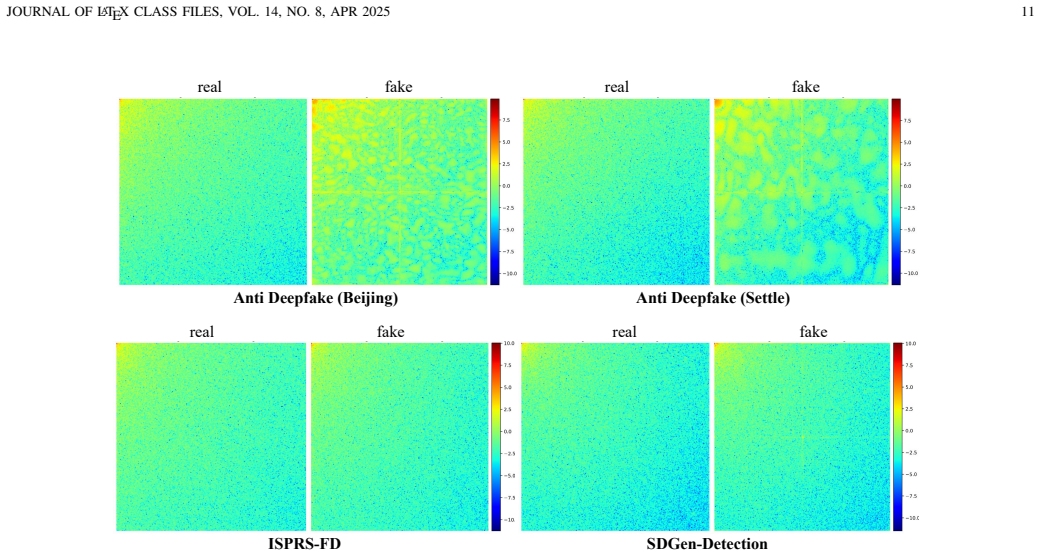
The central claim is that spatial and frequency features are genuinely complementary for detecting forged remote sensing imagery: the spatial branch captures object-level anomalies, while the frequency branch, built on a Fourier transform that discards low-frequency coefficients and learns separately on phase and amplitude spectra, captures spectral artifacts that are invisible to the eye. The fusion is done through domain projection units that map both branches into a shared subspace before summation, followed by a residual refinement block with channel and spatial attention. This design is meant to let the model focus on distinguishing regions rather than on generic objects such as roads or ships. Experiments support the claim with higher accuracy than spatial-only, frequency-only, and previously fused remote sensing detectors on ISPRS-FD, and with stable cross-city generalization on a GAN-based dataset and a stable-diffusion benchmark the authors constructed.
Load-bearing premise
The frequency branch assumes that the traces of forgery are always found in the fine details of an image, and that throwing away everything below a fixed cutoff in the frequency transform never removes the useful evidence.
Editorial extensions
If this is right
- A detector that combines both domains can train on mixed forgery types and keep balanced precision and recall, whereas the single-domain baselines in the paper over-predict the fake class and show large accuracy-versus-F1 gaps.
- Frequency-only features dominate on GAN-generated fakes, while attention-augmented spatial features dominate on stable-diffusion fakes, which is why the two branches are complementary in cross-generator tests.
- Self-supervised pretraining on remote sensing images helps more than supervised pretraining, and supervised semantic pretraining can even lower accuracy, suggesting the useful signal is image-level statistics rather than object semantics.
- Data augmentation that alters or blends image content, such as mixup, sharply reduces detection performance (31.55% F1 drop in the ablation), whereas random cropping helps, so augmentation must be chosen with spectral artifacts in mind.
- The newly constructed diffusion-based benchmark gives the community a test set with modern generative artifacts, alongside the existing GAN benchmark.
Reading between the lines
- The fixed high-pass cutoff in the frequency branch is the most exposed design choice: a generator trained to match real high-frequency spectra could push discriminative signal below $|i|,|j| = W_f/4, H_f/4$, so treating the cutoff as a tunable hyperparameter per generator is a direct testable extension.
- Because the claimed advantage is domain alignment rather than a remote-sensing-specific prior, the projection-plus-attention fusion could transfer to other forensic tasks where spatial and spectral cues diverge, such as face or document forgery detection.
- The pretraining comparisons imply a cheap practical rule for future benchmarks: start from self-supervised remote sensing weights rather than supervised natural-image weights, since the paper's numbers show the latter can reduce accuracy.
- Reporting GAN and diffusion results separately, as the paper does, will become more important as generative models improve, because averaged scores can hide which artifact family a detector actually handles.
Editorial analysis
A structured set of objections, weighed in public.
Referee Report
Summary. The paper proposes SFNet, a two-branch network for remote sensing image (RSI) forgery detection that extracts spatial features with a CNN and frequency features via FFT-based high-frequency extraction, then aligns and fuses these features through a domain mapping module and a CBAM-based mix-domain refinement module. The method is evaluated on ISPRS-FD, the Anti DeepFake dataset, and a self-constructed SDGen-Detection benchmark based on Stable Diffusion. The authors report state-of-the-art accuracy on ISPRS-FD (OA 81.82, F1 76.97) and claim a 4%–15.18% improvement over prior RS forgery detectors with robust cross-dataset generalization. Code is provided via GitHub.
Significance. If the reported gains are reliable, SFNet would be a useful contribution to RSI forgery detection, since it combines spatial and frequency cues in a comparatively simple architecture and the paper includes a new diffusion-based benchmark and ablation studies. The release of code is a concrete asset. However, the central empirical claim of universal superiority over state-of-the-art methods is not supported by the paper's own Table III, where SFNet is clearly worse than both Geo-DefakeHop and FreqNet on the Anti DeepFake generalization test. The significance thus depends on whether the claims are revised and whether the ISPRS-FD advantage is robust to split variability.
major comments (3)
- [Abstract and Table III] The abstract states that 'Experiments on three datasets show that SFNet achieves an accuracy improvement of 4%-15.18% over the state-of-the-art RS forgery detection methods and exhibits robust generalization capabilities.' This is directly contradicted by Table III on the Anti DeepFake cross-region test (training on Beijing, testing on Seattle): SFNet achieves OA 94.26/F1 94.01, while Geo-DefakeHop achieves 100/100 and FreqNet achieves 98.35/98.25. SFNet is therefore 4.09–5.74 accuracy points below two baselines on that dataset. The claimed improvement range only holds on ISPRS-FD (Table II) when compared with Conformer (4.13 OA) and Geo-DefakeHop (15.18 OA). The claim should be revised to name the specific comparison and dataset, or additional experiments are needed to support a general superiority claim.
- [Section IV.A.3 and Tables II–III] All experimental numbers come from a single random 50/50 train/test split, with no standard deviations, confidence intervals, or significance tests reported. The ISPRS-FD margin over Conformer is only 4.13 OA (81.82 vs. 77.69), which could plausibly change under split noise or different random seeds. Since the headline claim is a quantitative superiority over prior methods, the absence of any variance estimate weakens the evidence for the central result. Reporting results over multiple seeds and/or bootstrap intervals would be needed to establish the ranking.
- [Eq. (3) and Section V.C] The high-frequency extraction in the HFRI submodule uses a fixed cutoff: all Fourier coefficients with |i| < Wf/4 and |j| < Hf/4 are zeroed. This is a free parameter that determines how much low-frequency information is discarded. The sensitivity analysis in Section V.C varies a related scale parameter, but it is conducted only on ISPRS-FD; no cross-generator or cross-dataset analysis is provided. Given that the Introduction itself notes that diffusion models have 'significantly challenged the reliability' of frequency-domain priors, and that robust generalization across GAN and diffusion forgeries is a central claimed strength, the fixed cutoff's behavior on the SDGen-Detection and Anti DeepFake datasets should be tested.
minor comments (6)
- [Section IV.A.2] The definitions of TP, FN, and TN in the metrics paragraph are incorrect or incomplete: the text says 'The number of samples predicted to be true by the true image (TP)' and 'the number of samples predicted to be true by the fake image (TP)', which duplicates TP and omits a proper definition of TN/FP.
- [Abstract and Eq. (1)] Minor typos: 'This paper proposed' should be 'This paper proposes'; 'M axpooldenotes' should be 'MaxPool denotes'.
- [Section IV.C] The word 'caputure' appears in 'cannot fully caputure the anomalies'; it should be 'capture'.
- [Eqs. (10)–(11)] The phrase 'sigma activate function' should be 'sigmoid activation function'.
- [Section V.C] The sentence 'when the information filtering ratio exceeds 25% (scale <4), the detection performance decreases as the scale increases' is confusing, because scale <4 corresponds to filtering ratios above 25%, and the subsequent discussion of the relationship between scale and performance should be clarified with explicit axis labels for Figure 10.
- [Appendix A] The paper does not state whether the SDGen-Detection dataset will be made publicly available; given that the dataset is presented as a contribution to the community, this should be clarified.
Circularity Check
No significant circularity; the main results rest on external train/test evaluations and the self-citations are not load-bearing.
full rationale
I walked the derivation chain: SFNet's components (Eqs. 1-11) transform inputs through convolutions, FFT/iFFT, high-pass filtering, projection blocks, and CBAM attention. None of these equations incorporates the labels, evaluation metrics, or the reported test accuracies, so no output quantity is equivalent to an input by construction. The central ISPRS-FD result (Table II) is a standard 50/50 train/test split on an external dataset, with SFNet reaching 81.82 OA and 76.97 F1, and the generalization results (Table III) are held-out cross-region evaluations rather than fitted values. The only self-references are the authors' TOV-RS pretrained weights [66] in the pretraining ablation (Table IV) and the authors' own SDGen-Detection benchmark (Appendix A); that benchmark is an independent evaluation set, not a definition of SFNet, and the main reported SFNet result is the no-pretraining row (81.82 OA). There is no fitted parameter renamed as a prediction, no uniqueness theorem imported from prior author work, and no equation that reduces to the target claim. Any concern that the abstract's '4%-15.18%' improvement is overstated by Table III, where SFNet trails Geo-DefakeHop and FreqNet on Anti DeepFake, is an empirical-evidence or correctness issue, not circularity.
Assumptions & free parameters
free parameters (2)
- High-pass filter cutoff (Wf/4, Hf/4) =
|i| < Wf/4, |j| < Hf/4 zeroed (Eq. 3)
- SDGen-Detection generator and prompt =
Stable Diffusion 1.4 with Llava-1.6-34b prompts (Table VI)
assumptions (4)
- domain assumption Ground-truth labels for ISPRS-FD and Anti DeepFake are correct and the 50/50 random split is unbiased.
- domain assumption The high-pass filter in Eq. (3) isolates the frequency content most indicative of forgery.
- ad hoc to paper Fake images in SDGen-Detection are representative of diffusion-model forgeries beyond the specific generator and prompt used.
- standard math The FFT, iFFT, and convolution operations are numerically correct as implemented in the MMpretrain framework.
Cite this review
Pith. "Pith review of SFNet: Fusion of Spatial and Frequency-Domain Features for Remote Sensing Image Forgery Detection." pith.science (2026). https://pith.science/paper/AWCMKLLF
@misc{pith2026250620599,
  author       = {Pith},
  title        = {Pith review of: SFNet: Fusion of Spatial and Frequency-Domain Features for Remote Sensing Image Forgery Detection},
  year         = {2026},
  howpublished = {\url{https://pith.science/paper/AWCMKLLF}},
  note         = {Machine review of arXiv:2506.20599}
}
read the original abstract
The rapid advancement of generative artificial intelligence is producing fake remote sensing imagery (RSI) that is increasingly difficult to detect, potentially leading to erroneous intelligence, fake news, and even conspiracy theories. Existing forgery detection methods typically rely on single visual features to capture predefined artifacts, such as spatial-domain cues to detect forged objects like roads or buildings in RSI, or frequency-domain features to identify artifacts from up-sampling operations in adversarial generative networks (GANs). However, the nature of artifacts can significantly differ depending on geographic terrain, land cover types, or specific features within the RSI. Moreover, these complex artifacts evolve as generative models become more sophisticated. In short, over-reliance on a single visual cue makes existing forgery detectors struggle to generalize across diverse remote sensing data. This paper proposed a novel forgery detection framework called SFNet, designed to identify fake images in diverse remote sensing data by leveraging spatial and frequency domain features. Specifically, to obtain rich and comprehensive visual information, SFNet employs two independent feature extractors to capture spatial and frequency domain features from input RSIs. To fully utilize the complementary domain features, the domain feature mapping module and the hybrid domain feature refinement module(CBAM attention) of SFNet are designed to successively align and fuse the multi-domain features while suppressing redundant information. Experiments on three datasets show that SFNet achieves an accuracy improvement of 4%-15.18% over the state-of-the-art RS forgery detection methods and exhibits robust generalization capabilities. The code is available at https://github.com/GeoX-Lab/RSTI/tree/main/SFNet.
Figures


Figures from the paper (8 more)




Reference graph
Works this paper leans on
-
[1]
Art and the science of generative ai,
Z. Epstein, A. Hertzmann, the Investigators of Human Creativity, M. Akten, H. Farid, J. Fjeld, M. R. Frank, M. Groh, L. Herman, N. Leach, R. Mahari, A. S. Pentland, O. Russakovsky, H. Schroeder, and A. Smith, “Art and the science of generative ai,”Science, vol. 380, no. 6650, p. 1110–1111, 2023
work page 2023
-
[2]
Text-to-image diffusion models in generative ai: A survey,
C. Zhang, C. Zhang, M. Zhang, and I. S. Kweon, “Text-to-image diffusion models in generative ai: A survey,”arXiv preprint arXiv:2303.07909, 2023. JOURNAL OF LATEX CLASS FILES, VOL. 14, NO. 8, APR 2025 13 Llava-1.6-34b description Stable-diffusion-1.4 Fake Image Prompt*:describe scenes and objects Real Image Forgery Process Fig. 11: Fake image generation f...
arXiv 2023
-
[3]
A survey on generative diffusion models,
H. Cao, C. Tan, Z. Gao, Y . Xu, G. Chen, P.-A. Heng, and S. Z. Li, “A survey on generative diffusion models,”IEEE Transactions on Knowledge and Data Engineering, p. 1–20, 2024
work page 2024
-
[4]
OpenAI,Video generation models as world simulators, 2024
work page 2024
-
[5]
Deepfake: New era in the age of disinformation & end of reliable journalism,
E. Temir, “Deepfake: New era in the age of disinformation & end of reliable journalism,” vol. 13, no. 2, pp. 1009–1024, 2020
work page 2020
-
[6]
Deep fake geography? when geospatial data encounter artificial intelligence,
B. Zhao, S. Zhang, C. Xu, Y . Sun, and C. Deng, “Deep fake geography? when geospatial data encounter artificial intelligence,”Cartography and Geographic Information Science, vol. 48, no. 4, p. 338–352, 2021
work page 2021
-
[7]
Deepfake satellite imagery detection with multi-attention and super resolution,
U. A. ¸Cift¸ci and I. Demir, “Deepfake satellite imagery detection with multi-attention and super resolution,” inIGARSS 2023 - 2023 IEEE International Geoscience and Remote Sensing Symposium. IEEE, 2023, pp. 4871–4874
work page 2023
-
[8]
Bringing satellites down to earth: Six steps to more ethical remote sensing,
M. M. Bennett, C. J. Gleason, B. Tellman, L. F. Alvarez Leon, H. K. Friedrich, U. Ovienmhada, and A. J. Mathews, “Bringing satellites down to earth: Six steps to more ethical remote sensing,” vol. 2, p. 100003, 2024
work page 2024
Show all 74 references
-
[9]
Image fusion in remote sensing: An overview and meta analysis,
H. Albanwan, R. Qin, and Y . Tang, “Image fusion in remote sensing: An overview and meta analysis,”arXiv preprint arXiv:2401.08837, 2024
2024 arXiv
-
[10]
Satellite image forgery detection and localization using gan and one-class classifier,
S. K. Yarlagadda, D. Güera, P. Bestagini, F. M. Zhu, S. Tubaro, and E. J. Delp, “Satellite image forgery detection and localization using gan and one-class classifier,”arXiv preprint arXiv.1802.04881, 2018
2018 arXiv
-
[11]
On deep learning approach in remote sensing data forgery detection,
A. Kuznetsov, “On deep learning approach in remote sensing data forgery detection,” inProceedings of the International Conference on Information Technology and Nanotechnology (ITNT). Samara, Russia: IEEE, 2020, p. 1–4
2020
-
[12]
Spatial-spectral middle cross-attention fusion network for hyperspectral image superresolution,
X. Lang, T. Lu, Y . Zhang, J. Jiang, and Z. Xiong, “Spatial-spectral middle cross-attention fusion network for hyperspectral image superresolution,” Photogrammetric Engineering & Remote Sensing, vol. 90, no. 11, pp. 675–686, 2024
2024
-
[13]
Combined model color- correction method utilizing external low-frequency reference signals for large-scale optical satellite image mosaics,
H. Cui, G. Zhang, T.-Y . Wang, X. Li, and J. Qi, “Combined model color- correction method utilizing external low-frequency reference signals for large-scale optical satellite image mosaics,”IEEE Transactions on Geoscience and Remote Sensing, vol. 59, no. 6, p. 4993–5007, 2021
2021
-
[14]
Protecting world leaders against deep fakes,
S. Agarwal, H. Farid, Y . Gu, M. He, K. Nagano, and H. Li, “Protecting world leaders against deep fakes,”Proceedings of the IEEE Conference on Computer Vision and Pattern Recognition Workshops (CVPRW), vol. 1, p. 38, 2019
2019
-
[15]
Exposing deep fakes using inconsistent head poses,
X. Yang, Y . Li, and S. Lyu, “Exposing deep fakes using inconsistent head poses,” inProceedings of the IEEE International Conference on Acoustics, Speech and Signal Processing (ICASSP). Brighton, United Kingdom: IEEE, 2019, p. 8261–8265
2019
-
[16]
A review of deep learning- based approaches for deepfake content detection,
L. A. Passos, D. Jodas, K. A. P. Costa, L. A. Souza Júnior, D. Rodrigues, J. Del Ser, D. Camacho, and J. a. P. Papa, “A review of deep learning- based approaches for deepfake content detection,” vol. 41, no. 8, p. e13570, 2024
2024
-
[17]
Deep feature extraction for face liveness detection,
A. Sengur, Z. Akhtar, Y . Akbulut, S. Ekici, and U. Budak, “Deep feature extraction for face liveness detection,” inProceedings of the International Conference on Artificial Intelligence and Data Processing (IDAP). Malatya, Turkey: IEEE, 2018, p. 1–4
2018
-
[18]
Fake faces identification via convolutional neural network,
H. Mo, B. Chen, and W. Luo, “Fake faces identification via convolutional neural network,” inProceedings of the 6th ACM Workshop on Information Hiding and Multimedia Security. ACM, 2018, pp. 43–47
2018
-
[19]
Exposing deepfake videos by detecting face warping artifacts,
Y . Li and S. Lyu, “Exposing deepfake videos by detecting face warping artifacts,” inProceedings of the IEEE Conference on Computer Vision and Pattern Recognition Workshops (CVPRW), 2019
2019
-
[20]
Investigation of comparison on modified cnn techniques to classify fake face in deepfake videos,
A. G. S and N. Thillaiarasu, “Investigation of comparison on modified cnn techniques to classify fake face in deepfake videos,” inProceedings of the International Conference on Advanced Computing and Communication Systems (ICACCS). Coimbatore, India: IEEE, 2022, p. 702–707
2022
-
[21]
Generalizing face forgery detection with high-frequency features,
L. Yuchen, Z. Yong, Y . Junchi, and L. Wei, “Generalizing face forgery detection with high-frequency features,” inProceedings of the IEEE Conference on Computer Vision and Pattern Recognition (CVPR), 2021, p. 16317–16326
2021
-
[22]
Progressive growing of gans for improved quality, stability, and variation,
T. Karras, T. Aila, S. Laine, and J. Lehtinen, “Progressive growing of gans for improved quality, stability, and variation,” inProceedings of the International Conference on Learning Representations (ICLR), 2018, pp. 1–12
2018
-
[23]
A style-based generator architecture for generative adversarial networks,
T. Karras, S. Laine, and T. Aila, “A style-based generator architecture for generative adversarial networks,” inProceedings of the IEEE Conference on Computer Vision and Pattern Recognition (CVPR). Long Beach, CA, USA: IEEE, 2019, p. 4396–4405
2019
-
[24]
Face2face: Real-time face capture and reenactment of rgb videos,
J. Thies, M. Zollhofer, M. Stamminger, C. Theobalt, and M. Niessner, “Face2face: Real-time face capture and reenactment of rgb videos,” in Proceedings of the IEEE Conference on Computer Vision and Pattern Recognition (CVPR). Las Vegas, NV: IEEE, 2016, p. 2387–2395
2016
-
[25]
Deepfacelab: Integrated, flexible and extensible face- swapping framework,
I. Perov, D. Gao, N. Chervoniy, K. Liu, S. Marangonda, C. Umé, M. Dpfks, C. S. Facenheim, L. RP, J. Jiang, S. Zhang, P. Wu, B. Zhou, and W. Zhang, “Deepfacelab: Integrated, flexible and extensible face- swapping framework,”arXiv preprint arXiv:2005.05535, 2021
2005 arXiv
-
[26]
Thinking in frequency: Face forgery detection by mining frequency-aware clues,
Y . Qian, G. Yin, L. Sheng, Z. Chen, and J. Shao, “Thinking in frequency: Face forgery detection by mining frequency-aware clues,” inProceedings of the European Conference on Computer Vision (ECCV). Cham: Springer International Publishing, 2020, p. 86–103
2020
-
[27]
Fcanet: Frequency channel attention networks,
Z. Qin, P. Zhang, F. Wu, and X. Li, “Fcanet: Frequency channel attention networks,” inProceedings of the IEEE International Conference on Computer Vision (ICCV). Montreal, QC, Canada: IEEE, 2021, p. 763–772
2021
-
[28]
Frequency-aware deepfake detection: Improving generalizability through frequency space domain learning,
C. Tan, Y . Zhao, S. Wei, G. Gu, P. Liu, and Y . Wei, “Frequency-aware deepfake detection: Improving generalizability through frequency space domain learning,” inProceedings of the AAAI Conference on Artificial Intelligence, vol. 38, no. 5, 2024, p. 5052–5060
2024
-
[29]
Frequency-aware attentional feature fusion for deepfake detection,
C. Tian, Z. Luo, G. Shi, and S. Li, “Frequency-aware attentional feature fusion for deepfake detection,” inProceedings of the IEEE International Conference on Acoustics, Speech and Signal Processing (ICASSP), 2023, p. 1–5
2023
-
[30]
Denoising diffusion probabilistic models,
J. Ho, A. Jain, and P. Abbeel, “Denoising diffusion probabilistic models,” inProceedings of the Advances in Neural Information Processing Systems (NIPS). Red Hook, NY , USA: Curran Associates Inc., 2020, p. 6840–6851
2020
-
[31]
Zero-shot text-to-image generation,
A. Ramesh, M. Pavlov, G. Goh, S. Gray, C. V oss, A. Radford, M. Chen, and I. Sutskever, “Zero-shot text-to-image generation,” inProceedings of the International Conference on Machine Learning (ICML). PMLR, 2021, p. 8821–8831
2021
-
[32]
High- resolution image synthesis with latent diffusion models,
R. Rombach, A. Blattmann, D. Lorenz, P. Esser, and B. Ommer, “High- resolution image synthesis with latent diffusion models,” inProceedings of the IEEE Conference on Computer Vision and Pattern Recognition (CVPR). New Orleans, LA, USA: IEEE, 2022, p. 10674–10685
2022
-
[33]
Grad-cam: Visual explanations from deep networks via gradient-based localization,
R. R. Selvaraju, M. Cogswell, A. Das, R. Vedantam, D. Parikh, and D. Batra, “Grad-cam: Visual explanations from deep networks via gradient-based localization,”International Journal of Computer Vision, vol. 128, no. 2, p. 336–359, 2020. JOURNAL OF LATEX CLASS FILES, VOL. 14, NO...
2020
-
[34]
Visualizing data using t-sne
L. Van der Maaten and G. Hinton, “Visualizing data using t-sne.”Journal of machine learning research, vol. 9, no. 11, 2008
2008
-
[35]
Imagenet classification with deep convolutional neural networks,
A. Krizhevsky, I. Sutskever, and G. E. Hinton, “Imagenet classification with deep convolutional neural networks,”Communications of the ACM, vol. 60, no. 6, p. 84–90, 2012
2012
-
[36]
Very deep convolutional networks for large-scale image recognition,
K. Simonyan and A. Zisserman, “Very deep convolutional networks for large-scale image recognition,” inProceedings of the International Conference on Learning Representations (ICLR), 2014, p. 1–14
2014
-
[37]
Fake face detection methods: Can they be generalized?
A. Khodabakhsh, R. Ramachandra, K. Raja, P. Wasnik, and C. Busch, “Fake face detection methods: Can they be generalized?” in2018 International Conference of the Biometrics Special Interest Group (BIOSIG). Darmstadt: IEEE, 2018, p. 1–6
2018
-
[38]
What makes fake images detectable? Understanding properties that generalize,
L. Chai, D. Bau, S.-N. Lim, and P. Isola, “What makes fake images detectable? Understanding properties that generalize,” inProceedings of the European Conference on Computer Vision (ECCV), vol. 12371. Springer International Publishing, 2020, pp. 103–120
2020
-
[39]
Xception: Deep learning with depthwise separable convolu- tions,
F. Chollet, “Xception: Deep learning with depthwise separable convolu- tions,” inProceedings of the IEEE Conference on Computer Vision and Pattern Recognition (CVPR). Honolulu, HI: IEEE, 2017, p. 1800–1807
2017
-
[40]
Aggregated residual transformations for deep neural networks,
S. Xie, R. Girshick, P. Dollar, Z. Tu, and K. He, “Aggregated residual transformations for deep neural networks,” inProceedings of the IEEE Conference on Computer Vision and Pattern Recognition (CVPR). Honolulu, HI: IEEE, 2017, p. 5987–5995
2017
-
[41]
Deepfake video detection using convolutional vision transformer,
D. Wodajo and S. Atnafu, “Deepfake video detection using convolutional vision transformer,”arXiv preprint arXiv:2102.11126, 2021
2021 arXiv
-
[42]
Watch your up-convolution: Cnn based generative deep neural networks are failing to reproduce spectral distributions,
R. Durall, M. Keuper, and J. Keuper, “Watch your up-convolution: Cnn based generative deep neural networks are failing to reproduce spectral distributions,” inProceedings of the IEEE Conference on Computer Vision and Pattern Recognition (CVPR). IEEE, 2020-06, pp. 7887–7896
2020
-
[43]
Generative ai in vision: A survey on models, metrics and applications,
G. Raut and A. Singh, “Generative ai in vision: A survey on models, metrics and applications,”arXiv preprint arXiv:2402.16369, 2024
2024 arXiv
-
[44]
Robustness of copy-move forgery detection under high jpeg compression artifacts,
D.-Y . Huang, C.-N. Huang, W.-C. Hu, and C.-H. Chou, “Robustness of copy-move forgery detection under high jpeg compression artifacts,” vol. 76, no. 1, pp. 1509–1530, 2017-01
2017
-
[45]
Detecting and simulating artifacts in gan fake images,
X. Zhang, S. Karaman, and S.-F. Chang, “Detecting and simulating artifacts in gan fake images,” inProceedings of the IEEE International Workshop on Information Forensics and Security (WIFS). IEEE, 2019-12, pp. 1–6
2019
-
[46]
Leveraging frequency analysis for deep fake image recognition,
J. Frank, T. Eisenhofer, L. Schönherr, A. Fischer, D. Kolossa, and T. Holz, “Leveraging frequency analysis for deep fake image recognition,” inProceedings of the International Conference on Machine Learning (ICML), vol. 119. JMLR.org, 2020, p. 3247–3258
2020
-
[47]
A. K. Jain,Fundamentals of Digital Image Processing. Prentice-Hall, Inc., 1989
1989
-
[48]
Bihpf: Bilateral high-pass filters for robust deepfake detection,
Y . Jeong, D. Kim, S. Min, S. Joe, Y . Gwon, and J. Choi, “Bihpf: Bilateral high-pass filters for robust deepfake detection,” inProceedings of the IEEE Winter Conference on Applications of Computer Vision (WACV). Waikoloa, HI, USA: IEEE, 2022, p. 2878–2887
2022
-
[49]
Inconsistency-aware wavelet dual-branch network for face forgery detection,
G. Jia, M. Zheng, C. Hu, X. Ma, Y . Xu, L. Liu, Y . Deng, and R. He, “Inconsistency-aware wavelet dual-branch network for face forgery detection,” vol. 3, no. 3, pp. 308–319, 2021
2021
-
[50]
Frequency spectrum with multi-head attention for face forgery detection,
P. Singhal, S. Raj, J. Mathew, and A. Mondal, “Frequency spectrum with multi-head attention for face forgery detection,” inNeural Information Processing, M. Tanveer, S. Agarwal, S. Ozawa, A. Ekbal, and A. Jatowt, Eds. Springer Nature, 2023, pp. 200–211
2023
-
[51]
Add: Frequency attention and multi-view based knowledge distillation to detect low-quality compressed deepfake images,
L. M. Binh and S. Woo, “Add: Frequency attention and multi-view based knowledge distillation to detect low-quality compressed deepfake images,” Proceedings of the AAAI Conference on Artificial Intelligence, vol. 36, no. 11, p. 122–130, 2022
2022
-
[52]
Frepgan: Robust deepfake detection using frequency-level perturbations,
Y . Jeong, D. Kim, Y . Ro, and J. Choi, “Frepgan: Robust deepfake detection using frequency-level perturbations,” inProceedings of the AAAI Conference on Artificial Intelligence, vol. 36, 2022, p. 1060–1068
2022
-
[53]
Spatial-phase shallow learning: Rethinking face forgery detection in frequency domain,
H. Liu, X. Li, W. Zhou, Y . Chen, Y . He, H. Xue, W. Zhang, and N. Yu, “Spatial-phase shallow learning: Rethinking face forgery detection in frequency domain,” inProceedings of the IEEE Conference on Computer Vision and Pattern Recognition (CVPR). Nashville, TN, USA: IEEE, 202...
2021
-
[54]
Local relation learning for face forgery detection,
S. Chen, T. Yao, Y . Chen, S. Ding, J. Li, and R. Ji, “Local relation learning for face forgery detection,” inProceedings of the AAAI Conference on Artificial Intelligence, vol. 35, no. 2, 2021, p. 1081–1088
2021
-
[55]
Joint learning of frequency and spatial domains for dense image prediction,
S. Jia and W. Yao, “Joint learning of frequency and spatial domains for dense image prediction,”ISPRS Journal of Photogrammetry and Remote Sensing, vol. 195, p. 14–28, 2023
2023
-
[56]
Remote sensing image forgery detection using modified u-net,
H. Patil, S. Chaudhari, and V . Narawade, “Remote sensing image forgery detection using modified u-net,” inProceedings of the Asian Association on Remote Sensing, 2022
2022
-
[57]
Geo-defakehop: High-performance geographic fake image detection,
H.-S. Chen, K. Zhang, S. Hu, S. You, and C.-C. J. Kuo, “Geo-defakehop: High-performance geographic fake image detection,”arXiv preprint arXiv.2110.09795, 2021
2021 arXiv
-
[58]
Deep residual learning for image recognition,
K. He, X. Zhang, S. Ren, and J. Sun, “Deep residual learning for image recognition,” inProceedings of the IEEE conference on computer vision and pattern recognition, 2016, pp. 770–778
2016
-
[59]
Cbam: Convolutional block attention module,
S. Woo, J. Park, J.-Y . Lee, and I. S. Kweon, “Cbam: Convolutional block attention module,” inProceedings of the European Conference on Computer Vision (ECCV), vol. 11211, 2018, p. 3–19
2018
-
[60]
An image is worth 16x16 words: Transformers for image recognition at scale,
A. Dosovitskiy, L. Beyer, A. Kolesnikov, D. Weissenborn, X. Zhai, T. Unterthiner, M. Dehghani, M. Minderer, G. Heigold, S. Gelly, J. Uszkoreit, and N. Houlsby, “An image is worth 16x16 words: Transformers for image recognition at scale,” inProceedings of the International Conf...
2021
-
[61]
Rethinking the inception architecture for computer vision,
C. Szegedy, V . Vanhoucke, S. Ioffe, J. Shlens, and Z. Wojna, “Rethinking the inception architecture for computer vision,” inProceedings of the IEEE Conference on Computer Vision and Pattern Recognition (CVPR). Las Vegas, NV , USA: IEEE, 2016, p. 2818–2826
2016
-
[62]
Conformer: Local features coupling global representations for visual recognition,
Z. Peng, W. Huang, S. Gu, L. Xie, Y . Wang, J. Jiao, and Q. Ye, “Conformer: Local features coupling global representations for visual recognition,” inProceedings of the IEEE International Conference on Computer Vision (ICCV). Montreal, QC, Canada: IEEE, 2021, p. 357–366
2021
-
[63]
Imagenet: A large-scale hierarchical image database,
J. Deng, W. Dong, R. Socher, L.-J. Li, K. Li, and L. Fei-Fei, “Imagenet: A large-scale hierarchical image database,” in2009 IEEE Conference on Computer Vision and Pattern Recognition, 2009, p. 248–255
2009
-
[64]
A simple framework for contrastive learning of visual representations,
T. Chen, S. Kornblith, M. Norouzi, and G. Hinton, “A simple framework for contrastive learning of visual representations,” inProceedings of the International Conference on Machine Learning (ICML), vol. 119. PMLR, 2020, p. 1597–1607
2020
-
[65]
An empirical study of remote sensing pretraining,
D. Wang, J. Zhang, B. Du, G.-S. Xia, and D. Tao, “An empirical study of remote sensing pretraining,”IEEE Transactions on Geoscience and Remote Sensing, p. 1–1, 2022
2022
-
[66]
Tov: The original vision model for optical remote sensing image understanding via self- supervised learning,
C. Tao, J. Qi, G. Zhang, Q. Zhu, W. Lu, and H. Li, “Tov: The original vision model for optical remote sensing image understanding via self- supervised learning,”IEEE Journal of Selected Topics in Applied Earth Observations and Remote Sensing, vol. 16, p. 4916–4930, 2023
2023
-
[67]
Bam: Bottleneck attention module,
J. Park, “Bam: Bottleneck attention module,”arXiv preprint arXiv:1807.06514, 2018
2018 arXiv
-
[68]
Squeeze-and-excitation networks,
J. Hu, L. Shen, and G. Sun, “Squeeze-and-excitation networks,” in Proceedings of the IEEE conference on computer vision and pattern recognition, 2018, pp. 7132–7141
2018
-
[69]
Eca-net: Efficient channel attention for deep convolutional neural networks,
Q. Wang, B. Wu, P. Zhu, P. Li, W. Zuo, and Q. Hu, “Eca-net: Efficient channel attention for deep convolutional neural networks,” inProceedings of the IEEE/CVF conference on computer vision and pattern recognition, 2020, pp. 11 534–11 542
2020
-
[70]
The isprs benchmark on urban object classification and 3d building reconstruction,
F. Rottensteiner, G. Sohn, J. Jung, M. Gerke, C. Baillard, S. Benitez, and U. Breitkopf, “The isprs benchmark on urban object classification and 3d building reconstruction,”ISPRS Annals of the Photogrammetry, Remote Sensing and Spatial Information Sciences, vol. I–3, no. 1, p....
2012
-
[71]
Visual instruction tuning,
H. Liu, C. Li, Q. Wu, and Y . J. Lee, “Visual instruction tuning,” in Proceedings of the Advances in Neural Information Processing Systems (NIPS), vol. 36. Curran Associates, Inc., 2023, p. 34892–34916
2023
-
[72]
From text to pixel: Advancing long-context understanding in mllms,
Y . Lu, X. Li, T.-J. Fu, M. Eckstein, and W. Y . Wang, “From text to pixel: Advancing long-context understanding in mllms,”arXiv preprint arXiv.2405.14213, 2024. Ji Qireceived a B.S. degree in remote sensing science and technology from Central South Univer- sity, Changsha, Chi...
2024 arXiv
-
[2021]
His research interests include ecological remote sensing, deep learning for extracting remote Sensing information, vegetation phenology and ice phenology
He is currently a Lecturer with the School of Geography and Remote Sensing, Guangzhou University, Guangzhou, China. His research interests include ecological remote sensing, deep learning for extracting remote Sensing information, vegetation phenology and ice phenology. His re...
2022
-
[2024]
His research interests include computer vision, continual learning, and remote sensing image processing
He is currently a postdoctoral with the School of Geography and Remote Sensing, Guangzhou University, Guangzhou, China. His research interests include computer vision, continual learning, and remote sensing image processing. JOURNAL OF LATEX CLASS FILES, VOL. 14, NO. 8, APR 20...
2025
Reviewed August 6, 2026 · model on record in the stance chip above.
Discussion (0). Continue with ORCID to comment.