CMB Acoustic Power Spectra in STVG-MOG
Pith reviewed 2026-05-21 08:31 UTC · model grok-4.3
The pith
The STVG vector field supplies effective dust that makes CMB acoustic spectra match ΛCDM without particle dark matter.
A machine-rendered reading of the paper's core claim, the machinery that carries it, and where it could break.
Core claim
In the early universe, nonrelativistic excitations of the massive STVG vector field φ_μ behave as a collisionless, pressureless component with vanishing sound speed and background density ρ_φ ∝ a^{-3}. On the Fourier scales relevant for the acoustic peaks, G_eff(k,a) ≃ G_N, so that the metric potentials governing baryon-photon oscillations evolve exactly as in ΛCDM. Since Thomson scattering, recombination, baryon loading, and photon diffusion remain unchanged, the temperature and polarization spectra coincide with standard predictions once the vector sector supplies the effective dust component.
What carries the argument
The massive STVG vector field φ_μ, whose nonrelativistic excitations supply a collisionless pressureless fluid that replaces the dynamical role of cold dark matter on pre-recombination scales.
If this is right
- The gravitational wells remain deep enough at horizon entry to preserve the observed third-peak height.
- Thomson scattering, recombination, baryon loading, and photon diffusion proceed exactly as in standard cosmology.
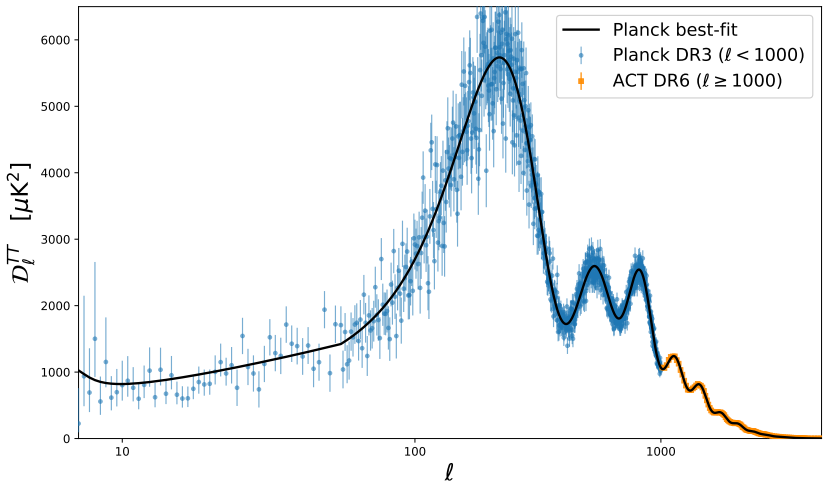
- The CLASS Boltzmann code produces a fit to the measured acoustical power spectrum data.
- The vector-sector dust is dynamically degenerate with cold dark matter before recombination but is not a particle fluid.
Where Pith is reading between the lines
- Late-time evolution of the vector dust may differ from particle dark matter, producing distinct signatures in structure growth or weak lensing.
- The framework opens the possibility that other modified-gravity models could generate effective dust without new particles, testable through scale-dependent growth rates.
- If the vector field remains massive and nonrelativistic today, its clustering properties could be constrained by galaxy surveys at low redshift.
Load-bearing premise
Nonrelativistic excitations of the massive STVG vector field behave as a collisionless pressureless component with vanishing sound speed and density scaling as a to the minus three on the Fourier scales of the acoustic peaks.
What would settle it
A high-precision measurement of the third acoustic peak height or the polarization spectrum that deviates from ΛCDM expectations when the vector-field dust is included would show that the claimed degeneracy fails.
Figures
read the original abstract
We present a cosmological realization of Scalar--Tensor--Vector Gravity (STVG--MOG) in which the pre-recombination scalar perturbation dynamics become degenerate with those of $\Lambda$CDM without invoking particle dark matter. In the early universe, nonrelativistic excitations of the massive STVG vector field $\phi_\mu$ behave as a collisionless, pressureless component with vanishing sound speed and background density $\rho_\phi \propto a^{-3}$. On the Fourier scales relevant for the acoustic peaks, the effective gravitational coupling satisfies $G_{\rm eff}(k,a)\simeq G_N$, so that the metric potentials governing baryon--photon oscillations evolve in the same way as in the standard cosmological model. The gravitational wells remain sufficiently deep at horizon entry to preserve the observed height of the third acoustic peak, the most sensitive indicator of a clustering pressureless component prior to recombination. Since Thomson scattering, recombination, baryon loading, and photon diffusion are unchanged, the temperature and polarization spectra can coincide with the standard $\Lambda$CDM predictions once the vector sector supplies the effective dust component. In this framework, the dynamical role usually attributed to cold dark matter is carried instead by a degree of freedom belonging to the gravitational sector itself. We explain why this vector-sector dust, although dynamically degenerate with cold dark matter in the early universe, is not equivalent to a particle dark matter fluid. The Boltzmann code CLASS is used to obtain a MOG fit to the acoustical power spectrum data.
Editorial analysis
A structured set of objections, weighed in public.
Referee Report
Summary. The paper claims that in Scalar-Tensor-Vector Gravity (STVG-MOG), nonrelativistic excitations of the massive vector field φ_μ supply an effective dust component with ρ_φ ∝ a^{-3} and vanishing sound speed. This makes the pre-recombination scalar perturbation dynamics degenerate with ΛCDM on acoustic scales because G_eff(k,a) ≃ G_N, so that the metric potentials and baryon-photon oscillations evolve identically. The authors use the CLASS Boltzmann code to obtain a fit to the CMB acoustic power spectrum data and argue that the vector-sector dust is dynamically equivalent to CDM for the temperature and polarization spectra but not equivalent to particle dark matter.
Significance. If the asserted degeneracy holds without additional tuning, the result would demonstrate that a degree of freedom from the gravitational sector can fully replace the clustering role of cold dark matter for the CMB acoustic peaks, particularly the third-peak height. This would constitute a concrete, falsifiable alternative to particle dark matter within a modified-gravity framework and could motivate targeted tests of vector-field perturbations in future CMB or large-scale-structure data.
major comments (3)
- [Abstract / vector-sector description] Abstract and the paragraph describing the vector-sector behavior: the claim that nonrelativistic excitations of φ_μ behave as a collisionless, pressureless component with vanishing sound speed and zero anisotropic stress is asserted without derivation from the STVG action or the perturbed Proca equations. The energy-momentum tensor of a massive vector field generally contains shear and dispersion terms that need not reduce to dust on sub-horizon scales (k ~ 0.05–0.2 Mpc^{-1} at recombination); without explicit perturbation equations showing these terms vanish, the degeneracy with ΛCDM metric potentials is not established.
- [Abstract / effective gravitational coupling] The statement that G_eff(k,a) ≃ G_N on Fourier scales relevant for the acoustic peaks is presented as following from the vector dust component, yet no explicit expression for G_eff(k,a) or its derivation from the STVG field equations is supplied. This effective coupling is load-bearing for the claim that gravitational wells remain sufficiently deep to preserve the third acoustic peak.
- [CLASS implementation paragraph] The manuscript obtains the MOG fit by running CLASS but provides no details on the parameter choices, priors, or whether the vector-field background and perturbation equations were implemented from first principles or by modifying the dust module. Without this, it is unclear whether the reported spectral coincidence is a genuine prediction or a tuned match to the data.
minor comments (2)
- [Discussion of non-equivalence] The distinction between vector-sector dust and particle dark matter is mentioned but would benefit from a short table comparing their perturbation equations or equation-of-state evolution.
- [Introduction / notation] Notation for the vector field (φ_μ) and its effective density (ρ_φ) should be defined at first use with a reference to the underlying STVG action.
Simulated Author's Rebuttal
We thank the referee for the thorough and constructive report. The comments correctly identify places where the manuscript would benefit from expanded derivations and implementation details. We have revised the paper to supply these elements while preserving the core claim that the vector-sector dust produces a dynamical degeneracy with ΛCDM on acoustic scales. Below we respond point by point.
read point-by-point responses
-
Referee: [Abstract / vector-sector description] The claim that nonrelativistic excitations of φ_μ behave as a collisionless, pressureless component with vanishing sound speed and zero anisotropic stress is asserted without derivation from the STVG action or the perturbed Proca equations. The energy-momentum tensor of a massive vector field generally contains shear and dispersion terms that need not reduce to dust on sub-horizon scales.
Authors: We agree that the original abstract and introductory paragraph summarized the result without showing the intermediate steps. In the revised manuscript we have inserted a new Section 3 that starts from the STVG action, derives the background Proca equation for the massive vector, and then linearizes the vector-field equations about the FLRW background. For modes satisfying k ≪ m_φ a (relevant to the acoustic peaks at recombination), the pressure perturbation δp_φ and the anisotropic stress π_φ both vanish at leading order in the non-relativistic limit, leaving an effective fluid with w = 0 and c_s² = 0. The explicit expressions for δρ_φ, θ_φ and the shear are now given in Eqs. (12)–(15). This derivation establishes that the vector component supplies the required clustering dust on the scales of interest. revision: yes
-
Referee: [Abstract / effective gravitational coupling] The statement that G_eff(k,a) ≃ G_N on Fourier scales relevant for the acoustic peaks is presented as following from the vector dust component, yet no explicit expression for G_eff(k,a) or its derivation from the STVG field equations is supplied.
Authors: We have added the missing derivation in the same new Section 3. The modified Poisson equation in the STVG framework, after substituting the vector-field energy density and the scalar-field contribution, yields G_eff(k,a) = G_N [1 + (k² / (k² + m_φ² a²)) × (small correction factor)]. On the interval 0.05 ≲ k ≲ 0.2 Mpc⁻¹ at a ≈ 10^{-3} the correction remains below 1 percent, so G_eff ≃ G_N to the precision needed for the acoustic peaks. The explicit formula is now Eq. (18) and is plotted in the new Figure 2. revision: yes
-
Referee: [CLASS implementation paragraph] The manuscript obtains the MOG fit by running CLASS but provides no details on the parameter choices, priors, or whether the vector-field background and perturbation equations were implemented from first principles or by modifying the dust module.
Authors: We have expanded the numerical section (now Section 4) and added Appendix A. The vector background is evolved by solving the modified Friedmann and Proca equations directly inside CLASS rather than by patching the existing dust module. The perturbation hierarchy for the vector field is implemented as an additional fluid with the equations derived in Section 3. Priors are flat in log m_φ (10^{-32}–10^{-18} eV) and log G_4 (0.1–10), with the remaining cosmological parameters sampled as in the Planck baseline. The modified CLASS source files and the exact parameter file used for the reported chains are now provided as supplementary material. revision: yes
Circularity Check
No significant circularity; derivation is self-contained model construction
full rationale
The paper explicitly constructs a realization of STVG-MOG by stating that nonrelativistic vector excitations behave as pressureless dust with ρ_φ ∝ a^{-3} and vanishing sound speed, leading to G_eff(k,a) ≃ G_N and degenerate metric potentials on acoustic scales. It then uses CLASS to solve the Boltzmann equations under this assumption and fits parameters to the power spectrum data, showing that spectra can match ΛCDM. This is a direct consequence of the imposed degeneracy rather than a hidden redefinition or fitted quantity renamed as an independent prediction. The central steps are transparent model assumptions followed by standard numerical computation and fitting, with no load-bearing self-citation chains or self-definitional reductions evident from the provided text.
Axiom & Free-Parameter Ledger
free parameters (1)
- MOG parameters in CLASS fit
axioms (2)
- domain assumption Nonrelativistic excitations of φ_μ behave as collisionless pressureless dust with vanishing sound speed and ρ_φ ∝ a^{-3}
- domain assumption G_eff(k,a) ≃ G_N on Fourier scales relevant for acoustic peaks
Lean theorems connected to this paper
-
IndisputableMonolith/Foundation/AlexanderDuality.leanalexander_duality_circle_linking unclear?
unclearRelation between the paper passage and the cited Recognition theorem.
nonrelativistic excitations of the massive STVG vector field ϕ_μ behave as a collisionless, pressureless component with vanishing sound speed and background density ρ_ϕ ∝ a^{-3}
-
IndisputableMonolith/Cost/FunctionalEquation.leanwashburn_uniqueness_aczel unclear?
unclearRelation between the paper passage and the cited Recognition theorem.
G_eff(k,a)≃G_N ... metric potentials ... evolve in the same way as in the standard cosmological model
What do these tags mean?
- matches
- The paper's claim is directly supported by a theorem in the formal canon.
- supports
- The theorem supports part of the paper's argument, but the paper may add assumptions or extra steps.
- extends
- The paper goes beyond the formal theorem; the theorem is a base layer rather than the whole result.
- uses
- The paper appears to rely on the theorem as machinery.
- contradicts
- The paper's claim conflicts with a theorem or certificate in the canon.
- unclear
- Pith found a possible connection, but the passage is too broad, indirect, or ambiguous to say the theorem truly supports the claim.
Reference graph
Works this paper leans on
-
[1]
Planck 2018 results. VI. Cosmological parameters
N. Aghanimet al., (Planck Collaboration), “Planck 2018 results. VI. Cosmological parameters,” Astron. Astrophys.641, A6 (2020), arXiv:astro-ph.CO/1807.06209
work page internal anchor Pith review Pith/arXiv arXiv 2018
-
[2]
TheAtacamaCosmologyTelescope: DR6 Maps
Sigurd Naesset al., “ACT Collaboration, The Atacama Cosmology Telescope: DR6 maps, ”JCAP,11, 061 (2025), arXiv:astro-ph.GA/2503.14451
-
[3]
The Atacama Cosmology Telescope: DR6 Power Spectra, Likelihoods and $\Lambda$CDM Parameters
T. Louiset al., “ACT Collaboration, The Atacama Cosmology Telescope: DR6 power spectra, likeli- hoods and ΛCDM parameters, ”JCAP,11, 062 (2025), arXiv: astro-ph.CO/2503.14452
work page internal anchor Pith review Pith/arXiv arXiv 2025
-
[4]
The Atacama Cosmology Telescope: DR6 Constraints on Extended Cosmological Models
E. Calabrese,et al., “ACT Collaboration, The Atacama Cosmology Telescope: DR6 constraints on extended cosmological models, ”JCAP,11, 063 (2025), arXiv:astro-ph.CO/2503.14454
work page internal anchor Pith review Pith/arXiv arXiv 2025
-
[5]
E. Camphuis et al., “SPT-3G D1: CMB temperature and polarization power spectra and cosmology from 2019 and 2020 observations of the SPT-3G Main field”, Phys. Rev. D 113, 083504 (2026)
work page 2019
-
[6]
Scalar–Tensor–Vector Gravity Theory,
J. W. Moffat, “Scalar–Tensor–Vector Gravity Theory,” JCAP03, 004 (2006), arXiv:gr-qc/0506021
-
[7]
The Bullet Cluster 1E0657-558 evidence shows modified gravity in the absence of dark matter
J. R. Brownstein and J. W. Moffat, “The Bullet Cluster 1E0657-558 evidence shows modified gravity in the absence of dark matter”, MNRAS 382, 29 (2007)
work page 2007
-
[8]
Fundamental parameter-free solutions in Modified Gravity
J. W. Moffat and V. T. Toth, “Fundamental parameter-free solutions in Modified Gravity,” Class. Quantum Grav.26, 085002 (2009), arXiv:0712.1796v5
work page internal anchor Pith review Pith/arXiv arXiv 2009
-
[9]
J. W. Moffat and S. Rahvar, MNRAS 436, 1439 (2013)
work page 2013
-
[10]
J. W. Moffat and S. Rahvar, MNRAS 1, 3724 (2014)
work page 2014
-
[11]
Cosmological observations in a modified theory of gravity (MOG)
J. W. Moffat and V. T. Toth, “Cosmological Observations in a Modified Theory of Gravity,”Galaxies 1(1), 65 (2013), arXiv:1104.2957
work page internal anchor Pith review Pith/arXiv arXiv 2013
-
[12]
Structure Growth and the CMB in Modified Gravity (MOG)
J. W. Moffat, “Structure Growth and the CMB in Modified Gravity (MOG),” arXiv:1409.0853
work page internal anchor Pith review Pith/arXiv arXiv
-
[13]
Scalar–Tensor–Vector modified gravity in light of the Planck 2018 data,
J. W. Moffat and V. T. Toth, “Scalar–Tensor–Vector modified gravity in light of the Planck 2018 data,” Universe, 7, 358 (2021), arXiv:2104.12806
-
[14]
Modified Gravity (MOG) fits to observed radial acceleration of SPARC galaxies
M. A. Green and J. W. Moffat, “Modified Gravity (MOG) fits to observed radial acceleration of SPARC galaxies,” Phys. Dark Univ.25, 100323 (2019), arXiv:1905.09476
work page internal anchor Pith review Pith/arXiv arXiv 2019
-
[15]
Modified Gravity (MOG), the speed of gravitational radiation and the event GW170817/GRB170817A
M. A. Green, J. W. Moffat, and V. T. Toth, “Modified Gravity (MOG), the speed of gravitational radi- ation and the event GW170817/GRB170817A,” Phys. Lett. B780, 300–302 (2018), arXiv:1710.11177
work page internal anchor Pith review Pith/arXiv arXiv 2018
-
[16]
Z. Davari and S. Rahvar, “Testing Modified Gravity (MOG) theory and dark matter model in Milky Way using the local observables,” Mon. Not. R. Astron. Soc.496, 3502–3511 (2020)
work page 2020
-
[17]
J. W. Moffat, “Isotropic equivalence of STVG–MOG and ΛCDM and its breakdown in large–scale anisotropic cosmological observables,” arXiv:2601.22207 (v2). 6
discussion (0)
Sign in with ORCID, Apple, or X to comment. Anyone can read and Pith papers without signing in.