Additional constraints for the tensor bootstrap
Pith reviewed 2026-06-25 22:07 UTC · model grok-4.3
The pith
Variants of positivity constraints built from open bubbles and color matrices yield sharp bounds on unitary tensor integrals at finite N and probe deviations from Gaussian universality.
A machine-rendered reading of the paper's core claim, the machinery that carries it, and where it could break.
Core claim
Recently suggested positivity constraints can be extended in two ways: by building them from open bubbles, which are tensor-like objects found by removing a tensor from a bubble invariant, and by building them from color matrices, which are matrices found by removing a color contraction from a bubble invariant. Using these positivity constraints produces sharp bounds on unitary tensor integrals at finite N and allows probing deviations from Gaussian universality in this limit.
What carries the argument
positivity constraints constructed from open bubbles and color matrices derived from bubble invariants
If this is right
- Sharp bounds can be placed on unitary tensor integrals at finite values of N.
- Deviations from Gaussian universality become detectable in the finite-N regime.
- The tensor bootstrap gains additional constraints that apply to arbitrary unitary tensor integrals.
- Two distinct constructions (open bubbles and color matrices) both contribute independent unitarity information.
Where Pith is reading between the lines
- These constraints could be combined with existing bootstrap methods to tighten bounds in related models with tensor degrees of freedom.
- At large N the bounds are expected to recover the Gaussian fixed point, providing a consistency check.
- Numerical implementations of the color-matrix variant may scale differently from the open-bubble variant, offering practical trade-offs.
Load-bearing premise
The recently suggested positivity constraints are valid and sufficient to constrain arbitrary unitary tensor integrals, and the variants from open bubbles and color matrices correctly capture additional unitarity conditions without artifacts or overconstraints.
What would settle it
A concrete unitary tensor integral evaluated at finite N that lies outside the sharp bounds obtained from the open-bubble or color-matrix constraints would falsify the claim that these constraints are valid and sufficient.
Figures
read the original abstract
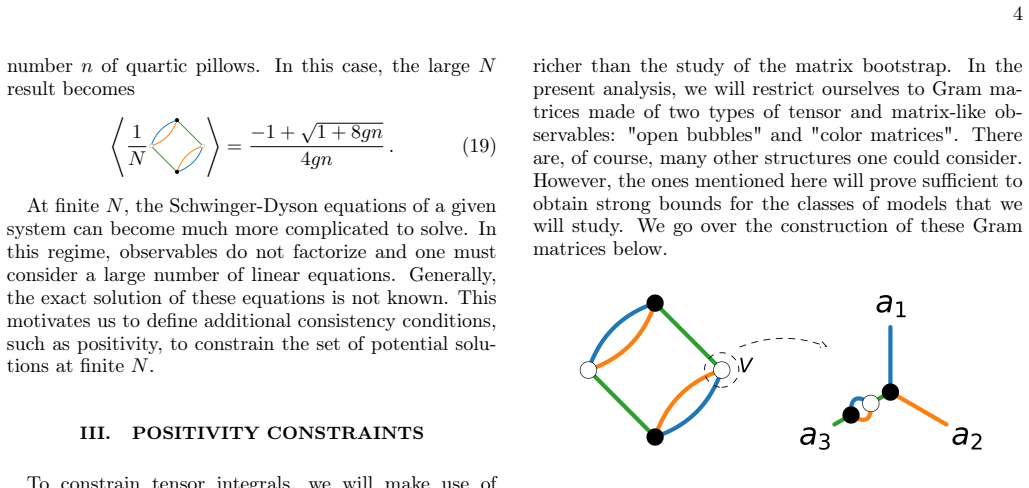
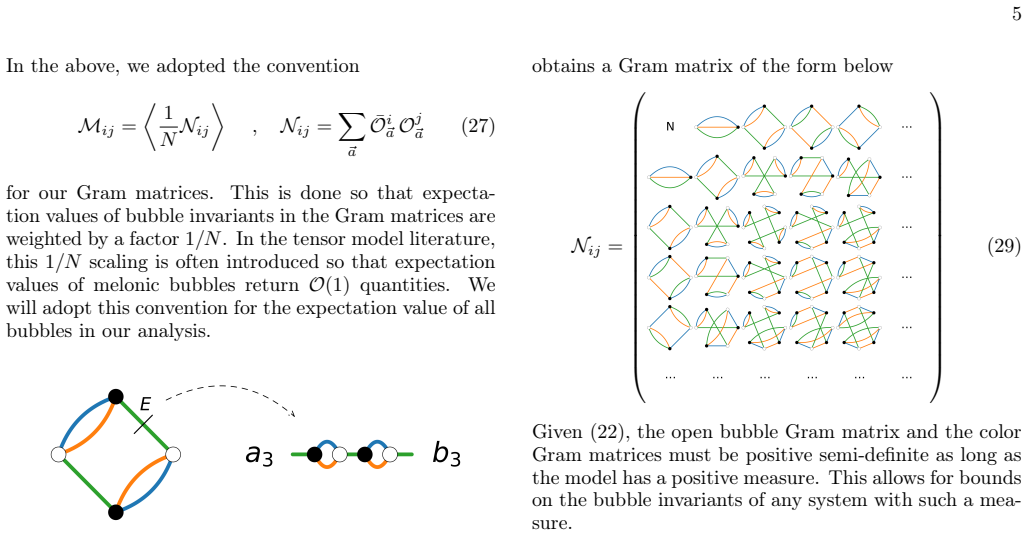
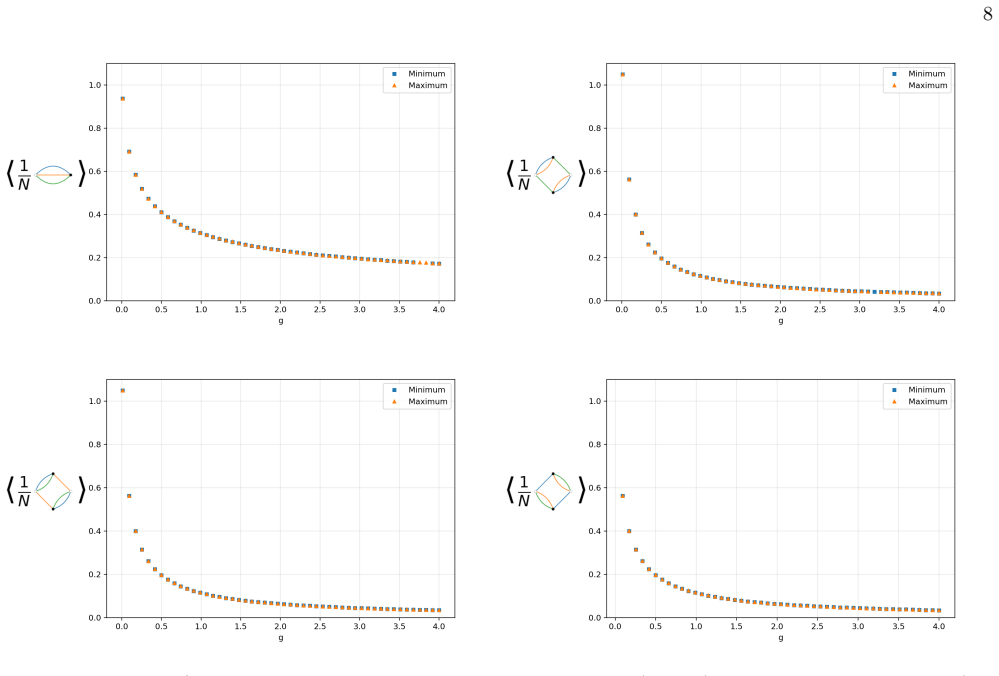
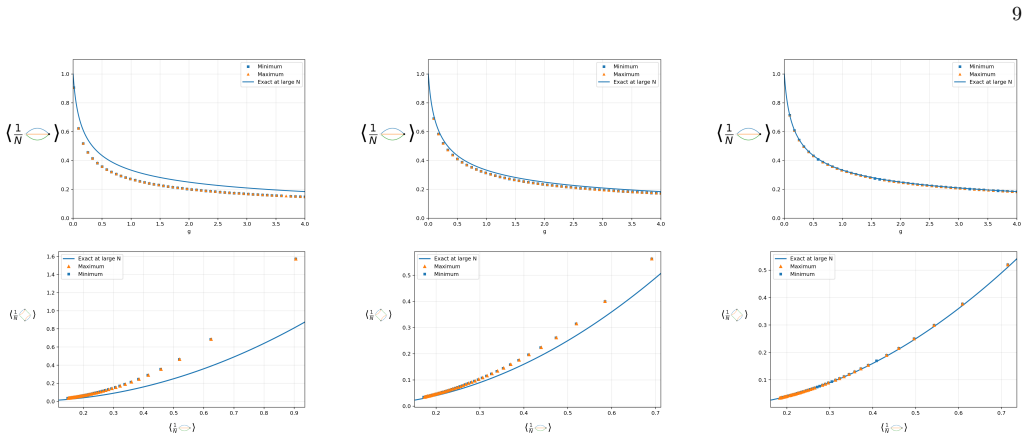
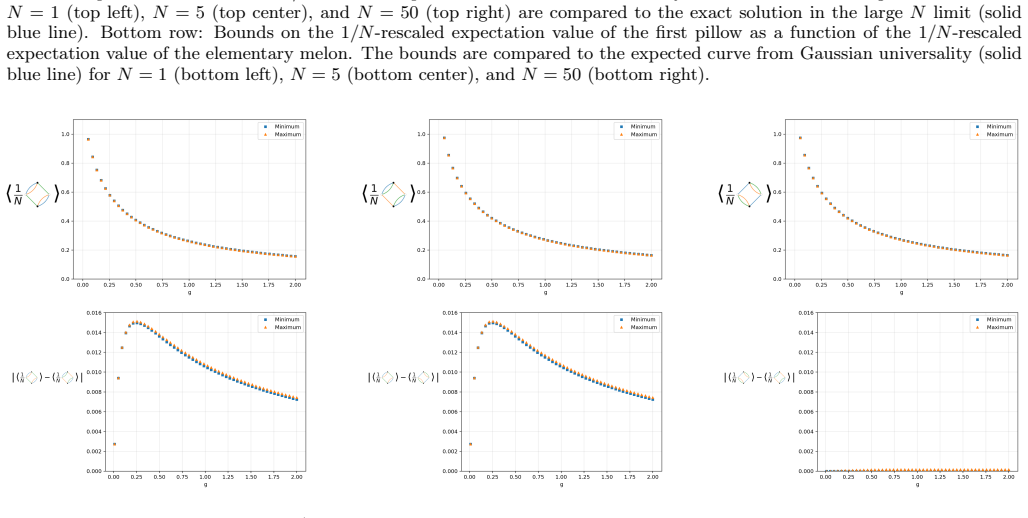
Recently, new positivity constraints were suggested to constrain arbitrary unitary tensor integrals. In the present work, we explore two variants of these positivity constraints: one built from ``open bubbles'', which are tensor-like objects found by removing a tensor from a bubble invariant, and the second built from ``color matrices'', which are matrices found by removing a color contraction from a bubble invariant. Using these positivity constraints, we find sharp bounds on unitary tensor integrals at finite $N$, and probe deviations from Gaussian universality in this limit.
Editorial analysis
A structured set of objections, weighed in public.
Referee Report
Summary. The paper explores two variants of recently suggested positivity constraints on unitary tensor integrals, constructed from open bubbles (tensor-like objects obtained by removing a tensor from a bubble invariant) and from color matrices (obtained by removing a color contraction from a bubble invariant). It applies these constraints to derive sharp bounds on unitary tensor integrals at finite N and to examine deviations from Gaussian universality.
Significance. If the proposed positivity constraints prove valid and non-redundant, the work could strengthen the tensor bootstrap by supplying additional tools for finite-N analyses, where Gaussian universality may break down. The emphasis on explicit constructions from bubble invariants is a positive step toward falsifiable bounds, though the absence of any displayed equations, bounds, or numerical results in the visible text prevents evaluation of whether these strengths are realized.
major comments (1)
- The central claim that the open-bubble and color-matrix variants yield sharp bounds at finite N cannot be assessed, as the abstract (and visible text) contains no equations, explicit positivity conditions, or example calculations that would allow verification of sufficiency or absence of artifacts/overconstraints.
Simulated Author's Rebuttal
We thank the referee for their report. The major comment concerns the assessability of our central claims from the abstract and visible text. We address this below.
read point-by-point responses
-
Referee: The central claim that the open-bubble and color-matrix variants yield sharp bounds at finite N cannot be assessed, as the abstract (and visible text) contains no equations, explicit positivity conditions, or example calculations that would allow verification of sufficiency or absence of artifacts/overconstraints.
Authors: We agree that the abstract contains no equations, which is standard for brevity. The full manuscript, however, defines the open-bubble positivity constraints explicitly in Section 2 by removing a tensor from the bubble invariant and derives the associated matrix positivity conditions. Section 3 constructs the color-matrix variants by removing color contractions and proves they are independent of the open-bubble set at finite N. Section 4 presents explicit numerical bounds for small N (including N=2,3) together with comparisons to Gaussian universality, showing saturation of the bounds by explicit unitary tensor integrals. These sections contain all required equations, positivity matrices, and sample calculations. If the editor prefers, we can add one sentence to the abstract summarizing the leading positivity condition. revision: partial
Circularity Check
No circularity identified; insufficient derivation details supplied
full rationale
The abstract and surrounding context contain no equations, no explicit derivation chain, and no self-citations or fitted quantities that could be inspected for reduction to inputs. Without the full manuscript's technical sections, positivity constraints, open-bubble constructions, or color-matrix variants, no load-bearing step can be quoted or shown to be self-definitional, fitted-as-prediction, or dependent on self-citation. The analysis therefore defaults to no significant circularity.
Axiom & Free-Parameter Ledger
Reference graph
Works this paper leans on
-
[1]
Sasakura, Tensor model for gravity and orientability of manifold, Mod
N. Sasakura, Tensor model for gravity and orientability of manifold, Mod. Phys. Lett. A6, 2613 (1991)
1991
-
[2]
Ambjorn, B
J. Ambjorn, B. Durhuus, and T. Jonsson, Three- dimensional simplicial quantum gravity and generalized matrix models, Mod. Phys. Lett. A6, 1133 (1991)
1991
-
[3]
Gross, Tensor models and simplicial quantum gravity in>2-D, Nucl
M. Gross, Tensor models and simplicial quantum gravity in>2-D, Nucl. Phys. B Proc. Suppl.25, 144 (1992)
1992
-
[4]
R. Gurau and J. P. Ryan, Colored Tensor Models - a review, SIGMA8, 020 (2012), arXiv:1109.4812 [hep-th]
Pith/arXiv arXiv 2012
-
[5]
Gurau,Random Tensors(Oxford University Press, 2017)
R. Gurau,Random Tensors(Oxford University Press, 2017)
2017
-
[6]
R. Gurau and J. P. Ryan, Melons are branched polymers, Annales Henri Poincare15, 2085 (2014), arXiv:1302.4386 [math-ph]
Pith/arXiv arXiv 2085
-
[7]
S. Carrozza and A. Tanasa,O(N)Random Ten- sor Models, Lett. Math. Phys.106, 1531 (2016), arXiv:1512.06718 [math-ph]
Pith/arXiv arXiv 2016
-
[8]
V. Bonzom and S. Dartois, Blobbed topological recur- sion for the quartic melonic tensor model, J. Phys. A51, 325201 (2018), arXiv:1612.04624 [hep-th]
Pith/arXiv arXiv 2018
-
[9]
M. R. Casali, P. Cristofori, S. Dartois, and L. Grasselli, Topology in colored tensor models via crystallization the- ory, J. Geom. Phys.129, 142 (2018), arXiv:1704.02800 [math-ph]
Pith/arXiv arXiv 2018
-
[10]
J. P. Ryan, Tensor models and embedded Riemann sur- faces, Phys. Rev. D85, 024010 (2012), arXiv:1104.5471 [gr-qc]
Pith/arXiv arXiv 2012
-
[11]
R. Martini and R. Toriumi, Trisections in colored tensor models, Ann. Inst. H. Poincare D Comb. Phys. Interact. 11, 453 (2023), arXiv:2110.06659 [math-ph]
arXiv 2023
-
[12]
L. Lionni and J. Thürigen, Multi-critical behaviour of 4- dimensional tensor models up to order 6, Nucl. Phys. B 941, 600 (2019), arXiv:1707.08931 [hep-th]
Pith/arXiv arXiv 2019
-
[13]
A. Chandra and L. Ferdinand, A stochastic analysis ap- proach to tensor field theories (2024), arXiv:2306.05305 [math.PR]
arXiv 2024
-
[14]
S. Sachdev and J. Ye, Gapless spin fluid ground state in a random, quantum Heisenberg magnet, Phys. Rev. Lett. 70, 3339 (1993), arXiv:cond-mat/9212030
Pith/arXiv arXiv 1993
-
[15]
Entanglement in Strongly- Correlated Quantum Matter
A. Kitaev, A simple model of quantum holography, Talks at the KITP Program “Entanglement in Strongly- Correlated Quantum Matter” (2015), april 7, 2015 and May 27, 2015
2015
-
[16]
J. Maldacena and D. Stanford, Remarks on the Sachdev- Ye-Kitaev model, Phys. Rev. D94, 106002 (2016), arXiv:1604.07818 [hep-th]
Pith/arXiv arXiv 2016
-
[17]
Witten, An SYK-Like Model Without Disorder, J
E. Witten, An SYK-Like Model Without Disorder, J. Phys. A52, 474002 (2019), arXiv:1610.09758 [hep-th]
Pith/arXiv arXiv 2019
-
[18]
I. R. Klebanov and G. Tarnopolsky, Uncolored ran- dom tensors, melon diagrams, and the Sachdev-Ye- Kitaev models, Phys. Rev. D95, 046004 (2017), arXiv:1611.08915 [hep-th]
Pith/arXiv arXiv 2017
-
[19]
I. R. Klebanov, F. Popov, and G. Tarnopolsky, TASI Lec- tures on LargeNTensor Models, PoST ASI2017, 004 (2018), arXiv:1808.09434 [hep-th]
Pith/arXiv arXiv 2018
- [20]
-
[21]
Gurau, The complete 1/n expansion of a syk–like ten- sor model, Nuclear Physics B916, 386–401 (2017)
R. Gurau, The complete 1/n expansion of a syk–like ten- sor model, Nuclear Physics B916, 386–401 (2017)
2017
-
[22]
V. Bonzom, L. Lionni, and A. Tanasa, Diagrammatics of a colored syk model and of an syk-like tensor model, lead- ing and next-to-leading orders, Journal of Mathematical Physics58, 10.1063/1.4983562 (2017)
-
[23]
N. Delporte and V. Rivasseau, The tensor track v: Holo- graphic tensors (2018), arXiv:1804.11101 [hep-th]
Pith/arXiv arXiv 2018
-
[24]
Ben Geloun and V
J. Ben Geloun and V. Rivasseau, A renormalizable syk- type tensor field theory, Annales Henri Poincaré19, 3357–3395 (2018)
2018
-
[25]
J. Ben Geloun and V. Rivasseau, A Renormalizable 4- DimensionalTensorFieldTheory,Commun.Math.Phys. 318, 69 (2013), arXiv:1111.4997 [hep-th]
Pith/arXiv arXiv 2013
-
[26]
S. Carrozza, D. Oriti, and V. Rivasseau, Renormalization of Tensorial Group Field Theories: Abelian U(1) Mod- els in Four Dimensions, Commun. Math. Phys.327, 603 (2014), arXiv:1207.6734 [hep-th]. 11
Pith/arXiv arXiv 2014
-
[27]
Ousmane Samary, C
D. Ousmane Samary, C. I. Pérez-Sánchez, F. Vignes- Tourneret, and R. Wulkenhaar, Correlation functions of a just renormalizable tensorial group field theory: the melonic approximation, Classical and Quantum Gravity 32, 175012 (2015)
2015
-
[28]
D. Benedetti, J. B. Geloun, and D. Oriti, Functional renormalisation group approach for tensorial group field theory: a rank-3 model, Journal of High Energy Physics 2015, 10.1007/jhep03(2015)084 (2015)
-
[29]
T. Krajewski and R. Toriumi, Exact Renormalisation Group Equations and Loop Equations for Tensor Models, SIGMA12, 068 (2016), arXiv:1603.00172 [gr-qc]
Pith/arXiv arXiv 2016
-
[30]
A. Eichhorn and T. Koslowski, Flowing to the contin- uum limit in tensor models for quantum gravity, Ann. Inst. H. Poincare D Comb. Phys. Interact.5, 173 (2018), arXiv:1701.03029 [gr-qc]
Pith/arXiv arXiv 2018
-
[31]
J. Ben Geloun and R. Toriumi, Renormalizable enhanced tensor field theory: The quartic melonic case, J. Math. Phys.59, 112303 (2018), arXiv:1709.05141 [hep-th]
Pith/arXiv arXiv 2018
-
[32]
Benedetti, Melonic CFTs, PoSCORFU2019, 168 (2020)
D. Benedetti, Melonic CFTs, PoSCORFU2019, 168 (2020)
2020
-
[33]
D. Benedetti, R. Gurau, S. Harribey, and K. Suzuki, Hints of unitarity at large n in the o(n )3 tensor field theory, Journal of High Energy Physics2020, 10.1007/jhep02(2020)072 (2020)
-
[34]
D. Benedetti, R. Gurau, S. Harribey, and D. Lettera, The f-theorem in the melonic limit, Journal of High Energy Physics2022, 10.1007/jhep02(2022)147 (2022)
-
[35]
C. Jepsen and Y. Oz, RG flows and fixed points ofO(N)r models, JHEP02, 035, arXiv:2311.09039 [hep-th]
-
[36]
A.MaloneyandE.Witten,AveragingoverNarainmoduli space, JHEP10, 187, arXiv:2006.04855 [hep-th]
arXiv 2006
-
[37]
A. Belin and J. de Boer, Random statistics of OPE co- efficients and Euclidean wormholes, Class. Quant. Grav. 38, 164001 (2021), arXiv:2006.05499 [hep-th]
arXiv 2021
- [38]
-
[39]
J. Chandra, S. Collier, T. Hartman, and A. Maloney, Semiclassical 3D gravity as an average of large-c CFTs, JHEP12, 069, arXiv:2203.06511 [hep-th]
-
[40]
Sasieta, Wormholes from heavy operator statistics in AdS/CFT, JHEP03, 158, arXiv:2211.11794 [hep-th]
M. Sasieta, Wormholes from heavy operator statistics in AdS/CFT, JHEP03, 158, arXiv:2211.11794 [hep-th]
- [41]
-
[42]
J. de Boer, D. Liska, and B. Post, Multibound- ary wormholes and OPE statistics, JHEP10, 207, arXiv:2405.13111 [hep-th]
-
[43]
D. L. Jafferis, L. Rozenberg, and G. Wong, 3d gravity as a random ensemble, JHEP02, 208, arXiv:2407.02649 [hep-th]
-
[44]
J. de Boer, J. Kames-King, and B. Post, Surgery and statistics in 3d gravity (2025), arXiv:2506.04151 [hep-th]
Pith/arXiv arXiv 2025
-
[45]
D. L. Jafferis, L. Rozenberg, and D. Wang, Open- closed 3d gravity as a random ensemble, JHEP10, 228, arXiv:2506.19817 [hep-th]
-
[46]
Hartman, Triangulating quantum gravity in AdS 3 (2025), arXiv:2507.12696 [hep-th]
T. Hartman, Triangulating quantum gravity in AdS 3 (2025), arXiv:2507.12696 [hep-th]
arXiv 2025
-
[47]
Chandra, Statistics in 3d gravity from knots and links, JHEP12, 139, arXiv:2508.10864 [hep-th]
J. Chandra, Statistics in 3d gravity from knots and links, JHEP12, 139, arXiv:2508.10864 [hep-th]
-
[48]
Wang, Crossing symmetry of OPE statistics (2025), arXiv:2512.21258 [hep-th]
D. Wang, Crossing symmetry of OPE statistics (2025), arXiv:2512.21258 [hep-th]
arXiv 2025
- [49]
-
[50]
B. Collins, R. Gurau, and L. Lionni, The Tensor Harish- Chandra–Itzykson–Zuber Integral II: Detecting Entan- glement in Large Quantum Systems, Commun. Math. Phys.401, 669 (2023), arXiv:2201.12778 [math-ph]
arXiv 2023
-
[51]
S. Carrozza, J. Chevrier, and L. Lionni, Tensor invari- ants for multipartite entanglement classification (2026), arXiv:2604.02269 [math-ph]
arXiv 2026
-
[52]
S. Carrozza, J. Chevrier, and L. Lionni, LargeNfac- torization of families of tensor trace-invariants (2026), arXiv:2605.12468 [math-ph]
Pith/arXiv arXiv 2026
-
[53]
R. Bonnin and C. Bordenave, Freeness for tensors (2024), arXiv:2407.18881 [math.PR]
Pith/arXiv arXiv 2024
-
[54]
B. Collins, R. Gurau, and L. Lionni, Free cumulants and freeness for unitarily invariant random tensors (2025), arXiv:2410.00908 [math-ph]
arXiv 2025
-
[55]
I. Nechita and S.-J. Park, Tensor free probability the- ory: asymptotic tensor freeness and central limit theorem (2025), arXiv:2504.01782 [math.OA]
arXiv 2025
-
[56]
Gurau, Colored Group Field Theory, Commun
R. Gurau, Colored Group Field Theory, Commun. Math. Phys.304, 69 (2011), arXiv:0907.2582 [hep-th]
Pith/arXiv arXiv 2011
-
[57]
R. Gurau and V. Rivasseau, The 1/N expansion of col- ored tensor models in arbitrary dimension, EPL95, 50004 (2011), arXiv:1101.4182 [gr-qc]
arXiv 2011
-
[58]
V. Bonzom, R. Gurau, A. Riello, and V. Rivasseau, Criti- cal behavior of colored tensor models in the large N limit, Nucl. Phys. B853, 174 (2011), arXiv:1105.3122 [hep-th]
Pith/arXiv arXiv 2011
-
[59]
R. Gurau, The complete 1/N expansion of colored tensor models in arbitrary dimension, Annales Henri Poincare 13, 399 (2012), arXiv:1102.5759 [gr-qc]
Pith/arXiv arXiv 2012
-
[60]
V. Bonzom, R. Gurau, and V. Rivasseau, Random tensor modelsinthelargeNlimit: Uncoloringthecoloredtensor models,Phys.Rev.D85,084037(2012),arXiv:1202.3637 [hep-th]
Pith/arXiv arXiv 2012
-
[61]
Gurau, Universality for Random Tensors, Ann
R. Gurau, Universality for Random Tensors, Ann. Inst. H. Poincare Probab. Statist.50, 1474 (2014), arXiv:1111.0519 [math.PR]
Pith/arXiv arXiv 2014
-
[62]
H. W. Lin, Bootstraps to strings: solving random matrix models with positivity, JHEP06, 090, arXiv:2002.08387 [hep-th]
arXiv 2002
-
[63]
V. Kazakov and Z. Zheng, Analytic and numerical boot- strap for one-matrix model and “unsolvable” two-matrix model, JHEP06, 030, arXiv:2108.04830 [hep-th]
-
[64]
X. Han, S. A. Hartnoll, and J. Kruthoff, Bootstrap- ping Matrix Quantum Mechanics, Phys. Rev. Lett.125, 041601 (2020), arXiv:2004.10212 [hep-th]
arXiv 2020
-
[65]
T. Banks, W. Fischler, S. H. Shenker, and L. Susskind, M theory as a matrix model: A conjecture, Phys. Rev. D55, 5112 (1997), arXiv:hep-th/9610043
Pith/arXiv arXiv 1997
-
[66]
H. W. Lin, Bootstrap bounds on D0-brane quantum me- chanics, JHEP06, 038, arXiv:2302.04416 [hep-th]
-
[67]
H. W. Lin and Z. Zheng, Bootstrapping ground state correlators in matrix theory. Part I, JHEP01, 190, arXiv:2410.14647 [hep-th]
-
[68]
H. W. Lin and Z. Zheng, High-precision boot- strap of multi-matrix quantum mechanics (2025), arXiv:2507.21007 [hep-th]
Pith/arXiv arXiv 2025
-
[69]
H. W. Lin, TASI lectures on Matrix Theory from a mod- ern viewpoint (2025), arXiv:2508.20970 [hep-th]
arXiv 2025
-
[70]
N. Ishibashi, H. Kawai, Y. Kitazawa, and A. Tsuchiya, A Large N reduced model as superstring, Nucl. Phys. B 498, 467 (1997), arXiv:hep-th/9612115. 12
Pith/arXiv arXiv 1997
- [71]
-
[72]
M. Cho, B. Gabai, J. Sandor, and X. Yin, Thermal bootstrap of matrix quantum mechanics, JHEP04, 186, arXiv:2410.04262 [hep-th]
-
[73]
S. Adams, Thermal Bootstrap of Large-N Matrix Models via Conic Optimization (2025), arXiv:2511.01209 [hep- th]
arXiv 2025
-
[74]
S. Laliberte and B. McPeak, Bootstrapping su- persymmetric (matrix) quantum mechanics (2025), arXiv:2510.01356 [hep-th]
arXiv 2025
-
[75]
M. Khalkhali, N. Pagliaroli, A. Parfeni, and B. Smith, Bootstrapping the critical behavior of multi-matrix mod- els, JHEP25, 158, arXiv:2409.07565 [math-ph]
-
[76]
S. Kováčik and K. Magdolenová, Eigenvalue distribu- tion from bootstrap estimates, Phys. Rev. D112, 126021 (2025), arXiv:2509.16005 [hep-th]
arXiv 2025
-
[77]
R.Maeta,MatrixBootstrapApproximationwithoutPos- itivity Constraint (2026), arXiv:2601.16099 [hep-th]
arXiv 2026
-
[78]
D. Berenstein, J. Rodrigues, and V. A. Rodriguez, Asymptotic bootstrap for unitary matrix integrals at complex coupling (2026), arXiv:2602.18559 [hep-th]
arXiv 2026
-
[79]
M. Cho, B. Gabai, H. W. Lin, J. Yeh, and Z. Zheng, Bootstrapping Euclidean Two-point Correlators (2025), arXiv:2511.08560 [hep-th]
Pith/arXiv arXiv 2025
-
[80]
M. Cho, Nonequilibrium Phase Transitions in LargeN Matrix Quantum Mechanics (2025), arXiv:2508.04764 [hep-th]
arXiv 2025
discussion (0)
Sign in with ORCID, Apple, or X to comment. Anyone can read and Pith papers without signing in.