REVIEW 3 major objections 6 minor 84 references
LAFR: Efficient Diffusion-based Blind Face Restoration via Latent Codebook Alignment Adapter
T0 review · 3 major / 6 minor · reviewed 2026-08-07 · deepseek-v4-flash
Pith's one-line read A codebook-based latent alignment adapter lets a frozen Stable Diffusion VAE restore degraded faces from just 600 training images, matching state-of-the-art face restoration with 7.5M trainable parameters.
desk verdict The 600-image efficiency claim is not credible from the paper's own tables; the method idea is salvageable but this draft overclaims. read the letter →
The pith
A machine-rendered reading of the paper's core claim, the machinery that carries it, and where it could break.
The reading
What carries the argument
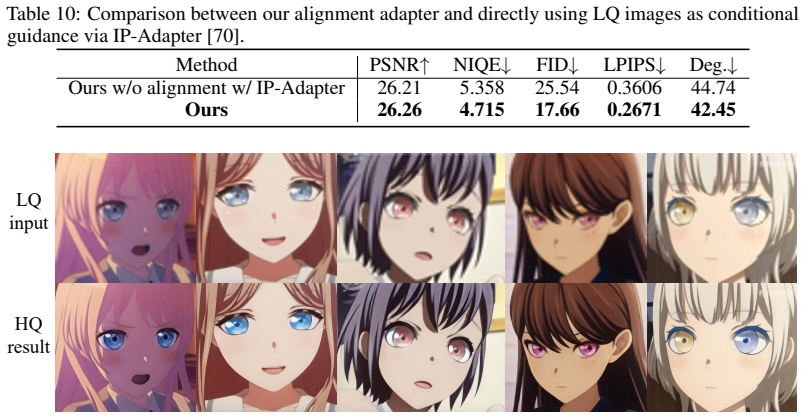
The central object is the Latent Codebook Alignment Adapter, a three-part module placed between the frozen VAE encoder and the denoising UNet: a shallow feature extractor, a codebook lookup that selects the nearest HQ anchor for each LQ latent, and a mapping network that turns the selected anchor into an aligned latent. It is trained with an $L_1$ alignment loss against the HQ latent. Around this adapter, the paper adds a multi-level restoration loss — $\mathcal{L}_{\text{res}}$, a CLIP-based identity loss, and a facial-structure cosine loss — and uses LoRA on the UNet's convolutional layers, with text and timestep embeddings replaced by fixed tensors, to keep training and inference cheap.
What would settle it
Train LAFR with codebooks of 128, 256, 512, and 1024 entries on the same 600-image set and measure identity-preservation metrics (Deg., LMD) and FID on CelebA-Test; if quality collapses as the codebook shrinks, the bottleneck — not the LoRA tuning — is carrying the restored identity, and any identity detail beyond 1024 anchors is already lost.
Extended reading notes
Core claim
The discovery is that the semantic misalignment between low-quality (LQ) and high-quality (HQ) latents in a VAE trained only on HQ images can be repaired by a small adapter without retraining the VAE. The adapter extracts a feature $f$ from the LQ latent, finds the nearest anchor $c^* = \arg\min_{c_i\in\mathcal{C}}\|f-c_i\|_2$ in a learned codebook of 1024 entries, and produces an aligned latent $z_{\text{aligned}} = M(c^*)$ through a small mapping network; a simple $L_1$ loss against the ground-truth HQ latent trains it. Restoring from $z_{\text{aligned}}$ instead of the raw LQ latent substantially improves quality, and when this adapter is combined with LoRA fine-tuning of convolution layers and a multi-level loss (image appearance, CLIP identity embeddings, and facial structure), the paper reports performance comparable to state-of-the-art diffusion methods on CelebA-Test and real-world benchmarks, using only 600 FFHQ images and 7.5M trainable parameters.
Load-bearing premise
The load-bearing premise is that every degraded face can be faithfully carried through a nearest-neighbor lookup against just 1024 learned anchor codes; the paper itself concedes in Section E that this codebook design depends on faces sharing highly similar layouts and would not transfer to diverse natural images.
Editorial extensions
If this is right
- If the central claim holds, blind face restoration no longer requires full VAE retraining or a 70K-image dataset; the same pre-trained diffusion prior can be adapted from a few hundred examples.
- The two-stage design decouples latent alignment from restoration, so the alignment adapter can be retrained or swapped without touching the denoising UNet.
- Pruning the text and timestep embedding modules and fixing them as precomputed tensors cuts inference cost and parameter count with, per the ablation, negligible quality loss.
- Because the multi-level loss supervises identity embeddings and facial structure directly against the HQ ground truth, the method avoids relying on unreliable LQ-conditioned guidance during sampling.
- Training time falls by about 70% relative to large-scale fine-tuning, making single-GPU, small-data deployment realistic.
Reading between the lines
- A test the paper does not run: shrink the codebook from 1024 anchors toward 128 while monitoring identity metrics; the point at which quality collapses would reveal how much identity information the bottleneck itself carries versus the mapping network and LoRA layers.
- The same adapter idea could be probed on other structured image domains (e.g., document, medical, or plate images) that also form compact layout distributions; the paper's own limitation note predicts it would fail on unconstrained natural images, so such domains are the natural testbed.
- Since the identity loss uses a CLIP vision encoder, which is not trained specifically for face recognition, an ArcFace-style embedding in the loss might shift the fidelity-identity trade-off; the paper uses ArcFace only for evaluation, not supervision.
- The t-SNE compactness argument for faces is qualitative; a formal measure across many identity and pose groups would sharpen the claim about why 600 images suffice.
Editorial analysis
A structured set of objections, weighed in public.
Referee Report
Summary. The paper proposes LAFR, a blind face restoration method that adapts a pre-trained Stable Diffusion model using a lightweight codebook-based latent alignment adapter and LoRA fine-tuning of the denoising UNet's convolutional layers. The authors claim that training on only 600 FFHQ images (0.9% of FFHQ) with 7.5M trainable parameters achieves performance comparable to state-of-the-art methods while reducing training time by 70%. Experiments are reported on CelebA-Test and real-world benchmarks (LFW-Test, WebPhoto-Test, Wider-Test) across a comprehensive set of full-reference and no-reference metrics.
Significance. If the central efficiency claim were solidly supported, LAFR would be a practically valuable contribution: it would demonstrate that a tiny data budget can suffice for face-restoration domain adaptation, with a compact adapter and low training cost. The paper also has a plausible architectural idea (latent-space codebook alignment without retraining the VAE) and an honest discussion of scope in Sec. E. However, the quantitative evidence is internally inconsistent, and the central claim is therefore not verifiable from the manuscript as written.
major comments (3)
- [Sec. 4.2 (Table 1) vs. Sec. B (Tables 8, 9)] The same LAFR configuration at 600 training images is reported as PSNR 26.26 in Table 1 (and Table 5, row #5) but 25.91 in Table 8. The same OSEDiff retrained on 70K images is 25.88 PSNR in Table 1 but 26.85 in Table 9. These discrepancies directly affect the headline comparison against state-of-the-art methods and the 'comparable to SOTA' claim. No error bars, random-seed information, or code/checkpoints are provided to establish which numbers are correct.
- [Sec. 4.3 (Fig. 6) and Sec. B (Table 8)] Table 8 shows LAFR PSNR rising to 26.64 at 800 images and 26.43 at 7,000 images, then collapsing to 24.77 at 21,000 and 25.16 at 70,000 images, which is below the 600-image value of 25.91. This non-monotonic scaling is not discussed and contradicts the text's statement that 'Beyond 600 training images, the improvements become marginal.' The data as presented suggest the 600-image choice is post hoc and that the model becomes unstable or is differently configured at larger scales.
- [Sec. 3.3] The training objective for the codebook is underspecified. The forward pass selects c* = argmin ||f - c_i|| and computes zaligned = M(c*), with Lalign = ||zaligned - zHQ||_1. Because argmin is non-differentiable, this loss cannot update the codebook entries c_i unless a straight-through estimator or commitment loss is used; none is described. As written, the mechanism by which the 1024 anchors are 'learned from HQ training data' is not reproducible.
minor comments (6)
- [Sec. 4.4] The sentence 'Conditioning the model on degraded image could lead to superior restoration quality' appears to be the opposite of the authors' argument (which is that LQ conditioning is unreliable). This is likely a typo and should be corrected.
- [Sec. 3.1] The t-SNE/ResNet-50 evidence uses CelebA versus ImageNet, while the method is trained on FFHQ; the connection between the two is not made. In addition, a silhouette score of 0.18 is conventionally interpreted as weak cluster structure, so the claim of 'a high degree of structural coherence' is overstated.
- [Sec. B] Tables 8 and 9 do not report the full set of metrics from Table 1 (e.g., LPIPS, DISTS, FID), making it impossible to compare the scaling behavior with the main results.
- [Abstract and Sec. 1] The abstract and Sec. 1 call 600 images '0.9% of FFHQ'; the exact fraction is 600/70,000 ≈ 0.857%. Please state the precise number or define the rounding.
- [Fig. 9] Fig. 9 does not appear to match the numbers in Tables 8 and 9; for example, the plotted PSNR values are inconsistent with the tabulated values. Please ensure the figure and tables correspond to the same runs.
- [Sec. E] Sec. E appropriately limits the method to faces, but this limitation is not mentioned in the abstract or introduction; consider stating the scope upfront.
Circularity Check
No significant circularity: the claimed derivation chain is an empirical training/evaluation pipeline with external benchmarks, and no load-bearing step reduces by construction to its own inputs.
full rationale
The paper's central claims are (1) a codebook-based latent alignment adapter corrects LQ/HQ VAE latent mismatch, and (2) 600 FFHQ images suffice for competitive face restoration. Neither claim is circular by the paper's own equations. The adapter maps an LQ latent feature f to a nearest codebook anchor c* and then to an aligned latent zaligned = M(c*), trained with Lalign = ||zaligned - zHQ||1 against the ground-truth HQ latent code (Sec. 3.3). This is direct supervised regression, not a quantity that is defined in terms of the result it is used to predict. The multi-level loss (Sec. 3.4) uses external encoders (CLIP, D3DFR) and pixel/feature losses; again, these are training objectives, not re-labeled predictions. The claim that facial images are structurally regular is supported by a t-SNE/silhouette analysis (Sec. 3.1), which is motivation rather than a derivation of the efficiency result. The data-efficiency conclusion is an empirical claim tested on CelebA-Test and real-world benchmarks, with external metrics (PSNR, SSIM, LPIPS, FID, NIQE, Deg, LMD); no fitted parameter is presented as a prediction. The paper does cite related work including work by co-author Jian Zhang (Ref. [59], DDNM), but that citation is background information and is not load-bearing. The most notable concern is internal inconsistency among reported PSNR values across Tables 1, 8, and 9, and the non-monotonic scaling curve in Table 8 (e.g., LAFR at 600 images PSNR 25.91 vs. 25.16 at 70K images). That is a reproducibility/accuracy problem that could undermine the empirical support for the efficiency claim, but it is not a circularity: the 600-image result is not constructed from the conclusion that 600 images suffice. No step in the paper equates an output with an input by definition, imports a unique solution from a self-citation, or renames a known empirical pattern as a derivation. Therefore the appropriate finding is no significant circularity, with score 0.
Assumptions & free parameters
free parameters (6)
- codebook vocabulary size =
1024
- codebook hidden dimension =
256
- LoRA rank =
4
- loss weights =
lambda_res = lambda_id = lambda_fs = 1; LPIPS lambda = 2
- training schedule =
100 epochs (stage 1), 17,000 steps (stage 2)
- training subset size =
600 FFHQ images (0.9%)
assumptions (6)
- domain assumption Faces share a highly regular layout and distribution across identities
- domain assumption The frozen Stable Diffusion VAE latent space is a valid target space for aligning LQ images
- ad hoc to paper Nearest-neighbor lookup into 1024 learned anchors is a sufficient bottleneck for latent alignment
- domain assumption CLIP (IP-Adapter) features and D3DFR structure features are valid measures of identity and facial structure
- domain assumption Removing text and timestep embeddings and fixing the prompt to 'face, high quality' preserves face restoration quality
- domain assumption The pre-trained Stable Diffusion v2-1 prior contains a useful face distribution
invented entities (1)
-
Latent codebook of 1024 HQ semantic anchors
Cite this review
Pith. "Pith review of LAFR: Efficient Diffusion-based Blind Face Restoration via Latent Codebook Alignment Adapter." pith.science (2026). https://pith.science/paper/AWTF2OR2
@misc{pith2026250523462,
  author       = {Pith},
  title        = {Pith review of: LAFR: Efficient Diffusion-based Blind Face Restoration via Latent Codebook Alignment Adapter},
  year         = {2026},
  howpublished = {\url{https://pith.science/paper/AWTF2OR2}},
  note         = {Machine review of arXiv:2505.23462}
}
read the original abstract
Blind face restoration from low-quality (LQ) images is a challenging task that requires not only high-fidelity image reconstruction but also the preservation of facial identity. While diffusion models like Stable Diffusion have shown promise in generating high-quality (HQ) images, their VAE modules are typically trained only on HQ data, resulting in semantic misalignment when encoding LQ inputs. This mismatch significantly weakens the effectiveness of LQ conditions during the denoising process. Existing approaches often tackle this issue by retraining the VAE encoder, which is computationally expensive and memory-intensive. To address this limitation efficiently, we propose LAFR (Latent Alignment for Face Restoration), a novel codebook-based latent space adapter that aligns the latent distribution of LQ images with that of HQ counterparts, enabling semantically consistent diffusion sampling without altering the original VAE. To further enhance identity preservation, we introduce a multi-level restoration loss that combines constraints from identity embeddings and facial structural priors. Additionally, by leveraging the inherent structural regularity of facial images, we show that lightweight finetuning of diffusion prior on just 0.9% of FFHQ dataset is sufficient to achieve results comparable to state-of-the-art methods, reduce training time by 70%. Extensive experiments on both synthetic and real-world face restoration benchmarks demonstrate the effectiveness and efficiency of LAFR, achieving high-quality, identity-preserving face reconstruction from severely degraded inputs.
Figures


Figures from the paper (6 more)


Reference graph
Works this paper leans on
-
[1]
Identity-preserving diffusion for face restoration
Xiaying Bai, Yuhao Yang, Wenming Yang, Rui Zhu, and Jing-Hao Xue. Identity-preserving diffusion for face restoration. In ICASSP 2025 - 2025 IEEE International Conference on Acoustics, Speech and Signal Processing (ICASSP), pages 1–5, 2025
2025
-
[2]
Progressive semantic-aware style transformation for blind face restoration
Chaofeng Chen, Xiaoming Li, Lingbo Yang, Xianhui Lin, Lei Zhang, and Kwan-Yee K Wong. Progressive semantic-aware style transformation for blind face restoration. In Proceedings of the IEEE/CVF conference on computer vision and pattern recognition, pages 11896–11905, 2021
2021
-
[3]
Faithdiff: Unleashing diffusion priors for faithful image super-resolution
Junyang Chen, Jinshan Pan, and Jiangxin Dong. Faithdiff: Unleashing diffusion priors for faithful image super-resolution. In The IEEE Conference on Computer Vision and Pattern Recognition (CVPR), 2025
2025
-
[4]
Towards real-world blind face restoration with generative diffusion prior
Xiaoxu Chen, Jingfan Tan, Tao Wang, Kaihao Zhang, Wenhan Luo, and Xiaochun Cao. Towards real-world blind face restoration with generative diffusion prior. IEEE Transactions on Circuits and Systems for Video Technology, 2024
2024
-
[5]
Imagenet: A large-scale hierarchical image database
Jia Deng, Wei Dong, Richard Socher, Li-Jia Li, Kai Li, and Li Fei-Fei. Imagenet: A large-scale hierarchical image database. In Proceedings of the IEEE Conference on Computer Vision and Pattern Recognition (CVPR), 2009
work page 2009
-
[6]
Arcface: Additive angular margin loss for deep face recognition
Jiankang Deng, Jia Guo, Niannan Xue, and Stefanos Zafeiriou. Arcface: Additive angular margin loss for deep face recognition. In Proceedings of the IEEE/CVF conference on computer vision and pattern recognition, pages 4690–4699, 2019
2019
-
[7]
Accurate 3d face reconstruc- tion with weakly-supervised learning: From single image to image set
Yu Deng, Jiaolong Yang, Sicheng Xu, Dong Chen, Yunde Jia, and Xin Tong. Accurate 3d face reconstruc- tion with weakly-supervised learning: From single image to image set. In Proceedings of the IEEE/CVF conference on computer vision and pattern recognition workshops, 2019
work page 2019
-
[8]
Diffusion models beat gans on image synthesis
Prafulla Dhariwal and Alexander Nichol. Diffusion models beat gans on image synthesis. In Proceedings of the Advances in Neural Information Processing Sysstems (NeurIPS), 2021
work page 2021
Show all 84 references
-
[9]
Image quality assessment: Unifying structure and texture similarity
Keyan Ding, Kede Ma, Shiqi Wang, and Eero P Simoncelli. Image quality assessment: Unifying structure and texture similarity. IEEE Transactions on Pattern Analysis and Machine Intelligence (TPAMI), 2020
2020
-
[10]
Tsd-sr: One-step diffusion with target score distillation for real-world image super- resolution
Linwei Dong, Qingnan Fan, Yihong Guo, Zhonghao Wang, Qi Zhang, Jinwei Chen, Yawei Luo, and Changqing Zou. Tsd-sr: One-step diffusion with target score distillation for real-world image super- resolution. In Proceedings of the IEEE/CVF conference on computer vision and pattern ...
2025
-
[11]
Generative diffusion prior for unified image restoration and enhancement
Ben Fei, Zhaoyang Lyu, Liang Pan, Junzhe Zhang, Weidong Yang, Tianyue Luo, Bo Zhang, and Bo Dai. Generative diffusion prior for unified image restoration and enhancement. In Proceedings of the IEEE/CVF Conference on Computer Vision and Pattern Recognition (CVPR), 2023
2023
-
[12]
Infobfr: Real-world blind face restoration via information bottleneck
Nan Gao, Jia Li, Huaibo Huang, Ke Shang, and Ran He. Infobfr: Real-world blind face restoration via information bottleneck. arXiv preprint arXiv:2501.15443, 2025
2025 arXiv
-
[13]
Vqfr: Blind face restoration with vector-quantized dictionary and parallel decoder
Yuchao Gu, Xintao Wang, Liangbin Xie, Chao Dong, Gen Li, Ying Shan, and Ming-Ming Cheng. Vqfr: Blind face restoration with vector-quantized dictionary and parallel decoder. In Proceedings of the European Conference on Computer Vision (ECCV), 2022
2022
-
[14]
Deep residual learning for image recognition
Kaiming He, Xiangyu Zhang, Shaoqing Ren, and Jian Sun. Deep residual learning for image recognition. In Proceedings of the IEEE conference on computer vision and pattern recognition, pages 770–778, 2016
2016
-
[15]
Gans trained by a two time-scale update rule converge to a local nash equilibrium
Martin Heusel, Hubert Ramsauer, Thomas Unterthiner, Bernhard Nessler, and Sepp Hochreiter. Gans trained by a two time-scale update rule converge to a local nash equilibrium. In Advances in neural information processing systems (NeurIPS), volume 30, 2017
2017
-
[16]
Denoising diffusion probabilistic models
Jonathan Ho, Ajay Jain, and Pieter Abbeel. Denoising diffusion probabilistic models. In Proceedings of the Advances in Neural Information Processing Systems (NeurIPS), 2020
2020
-
[17]
Lora: Low-rank adaptation of large language models
Edward J Hu, Yelong Shen, Phillip Wallis, Zeyuan Allen-Zhu, Yuanzhi Li, Shean Wang, Lu Wang, Weizhu Chen, et al. Lora: Low-rank adaptation of large language models. In Proceedings of the International Conference on Learning Representations (ICLR), 2022
2022
-
[18]
Face restoration via plug-and-play 3d facial priors
Xiaobin Hu, Wenqi Ren, Jiaolong Yang, Xiaochun Cao, David Wipf, Bjoern Menze, Xin Tong, and Hongbin Zha. Face restoration via plug-and-play 3d facial priors. IEEE Transactions on Pattern Analysis and Machine Intelligence, 44(12):8910–8926, 2021. 13
2021
-
[19]
Labeled faces in the wild: A database forstudying face recognition in unconstrained environments
Gary B Huang, Marwan Mattar, Tamara Berg, and Eric Learned-Miller. Labeled faces in the wild: A database forstudying face recognition in unconstrained environments. In Workshop on faces in’Real- Life’Images: detection, alignment, and recognition, 2008
2008
-
[20]
Decomposed diffusion sampler for accelerating large-scale inverse problems
Chung Hyungjin, Lee Suhyeon, and Ye Jong Chul. Decomposed diffusion sampler for accelerating large-scale inverse problems. In Proceedings of the International Conference on Learning Representations (ICLR), 2024
2024
-
[21]
A style-based generator architecture for generative adversarial networks
Tero Karras, Samuli Laine, and Timo Aila. A style-based generator architecture for generative adversarial networks. In Proceedings of the IEEE/CVF conference on computer vision and pattern recognition, pages 4401–4410, 2019
2019
-
[22]
Denoising diffusion restoration models
Bahjat Kawar, Michael Elad, Stefano Ermon, and Jiaming Song. Denoising diffusion restoration models. In Proceedings of the Advances in Neural Information Processing Systems (NeurIPS), 2022
2022
-
[23]
Musiq: Multi-scale image quality transformer
Junjie Ke, Qifei Wang, Yilin Wang, Peyman Milanfar, and Feng Yang. Musiq: Multi-scale image quality transformer. In Proceedings of the IEEE/CVF international conference on computer vision, pages 5148–5157, 2021
2021
-
[24]
Auto-encoding variational bayes
Diederik P Kingma, Max Welling, et al. Auto-encoding variational bayes. In Proceedings of the Interna- tional Conference on Learning Representations (ICLR), 2014
2014
-
[25]
Dual prompting image restoration with diffusion transformers
Dehong Kong, Fan Li, Zhixin Wang, Jiaqi Xu, Renjing Pei, Wenbo Li, and WenQi Ren. Dual prompting image restoration with diffusion transformers. arXiv preprint arXiv:2504.17825, 2025
2025 arXiv
-
[26]
Enhancing variational autoencoders with smooth robust latent encoding
Hyomin Lee, Minseon Kim, Sangwon Jang, Jongheon Jeong, and Sung Ju Hwang. Enhancing variational autoencoders with smooth robust latent encoding. arXiv preprint arXiv:2504.17219, 2025
2025 arXiv
-
[27]
Blind face restoration via deep multi-scale component dictionaries
Xiaoming Li, Chaofeng Chen, Shangchen Zhou, Xianhui Lin, Wangmeng Zuo, and Lei Zhang. Blind face restoration via deep multi-scale component dictionaries. In Proceedings of the European Conference on Computer Vision (ECCV), pages 399–415, 2020
2020
-
[28]
Learning warped guidance for blind face restoration
Xiaoming Li, Ming Liu, Yuting Ye, Wangmeng Zuo, Liang Lin, and Ruigang Yang. Learning warped guidance for blind face restoration. In Proceedings of the European Conference on Computer Vision (ECCV), September 2018
2018
-
[29]
Authface: Towards au- thentic blind face restoration with face-oriented generative diffusion prior.arXiv preprint arXiv:2410.09864, 2024
Guoqiang Liang, Qingnan Fan, Bingtao Fu, Jinwei Chen, Hong Gu, and Lin Wang. Authface: Towards au- thentic blind face restoration with face-oriented generative diffusion prior.arXiv preprint arXiv:2410.09864, 2024
2024
-
[30]
Diffusion restoration adapter for real-world image restoration
Hanbang Liang, Zhen Wang, and Weihui Deng. Diffusion restoration adapter for real-world image restoration. arXiv preprint arXiv:2502.20679, 2025
2025 arXiv
-
[31]
Catch missing details: Image reconstruction with frequency augmented variational autoencoder
Xinmiao Lin, Yikang Li, Jenhao Hsiao, Chiuman Ho, and Yu Kong. Catch missing details: Image reconstruction with frequency augmented variational autoencoder. In Proceedings of the IEEE/CVF Conference on Computer Vision and Pattern Recognition, pages 1736–1745, 2023
2023
-
[32]
Faceme: Robust blind face restoration with personal identification
Siyu Liu, Zheng-Peng Duan, Jia OuYang, Jiayi Fu, Hyunhee Park, Zikun Liu, Chun-Le Guo, and Chongyi Li. Faceme: Robust blind face restoration with personal identification. arXiv preprint arXiv:2501.05177, 2025
2025 arXiv
-
[33]
Deep learning face attributes in the wild
Ziwei Liu, Ping Luo, Xiaogang Wang, and Xiaoou Tang. Deep learning face attributes in the wild. In Proceedings of the IEEE international conference on computer vision, pages 3730–3738, 2015
2015
-
[34]
3d priors-guided diffusion for blind face restoration
Xiaobin Lu, Xiaobin Hu, Jun Luo, Ben Zhu, Yaping Ruan, and Wenqi Ren. 3d priors-guided diffusion for blind face restoration. In Proceedings of the 32nd ACM International Conference on Multimedia, pages 1829–1838, 2024
2024
-
[35]
Pulse: Self-supervised photo upsampling via latent space exploration of generative models
Sachit Menon, Alexandru Damian, Shijia Hu, Nikhil Ravi, and Cynthia Rudin. Pulse: Self-supervised photo upsampling via latent space exploration of generative models. In Proceedings of the IEEE/CVF Conference on Computer Vision and Pattern Recognition (CVPR), 2020
2020
-
[36]
Diffusion autoencoders: Toward a meaningful and decodable representation
Konpat Preechakul, Nattanat Chatthee, Suttisak Wizadwongsa, and Supasorn Suwajanakorn. Diffusion autoencoders: Toward a meaningful and decodable representation. In Proceedings of the IEEE/CVF Conference on Computer Vision and Pattern Recognition (CVPR), pages 10619–10629, June 2022
2022
-
[37]
Diffbfr: Bootstrapping diffusion model for blind face restoration
Xinmin Qiu, Congying Han, ZiCheng Zhang, Bonan Li, Tiande Guo, and Xuecheng Nie. Diffbfr: Bootstrapping diffusion model for blind face restoration. In Proceedings of the 31st ACM International Conference on Multimedia, pages 7785–7795, 2023. 14
2023
-
[38]
Learning transferable visual models from natural language supervision
Alec Radford, Jong Wook Kim, Chris Hallacy, Aditya Ramesh, Gabriel Goh, Sandhini Agarwal, Girish Sastry, Amanda Askell, Pamela Mishkin, Jack Clark, et al. Learning transferable visual models from natural language supervision. In Proceedings of the International Conference on M...
2021
-
[39]
High-resolution image synthesis with latent diffusion models
Robin Rombach, Andreas Blattmann, Dominik Lorenz, Patrick Esser, and Bjorn Ommer. High-resolution image synthesis with latent diffusion models. In Proceedings of the IEEE/CVF Conference on Computer Vision and Pattern Recognition (CVPR), 2022
2022
-
[40]
Silhouettes: a graphical aid to the interpretation and validation of cluster analysis
Peter J Rousseeuw. Silhouettes: a graphical aid to the interpretation and validation of cluster analysis. Journal of computational and applied mathematics, 20:53–65, 1987
1987
-
[41]
Image super-resolution via iterative refinement
Chitwan Saharia, Jonathan Ho, William Chan, Tim Salimans, David J Fleet, and Mohammad Norouzi. Image super-resolution via iterative refinement. IEEE Transactions on Pattern Analysis and Machine Intelligence (TPAMI), 2022
2022
-
[42]
Cluster quality analysis using silhouette score
Ketan Rajshekhar Shahapure and Charles Nicholas. Cluster quality analysis using silhouette score. In 2020 IEEE 7th International Conference on Data Science and Advanced Analytics (DSAA) , pages 747–748, 2020
2020
-
[43]
Denoising diffusion implicit models
Jiaming Song, Chenlin Meng, and Stefano Ermon. Denoising diffusion implicit models. In Proceedings of the International Conference on Learning Representations (ICLR), 2021
2021
-
[44]
Score-based generative modeling through stochastic differential equations
Yang Song, Jascha Sohl-Dickstein, Diederik P Kingma, Abhishek Kumar, Stefano Ermon, and Ben Poole. Score-based generative modeling through stochastic differential equations. In Proceedings of the International Conference on Learning Representations (ICLR), 2020
2020
-
[45]
Clr-face: Conditional latent refinement for blind face restoration using score-based diffusion models
Maitreya Suin and Rama Chellappa. Clr-face: Conditional latent refinement for blind face restoration using score-based diffusion models. In Proceedings of the International Joint Conference on Artificial Intelligence (IJCAI), 2024
2024
-
[46]
Diffuse and restore: A region-adaptive diffusion model for identity-preserving blind face restoration
Maitreya Suin, Nithin Gopalakrishnan Nair, Chun Pong Lau, Vishal M Patel, and Rama Chellappa. Diffuse and restore: A region-adaptive diffusion model for identity-preserving blind face restoration. In Proceedings of the IEEE/CVF Winter Conference on Applications of Computer Vis...
2024
-
[47]
Pixel-level and semantic-level adjustable super-resolution: A dual-lora approach
Lingchen Sun, Rongyuan Wu, Zhiyuan Ma, Shuaizheng Liu, Qiaosi Yi, and Lei Zhang. Pixel-level and semantic-level adjustable super-resolution: A dual-lora approach. In Proceedings of the IEEE/CVF Conference on Computer Vision and Pattern Recognition, 2025
2025
-
[48]
Dual associated encoder for face restoration
Yu-Ju Tsai, Yu-Lun Liu, Lu Qi, Kelvin CK Chan, and Ming-Hsuan Yang. Dual associated encoder for face restoration. In Proceedings of the International Conference on Learning Representations (ICLR), 2024
2024
-
[49]
Joint face image restoration and frontalization for recognition
Xiaoguang Tu, Jian Zhao, Qiankun Liu, Wenjie Ai, Guodong Guo, Zhifeng Li, Wei Liu, and Jiashi Feng. Joint face image restoration and frontalization for recognition. IEEE Transactions on Circuits and Systems for Video Technology, 32(3):1285–1298, 2022
2022
-
[50]
Neural discrete representation learning
Aaron Van Den Oord, Oriol Vinyals, et al. Neural discrete representation learning. In Proceedings of the Advances in Neural Information Processing Systems (NeurIPS), 2017
2017
-
[51]
Visualizing data using t-sne
Laurens Van der Maaten and Geoffrey Hinton. Visualizing data using t-sne. Journal of machine learning research, 9(11), 2008
2008
-
[52]
Pfstorer: Person- alized face restoration and super-resolution
Tuomas Varanka, Tapani Toivonen, Soumya Tripathy, Guoying Zhao, and Erman Acar. Pfstorer: Person- alized face restoration and super-resolution. In Proceedings of the IEEE/CVF Conference on Computer Vision and Pattern Recognition (CVPR), pages 2372–2381, June 2024
2024
-
[53]
Gomez, Lukasz Kaiser, and Illia Polosukhin
Ashish Vaswani, Noam Shazeer, Niki Parmar, Jakob Uszkoreit, Llion Jones, AidanN. Gomez, Lukasz Kaiser, and Illia Polosukhin. Attention is all you need. In Proceedings of the Advances in Neural Information Processing Systems (NeurIPS), 2017
2017
-
[54]
Old photo restoration via deep latent space translation
Ziyu Wan, Bo Zhang, Dong Chen, Pan Zhang, Dong Chen, Fang Wen, and Jing Liao. Old photo restoration via deep latent space translation. IEEE Transactions on Pattern Analysis and Machine Intelligence , 45(2):2071–2087, 2023
2023
-
[55]
Exploring clip for assessing the look and feel of images
Jianyi Wang, Kelvin CK Chan, and Chen Change Loy. Exploring clip for assessing the look and feel of images. In Proceedings of the AAAI Conference on Artificial Intelligence, 2023. 15
2023
-
[56]
Chan, and Chen Change Loy
Jianyi Wang, Zongsheng Yue, Shangchen Zhou, Kelvin C.K. Chan, and Chen Change Loy. Exploiting diffusion prior for real-world image super-resolution. International Journal of Computer Vision (IJCV), 2024
2024
-
[57]
Osdface: One-step diffusion model for face restoration
Jingkai Wang, Jue Gong, Lin Zhang, Zheng Chen, Xing Liu, Hong Gu, Yutong Liu, Yulun Zhang, and Xiaokang Yang. Osdface: One-step diffusion model for face restoration. In Proceedings of the IEEE/CVF Conference on Computer Vision and Pattern Recognition, 2025
2025
-
[58]
Towards real-world blind face restoration with generative facial prior
Xintao Wang, Yu Li, Honglun Zhang, and Ying Shan. Towards real-world blind face restoration with generative facial prior. In The IEEE Conference on Computer Vision and Pattern Recognition (CVPR), 2021
2021
-
[59]
Zero-shot image restoration using denoising diffusion null-space model
Yinhuai Wang, Jiwen Yu, and Jian Zhang. Zero-shot image restoration using denoising diffusion null-space model. In Proceedings of the Eleventh International Conference on Learning Representations (ICLR), 2023
2023
-
[60]
Sinsr: diffusion-based image super-resolution in a single step
Yufei Wang, Wenhan Yang, Xinyuan Chen, Yaohui Wang, Lanqing Guo, Lap-Pui Chau, Ziwei Liu, Yu Qiao, Alex C Kot, and Bihan Wen. Sinsr: diffusion-based image super-resolution in a single step. In Proceedings of the IEEE/CVF Conference on Computer Vision and Pattern Recognition (C...
2024
-
[61]
Dr2: Diffusion-based robust degradation remover for blind face restoration
Zhixin Wang, Ziying Zhang, Xiaoyun Zhang, Huangjie Zheng, Mingyuan Zhou, Ya Zhang, and Yanfeng Wang. Dr2: Diffusion-based robust degradation remover for blind face restoration. In Proceedings of the IEEE/CVF Conference on Computer Vision and Pattern Recognition, pages 1704–1713, 2023
2023
-
[62]
Image quality assessment: from error visibility to structural similarity
Zhou Wang, Alan C Bovik, Hamid R Sheikh, and Eero P Simoncelli. Image quality assessment: from error visibility to structural similarity. IEEE transactions on image processing, 13(4):600–612, 2004
2004
-
[63]
Restoreformer++: Towards real-world blind face restoration from undegraded key-value pairs
Zhouxia Wang, Jiawei Zhang, Tianshui Chen, Wenping Wang, and Ping Luo. Restoreformer++: Towards real-world blind face restoration from undegraded key-value pairs. IEEE Transactions on Pattern Analysis and Machine Intelligence, 45(12):15462–15476, 2023
2023
-
[64]
One-step effective diffusion network for real-world image super-resolution
Rongyuan Wu, Lingchen Sun, Zhiyuan Ma, and Lei Zhang. One-step effective diffusion network for real-world image super-resolution. In Proceedings of the Advances in Neural Information Processing Systems (NeurIPS), 2024
2024
-
[65]
Seesr: Towards semantics-aware real-world image super-resolution
Rongyuan Wu, Tao Yang, Lingchen Sun, Zhengqiang Zhang, Shuai Li, and Lei Zhang. Seesr: Towards semantics-aware real-world image super-resolution. In Proceedings of the IEEE/CVF Conference on Computer Vision and Pattern Recognition (CVPR), 2024
2024
-
[66]
Diffbir: Towards blind image restoration with generative diffusion prior
Lin Xinqi, He Jingwen, Chen Ziyan, Lyu Zhaoyang, Dai Bo, Yu Fanghua, Ouyang Wanli, Qiao Yu, and Chao Dong. Diffbir: Towards blind image restoration with generative diffusion prior. In Proceedings of the European Conference on Computer Vision (ECCV), 2024
2024
-
[67]
Pgdiff: Guiding diffusion models for versatile face restoration via partial guidance
Peiqing Yang, Shangchen Zhou, Qingyi Tao, and Chen Change Loy. Pgdiff: Guiding diffusion models for versatile face restoration via partial guidance. In Advances in Neural Information Processing Systems, 2023
2023
-
[68]
Maniqa: Multi-dimension attention network for no-reference image quality assessment
Sidi Yang, Tianhe Wu, Shuwei Shi, Shanshan Lao, Yuan Gong, Mingdeng Cao, Jiahao Wang, and Yujiu Yang. Maniqa: Multi-dimension attention network for no-reference image quality assessment. In Proceedings of the IEEE/CVF Conference on Computer Vision and Pattern Recognition (CVPR), 2022
2022
-
[69]
Gan prior embedded network for blind face restoration in the wild
Tao Yang, Peiran Ren, Xuansong Xie, and Lei Zhang. Gan prior embedded network for blind face restoration in the wild. In Proceedings of the IEEE/CVF conference on computer vision and pattern recognition, pages 672–681, 2021
2021
-
[70]
Ip-adapter: Text compatible image prompt adapter for text-to-image diffusion models
Hu Ye, Jun Zhang, Sibo Liu, Xiao Han, and Wei Yang. Ip-adapter: Text compatible image prompt adapter for text-to-image diffusion models. arXiv preprint arxiv:2308.06721, 2023
2023 arXiv
-
[71]
Restorerid: Towards tuning-free face restoration with id preservation
Jiacheng Ying, Mushui Liu, Zhe Wu, Runming Zhang, Zhu Yu, Siming Fu, Si-Yuan Cao, Chao Wu, Yunlong Yu, and Hui-Liang Shen. Restorerid: Towards tuning-free face restoration with id preservation. arXiv preprint arXiv:2411.14125, 2024
2024 arXiv
-
[72]
Retouchingffhq: A large-scale dataset for fine-grained face retouching detection
Qichao Ying, Jiaxin Liu, Sheng Li, Haisheng Xu, Zhenxing Qian, and Xinpeng Zhang. Retouchingffhq: A large-scale dataset for fine-grained face retouching detection. In Proceedings of the 31st ACM International Conference on Multimedia, pages 737–746, 2023
2023
-
[73]
Adaptbir: Adaptive blind image restoration with latent diffusion prior for higher fidelity
Liu Yingqi, He Jingwen, Liu Yihao, Lin Xinqi, Yu Fanghua, Hu Jinfan, Qiao Yu, and Dong Chao. Adaptbir: Adaptive blind image restoration with latent diffusion prior for higher fidelity. Pattern Recognition, 155:110659, 2024. 16
2024
-
[74]
Scaling up to excellence: Practicing model scaling for photo-realistic image restoration in the wild
Fanghua Yu, Jinjin Gu, Zheyuan Li, Jinfan Hu, Xiangtao Kong, Xintao Wang, Jingwen He, Yu Qiao, and Chao Dong. Scaling up to excellence: Practicing model scaling for photo-realistic image restoration in the wild. In Proceedings of the IEEE/CVF Conference on Computer Vision and ...
2024
-
[75]
Arbitrary-steps image super-resolution via diffusion inversion
Zongsheng Yue, Kang Liao, and Chen Change Loy. Arbitrary-steps image super-resolution via diffusion inversion. In Proceedings of the IEEE/CVF conference on computer vision and pattern recognition (CVPR), 2025
2025
-
[76]
Difface: Blind face restoration with diffused error contraction
Zongsheng Yue and Chen Change Loy. Difface: Blind face restoration with diffused error contraction. IEEE Transactions on Pattern Analysis and Machine Intelligence, 2024
2024
-
[77]
Resshift: Efficient diffusion model for image super-resolution by residual shifting
Zongsheng Yue, Jianyi Wang, and Chen Change Loy. Resshift: Efficient diffusion model for image super-resolution by residual shifting. In Proceedings of the Advances in Neural Information Processing Systems (NeurIPS), 2023
2023
-
[78]
A feature-enriched completely blind image quality evaluator
Lin Zhang, Lei Zhang, and Alan C Bovik. A feature-enriched completely blind image quality evaluator. IEEE Transactions on Image Processing, 24(8):2579–2591, 2015
2015
-
[79]
Adding conditional control to text-to-image diffusion models
Lvmin Zhang, Anyi Rao, and Maneesh Agrawala. Adding conditional control to text-to-image diffusion models. In IEEE International Conference on Computer Vision (ICCV), 2023
2023
-
[80]
The unreasonable effectiveness of deep features as a perceptual metric
Richard Zhang, Phillip Isola, Alexei A Efros, Eli Shechtman, and Oliver Wang. The unreasonable effectiveness of deep features as a perceptual metric. In Proceedings of the IEEE conference on computer vision and pattern recognition, pages 586–595, 2018
2018
-
[81]
Towards authentic face restoration with iterative diffusion models and beyond
Yang Zhao, Tingbo Hou, Yu-Chuan Su, Xuhui Jia, Yandong Li, and Matthias Grundmann. Towards authentic face restoration with iterative diffusion models and beyond. In Proceedings of the IEEE/CVF International Conference on Computer Vision (ICCV), pages 7312–7322, October 2023
2023
-
[82]
Rethinking deep face restoration
Yang Zhao, Yu-Chuan Su, Chun-Te Chu, Yandong Li, Marius Renn, Yukun Zhu, Changyou Chen, and Xuhui Jia. Rethinking deep face restoration. In Proceedings of the IEEE/CVF Conference on Computer Vision and Pattern Recognition, pages 7652–7661, 2022
2022
-
[83]
Towards robust blind face restoration with codebook lookup transformer
Shangchen Zhou, Kelvin Chan, Chongyi Li, and Chen Change Loy. Towards robust blind face restoration with codebook lookup transformer. In Advances in Neural Information Processing Systems, 2022
2022
-
[84]
Oftsr: One-step flow for image super-resolution with tunable fidelity-realism trade-offs
Yuanzhi Zhu, Ruiqing Wang, Shilin Lu, Junnan Li, Hanshu Yan, and Kai Zhang. Oftsr: One-step flow for image super-resolution with tunable fidelity-realism trade-offs. arXiv preprint arXiv:2412.09465, 2024. 17
2024
Reviewed August 7, 2026 · model on record in the stance chip above.
Discussion (0). Sign in to comment.