REVIEW 3 major objections 5 minor 80 references
DAPPER: A Performance-Attack-Resilient Tracker for RowHammer Defense
T0 review · 3 major / 5 minor · reviewed 2026-08-09 · deepseek-v4-flash
Pith's one-line read The paper claims that a 96KB SRAM RowHammer tracker can absorb deliberate performance attacks at a RowHammer threshold of 500 with only 0.9% average slowdown.
desk verdict The Perf-Attack study is the real contribution; the 99.99% security claim is broken by a same-bank scan that the probabilistic model misses. read the letter →
The pith
A machine-rendered reading of the paper's core claim, the machinery that carries it, and where it could break.
The reading
What carries the argument
The load-bearing object is DAPPER-H's two-table Row Group Counter (RGC) scheme. An RGC is a small SRAM counter shared by a fixed-size group of rows; DAPPER-H keeps two tables, each with its own Low-Latency Block Cipher (LLBC), a four-round keyed permutation that encrypts a row address before the address is divided into groups. A row increments a table's counter only if the per-bank bit-vector for the first table is already set, which prevents a streaming attacker from filling groups with one activation per bank. Mitigative refresh fires only when the counters in both tables reach the mitigation threshold ($N_M = N_{RH}/2$), and reset counters carry over the other table's count when a group is mitigated. The scheme's security rests on the two independent keyed mappings being unpredictable between key rotations every $t_{REFW} = 32$ms, so that an attacker cannot deliberately concentrate activations in one group.
What would settle it
Measure the actual mapping-capture rate: run an attacker that activates one row $N_M - 2$ times, probes random pairs of rows, and watches for mitigative refreshes; if more than roughly one in ten thousand refresh windows yields a successful mapping pair, the probability model is wrong. A second check is to test whether the LLBC output can be distinguished from a random permutation by timing or access-pattern side channels on real hardware.
Extended reading notes
Core claim
The central claim is that the performance overhead of RowHammer mitigation comes not from tracking rows, but from letting an attacker predict the tracking structure. Existing low-cost trackers share counters across rows and keep counters in DRAM or the last-level cache; an adversary who controls which rows map to which counter can force counter-cache misses or repeated full-bank refreshes. DAPPER-H makes the row-to-counter assignment unobservable: two independent four-round block ciphers map every activated row to a group in each of two SRAM tables, a per-bank bit-vector stops cross-bank streaming from inflating the first table, and a mitigation refreshes only the rows appearing in both groups. Because the cipher keys rotate every 32ms refresh window, capturing a single pair of mappings is claimed to be preventable with 99.99% probability per window. The paper supports this with a probabilistic analysis and with simulations across 57 workloads showing less than 1% average slowdown at a threshold of 500 under active performance attacks, and less than 6% even at a threshold of 125.
Load-bearing premise
The security number rests on the assumption that the four-round block cipher looks like a random permutation to software, and that the paper's probability model counts every guess an attacker can make inside one refresh window; if either fails, mapping-capturing attacks become easier and the 99.99% prevention claim does not hold.
Editorial extensions
If this is right
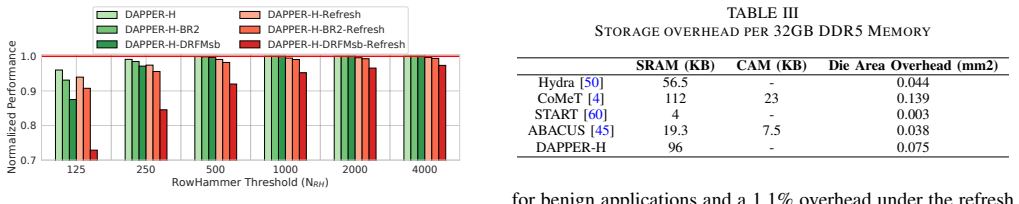
- If DAPPER-H works as claimed, the performance-attack class becomes survivable at thresholds as low as 500: average slowdown under active attacks is 0.9%, versus 60–90% for existing shared-counter trackers.
- The same 96KB SRAM budget keeps benign workloads at 0.1% average slowdown, so the security comes without a standing performance tax.
- Even at an ultra-low threshold of 125, the paper projects at most a 6% slowdown under refresh attacks, indicating graceful degradation as DRAM becomes more fragile.
- Per-bank mitigative refresh is a major cost lever: switching to same-bank DRFM commands raises slowdown to 8% at a threshold of 500, so future DRAM refresh commands should preserve bank-level granularity.
- A single brief mapping leak is survivable because keys rotate every 32ms; attackers need repeated success across refresh windows to sustain a denial-of-service, and DAPPER-H's design denies that.
Reading between the lines
- Editorial inference: the same two-table hash plus bit-vector pattern could transfer to other shared performance counters in the memory controller, such as wear-leveling or prefetch-throttle counters, where set-conflict and streaming attacks create denial-of-service.
- Editorial inference: the paper's security argument counts a single refresh window in isolation; a persistent adversary who accumulates one successful capture every few hours could still learn a partial map over days, so a stronger design might rekey more often than 32ms or rotate the number of tables.
- Editorial inference: the analysis assumes the attacker cannot distinguish LLBC outputs from random permutations; if future cryptanalytic shortcuts appear, replacing the four-round cipher with a stronger low-latency permutation would preserve the architecture while changing only the cipher block.
Editorial analysis
A structured set of objections, weighed in public.
Referee Report
Summary. The paper proposes DAPPER, a host-side RowHammer mitigation tracker. DAPPER-S uses a single secure hash to randomize row-to-row-group-counter mappings, while DAPPER-H adds a second hash, a per-bank bit-vector, and a selective mitigative-refresh mechanism. The paper claims that DAPPER-H prevents Mapping-Capturing attacks with 99.99% probability per refresh window and incurs only 0.9% average slowdown under active Perf-Attacks at NRH=500, with 96KB SRAM per 32GB DRAM. The paper also demonstrates RH-Tracker-based Perf-Attacks against Hydra, START, CoMeT, and ABACUS, and evaluates DAPPER against those baselines, BlockHammer, PARA, PrIDE, and PRAC across 57 workloads.
Significance. If the security and performance claims held, DAPPER-H would be a notable advance in low-cost, low-overhead RowHammer mitigation at ultra-low thresholds. The paper's strengths include a systematic demonstration of Perf-Attacks on four existing trackers, a wide-ranging simulation study (57 workloads, multiple NRH values, blast radius and DRFM variants), and a concrete hardware design with modest SRAM overhead. The security analysis, however, contains a load-bearing gap: the probabilistic model undercounts the attacker's probing capabilities, and a simple same-bank scan defeats the claimed 99.99% prevention. Because this attack is within the paper's own threat model, the central contribution is not currently established.
major comments (3)
- [Section VI-C, Equations (6)-(7)] The attack model assumes the attacker can make only two random probes per trial and therefore computes a per-trial success probability of about (2/8192)^2 and about 2500 trials, yielding a 0.01% failure rate per refresh window. This is not an upper bound. After priming a target row T in a single bank to NM-2=248 activations, an attacker can sequentially activate the other rows in the same bank. Because the bit-vector gates only first-time per-bank increments of Table 1, and T's bank bit is already set, any scanned row that shares T's Table-1 group increments that group's counter, and any scanned row that shares T's Table-2 group increments that group's counter. In a 64K-row bank with 8K groups, each group has about 8 rows per bank, so both counters reach 250 within roughly a few dozen activations (microseconds), far inside tREFW. The resulting mitigation reveals the triggering row as sharing one of T's groups, giving the attacker a mapping pair. The success probability is therefore close to 1, not 0.01%. The bit-vector does not prevent this attack because all probes are in the same bank.
- [Section VI-B, update operation] The paper does not specify the behavior of an RGC when it reaches NM while the other table's RGC for the same row has not reached NM. Table 2 is incremented on every activation, while Table 1 is incremented only when the bank bit is already set; an attacker can therefore drive a Table-2 counter past NM (e.g., by activating rows that map to the same Table-2 group across many banks) without the corresponding Table-1 counter reaching NM. If counters are not saturating, this can lead to overflow, and if they saturate, the paper should say so and analyze the security impact of 'stuck' counters. As written, the design's behavior in this state is undefined and the security analysis does not cover it.
- [Section VI-D, Figure 10] The performance evaluation under Perf-Attacks only considers the streaming and refresh attacks; it does not include the same-bank Mapping-Capturing attack described above. Since that attack enables the attacker to learn the group mappings and then launch targeted mitigative-refresh storms, the reported 0.9% average slowdown under active Perf-Attacks does not represent the full attack surface that the paper claims to address.
minor comments (5)
- [Section V-D] Equation (1) uses tRC in the computation of t_left; please clarify that the priming phase takes (NM-1)*tRC and that t_left is treset minus that time.
- [Section VI-H] The storage calculation appears inconsistent: 8K 1-byte entries per RGC table gives 8KB per table, i.e., 16KB for both tables, not 32KB; the bit-vector size also depends on the number of banks per rank and should be stated explicitly.
- [Figure 8] The four-step annotation is difficult to follow; the text refers to steps (1)-(4) but the figure labels are small and not clearly connected to the described update and reset operations.
- [Section VI-C, Discussion] The paper states that the LLBC is resistant to shortcut attacks citing prior work; since this is a core security assumption, a brief discussion of why N-to-N encryption avoids the CEASER/CUBE attacks would be helpful.
- [Section III-D] There is a typo: 'slwdown' should be 'slowdown'.
Circularity Check
No significant circularity: DAPPER-H's performance results come from Ramulator simulations and its security bound follows from explicit probability equations, with self-citations used only for baselines or alignment, not as load-bearing justification.
full rationale
The paper's central performance claim (0.9% average slowdown under Perf-Attacks at N_RH=500) is obtained from cycle-accurate Ramulator simulations of 57 workloads, not from fitting a parameter to a target number. The design parameters (row group size 256, N_M = N_RH/2, tREFW-based reset) are standard choices drawn from prior published RowHammer trackers and JEDEC timing specifications, and the paper reports measured slowdowns rather than using the slowdown numbers to calibrate the security analysis. The security claim for DAPPER-H is derived arithmetically from Equations (6) and (7), which define p as the probability that two random accesses hit both target row-group counters and T as the number of trials allowed within one refresh window; the 99.99% prevention figure is a direct computation from those expressions and the stated 8K row groups and 2.5K trials. No equation in the paper equates the security result to a fitted or observed value. The same-bank scanning attack raised by a skeptical reader challenges whether Equations (6)-(7) model an upper bound on attacker capability; that is a correctness or threat-model limitation, not circularity, because a flawed or overly optimistic model is not the same as a model that assumes its own conclusion. Self-citations are present but not load-bearing: [73] (QPRAC, with author overlap) is used only as a comparison baseline for PRAC, and [50] (Hydra, with coauthor Nair) is used as a baseline to demonstrate Perf-Attacks, not to justify DAPPER-H's properties. The LLBC randomness assumption is imported from external prior work (CEASER, CUBE, SCARF), and the paper's own earlier RowHammer defenses are not used to establish the uniqueness or correctness of the proposed mechanism. Overall, the derivation chain is self-contained with respect to its measured performance and its stated probabilistic model; no circular reduction was found.
Assumptions & free parameters
free parameters (4)
- row group size (RG) =
256 rows
- mitigation threshold (NM) =
NRH/2 (e.g., 250 at NRH=500)
- reset period (treset) =
12-36 us for DAPPER-S, tREFW (32 ms) for DAPPER-H
- LLBC rounds =
4
assumptions (5)
- domain assumption The four-round low-latency block cipher (LLBC) behaves as a secure pseudorandom permutation against a software adversary.
- domain assumption The adversary can observe timing differences caused by mitigative refreshes.
- domain assumption The memory controller can issue per-bank victim row refresh (VRR) commands.
- domain assumption Row-to-group mapping under the secure hash is uniformly random and independent for each row.
- domain assumption A user-level attacker can execute malicious code on one or more cores while benign workloads run on others.
Cite this review
Pith. "Pith review of DAPPER: A Performance-Attack-Resilient Tracker for RowHammer Defense." pith.science (2026). https://pith.science/paper/AWUEMYMQ
@misc{pith2026250118857,
  author       = {Pith},
  title        = {Pith review of: DAPPER: A Performance-Attack-Resilient Tracker for RowHammer Defense},
  year         = {2026},
  howpublished = {\url{https://pith.science/paper/AWUEMYMQ}},
  note         = {Machine review of arXiv:2501.18857}
}
read the original abstract
RowHammer vulnerabilities pose a significant threat to modern DRAM-based systems, where rapid activation of DRAM rows can induce bit-flips in neighboring rows. To mitigate this, state-of-the-art host-side RowHammer mitigations typically rely on shared counters or tracking structures. While these optimizations benefit benign applications, they are vulnerable to Performance Attacks (Perf-Attacks), where adversaries exploit shared structures to reduce DRAM bandwidth for co-running benign applications by increasing DRAM accesses for RowHammer counters or triggering repetitive refreshes required for the early reset of structures, significantly degrading performance. In this paper, we propose secure hashing mechanisms to thwart adversarial attempts to capture the mapping of shared structures. We propose DAPPER, a novel low-cost tracker resilient to Perf-Attacks even at ultra-low RowHammer thresholds. We first present a secure hashing template in the form of DAPPER-S. We then develop DAPPER-H, an enhanced version of DAPPER-S, incorporating double-hashing, novel reset strategies, and mitigative refresh techniques. Our security analysis demonstrates the effectiveness of DAPPER-H against both RowHammer and Perf-Attacks. Experiments with 57 workloads from SPEC2006, SPEC2017, TPC, Hadoop, MediaBench, and YCSB show that, even at an ultra-low RowHammer threshold of 500, DAPPER-H incurs only a 0.9% slowdown in the presence of Perf-Attacks while using only 96KB of SRAM per 32GB of DRAM memory.
Figures


Figures from the paper (14 more)




Reference graph
Works this paper leans on
-
[1]
UBC Advanced Research Computing,
“UBC Advanced Research Computing, ”UBC ARC Sockeye.” UBC Advanced Research Computing, 2019, doi: 10.14288/SOCKEYE.”
doi:10.14288/sockeye 2019
-
[2]
Panopticon: A complete in-dram rowhammer mitigation,
T. Bennett, S. Saroiu, A. Wolman, and L. Cojocar, “Panopticon: A complete in-dram rowhammer mitigation,” in Workshop on DRAM Security (DRAMSec) , 2021
work page 2021
-
[3]
R. Bodduna, V . Ganesan, P. SLPSK, K. Veezhinathan, and C. Rebeiro, “Brutus: Refuting the security claims of the cache timing randomiza- tion countermeasure proposed in ceaser,” IEEE Computer Architecture Letters, vol. 19, no. 1, pp. 9–12, 2020
work page 2020
-
[4]
Comet: Count-min-sketch- based row tracking to mitigate rowhammer at low cost,
F. N. Bostanci, I. E. Y ¨uksel, A. Olgun, K. Kanellopoulos, Y . C. Tu˘grul, A. G. Ya˘glic ¸i, M. Sadrosadati, and O. Mutlu, “Comet: Count-min-sketch- based row tracking to mitigate rowhammer at low cost,” in 2024 IEEE International Symposium on High-Performance Computer Architecture (HPCA), 2024, pp. 593–612
2024
-
[5]
SCARF – a Low-Latency block cipher for secure Cache-Randomization,
F. Canale, T. G ¨uneysu, G. Leander, J. P. Thoma, Y . Todo, and R. Ueno, “SCARF – a Low-Latency block cipher for secure Cache-Randomization,” in 32nd USENIX Security Symposium (USENIX Security 23) . Anaheim, CA: USENIX Association, Aug. 2023, pp. 1937–1954. [Online]. Available: https://www.usenix.org/conference/ usenixsecurity23/presentation/canale
work page 2023
-
[6]
Understanding the security benefits and overheads of emerging industry solutions to dram read disturbance,
O. Canpolat, A. G. Ya ˘glıkc ¸ı, G. F. Oliveira, A. Olgun, O. Ergin, and O. Mutlu, “Understanding the security benefits and overheads of emerging industry solutions to dram read disturbance,” in Workshop on DRAM Security (DRAMSec) , 2024
2024
-
[7]
Breakhammer: Enhancing rowhammer mitigations by carefully throttling suspect threads,
O. Canpolat, A. G. Ya ˘glıkc ¸ı, A. Olgun, I. E. Yuksel, Y . C. Tu ˘grul, K. Kanellopoulos, O. Ergin, and O. Mutlu, “Breakhammer: Enhancing rowhammer mitigations by carefully throttling suspect threads,” in 2024 57th IEEE/ACM International Symposium on Microarchitecture (MICRO), 2024, pp. 915–934
2024
-
[8]
Towards variation-aware system-level power estimation of drams: an empirical approach,
K. Chandrasekar, C. Weis, B. Akesson, N. Wehn, and K. Goossens, “Towards variation-aware system-level power estimation of drams: an empirical approach,” in Proceedings of the 50th Annual Design Automation Conference , ser. DAC ’13. New York, NY , USA: Association for Computing Machinery, 2013. [Online]. Available: https://doi.org/10.1145/2463209.2488762
Show all 80 references
-
[9]
Exploiting correcting codes: On the effectiveness of ecc memory against rowhammer attacks,
L. Cojocar, K. Razavi, C. Giuffrida, and H. Bos, “Exploiting correcting codes: On the effectiveness of ecc memory against rowhammer attacks,” in 2019 IEEE Symposium on Security and Privacy (SP) , 2019, pp. 55– 71
2019
-
[10]
Benchmarking cloud serving systems with ycsb,
B. F. Cooper, A. Silberstein, E. Tam, R. Ramakrishnan, and R. Sears, “Benchmarking cloud serving systems with ycsb,” in Proceedings of the 1st ACM Symposium on Cloud Computing , ser. SoCC ’10. New York, NY , USA: Association for Computing Machinery, 2010, p. 143–154. [Online]....
-
[11]
Spec cpu2006 benchmark suite,
S. P. E. Corporation, “Spec cpu2006 benchmark suite,” 2006. [Online]. Available: http://www.spec.org/cpu2006/
2006
-
[12]
Safeguard: Reduc- ing the security risk from row-hammer via low-cost integrity protection,
A. Fakhrzadehgan, Y . Patt, P. Nair, and M. Qureshi, “Safeguard: Reduc- ing the security risk from row-hammer via low-cost integrity protection,” in 2022 IEEE International Symposium on High Performance Computer Architecture (HPCA). IEEE, 2022
2022
-
[13]
Apache hadoop
A. Foundation, “Apache hadoop.” [Online]. Available: http://hadoop. apache.org/
-
[14]
Mediabench ii video: Expediting the next generation of video systems research,
J. E. Fritts, F. W. Steiling, J. A. Tucek, and W. Wolf, “Mediabench ii video: Expediting the next generation of video systems research,” Microprocessors and Microsystems , vol. 33, no. 4, pp. 301– 318, 2009, media and Stream Processing. [Online]. Available: https://www.science...
2009
-
[15]
Another flip in the wall of rowhammer defenses,
D. Gruss, M. Lipp, M. Schwarz, D. Genkin, J. Juffinger, S. O’Connell, W. Schoechl, and Y . Yarom, “Another flip in the wall of rowhammer defenses,” in 2018 IEEE Symposium on Security and Privacy (SP) . IEEE, 2018, pp. 245–261
2018
-
[16]
Rowhammer.js: A remote software-induced fault attack in javascript,
D. Gruss, C. Maurice, and S. Mangard, “Rowhammer.js: A remote software-induced fault attack in javascript,” in Proceedings of the 13th International Conference on Detection of Intrusions and Malware, and Vulnerability Assessment - V olume 9721 , ser. DIMV A 2016. Berlin, Heide...
2016 doi
-
[17]
Uncovering in-dram rowhammer protection mechanisms: A new methodology, custom rowhammer patterns, and implications,
H. Hassan, Y . C. Tugrul, J. S. Kim, V . Van der Veen, K. Razavi, and O. Mutlu, “Uncovering in-dram rowhammer protection mechanisms: A new methodology, custom rowhammer patterns, and implications,” in MICRO-54: 54th Annual IEEE/ACM International Symposium on Microarchitecture,...
2021
-
[18]
Dsac: Low-cost rowhammer mitigation using in-dram stochastic and approximate counting algorithm,
S. Hong, D. Kim, J. Lee, R. Oh, C. Yoo, S. Hwang, and J. Lee, “Dsac: Low-cost rowhammer mitigation using in-dram stochastic and approximate counting algorithm,” 2023. [Online]. Available: https://arxiv.org/abs/2302.03591
2023 arXiv
-
[19]
Pride: Achiev- ing secure rowhammer mitigation with low-cost in-dram trackers,
A. Jaleel, G. Saileshwar, S. W. Keckler, and M. Qureshi, “Pride: Achiev- ing secure rowhammer mitigation with low-cost in-dram trackers,” in 2024 ACM/IEEE 51st Annual International Symposium on Computer Architecture (ISCA), 2024, pp. 1157–1172
2024
-
[20]
Blacksmith: Scalable rowhammering in the frequency domain,
P. Jattke, V . Van Der Veen, P. Frigo, S. Gunter, and K. Razavi, “Blacksmith: Scalable rowhammering in the frequency domain,” in 2022 IEEE Symposium on Security and Privacy (SP) , 2022, pp. 716–734
2022
-
[21]
ZenHammer: Rowhammer attacks on AMD zen-based platforms,
P. Jattke, M. Wipfli, F. Solt, M. Marazzi, M. B ¨olcskei, and K. Razavi, “ZenHammer: Rowhammer attacks on AMD zen-based platforms,” in 33rd USENIX Security Symposium (USENIX Security 24). Philadelphia, PA: USENIX Association, Aug. 2024, pp. 1615–1633. [Online]. Available: http...
2024
-
[22]
Architectural support for mitigating row hammering in dram memories,
D.-H. Kim, P. J. Nair, and M. K. Qureshi, “Architectural support for mitigating row hammering in dram memories,”IEEE CAL, vol. 14, no. 1, pp. 9–12, 2014
2014
-
[23]
Revisiting rowhammer: An experimental analysis of modern dram devices and mitigation techniques,
J. S. Kim, M. Patel, A. G. Ya ˘glıkc ¸ı, H. Hassan, R. Azizi, L. Orosa, and O. Mutlu, “Revisiting rowhammer: An experimental analysis of modern dram devices and mitigation techniques,” in 2020 ACM/IEEE 47th Annual International Symposium on Computer Architecture (ISCA) . IEEE,...
2020
-
[24]
Hammerfilter: Robust protection and low hardware overhead method for rowhammer,
K. Kim, J. Woo, J. Kim, and K.-S. Chung, “Hammerfilter: Robust protection and low hardware overhead method for rowhammer,” in 2021 IEEE 39th International Conference on Computer Design (ICCD) , 2021, pp. 212–219
2021
-
[25]
Mithril: Cooperative row hammer protection on commodity dram leveraging managed refresh,
M. J. Kim, J. Park, Y . Park, W. Doh, N. Kim, T. J. Ham, J. W. Lee, and J. H. Ahn, “Mithril: Cooperative row hammer protection on commodity dram leveraging managed refresh,” in 2022 IEEE International Sympo- sium on High-Performance Computer Architecture (HPCA) , 2022, pp. 115...
2022
-
[26]
How to kill the second bird with one ecc: The pursuit of row hammer resilient dram,
M. J. Kim, M. Wi, J. Park, S. Ko, J. Choi, H. Nam, N. S. Kim, J. H. Ahn, and E. Lee, “How to kill the second bird with one ecc: The pursuit of row hammer resilient dram,” in Proceedings of the 56th Annual IEEE/ACM International Symposium on Microarchitecture , ser. MICRO ’23. ...
2023
-
[27]
W. Kim, C. Jung, S. Yoo, D. Hong, J. Hwang, J. Yoon, O. Jung, J. Choi, S. Hyun, M. Kang, S. Lee, D. Kim, S. Ku, D. Choi, N. Joo, S. Yoon, J. Noh, B. Go, C. Kim, S. Hwang, M. Hwang, S.-M. Yi, H. Kim, S. Heo, Y . Jang, K. Jang, S. Chu, Y . Oh, K. Kim, J. Kim, S. Kim, J. Hwang, S...
2023
-
[28]
Flipping bits in memory without accessing them: An experimental study of dram disturbance errors,
Y . Kim, R. Daly, J. Kim, C. Fallin, J. H. Lee, D. Lee, C. Wilkerson, K. Lai, and O. Mutlu, “Flipping bits in memory without accessing them: An experimental study of dram disturbance errors,” ACM SIGARCH Computer Architecture News , vol. 42, no. 3, pp. 361–372, 2014
2014
-
[29]
Ramulator: A fast and extensible dram simulator,
Y . Kim, W. Yang, and O. Mutlu, “Ramulator: A fast and extensible dram simulator,” IEEE Computer architecture letters , vol. 15, no. 1, pp. 45–49, 2015
2015
-
[30]
Half-double: Hammering from the next row over,
A. Kogler, J. Juffinger, S. Qazi, Y . Kim, M. Lipp, N. Boichat, E. Shiu, M. Nissler, and D. Gruss, “Half-double: Hammering from the next row over,” Aug. 2022, 31st USENIX Security Symposium : USENIX Security ’22, USENIX ’22 ; Conference date: 10-08-2022 Through 12- 08-2022
2022
-
[31]
Rambleed: Reading bits in memory without accessing them,
A. Kwong, D. Genkin, D. Gruss, and Y . Yarom, “Rambleed: Reading bits in memory without accessing them,” in 2020 IEEE Symposium on Security and Privacy (SP) , 2020, pp. 695–711
2020
-
[32]
Twice: preventing row-hammering by exploiting time window counters,
E. Lee, I. Kang, S. Lee, G. E. Suh, and J. H. Ahn, “Twice: preventing row-hammering by exploiting time window counters,” in Proceedings of the 46th International Symposium on Computer Architecture , 2019, pp. 385–396
2019
-
[33]
Newcache: Secure cache architecture thwarting cache side-channel attacks,
F. Liu, H. Wu, K. Mai, and R. B. Lee, “Newcache: Secure cache architecture thwarting cache side-channel attacks,” IEEE Micro, vol. 36, no. 5, pp. 8–16, 2016
2016
-
[34]
Moesi-prime: Preventing coherence-induced hammering in commodity workloads,
K. Loughlin, S. Saroiu, A. Wolman, Y . A. Manerkar, and B. Kasikci, “Moesi-prime: Preventing coherence-induced hammering in commodity workloads,” in Proceedings of the 49th Annual International Symposium on Computer Architecture , ser. ISCA ’22. New York, NY , USA: Association...
2022
-
[35]
Rowpress: Amplifying read disturbance in modern dram chips,
H. Luo, A. Olgun, A. G. Ya ˘glıkc ¸ı, Y . C. Tu˘grul, S. Rhyner, M. B. Cavlak, J. Lindegger, M. Sadrosadati, and O. Mutlu, “Rowpress: Amplifying read disturbance in modern dram chips,” in Proceedings of the 50th Annual International Symposium on Computer Architecture , ser. IS...
-
[36]
Ramulator 2.0: A modern, modular, and extensible dram simulator,
H. Luo, Y . C. Tu ˘grul, F. N. Bostancı, A. Olgun, A. G. Ya ˘glıkc ¸ı, and O. Mutlu, “Ramulator 2.0: A modern, modular, and extensible dram simulator,” IEEE Computer Architecture Letters, vol. 23, no. 1, pp. 112– 116, 2024
2024
-
[37]
Protrr: Principled yet optimal in-dram target row refresh,
M. Marazzi, P. Jattke, F. Solt, and K. Razavi, “Protrr: Principled yet optimal in-dram target row refresh,” in 2022 IEEE Symposium on Security and Privacy (SP) , 2022, pp. 735–753
2022
-
[38]
JESD79-5C
JEDEC. JESD79-5C. https://www.jedec.org/document search?search api views fulltext=jesd79-5c
-
[39]
DDR5 SDRAM Datasheet
Micron. DDR5 SDRAM Datasheet. https://media-www.micron.com/- /media/client/global/documents/products/data-sheet/dram/ddr5/ddr5 sdram core.pdf
-
[40]
Memory performance attacks: Denial of memory service in Multi-Core systems,
T. Moscibroda and O. Mutlu, “Memory performance attacks: Denial of memory service in Multi-Core systems,” in 16th USENIX Security Symposium (USENIX Security 07) . Boston, MA: USENIX Association, Aug. 2007. [Online]. Available: https://www.usenix.org/conference/16th-usenix-secu...
2007
-
[41]
Stall-time fair memory access scheduling for chip multiprocessors,
O. Mutlu and T. Moscibroda, “Stall-time fair memory access scheduling for chip multiprocessors,” in 40th Annual IEEE/ACM International Symposium on Microarchitecture (MICRO 2007) , 2007, pp. 146–160
2007
-
[42]
Sudoku: Tolerating high- rate of transient failures for enabling scalable sttram,
P. J. Nair, B. Asgari, and M. K. Qureshi, “Sudoku: Tolerating high- rate of transient failures for enabling scalable sttram,” in 2019 49th Annual IEEE/IFIP International Conference on Dependable Systems and Networks (DSN) , 2019, pp. 388–400
2019
-
[43]
Archshield: Architectural framework for assisting dram scaling by tolerating high error rates,
P. J. Nair, D.-H. Kim, and M. K. Qureshi, “Archshield: Architectural framework for assisting dram scaling by tolerating high error rates,” in Proceedings of the 40th Annual International Symposium on Computer Architecture, ser. ISCA ’13. New York, NY , USA: Association for Com...
2013
-
[44]
Xed: Exposing on-die error detection information for strong memory reliability,
P. J. Nair, V . Sridharan, and M. K. Qureshi, “Xed: Exposing on-die error detection information for strong memory reliability,” in 2016 ACM/IEEE 43rd Annual International Symposium on Computer Architecture (ISCA) , 2016, pp. 341–353
2016
-
[45]
ABACuS: All-Bank activation counters for scalable and low overhead RowHammer mitigation,
A. Olgun, Y . C. Tugrul, N. Bostanci, I. E. Yuksel, H. Luo, S. Rhyner, A. G. Yaglikci, G. F. Oliveira, and O. Mutlu, “ABACuS: All-Bank activation counters for scalable and low overhead RowHammer mitigation,” in 33rd USENIX Security Symposium (USENIX Security 24). Philadelphia,...
2024
-
[46]
Graphene: Strong yet lightweight row hammer protection,
Y . Park, W. Kwon, E. Lee, T. J. Ham, J. Ho Ahn, and J. W. Lee, “Graphene: Strong yet lightweight row hammer protection,” in 2020 53rd Annual IEEE/ACM International Symposium on Microarchitecture (MICRO), 2020, pp. 1–13
2020
-
[47]
Systematic analysis of randomization-based protected cache architectures,
A. Purnal, L. Giner, D. Gruss, and I. Verbauwhede, “Systematic analysis of randomization-based protected cache architectures,” in 2021 IEEE Symposium on Security and Privacy (SP) , 2021, pp. 987–1002
2021
-
[48]
Moat: Securely mitigating rowhammer with per-row activation counters,
M. Qureshi and S. Qazi, “Moat: Securely mitigating rowhammer with per-row activation counters,” 2025
2025
-
[49]
Mint: Securely mitigating rowham- mer with a minimalist in-dram tracker,
M. Qureshi, S. Qazi, and A. Jaleel, “Mint: Securely mitigating rowham- mer with a minimalist in-dram tracker,” in 2024 57th IEEE/ACM International Symposium on Microarchitecture (MICRO), 2024, pp. 899– 914
2024
-
[50]
Hydra: Enabling low-overhead mitigation of row-hammer at ultra-low thresholds via hybrid tracking,
M. Qureshi, A. Rohan, G. Saileshwar, and P. J. Nair, “Hydra: Enabling low-overhead mitigation of row-hammer at ultra-low thresholds via hybrid tracking,” in Proceedings of the 49th Annual International Symposium on Computer Architecture , ser. ISCA ’22. New York, NY , USA: Ass...
2022
-
[51]
Ceaser: Mitigating conflict-based cache attacks via encrypted-address and remapping,
M. K. Qureshi, “Ceaser: Mitigating conflict-based cache attacks via encrypted-address and remapping,” in 2018 51st Annual IEEE/ACM International Symposium on Microarchitecture (MICRO), 2018, pp. 775– 787
2018
-
[52]
New attacks and defense for encrypted-address cache,
M. K. Qureshi, “New attacks and defense for encrypted-address cache,” in Proceedings of the 46th International Symposium on Computer Architecture, ser. ISCA ’19. New York, NY , USA: Association for Computing Machinery, 2019, p. 360–371. [Online]. Available: https://doi.org/10....
2019
-
[53]
Enhancing lifetime and security of pcm-based main memory with start-gap wear leveling,
M. K. Qureshi, J. Karidis, M. Franceschini, V . Srinivasan, L. Lastras, and B. Abali, “Enhancing lifetime and security of pcm-based main memory with start-gap wear leveling,” in Proceedings of the 42nd Annual IEEE/ACM International Symposium on Microarchitecture , ser. MICRO
-
[54]
Avatar: A variable-retention-time (vrt) aware refresh for dram systems,
M. K. Qureshi, D.-H. Kim, S. Khan, P. J. Nair, and O. Mutlu, “Avatar: A variable-retention-time (vrt) aware refresh for dram systems,” in 2015 45th Annual IEEE/IFIP International Conference on Dependable Systems and Networks , 2015, pp. 427–437
2015
-
[55]
New York, NY , USA: Association for Computing Machinery, 2009, p. 14–23. [Online]. Available: https://doi.org/10.1145/1669112.1669117
2009
-
[56]
MIRAGE: Mitigating Conflict- Based cache attacks with a practical Fully-Associative design,
G. Saileshwar and M. Qureshi, “MIRAGE: Mitigating Conflict- Based cache attacks with a practical Fully-Associative design,” in 30th USENIX Security Symposium (USENIX Security 21) . USENIX Association, Aug. 2021, pp. 1379–1396. [Online]. Available: https: //www.usenix.org/confe...
2021
-
[57]
ABACuS — GitHub Repository,
SAFARI Research Group, “ABACuS — GitHub Repository,” 2023. [Online]. Available: https://github.com/CMU-SAFARI/ABACuS
2023
-
[58]
Impress: Securing dram against data-disturbance errors via implicit row-press mitigation,
A. Saxena, A. Jaleel, and M. Qureshi, “Impress: Securing dram against data-disturbance errors via implicit row-press mitigation,” in 2024 57th IEEE/ACM International Symposium on Microarchitecture (MICRO) , 2024, pp. 935–948
2024
-
[59]
Randomized row-swap: mitigating row hammer by breaking spatial correlation between aggressor and victim rows,
G. Saileshwar, B. Wang, M. Qureshi, and P. J. Nair, “Randomized row-swap: mitigating row hammer by breaking spatial correlation between aggressor and victim rows,” in Proceedings of the 27th ACM International Conference on Architectural Support for Programming Languages and Op...
2022
-
[60]
Start: Scalable tracking for any rowhammer threshold,
A. Saxena and M. Qureshi, “Start: Scalable tracking for any rowhammer threshold,” in 2024 IEEE International Symposium on High-Performance Computer Architecture (HPCA) , 2024, pp. 578–592
2024
-
[61]
Rubix: Reducing the overhead of secure rowhammer mitigations via randomized line-to-row mapping,
A. Saxena, S. Mathur, and M. Qureshi, “Rubix: Reducing the overhead of secure rowhammer mitigations via randomized line-to-row mapping,” in Proceedings of the 29th ACM International Conference 15 on Architectural Support for Programming Languages and Operating Systems, V olume...
2024
-
[62]
Exploiting the dram rowhammer bug to gain kernel privileges,
M. Seaborn and T. Dullien, “Exploiting the dram rowhammer bug to gain kernel privileges,” Black Hat , vol. 15, p. 71, 2015
2015
-
[63]
Aqua: Scalable rowhammer mitigation by quarantining aggressor rows at runtime,
A. Saxena, G. Saileshwar, P. J. Nair, and M. Qureshi, “Aqua: Scalable rowhammer mitigation by quarantining aggressor rows at runtime,” in 2022 55th IEEE/ACM International Symposium on Microarchitecture (MICRO), 2022, pp. 108–123
2022
-
[64]
Mitigating wordline crosstalk using adaptive trees of counters,
S. M. Seyedzadeh, A. K. Jones, and R. Melhem, “Mitigating wordline crosstalk using adaptive trees of counters,” in 2018 ACM/IEEE 45th Annual International Symposium on Computer Architecture (ISCA) . IEEE, 2018, pp. 612–623
2018
-
[65]
Security refresh: prevent malicious wear-out and increase durability for phase- change memory with dynamically randomized address mapping,
N. H. Seong, D. H. Woo, and H.-H. S. Lee, “Security refresh: prevent malicious wear-out and increase durability for phase- change memory with dynamically randomized address mapping,” in Proceedings of the 37th Annual International Symposium on Computer Architecture, ser. ISCA ...
-
[66]
SPEC CPU2017 Benchmark Suite,
Standard Performance Evaluation Corporation, “SPEC CPU2017 Benchmark Suite,” 2017. [Online]. Available: http://www.spec.org/ cpu2017/
2017
-
[67]
Making dram stronger against row hammering,
M. Son, H. Park, J. Ahn, and S. Yoo, “Making dram stronger against row hammering,” in 2017 54th ACM/EDAC/IEEE Design Automation Conference (DAC), 2017, pp. 1–6
2017
-
[68]
Roguerfm: Attacking refresh management for covert-channel and denial-of-service,
H. Taneja and M. Qureshi, “Roguerfm: Attacking refresh management for covert-channel and denial-of-service,” 2025. [Online]. Available: https://arxiv.org/abs/2501.06646
2025 arXiv
-
[69]
The blacklisting memory scheduler: Achieving high performance and fairness at low cost,
L. Subramanian, D. Lee, V . Seshadri, H. Rastogi, and O. Mutlu, “The blacklisting memory scheduler: Achieving high performance and fairness at low cost,” in 2014 IEEE 32nd International Conference on Computer Design (ICCD) , 2014, pp. 8–15
2014
-
[70]
New cache designs for thwarting software cache-based side channel attacks,
Z. Wang and R. B. Lee, “New cache designs for thwarting software cache-based side channel attacks,” SIGARCH Comput. Archit. News, vol. 35, no. 2, p. 494–505, Jun. 2007. [Online]. Available: https://doi.org/10.1145/1273440.1250723
2007
-
[71]
TPC Benchmarks
Transaction Processing Performance Council, “TPC Benchmarks.” [Online]. Available: http://tpc.org/
-
[72]
Shadow: Preventing row hammer in dram with intra-subarray row shuffling,
M. Wi, J. Park, S. Ko, M. J. Kim, N. S. Kim, E. Lee, and J. H. Ahn, “Shadow: Preventing row hammer in dram with intra-subarray row shuffling,” in 2023 IEEE International Symposium on High-Performance Computer Architecture (HPCA) . IEEE, 2023, pp. 333–346
2023
-
[73]
ScatterCache: Thwarting cache attacks via cache set randomization,
M. Werner, T. Unterluggauer, L. Giner, M. Schwarz, D. Gruss, and S. Mangard, “ScatterCache: Thwarting cache attacks via cache set randomization,” in 28th USENIX Security Symposium (USENIX Security 19) . Santa Clara, CA: USENIX Association, Aug. 2019, pp. 675–692. [Online]. Ava...
2019
-
[74]
Scalable and secure row-swap: Efficient and safe row hammer mitigation in memory systems,
J. Woo, G. Saileshwar, and P. J. Nair, “Scalable and secure row-swap: Efficient and safe row hammer mitigation in memory systems,” in 2023 IEEE International Symposium on High-Performance Computer Architecture (HPCA), 2023, pp. 374–389
2023
-
[75]
Qprac: Towards secure and practical prac-based rowhammer mitigation using priority queues,
J. Woo, S. Lin, P. J. Nair, A. Jaleel, and G. Saileshwar, “Qprac: Towards secure and practical prac-based rowhammer mitigation using priority queues,” in 2025 IEEE International Symposium on High-Performance Computer Architecture (HPCA) , 2025
2025
-
[76]
DeepHammer: Depleting the Intelligence of Deep Neural Networks through Targeted Chain of Bit Flips,
F. Yao, A. S. Rakin, and D. Fan, “DeepHammer: Depleting the Intelligence of Deep Neural Networks through Targeted Chain of Bit Flips,” in 29th USENIX Security Symposium (USENIX Security 20) . USENIX Association, Aug. 2020, pp. 1463–1480. [Online]. Available: https://www.usenix...
2020
-
[77]
Block- hammer: Preventing rowhammer at low cost by blacklisting rapidly- accessed dram rows,
A. G. Ya ˘glikc ¸i, M. Patel, J. S. Kim, R. Azizi, A. Olgun, L. Orosa, H. Hassan, J. Park, K. Kanellopoulos, T. Shahroodi et al. , “Block- hammer: Preventing rowhammer at low cost by blacklisting rapidly- accessed dram rows,” in 2021 IEEE International Symposium on High Perfor...
2021
-
[78]
Mrloc: Mitigating row-hammering based on memory locality,
J. M. You and J.-S. Yang, “Mrloc: Mitigating row-hammering based on memory locality,” in 2019 56th ACM/IEEE Design Automation Conference (DAC), 2019, pp. 1–6. 16
2019
-
[79]
Hira: Hidden row activation for reducing refresh latency of off-the-shelf dram chips,
A. G. Ya ˘glikc ¸i, A. Olgun, M. Patel, H. Luo, H. Hassan, L. Orosa, O. Ergin, and O. Mutlu, “Hira: Hidden row activation for reducing refresh latency of off-the-shelf dram chips,” in 2022 55th IEEE/ACM International Symposium on Microarchitecture (MICRO), 2022, pp. 815– 834
2022
-
[2023]
Available: https://doi.org/10.1145/3579371.3589063
[Online]. Available: https://doi.org/10.1145/3579371.3589063
Reviewed August 9, 2026 · model on record in the stance chip above.
Discussion (0). Continue with ORCID to comment.